




Abstract
Abstract
When a publicly held company proposed shipping wastewaters from fracking sites in the Marcellus Shale by barge over the Ohio River, public sentiment was strong. The people of Appalachia had suffered water contamination from accidents involving extractive industries numerous times in the past. This case study used qualitative methods to evaluate and measure public participation in permit proceedings in both the United States Coast Guard and the Army Corps of Engineers. Our study highlighted public success in defeating the proposal to allow shipping of fracking waste by barge on rivers in the United States, but confirms the findings of earlier studies showing difficulties individual citizens have in effectively participating and engaging in federal permit and rulemaking proceedings. The study suggests that to reduce environmental injustices in future proceedings, federal agencies issuing permits and engaged in rulemakings should adapt procedures to expand Internet availability of dockets.
Introduction
W
This study begins with an overview of the scientific literature concerning environmental and health hazards from fracking wastes. The study next examines literature concerning effective citizen participation in federal administrative proceedings. The case study then explains the qualitative methods used to evaluate and measure public participation in permit proceedings in both the United States Coast Guard (Coast Guard) and the Army Corps of Engineers (the Corps)—thus, examining both permit proceedings specific to shipping fracking wastes on the Ohio River and then examining broader proposed policies regarding barging fracking wastes on all territorial rivers of the United States.
Our study highlighted public success in defeating the proposal to allow shipping of fracking waste by barge on rivers in the United States, but confirms the findings of earlier studies showing difficulties individual citizens have in effectively participating and engaging in federal permit and rulemaking proceedings. The study suggests that to reduce environmental injustices in future proceedings, federal agencies issuing permits and engaged in rulemaking should adapt procedures to expand Internet availability of dockets.
Disposal of Fracking Wastewaters
Changes in technologies used to drill for oil and natural gas have created enormous public debate and controversy. 2 The development of high-volume hydraulic fracturing combined with horizontal drilling (what the public calls “fracking”) allows recovery of oil and gas previously literally trapped in shale rock. 3 Increased energy from fracking is hailed as a means for the United States and other countries with large shale plays to move toward energy independence and become less development on Organization of Petroleum Exporting Countries (OPEC)-controlled oil. Fracking has led to a dramatic drop in the price of oil and gas. The promise of energy independence is also considered an important means of protecting U.S. domestic security.
While some economists and politicians hail fracking as a means to bring energy security and low-cost fuels, scientific research shows that fracking creates environmental and public health issues 4 that include the following: contamination of ground water and surface water from methane intrusion 5 ; elevated radiation in drinking water sources 6 ; increased metals and assorted process chemicals in potable water; increased public exposure to VOC, NOx, PAH, and other air pollutants 7 ; leakage of methane from drill sites that contributes to climate change 8 ; damage to wildlife (including endangered species) 9 ; and increased seismic activities. 10
Since 2008, about 2 million wells have been drilled nationwide by using fracking, a process that requires large volumes of water 11 to be mixed with silica 12 and various chemicals and then injected into a predrilled well to break open fissures in the shale. 13 The water pressure expands pre-existing cracks in the rock. Silica holds open the expanded cracks to allow the oil or gas to flow to the surface. 14 Chemicals are added to prevent overheating of mechanical devices. Biocides are added to prevent organic growth in the well. 15 After the water solution is injected into the well and the frac is completed, much of the water returns to the surface as flowback. 16 These flowback or produced waters contain the original chemical mix plus metals and naturally occurring radiation from the ground. 17 Fracking wastewaters tend to have elevated concentrations of arsenic, selenium, strontium, and total dissolved solids. 18
The average fracking well uses millions of gallons of water. 19 Industry encourages recycling of produced water to avoid unnecessary contamination of fresh water. 20 As such, retention ponds, tanks, and trucks store wastewaters until processed and reused in the next drill site. 21 Wastewater accidents and spills causing surface water pollution are well documented by studies 22 and by states and the federal government.
Public worry over adverse health effects led to a moratorium of fracking in New York 23 and Maryland. 24 Other states promulgated regulations to try to prevent onsite accidents and spills of shale oil and gas wastes. 25 These state regulations address predictable problems such as breach of open pits due to bad weather and leaking storage tanks. 26
Accidents and spills of produced waters in transport are governed by regulations administered by the Department of Transportation. The Federal Motor Carrier Safety Administration addresses trucking of wastes that are considered hazardous materials. The United States Coast Guard addresses hazardous materials shipped by barge.
Since fracking requires the use of a lot of water and the number of wells drilled has expanded exponentially since 2008, 27 an industry developed to fill the need for proper disposal of fracking wastes. 28 One player in the industry was GRH, a wholly owned subsidiary of GRH Resources, Inc., listed as GRH on the New York Stock Exchange.
GRH began its operations in the Eagle Ford, Bakken, and Mississippian Shale plays. In 2013, GRH abandoned western operations and decided to work “exclusively on higher rate-of-return markets in the Marcellus and Utica Shale.” 29 Increased drilling in the Marcellus Shale created a dramatic demand for treatment and disposal services for oil and gas wastes. GRH claimed that it was the “largest water treatment and fluids management company in the Marcellus and Utica Shale region.” 30 In fact, the company claimed oil and gas activity “has driven utilization rates to maximum capacity levels at many of GRH's divisions.” 31 GRH operated an in-house fleet of ∼407 trucks used to transport oil and gas wastewaters throughout Ohio, Pennsylvania, West Virginia, Kentucky, and other portions of the Appalachian Basin. 32
GRH determined that it would be more cost-effective to transport wastes by barge than using trucks. Accordingly, GRH “spearheaded the movement to barge” fracking wastes. 33 In 2011, GRH sought permission from the Coast Guard to transport Appalachian fracking wastes by barge over the Ohio River. 34 In addition, in 2013, GRH made a second application to the Army Corps of Engineers for permission to build a barge offloading facility on the banks of the Ohio River. 35 GRH needed permission from both the Coast Guard and the Corps to shift transport of fracking wastes from its 400-truck fleet to barges. The Coast Guard had authority under the HazMat rules to determine whether the wastes could be transported on rivers. The Corps had jurisdiction under the Rivers and Harbors Act to determine if the docking facilities could be built safely.
GRH asserted that there were distinct health and community benefits in shifting transport from truck to barge. According to GRH, “Barging substantially reduces the total number of hours driven by brine trucks on the road.” 36 The company estimated that “a single 10,000 barrels of brine barge will remove in excess of 600 hours of water truck traffic.” 37 The fracking wastewaters were being moved from drill sites across Appalachia for disposal in deep injection wells located in Ohio and West Virginia. 38 If either permit was denied, GRH could not ship fracking wastes by barge but would need to continue trucking.
Under U.S. administrative law, both the Corps and the Coast Guard were required to provide notice and an opportunity for the public to comment before issuing the permits. The permit applications attracted a lot of public attention and numerous organizations mobilized to resist the permits.
This study investigated public participation in the controversial permit proceedings before Corps 39 and the Coast Guard 40 regarding shipping of fracking wastes by barge on the Ohio River. We began our study by reviewing literature concerning the effectiveness of public participation in federal proceedings requiring notice and comment. Next, we examined the dockets collecting materials concerning the two permit applications to ship fracking wastes by barge over the Ohio River, evaluating: (1) who submitted comments (individual members of the general public, academics, government, industry, and finally environmental and NGO groups), (2) whether the public favored or opposed the permits and themes appearing in the comments (including request to hold a hearing), (3) the need to extend the comment period or hold public hearings, and (4) environmental and public health concerns such as worry about contamination of fresh drinking water sources due to accidents and spills.
The study looked at who participated, whether commenters did so on their own or as part of an organized campaign, and whether commenters favored or opposed the proposed rulemaking and the nature of concerns raised in the comments. Finally, we compared patterns of public participation in these proceedings with what was found in current literature to make policy recommendations. The goal of the research was to use this case study to determine better mechanisms for future public participation in public rulemaking and permitting. The article concludes with recommendations to both the federal agencies and the public on how to improve rulemaking and e-rulemaking to ensure more effective public participation and a smoother regulatory process.
Citizen Participation in Administrative Proceedings
The ability of people to participate in administrative procedures is a significant tenant of U.S. democratic principles. 41 Public participation in administrative procedures takes place in a variety of ways. Informal interaction between the regulating government and the public often occurs before promulgation of proposed activities. 42 Meetings and communications before rulemaking often take place with sophisticated parties who self-identify as experts. 43
Discussions between regulated entities, NGOs, and government before administrative proposal are well documented. 44 Preadministrative discussions enable the government to propose regulations that are less likely to be challenged in court once finalized. The disadvantage of preadministrative activity is that the proposed rule is often so vetted and so heavily negotiated that the result presented to the public solicits more of a rubber stamp than real input. 45
The rubber stamp mentality of federal administrative action is compounded by the fact that most members of the public do not understand how to effectively participate in the administrative process. 46 Notices by government entities seeking comment mandate responses with legal and scientific support. Most sophisticated parties understand the need for detailed citation and act in kind. 47 The vast majority of individuals submitting comments, however, tend to treat comments as a vote for or against the agency proposal. 48 As a result, a lot of comments submitted to public agencies are passionate but not very helpful to the agency. 49 Most public comments are short and express only general sentiments. Many are patterned by NGOs who urge public participation of members and contributors using a boilerplate template. 50 Many submitted comments ask that the agency in question “does its job.” 51 Few comments from the general public provide new insights to the specifics of the administrative proposal. 52 Comments from the general public that do offer new insights tend to be personal and anecdotal in nature, while interesting, personal data tend to be discounted by government agencies in favor of comments supported by peer-reviewed scientific studies and legal citation. Hence, a lot of comments sent to federal agencies do not help the agency in finalizing regulatory actions. Rather, many comments repeat platitudes and add to administrative burden as the agency is required to sift through what may be large numbers of documents to try and find data useful to the decision-making process. 53
In theory, the Internet offers new ways for the public to participate in administrative actions.
54
The federal government launched
Not all federal agencies participate equally and not all federal administrative procedures are online. 57 Permit applications, for example, may not be handled in an online docket even though these proceedings are required to allow public notice and comment. Congressional budget cuts make expansive public participation in permit proceedings difficult. 58 Over the years, Congress has provided less and less funding to administer and enforce federal environmental laws. 59 The need for federal agencies to operate with increased austerity clearly conflicts with demands by industry and members of the regulated community to obtain permits in a swift and timely manner. 60
Methods
This study used qualitative methods
61
to explore the impacts of public participation on permit and regulatory rulemaking proceedings exploring the possibility of shipping wastes from shale oil and gas extraction by barge. We identified two dockets in related proceedings. We gathered materials about the Coast Guard proceeding from the docket on
After completing the literature review, our team developed a coding scheme to review the public comments submitted to each docket. 62 We began coding by identifying whether writers wrote as experts, as part of an organized campaign or on their own as members of the general public. If the writer identified as an expert, we inquired what type of organization they affiliated with: government, industry, academic, or NGO. Next, we evaluated whether the comment was written de novo by the commenter or was copied and edited from a model letter supplied by an organized group urging action. Finally, we evaluated the comments using themes that emerged 63 as important to the general public concerning environmental and health risks posed by shipping wastes from shale oil and gas extraction by barge.
Comments were coded examining both substantive and procedural concerns, as depicted in Table 1.
Coders evaluated whether or not each comment letter discussed each of the codes in Coast Guard, and Corps dockets were each indexed separately in sortable spreadsheets. In the Coast Guard proceeding, we used the docket identification number assigned by the agency on
Results: Shipping Fracking Wastes on the Ohio River
GRH requested a permit from the Coast Guard and the Corps on June 27, 2014, pursuant to Section 10 of the Rivers and Harbors Act of 1899 to allow construction and operation of a dock on the Ohio River in Meigs County, Ohio, which could accommodate two tank barges simultaneously. 65 The plan included building a 100-foot walkway and pipeway from shore to the dock and installing a large crane to help move fracking wastewaters from shore to the barges. 66 Once built, the docking facility could load and unload fracking wastewaters at the rate of an estimated 2.5 million bbl per year. The wastes would be stored in above ground storage tanks on land until loaded onto the barges for shipment downriver to be disposed in deep injection wells. 67
Originally, GRH proposed transporting and unloading a combination of what is called “legacy fluid” (fluids generated by old oil and gas wells that did not use fracking as part of the drilling process) and wastes generated from fracking operations. 68 Legacy fluid is not considered to be a hazardous waste under Resource Conservation and Recovery Act (RCRA) Subtitle C. 69 Transport of fracking wastewaters would, however, require permits that ensured minimization of impact on the waters of the United States—here the Ohio River. No initial dredging was required to build the dock and GRH incorporated best management practices for storm water management and water pollution controls in the permit application. 70
The Corps invited public comments to evaluate the permit application, including assessing impacts on endangered species, historic properties, water quality, general environmental effects, and other public interest factors. The application generated robust attention. The Corps reported receipt of 525 written comments, 71 an extraordinary number for a permit application.
Although the Clinton, Bush, and Obama administrations all set goals to move more federal proceedings online, the docket the Corps created to consider building the GRH dock was not online. The Corps posted notice of the GRH permit application on the Internet, but followed old school pre-Internet protocols for collecting comments. 78 The Corps opened a paper file in the office in Huntington, West Virginia. The agency was so old school for this permit proceeding that it had to be persuaded to allow comments by e-mail, rather than only by U.S. mail. 72
With regard to public examination of docketed materials, Corps said that, “During the evaluation process, any interested party can request copies of the permit application, compensatory mitigation plan, or other information pertaining to the proposal through the Freedom of Information Act (FOIA) procedures and may come to the District Office to review the information.” 73 When sent, materials available pursuant to FOIA were not all encompassing. The Corps took the position that “Pre-decisional documents are not available to the public under the FOIA process.” Only after the Corps permit was issued could the public obtain and evaluate the complete docket. 74
Although the Corps received 525 written comments in response to two public notices published in the Federal Register, 75 administrative law favors granting the permit application “unless its issuance is found to be contrary to the public interest.” 76 All submitted comments become part of the permit record and must be considered in the determination of the permit application.
The vast majority of comment letters (written by individuals, organizations, and county governments) expressed opposition to the dock permit and commenters strongly opined that issuing the permit did not reflect public interest. 77 The Corps recognized that the “major concerns expressed by persons opposing the authorization of the facility were related to the product proposed to be offloaded at the facility and its effects on public safety.” 78 Simply said, the public expressed worry about potential impact of shipping fracking wastes on drinking water quality.
Most of the comments (426) submitted came from members of the general public. A small percentage of commenters self-identified as experts: 10 were from government entities; 19 were written by academics; and 9 were from industry (Fig. 1).
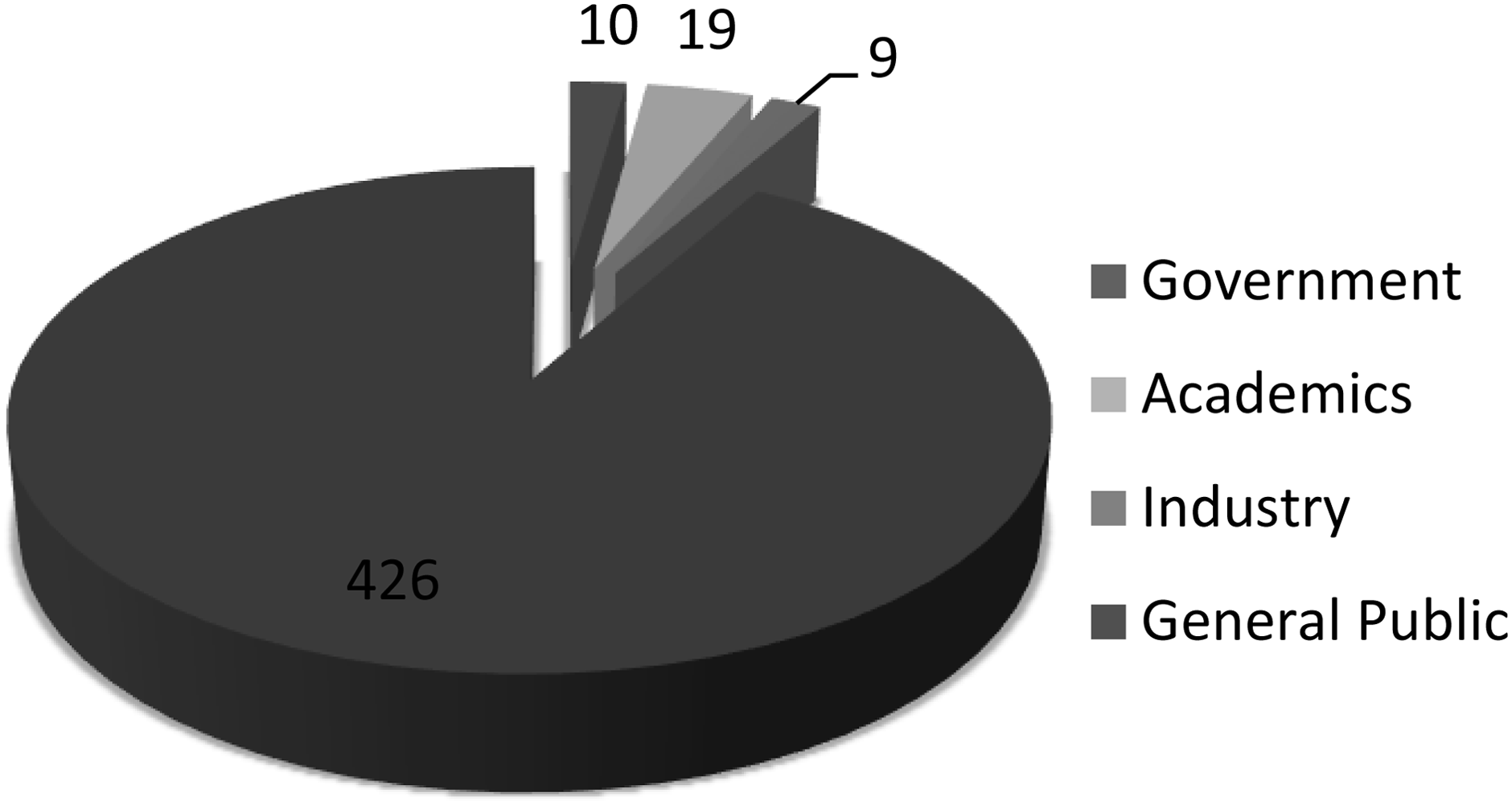
Who submitted comments to LRH-2009-835-OHR.
Most of the comments (304) were original, unique text, but 157 comments were boilerplate copies of letters obtained by writers from various sources (Fig. 2). Overwhelmingly, the commenters opposed the proposed actions. In fact, only one comment supported granting the permit.
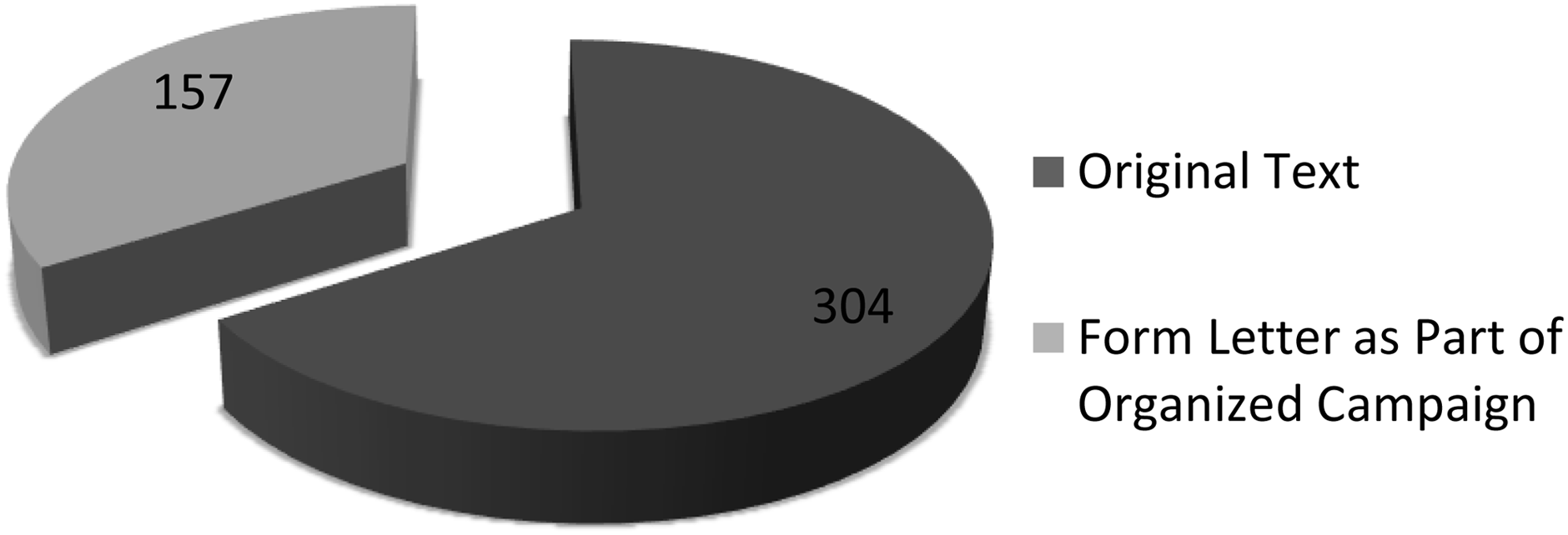
Types of comments submitted to LRH-2009-835-OHR.
The most prevalent substantive concerns were raised regarding potential accidents (171 mentions) and spills (366 mentions) that could impair river water quality and harm drinking water (244 mentions). A large number of comments (302) also addressed concerns about chemical analysis of fracking wastes to ensure safe treatment and handling (Fig. 3).
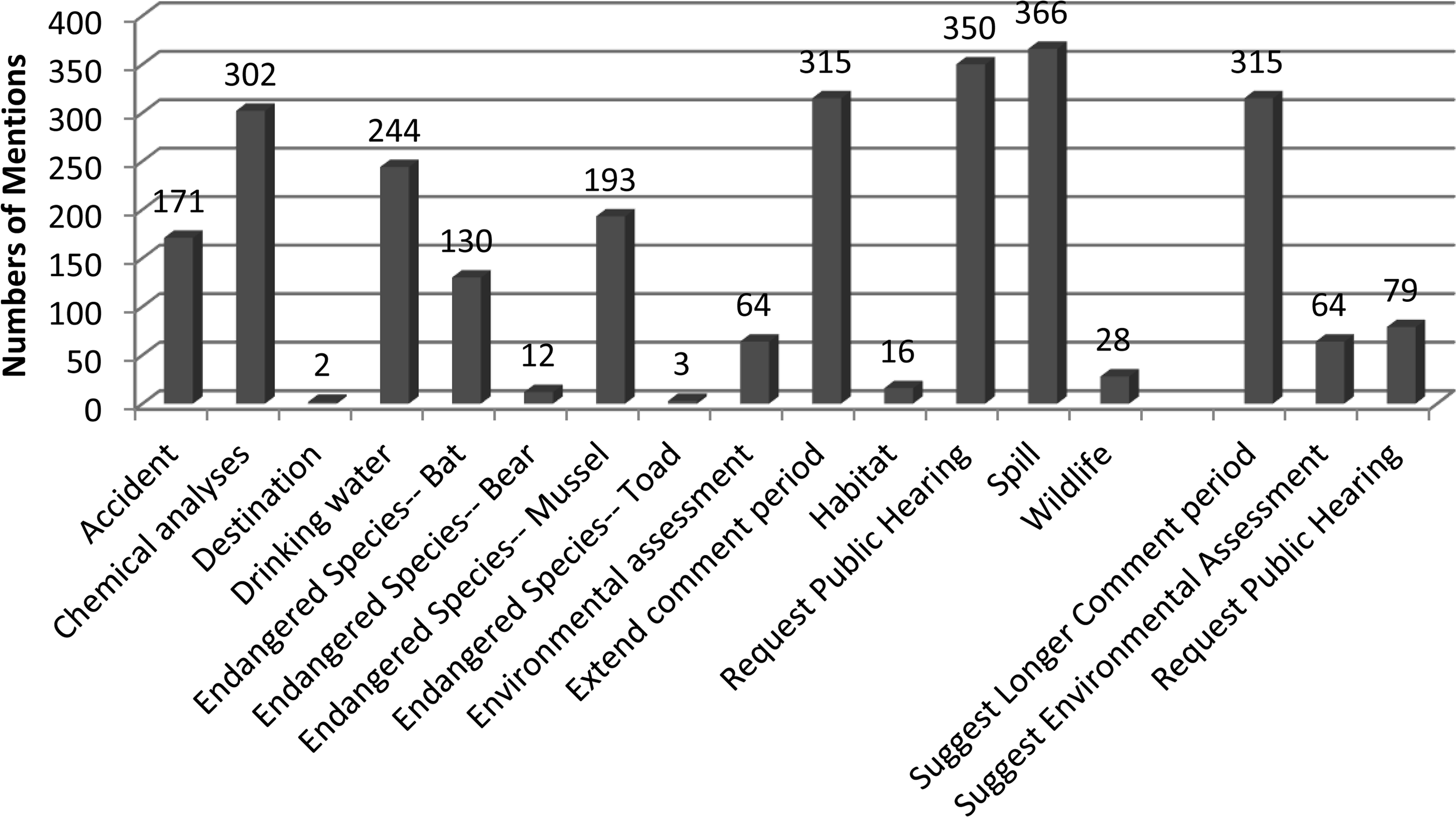
Summary of public comments LRH-2009-835-OHR (N = 468).
A final prevailing theme was concern about damage to habitat and wildlife generally and endangered species in particular: 244 comments mentioned endangered bats, 193 discussed a variety of endangered mussels, 12 comments referenced endangered bears, and 2 endangered toads (Fig. 3). 79 Although the public did not know it, GRH had hired a malacologist to conduct a mussel survey to be sure to avoid or alleviate disturbances to endangered aquatic life when building the dock. The GRH study was evaluated by Corps, in consultation with the U.S. Fish and Wildlife Service (FSW) pursuant to Section 7(c) of the Endangered Species Act of 1972. Ultimately, the Corps found that building the dock would have no effect on nonaquatic endangered species (such as bats) because no trees or vegetation would be removed in construction. 80
The general public raised numerous procedural as well as substantive concerns about the Corps permit process: 315 comments requested a longer comment period, 64 suggested the need for an environmental assessment, and 79 wanted a public hearing (Fig. 3). The Corps did not hold a hearing, explaining that to do so was not practical because the law required the Corp to accept comments for a “reasonable time” defined as not more than 30 days or less than 15 days from the date of notice. 81 The Corps did, however, extend the comment period to 60 days. The Corps also used comments submitted by the public as a basis to prepare an Environmental Impact Statement pursuant to the National Environmental Policy Act. 82
Figure 3 below summarizes public concerns discussed in the Corps docket considering the building of a dock to ship fracking wastes.
To deny a permit application, administrative law requires commenters to provide sufficient detail and documentation to provide a clear understanding of and support for opposition. 83 Studies show that lack of particularity is a frequent deficit in public comments across federal agencies and proposed activities. 84 In the Corp permit application, the bulk of comment writers raised environmental and health concerns about shipping fracking wastes over a drinking water source, but most writers did not do so with particularity. The majority of comments submitted by the general public were less than a page and most contained no legal or scientific documentation that the Corps could use as evidence in decision-making. Most comments gave opinions (often quite passionately), but not facts.
A sizable number of comments raised objections on the very real procedural grounds that it was premature for the Corps to consider a permit to build a waste transfer station when the Coast Guard had not yet decided whether or under what conditions fracking wastes would be allowed to be shipped on intercoastal rivers. The Corps did not address this argument in its published permit decision 85 as the procedural hurdle became moot on September 25, 2014, when GRH revised its permit application to include the transporting and offloading of only legacy fluid. The GRH permit revision limiting transport to “traditional” well waste (oilfield produced by-product) coming from wells that do not use fracking to extract product was practical. No fracking wastewaters could be transported from any facility without prior approval from the Coast Guard; and the Coast Guard was undergoing its own regulatory review to determine whether and under what conditions Coast Guard would allow shipping of fracking wastewaters over rivers. 76 GRH sought to divorce permitting of its proposed docking facility from the Coast Guard controversy about shipping fracking wastewaters by barge.
The GRH-modified permit application was successful. On February 11, 2015, the Corps granted the modified permit and allowed GRH to construct the facility after evaluating “probable impacts, including cumulative impacts, of the proposed activity on the public interest.” 86 The Corps balanced “benefits that reasonably may be expected to accrue” against “reasonably foreseeable detriments.” 78 These included:
conservation, economics, aesthetics, general environmental concerns, wetlands, historic properties, fish and wildlife values, flood hazards, floodplain values, land use, navigation, shoreline erosion and accretion, recreation, water supply and conservation, water quality, energy needs, safety, food and fiber production, mineral needs, considerations of property ownership and, in general, the needs and welfare of the people. 76
The Corp permit expressly prohibited offloading of wastes generated from wells using fracking technology. The Corps was emphatic that if the Coast Guard did decide to promulgate regulations to allow transport of fracking wastes, 87 GRH could modify the permit application and expand to include shipping fracking wastes rather than just the legacy wastes allowed under the permit granted. 88
Following issuance of the Corps permit, GRH posted a statement on its website that said, “recent approval by the U.S. Coast Guard to transport oilfield waste water along the Ohio waterways, promises to add to the company's future transportation capabilities.” 89 A group asked the US Securities and Exchange Commission (SEC) to investigate whether the GRH statement was misleading to investors, given that the Corps permit allowed only transport of waste from a limited number of legacy wells and not the more lucrative and abundant waste from fracked wells. 90 The Corps made clear that under a 1987 Coast Guard Guidance document, GRH could transport only legacy oil waste, but not the more prolific waste from wastes from wells using fracking. 91
The weight of public opinion on the permit proceeding was apparent. Public pressure raised concerns about shipping fracking wastes and so GRH modified the permit to take those public objections out of the Corps analytical process. Once fracking wastewaters were removed from consideration, the Corps had no choice but to grant the permit to build the dock.
Results: Shipping of Fracking Wastes Nationwide
In 2011, GRH approached the Coast Guard seeking permission to transport shale gas extraction wastewater (SGEWW) by tank barge. 92 Worried that the GRH permit would be the first of many requests, the Coast Guard began to develop a standardized national policy to replace the existing case-by-case permit process. The Coast Guard expected an increase in requests to ship fracking wastes by barge in the northern Appalachian Mountains. Fracking produces extremely large volumes of wastewaters, “some of which may contain hazardous materials including radioactive isotopes.” 93 Although barge transport of fracking wastewaters falls under the Coast Guard's existing regulations for bulk liquid hazardous material, all shippers must obtain permission before they can begin shipping. The Coast Guard proposal was designed to update the decade's old rules to reflect modern technology and practices and to avoid delay when processing requests to barge fracking wastes. 94
On October 30, 2013, the Coast Guard published a proposed policy letter in the Federal Register
95
that would standardize both the process barge owners can use to transport fracking wastes and the information required by the Coast Guard in the permitting process. The Coast Guard letter set out suggested process for performing: (1) chemical analyses of each barge load of fracking wastewaters, (2) a radiation survey of each shipment before allowing personnel to board the barge and before moving the wastes to any other location, and (3) the means for venting tanks on the barge to prevent accumulation of radon in the ship.
96
Each requirement was designed to balance the need to expedite permits but still protect workers and the environment. The Coast Guard created docket Coast Guard-2013-0915 on
Public interest in the Coast Guard proposal was robust. The Coast Guard received 70,115 comments,
98
of which 1071 were posted to the docket on
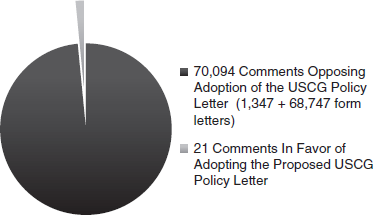
Public response to USCG proposal to allow barging of fracking wastes USCG-2013-0915-0015 (N = 70, 115).
The comments supporting the proposal alleged that the risk of transporting fracking wastes by barge was lower than the risk associated with transport by rail or truck—to the environment, to workers shipping wastes, and to the public. 99 Proponents said the risk of trucking or rail accidents was greater than the likelihood of a barge accident. The supporters also asserted that the content of fracking waste was less hazardous than other cargoes shipped over U.S. waters—such as oil and gasoline. 100
The 68,747 form letters submitted to the Coast Guard were brief statements with both similar format and wording. The form letters contained no legal or scientific citation to support. Most form letters published in the docket on
All 68,747 form letters from all four campaigns expressed disapproval of Coast Guard's proposed policy letter and expressed opposition to hydraulic fracturing in general.
Although most comments submitted to the docket were sent at the suggestion of organized campaigns by environmental groups, not all public opposition to the Coast Guard proposal came as a form letter. One thousand three hundred sixty-eight comments were submitted and published in the docket, which were original text (Fig. 5).
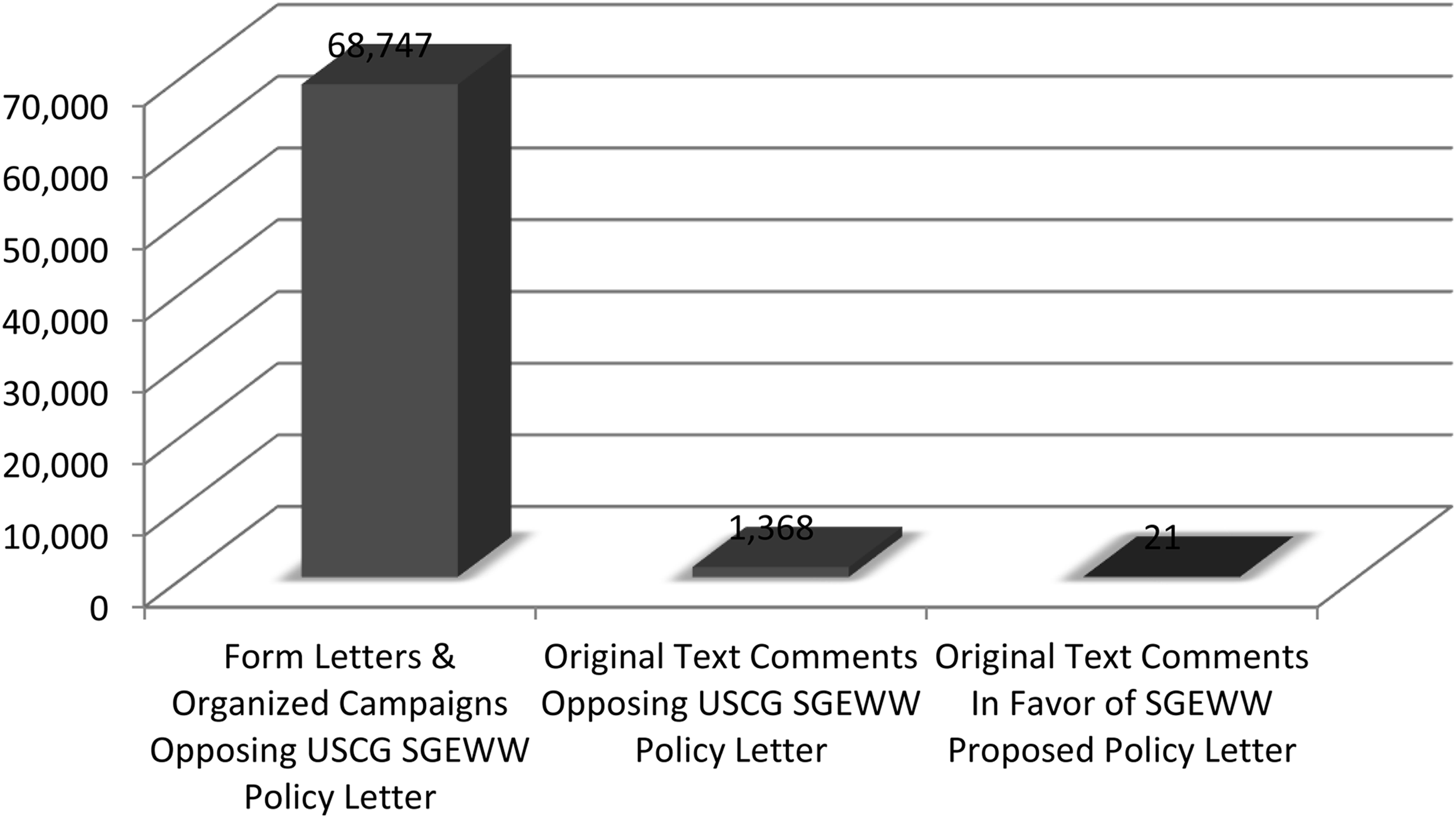
Types of comments written: USCG-2013-0915-0045 (N = 70, 115).
A typical public sentiment opposing the Coast Guard proposal to allow shipping of fracking wastes on U.S. rivers can be found in the statement that:
I do not believe waste from hydro fracking should be shipped on our rivers due to the toxic nature of such waste. Accidents happen and the consequences would be far- reaching. I urge you not to allow this to go forward.” 101
Other comments objected to fracking generally, but did not address the specifics of the Coast Guard proposal, as in this example:
You guys just can't wait to figure out how to help expand the possibilities of wrecking the environment in the process of enriching the oil and gas companies. This region is not the wide-open, big-sky-country of the west, which should be protected as well, but has an extremely low population density. The population of northeast stands a far greater chance of being poisoned by every phase of the fracking process not only by it's very nature or by “accident.” Cut it out! No fracking—PERIOD. The oil and gas companies are just too irresponsible and profit driven to do things properly. Not to mention the fact that all that natural gas which was supposed to enhance our energy independence is clearly going to be sold overseas. 102
Such generalized opposition to fracking is, of course, outside the scope of Coast Guard decision-making and the Coast Guard stated it found such comments distracting from the core task. 103
The majority of comments were written by members of the general public and not by self-identified experts. Only eight comments were written by government representatives. Eight comments were sent by academics. Nine comments were submitted by industry. Seventeen comments were written by environmental groups. One thousand thirty-three individuals wrote comments (Fig. 6).
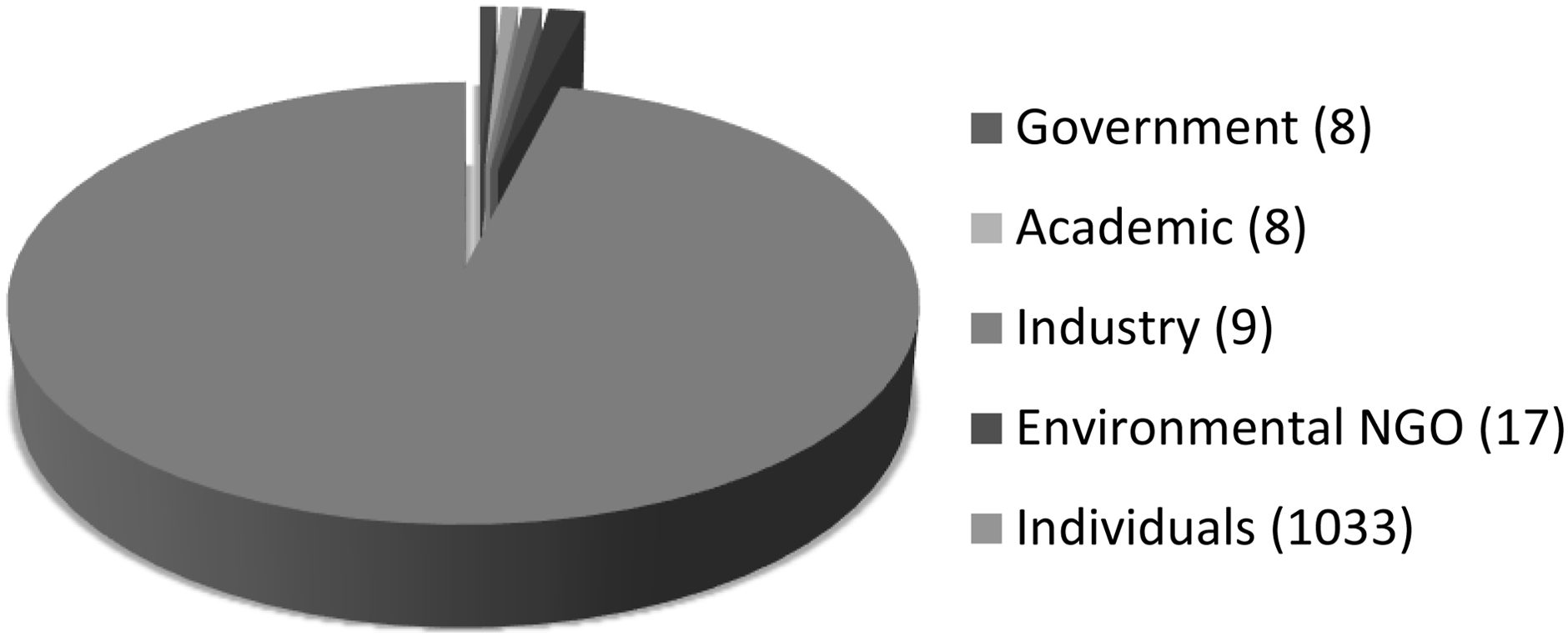
Who submitted comments posted on
A concern echoed again and again in public comments in the Coast Guard docket asserted that Coast Guard “provided inadequate information about SGEWWs ultimate destination and the methods for its ultimate disposal.” 104 Certain commenters pointed out that the Coast Guard policy had “inadequate information about cleanup plans in the event of an SGEWW spill.” 105 Coast Guard noted that environmental liability and cleanup requirements, while a reasonable concern, are governed by a different set of federal regulations (enforced by a different federal agency) and therefore, also outside the scope of lawful consideration. 106
The docket showed a strong trend to address general dislike of environmental policy rather than the specific issue for which comment was requested. This trend reinforces earlier studies that show public participation can sometimes compound the agency decision-making process without adding informative data to aid the task. 107 Activity in this docket supported studies that show policy-oriented groups often mobilize members and use public administrative dockets as a means to express concern about environmental matters even if those matters do not pertain to the scope of the request. 108
Not all of the NGO campaigns contained extraneous data. Organized campaigns expressed extreme concern that a spill or accident from the barges transporting fracking wastes would release chemicals into rivers that could put drinking water at risk. Four hundred three comments discussed fear of spills and 394 comments wrote about potential accidents from shipping fracking wastes. One hundred twenty-five comments noted that between 3 and 5 million people get their drinking water from the Ohio river; these writers worried that protections were needed to protect the drinking water source for so many people and that banning the shipping of fracking wastewaters was a reasonable means to protect drinking water. The following comment illustrates:
Please do not allow the carriage of conditionally permitted shale gas extraction waste on the Ohio River. Between 3 and 5 million people get their drinking water from the Ohio river. Greenhunter energy proposes to bring concentrated radioactive fracking waste down the Ohio River. This is not in the interest of the millions of people who get their water from the river. Please do not permit this. 109
Like the Corps permit proceeding, numerous commenters to the Coast Guard docket noted procedural concerns. Two hundred forty-two comments asked Coast Guard to extend the public comment period. The Coast Guard ultimately said extension of the comment period was unnecessary in light of the complete withdrawal of the policy and Coast Guard decision to keep the current permit process in place. 110
Commenters questioned whether the Coast Guard should issue a policy letter rather than embark on a formal rulemaking proceeding. For example, a letter from the Delaware Riverkeeper Network and 140 additional organizations from around the national said a rulemaking, rather than a policy letter, is the appropriate avenue to evaluate policy needed concerning shipping of fracking wastes, 103 because a rulemaking would provide more transparency and greater opportunities for public participation than were provided in the limited 30-day public comment period. The Coast Guard strongly disagreed with the contention that a rulemaking was needed stating that, “Detailed information on how to achieve compliance is often better suited to guidance documents such as the withdrawn policy letter.” 111 Coast Guard also asserted that, “Effective enforcement is already provided via existing regulations prohibiting the carriage of unlisted cargoes without specific permission from the Coast Guard.” 112 Rather than draft a regulation, Coast Guard withdrew its policy letter and reverted to its original policy of making a case-by-case determination. 113
One hundred fifty-six commenters wanted the Coast Guard to conduct an environmental assessment and 185 wanted Coast Guard to conduct a more detailed environmental impact analysis to study the effectiveness of the proposed policy letter in the event of a spill or accident. 114 For example, a comment from the general public said:
The chemicals used to extract shale gas are toxic. Allowing huge quantities of waste water to be shipped on waterways presents a serious threat for contamination in waterways that are trying to be restored. An environmental study is required and shipping should be postponed until the study is complete. 115
The Coast Guard said it “intends to evaluate the environmental impacts under NEPA for each request to ship SGEWW by barge, on a case-by-case basis under existing regulations.” 116 The Coast Guard also promised data learned through the NEPA environmental assessment process “may be used, as appropriate, to inform any future rulemaking or guidance on this issue.” 117
Substantive concerns raised in public comments centered on Coast Guard's proposed chemical analysis protocol. These comments fell squarely within the Coast Guard's request for input. As research from prior studies suggest, the most useful comments submitted to the Coast Guard docket were submitted by experts; but in at least one instance members of the general public had hired a lawyer to advocate on their behalf. For example, the NGO group headed by the Delaware Riverkeeper Network explained concerns that use of alternative methods of conducting chemical analysis may not be transparent to the general public. 118
The Coast Guard dismissed the NGO concerns of operational transparency. 119 The Coast Guard said existing regulations provide the opportunity to propose alternatives or equivalent methods of compliance, but determinations on appropriate methods of compliance have never been generally available to the public “because they do not create rights or obligations for anyone other than the requester, and they could contain proprietary information about the alternative requested or approved.” 74 The Coast Guard declared it had no intention of changing policy on public disclosure of treatment methodology in the case of fracking wastes.
One hundred ninety-one comments discussed the need for transparent disclosure of chemical analysis. Again, comments submitted by experts were most detailed. However, the consortium of 46 organizations in Ohio, Pennsylvania, Michigan, Kentucky, Illinois, New York, and West Virginia that hired attorney Terry Lodge also presented a sophisticated opposition when it asserted the Coast Guard should require chemical analyses of barge loads of fracking wastes be submitted to Coast Guard rather than be held by industry. 120 The Coast Guard rejected the NGO argument and found that the better practice was for barge owners to retain records of the chemical analyses and surveys after Coast Guard examined those records and before allowing workers or Coast Guard personnel enter a barge's tank. 121 The Coast Guard explained that, “by cumulating data from the chemical analyses records [Coast Guard] could determine whether hazardous materials had built up within the barge's tank.” 122
NGO groups were concerned that the Coast Guard proposal would result in “uncertain or unknown effects or risks to various aspects of the environment and public health” and “negative impacts to areas that have unique historical, cultural, and ecological characteristics.” 123 The Coast Guard promised to “carefully consider the environmental impacts of each request to ship SGEWW by barge on a case-by-case basis under existing regulations.” 124 However, the ultimate Coast Guard decision to return to a case-by-case analysis would potentially remove future permit applications from public notice and comment.
One hundred eighty-three comments expressed worry that the Coast Guard proposal did not adequately protect worker safety. The Coast Guard rejected worker safety concerns and all suggestions that the agency gave “inadequate consideration to worker safety hazards and mitigation measures.” 125 The Coast Guard explained that analyses and surveys evaluating the safety of barge tanks would be undertaken before any personnel would be allowed to board a barge shipping fracking wastewaters. Once the chemical components of the fracking wastes were identified, the Coast Guard could use existing regulatory protocols to mitigate any safety risks to workers. 126
The summary of findings regarding the Coast Guard docket concerning shipping of fracking waste is found in Figure 7.
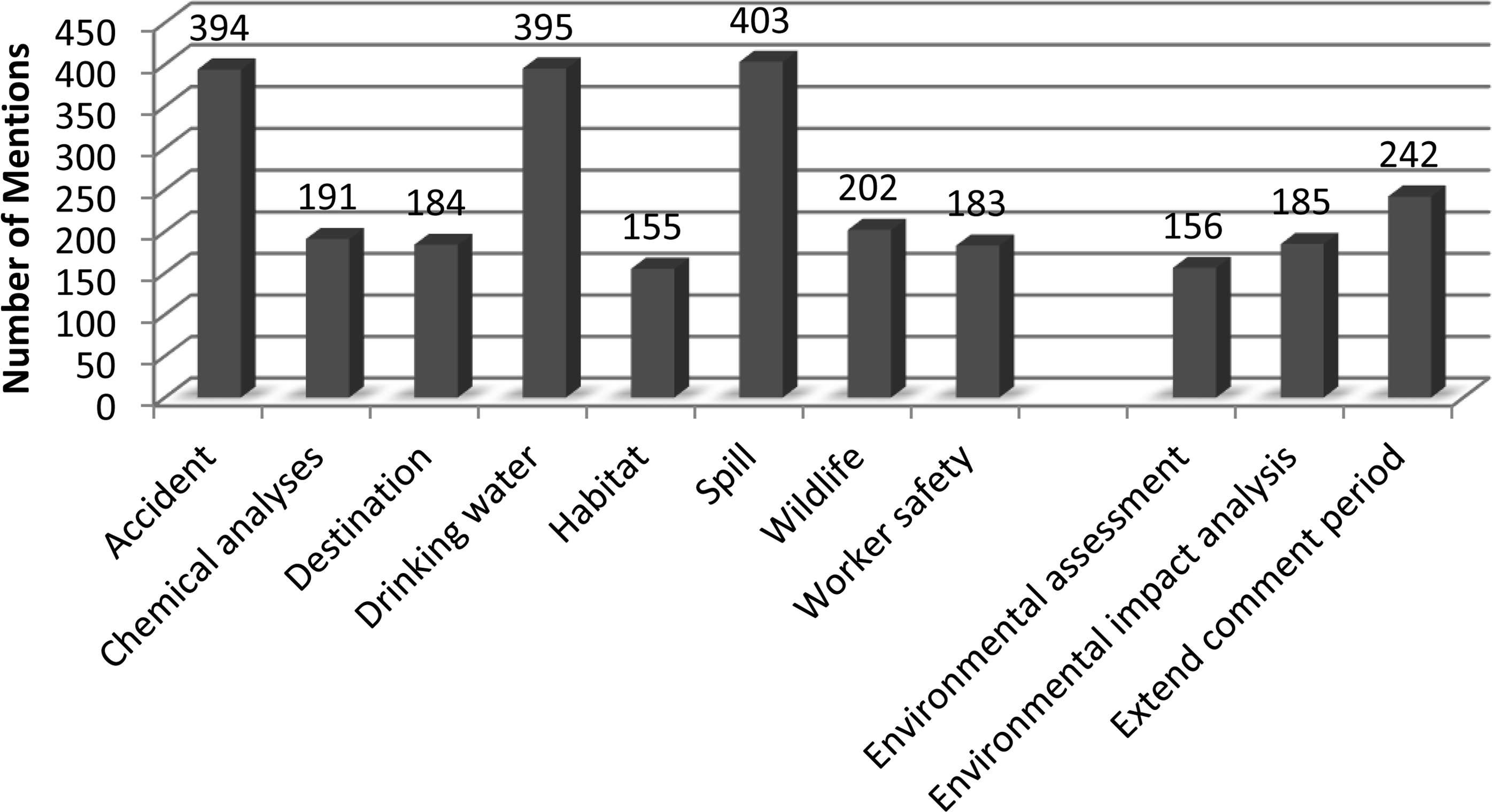
Summary of public comments: USCG-2013-0915-001 (N = 1071).
On February 23, 2016, the Coast Guard withdrew the proposed SGEWW policy, in part, due to lack of interest by industry. 127 The Coast Guard decided to keep the existing case-by-case determination in place 128 and would “consider instituting a standardized process for transporting SGEWW in bulk after it has assessed whether current regulations are inadequate to handle requests for transport of SGEWW in bulk and environmental impacts that may be associated with SGEWW transport by barge.” 129 The Coast Guard would use experience with individual approvals to inform any future policy changes.” 130
A spokesperson for GRH responded to the Coast Guard announcement by promising to file a new permit application to ship fracking wastes under existing Coast Guard rules. 131 GRH, however, sought Chapter 11 bankruptcy protection only a week after Coast Guard withdrew its proposed guidance concerning shipping of fracking wastes on U.S. rivers. 132 GRH lost its listing on the New York Stock Exchange. 133 The GRH assets were sold to FQ Disposal LLC on May 5, 2016, and the successor abandoned the project advocating shipping fracking wastewaters by barge. 134
Discussion: Policy Implications from the Case Study
A comparison of themes raised in the two dockets shows clear patterns (Fig. 8). Many comments from the general public expressed anger at the federal government for allowing practices that might adversely impact public health and the environment. Many expressed fear that industry did not have adequate incentives to protect drinking water.
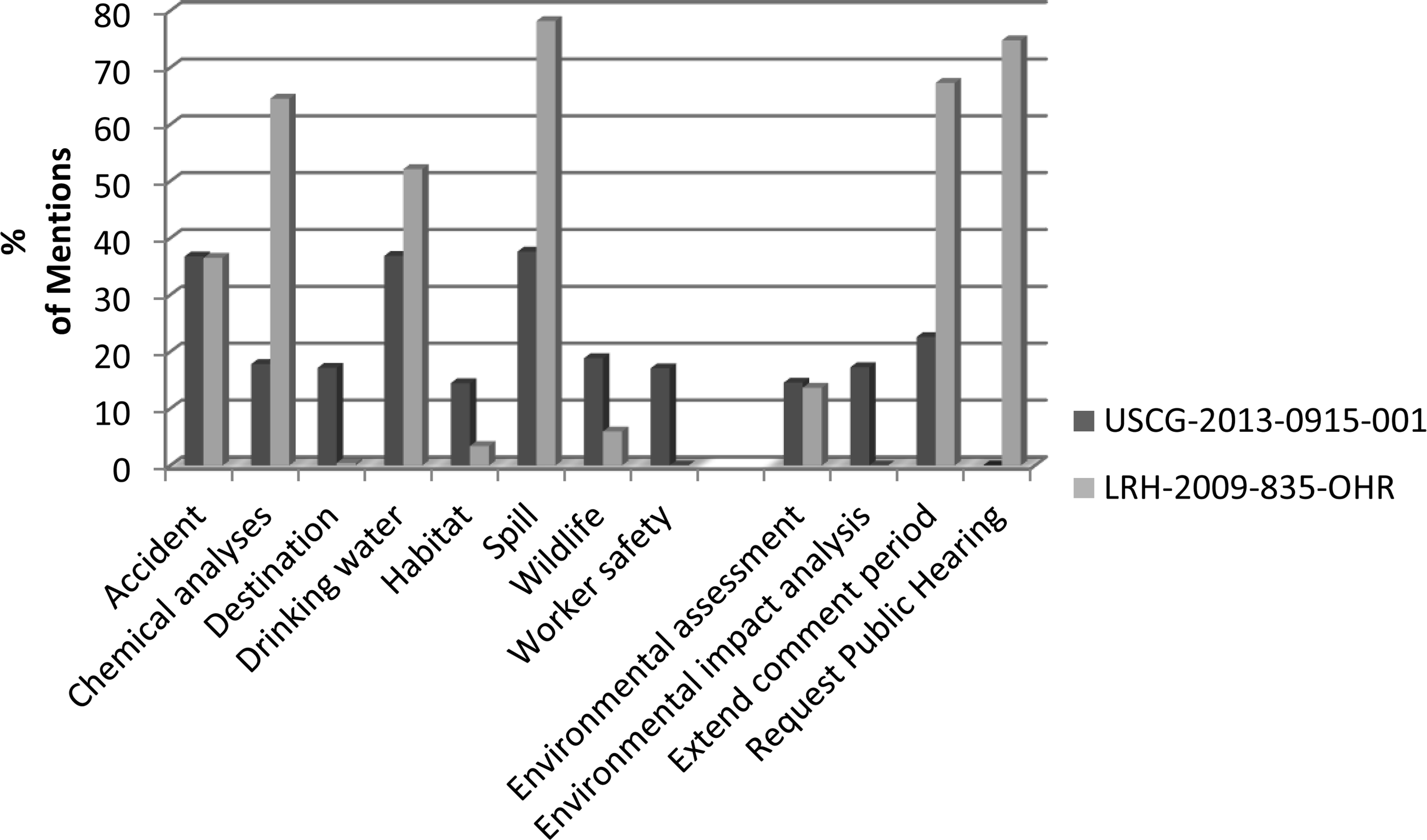
Comparison of public comments of COE and USCG dockets considering shipping of SGEWW. SGEWW, shale gas extraction wastewater.
For example, one commenter who founded a grassroots organization to resist the permits that would allow the shipping of fracking wastewaters by barge on the Ohio River said:
I am the founder of the Wheeling Water Warriors. We are a group of 700+ grassroots activists who oppose fracking, and in particular, the barging of fracking wastes on our Rivers. We note that fracking waste contains numerous toxic and carcinogenic chemicals, and radioactivity, which we believe will endanger our environment and public health for generations to come. Many of the chemicals used are subject to exemptions from the Clean Air and Clean Water Acts, the so-called Halliburton loopholes, and we are unable to even correctly identify what might chemicals might be in an industrial fracking accident. This puts first responders at great risk. The frack waste is to be barged to injection well sites, and we are aware that injection wells are known to trigger seismic activity and earthquakes.
With regard to transport, a truck accident on solid ground is a disaster, but a barge going down with between 900 and 1000 trucks of frack fluid, is an environmental catastrophe. In the event of an accident or spill, frack waste can be contained to a degree on soil, but NOT in water. The plant where they want to ship waste from Wheeling is a mere 1.2 miles upriver from the main water intake for all of Ohio County, West Virginia. We are aware of at least 5 barging accidents on the Ohio River in the last 2 years, and at least one of those barges is still at the bottom of the Ohio River. We are unable to fathom how a sunken barge with hundreds of thousands of gallons of toxic water can ever be brought back up from the bottom of the river in the event of an accident. Over 5 million people draw their primary drinking water from the Ohio River, and 1/10 of the entire population of the U.S. lives within the Ohio River Basin. Dilution is NOT the solution to pollution.
PLEASE do not allow the barging of frack wastes on our Rivers! 135
The public raised both procedural and substantive objections to the permit applications concerning whether or not the Corps and the Coast Guard would each allow barging of fracking wastes.
While both the Corps and the Coast Guard appeared to consider public comments carefully, neither agency appeared particularly swayed by public opinion. The Corps noted public concern about building the barging facility, but stated the protections in the permit were adequate. Similarly, the Coast Guard explained that withdrawal of its proposed policy letter was based largely on lack of interest by industry rather than concerns raised by the public. The Coast Guard determination to review shipping of fracking wastes on a case-by-case basis would take the permit process outside public view—exactly the opposite of the procedural concerns raised by commenters.
From a policy perspective, certain important themes emerge in the examination of public input in this case study that are reminiscent of earlier studies on energy justice movements 136 and on social representations of energy policy found in newspaper coverage. 137 First, the public does indeed have an interest in permit proceedings that could impact public health and the environment. To facilitate this input, government agencies should place the docket for permits online and make materials freely available without requiring FOIA requests (and potential fees to duplicate and mail paper materials). Placing materials online would allow better and more informed public participation. 138
Second, although federal agencies posting to federal dockets mostly keep track of all materials sent—they do not do a good job of indicating who sent mass mailings and the numbers posted for each mass submission. In the Coast Guard docket, it was not apparent that the agency had had more than 70,000 public comments until Coast Guard withdrew its proposal; the docket on
Third, NGOs and environmental groups organizing mass campaigns would better serve both their members and rule makers if they direct writers to address the substance of the administrative proceedings and avoid general theories and platitudes that the agency is not allowed to take into consideration.
Most comments written at the behest of organized groups were short, without legal or scientific citation, and addressed issues outside the purview of agency authority. The form comments sent at the suggestion of organized groups looked more like votes than informed participation. 139 While such mass action may empower the citizenry, brief undocumented letters do little to either inform the agency or allow private citizens to be heard in administrative proceedings. 140 Large general campaigns that object generally have the effect of drowning out detailed comments. 141 Both the agency and citizens trying to understand different points of view in a multifaceted, highly nuanced debate spend a large amount of time sorting through nonresponsive paper, that is, the comment equivalent of shouting and chanting. 142 These mass writing campaigns add work without adding any insight other than the public is impassioned. 143
Conclusion
In this study, we used qualitative methods
144
to identify and understand the impacts of public participation on permit and regulatory rulemaking proceedings that garnered public interest due to the role in oil and gas production. Specifically, the regulatory actions involved proposals to ship fracking wastes by barge on the Ohio River,
145
a drinking water source to millions of people.
146
The two dockets we explored were related proceedings.
147
The two dockets differed, however, in that one docket was easily available online on the government hosted website
In both dockets, most comments were submitted by members of the general public. Many comments were form letters written at the suggestion of organized environmental groups. Comments written by the general public that did not track form letters usually expressed general sentiments about the proposal rather than answering the specific questions and concerns posed by the federal agency. Many comments addressed issues clearly outside the regulatory purview of the agency. Most comments had little or no scientific or legal citation to support assertions. As researchers before noted, 150 the comments of the general public looked more like votes than meaningful contributions to a regulatory dilemma. 151
In contrast, the small minority of comments submitted by experts were generally highly sophisticated, contained significant legal and scientific support, and responded with specificity to the questions with which the agency was charged in the specific rulemaking. Comments by experts (whether in support, in opposition, or with mixed response) tended to be long and were submitted as and with attachments.
This case study confirmed the finding of earlier studies 152 that the public does indeed have an interest in fracking related permit proceedings because the public is concerned the permit could negatively impact public health and the environment. To facilitate better public participation, federal agencies should place the docket for environmental permits online so that they are freely and readily available for public inspection and consideration. 153
Federal agencies should also do a better job of posting and keeping track of all materials—including mass mailings—posted to online dockets.
154
It is not always apparent on docket on
The public needs better education on how to effectively participate in rulemaking proceedings. 155 Just putting dockets online does not make the democratic process more accessible without instructing the public on what is and what is not expected. 156 To the extent NGOs and environmental groups use mass campaigns to influence agency decisions, groups would be more effective if they direct comment writers to address the substance of the administrative proceedings and avoid general theories or platitudes beyond the scope of the rulemaking. 157 To do so, groups may need to consult with or hire an expert to assist preparing comments. While general expressions of concern or discontent may serve membership interests of environmental groups, such comments hinder rather than help the agency—especially when the submitted comments discuss matters that the agency is by law not allowed to take into consideration. 158
Finally, increased democratic participation yields challenges in addition to strengths.
159
Agencies are able to use software to sort similar comments and separate meaningful input from more of the same. The inability of the public to do so as well, however, prevents the public from being able to locate, understand, and assimilate differing notions important to the underlying debate.
160
The development of better software on
Footnotes
Acknowledgments
The author thanks Sarah Louis Kuril, Emily Austerberry, and Mustafa Ali for research assistance in this project.
Author Disclosure Statement
No competing financial interests exist.