




Abstract
Abstract
The impacts of the Flint Water Crisis (FWC) present municipal and state officials, emergency responders, community organizations, and residents with considerable uncertainties about how to reorganize and respond in the wake of tragedy. In addition to the collapse of infrastructure and governance systems, the community is experiencing a collapse of its communication and knowledge-sharing networks, specifically between those directly impacted by the crisis and those involved in the emergency response. In this article, we summarize what we learned from a community engagement process that took place in the winter and spring of 2016 after widespread acknowledgment of the FWC and review the (1) results of five “participatory modeling” workshops with residents carried out in the city of Flint and (2) results of a follow-up cultural consensus survey administered to Flint residents and FWC responders engaged in the recovery to evaluate the degree of agreement among actors about the dynamics of the FWC. The modeling exercise revealed that Flint residents perceive that long-term racial and economic marginalization and political disenfranchisement led to the FWC. Cultural consensus data indicate that nonresidents are less likely to share this view about the causes of the crisis; however, there was more agreement between Flint residents and nonresidents around the consequences of, and solutions to, the FWC. Agreement around potential solutions is encouraging, but if recovery efforts fail to address Flint residents' underlying concerns about long-term marginalization and disenfranchisement, there is a risk of further erosion of trust and communication between residents, state officials, and emergency responders.
Introduction
T
In times of crisis, these breakdowns in trust and communication drive the development of insular, rigid, and balkanized knowledge structures 2 that may result in the development of exclusive and hostile factions. Such factions are represented by multiple closed networks with limited knowledge sharing and learning between them. 3 The insular nature of these closed knowledge networks may then result in a series of isolated groups, each with their own explanations for the causes, consequences, and solutions to the crisis, which reduces the at-large community's collective ability to learn, adapt, and respond to the hazards. Failure to adapt in the wake of crisis can then lead to further alienation, impede collective action, and have long-term negative impacts on community health, cohesion, and well-being, locking communities into a vicious cycle. 4 Currently, multiple stakeholder groups in Flint are dealing with considerable uncertainties about how to address the issues they face in the near future and how to communicate and evaluate these concerns between those impacted and those charged with developing policies that respond to the Flint Water Crisis (FWC).
In continuing to manage and repair the damage (both physical and emotional), the Flint community at large is engaged in a learning process, rebuilding their knowledge to help them to identify the causes, consequences, and solutions to this crisis and determine what adaptations and solutions will be effective in mitigating future unwanted outcomes. Because the speed at which this knowledge rebuilding takes place is determined by the state of communication and social networks, issues of trust between residents and decision makers, the ability of the residents to identify and communicate their concerns to officials at multiple levels, and the ability of these officials at multiple levels to respond to resident concerns in terms that are meaningful to communities remain crucial to addressing the ongoing needs of the community.
Taking into account all these varying factors in knowledge transfer and communication through networks, the FWC prompted community leaders, academic researchers, and systems-modelers to explore the perspectives of Flint residents about the disaster. City-level discussions in the immediate wake of the FWC indicated that due to decreased trust between residents and many government officials, communication in the city was impaired. The lack of communication and trust between those impacted by the FWC and those responding to the FWC made incorporating community perspectives into recovery planning difficult. Community leaders identified the need for an efficient and systematic approach for capturing and communicating resident concerns to officials engaged in response planning.
Collaborative and Cultural Modeling Methods to Capturing Community Knowledge
A team of Flint-based community partners and university researchers engaged in a two-phased approach to capture community perspectives about the complex dynamics of the FWC. The approach included (1) a series of community-based modeling workshops with residents held throughout the city of Flint and (2) a follow-up online survey with FWC responders and residents to better understand the diverse beliefs about the causes, consequences, and solutions to the FWC (Table 1).
FWC, Flint Water Crisis.
Collaborative modeling workshops using fuzzy cognitive maps
During the modeling workshops, residents were encouraged to view the Flint community and the FWC as a system of interacting components and events using a collaborative modeling approach called Fuzzy Cognitive Mapping (FCM).5,6 During each 2-hour workshop, a free online FCM-based software called Mental Modeler7,8 was used to create a collaborative group model that was constructed as participants shared their individual perspectives and reflected on the dynamics of the FWC. Each workshop followed a similar outline and was guided by semistructured questions about the (1) causes, (2) consequences, and (3) potential solutions to the FWC.
Residents were asked to first consider the consequences of the FWC in terms of how they anticipate being impacted in the short and long term. As participants shared their experiences, a facilitator translated their statements into the projected model 9 and residents were asked if the concept map reflected their knowledge. An example of a community-based model about the impacts of the FWC, collected during one workshop, can be found in Figure 1. Next, residents were asked to think about what factors led to the FWC. An example of a community-based model about the causes of the FWC can be found in Figure 2. Finally, residents were asked to brainstorm potential solutions and define where these policies or strategies might fit into the model, which were then added (for more details about the modeling approach and examples of how resident narratives were translated into semiquantitative concept, mapping with Mental Modeler). These individual workshop models were then analyzed and aggregated into one community model that was presented back to residents in an “all hands” workshop that included many previous workshop participants along with representatives from non-governmental organizations (NGOs), community groups, and city, state, and federal officials.

Example of submodel developed with 11 residents during workshop 3 shows the direct and indirect effects of “lead exposure” and its impact on the Flint community when represented as a system of interacting components. Red lines indicate decreasing influence and blue lines indicate increasing influence. For example, when “lead exposure” increases, it decreases “K-12 education” quality and increases both “stigma” and “uncertainty of long-term effects” which, in turn, increase “stress.” Similar models were collected during all individual workshops held throughout the city and reviewed during the “all hands” workshops to generate clear policy recommendations from the community. Models were developed using Mental Modeler software (
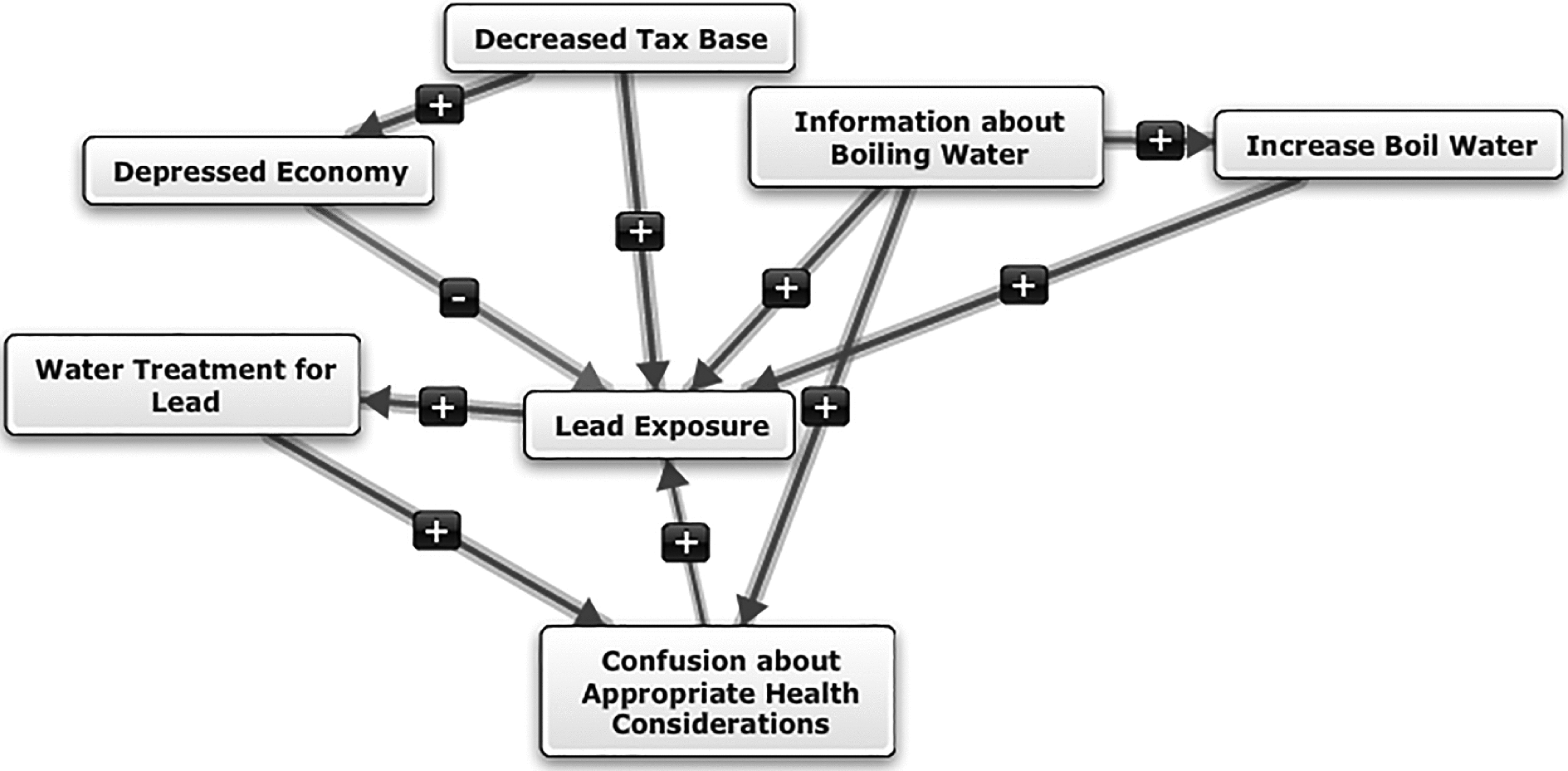
Example of a submodel collected with 14 residents collected during workshop 1 indicates that “decreased tax base” and “information about boiling water” were main driving factors that increased “lead exposure,” which were exacerbated by intermediate factors such as “confusion about appropriate health considerations” and “depressed economy” in Flint.
Cultural consensus survey with residents and FWC responders
After the modeling workshops, an online survey was developed based on the major themes that emerged from the model-building exercises. The purpose of the survey was to identify areas of consensus and disagreement about the FWC between residents and FWC responders to determine levels of agreement about the dynamics of the FWC from those impacted and those involved in the recovery effort. The survey included a series of true/false questions about the causes, consequences, and solutions to the FWC and was administered to 355 individuals who represented various community (NGOs, schools, churches) and government organizations involved in the recovery. The FWC responder contact list used for the survey was obtained through a local emergency response organization that had collected this information in the first 5 months of 2016. Therefore, the survey data presented represents a convenience sample and is not a randomized sample of FWC responders or residents. However, these data do reflect perspectives of those actively involved in the months following public acknowledgment of the FWC. Of the 355 individuals who were contacted to take the survey, 101 individuals participated in the larger study. The survey was also administered in-person during the “all hands” modeling workshop with residents for a total of 137 respondents.
Cultural consensus modeling was used to analyze whether there was cultural agreement across residential (i.e., resident or nonresident) and racial (i.e., non-white and white) lines. Cultural consensus modeling is based on the assumption that cultural groups share a cohesive worldview due to their information sharing and social networks. Factor analysis is used to determine if respondents' answers yield a single factor loading, and if so, the respondents are assumed to be part of a single cultural system. 10 Multiple factor loadings indicate that the group does not share a cohesive culture.
Results and Discussion
Below we present an overview of the analysis of the collaborative modeling workshops and the results of the survey analysis.
Analysis of workshop models
Perceived causes of the FWC
Analysis of the models indicated several similarities across the individual models collected during the four workshops. While the direct physical causes of the water crisis include the city's deteriorated infrastructure and the change in water source to the Flint River and water treatment, the community-created models of the FWC revealed underlying causes that included the following:
• exploitative practices by industry; • Flint's depressed economy and tax base; • a history of marginalization by race and socioeconomic status; • loss of decision-making control among residents; and • austerity measures put in place by state government.
These long-standing issues were perceived to create an environment for the infrastructure deterioration and for the decisions that led to the water crisis. Residents identified these as persistent issues that have plagued Flint for decades.
Perceived consequences of the FWC
Analysis across the individual models indicated that exposure to lead in the water has had several consequences from the community's perspective, ranging from physical health effects and crisis-induced trauma to further economic decline. The immediate effects include decreases in the following:
• overall community health (particularly children's health); • real estate values; • trust in officials; • educational outcomes/attainment; and • the local economy.
Immediate effects also include increases in the following:
• emotional stress and fear; • daily household labor; • exacerbation of pre-existing health conditions; • uncertainty; • opportunities for outside businesses to take advantage of recovery efforts; and • the negative consequences from the stigma of poverty and social failures associated with Flint.
The serious health issues resulting from the lead exposure were the most immediate concern of the residents, particularly for those who take care of children and the elderly. It is important to note that uncertainty about the health effects is pervasive in the community due to a lack of consistent, reliable, and trusted information regarding how to assess their personal risks, lack of scientific data on personal and community exposure, and how this information is changing over time. This uncertainty adds to significant long-term psychological stress. Residents believe that dealing with these impacts will create significant barriers to recovery even after infrastructure improvements have been made in the city.
Policy solutions to the FWC
During workshops, participants discussed and modeled both short-term and long-term solutions to the crisis. The immediate solutions to the water crisis recommended across all workshops included installation of whole-house filters and replacing lead water pipes. While these physical improvements were largely seen as immediate and necessary, residents considered them ineffective in addressing systemic issues such as economic depression. Residents certainly identified a need for reparations and real estate buy-outs as a possible solution, but also continued to seek more sustainable solutions to some of the systemic issues that allowed the lead poisoning to develop and escalate. Residents were aware of recent steps that have been taken to restore power to the mayor and city council, but several workshop participants stressed the importance of ensuring that local decision makers should have a dominant voice in how recovery funds are used.
In general, residents were concerned about the lack of “inside-the-community” policy solutions. To this end, participants suggested the establishment of a local workforce training program that could address the filter installation, pipe replacement, and social/monitoring programs needed within Flint in the short term. In addition, in the long term, a trained labor force could also be exported to other communities and municipalities who, due to the national publicity of the FWC, are now reminded of the public health crises that can result from infrastructure neglect. Residents spoke about Flint being the “canary in the coal mine” for other communities that will likely face similar issues. The community expressed a concern that current government officials may not see the FWC as opportunity for long-term investment in Flint and, therefore, may be reluctant to provide funding for anything beyond immediate issues related to acute lead exposure.
Residents suggested a long-term healthcare plan as a way to deal with some of the anticipated future health issues expected to result from lead exposure. They also expressed concerns about how the crisis would affect youth in the community in years to come, particularly in terms of educational attainment and delinquency. Policy suggestions include the development of a long-term monitoring plan for the children exposed to lead to track child development issues, and the development of family support programs in schools.
Breaking free of the vicious cycle
A dominant theme identified across workshops and analysis of community models were the concern that the recovery money now entering Flint would be contracted to businesses based outside the Flint community. While these contracts may have short-term benefits, such as reducing immediate and extreme lead exposure, such policies were perceived to perpetuate the social and environmental problems that Flint has faced for many decades (Fig. 3). Outsourcing solutions to the FWC would maintain problems associated with the economically depressed community and not provide them with a way to contribute to the replacement of their infrastructure and manage impacts of the disaster, or allow them to rebuild their community and ensure that problems similar to the FWC can be avoided in the future.

Example of subgraph of the concept map collected during workshop 3 indicated that residents felt that the city of Flint was locked in a “vicious cycle” and that an economic atmosphere of “parts before people” and loss of manufacturing jobs in the Flint led to “marginalization” and a “decreased tax base” that led to a decrease in “local decision-making control” and facilitated a lack of investment in “aging infrastructure.” These two factors in particular increased lead exposure through the Flint Water Crisis in turn increasing further marginalization.
To address the systemic injustice that led to the crisis, several workshop participants recommended that this disaster could be viewed as an opportunity to rebuild the economic tax base of the city. Rather than viewing the FWC as a series of tragic consequences resulting from a handful of bad decisions, some residents of Flint view it as the result of the complex interplay among numerous factors that include (but are not limited to) a decreased tax base, a history of marginalization, and the inability of the municipality to make decisions based on local knowledge because of the emergency manager program. Therefore, their policy recommendations included local-scale solutions such as providing opportunities for workforce training in Flint to rebuild infrastructure and developing entrepreneurial opportunities through which the Flint community might design and engage in rebuilding.
Survey and cultural consensus analysis
Perceived power in decision making
Analysis of the survey data indicate that there is agreement among residents and FWC responders regarding what institutions and groups were perceived to have decision-making power in the wake of the FWC. When asked to rank their level of agreement about organizations or groups holding decision-making power from Strongly Agree (1) to Strongly Disagree (5), with 3 being neutral, survey responses indicated that state, federal, and city officials and federal scientists currently hold the most decision-making power, while national NGOs, university scientists, and Flint residents hold the least decision-making power (Table 2).
NGOs, non-governmental organizations; SD, standard deviation.
Consensus about causes, consequences, and solutions to the FWC
To understand the degree of consensus about causes, consequences, and solutions to the FWC, survey participants were separated by basic demographic information (i.e., race and residential status) and cultural consensus analysis was used to determine whether cultural views about the FWC were shared or distinct along racial or residential lines (Table 3).
Participants were asked to provide true/false responses to a series of statements. Responses were grouped by race and residential status to assess agreement within and between different cultures of the community. The table shows the proportion of respondents who answered “true” to specific statements. The Eigenvalue ratio indicates whether or not there is consensus within the group (>3.0 indicates consensus). The bold values indicate whether or not there was consensus across groups.
Based on proportion of true/false statements and patterns of agreement, survey results indicate that there is general consensus about the consequences and solutions among those surveyed independent of racial or residential lines. However, survey results also indicate that there was variation both within and across respondent groups in terms of what caused the event to occur. Some differences along racial or residential lines were found. For example, whites and nonresidents were less likely than residents and non-whites to agree that recovery money was primarily benefiting businesses outside of Flint. In addition, Flint residents were more likely than other groups to agree that the FWC happened because of austerity measures taken by the state. Finally, there was general agreement among all respondents that removing the pipes would not solve the problem and that recovery funds should be used to re-energize the tax base in Flint.
Conclusion
The purpose of this research was to capture the perspectives of the Flint community members to inform future planning and policy development in Flint. Participatory modeling workshops and surveys identified some systemic causes of the water crisis that replacing the lead pipes will not be able to address. When considered together, the data we collected from community members present troubling findings: there is widespread agreement that Flint residents do not have power in the decision-making process, residents do not trust those who have the power in the recovery process, and some of the risks perceived by residents are not shared by those engaged in the FWC recovery effort who live outside their communities. If care is not taken to increase community voice and discuss the concerns identified by residents, it is unlikely that social conditions in Flint will improve.
While the Flint community participants expect to deal with negative impacts of the FWC in the years to come, many of those we spoke with shared their view that this disaster may serve as an opportunity to create a more cohesive and resilient community through entrepreneurship and local, long-term recovery efforts. Therefore, as recovery planning efforts continue and increase, care should be taken to clearly communicate (through trusted sources) and engage with Flint residents. Furthermore, efforts should be undertaken to “insource” FWC responses, including hiring Flint-based contractors as well as training and organizing Flint residents so that they can provide skilled labor and management for FWC solutions. Although there appeared to be some disagreement about definitive and exact reasons why the FWC occurred, it is encouraging that this research revealed consensus about some of the major problems Flint residents now face, as well as some short- and long-term solutions to these problems.
Footnotes
Acknowledgments
The authors thank the Community Foundation of Greater Flint and MSU's University Outreach and Engagement who funded this research. In addition, they thank all workshop participants, as well as Patrick O'Neal, Tryphena Clarke, Lynn Williams, Isaiah Oliver, Kyle Metta, Maddie Gorman, Rene Wallace, and especially Robert Brown and Artina Sadler for their support and collaboration.
Author Disclosure Statement
No competing financial interests exist.