




Abstract
Abstract
As efforts to decarbonize the electric sector take on increased urgency, governments are turning to wood pellets as a potential renewable energy resource. However, the production of pellets from woody biomass has immediate community-wide impacts on air and water quality. This article investigates the siting of wood pellet production facilities in the southeastern United States and finds that they are 50% more likely to be located in environmental justice (EJ)-designated communities. We define an EJ community as a county where the poverty level is above the state median and at least 25% of the population is nonwhite. In addition, we find that all biomass pellet mills in North Carolina and South Carolina are in EJ communities. There is a longstanding history of EJ communities being disproportionately targeted for the siting of coal and natural gas power plants, in addition to waste-to-energy plants and landfills. Wood pellet production facilities are similar to these plants in their emissions of harmful particulate matter, airborne pollutants such as carbon monoxide, carbon dioxide, nitrogen oxides, sulfur oxides, and their degradation of local water quality. Wood pellet production is increasing rapidly in the southeastern United States. These data add to growing evidence that biomass pellet mills in the southeastern United States place an undue burden on economically depressed areas of color.
Introduction
T
The existing literature on EJ communities is robust, as is the literature on the environmental and health impacts of biomass production. However, with the exception of Booth, Shrader-Frechette, and Preisser, and Mittlefehldt and Tedford, which focus on biomass facilities for heat and electricity production and EJ communities in Pennsylvania, Indiana, and Vermont, respectively, little research has focused on the southeastern United States, an area where a majority of national production capacity for wood pellets is located. 1 , 2 , 3
The production of woody biomass pellets is an energy intensive process that includes shipping logs and other raw material to the production facility, usually through truck or rail; processing through chipping, drying, grinding, and pelleting machines; and finally bagging and shipping, again, usually through truck and rail to international export terminals. 4 In 2016, >99% of the wood pellet exports to the EU originated from southeastern U.S. ports. 5 Owing to the high economic costs of shipping whole trees and forest residue, most input materials are sourced from within a 75-mile radius of the processing facility. 6
In addition, biomass and coal are usually burned on-site to generate the needed electricity to fuel the plants. Throughout this process, emissions from shipping and processing are generated, along with increased road and rail traffic, noise pollution, and degradation of regional water quality and ecosystem services, all of which impact the populations in the surrounding areas.
The National Association for the Advancement of Colored People (NAACP) found that African Americans who live near biomass power plants are more likely to suffer from increased exposure to a number of dangerous emissions, such as smog, asbestos, sulfur dioxide, and other toxins, than any other racial group in America. 7 For this reason, a number of southern chapters of the NAACP opposed the siting of wood pellet production facilities in their communities, with one Georgia chapter stating that the siting of a wood pellet production facility in their community was “a clear cut example of environmental racism.” 8
This article is laid out as follows: Framing EJ in the Southeast section frames the issue of EJ in southeastern United States and defines the term as it is commonly used; Wood Pellet Production Facilities section presents some of the dangers that wood pellet production facilities pose to local communities; Methodology section lays out our methodology for determining whether or not a community is an EJ community; Data section presents results from a chi-squared analysis; Results and Discussion section discusses our results; A Contemporary Case section highlights a contemporary case in Richmond County, North Carolina, where residents are fighting the siting of a woody biomass pellet production facility in their community; finally we conclude in Conclusion section.
Framing Ej in the Southeast
EJ scholars have shown that economically depressed communities of color shoulder disproportionate environmental and health burdens when it comes to the siting of hazardous waste sites, landfills, and fossil fuel plants. The history of EJ has roots in the southeastern United States. In 1982, in Warren County, North Carolina, plans to deposit 40,000 tons of soil contaminated with polychlorinated biphenyl (PCB), a known toxic substance, were drawn up by the state. Proposals for the 143-acre PCB landfill in Afton, a rural town in Warren County that was 84% black with per capita incomes of $6984, compared with $9283 for the state overall, were met with strong resistance from the local community. 9
Although ultimately unsuccessful, town residents mobilized opposition around the toxic landfill through a series of nonviolent, civil disobedience actions, including a 6-week opposition to the trucking in of 7097 truckloads of contaminated soil. 10 Residents argued that their community was chosen as the location for the toxic landfill, not because the site was the safest, most suitable, or even cheapest location, but rather because their community was politically and economically disenfranchised, and would therefore, be an easier community in which the state could locate the landfill. 11
In 1987, the United Church of Christ, an organization involved in the Warren County, PCB landfill struggle, published the first report proving that race was among the most significant variables associated with the location of hazardous waste sites throughout the United States, with targeted communities having twice the average percentage of minority residents than communities without hazardous waste sites. 12 A follow-up report published 20 years later found that little had changed, noting that the majority of hazardous waste sites in the country are sited in neighborhoods with majority nonwhite populations. 13
As the case of Warren County illustrates, making claims of EJ requires more than just the uncovering and presentation of evidence that a community has been the victim of an environmental wrongdoing. Rather, EJ requires both an evidence-based finding with a normative judgment that a community has been the victim of an injustice. 14 Therefore, a standard of justice is necessary to determine how and in what way a community's right to justice has been violated.
There are a number of definitions in both the academic literature and regulatory statutes for the term “environmental justice.” Although they are all slightly different, the common components include equal protection and fair treatment regardless of race, economic status, or geographic location with regard to the “development, implementation, and enforcement of environmental law, regulations, and policies.” 15 In addition, a number of definitions cite the equal right to a healthy and just environment. 16 These definitions serve as the normative grounding for our use of the term “environmental justice” in this article. Communities must have access to distributional justice through the equal right to healthy and livable environments, in addition to procedural justice through equal protection and fair treatment of a community regardless of race, economic status, or geographic location. Finally, communities must have meaningful involvement in decision making to ensure process justice. 17
We define EJ communities as a county that has a nonwhite population over 25%, and an average poverty level for all age groups above the state median. This definition is used by the state of Massachusetts to establish quantitative parameters for designating EJ communities. 18 Although this definition is limited in that it is solely a quantitative measure, it serves as a useful metric to capture a wide geographic area. A Contemporary Case section provides experiential and qualitative evidence from a contemporary instance of a wood pellet production facility in an EJ community.
Wood Pellet Production Facilities
Woody biomass is an energy-lite resource that some policy makers consider renewable due to the regenerative, carbon sequestering features of forests. Although the EPA does not consider all biomass to be carbon neutral, the energy resource is able to benefit from generous federal renewable energy tax credits. 19 Wood pellet production facilities, however, present a danger to human health due to the high levels of ambient air pollution, and other deleterious effects, such as increased lower respiratory infections in young children and chronic obstructive pulmonary disease. 20 In addition, biomass releases more carbon dioxide per unit of energy generated and releases 25 times more fine particulate matter, a proven cause of respiratory illnesses in children, including asthma, than comparable coal-fired plants. 21
According to the Energy Information Administration (EIA), the United States biomass manufacturing capacity is currently at 13 million tons per year, with 75% of that capacity located in the south. 22 Plants in the southeast produced more than 9.6 million dry tons of wood pellets in 2015, with exports from the region expected to increase from 10.6 million tons in 2019 to more than 15 million tons by 2030. 23 As global demand for wood pellets increases, pellet companies are expanding operations, with almost 1 million tons of processing capacity either planned or under construction. 24
The EIA estimates that biomass energy could produce 15% of United States energy needs by 2035, up from 8% in 2009. 25 Of the 37 wood pellet production facilities that are either in operation or under construction in our nine southern states of interest, with an annual production capacity of at least 50,000 tons per year, average annual capacity is more than 250,000 tons, with some as large as 825,000 tons per year. By our estimate, to meet this demand, the average plant would require more than 6000 acres annually of local forest as supply inputs. 26
Reducing local forest cover impacts human health by reducing the positive air and water quality benefits that local forests provide. For example, forested land absorbs twenty times more water during storm events than a parking lot, and six times more than a residential lawn. 27 A correlative study in the Midwest found that rates of heart disease and lower respiratory illness increased after emerald ash borer devastated ash trees in the region. 28 In the conterminous United States, trees remove up to 23.2 million tons per year of air pollutants, while forested rural areas remove roughly 25 times more pollution than urban areas. 29 These studies, in combination with others, show the positive health benefits of forested areas, and demonstrate that deforestation in the surrounding area of wood pellet production facilities further burdens EJ communities.
Biomass pellet manufacturing is an energy intense process that has high transportation, processing, and shipping emissions. 30 These include emissions from logging operations, transportation, chipping and pelleting, and finally, transportation to end-use consumers. In addition, there are significant inputs, from fertilizer to fossil fuels in the production process. Although comprehensive life-cycle analysis of biomass production and consumption is inconclusive, there is evidence that the resulting emissions from biomass pellet production are substantial. 31 , 32
A majority of wood pellet production facilities burn biomass and coal on-site to power plant processing operations. 33 This invariably leads to significant emissions within the local vicinity of the plant. Numerous studies linked the burning of biomass to increased particulate matter concentrations, a key cause of acute and chronic respiratory illnesses, particularly within young and elderly populations. 34 , 35 In addition, one study found a statistically significant relationship between exposure to PM 2.5 and a 6.8% increase in the risk of premature birth in North Carolina mothers. 36 It is for these reasons that the American Lung Association and the American Heart Association, along with dozens of other public health, medical, and nursing organizations, oppose the expanded use and construction of wood pellet production facilities. 37 , 38
Methodology
With much of the United States biomass manufacturing capacity located in the southeast, we focused on the 793 counties in nine states of interest: Alabama, Arkansas, Georgia, Florida, Louisiana, Mississippi, North Carolina, South Carolina, and Virginia. Using 2015 American Community Survey data from the U.S. Census Bureau, we compiled population, income, and racial demographic information for all 793 counties.
Using publicly available information found on the biomass industry trade website, we located 32 biomass processing facilities that are either built or under construction and located in our nine states of interest. 39 Plants with an annual capacity of less than 50,000 tons were excluded from our sample. We then created binary variables for whether or not a county represented an EJ county. Finally, we used a chi-square test of independence between wood pellet production facility locations and EJ communities to determine the likelihood that a woody biomass pellet facility is located in an EJ community.
Data
We found that of the 793 counties in our nine states of interest, there are 282 counties that meet our definition of an EJ community. Of the 32 wood pellet production facilities, we found that 18 were located in EJ communities, with an additional 3 facilities located within 4 miles of an EJ community. We mapped our variables of interest and located EJ communities. Figure 1 depicts the percentage of nonwhite residents in all 793 southeastern counties; Figure 2 illustrates the percentage of residents living below the state median income in all 793 southeastern counties, and Figure 3 highlights defined EJ communities. In all three figures, the dots represent the 27 wood pellet production facilities of interest that are operating, but not those that are under construction or planned.
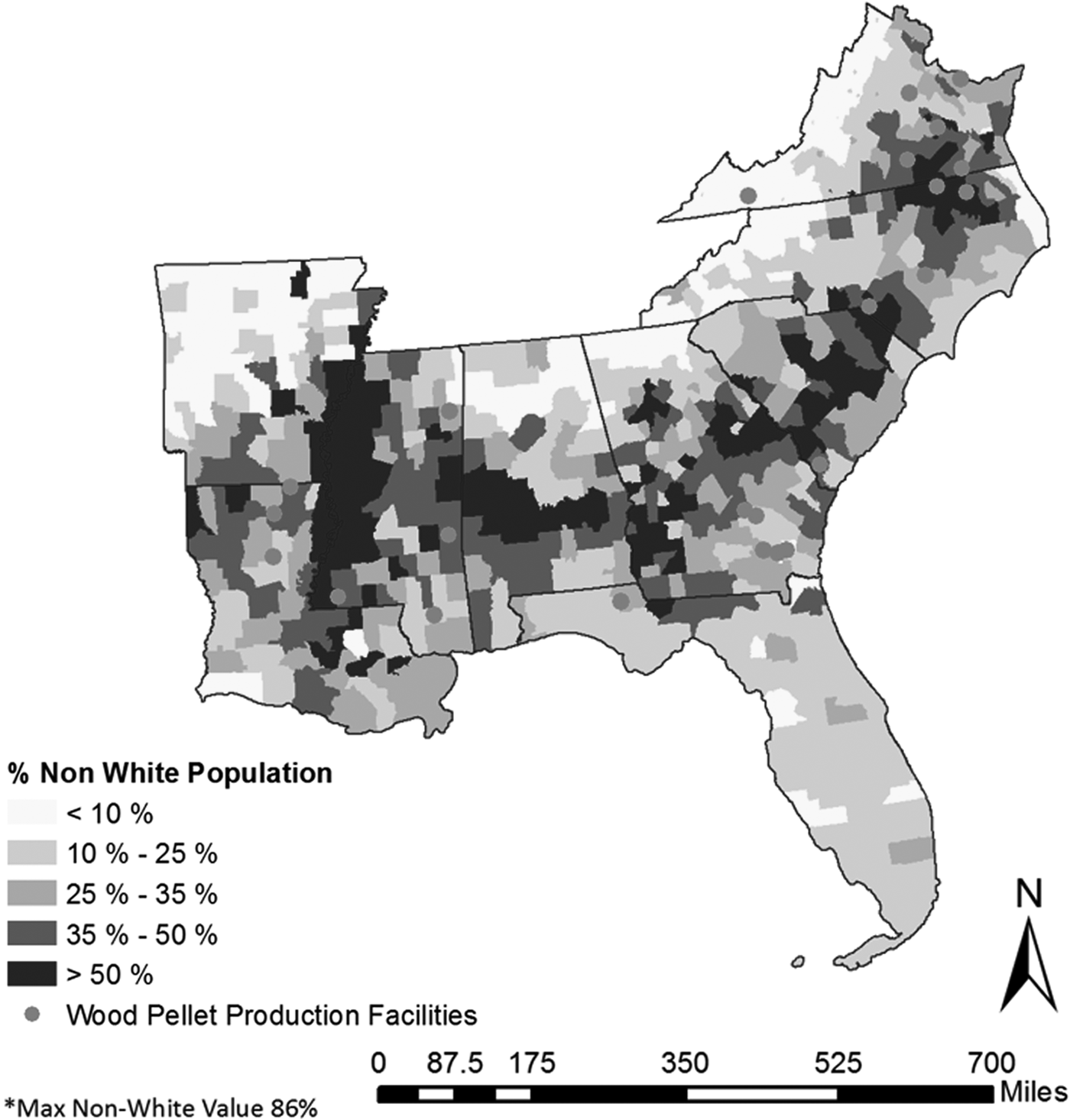
Percentage nonwhite population by county.

Percentage poverty, all ages, by county.
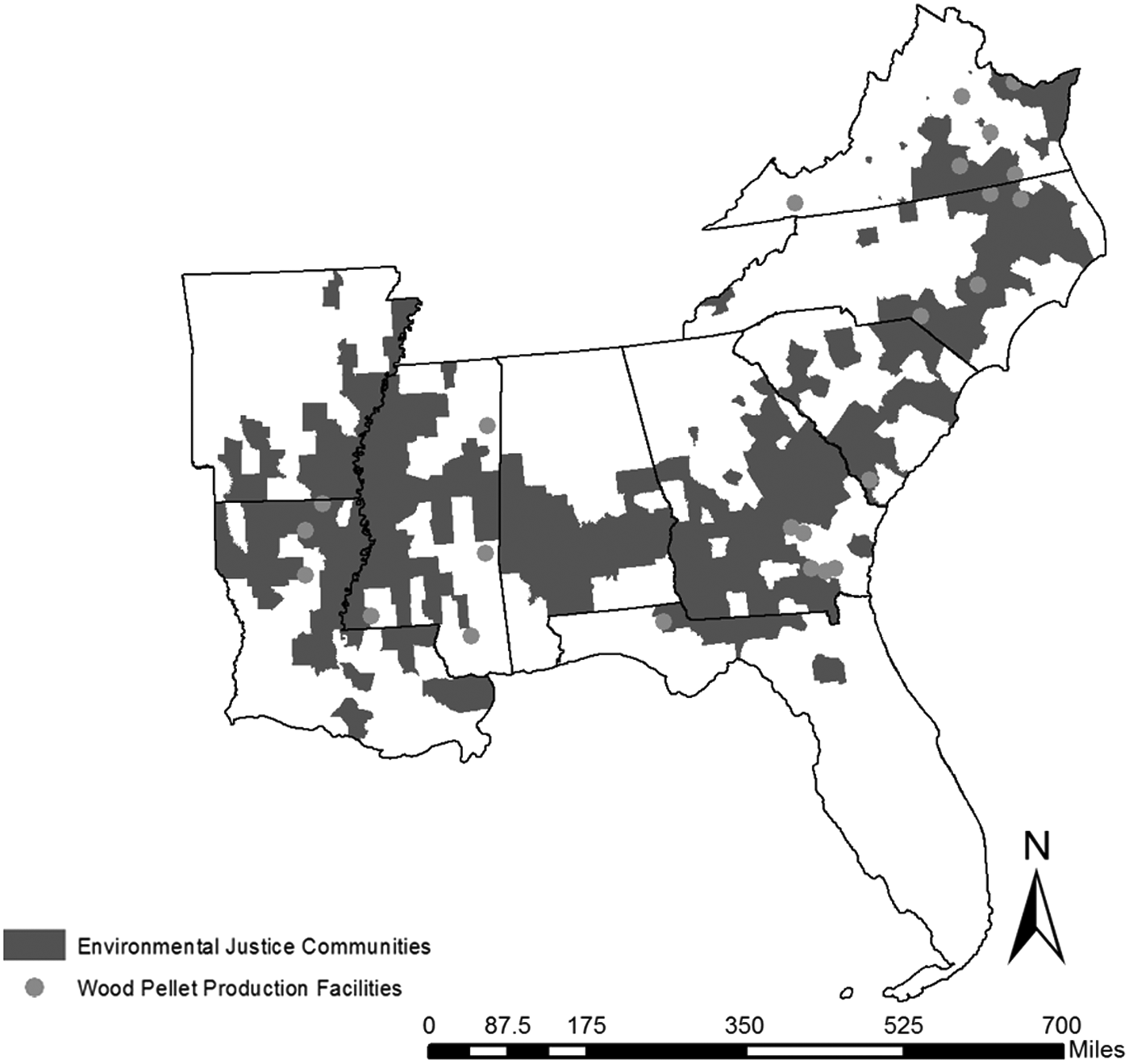
Environmental justice communities and wood pellet production facilities in the southeastern United States.
Results and Discussion
We conducted a chi-squared analysis of independence to determine the likelihood that a biomass pellet facility is located in an EJ-designated community. We found a statistically significant result, at the 5% level, showing that the relationship between a wood pellet production facility location and EJ community is not independent of each other. In addition, we found that given it was an EJ community, there was a 53% greater chance that there was a biomass plant located in that community. Finally, we found that all wood pellet production facilities in North Carolina and South Carolina are located in EJ-designated communities.
A Contemporary Case
In 2014, the Richmond County Bureau of Economic Development, along with Governor Pat McCrory and Enviva Pellets Hamlet, LLC, announced plans to build a biomass pellet manufacturing plant in Hamlet, North Carolina, a town with less than 6500 residents in the south-central part of the state. The Enviva plant is the beneficiary of $1.7 million in state and local tax credit subsidies. 40 The announcement touted the estimated $107 million in planned investment and hiring of 79 employees. 41
What the joint press release neglected to mention were the potentially detrimental effects to human health, well-being, and the environment that this biomass pellet facility would bring to the community. Hamlet, according to the EPA's EJSCREEN tool, is in the 70th to 90th percentiles for traffic proximity, Superfund site proximity, ozone, PM 2.5, and air toxics cancer risk among minority and low-income communities. 42 The Concerned Citizens of Richmond County, a grassroots community organization, rallied against the siting of the plant, stating that, along with a freight train station, natural gas pipeline, chicken processing facility, and natural gas-fired power plant in the county, the “Enviva plant is an additional injustice in our community.” 43 The median poverty line in North Carolina is 20.15%, whereas in Richmond County it is 27.3%. The percentage nonwhite population in the county stands at 37.5%. Richmond County, using our already stated criteria, is designated as an EJ community.
County residents raised concerns regarding the noise, traffic congestion, and air pollution that the wood pellet production facility will bring with it. Sadly, residents' objections to the siting of the plant in Richmond County have not been heard, as county commissioners repeatedly denied residents the opportunity to speak publicly before the commission. 44
In addition, it is contested that the original air permit for the plant was issued without an opportunity for public comment on the part of the community. The Southern Environmental Law Center filed a petition in May 2017 with the Department of Environmental Quality (DEQ), arguing that the DEQ failed to “correct the deficient public notice and improper denial of a public hearing that accompanied the original draft permit.” 45 The case in Hamlet, North Carolina, represents a classic case of EJ denied by distributive, procedural, and process-orientated standards of justice.
Conclusion
Those fighting for EJ celebrate North Carolina as the birthplace of the EJ movement in the 1980s. As this article has shown, North Carolina and much of the southeastern United States remain at the center of the fight for just and healthy communities. Wood pellet production facilities are found predominantly in the southeastern United States. The southeast produces more than 12 million tons of biomass pellets in 2017, with those estimates expected to rise. 46 These plants emit significant levels of carbon monoxide, carbon dioxide, nitrogen oxides, sulfur oxides, and particulate matter. Harmful airborne pollutants threaten public health, particularly in the young and elderly.
By defining EJ communities as communities with high levels of poverty and large nonwhite populations, we showed that they are roughly 50% more likely than non-EJ communities to have a biomass pellet facility located in their community. In addition, North and South Carolina had wood pellet production facilities located exclusively in EJ communities. A contemporary instance of a biomass wood pellet production facility being placed in an EJ community is illustrated by our example of Richmond County, North Carolina, showing that residents' right to EJ is being denied. This research details the continued pattern of energy projects and development being sited in areas where communities are economically, politically, and socially marginalized.
Footnotes
Author Disclosure Statement
No competing financial interests exist.