




Abstract
Abstract
Social and environmental quality are essential components of urban parks, yet they are difficult to define and measure systematically and comprehensively across different types of parks. To simplify this issue, scholars have often equated park size with quality. However, we argue that there are many other significant aspects of park quality in addition to park size, which include constructs such as safety, access, amenities, social inclusion, aesthetics, and ecological vitality. Even though these additional constructs might be difficult to define and measure, they are relevant aspects of park quality. Since access, safety, and aesthetics might be less available in parks in lower socioeconomic or racially diverse neighborhoods, these are especially important for a comprehensive definition of urban park quality. To accurately compare urban park quality across parks in different geographical areas, a more systematic and comprehensive definition of park quality is needed. The goal of this study is to combine various strands of the literature for the purpose of advancing a conceptual model that defines social and environmental quality constructs, such as those focused on access, amenities, safety, social inclusion, aesthetics, and ecological vitality.
Introduction
A
However, developing a more systematic and comprehensive definition of park quality is challenging because existing studies highlight different definitions of park quality. For example, some studies might focus on the absence of negative visual features, such as graffiti and litter, whereas other studies might focus on the presence of positive visual features of the park, such as historical markers and art. 5 Furthermore, much of the urban park quality literature is focused on measuring the physical variables of the park (e.g., park size) while often ignoring (or leaving out) important social variables (e.g., opportunities for social gatherings in the park). This has led to an incomplete and disjointed definition of quality for urban park spaces and, in turn, little direction for planners.
To date, there are few studies that have explored how to conceptualize and measure comprehensive park quality systematically across multiple locations. For instance, Taylor et al. 6 studied disparities in physical activity across different socio-economic status (SES) groups. They concluded that the environmental justice literature lacks a comprehensive discussion of variables for investigating park quality. In a similar vein, although Wolch et al. 7 mentioned that metrics such as “presence vs. absence of a park or recreation facility near the home, density of facilities, or total park acreage within a given radius of home” have been used to measure access, there is no consensus about the measurement of green space access among scholars. This lack of consensus about the definition of park quality makes it difficult to examine inequities in the perceptions and experiences of park benefits by different social groups. How one defines park quality is central to our understanding of disparities in the distribution of park-related benefits.
The purpose of this article is to develop a more comprehensive and inclusive definition of urban park quality. We believe that this conceptual model is especially important for analyzing discrepancies in park quality across different socioeconomic and racial or ethnic groups because incorporating a comprehensive model into park planning can help increase accessibility and usage for a broader spectrum of residents.
Conceptualizing the quality of urban park spaces: why it matters
Although previous studies have examined the equitable distribution of parks in communities, there is little consensus about whether lower SES groups and racial/ethnic minority groups are more likely to live near a low-quality park. 8 Some studies have found disparities in green space neighborhoods of varying demographics and others found few (if any) disparities. 9 One reason for these mixed results is the diversity of urban contexts across the United States and cross-nationally. However, more fundamentally, this inconsistency is likely a function of the different definitions and conceptualizations of the core features of urban parks, such as access, accessibility, or quality.
But why is the equitable distribution of high-quality parks and urban green spaces important in the first place? The most widely used justification is that urban green spaces can help mitigate environmental disamenities and create better public health outcomes. 10 In tradition, environmental justice studies have reported that low-income or ethnoracial minority neighborhoods are more likely to experience environmental burdens associated with adverse health impacts. 11 For example, environmental and health benefits that accompany urban parks can serve as a means to combat the effects of hazardous sites. 12 Several studies have also linked mental health outcomes to the presence, availability, and quality of parks and natural features. 13 Additional studies have explored parks as recreation resources that can contribute to higher physical activity and positive health outcomes among residents. 14 These studies demonstrate positive mental and physical health outcomes that are associated with green spaces, such as reduced stress, reduced rates of mental illness, and reduced rates of obesity. 15 In sum, access to high-quality urban parks can be important for residents' health and well being.
Park Quality: a Conceptual Model
Many scholars have examined various elements of park quality. 16 However, most of these elements have been discussed in relation to a particular narrowly focused outcome such as public health, environmental justice, and sustainability. This has led to multiple and diversified sets of measures for park quality.
Given the complexity associated with the various aspects of park quality, we propose layering the concepts of quality into indicators, constructs, dimensions, and lenses. To explain each of these concepts within the model, we start with the smallest category (indicators) and work up to the most comprehensive categories (lenses and dimensions). Before delving into the literature review, we define each of these terms for our conceptual model. This will allow us to organize the existing literature according to these four terms (as summarized in Table 1). The concepts of indicators, constructs, dimensions and lenses, are displayed graphically within our conceptual model framework shown in Figure 1.
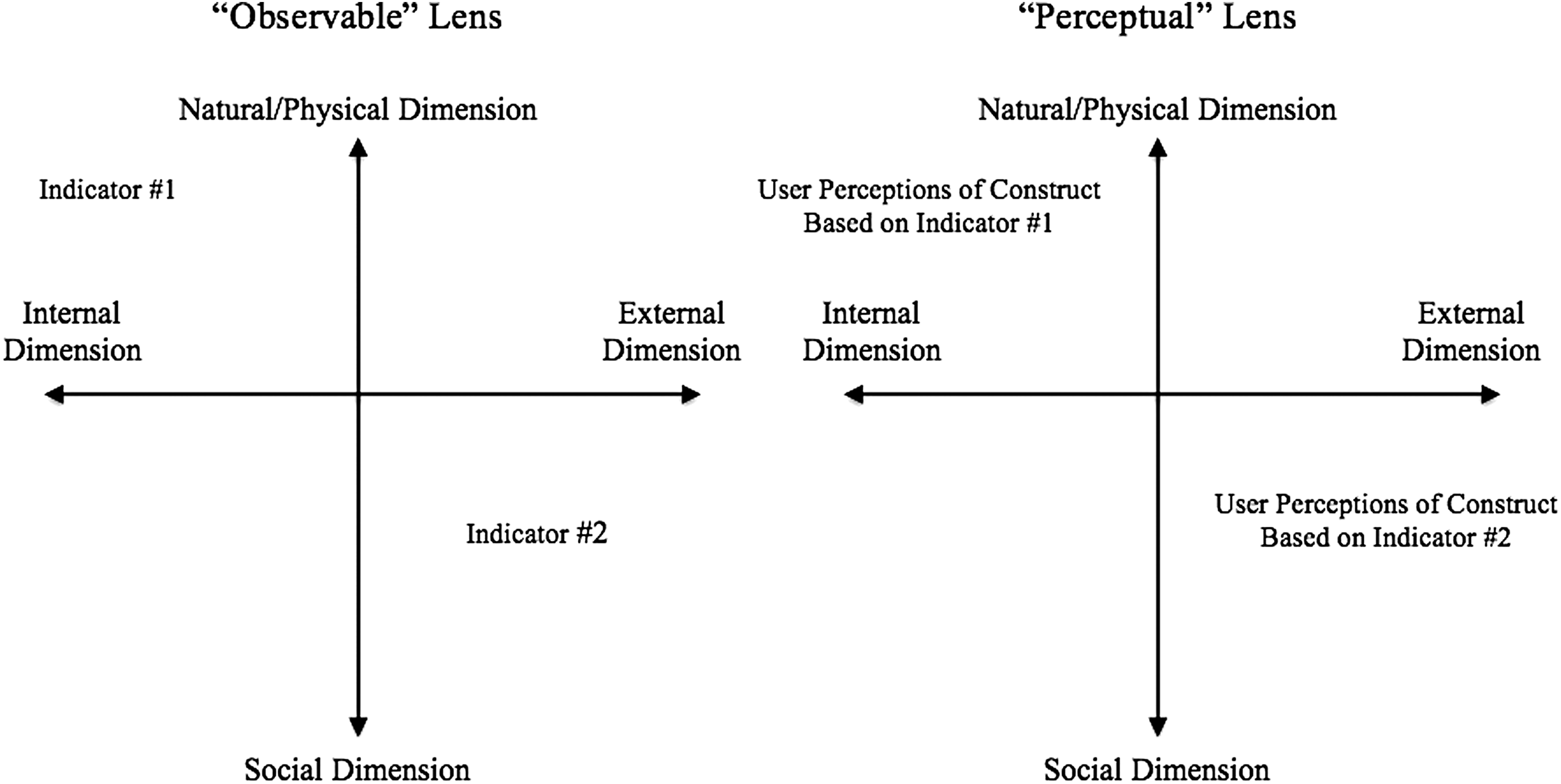
Conceptual model with indicators, dimensions, and lenses.
Organizing the Existing Literature by Indicators, Constructs, and Dimensions of Park Quality
Alessandro Rigolon. “A Complex Landscape of Inequity in Access to Urban Parks: A Literature Review,” Landscape and Urban Planning 153 (2016): 160–169.
Anastasia Loukaitou-Sideris and Athanasios Sideris. “What Brings Children to the Park? Analysis and Measurement of the Variables Affecting Children's Use of Parks,” Journal of the American Planning Association 76 (2009): 89–107.
Anastasia Loukaitou-Sideris, Lené Levy-Storms, Lin Chen, and Madeline Brozen. “Parks for an Aging Population: Needs and Preferences of Low-income Seniors in Los Angeles,” Journal of the American Planning Association 82 (2016): 236–251.
Andrew M. Coutts, Nigel J. Tapper, Jason Beringer, Margaret Loughnan, and Matthias Demuzere. “Watering Our Cities: The Capacity for Water Sensitive Urban Design to Support Urban Cooling and Improve Human Thermal Comfort in the Australian Context,” Progress in Physical Geography 37 (2013): 2–28.
Argiro Dimoudi and Marialena Nikolopoulou. “Vegetation in the Urban Environment: Microclimatic Analysis and Benefits,” Energy and Buildings 35 (2003): 69–76.
Bethany B. Cutts, Kate J. Darby, Christopher G. Boone, and Alexandra Brewis. “City Structure, Obesity, and Environmental Justice: An Integrated Analysis of Physical and Social Barriers to Walkable Streets and Park Access,” Social Science & Medicine 69 (2009): 1314–1322.
Betty Gill and Edda Simeoni. “Residents' Perceptions of an Environmental Enhancement Project in Australia,” Health Promotion International 10 (1995): 253–259.
Briony A. Norton, Andrew M. Coutts, Stephen J. Livesley, Richard J. Harris, Annie M. Hunter, and Nicholas S.G. Williams. “Planning for Cooler Cities: A Framework to Prioritise Green Infrastructure to Mitigate High Temperatures in Urban Landscapes,” Landscape and Urban Planning 134 (2015): 127–138.
Byong-Suk Kweon, William C. Sullivan, and Angela R. Wiley. “Green Common Spaces and the Social Integration of Inner-city Older Adults,” Environment and Behavior 30 (1998): 832–858.
Cachel Holman, Robert Donovan, and Billie Corti. “Factors Influencing the Use of Physical Activity Facilities: Results from Qualitative Research,” Health Promotion Journal of Australia 6 (1996): 16–21.
Chih-Fang Fang and Der-Lin Ling. “Investigation of the Noise Reduction Provided by Tree Belts,” Landscape and Urban Planning 63 (2003): 187–195.
Christopher C. Weiss, Marnie Purciel, Michael Bader, James W. Quinn, Gina Lovasi, Kathryn M. Neckerman, and Andrew G. Rundle. “Reconsidering Access: Park Facilities and Neighborhood Disamenities in New York City,” Journal of Urban Health 88 (2011): 297–310.
Daniel J. Kruger, Thomas M. Reischl, and Gilbert C. Gee. “Neighborhood Social Conditions Mediate the Association between Physical Deterioration and Mental Health,” American Journal of Community Psychology 40 (2007): 261–271.
Dorceta E. Taylor. “Racial and Ethnic Differences in Connectedness to Nature and Landscape Preferences among College Students,” Environmental Justice 11 (2018): 118–136.
Douglas D. Perkins and D. Adam Long. Neighborhood Sense of Community and Social Capital. (Kluwer Academic/Plenum Publishers, 2002), 291–318.
Emily Talen. “Pedestrian Access as a Measure of Urban Quality,” Planning Practice and Research 17 (2002): 257–278.
Gary W. Evans. “The Built Environment and Mental Health,” Journal of Urban Health 80 (2003): 536–555.
Gavin R. McCormack, Melanie Rock, Ann M. Toohey, and Danica Hignell. “Characteristics of Urban Parks Associated with Park Use and Physical Activity: A Review of Qualitative Research,” Health & Place 16 (2010): 712–726.
Gordon Waitt and Hayden Knobel. “Embodied Geographies of Liveability and Urban Parks,” Urban Studies (2017). DOI:10.1177/0042098017740080
Herbert P. Bangs Jr. and Stuart Mahler. “Users of Local Parks,” Journal of the American Institute of Planners 36 (1970): 330–334.
Hua Bai, Sonja A. Wilhelm Stanis, Andrew T. Kaczynski, and Gina M. Besenyi. “Perceptions of Neighborhood Park Quality: Associations with Physical Activity and Body Mass Index,” Annals of Behavioral Medicine 45 (2013): S39–S48.
Huilin Liang and Qingping Zhang. “Assessing the Public Transport Service to Urban Parks on the Basis of Spatial Accessibility for Citizens in the Compact Megacity of Shanghai, China,” Urban Studies 55 (2018): 1983–1999.
Jacinta Francis, Billie Giles-Corti, Lisa Wood, and Matthew Knuiman. “Creating Sense of Community: The Role of Public Space,” Journal of Environmental Psychology 32 (2012): 401–409.
Jason Byrne and Jennifer Wolch. “Nature, Race, and Parks: Past Research and Future Directions for Geographic Research,” Progress in Human Geography 33 (2009): 743–765.
Jason Byrne. “When Green is White: The Cultural Politics of Race, Nature and Social Exclusion in a Los Angeles Urban National Park,” Geoforum 43 (2012): 595–611.
Jennifer R. Wolch, Jason Byrne, and Joshua P. Newell. “Urban Green Space, Public Health, and Environmental Justice: The Challenge of Making Cities ‘Just Green Enough’,” Landscape and Urban Planning 125 (2014): 234–244.
Jenny Roe, Peter A. Aspinall, and Catharine Ward Thompson. “Understanding Relationships between Health, Ethnicity, Place and the Role of Urban Green Space in Deprived Urban Communities,” International Journal of Environmental Research and Public Health 13 (2016): 681–701.
Joan Flocks, Francisco Escobedo, Jeff Wade, Sebastian Varela, and Claudia Wald. “Environmental Justice Implications of Urban Tree Cover in Miami-Dade County, Florida,” Environmental Justice 4 (2011): 125–134.
John S. Akama and Damiannah Mukethe Kieti. “Measuring Tourist Satisfaction with Kenya's Wildlife Safari: A Case Study of Tsavo West National Park,” Tourism Management 24 (2003): 73–81.
Karin Peters, Birgit Elands, and Arjen Buijs. “Social Interactions in Urban Parks: Stimulating Social Cohesion?” Urban Forestry & Urban Greening 9 (2010): 93–100.
Kevin T. Smiley, Tanvi Sharma, Alan Steinberg, Sally Hodges-Copple, Emily Jacobson, and Lucy Matveeva. “More Inclusive Parks Planning: Park Quality and Preferences for Park Access and Amenities,” Environmental Justice 9 (2016): 1–7.
Kira Krenichyn. “‘The Only Place to Go and Be in the City’: Women Talk about Exercise, Being Outdoors, and the Meanings of a Large Urban Park,” Health & Place 12 (2006): 631–643.
Matthew Carmona, Steve Tiesdell, Tim Heath, and Taner Oc. Public Places, Urban Spaces: The Dimensions of Urban Design. (Routledge, 2010).
Megan Kelly Cronan, Kimberly J. Shinew, Ingrid Schneider, Sonja A. Wilhelm Stanis, and Deborah Chavez. “Physical Activity Patterns and Preferences among Latinos in Different Types of Public Parks,” Journal of Physical Activity and Health 5 (2008): 894–908.
Meredith A. Perry, Hemakumar Devan, Harry Fitzgerald, Karen Han, Li-Ting Liu, and Jack Rouse. “Accessibility and Usability of Parks and Playgrounds,” Disability and Health Journal (2017). DOI:10.1016/j.dhjo.2017.08.011
Nik Heynen, Harold A. Perkins, and Parama Roy. “The Political Ecology of Uneven Urban Green Space: The Impact of Political Economy on Race and Ethnicity in Producing Environmental Inequality in Milwaukee,” Urban Affairs Review 42 (2006): 3–25.
Peter H. Kahn and Stephen R. Kellert. Children and Nature: Psychological, Sociocultural, and Evolutionary Investigations. (MIT Press, 2002).
Rachel Spronken-Smith and T.R. Oke. “Scale Modeling of Nocturnal Cooling in Urban Parks,” Boundary-Layer Meteorology 93 (1999): 287–312.
Rachel Spronken-Smith and T.R. Oke. “The Thermal Regime of Urban Parks in Two Cities with Different Summer Climates,” International Journal of Remote Sensing 19 (1998): 2085–2104.
Raffaele Lafortezza, Giuseppe Carrus, Giovanni Sanesi, and Clive Davies. “Benefits and Well-being Perceived by People Visiting Green Spaces in Periods of Heat Stress,” Urban Forestry & Urban Greening 8 (2009): 97–108.
Richard A. Fuller, Katherine N. Irvine, Patrick Devine-Wright, Phillip H. Warren, and Kevin J. Gaston. “Psychological Benefits of Greenspace Increase with Biodiversity,” Biology Letters 3 (2007): 390–394.
Liss Richaud. “Between ‘Face’ and ‘Faceless’ Relationships in China's Public Places: Ludic Encounters and Activity-oriented Friendships among Middle-and old-aged Urbanites in Beijing Public Parks,” Urban Studies 55 (2018): 570–588.
R.W. Landles. “Criminal Activity in Selected Seattle Parks,” (Department of Parks and Recreation, Seattle, WA, 1970).
Sandra C. Lapham, Deborah A. Cohen, Bing Han, Stephanie Williamson, Kelly R. Evenson, Thomas L. McKenzie, Amy Hillier, Phillip Ward. “How Important is Perception of Safety to Park Use? A Four-city Survey,” Urban Studies 53 (2016): 2624–2636.
Seymour Gold. “Nonuse of Neighborhood Parks,” Journal of the American Institute of Planners 38 (1972): 369–378.
Takemi Sugiyama, Karen Villanueva, Matthew Knuiman, Jacinta Francis, Sarah Foster, Lisa Wood, and Billie Giles-Corti. “Can Neighborhood Green Space Mitigate Health Inequalities? A Study of Socio-economic Status and Mental Health,” Health & Place 38 (2016): 16–21.
Theano Samara and Thekia Tsitsoni. “The Effects of Vegetation on Reducing Traffic Noise from a City Ring Road,” Noise Control Engineering Journal 59 (2011): 68–74.
Viniece Jennings, Cassandra Johnson Gaither, and Richard Schulterbrandt Gragg. “Promoting Environmental Justice through Urban Green Space Access: A Synopsis,” Environmental Justice 5 (2012): 1–7.
Viniece Jennings, Lincoln Larson, and Jessica Yun. “Advancing Sustainability through Urban Green Space: Cultural Ecosystem Services, Equity, and Social Determinants of Health,” International Journal of Environmental Research and Public Health 13 (2016): 196–210.
William E. Hammitt, Judy N. Dulin, and GR Wells. “Determinants of Quality Wildlife Viewing in Great Smoky Mountains National Park,” Wildlife Society Bulletin 21 (1993): 21–30.
Yang Zhang. “How Urban Green Spaces Relate to Health and Well-being: The Interplay between Green Space Attachment, Perceived Quality, and Affordance,” (Ph.D. diss., University of Groningen, Netherlands, 2017).
Yolonda L. Youngs, Dave D. White, and Jill A. Wodrich. “Transportation Systems as Cultural Landscape in National Parks: The Case of Yosemite,” Society and Natural Resources 21 (2008): 797–811.
Indicators and constructs
Indicators are the variables that we can measure and operationalize within the park, as well as use to compare across parks. These are variables such as the number of safety lights in a park, the acreage of the park, or the neighborhood crime rate surrounding the park. The indicators are highlighted in Figure 1. The constructs in our conceptual model are the categories that we use to group indicators together. Based on the literature, we have identified six constructs: access construct, amenities construct, safety construct, social inclusion construct, visual and aesthetic construct, and ecological construct. We discuss each of these in more detail hereunder.
Dimensions
We have defined two dimensions of park quality (the internal/external dimension and the physical/social dimension). We argue that all indicators of park quality fall somewhere on the spectrum from being internal or external to the park, as well as representing a physical or social aspect of the park. For example, park quality can be measured by variables that are internal to park (e.g., amenities such as rest rooms), but also by external variables (e.g., neighborhood crime rates outside the park). In addition, park quality can be measured by variables that are part of the physical or natural environment (e.g., the presence of grassy areas for sitting) and variables that are part of the social environment (e.g., popularity of the park for children and playing). Even though many previous studies about park quality have focused only on internal physical variables (such as park acreage), we argue in our model that external and social variables are also important measures of park quality.
Lenses
The final concept introduced in our model is the idea of perceptual lenses. We argue that different park users and stakeholders can have varying perceptions about the way indicators enhance or inhibit park quality. We propose two lenses for our model: the “observable” lens and the “perceptual” lens. For example, although a park might have 50 lights within the boundary (i.e., the “observable” lens that simply gives a total), one park user might perceive this as making the park safe, whereas another might feel that this light is not enough (i.e., the “perceptual” lens takes into account differences in perceptions across users). We also use the concepts of lenses to argue that the perception of park quality can vary depending upon time of day and seasons. For instance, some users might perceive the same park differently during the day or night or during different temperatures. The two lenses are particularly relevant for environmental justice issues related to park quality. Smiley et al. 17 demonstrated that preferences for park quality and park improvements might differ by park user groups. In other words, planners cannot assume that all communities in an urban area will have the same types of preferences for park improvements. Also, planners cannot assume that all communities will have the same perceptions about what constitutes a “quality” urban park. Those definitions of quality must include both observable features (e.g., numbers of lights in a park) and perceptual features (e.g., how that number of lights is perceived as being safe—or not safe—across different neighborhoods).
Applying the Conceptual Model to Existing Literature
Now that we have defined our model and the concepts of indicators, constructs, dimensions, and lenses, we analyze the existing literature on park quality within this context to demonstrate how the model can organize the disparate definitions of park quality. The summary of this literature review is displayed in Table 1.
Access construct
In this article, we define access as a construct of park quality. For example, we argue that a park that is not accessible should not be defined as a high-quality park. Therefore, we argue that access is one component of park quality—and that park quality consists of many other dimensions in addition to access. Access matters especially when the benefit of environmental amenities is clearly identified.
Since parks provide diverse benefits, accessibility to parks has been a critical issue in the environmental justice literature. Previous studies in the environmental justice literature have defined accessibility broadly and measured it through several attributes of parks such as park proximity, park size, park density, and park quality. 18 Also, park size, spacing, and distribution patterns have been important guidelines for planning and zoning of local parks. 19 In this vein, optimum distance, size, and distribution of parks are key measures of park accessibility.
One of the most fundamental aspects of park accessibility is the actual presence of a park. 20 Once a park exists, however, objective proximity to the park becomes an important component of accessibility. For example, research has shown that accessible parks need to be within walking distance (or <0.8 kilometers mile) of users 21 or close to diverse modes of transportation at an affordable price. 22 Yet, there are additional aspects of accessibility beyond park existence and objective proximity. Other factors that impact park accessibility include neighborhood safety 23 and uneven public transport accessibility. 24 In addition, objective proximity is not always the same as perceived proximity because individuals can evaluate access to parks in different ways. For example, a park that is perceived as walkable for one person might not be perceived as walkable by a different person with poorer health. 25 Another important component of access is related to social barriers. For example, some groups of park users might have unequal “social access” to parks. 26
The physical characteristics of a park also impact its accessibility. Park size is one characteristic that is covered extensively in the literature. In general, larger parks are considered to be more accessible. Therefore, total park acreage and the number of parks within a given neighborhood (or census tract) have been used as indicators of park accessibility. 27
Another important consideration for accessibility is related to the socioeconomic and demographic characteristics of the community in which a park is located. For example, the equitable distribution of parks across different neighborhoods (e.g., park acres per resident) and park congestion caused by park users are defined in the literature as indicators of park accessibility. 28
Lastly, there are important considerations for accessibility that go beyond proximity, size, and equitable distribution across user groups. Scholars have also included measures of accessibility for people with disabilities, as well as the availability of information and assistance for park users in discussions about park accessibility. 29
Amenities construct
Park quality is also affected by the availability of amenities within and around the park. These include actual amenities (e.g., restrooms), as well as maintenance levels for those amenities. 30 Some existing research in this area has explored the availability (and density) of basic amenities in parks, in addition to the presence of facilities for culturally diverse activities. 31 In the literature, basic amenities include physical items within the parks such as restrooms, water fountains, grass/lawn areas for sitting, benches, and lighting. The facilities for culturally diverse activities include physical items both within and outside of the park, such as picnic tables, fields for sports activities, playgrounds, fishing spots, hiking trails, and retail shops near the parks. However, perceptions about the usefulness of these amenities can vary based on the characteristics and preferences of park users. For example, when public parks with playgrounds are identified as being an area for children to play, then adolescent and adult populations may be reluctant to use those parks. 32
Although the presence of amenities is important for park quality, the ongoing maintenance of those amenities is another significant component of park quality. 33
Safety construct
The level of safety associated with a park is an important aspect of park quality. 34 When considering the concept of park safety, it is important to focus on both the safety inside the park and the safety associated with external areas surrounding the park (i.e., the neighborhoods and streets around the park itself). In the literature, the internal characteristics of safe parks include high-quality lighting and fencing, less litter, fewer criminal activities (e.g., vandalism and drug dealing), and on-duty security guards. 35 The external characteristics of safe parks include lower crime rates, lower poverty rates, and lower traffic density in the surrounding neighborhoods and streets around the park. 36
It is also relevant to make a distinction between observed aspects of safety (e.g., the presence of two security guards in a park) and perceived aspects of safety (e.g., do the security guards make people feel more or less safe?). Even when data demonstrate that most neighborhood parks are just as safe as other public places, people can develop fear toward public parks, which can reduce park visitation and use. 37 For example, subjectively evaluated levels of lighting impacted perceptions of park safety by Latino women. 38 In addition, seniors perceive more vulnerability to potential crimes and threats in public parks. 39 Also, research has shown that individuals have different perceptions about the safety of nature based on demographic differences such as race and ethnicity. 40 These differing perceptions about park safety across different user groups can impact the utilization of the park. For example, researchers found women, older people, and racial/ethnic minorities are less likely to visit a park if they think it is located in an unsafe area. 41
Social inclusion construct
People visit parks regularly for social interaction with others 42 so it is important for parks to provide a familiar and comfortable social context for social interaction and gathering. 43 Therefore, we believe that park quality should include a focus on opportunities for social gathering and socially beneficial activities for diverse types of social groups.
In the literature, scholars have focused on the level of popularity and the level and types of activity in relation to park quality. 44 Some scholars have also explained how urban parks play a role in promoting social inclusion and social cohesion. 45 For example, parks can encourage positive emotional bonds to both the place and the visiting communities within the park and, therefore, enhance the level of social cohesion within the park. 46 In contrast, if park administrators attempt to restrict or limit access by some users based on their race, ethnicity, age, or gender, then those groups could experience social exclusion and not visit the park. 47
Visual and aesthetic construct
The visual and aesthetic attributes of parks are important components of park quality. Visually and aesthetically attractive parks will draw more users and these users will be more engaged in physical activities in parks. 48 The visual aspects of a park include the design elements of the park (e.g., the physical landscape and layout of the park), as well as the users' perceptions about the beauty of the park. In terms of physical landscape and layout, users will typically have a more positive experience in the park if they are able to move easily through the park readily to see the routes available to them. 49 For example, connected pathways to a park or proximity to pedestrian pathways increases usability of parks. 50 Also, the absence of incivilities such as graffiti and litter is one of the important factors that define quality of public space. 51
Ecological construct
Parks can also provide ecosystem services for animal and plants within the park. This can have positive effects on well-being. 52 For example, green spaces can aid in filtering air, reducing noise, 53 cooling temperatures, and replenishing water. 54 Therefore, parks have the ability to improve the ecological integrity of the surrounding community and promote the physical and mental health of the community members.
Indicators of park quality that are related to the air quality aspects of the ecological construct include variables such as the number of trees, tree coverage, tree density, tree condition, tree diversity, leaf area index, and pollution removal rates by trees. 55 The vegetation within parks can also help with thermal heat reduction since tree canopies can provide shade for park users, while also lowering temperatures of nearby areas. 56 Some parks might include water features that can further reduce temperatures in hot summer months. 57 Water features in parks can play multiple roles because they also provide water for animals and plants, in addition to playing a role in storm water retention. 58
Parks can also provide opportunities for users to interact with plants and animals, which also have important effects on physical and psychological health. 59 Scholars have shown that increased biodiversity and species richness in parks are associated with positive psychological well-being of park users. 60
In contrast, park users may be exposed to pollutants depending on the location of a park and surrounding disamenities. In the literature, researchers have explained health risks encountered by park users because of these disamenities. 61
Now that we have explained the components of our model (i.e., indicators, constructs, dimensions, and lenses), we will introduce an example.
An Example of Park Quality: Indicator, Construct, Dimension, and Lens
To further link the existing literature into our conceptual model, we give an example of how two indicators within the safety construct (i.e., (1) number of lights in a park and (2) crime rate in the surrounding neighborhood) would be integrated into our model. The details are displayed in Figure 2.
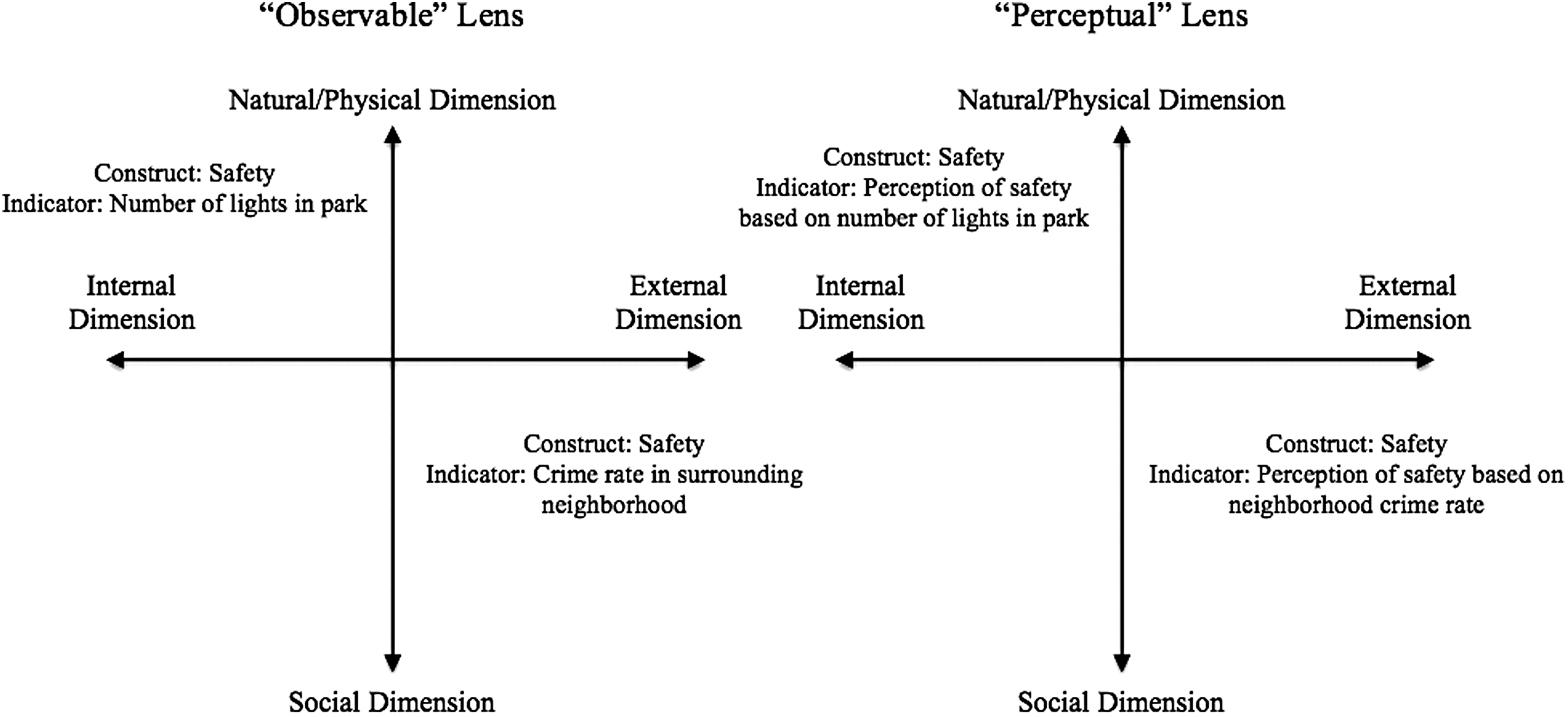
Example of indicators and constructs within model.
As the figure illustrates, both indicators are components of the safety construct because they address issues of park safety. The indicator of “number of lights” is internal to the park because the lights are actually located within the park. Also, the “number of lights” indicator is a largely physical (rather than social) component of the park. Because of these two characteristics, the indicator of “number of lights” is located in the top left quadrant of the model in Figure 2. The second indicator is “crime rate in surrounding neighborhood.” This indicator is more of a social variable and it is external to the park (i.e., in the surrounding neighborhood). Therefore, this second indicator is located in the bottom-right quadrant of the model.
Figure 2 also shows the difference between the “observable” and “perceptual” aspects of the indicators. On the left side of the figure, the “observable” lens is explained with the indicator providing the observable details about the variable (e.g., the number of actual lights in the park). On the right side of the figure, the “perceptual” lens measures the park users' perceptions about the construct based on the indicator (e.g., the user's perceptions of park safety based on the number of lights in the park).
We argue that the distinction between the “observable” and “perceptual” lenses is particularly important when comparing park quality across different park users and stakeholders. For example, park users across different SES groups, age groups, and race/ethnicity groups might have different perceptions about park quality. Although it is important to track “observable” indicators in a park to measure quality, it is also important to understand whether the users of that park interpret those indicators as contributing to—or subtracting from—the park quality. We expect that user perceptions will vary across different parks and across different user groups.
Conclusion
For decades now, the issue of demographic change has been a key topic in debates regarding various dimensions of daily life. These debates often center on larger issues such as satisfaction or happiness with particular policies, social conditions, or other elements of one's immediate surroundings. Included in these important discussions is the issue of urban development and, in particular, the importance of amenities such as urban parks. More specifically, the environmental justice literature has focused on quality as an essential component of urban parks. To date, quality has been an essential component of urban parks precisely because it facilitates an understanding of the role that parks play influencing the lives of surrounding communities, and the extent to which these communities rely on such spaces for recreation, community integration, and relationship building.
Although these debates have meaningful implications, existing discussions of urban parks and conceptualizations of quality have been limited in their ability to advance an inclusive perspective. Much of the current research remains divided when it comes to the notion of quality, how to define it, and why it matters. This study marks an important effort to combine various strands of literature for the purpose of advancing a model that defines quality and constitutive constructs.
In a larger sense, the framework we propose in this article is an attempt to address the lack of inclusivity. We do so by developing a model that accounts for various observable and perceptual drivers of urban park quality. Public parks are meant to be inclusive and open to everyone, but in reality there are barriers, both symbolic and physical, that limit access to some populations. By understanding quality in this new framework, we can think about how we can expand access and make park usage and design more equitable.
To understand the importance of a comprehensive model, we can look at how it can help us understand how different populations experience parks. Studies have found a wide disparity in the acreage, amenities, and location of parks between low-income minorities and more affluent nonminority neighborhoods. 62 Yet, these studies do not tell us the nuances of the disparity between different groups. For instance, parks often provide amenities that are reflective of their surrounding culture and needs. Some parks might have more barbeque pits and areas for picnics and gatherings. For families that do not have yards or have families and gatherings too large for their homes and yards, these parks are an extension of their homes and community and provide access to nature. 63 Some parks have skate parks and others have obstacle courses geared toward enhancing physical fitness. Parks are meant to give residents a space to exercise safely. Yet, in low-income communities, some studies have found fewer play structures than more affluent neighborhoods. This matters because increasingly youth are becoming less active with fewer connections to nature, which can lead to a host of poor health outcomes. 64
The number and type of amenities are important, but the perception of these amenities is also important. For some residents, skate parks are a signal that too many deviant youth will be gathered. For instance, senior residents might not feel safe in this context. 65 Yet, for others, skate parks are a place to keep kids out of trouble. 66 For some park users, bathrooms are a welcome amenity; yet, for others these bathrooms are places that harbor criminal activity. These perceptions can vary across populations and between locations as well. A bathroom in a more affluent park might be perfect for small children though at night the same parents might be afraid to enter the restroom facilities. Moreover, some parks may appear aesthetically pleasing and accommodating but might not have the right amount of shade for its climate or the right amount of seating to encourage social gatherings. Understanding how different groups feel about parks across different seasons and times of day is essential for understanding why some parks are better utilized than others.
In this study, we have developed a conceptual model that integrates different dimensions of park quality presented in the literature. Past literature has focused on park quality in a number of ways, but it has generally viewed quality as a subset of access and other variables. Our model views quality as an overriding concept that includes access among other constructs. Proximity to a park is important, but if residents do not feel safe or welcome at the park, it does not matter how close it is or how many amenities are available. For example, our model would assess park quality as low if residents could not access a park for any reason (either observable or perceptual).
We see some policy and planning applications for this model as well. We believe that this model can be developed into a tool to help local government officials assess the quality of their current parks. It can further be used as an instrument to help in the development of future parks. By looking at parks comprehensively, across multiple dimensions, cities can find parks that meet the needs of a diverse population. Inherent to this framework and model is feedback from residents. Studies of perceptions and resident feedback are essential for developing parks that are safe and usable for everyone. Toward that end, we envision residents playing an active role in this process through surveys, focus groups, meetings, and design input. This interaction would occur not just before the design of a park but also serve as an ongoing conversation with residents as populations, needs, and preferences change over time. Pfeiffer and Cloutier 67 developed “The Sustainability Through Happiness” framework for a participatory planning process that ensures that residents and officials are cocreators of their neighborhood interventions. Their framework builds on approaches that are focused on physical health to include social dimensions that have been associated with increases in happiness for residents. Our model focuses on urban parks and could easily be incorporated into this type of participatory model.
Lastly, this model is an attempt to synthesize and integrate current research to attempt to address a gap in the park quality literature. Although we believe the model is a good start, it is not without its limitations. The list of constructs and indicators is not exhaustive, and the next step will be to apply the model to cases to better understand its limitations and to evolve it further.
Footnotes
Author Disclosure Statement
No competing financial interests exist.