




Abstract
Abstract
In this article, we present Toxic Bios, a public environmental humanities (EH) project that aims to coproduce, gather, and make visible stories of contamination and resistance. To explain the rationale of the project and its potentialities, first we offer a brief reflection on the field of the EH and its (possible) contribution to environmental justice research, then, we illustrate the guerrilla narrative strategy experimented through the project.
Environmental Humanities and Environmental Justice
In the past decade, we have seen the emergence of a new field of studies: the environmental humanities (EH). This field includes all the humanities disciplines that engage with the environment, as, for instance, ecocriticism, 1 environmental history, environmental philosophy, arts, film studies, and others. For Castree et al., the EH “illuminate peoples' complex and divergent understandings of life—human and nonhuman—on Earth,” including in the analysis “things as love, trust, fear, commitment, devotion, and loyalty.” 2 Although some scholars may envision the EH as a new discipline, we align ourselves with those who prefer to think of it as a multidisciplinary field, wherein scholars from various disciplines converge, often with a strong commitment toward the environmental challenges of the present. In an introductory volume to the field, Iovino and Oppermann have written that “[this new field] brings the social sciences, the humanities, and the natural sciences together in diverse ways to address the current ecological crises from closely knit ethical, cultural, philosophical, political, social, and biological perspectives.” 3
Logo of the Toxic Bios project (from
Among the newly created EH centers, the Environmental Humanities Laboratory (EHL), based at KTH Royal Institute of Technology in Stockholm, is well known for its societal engagement, its commitment to socioenvironmental justice, and its undisciplined approach. Following Bergthaller et al., the EHL envisions environmental justice (EJ) as one of the crosscutting themes around which the plurality of EH disciplinary approaches can find a common ground: “As a concept, environmental justice certainly identifies overlapping territory where social, cultural and environmental challenges must be confronted all at once.” 4 According to Rob Nixon, one of the most influential EH scholars, the engagement with EJ has contributed to expunge “some earlier more naïve and more provincial versions of environmental humanities” while keeping it open to a nonacademic audience. 5
In this article, we explore further Rob Nixon's insights on the connections between EJ and EH, proposing four main areas of intervention.
Looking for narrative justice
Coming from different disciplinary fields, both Donna Houston 6 and Stefania Barca 7 have proposed the concept of narrative (in)justice as key to EJ research, arguing that contaminated communities have also been exposed to a form of narrative violence consisting in the silencing and/or invisibilization of their stories. The price these communities have paid for progress and economic growth has been erased from collective memory. The EH are well suited to uncover this narrative injustice and, consequently, to counteract it by “telling the right story,” that is, unearthing or coproducing more just narratives by exposing injustice while exploring paths and visions that have often been ignored. 8
Sabotaging toxic narratives
Directly connected to the concept of narrative (in)justice is that of toxic narrative. According to the collective of Italian radical writers Wu Ming, mainstream narratives are often toxic in the sense that they “contaminate” public discourses by imposing official truths while dismissing any alternative point of view. 9 We assume that toxic narratives are another name for what Latinx critical race theorists have called majoritarian stories 10 and we argue that, from an EJ point of view, those stories hinder the possibility to even see the injustice. A toxic narrative blames the exposed communities for their lifestyle or naturalizes a capitalist-made disaster as a tragic accident. Working with narratives and meaning-making through the methodologies and theories of the (critical) humanities, the EH have the tools to disarticulate and sabotage those toxic narratives.
Imagining alternatives
Science fiction writer Ursula Le Guin has often argued that capitalism and its apparently inescapable power need new imaginaries. 11 Political ecologists have echoed Le Guin's argument, lamenting that nowadays “it is easier to imagine the end of the world than the end of capitalism.” 12 This is an intellectual defeat rather than a political one. EH can challenge hegemonic concepts such as growth, modernization, and competition while excavating the variety of ideas and experiences produced on the ground. As examples, we might list here research in degrowth and feminist political economy, dismantling the imaginary of economic growth vis-à-vis uncovering alternative visions and social practices, or research on the commons and commoning practices as alternatives to capitalism. 13
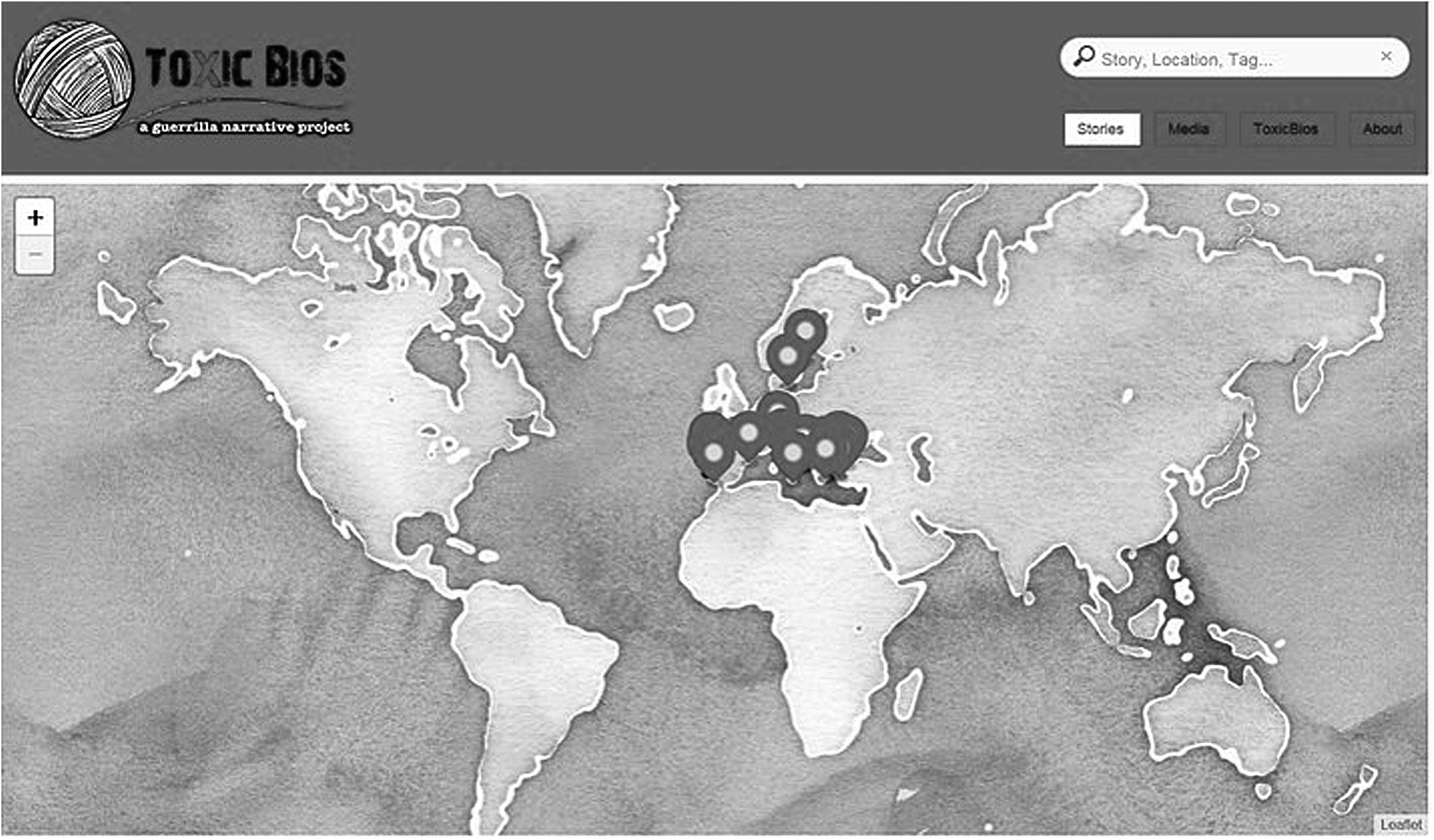
Toxic Bios interface for the online search (from
Making communities out of stories
Storytelling is not only a methodology to collect stories of contamination. It has always been a foundational tool in community building. Bonds are created by sharing stories. Storytelling creates a narrative agora where nonmainstream forms of evidence and understanding are transformed into collective knowledge. With their focus on first person or collective narratives and storying, the EH can help to understand the making of a resisting community. Indeed, we do not think of such communities as “natural” entities, produced by the simple fact of living in the same neighborhood, but rather as being produced through struggles and stories. In this sense, we envision the EH as both an investigative and performative practice, which both excavate and coproduce these foundational stories.
Toxic Bios and Guerrilla Narrative
Toxic Bios was born as a spin-off of a writing project developed by Marco Armiero while researching the waste struggles in Naples, Italy.
14
Aiming to challenge the patterns of authorship and production of knowledge, he edited a book collection in which 10 women wrote their stories of activism and contamination.
15
It was from that experience that we started thinking of an open platform to expand the collection of toxic stories. Our familiarity with the EJ Atlas (
Despite an extremely limited budget, the project has created to date (June 2018) nine Toxic Bios Hubs, mostly formed by hybrid groups of scholars and activists. The hubs are distributed in seven countries (Brazil, Greece, Italy, Portugal, Spain, Sweden, and Turkey), but new hubs can continuously join the project. The aim of the project is to coproduce and/or uncover stories of contamination and resistance. All these stories, almost 70 by June 2018, will be available on the Toxic Bios platform (
We have called the approach used in this project guerrilla narrative (GN), meaning the sabotage of toxic narratives, which silence injustice, through the coproduction of a counter-hegemonic storytelling. 17 Methodologically, GN is a close relative to oral history, with which it shares the ambition to recenter historical narratives around the voices of those who have been ignored or silenced. Compared with oral history, GN has a more explicit political agenda, it includes a larger variety of formats (video, audio, autobiography, interview, songs, pictures, writings, etc.), and has a more explicit collective character in the sense that it presupposes the sharing of stories as an empowering strategy. In GN, the storyteller is telling her story not only to a researcher who will use it as a source, but also to the public at large. A GN approach has been recently employed in epidemiological research in Manfredonia, Italy, where it has allowed assessing the long-term effects of an industrial disaster occurred in 1976 by crisscrossing the collective memory and public perception of toxicity with the available public health data. 18
Together with oral history, (eco)feminist theories and practices have also been extremely influential for the development of the Toxic Bios project. While methodologically rooted in Sandra Harding's strong objectivity, 19 Toxic Bios has evidently built upon a rich feminist scholarship, which has recentered research and theories around the materiality of the body and the environment. 20 We have followed here what Iovino and Oppermann have argued about material ecocriticism: “Bodies, both human and nonhuman, provide an eloquent example of the way matter can be read as a text. Being the ‘middle place’ where matter enmeshes in the discursive forces of politics, society, technology, biology, bodies are compounds of flesh, elemental properties, and symbolic imaginaries.” 21
Crosscutting Themes in the Toxic Bios Repository
Through coding and constant comparison, we have identified several themes traversing most, if not all, of the stories collected in the Toxic Bios project.
Transcorporeality in action
Toxic Bios is deeply influenced by what feminist scholar Stacy Alaimo has defined “trans-corporeality.” According to Alaimo, “Trans- corporeality means that all creatures, as embodied beings, are intermeshed with the dynamic, material world, which crosses through them, transforms them, and is transformed by them.” 22 Confirming the transcorporeality paradigm, the Toxic Bios stories are often more-than-human stories. Antonio Costa, from Portugal, offers a clear example of this more-than-human narrative when in his story he connects the dead fish in the river, the factory in the background, and the health problems of the people living there. Sometimes the transcorporeality has a more positive character, envisioning a more-than-human community. Angela Rosa, a Portuguese farmer fighting against genetically modified organisms, pesticides, and oil extraction, speaks of her intimate connection with the land, the trees, and the (agri)cultural landscape.
Ways of knowing and regimes of legitimation
A toxic story is intrinsically a story about the construction and legitimation of knowledge. It tells a personal or collective truth that is almost always questionable. As Iengo and Armiero have argued, the body is a battleground where different narratives clash. 23 Rosa Maria, a member of the Portuguese grassroots association ADACE, explains the difficulties to prove that a community has been contaminated, no matter how much the environmental and public health problems may seem evident to local inhabitants. She talks about the importance of smell, taste, and traditional knowledge of wind patterns as tools in the hands of citizens. 24 However, this kind of knowledge, she believes, is not considered strong enough to claim expertise in the face of corporate and governmental power. Father Yannis, a priest of a small parish on the Asopos River in Greece, was accused to be antiscience as he claimed to be able to perceive the industrial contamination of the river through his senses, that is, only by tasting or smelling the water. Similarly, Giorgios, from the “SOS HALKIDIKI” antigold extraction movement, argues that one can perceive the asbestos contamination merely by looking at the stratum of dust covering the olive trees in the area.
Politicization
Many storytellers talk about their previous political experiences. Some reveal that they have a history of social or political engagement, others insist that the mobilization against contamination is their first experience. The recurrence of this theme does not solve the definition of what is the political. As Armiero and D'Alisa have shown, Teresa, a Neapolitan activist fighting against the Campania waste emergency, did not consider her experience with the Sem Terra Movement in Brazil as a political activity, for she went there through her local parish. 25 The memory passed onto generations is another terrain of politicization, as in the story of the Vajont dam disaster in Northeast Italy. 26 To this day, in the Vajont valleys some kinds of mourning and memories are socially acceptable while others are silenced. Carolina is still among those who fight to politicize the suffering and transform it into collective actions, despite all the attempts to defuse the rage and narcotize the mourning.
Making kin through toxic lives
Toxic Bios opens a path of exploration in one of the most vexed issues in the study of EJ struggles: the community. Often, scholars working on EJ conflicts have been criticized for a certain romanticization of “the local community.” However, even more problematic is the idea that the community is a pre-existing ontological, almost natural, fact. Instead, Toxic Bios reveals that a resisting community is created in the very experience of contamination; one might say that this bond is a collateral and unwanted effect of the blend of toxins and stories. The coral biography of Vincenzo, narrated by an ensemble of activists from the Campania region (Italy), is the self-evident representation of how the embodied experience of toxicity creates new kin.
Conclusion
In this article, we have presented an ongoing EH project that aims to foster EJ through enhancing narrative justice, contrasting toxic narratives, and uncovering unheard stories. We have placed this project within the larger field of the EH, suggesting a series of areas in which it can contribute to the EJ field. More broadly, we suggest that the Toxic Bios platform not only provides empirical materials for scholars working on EJ but it also offers the GN practice as a tool to EJ scholars interested in EH-oriented coresearch. The aim is to prove that EH scholars can contribute to EJ research and struggles.
Lois Gibbs, the leader of the Love Canal mobilization, once said that one's own story is the most precious weapon when fighting against environmental injustice. Similarly, Naomi Klein has argued that the “shock doctrine” can only be imposed on a community by erasing its collective memories. 27 Thereby, taking control of our stories is per se an act of rebellion. The power of storytelling, of narrating injustice, is so strong that state and corporate powers try to silence it, producing toxic narratives or delegitimizing/killing those who can tell different stories. After all, many of the environmental activists who have been killed in the past few years were not “experts” in control of some unquestionable data, but storytellers mobilizing their own experience in speaking truth to power and to the public. 28
It is difficult to assess the policy impact of Toxic Bios and much work must still be done to imagine and experiment all the possible paths that project may open. The cases collected in this project show that scientific investigations and legal battles have often been generated through the practice of producing and sharing counter-narratives of contamination, as in the cases of Kirklareli in the Thrace Region and of the Land of Fires in Italy. 29 As another example of the policy outcomes of the project, we can mention that one researcher and one storyteller from Toxic Bios have been recently invited to the European Parliament to contribute to the elaboration of an EJ platform.
Stories are powerful instruments: they can be used to change the world or to accept it as it is. Perhaps radical social change implies taking control of not only the means of production but also of those of narration.
Footnotes
Acknowledgments
The Toxic Bios project was funded by The Seed Box: a Mistra–Formas Environmental Humanities Collaboratory. Lucia Fernandes' research is supported by Fundação para a Ciência e a Tecnologia (FCT, Portugal): grant SFRH/BPD/79933/2011 (POCH funds from ESF and MCTES).
Author Disclosure Statement
No competing financial interests exist.
1
The most widely quoted definition of ecocriticism is that of Cheryll Glotfelty. “Simply put, ecocriticism is the study of the relationship between literature and the physical environment.” In: Cheryll Glotfelty and Harold Fromm (eds). The Ecocriticism Reader. (The University of Georgia Press, 1996), xviii.
2
Noel Castree, William M. Adams, John Barry, Daniel Brockington, Bram Büscher, Esteve Corbera, David Demeritt, Rosaleen Duffy, Ulrike Felt, Katja Neves, Peter Newell, Luigi Pellizzoni, Kate Rigby, Paul Robbins, Libby Robin, Deborah Bird Rose, Andrew Ross, David Schlosberg, Sverker Sörlin, Paige West, Mark Whitehead, and Brian Wynne. “Changing the Intellectual Climate,” Nature Climate Change 4 (2004): 765.
3
Serenella Iovino and Serpil Oppermann. “Introduction.” In: Serpil Oppermann and Serenella Iovino (eds). Environmental Humanities: Voices from the Anthropocene. (Rowmann & Littlefield, 2016), 1.
4
Hannes Bergthaller, Rob Emmett, Adeline Johns-Putra, Agnes Kneitz, Susanna Lidström, Shane McCorristine, Isabel Pérez Ramos, Dana Phillips, Kate Rigby, Libby Robin. “Mapping Common Ground: Ecocriticism, Environmental History, and the Environmental Humanities,” Environmental Humanities 5 (2014): 271.
5
Miyase Christensen. “Slow Violence in the Anthropocene: An Interview with Rob Nixon on Communication, Media, and the Environmental Humanities,” Environmental Communication 12 (2018): 7–11.
6
Donna Houston. “Environmental Justice Storytelling: Angels and Isotopes at Yucca Mountain, Nevada,” Antipode 45 (2013): 417–435.
7
Stefania Barca. “Telling the Right Story: Environmental Violence and Liberation Narratives,” Environment and History 20 (2014): 535–546.
8
Barca. “Telling the Right Story.”
9
Wu Ming. How to Tell a Revolution from Everything Else. (UNC Global Education Center, 2011). <
10
Daniel G. Solórzano and Tara J. Yosso. “Critical Race Methodology: Counter-Storytelling as an Analytical Framework for Education Research,” Qualitative Inquiry 8 (2002): 23–44.
11
Here we are referring to her speech at the National Book Awards in November 2014. <
12
According to Mark Fisher, this line can be attributed to both Fredric Jameson and Slavoj Žižek. In: Marcìk Fisher (ed). Capitalist Realism: Is There No Alternative? (Zero Books, 2009), 2.
13
See, for instance: Giacomo D'Alisa, Federico Demaria, and Giorgos Kallis. Degrowth: A Vocabulary for a New Era. (Routledge, 2015); J.K. Gibson-Graham. The End of Capitalism (As We Knew It). (Blackwell Publishers, 1996); Silvia Federici. Revolution at Point Zero. (PM Press, 2012); and Massimo De Angelis. Omnia Sunt Communia. (Zed Books, 2017).
14
The so-called Campania waste emergency comprises both the mismanagement of urban waste by the local government and the illegal dumping of toxic waste by the mafia. It is impossible to mention all the publications produced on the waste emergency. For an EH perspective on the waste crisis, see Serenella Iovino. Ecocriticism and Italy. (Bloomsbury, 2016), 13–43. A well-informed and concise excursus on the Campania waste emergency is available in Wikipedia.
15
Marco Armiero. Teresa e le altre. (Jaca Book, 2014).
16
The EJ Atlas is an open access database of environmental conflicts.
17
Ilenia Iengo and Marco Armiero. “The Politicization of Ill Bodies in Campania, Italy,” Journal of Political Ecology 24 (2017): 44–58.
18
Bruna De Marchi, Annibale Biggeri, Marco Cervino, Cristina Mangia, Giulia Malavasi, Emilio Antonio Luca Gianicolo, and Maria Angela Vigotti. “Case Study—A Participatory Project in Environmental Epidemiology: Lessons from the Manfredonia Case Study (Italy 2015–2016),” Public Health Panorama 3 (2017): 321–327.
19
“‘Strong Objectivity’: A Response to the New Objectivity Question,” Synthese 104 (1995): 331–349. For a discussion of how this approach can be applied to EJ research, see Barbara Allen. Uneasy Alchemy: Citizens and Experts in Louisiana's Chemical Corridor Disputes. (MIT, 2003); and Stefania Barca. “Bread and Poison. The Story of Labor Environmentalism in Italy.” In: Christopher C. Sellers and Joseph Melling (eds). Dangerous Trade: Histories of Industrial Hazard Across a Globalizing World. (Temple UP, 2012), 126–139.
20
See, for example, Stacy Alaimo and Susan J. Heckman (eds). Material Feminism. (Indiana University Press, 2008).
21
Serenella Iovino and Serpil Oppermann. Material Ecocriticism. (Indiana University Press, 2014), 6.
22
Stacy Alaimo. “Trans-Corporeality.” In: Rosi Braidotti and Maria Hlavajova (eds). Posthuman Glossary. (Bloomsbury, 2018), 435.
23
Iengo and Armiero. “The Politicization of Ill Bodies.”
24
Marco Armiero and Salvatore Paolo De Rosa. “Political Effluvia. Smells, Revelations, and the Politicization of Daily Experience in Naples, Italy.” In: Jocelyn Thorpe, Stephanie Rutherford, and L. Anders Sandberg (eds). Methodological Challenges in Nature-Culture and Environmental History Research. (Routledge, 2016), 173–186.
25
Marco Armiero and Giacomo D'Alisa. “Rights of Resistance: The Garbage Struggles for Environmental Justice in Campania, Italy,” Capitalism, Nature, Socialism 23 (2012): 52–68.
26
In 1963 a massive landslide ruined in the Vajont reservoir, causing a tsunami wave that killed 2000 people. For an EJ interpretation of this story, see Marco Armiero. A Rugged Nation. Mountains and the Making of Modern Italy. (White Horse Press, 2011), 173–194.
27
Naomi Klein. The Shock Doctrine. (Alfred A. Knopf, 2007).
28
The Global Witness' reports on the assassination of environmentalists have been crucial to raise awareness on this phenomenon <
29
The Land of Fires is an area comprised between the cities of Naples and Caserta heavily affected by toxic contamination.