




Abstract
Abstract
As more research has been done regarding access to parks with a lens of environmental justice, the results on who has access and what type of access has been mixed, although overall there remains an overall inequity regarding amenities and quality of parks favoring more affluent or privileged people. Research going forward needs to begin to break down the circumstances that create more or less equitable park distributions, by incorporating qualitative research, including procedural justice elements, and a more contextual background. Tallahassee was used for a mixed-methods notable case study because it has been singled out as one of the most economically segregated cities in the United States but is considered to have a good park system. Residents in segregated cities are often stuck in disadvantaged locations due to both market forces and discrimination, and these disadvantaged locations limit opportunities and amenities to change their circumstances. A Geographic information system (GIS) analysis showed that the general distribution of parks in Tallahassee was equitable, favoring lower income block groups. Planning processes were identified through documents and interviews that help explain the development and pressures of this outcome.
Introduction
The environmental justice agenda recognizes the importance of providing opportunities for green spaces and parks to deliver equitable access to their attributed physical, mental, and social benefits. 1 The importance of parks to quality of life, and economic benefit, social importance, and health and environmental benefit has caused many to recognize it as a right, not a privilege. 2 Establishing parks as a place where social justice should play out is an important concept in how we develop and maintain parks. Planning, even for parks, is a political process, 3 and justice should be a criterion for public policy. 4
Overall, studies have found inequities in park acreage and park quality, whereby minorities and low socio-economic status (SES) populations had fewer or lower quality parks. 5 Mixed results showing equal access and the reverse, where blacks and Latinos live closer to parks than whites, have also been discovered. 6 An audit of 103 parks found that park access across the United States was equitable, but disadvantaged block groups were likely to have fewer amenities and more incivilities. 7 This study wants to point out that we are only measuring a specific point in time with these methods; understanding the processes behind the outcomes can give us more information for policy decision making. Although Baltimore is another city with segregation, its historical process of neglect of parks in majority African American neighborhoods has led to park inequities 8 ; whereas though Tallahassee has been more equitable, even with high segregation levels, it faces risks in the future tied to its geography and planning processes. Both cities could use more procedural justice.
The simple quantitative tact toward evaluating equity of parks has helped to identify areas of distributional justice to ameliorate and improve, but equal is based on a desirable goal, and equity is based on an ethical precept that denotes fairness. 9 For example, Loukaitou-Sideris and Stieglitz 10 considered that perhaps residents without yards or greenspace would appreciate and use parks more. Certain circumstances mean that some populations may need more features, amounts, or types of parks than others. Therefore, continued research needs to try to understand the differences between cities that are and are not equitable. Previous Geographic information system (GIS) work on access, including ParkServe, 11 although important tools for recognition of current status and possible problems, only reveal a snapshot in time. Similarly, based on collected data limitations, this study's quantitative methodology considered the equality elements; however, the qualitative portion of this research was meant to reflect more on equity, particularly from a procedural justice evaluation. Procedural justice includes stakeholders in the participatory process. 12 Using qualitative methods and case studies can help identify policies of discrimination, discrepancies of power in planning, 13 and consequences of sprawl and neighborhood demographics to look at the processes, circumstances, and particulars that may shape the direction of a city's park access. This study, therefore, set out to use mixed methods to determine the distribution of parks and the planning politics that create and maintain this distribution.
Tallahassee As Site: a Segregated, Southern City
In this article, Tallahassee, Florida, was used as a notable case study because it has been singled out as one of the most economically segregated cities in the United States. 14 This segregation divides city resources, often seeing a discrepancy between the north and the notable, poor, and historic African American neighborhoods of Frenchtown and South City. 15 In the 1960s, the city shut down pools instead of integrating them. 16 After desegregation, a city-owned golf course maintained segregation by leasing it to a private company. 17
Segregation has continued to play a significant role in parks. The building of a $7.3 million pedestrian bridge for the new urban centerpiece, Cascades Park, was labeled “extravagant.” However, this bridge was defended, not for the connection it makes to the trail system, but because it provided a gateway, a literal bridge across segregation, to South City. 18
Methods
This study employed a mixed-methods approach using GIS quantitative analysis and qualitative methods to complete a case study of the site.
Eighty-six parks are listed by Tallahassee GIS. Inaccessible and nongreen/nonrecreational spaces were removed. This left a total of 59 parks. Park entrances were mapped to create a 0.5-mile network analysis. 19 To track quality, three trained researchers evaluated park quality by using operationalized Physical Activity Resource Assessment (PARA) assessment, 20 modified to incorporate additional neighborhood features as identified in Community Park Audit Tool (CPAT 21 ) as well as modifications needed to capture local park elements.
For the qualitative analysis, data were collected via a review of plans and public meeting minutes, participant observation, and semi-structured interviews with city and county planners (2), parks and recreation staff (3), parks and recreation advisory board members (3), city utilities/stormwater (1), and previous city/county commissioners (2). Interviews averaged 1 hour in duration. Transcripts were coded in two steps by using descriptive and thematic coding of grounded theory. 22
Park Access
Park accessibility coverage in city limits was 18%. By population, 27% of the population has access to a park, below the Trust for Public Land's ParkServe national average at 54%. Tallahassee has recognized vulnerable census tracts with historical inequality by creating a consolidated plan that defines at-risk census tracts and makes recommendations for special needs and improvements, covering crime, food deserts, low pedestrian access, etc. In the at-risk area block groups, there was a park coverage of 38%. In other words, 24% of the city's park area falls into these eight census tracts (Fig. 1).
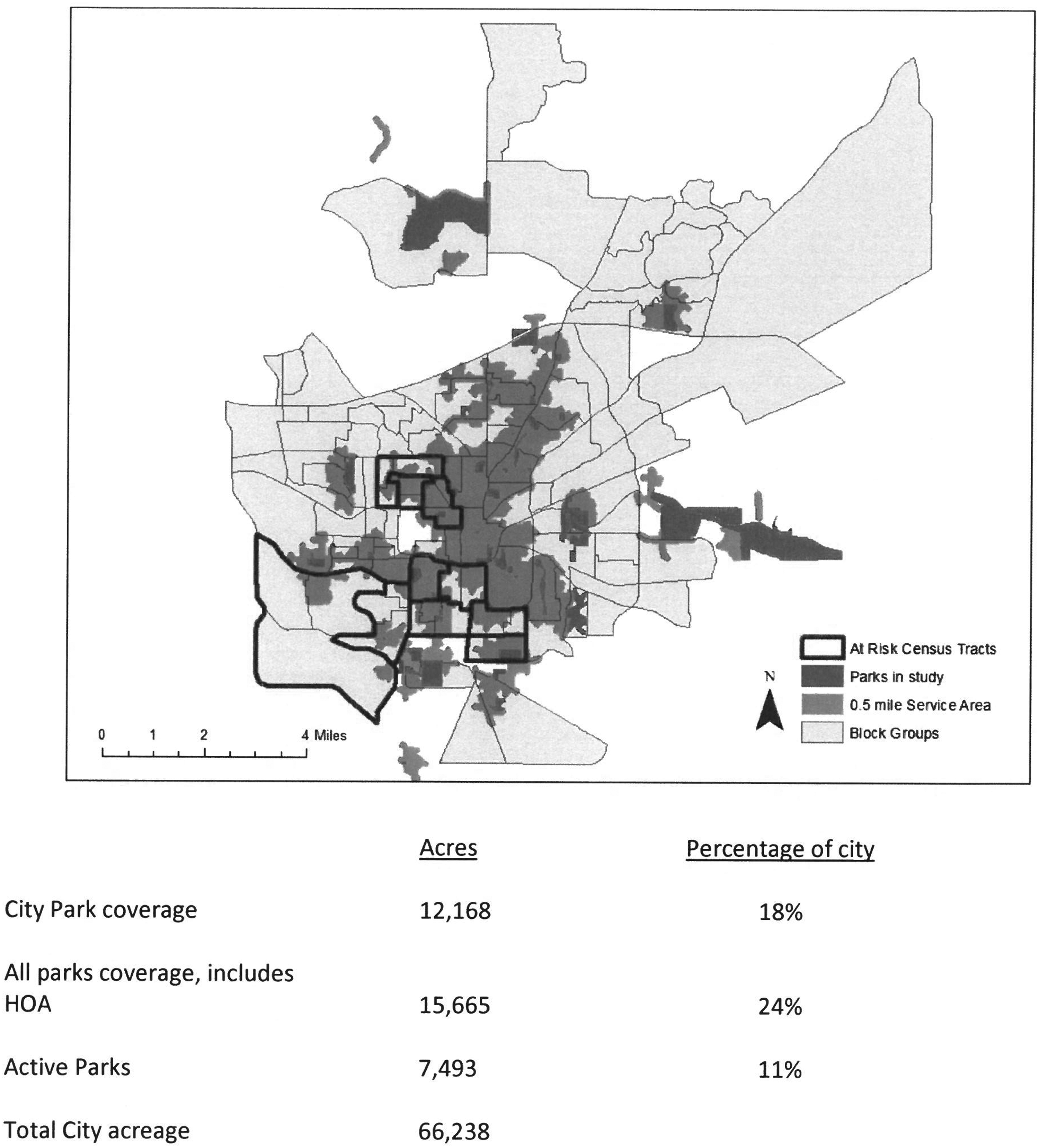
Park network coverage of city based on 0.5-mile network distance.
Lower income block groups had more access to parks, although the difference diminished when homeowners association (HOA) and fee-required parks were added. No difference was found by minority status. Only one significant difference was found in the Jonckheere–Tepstra test (J–T) of ordered alternatives. The acreage of parks was borderline for the test with a J–T significance of 0.053, showing larger acreage parks available to higher income block groups at the periphery (Table 1 and Fig. 2).
Results of Jonckheere–Tepstra Test for Ordered Alternatives
Median income based on city-wide block group tertiles.
Mann–Whitney test showed significant difference between low and medium income for percentage of active parks (p = 0.012).
J–T, Jonckheere–Tepstra test.
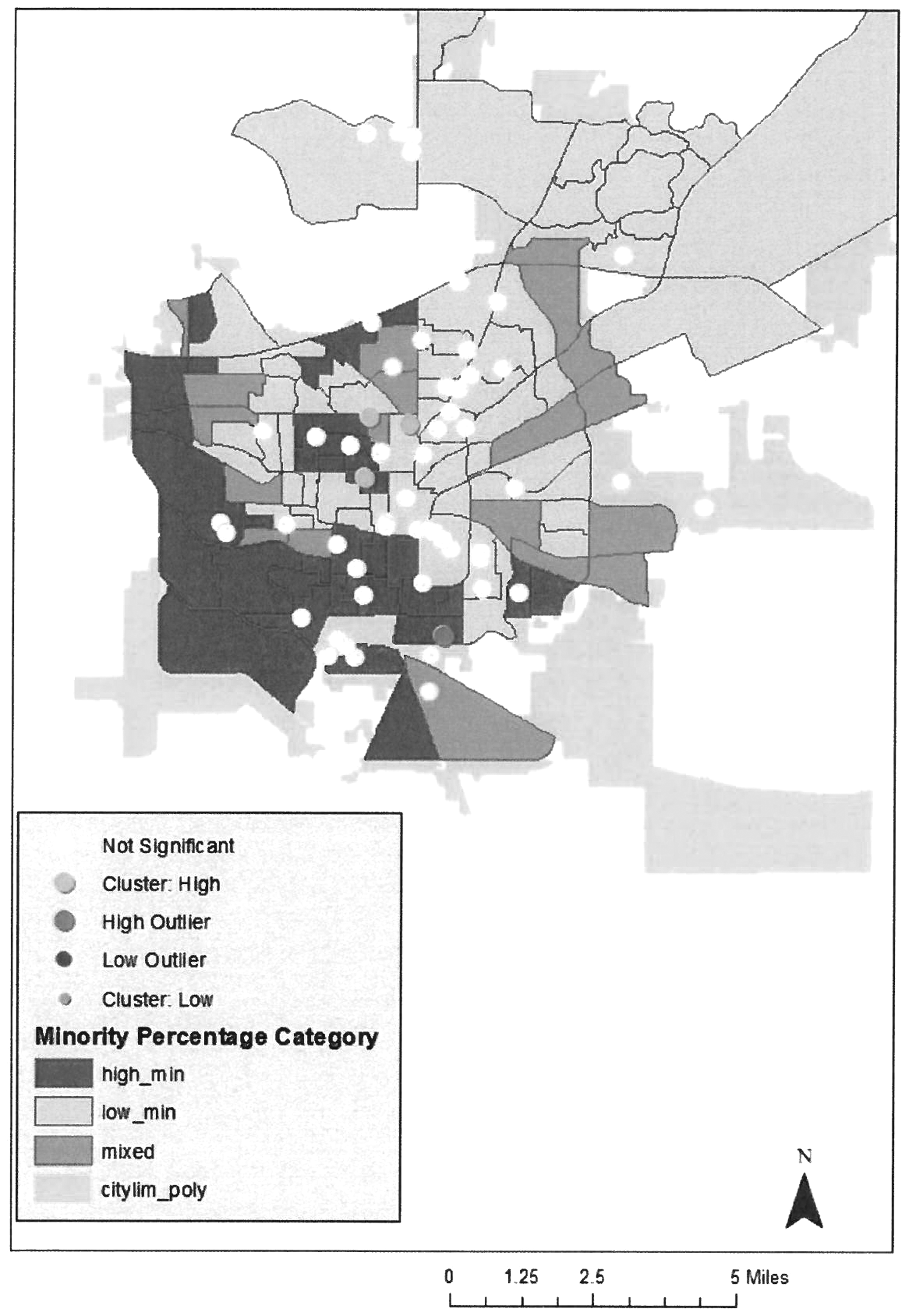
Average incivilities clustering using Local Moran's I over percent minority block groups.
The local Moran's I, a test for clustering, identified a known outlier on incivilities. McLean Park, a 52-acre park, pool, and community center, had low-quality scores for outdoor park features and high incivilities. The park is located in a low-SES, high-minority area. Although these statistics could indicate low-quality service for residents, park staff spent additional staff and resources attempting to correct the problem, having it on a continuous maintenance schedule whereas other parks are not maintained on Sundays. Park staff believed that the location on a major road and the existence of secluded areas where behavior such as littering and alcohol use could not be easily monitored created this challenge.
Processual Themes
Perhaps it is unusual to begin the results of a process with an outcome, but in this case, outcome is noteworthy. A key theme of every interview was how well Tallahassee has done in providing a lot of park space, with accessibility across demographics. The message was that Tallahassee has “a multitude of different, unique park experiences,” and that for a city of this size, has more parks than one would see in most other places. This may sound like an official line, but it was often spoken with passion, outside of the questions of the interview, and spoken along with stories of other places visited by the respondent.
A key theme of the qualitative work was based on the public being left out of the process (Fig. 3). Many of the park planning processes are completed by staff and only brought to public meeting after design and concept are complete. Public response at meetings included pleas to let them have input earlier because public comment often fell after design when it would be too expensive to change the design. Public comment often occurs when agenda items show up on Commission meetings, although Commissioner-formed task forces and committees have added stakeholder input with appointed representatives. Parks Advisory Board members also suggested that they were “mostly informational, than advisory.” Some members of the board also admitted to not being very park-going, so the board may not be drawing from users. One contrary piece of evidence occurred when plans to build a second senior center were being brought to the public with hand-drawn maps to address this particular issue and increase participation. However, although questions were asked, few remarks followed with any indication that they would be considered.
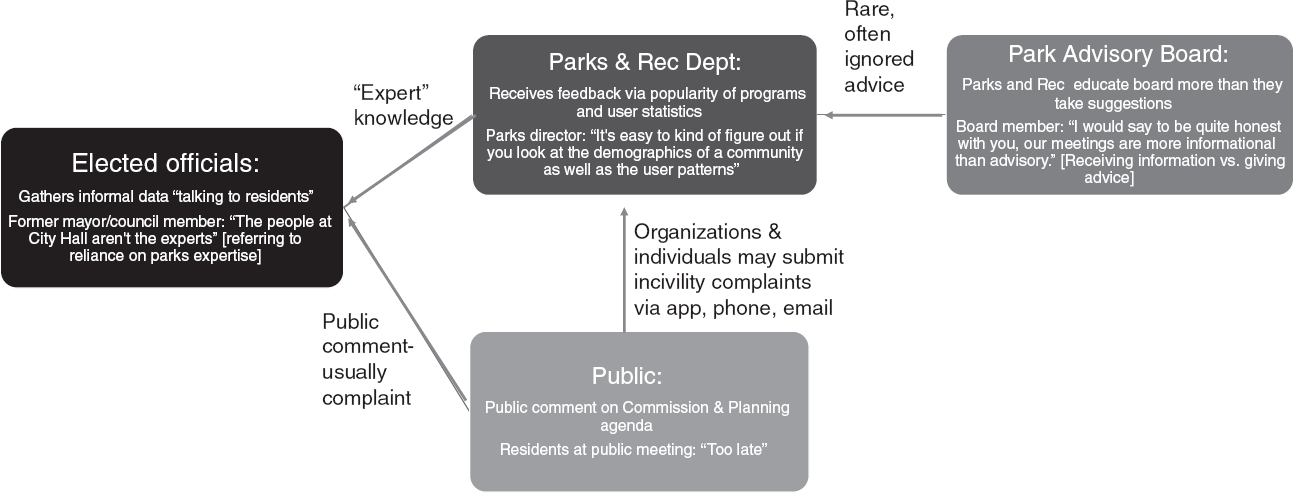
Processual/participatory themes.
Interviews identified another problem with creating equitable and desirable park land (Fig. 4): issues with acquiring the desired parkland from developers. A lack of parks and recreation approval of acquired parkland and a comprehensive plan that favors conservation and greenway connection has resulted in a lot of new parkland that is linear, in wetland areas, or in need of grading to be developed. This is visible via the number of inaccessible and undeveloped parks within the city. This has led to congested active parks, which necessitate residents to travel further for active recreation, such as soccer and baseball fields.
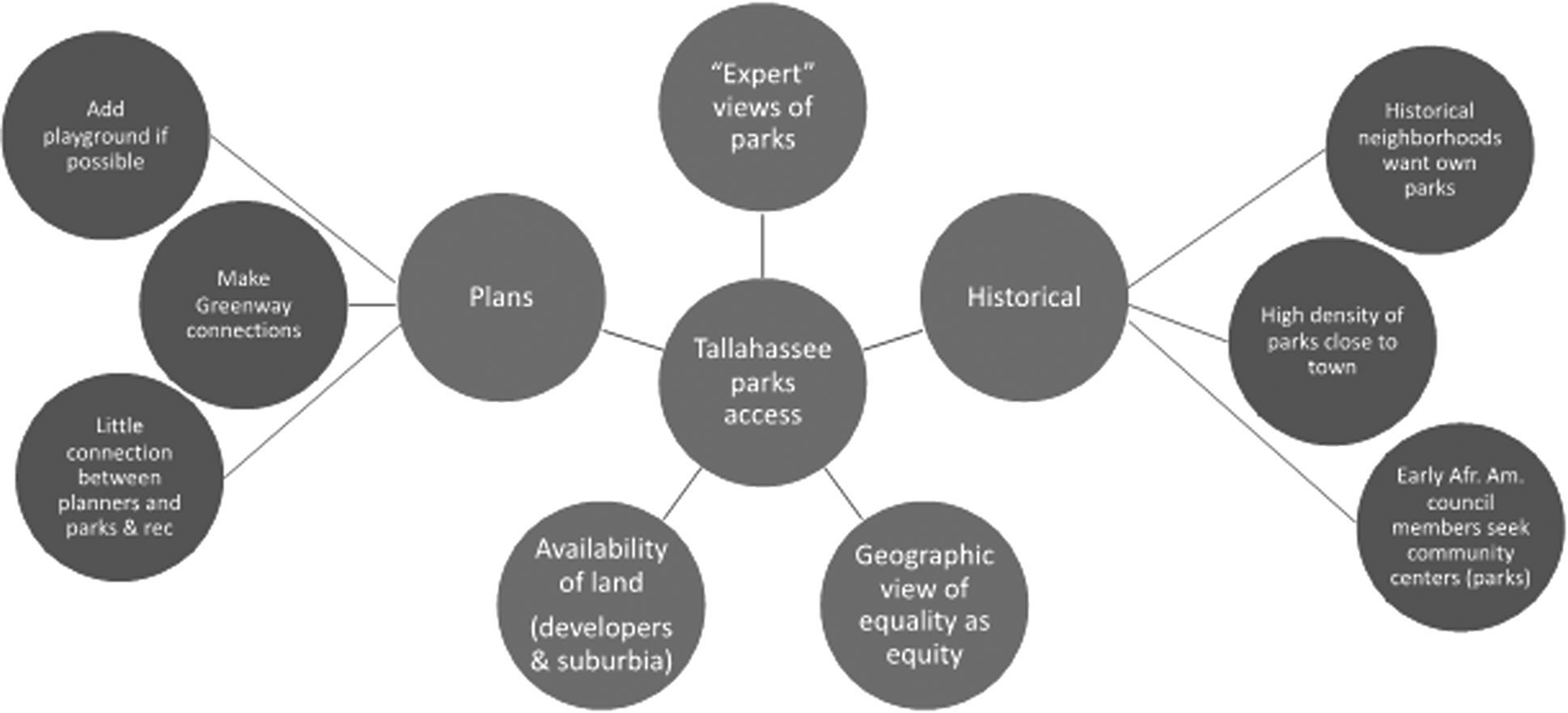
Qualitative themes related to Tallahassee park access.
Planners and parks and recreation staff agree that there is a disconnect between park acquisition and operations. Parks and recreation are not sufficiently involved with the comprehensive plan nor with meetings with developers. This is due to the capacity of parks and recreation to attend such meetings and the lack of having a planner who specializes in parks and greenspace.
Another important disconnect is exemplified by the 10-minute walk website (ParkServe), where a Tallahassee mayor agreed to the goal of bringing parks into a 10-minute walk from every resident. The parks and recreation department was unaware of promises like this. As a point of disconnect, before the researcher mentioned it, one parks and recreation interviewee noted its impossibility: “Now, in a perfect world, you'd love it if everybody had a park within walking distance. That's just not reality.” If parks and recreation are not on board, then there may be little active implementation.
Tallahassee is an example of a process that is less just, but the outcome has been fairly equitable. The public process is one that falls within tokenism. 23 The literature argues for more creative public control, meaning public processes, as suggested by community participation and a deliberative process. 24 City policy makers could start a more transparent and early public participation process that includes parks and recreation as stakeholders to determine how future parks should be planned for and guidelines for the acceptance of adequate parkland from developers. Since the completion of this study, parks and recreation have appeared to shift their public participation process, partly in response to public outcry about the removal of trees at one of the parks; therefore, it set up a website to collect early response to its plans.
Maintaining a Legacy?
Equitable distribution, whereby low-SES and minority residents are well served, has mostly occurred in Tallahassee, but as one planning staff noted, “a lot is patting on the back for things that are historical, done by our predecessors.” Most of the neighborhoods that have access to parks are older, more historical neighborhoods.
As a whole, the middle-class neighborhoods have fewer city parks in their neighborhoods. Interviews with staff identified two main reasons for this outcome. First, master-planned communities have maintained their own park space to manage the needs of citizens in new developments without burdening taxpayers. However, private park space is of concern in environmental justice because it could indicate measures to control “public” space. Second, when many suburban communities were built, there were agreements to use school grounds as shared park space. Due to expansions in school sports programs and increased security concerns, school parks are no longer considered public recreational spaces. This caused a scramble to create parks for underserved areas of town, often with parks acquired less strategically and more economically based due to high land costs in these populated areas.
There appears to be a concerted effort to maintain a standard of quality across all parks, an important note since other cities have noted inequities based on park quality. 25 Elected leadership appeared to be somewhat responsible for the continued quality of parks as many neighborhood parks were deteriorating in the 1980s and 1990s, and despite decreased budgets elsewhere, they recognized the need to maintain existing parks even while creating new.
The disparities appeared in an unused disk golf course in South City that was observed being used for all-terrain vehicles (ATVs). Incivilities included higher levels of erosion, litter, signs of alcohol abuse, and misused park furniture. Staff admitted that the neighborhood's lack of interest, combined with a higher level of difficulty, made this course less successful. However, this speaks to a conundrum that afflicts decision makers: to provide features that the neighborhood wants or to provide opportunities that the community may otherwise lack access to. One planner said that they do not want to appear insensitive to community needs, but they do not want to be inequitable and not provide opportunity for the community, a worthwhile recognition considering the outcomes due to lack of opportunity in apartheid cases, 26 but also an issue that participatory planning might address.
The second senior center, planned for the north-eastern section of town, adjacent to a 55+ community and nearby an assisted living facility, illustrates another way that segregation affects park planning. The location age-wise is ideal; however, it is located in a low-minority block group, adjacent to a mixed but not high-minority area. A Parks and Recreation Advisory board member expressed concerns that it could segregate the seniors, leaving the old urban one as majority black whereas white residents attend the newer center. Although this voiced concern may indicate awareness, the response was that it could happen but that they would hope not. In addition, three new parks will add to the growing disparity, two of which would increase the park acreage disparity.
Conclusion
While recognizing whether the distribution of parks and their quality is equitable is an important first step in responding to inequities, context is important to understand future development and whether procedural justice has been achieved. Tallahassee remains economically and racially segregated, whereas the parks have been mostly equitably distributed with lower income neighborhoods having slightly higher access to parks, with the exception of the size of acreage that increases toward the outer northern and eastern sides of town where the white middle class resides. This spatial distribution has occurred without plans or processes that explicitly work toward equity. City documents and general political–geographical negotiations from council members representing underserved neighborhoods may represent other forces within politics that maintain equilibrium, but this study also found forces that could work to push inequities forward if unchecked.