




Abstract
Abstract
Previous research has shown that white males tend to perceive risks from environmental exposures as lower than women and members of minority populations, often referred to as the white male effect. However, this effect was mostly demonstrated without regard to the actual lived environment experienced by the study participants. There is growing evidence that differences in risk perceptions cannot be adequately explained through race or gender. This cross-sectional study collected survey data from residents of Manchester, a small neighborhood in Houston, Texas, characterized by industrial sites, unimproved infrastructure, nuisance flooding, and poor air quality. Trained community members attempted a complete census within the geographically compact neighborhood. Logistic regression was used to estimate the relative effect of race on environmental health perceptions adjusted for generational age. In contrast to previous research, our study (N = 109) showed that nonwhite individuals perceived a lower environmental health risk compared with their white counterparts. Comparing female and minority racial groups with white males showed that on most issues, white males had the highest perception of risk. For example, adjusted for age, nonwhite respondents perceived the risk of contact with standing water as significantly lower than white respondents (odds ratio = 0.34; 95% confidence interval = 0.12–0.93). This study supports the hypothesis that when environmental conditions experienced by individuals are the same, minority groups tend to underestimate their risk compared with white males. One possible explanation put forth is that communal norms are created within minority populations through generations of exposure to negative environmental conditions compared with white populations.
Introduction
Prior research in the United States has demonstrated differences in risk perceptions of environmental exposures by race and gender. 1 , 2 The largest differences in perceptions of environmental harm have been seen with white males, who typically view the potential health risks of environmental exposure as lower than women or nonwhite racial groups. 3 , 4 , 5 , 6 This has been attributed to male predominance in positions of political, social, technological, and economic power. 7 However, there is increasing evidence that gender and race may play a smaller role in determining an individual's perceptions of potential environmental risks compared with the community and generational experiences with one's lived environment. 8 , 9 One possible explanation hypothesized here is that women and racial minorities who live in areas characterized by poor environmental conditions create cultural norms that make them less likely to recognize potential environmental harm. Poor environmental conditions are experienced more by minority communities than majority populations. To address the inconsistencies of these findings, a cross-sectional study was conducted in the neighborhood of Manchester in Houston, TX.
Background
Risk perception is a principal variable in understanding how individuals and communities respond and react to potential environmental hazards. Owing to the importance of perceptions on potential environmental harm, researchers have struggled to understand the underlining influences that persuade individual environmental risk sensitivities. Lindel and Hwang surveyed 321 households in Harris County, TX, to assess risk perceptions on flooding, hurricanes, and toxic chemical releases. 10 They found that individuals' hazard experience, gender, and income played a large role in determining how they viewed the threat of potential hazards. It was also shown that proximity to hazards and ethnicity of the respondents affected their perceived personal risk of environmental threats. Similarly, researchers Lachlan et al., after utilizing 937 surveys from Hurricane Katrina displacees, found a clear difference in perceptions of hazard risk and outrage as related to the respondent's race. 11
Prior research has shown different perceptions of potential harm from environmental exposures, with white males tending to have the lowest perception of risk. For example, differences in perceived risk between races, as well as acceptance of living in communities that are exposed to industrial pollutants, have been documented by researchers in studies within the urban settings of Philadelphia, PA. 12 This study surveyed potential jurors from the city on perceptions of risk to air pollution, finding that nonwhite females reported the highest concern. Similar differences in perceived risk have been found in rural northern California with use of herbicides to manage invasive weed species. 13 This phenomenon has been termed the white male effect. 14
The predominant explanation for this difference is that white males within the United States have more power over their environment and are involved to a greater degree in creation, management, and benefits of technology and industrial pursuits and therefore are more likely to see benefits rather than health risks. 15 Another explanation for differences in risk perceptions may be cultural differences between groups. Due to white male's risk skepticism and hierarchical and individualistic nature, when activities that are integral to their identity are threatened, they will underestimate the inherent risk. Cultural protective cognition, according to Kahan et al., is what explains this difference because white male cultural identity is inherently linked to technocratic endeavors in ways that the identities of women and minority populations are not. 16
While this phenomenon has been studied in multiple settings, the majority of research is set in large geographic areas, such as at the national, state, or county level, which do not take into account the actual environmental conditions in which the individuals answering the questions live. More recently, there has been some evidence to suggest that differences in perceptions of environmental harm are more closely related to the specific area in which individuals live rather than the race or ethnicity of the respondents. For example, in a study of Swedish society in which disproportionate exposures to industrial pollutants with regard to differing racial groups are not as distinct as in the United States, Olofsson and Rashid found that differences in perceived environmental risks mostly vanished. 17 Within the United States, when surveying deep south coastal residents living in an area characterized by industrial water pollution, Marshal et al. found that the difference between groups was less pronounced when both minority and majority groups experienced similar environmental pollution. 18 Furthermore, according to Satterfield et al., when asked if hazardous facilitates are more common in minority communities, only 50.4% of white males agreed, while 66.5% of nonwhite males agreed. 19 This division is shown in gender as well, with 71.6% of nonwhite females agreeing with the previous statement compared with slightly above 50% of males (Johnson, 2002). This gap between beliefs and empirical evidence further demonstrates that these different groups are living in different environmental conditions. 20 Generational conditions of living in areas characterized by poor environmental conditions may create expectational norms among minority groups that accept poorer conditions than their white counterparts due to experiencing these conditions for longer periods of time.
The use of race as an etiologic quantity within medical research has been criticized as failing to account for fine-grain differences between individuals and communities. 21 , 22 Residual confounding when using race as a surrogate for other variables, such as socioeconomic status, as well as potential societal harm has been voiced by public health practitioners. 23 However, when utilizing racial stratification as a substitute for environmental, social, and political experiences of these communities, it has been shown to be helpful in understanding communal and individual perspectives. Researchers Kaufman and Cooper (2001) 24 concluded that using race to predict behavioral decisions or aspects of social interactions is valid, interpretable, and important. The norms created within communities through generational exposures to poor environmental conditions are not fully understood within public health research.
To better understand the effects of gender and race on risk perception, data were collected in a location in which all individuals experience a similar relationship with their environmental conditions regardless of race. A goal of this study was to determine whether perceived risks are a continuation of environmental justice issues that have permeated the racial minority experience within the United States for decades or if the white male effect would be shown to exist in this community.
Materials and Methods
Study location and population
Manchester, Texas, is a small neighborhood in eastern Houston on the Houston Ship Channel that is primarily nonwhite Hispanic and has endured numerous issues with flooding, 25 air pollution, 26 and health concerns. 27
Houston Ship Channel communities are at particularly high risk of impacts from the nexus of exposure to hazardous substances and natural disasters. For example, within 1 mile of the Manchester neighborhood, there are 21 facilities that report to the Environmental Protection Agency (EPA) Toxic Release Inventory; 11 large quantity generators of hazardous waste; 4 facilities that treat, store, or dispose of hazardous wastes; 9 major dischargers of air pollution; and 8 major stormwater discharging facilities. 28 The area is also highly vulnerable to the impacts of natural disasters, both socially and physically. The population of the Manchester Super Neighborhood is 98% minority, with a median income that is one-third less than that in the City of Houston overall. Only 6% of residents have obtained a bachelor's degree. 29 Floodplains along Sims Bayou have increased by 15% since 1980 due to increases in development and impervious cover, such as concrete and asphalt, while the expected sea-level rise could expose another 35,000 residents in Ship Channel neighborhoods to flooding. 30
Based on these characteristics and an existing relationship with community-based environmental justice and education groups as part of the Resilience and Climate Change Cooperative Project (RCCCP) at Texas A&M University, the Manchester neighborhood was selected as a case study location to assess if differences in environmental harm persist between racial and gender groups given that all residents have similar experiences with poor environmental conditions.
Community meeting
The direction of this study was, in large part, due to a community meeting held in the spring of 2015 that included local community engagement groups, such as the Texas Environmental Justice Advocacy Services (TEJAS) and the Green Ambassadors, as well as residents of Manchester. RCCCP hosted this meeting in a local church community center to discuss having an ongoing relationship with the neighborhood and responding to concerns voiced by them. This was an attempt to ensure that the data collected and the research performed would be of actual interest to individuals living in the study region, and furthermore, it took advantage of local expertise and knowledge.
During these meetings, individuals voiced a concern for poor water conditions (both surface and drinking water), poor infrastructure on the roads and houses, proximity to industrial buildings and waste facilities, and a lack of access to city services. During this meeting, RCCCP researchers refrained from discussing any known issues at this point and simply listened to the attendees to better gauge the appropriate type of research to conduct as well as to ensure that information gleaned in future projects would not be biased from any notions we may have discussed. The wording on the survey was also informed by this meeting (i.e., “living near waster facilities,” etc.) as this was how the residents discussed these issues.
Survey
Due to the relatively compact geography of the Manchester neighborhood, a complete census was attempted. Trained survey teams walked every public road and passed every home within the borders of Manchester during December 2015. Homes that were completely fenced off, abandoned, or were deemed unsafe to approach by the interview team were the only homes not approached during the canvassing.
Community partners already engaged with the broader RCCCP project assisted with survey data collection to help increase response rates. Specifically, the Green Ambassadors 31 from Furr High School in Houston, Texas, and the EpiAssist student volunteer program at the Texas A&M University Health Science Center School of Public Health 32 were chosen to help collect survey data. Teams were assembled that consisted of two or three individuals each with graduate students from the EpiAssist program and a Spanish speaker since language barriers have been shown to be an issue of nonresponse in prior community surveys.
The survey consisted of 24 questions that included demographic information (gender, race, and age) and language proficiency (can anyone in the household speak English well). Questions related to perceptions of environmental harm surrounding issues of pollution, natural disasters, and infrastructure. The participants were asked if they thought exposure to the following issues could negatively impact their health: living near too many waste facilities, living near too many industrial buildings, living in buildings that need repair, exposure to standing water, and having poor road infrastructure as dictated by potholes. Each response had a binary outcome (yes or no).
Race was coded as either non-Hispanic white or nonwhite to account for the relatively low amount of respondents from African American participants. Age was categorized by generational groups to account for potential differences in attitudes and experiences between these groups. They were placed in the millennial group (being born between 1980 and 2000), Generation X (born between 1965 and 1980), the baby boomers (born between 1946 and 1964), or the mature generation (born between 1927 and 1945). These categories were selected based on prior research demonstrating differences in attitudes of different generations. 33 , 34 , 35 , 36
After giving oral informed consent, neighborhood residents completed the interviewer-administered survey. The survey and accompanying consent materials were approved by the Texas A&M University Institutional Review Board (#15-0648D).
Statistical methods
Descriptive statistics were calculated for each variable. Logistic regression was utilized to estimate the relative effect of race on environmental health perceptions, and multiple logistic regression was used to adjust for the different generational age categories. Comparisons were made between racial groups as well as by grouping different races and genders. White males were characterized as the lowest risk and used as the referent group.
Results
Between December 19 and December 26, 2015, 109 (N = 109) surveys were collected with an overall response rate of 72.7%. Of the 192 homes that were approached, contact was made with 150, and this gave a contact rate of 78.1%. Twenty-eight percent (N = 31) were completed by non-Hispanic white individuals, 62.4% (N = 68) Hispanic or Latino individuals, and 8.3% (N = 9) African American, with one respondent refusing to respond to questions about race. There was an almost even split between male, 49.5% (N = 54), and female, 50.5% (N = 55), respondents. Table 1 provides additional community characteristics.
Sample Characteristics
Self-reported gender, race, and age are reported alone with professed language preference.
The majority of all respondents, regardless of race or gender, felt that living near waste facilities and industrial buildings could cause negative health outcomes. The largest differences in perceptions were with road infrastructure, where 27.8% (N = 5) of white males said it was a health concern compared with white females (46.1%; N = 6), nonwhite males (54.3%; N = 19), and nonwhite females (53.7%; N = 23). White males were most concerned with living near waste facilities and experiencing homes that are in need of repairs compared with their counterparts (Fig. 1).
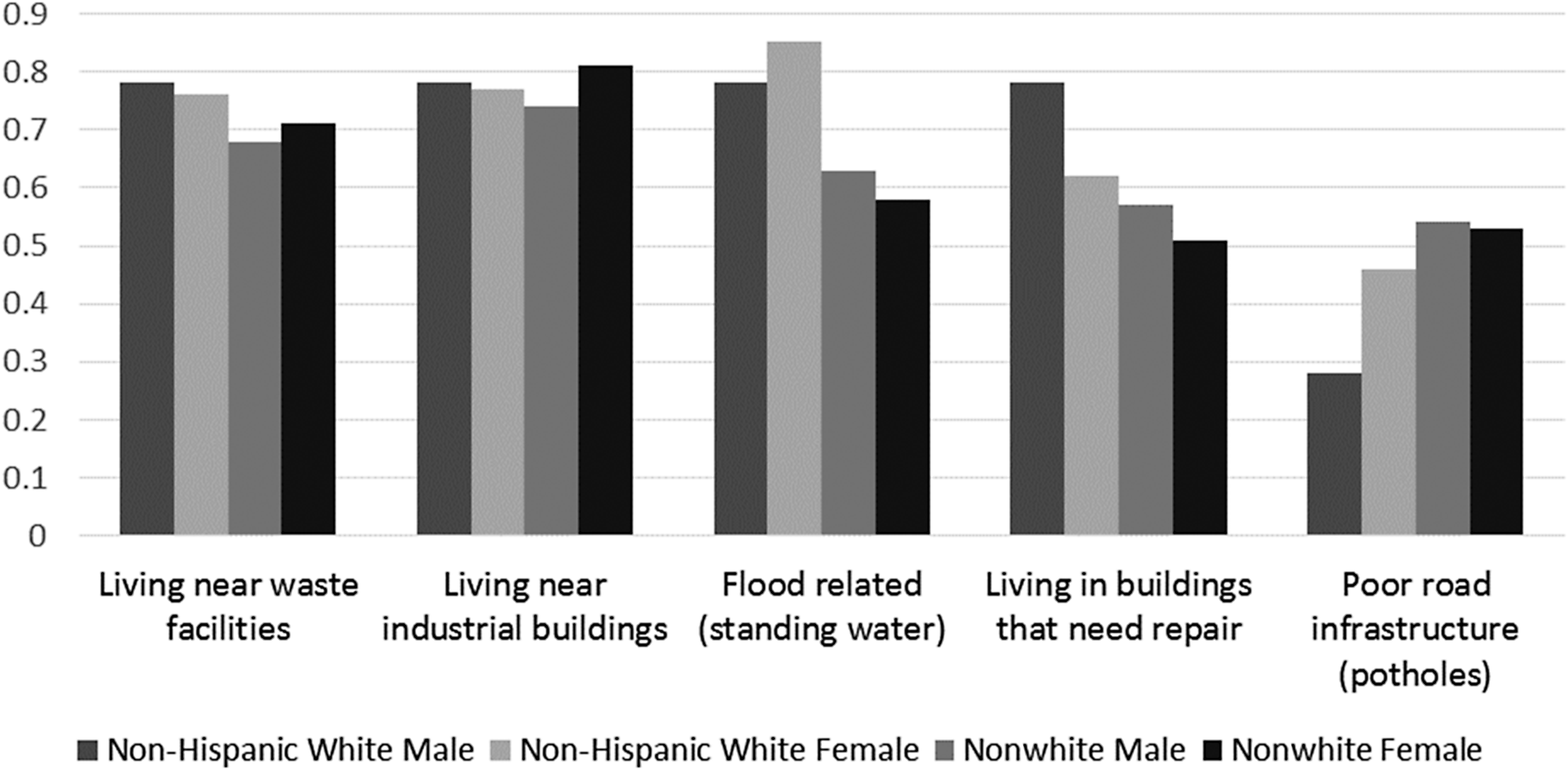
Mean risk perception by race and gender. Reports of perceptions of risk were obtained through self-reported questionnaires and stratified by race and gender.
When comparing nonwhite participants with non-Hispanic white individuals, the overall perception of environmental harm was lower for minority populations. Table 2 shows the crude and adjusted odds ratios (ORs) and 95% confidence intervals (95% CIs) for each of the environmental exposures mentioned in the survey. On all exposures, with the exception of poor road conditions, the nonwhite group perceived a lower health risk than non-Hispanic whites. Exposure to standing water associated with flooding was significantly associated with a lower health risk by minority residents, with a statistically significant decrease in risk perception (OR = 0.34; CI = 0.13–0.94). Adjusting for the generational age of participants did not impact the direction of the associations.
Odds Ratios and 95% Confidence Intervals of Environmental Health Perceptions of Harm to Oneself or Community in the Neighborhood of Manchester in Houston, TX, in 2015 by Issue
Adjusted by generational age (<35, 36–50, 51–69, or 70+).
Significant at <0.05.
CI, confidence interval; OR, odds ratio.
Table 3 shows the results of comparing non-Hispanic white males with each gender and racial category. Analyses of reported perceptions of environmental harm to one's personal health or the health of the community indicated that on issues of living near industrial buildings, living near waste facilitates, and living in buildings that need repair, non-Hispanic white males showed the greatest concern. On issues of exposure to standing water, non-Hispanic white females were 57% more likely to shows concern than their male counterparts (OR = 1.57; 95% CI = 0.24–10.22). The main exception was the issue of living with poor road infrastructure, where non-Hispanic white females and nonwhite males and females perceived increases in potential harm. It is important to note that each of the points failed to produce statistically significant differences between any groups, likely due to the limited sample size.
Odds Ratios and 95% Confidence Intervals of Environmental Health Perceptions of Harm to Oneself or Community Grouped by Race and Gender
Discussion
Our cross-sectional study was designed to evaluate whether there was evidence of the white male effect in a small neighborhood in Houston, Texas, where the environmental conditions are well known and the lived environmental experience was similar for all racial groups within the geographically compact neighborhood of Manchester. Findings of this research suggest that this effect does not hold in this population. Within the surveyed population in Manchester, minority populations tended to underreport perceived health problems associated with certain environmental exposures compared with non-Hispanic white groups. These results were not attenuated when adjusting for gender; non-Hispanic white males often reported the highest level of concern. These findings lend support to the hypothesis that minority groups are less likely to report a problem with even egregious environmental conditions due to cultural norms surrounding these communities from generations of poor environmental living conditions discussed at length in environmental justice research. 37 , 38 , 39 , 40 These results further support findings from researchers Olofsson and Rashid who found that equity, in regard to exposure to environmentally polluted areas, tended to remove differences in perceptions of environmental harm between different racial and ethnic groups. 41 It should be noted, however, other alternative explanations could exist to explain the disparate perceptions between groups in the study. Information on socioeconomic variables, such as educational attainment or employment data, was not collected. This information could soften the results if controlled for as these have been found to inform perceptions of risk. 42
The strength of this study lies in the well-documented problems with the quality of air, standing surface water, proximity to waste and industrial buildings, and infrastructure conditions in this small neighborhood. Furthermore, partnerships with local students and volunteers to conduct survey data collection ensured that language and cultural boundaries did not pose a problem in receiving quality data. A response rate of 72.7% (109/150), a high proportion within a small neighborhood, further demonstrated the interest within the neighborhood around environmental health issues.
This study has several limitations. Despite the relatively high response rate, a small total number of participants completed the survey, reducing our statistical power and our ability to adjust by multiple confounders. Non-Hispanic whites were overrepresented in our survey responses compared with the U.S. Census data on race and ethnicity of Manchester residents (City of Houston Planning and Development Department, 2014). Non-Hispanic whites were more likely to complete the survey than their nonwhite counterparts and this could have caused selection bias within this study. The use of trained local volunteers and Spanish speakers was an effort to address this potential bias. Data on socioeconomic status were not collected and could account for some confounding.
Conclusion
The results of our small case study suggest that the white male effect may not be seen with different racial or gender groups who experience the same environmental conditions. Furthermore, one plausible explanation for the reduction in perceived risk from minority populations in this study could be accounted for from long-term cultural norms that may inform individuals' opinions about the health risks of various environmental exposures. Gender and racial perceptions of environmental harm will require additional research to better understand how individuals and communities view their lived environment and its impact on their health; until that time, no conclusive statements can be made on the underlining reasons for the findings from this study.
Footnotes
Author Disclosure Statement
No competing financial interests exist.