




Abstract
Abstract
Parks and urban green spaces are important factors for the quality of life and promoting environmental justice. Although a high park utilization improves health and well-being, the Iranian urban residents have a low park utilization. Nevertheless, historical Persian gardens have remained as successful urban green spaces among urban residents. In this study, four well-known historical Persian gardens in Shiraz city (Eram, Hafeziyeh, Jahan Nama, and Afifabad) have been investigated on physical, social, and psychological aspects to identify their associations with the utilization of these spaces. Of 800 questionnaires distributed among adult residents in two seasons in these gardens, 775 questionnaires were collected. Connecting to nature, refreshing, and relaxing were detected as the most frequently referred reasons for garden visitation compared with social and physical activities. Attachment to place, aesthetics of gardens, accessibility, and feeling safe were associated with higher garden visitation. However, bonding with the place (as a psychological factor) and feeling safe (as a social factor) were more associated with garden visitation compared with aesthetics and accessibility of gardens (physical factor). The significant role of safety on mediating effects of other attributes on garden visitation was revealed, as well. So, park designers and planners should improve park qualities by investing in affective components, infrastructure, and activities, which support social benefits to increase the number of park users.
Introduction
Based on socio-ecological models, human behavior is affected by places or settings that create a physical environment. 1 Public open spaces such as parks have been identified as environmental supports for leisure activity. 2 These spaces help in promoting physical health, 3 psychological health, 4 and social well-being. 5 A higher frequency of park visitation improves health and well-being. 6 Although many studies have been performed regarding the association of urban green spaces and public health in developed countries, 7 in different contexts such as Iran it is unclear to what extent environmental settings promote health conditions. Following the style of European urban green spaces, which were created based on their culture and climate, resulted in low park utilization in Iran. 8 Nevertheless, historical Persian gardens have remained as successful urban green spaces among urban residents. 9 Hence, understanding these spaces, which follow the climate and the culture of Iran, may help to improve the quality and quantity of contemporary urban green spaces in Iranian communities.
The review of the behavioral theories has shown that human conduct might be clarified based on inspirations and feelings where individuals' conduct is guided by the need to fulfill physical, social, and physiological demands. 10 This conduct procedure can be comprehended through the idea of inspiration, as people are pulled into regular settings in the quest for individual advantages. Then, again, the expectation to connect with parks is personally connected with their level of responsiveness as far as addressing their requirements. 11 This incorporates the need to relax, refreshment, recreation, and socializing. 12 The physical impact affects the physical condition that decides the responsiveness of the general population places such as accessibility, legibility, aesthetics, and other subcategories. The social impact demonstrates the impact of the inhabitants' social condition for better use of open spaces. This impact tends to the huge capacity of social conditions to promote park utilization such as feeling safe. The psychological impact shows the process of people attachment to the place. The procedure of place attachment experiences four interrelated subclassifications. The conative, functional, cognitive, and social bonding with the place impact the psychological part of place attachment or the meaning of the place for human. 13 Compared with the psychological effects, 14 the physical and social impacts are the most widely recognized factors used to enhance the park utilization, 15 however, the studies were mainly performed in America, Europe, and Australia. To achieve a comprehensive knowledge regarding promoting contemporary park utilization in the context of Iran, we investigated the association of these three constructs (i.e., physical, social, and psychological) concurrently with the utilization of historical Persian gardens that are known as successful urban green spaces in Iran.
Historical Persian gardens
More than half of Iran is covered with deserts that led to hot and arid climates in this country. Ancient gardens have been built to create places with pleasant weather in hot summer and cold winter. Water and plan of gardens “Chahar Bagh” (literally means four gardens) are key elements in designing Iranian ancient gardens. Based on this plan, the garden is divided into four sectors that symbolize Eden and the four Zoroastrian elements of sky, earth, water, and plants. Water is not only used for irrigating plants but also implies happiness, joy, and freshness. In addition, walls surrounding the ancient gardens protect them from sandstorms and extreme climates as well as giving privacy to users. Furthermore, a building (Koushk) is usually designed in the middle of these gardens. The first Persian garden was designed in Pasargadae, in Fars province in 550 BS. This garden is known as the royal garden of Cyrus the Great (the king of the Achaemenian dynasty). Later, these types of gardens were built in other cities of Iran, including Tabriz, Isfahan, Shiraz, Yazd, and Kerman, such that in the eleventh century they became as an indispensable part of urban public open spaces. 16
In the eighteenth century, when the style of European gardens (chiefly French ones) became popular among designers, the pattern of ancient gardens was less considered, resulting in parks and green spaces that were not suitable for climate and culture in Iranian societies. 17 Consequently, the use of such spaces was reduced among urban residents. In the nineteenth century, again park designers tried to consider and apply the pattern of ancient gardens in the design of modern gardens and parks 18 ; however, the gardens created thus were not as successful as existing historical Persian gardens. In this study, we investigated four popular and famous historical Persian gardens in Shiraz city to know what factors influence the utilization of these places.
Methods
Shiraz as the capital of Fars province is the fifth most populous city of Iran. The city, located in the southwest of Iran, has a moderate climate. The city as one of the oldest cities of ancient Persia has been the center of trading in the region for >1000 years. Shiraz has about 1,500,644 inhabitants and is known as a city of literature, poets, and gardens. The earliest and the most famous gardens of Iran are located in this city (Fig. 1).
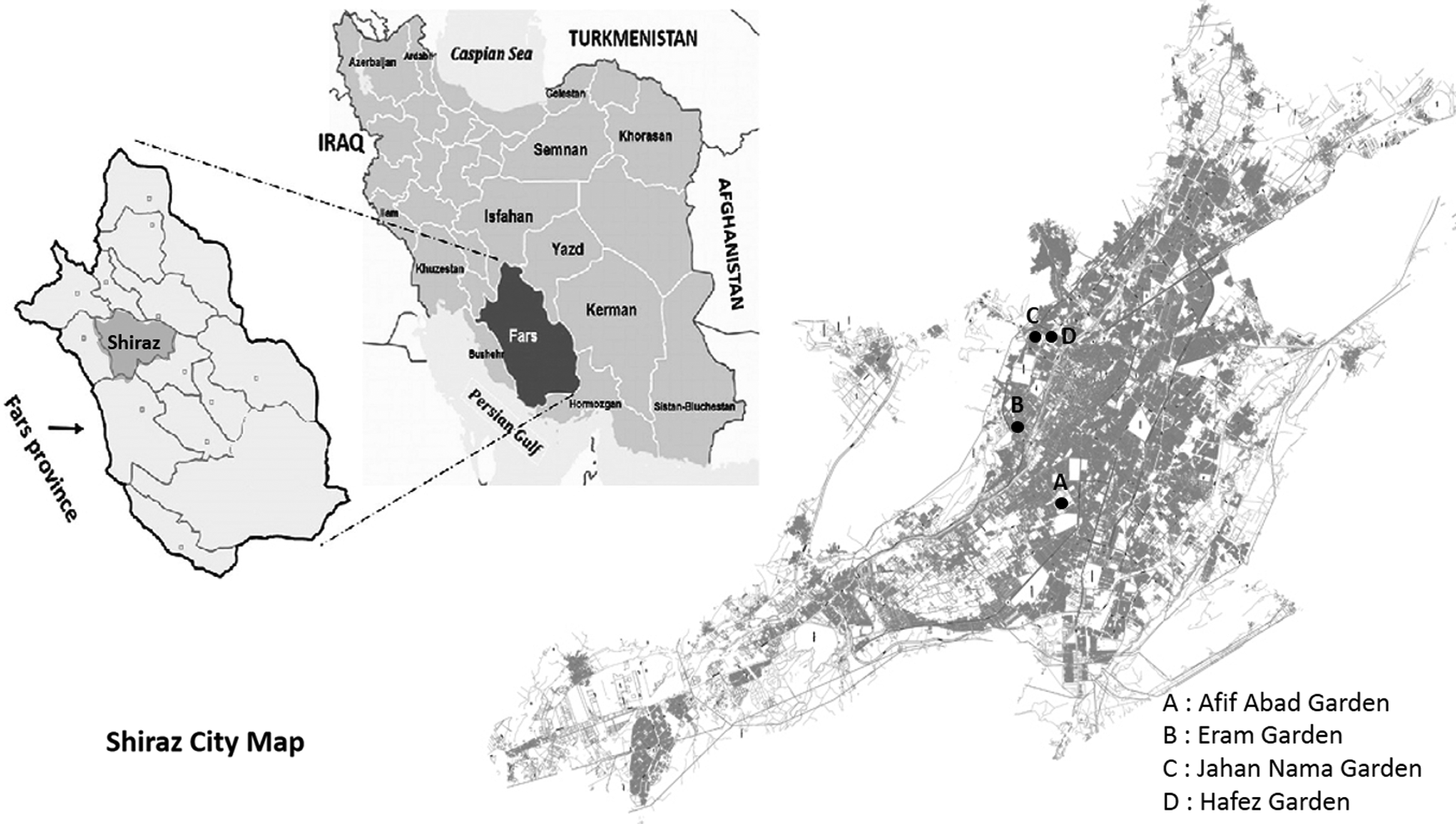
The location of the gardens in Shiraz city.
A total of 19 gardens are located in Shiraz city. However, seven of these gardens are either destroyed or under reconstruction. Based on the accessibility of gardens for public use, popularity (information gathered from cultural heritage based on the number of visitation), and garden's size, four gardens were purposefully selected; that is, Eram (11 ha), Hafeziyeh (2 ha), Jahan Nama (8.2 ha), and Afifabad (12.7 ha) (Fig. 2).

Gardens view [
Spring and summer are known as suitable times for outdoor activities in Shiraz city. Thus, data collection was conducted in these two seasons in 2018. A total of 100 questionnaires in each season were distributed in different parts of each garden (totally 800 questionnaires) at different hours of the day (weekday and weekend) among adult (>18 years old) residents of Shiraz using convenience purposeful sampling. The questionnaires were completed in the gardens by respondents who provided their immediate experience and perception. Finally, 775 questionnaires were used for further analysis (Eram = 196, Hafeziyeh = 194, Jahan Nma = 194, and Afifabad = 191).
Dependent variable
The frequency of garden visitation was assessed by one item “how often do you visit this garden?” with a five-point ordinal answering scale “1 being a couple of days in a week to 5 being once in a year.” In addition, the users were asked to determine the reason for garden visitation by asking six questions using 1 (a little bit) to 5 (very much) (Cronbach's α = 0.86). Full details of items are presented in Table 1.
Reason of Visiting Historical Persian Gardens
Test is significant at the 0.05 level (two-tailed).
SD, standard deviation.
Independent variable
To measure the physical features of gardens, their aesthetics and accessibility of the gardens were assessed. The aesthetics of gardens were measured by three items regarding “interesting things to look at,” “attractiveness of the garden,” and “lots of greenery”. 19 Accessibility was measured by a single item “there is convenient access to the garden by car/foot” adopting from Cerin et al. 20 Safety was measured to assess the social feature of the gardens by a single question “I feel safe to walk alone in the garden” adopting from Sallis et al. 21 Furthermore, place attachment as a psychological factor was measured using items adapted from Kyle et al., 22 including place identity (three items), place affect (three items), place dependence (three items), and place social bonding (three items). All the items were measured on a five-point scale (1 strongly disagree to 5 strongly agree). Full details of questionnaire items and their reliabilities are presented in Appendix Table A1.
Sociodemographic variables
Years of living in Shiraz, gender, age, and education level were asked to obtain sociodemographic information of the respondents.
Data analysis
The data were analyzed using SPSS version 22. Descriptive statistics were used to show sociodemographic information of respondents. The frequency of garden visitation and reason of visitation were presented as descriptive statistics. Mann–Whiney U test was performed to examine the differences between women and men for reason of garden visitation. Ordinal regression was used to analyze the association of social, physical, and psychological factors with frequency of garden visitation. A four-stage modeling approach was used to determine the influence of factors on garden visitation. In each model, individual variables were separately included to assess the compositional effects. Model 1 assessed perceptual factors, including place identity, place affect, place dependence, and place social bonding. Model 2 assessed the influence of physical features, including accessibility and aesthetics of gardens. Model 3 included safety as a social feature. Finally, Model 4 evaluated the association of all features on garden visitation simultaneously.
Results
The findings revealed no significant difference in visitation based on location and season; thus, the data of all gardens were combined. Of 800 questionnaire distributed, 750 were completed (51.7% women and 48.3% men) and included in statistical analysis. The mean age of participants was 33.4, half of which aged 18–30 years. Most of the participants had a bachelor or higher education (69.6%). Besides, more than half of the respondents reported visiting the gardens at least once a week (52.3%) (Table 2).
Descriptive Statistics of Respondents
As shown in Table 1, we found the nature of garden (mean = 4.06) and individual attitudes (mean = 3.97) as the main reason for visiting gardens for both women and men respondents, followed by reducing negative attitudes (mean = 3.86), enjoying weather (mean = 3.55), social (mean = 3.32), and physical activities (mean = 2.60). Besides, except for one item (reducing negative attitudes), no significant differences were determined between visiting gardens based on the gender differences.
The results of ordinal regression in predicting log odds of historical Persian garden visitation are presented in Table 3. As shown in Model 1, all four features of place attachment increased odds of garden visitation, where visitation rate was decreased by age of participants. The model explained 52% of garden visitation and was the highest predictor of garden visitation compared with physical and social features. Model 2 examined the effect of physical features. Aesthetics of gardens and access to gardens were significantly associated with higher garden visitation. The model had the lowest predictor of garden visitation and explained almost 40% of the variance in frequency of garden visitation (i.e., a 12% drop). At the individual level, older participants were less likely to visit gardens. Model 3 added safety as a social feature. Feeling safe increased odds of garden visitation, whereas older participants and men were associated with higher garden visitation. The modest variance increase of 3% was observed in this model. In the final model, all physiological, physical, and social features were added. Although accessibility became insignificant, some drops were observed in the association of other measurements. This evidence showed that the items mediate the association of each other on garden visitation, although the mediation effect of items was less on safety.
Ordinal Regression Analysis for Predicting Historical Persian Garden Visitation
Nagelkerke.
*p < 0.05; **p < 0.01.
CI, confidence interval.
Discussion
We observed that psychological, physical, and social factors influence frequent visitation of historical Persian gardens in Shiraz city. Based on the results of the study, psychological features play a significant role in the successfulness of historical Persian gardens. Although physical and social features mediate their effects, the association was still significant. Attachment to place is important because it raises protective behaviors of that place. 23 Frequent visitation of the place increases affective, social, functional, and cognitive bonding with a place. 24 In this regard, the attachment to the gardens may be due to the historical background and high greenery of these spaces 25 that lead to higher frequency of visitation.
The findings indicated that safety results in a significant effect on garden visitation and significantly mediates the effects of psychological and social factors. However, these factors do not mediate its effect and show the strong effect of safety on public open space utilization. In this regard, the association of safety with park utilization is controversial 26 ; nevertheless, many studies support this finding. 27 Besides, when examining the association of safety and garden visitation, the association of gender and garden visitation became significant, which signify the role of gender on the perception of safety in public space utilization. 28
In support of several studies, 29 the association of aesthetics and access to gardens with the frequent visitation of the garden was found. Unlike the findings of many studies, 30 when psychological and social factors are added to the model, the association of access is removed. 31 This finding can be explained in different ways. It may suggest the strong effect of place attachment, safety, and aesthetics of gardens on garden visitation in comparison with accessibility. Moreover, this result may suggest the spatial distribution of the garden's location that affects measuring this feature. More research, however, is needed to investigate the role of accessibility on historical Persian garden visitation, whereas its association with public open spaces was confirmed in several studies in the context of Iran. 32
In support of previous studies, 33 older adults were less likely to visit the gardens. These differences in findings may be due to a small number of old adults. Compared with studies in developed countries, 34 there are fewer studies about older people and park utilization in developing countries. Thus, it is necessary to apply more research on this field in developing countries such as Iran.
Although the parks are used for different purposes, we found that connecting to nature and refreshing are the most important reasons for garden visitation compared with social and physical activity. 35 Furthermore, a social activity that occurs in these spaces implies that nature and greenery promote using outdoor spaces and raise social interaction and integration among residents, leading to shared values and supportive behavior 36 and enhanced everyday well-being. 37 Also, historical Persian gardens are less used for exercise and other physical activities. This may be due to the function of such spaces created to link to the nature and for relaxing. In addition, no facilities for vigorous activity were implemented in these spaces, which may cause a less vigorous activity in the gardens. The greenery of these spaces, which follows the culture and the climate of the region, has a strong effect on garden use that led to people's well-being.
One of the main strengths of this study is the inclusion of physical, social, and psychological features, and their association with the frequent visitation of historical Persian gardens. To our knowledge, this is the first study that investigated these relationships in the context of Iran. The findings of the study enhance the understanding and appreciation regarding historical Persian gardens and their contribution to landscape design concept. In addition, the study added more robustness to the growing knowledge on the field of public open spaces context by examining the factors in different models to know the mediate effect of each variable and its association with public open space utilization. The study had some limitation, however. The sampling was done among the resident adults' visitors within the gardens, which do not represent all residents' population. However, by collecting data within the gardens, we could obtain an immediate perception of visitors. To achieve a comprehensive knowledge regarding the historical Persian gardens, investigation of gardens in other parts of Iran is needed since the findings cannot be generalized to other historical Persian gardens in Iran. The study relied on self-reported perceived gardens that may have some bias. Objective measurements of physical and social features of these spaces are suggested for future research.
Conclusion
The study investigated the association of physical, social, and psychological aspects on visitation of four well-known historical Persian gardens. With regard to this investigation, historical Persian gardens could be some proper places for social activities and fulfill the mental needs of residents, which signify the role of these spaces for people's daily well-being. Historical Persian gardens supply the social, physical, and psychological needs of residents. Experiencing nature is the foremost reason for large visitation of historical Persian gardens. The diversity of nature, as well as the coherent and historical aspects of the gardens, makes the residents attached and dependent on these places. The study suggests that public open spaces should have appropriate size to encourage residents to cognitive, physical, and social interaction with the nature of parks. Finally, park designer and planner should improve park qualities by investing in affective components, infrastructure, and activities that support social benefits to increase the number of park users.
Footnotes
Acknowledgment
We are very grateful to residents of Shiraz city who participated in the study.
Author Disclosure Statement
No competing financial interests exist.
Appendix Table A1. Place Attachment and Garden's Aesthetics Questions with Their Reliabilities (Cronbach's α)
| Cronbach's α | |
|---|---|
| Place identity | 0.87 |
| I identify strongly with this garden | |
| I feel this garden is part of me | |
| Visiting this garden says a lot about who I am | |
| Place affect | 0.89 |
| I am very attached to this garden | |
| I feel a strong sense of belonging to this garden and its settings/facilities | |
| This garden means a lot to me | |
| Place dependence | 0.82 |
| For what I like to do, I could not imagine anything better than the settings and facilities provided by this garden | |
| For the activities I enjoy the most, the settings and facilities provided by this garden are the best | |
| I enjoy visiting this garden and its environment more than any other parks | |
| Place social bonding | 0.79 |
| Many of my friends/family prefer this garden over many other parks | |
| If I were to stop visiting this garden, I would lose contact with a number of friends | |
| My friends/family would be disappointed if I were to start visiting other settings and facilities | |
| Aesthetics of garden | 0.86 |
| There are interesting things to look at in the garden | |
| The garden is very attractive | |
| There are lots of greenery in the garden |