




Abstract
Abstract
Access to clean cooking fuels is critical for human health and features, prominently in the UN Sustainable Development Goals. However, our understanding of the probabilities of access to clean cooking across sub-Saharan Africa (SSA) is emergent. A pooled regression analysis of the compositional and contextual factors that cumulatively influence access to clean cooking fuels in 31 SSA countries, between 2010 and 2016, was carried out. Household access to clean cooking fuels across the 31 countries was just 10%. Access of urban households to clean cooking fuels was 26% and it was 2% for rural households. Higher probabilities of access were observed for households that were rich and highly educated compared with households that were either rich but with low education or poor but highly educated. Middle households with heads educated to secondary level or higher in both urban and rural areas almost have the same chance with the rich households with uneducated heads or educated to primary level regarding access to clean cooking fuels. The average probability of poor households with heads educated to secondary level or higher is twice that of poor households with uneducated heads or educated to primary level. The average probability of access to clean cooking of rich households with heads educated to secondary or higher level is ten times higher than for poor households with uneducated heads. These findings are mediated and attenuated by compositional and contextual factors, giving credence to the fact that the challenge of access to clean cooking fuels in SSA is multifaceted and requires interdisciplinary research and policy interventions encompassing health, environment, culture, and economics.
Introduction
The sustainable development goals (SDGs), embraced in 2015 by 193 nations, signify a principal step toward addressing poverty, inequality, and climate change over the next 15 years. Clean cooking features prominently in the SDGs as it is directly or indirectly related to 8 out of the 17 SDGs, including poverty, hunger, good health and well-being, quality education, and gender equality. 1 , 2 It is also linked directly to climate action, affordable and clean energy and indirectly to decent work and economic growth, sustainable cities, and life on land.1,2 Access to energy at household level is critical for human survival and remains a topical issue in international development and environmental management. 3 It has been described as “the golden thread” linking economic growth, social equity, and environmental sustainability by the International Energy Agency and World Bank. In this regard, the pursuit of sustainable economic development cannot be delinked from access to clean household energy. 4 Nonetheless, access to clean energy at the household level remains a daunting task for many low- to medium-income households in developing countries. 3
Globally, 1.2 billion people are without electricity and depend on oil and kerosene lamps for lighting. More than 2.7 billion people do not have access to clean energy and rely on traditional solid biomass as the main choice for cooking. 5
Household reliance on traditional biomass fuels for cooking has a wide range of adverse effects on public health and the environment. 6 The use of traditional biomass fuel is regarded as a first-order public health crisis. 7 A study 8 revealed that 1.5 million premature deaths that occur annually worldwide are attributed to indoor air pollution from the use of solid fuels. Biomass use accounts for 85% of such deaths. 9 Indoor air pollution linked with combustion of biomass kills more people than malaria in developing countries, exceeded only by malnutrition, unprotected sex, and unimproved water and sanitation in terms of health threats. 10 According to the International Energy Agency (IEA), 9 indoor air pollution is responsible for about 36% of lower respiratory infections and 22% of chronic respiratory disease. The over-reliance on traditional biomass energy is also detrimental to our environment. It is the leading contributing factor to increases in greenhouse gas emissions, deforestation, loss of biodiversity, and decline in capacity to mitigate climate change. 11 The combustion of fuel wood, roots, agricultural residues, and animal dung release high emissions of carbon monoxide, hydrocarbons, and particulate matter. 12
Sub-Saharan Africa (SSA) accounts for about 13% of the world's population. 11 SSA has the highest percentage of population depending on biomass resources as it is the main fuel for cooking. 13 In SSA, two out of three people have no access to electricity 14 ; as a result, 90% of the population uses traditional fuels for cooking, heating, and lighting. 15 The region recorded an increase of 0.3 percentage points in access to clean cooking fuels annually between 2014 and 2016. 16
Nine out of the top 20 access-deficit countries in clean cooking are in SSA. 16 Currently, 7.5 million tons (Mt) of PM2.5 (particulate matter with diameter less than 2.5 micrometers) are released annually in Africa, of which almost three-quarters is attributed to the combustion of biomass fuels indoors. 5 Nearly 600,000 Africans died annually from household air pollution from emissions produced by solid fuels. 7 SSA and Southeast Asia are ranked highest in terms of the number of premature deaths caused by the use of solid fuels.
To overcome the adverse effects associated with the use of traditional biomass fuel and other forms of “dirty” energy at the household level and improve living standards in SSA, there must be a transition toward cleaner and modern forms of household energy. Insights into cumulative determinants of access to clean cooking fuels are critical to aid appropriate interventions to effectively enhance living standards in SSA. It is, therefore, necessary to understand the compositional and contextual factors that independently or jointly influence access to clean cooking fuels in SSA. A large body of empirical studies have highlighted the strong influence of wealth status and level of education of household head on access to clean cooking fuels. 17 However, these studies assessed the influence of wealth and education separately. Besides, most of the studies were done for a country or few countries. It has been suggested that the factors likely to affect household energy choices systematically vary by geographical location. 3 In this study, we carried out a pooled regression analysis of multi-country data to evaluate the joint effect of wealth and level of education of household heads in determining access to clean cooking fuels across 31 sub-Saharan African countries.
Theoretical Context
In the past, access to clean cooking fuels was assessed by using the energy ladder model. 18 , 19 , 20 The energy ladder model has become a common representation used to describe the differences in energy use patterns of households. The energy ladder hypothesizes that with the rise in income, households shift from traditional biomass energy to cleaner and more modern forms of energy. 19
The ladder model envisions a three-stage energy-use pattern at the household level. 18 The lowest stage represents the least efficient and most polluting fuels (i.e., universal reliance on biomass energy). Households rely entirely on biomass energy through the combustion of firewood and animal wastes. In the intermediate stage, households move to “transition” fuels that burn more efficiently, nonetheless still have significant emissions. The fuels include charcoal, kerosene, and coal. In the third stage, which is the most advanced stage, households rely on the cleanest forms of energy such as liquefied petroleum gas (LPG), natural gas, electricity, or biofuels.
Access to clean cooking fuels currently receives much attention especially in SSA due to the adverse impact of traditional fuel use on environment and health. 21 It makes it imperative to empirically assess the determinants of access to clean cooking fuels, particularly in SSA where the vast majority do not have access. Studies have shown that the variations in access to clean cooking fuels are dependent on household economic status. 22 , 23 A study 24 has suggested that the energy ladder also assumes that clean and expensive energy technologies are locally and universally perceived to indicate higher status, hence the desire of households to switch to more efficient and cleaner energy just to demonstrate an increase in socioeconomic status and nothing to do with the negative effects of unclean energy. Studies 24 assert that a complex set of factors inform the transition and have subsequently questioned the assumption that energy choice is solely based on income or wealth status of households.
Methods
Data source
This study used nationally representative household survey data from Demographic and Health Surveys (DHS) for 31 SSA countries. The DHS are an important source of comparative quantitative data across developing countries on both rural and urban populations. 3 The DHS provide data on several indicators for monitoring population, health, nutrition, and household energy. Data on cooking fuel are collected at the household level. DHS are based on probability sampling using existing sampling frames primarily, population censuses. The selection criteria for including a country in this study were as follows: (1) The country should be found in SSA based on the United Nations regional groupings; (2) should have DHS dataset with standardized questions on type of cooking fuel, level of education, wealth index, and other important demographic variables such as age of household head, gender, household size, and type of place of residence; (3) and should have datasets in the study time frame, 2010–2016.
Study countries
Based on the criteria, a total of 31 countries in SSA were included in the study (Fig. 1). Where multiple datasets were available for the time frame for a country, the most recent survey was used. The classification of study countries into major regions in Table 1 was based on the United Nations World Population Aging report 2015. 25
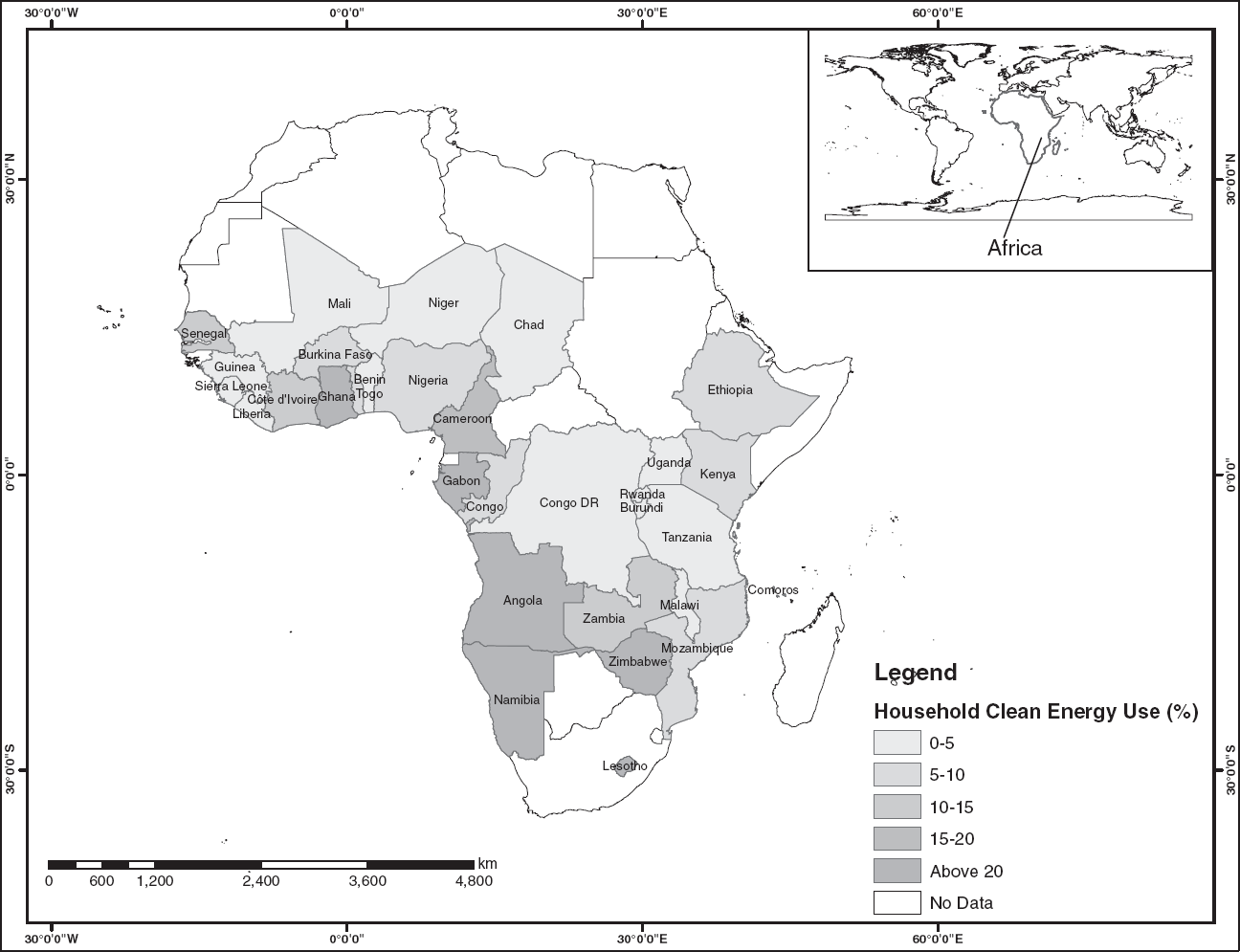
The study countries in SSA. The spatial distribution of the study countries in SSA is shown. SSA, sub-Saharan Africa.
Study Countries Disaggregated by Geopolitical Region and Year of Dataset
Measures
Response variable
The dependent or outcome variable considered in this study was access to clean cooking fuels. Clean and unclean cooking fuels were represented as a dichotomous variable, with “1” representing “clean” and “0” representing “unclean.” The study considered clean cooking fuels as cooking energy sources that fall under the advanced fuels (LPG, natural gas, biofuel, and electricity) category in the energy ladder model. The unclean cooking fuels refer to cooking energy sources that fall under both traditional and transition fuels such as firewood, animal waste, agriculture waste, kerosene, coal, and charcoal.
Key explanatory variable
The main explanatory or independent variable was selected based on literature, parsimony, practical significance, and theoretical relevance. The explanatory variable was derived from combining two variables, that is highest education level attained (no education/preschool, primary, secondary, higher) and wealth index (poorer, poor, middle, rich, and richer) of the household head. Based on the need for sufficient cases in each sub-group to facilitate robust analyses, the observations regarding no education/preschool and primary were recoded as no education or educated to the primary level. Observations under secondary and higher were combined and recoded as educated to secondary or higher level. Observations under poorer and poor were combined and recoded as “poor.” Observations under richer and rich were also combined and recoded as “rich.”
The combination of the two variables produced the explanatory variable—”wealth educational attainment” with six mutually exclusive groups: poor household with uneducated head or educated to primary level, poor household with head educated to secondary or higher level, middle household with uneducated head or educated to primary level, middle household with head educated to secondary or higher level, rich household with uneducated head or educated to primary level, and rich household with head educated to secondary or higher level.
Compositional and contextual factors
In this study, the compositional factors included gender of household head (male or female), age of household (young adult: less than 35 years, middle-aged adult: 35–55 years, old-aged adult: more than 55 years), and household size (small: 1–5, medium: 6–10, large: above 10). The contextual factors were place of residence (urban, rural) and geographical region (western Africa, eastern Africa, southern Africa, and central Africa).
Data analysis
All statistical analyses were carried out in STATA 13 MP (StataCorp, College Station, TX). Descriptive analyses were done on access to clean cooking fuels between urban and rural households and also to explore the inequalities among study countries. The descriptive analyses also evaluated the disparities in access among the four geographical regions in SSA. Inferential and multivariate techniques were applied to examine associations between access to clean cooking fuels and the joint effect of wealth status and highest education level (wealth educational status) of household heads. Theoretically relevant compositional factors and contextual factors were controlled for in the multivariate analyses.
Univariate analysis
Univariate analyses of predictors of access to clean cooking fuels were performed to determine whether the observed differences in household access to clean cooking fuels were independent by using Pearson chi-square and Cramer's V statistic. Statistical significance was set to 0.05 for all the analyses. The outputs were presented as contingency tables in the results. The chi-square test of independence is a nonparametric statistical test that is used to determine whether two or more groups of samples are independent or not. 26
The associations between the compositional and contextual factors and access to clean cooking fuels (response variable) were also explored. Cramer's V statistic was used to measure the strength of association between the variables. 27
Multivariate regression
The joint effect of wealth and education on access to clean cooking fuels was estimated by using a negative log–log regression model and reported as odds ratios (OR). An OR of 1 means that the predictor does not affect the odds of access to clean cooking fuels; OR >1 means that the predictor is associated with higher odds of access to clean cooking fuels; and OR <1 means that the predictor is associated with lower odds of access to clean cooking fuels. A negative log–log regression model is apt for a dichotomous response variable, in which 55% or more of responses are not affirmative. The study accounted for clustering of observations in units of household, and robust estimates of variance was used to correct for this and any statistical outliers in the estimation of standard errors.
The study employed a 95% confidence interval (CI), and the level of statistical significance was set at 0.05. Compositional (sex of household head, age of household head, household size) and contextual (type of place of residence, geographical region) variables that are known in literature to influence access to clean cooking fuels were controlled for in the models. Three models were run, namely, wealth educational status of household head and biosocial (model 1), sociocultural (model 2), and contextual (model 3).
In the multivariate analysis, the practical significance of the findings was also estimated by using predictive probabilities. The predictive probabilities calculated were adjusted predictions that are referred to as margins in Stata. 28 Margins are statistics computed from predictions of a model at fixed values of some covariates and averaging or otherwise integrating over the remaining covariates. 29
Ethical statement
The procedures and copies of the questionnaire used to obtain the study data in the DHS program have been reviewed and approved by the ICF Institutional Review Board (IRB). In addition, the ICF IRB ensures that the survey agrees with the United States Department of Health and Human Services regulations for the protection of human subjects CFR 46. The survey protocols used also complied with various host country laws.
Results
Descriptive analyses
Access to clean cooking fuels across the study countries in SSA is shown in Figure 2. Access to clean cooking fuels across the 31 study countries in 2010–2016 was ∼10%. Gabon had the highest access to clean cooking fuels of 60% and Liberia had the least access of 0.07%. The best performing countries with access above 20% were Gabon (60%), Namibia (42%), Angola (40%), Zimbabwe (35%), Lesotho (32%), and Ghana (21%). The least performing countries with access less than 1% were Mali (0.7%), Tanzania (0.5%), Rwanda (0.5%), Guinea (0.4%), Burundi (0.2%), Sierra Leone (0.1%), and Liberia (0.1%).
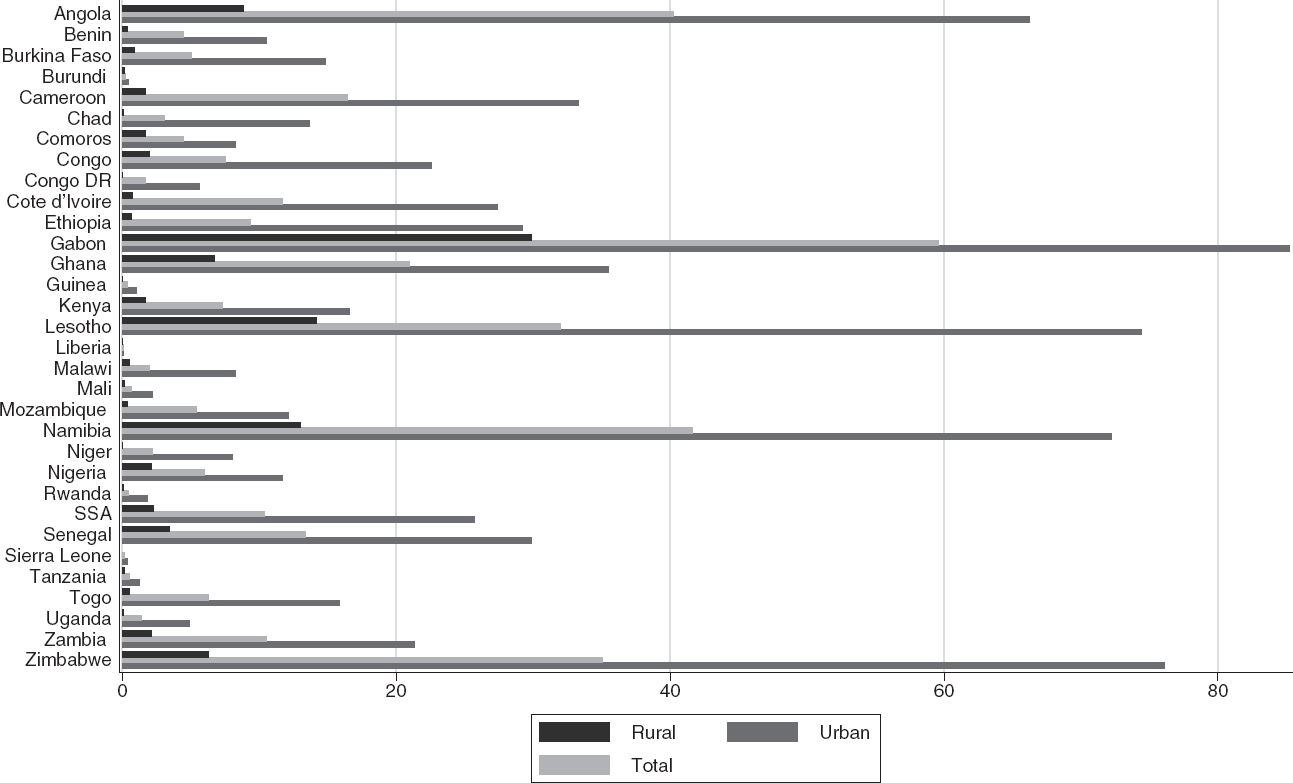
Rural–urban heterogeneities in access to clean energy across the 31 countries. Access to clean energy was higher in urban areas than in rural areas in each of the 31 countries that were included in the study.
The descriptive statistics indicate a wide gap between the urban households and the rural households in terms of access to clean cooking fuels. The urban households that had access to clean cooking fuels were 26% and the rural households had 2% access. The disparities were observed in all the countries from the best performing country through to the least performing country. Zimbabwe had the highest disparity in access to clean cooking fuels between urban households (76%) and rural households (6%).
The descriptive results also show significant inequalities in access to clean cooking fuels among the geographical regions. Southern Africa had the highest access, accounting for more than half (54%) of the population in SSA that have access to clean cooking fuels. Central Africa had the second highest of about half (27%) of that of southern Africa. Western and Eastern Africa had the lowest access to clean cooking fuels with 9% and 10%, respectively.
Univariate analyses
Nonparametric Pearson chi-square test of independence was calculated for access to clean cooking fuels and wealth educational attainment as well as the compositional and contextual factors. The chi-square static report rejected the hypotheses that access to clean cooking fuels is independent of the wealth educational attainment, and the compositional and contextual factors of the households (Table 2). The Cramer's V statistic for wealth educational attainment, type of place residence, geographical region, and country indicates strong associations with access to clean cooking fuels. However, the Cramer's V statistic for sex, age, and household size shows weak associations with access to clean cooking. All the results for the univariate analyses were statistically significant.
Percentage Distribution of Access to Water Sources by Predictor Variables
Multivariate analyses
In the multivariate analyses, three models, namely, wealth educational attainment and biosocial (model 1), sociocultural (model 2), and contextual (model 3), were developed to assess their relationship with access to clean cooking fuels. Table 3 shows the OR, robust standard errors, probability values, and CIs in the models. In model 1 (wealth educational attainment and biosocial factors), poor households with heads educated to secondary or higher level were 65.7% more likely to have access to clean cooking fuels compared with poor households with uneducated heads or educated to primary level. Middle households with uneducated heads or educated to primary level were 34% more likely to have access to clean cooking fuels compared with poor households with uneducated heads or educated to primary level. Middle households with heads educated to secondary or higher level were 124.6% more likely to have access to clean cooking fuels compared with poor households with uneducated heads or educated to primary level.
Association Between Household Characteristics (Explanatory Variables) and Access to Clean Cooking Fuels
Bold font indicates statistically significant parameter estimates.
CI, confidence interval; OR, odds ratio.
Rich households with uneducated heads or educated to primary level were 92.7% more likely to have access to clean cooking fuels compared with poor households with uneducated heads or educated to primary level. Rich households with heads educated to secondary or higher level were far more likely to have access to clean cooking fuels compared with poor households with uneducated heads or educated to primary level. Female-headed households (OR = 1.22, p < 0.0001) were also more likely to have access to clean cooking fuels than male-headed households.
In the sociocultural model, poor households with heads educated to secondary or higher level were 65.6% more likely to have access to clean cooking fuels compared with poor households with uneducated heads or educated to primary level. Middle households with uneducated heads or educated to primary level were 35% more likely to have access to clean cooking fuels compared with poor households with uneducated heads or educated to primary level. Middle households with heads educated to secondary or higher level were 124.6% more likely to have access to clean cooking fuels compared with poor households with uneducated heads or educated to primary level. Rich households with uneducated heads or educated to primary level were 91% more likely to have access to clean cooking fuels compared with poor households with uneducated heads or educated to primary level. Rich households with heads educated to secondary or higher level were far more likely to have access to clean cooking fuels compared with poor households with uneducated heads or educated to primary level.
Female-headed households (OR = 1.18, p < 0.0001) were also more likely to have access to clean cooking fuels than male-headed households. With regards to age of household head, households with middle-aged adult (OR = 1.05, p < 0.0001) and older-aged adult (OR = 1.02, p < 0.0001) heads were marginally more likely to have access to clean cooking fuels than households with young adult heads. Regarding household size, medium- (OR = 0.83, p < 0.0001) and large- (OR = 0.84, p < 0.0001) sized households were less likely to have access to clean cooking fuels compared with small-sized households.
When the contextual factors were controlled in model 3, poor households with heads educated to secondary or higher level were 42.2% more likely to have access to clean cooking fuels compared with poor households with uneducated heads or educated to primary level. Middle households with uneducated heads or educated to primary level were 32.1% more likely to have access to clean cooking fuels compared with poor households with uneducated heads or educated to primary level. Middle households with heads educated to secondary or higher level were 91.4% more likely to have access to clean cooking fuels compared with poor households with uneducated heads or educated to primary level. Rich households with uneducated heads or educated to primary level were 94.2% more likely to have access to clean cooking fuels compared with poor households with uneducated heads or educated to primary level.
Rich households with heads educated to secondary or higher level were far more likely to have access to clean cooking fuels compared with poor households with uneducated heads or educated to primary level. Female-headed households (OR = 1.11, p < 0.0001) were also more likely to have access to clean cooking fuels than male-headed households. Households with middle-aged adult heads were 3.6% slightly more likely to have access to clean cooking fuels than households with young adult heads. Medium- (OR = 0.78, p < 0.0001) and large- (OR = 0.79, p < 0.0001) sized households were less likely to have access to clean cooking fuels compared with small-sized households. The rural households were 50.6% less likely to have access to clean cooking fuels than urban households. Regarding geographical region, households in southern Africa (OR = 3.49, p < 0.0001) and central Africa (OR = 2.32, p < 0.0001) were more likely to have access to clean cooking fuels compared with households found in western Africa.
Predictive probabilities of independent variables to access to clean cooking fuels
The margins for the independent variables for model 3 were computed to estimate predictive probabilities of responses for specified values of covariates. The margins are presented with the standard errors, p-values, and the CIs (Table 4). The results show that the higher the wealth and education status, the higher the probability of having a greater proportion of households having access to clean energy. Based on the model of wealth educational attainment with compositional and contextual variables on household access to clean cooking fuels: 0.024 (2.4%) would be the average probability of access to clean cooking fuels if every household in the data were treated as if they were poor households with uneducated heads or educated to primary level; 0.051 (5.1%) would be the average probability if every household were treated as if they were poor households with heads educated to secondary or higher level; 0.044 (4.4%) would be the average probability if every household were treated as if they were middle households with uneducated heads or educated to primary level; 0.088 (8.8%) would be the average probability if every household were treated as if they were middle households with heads educated to secondary or higher level; 0.090 (9%) would be the average probability if every household were treated as if they were rich households with uneducated heads or educated to primary level; and 0.246 (24.6%) would be the average probability if every household were treated as if they were rich households with heads educated to secondary or higher level.
Predictive Probabilities of Independent Variables to Access to Clean Cooking
CI, confidence interval; SE, standard error.
In terms of sex of household head, 0.099 (9.9%) would be the average probability of access to clean cooking fuels if every household in the data were treated as if they were headed by men and 0.114 (11.4%) would be the average probability if every household were treated as if they were headed by women. Considering age group of the household head, 0.101 (10.1%) would be the average probability of access to clean cooking fuels if every household in the data were treated as if they were headed by a young adult; 0.106 (10.6%) would be the average probability if every household were treated as if they were headed by a middle-aged adult; and 0.102 (10.2%) would be the average probability if every household were treated as if they were headed by an older-aged adult.
With regards to household size, 0.114 (11.4%) would be the average probability of access to clean cooking fuels if every household in the data were treated as if they were of small size, 0.083 (8.3%) would be the average probability if every household were treated as if they were of medium size; and 0.084 (8.4%) would be the average probability if every household were treated as if they were of large size. When the margins of type of place of residence were considered, 0.151 (15.1%) would be the average probability of access to clean cooking fuels if every household in the data were treated as if they were found in an urban area and 0.050 (5%) would be the average probability if every household were treated as if they were located in a rural area.
Regarding geographical regions, 0.065 (6.5%) would be the average probability of access to clean cooking fuels if every household in the data were treated as if they were in western Africa; 0.064 (6.4%) would be the average probability if every household were treated as if they were in eastern Africa; 0.286 (28.6%) would be the average probability if every household were treated as if they were in southern Africa; and 0.191 (19.1%) would be the average probability if every household were treated as if they were in central Africa.
Geographical location variables, including place of residence and geographical region, were found to have strong influence on wealth educational attainment in predicting access to clean cooking fuels. We further sought to find out the interaction of wealth educational attainment and these two moderating variables on access to clean cooking fuels by plotting the predictive margins of their joint effect and access to clean cooking. Figure 3 shows a vast disparity in access to clean cooking fuels between urban and rural areas that was observed in the descriptive statistics.

Joint effect of wealth educational attainment and geographical region on household access to clean energy. 1 denotes poor household with uneducated head or educated to primary level; 2 denotes poor household with head educated to secondary or higher level; 3 denotes middle household with uneducated head or educated to primary level; 4 denotes middle household with head educated to secondary or higher level; 5 denotes rich household with uneducated head or educated to primary level; and 6 denotes rich household with head educated to secondary or higher level.
Poor households with uneducated heads or educated to primary level in urban areas have higher probability in access to clean cooking fuels than all the categories of wealth educational attainment in rural areas, except rich households with heads educated to secondary or higher level. Middle households with heads educated to secondary or higher level in both urban and rural areas almost have the same chance with the rich households with uneducated heads or educated to primary level regarding access to clean cooking fuels. Rich households with heads educated to secondary or higher level in both urban and rural areas have a relatively high probability of having access to clean cooking fuels compared with the remaining five categories of wealth educational attainment.
Figure 4 show that access to clean cooking by western and eastern Africa households overlaps with all the categories under wealth educational attainment. All the categories under wealth educational attainment in western and eastern Africa had low probabilities of access to clean cooking fuels, except rich households with heads educated to secondary or higher level. Middle households with heads educated to secondary or higher level in central Africa and poor households with heads educated to secondary or higher level in southern Africa stand a higher chance of having access to clean cooking fuels compared with rich households with heads educated to secondary higher level. Poor households with heads educated to secondary or higher level in southern Africa have a higher probability of having access to clean cooking fuels compared with all the groupings under wealth educational attainment in central Africa. Middle households with uneducated heads or educated to primary level in all the four geographical regions have lesser chance of having access to clean cooking fuels than poor households with heads educated to secondary or higher level.

Joint effect of wealth educational attainment and type of place of residence on household access to clean energy. 1 denotes poor household with uneducated head or educated to primary level; 2 denotes poor household with head educated to secondary or higher level; 3 denotes middle household with uneducated head or educated to primary level; 4 denotes middle household with head educated to secondary or higher level; 5 denotes rich household with uneducated head or educated to primary level; and 6 denotes rich household with head educated to secondary or higher level.
Discussion
Based on the findings, a vast majority of SSA households did not have access to clean cooking fuels and relied on solid fuels, which have adverse implications on human health and the environment. Only 10% of the population had access to clean cooking in the period 2010–2016. A study 30 came out with similar findings. This value is less than the 18% that has been reported. 31 In their report, kerosene was considered a clean fuel, unlike in this study. The slow progress in access to clean cooking fuels in SSA has been attributed to rapid population growth, escalating fuel costs, and fuel supply interruptions. 31 Another setback to access is fuel stacking whereby households continue to use biomass alongside the clean energy for cultural reasons, such as predilection for the taste of food cooked in traditional ways. 32 Even though the SSA had seen marginal improvement in access, the region's overall population grew four times faster than the population with access to clean cooking fuels, thereby overshadowing the little improvement achieved. 16
The findings also indicate enormous disparities in access to clean cooking fuels among SSA countries. The geographical disparity in access can be attributed to the adoption of good policies that favor the use of clean cooking fuels in households at the national levels. However, issues such as affordability, lack of knowledge on deleterious effects of dirty fuel, and availability of clean fuel sources may inhibit access to clean energy. Subsidizing the cost of clean energy for households has also increased access to clean cooking fuels in countries such as Senegal, Ghana, and Gabon.13,16 All the world's 20 lowest access countries over the 2010–2016 reported 16 were countries in SSA. These countries were part of the worst performing countries observed in our study. The SSA countries (Gabon, Angola, and Ghana) that have been identified to be part of the fast growing developing countries in terms of access to clean cooking by IEA16,32 were found to be part of the best performing countries in this study.
Several studies have been carried out to explore the associations between access to clean cooking fuels and wealth as well as education. However, these studies treated wealth and education as separate determinants. Wealthy households prefer clean cooking fuels, whereas poor households may opt for other forms of fuels that are regarded as “dirty” due to their inability to afford cleaner fuels.19, 33
A study 34 found that in Bhutan the use of electricity continued to increase with a rise in income whereas the consumption of solid fuels and kerosene progressively declined with an increase in income. Studies also show that education is a strong determinant of access to clean cooking fuels. The higher the education level, the larger the probability of having access to clean cooking fuels and the lesser the probability of using solid fuels. 35 This is attributed to the fact that educated people become aware of the harmful effects of using traditional biomass fuels both on health 36 and on the environment. 35 However, the relationship is not linear given that awareness does not always translate into desirable behavioral change (i.e., knowledge-action gap).
The findings of this study give a strong indication of influence of the joint effect of wealth and education (wealth educational attainment) on access to clean cooking fuels. The results show that the household shift to cleaner cooking fuels is not solely based on the wealth of the household as indicated by the energy ladder theory. It was observed that education is equally important when assessing the determinants of the household choice of cooking fuel, which is consistent with other studies.19,20 This also agrees with another study, 24 which questioned the energy ladder model on the basis that wealth determines the shifting of households to different cooking energy. For instance, the model 3 in this study shows that poor households with heads educated to secondary or higher level had higher odds of having access to clean cooking fuels than middle households with uneducated heads or educated to the primary level.
Besides, the average probability of poor households with heads educated to secondary or higher level was higher than middle households with uneducated heads or educated to the primary level. It gives credence to the fact that even though some households may have the means to afford clean cooking fuels, they still resort to less efficient and polluting fuels because they may be uninformed of the dire consequences of using such energy sources. Thus, a low level of education moderates the probability of access to clean cooking fuels by even income groups that can afford them. Otherwise, households with poor education have to be in the rich category to have a higher probability of access to clean energy. The joint effect of wealth and education is clearly seen in the multivariate analyses where rich households with well-educated heads were ∼300% more likely to have access than poor households with uneducated heads. This suggests that progress toward a greater access to clean cooking fuels will be positively influenced by concurrent improvement in the level of education and incomes of households.
There have been contradictory study outcomes on the gender of the household head and its association with access to clean cooking fuels. The findings of this study reveal that female headed households were marginally more likely to have access to clean cooking fuels than male-headed households. This observation is consistent with other studies.21, 37 , 38 However, studies 39 , 40 , 41 have found that this observation was not statistically significant. The plausible explanation to female-headed households having higher odds to access to clean cooking fuels is that women are in charge of cooking and this makes them more aware of the beneficial effects (in terms of health, dignity, and cooking time or effort) of clean cooking fuels. However, most female-headed households fall within the poorest class of society, which limits their access to clean cooking fuels, 20 and this accounts for the marginal likelihood of access to clean cooking fuels observed in this study. The role of gender in explaining access to clean cooking fuels is attributed to a combination of preference characteristics, time opportunity cost considerations, and the within-household bargaining position of women. 21
The empirical findings of some studies have come out with diverse views on the role of age in explaining access to clean cooking fuels. Our findings indicate a positive and significant impact of age of the household head on access to clean cooking fuels. As the age of the household head increases, access to clean cooking fuels also increases. The odds of middle-aged headed households were 3.6% higher than those of households headed by young adults and this agrees with other studies.33,38, 42 A study 21 asserted that young people have liquidity constraint and are only able to afford cheaper fuels that have undesirable effects. Conversely, a study 31 found that in Bhutan, older heads prefer fuel wood to electricity. Older people are usually conservative and tend to preserve their culture, including traditional household energy use. Findings from other studies39,40 suggested that the role of the age of the household heads has no association with access to clean cooking fuels.
The study found that larger households have less likelihood of having access to clean cooking fuels compared with smaller households and this agrees with the findings of other studies33,41 that allude to the fact that larger households prefer dirty fuels to clean fuels. Wealth decreases with increasing household size and reduces the ability to afford cleaner energy sources that are deemed to have high commercial value. Larger families require a large quantity of food and as a result, they consume a larger quantity of energy, which prevents them from having access to clean cooking fuels due to economic constraint. 43 On the contrary, other studies argue that larger households have higher odds of having access to clean cooking fuels.41, 44
Access to clean cooking fuels was higher in urban households than in rural households. In the pooled descriptive analyses, the urban households recorded 26% access to clean cooking fuels compared with 2% for rural households. The huge disparities were in all the 31 countries studied. Zimbabwe recorded the highest variation between urban (76%) and rural (6%) households. The inequality was also observed in the multivariate statistics. Rural households were more than 50% less likely to have access to clean cooking fuels.
The gap between urban and rural in access to clean cooking fuels observed in this study has been reported by several studies and reports from international agencies that monitor access to clean cooking.3,14,16,31 This means that the location where a household resides is crucial in determining access to clean cooking fuels in SSA. Urbanization, therefore, is a major driver of access to clean cooking fuels. 20 The two main factors (wealth and education) found in this study to have strong and positive associations with access to clean cooking fuels are known to be low in rural areas and explain why access is also low. In addition, clean energy sources may not be readily available as compared with solid fuels in rural areas and this may also contribute to rural households' lower preference for clean cooking fuels.
The disparities in access were also high in the four geographical regions in SSA. Households located in southern and central Africa are more likely to have access to clean cooking fuels compared with households found in western Africa. The finding is amply evident in Figure 3. Sub-regional inequalities in access can be attributed to factors that are not different from those that contribute to reducing disparities among countries, which include eradication of poverty and reduction of illiteracy rate, proactive clean energy policies such as subsidies for those below the safety net, and adoption of modern cooking technologies.
Conclusion
This study sought to examine the joint effect of wealth and education on household access to clean cooking fuels in SSA. In summary, the determinants of access to clean cooking in SSA have socioeconomic and geographical dimensions. Despite the well-known and documented harmful effects of solid fuels on health and the environment, SSA countries continue to record slow progress in access to clean cooking fuels, as evidenced by our findings. The study found that the joint effect of education and wealth has a strong and magnified influence on access to clean cooking fuels. Apart from the very rich households, low level of education moderates access to clean cooking fuels by non-poor households that could potentially afford them.
Higher probabilities of access were observed for households that were rich and highly educated compared with households that were either rich but with low education or poor but highly educated. Access to clean cooking fuels was observed to be significantly disproportionate in geographical locations (urban/rural) within countries and across countries as well as the four sub-regions studied. Some household-level demographics such as gender and age, household head, and household size were found to influence access to clean cooking fuels. In general, poor and uneducated, male-headed, young-adult headed, rural, and medium- to large-sized households have lower odds of access to clean cooking fuels.
The findings of the study have significant implications on access to clean cooking policies in SSA countries. Increasing access to education is crucial for promoting awareness about the dire consequences of using traditional biomass energy and raising household income by creating employment opportunities. Thus, promotion of large-scale education and increasing household income are two major factors that can potentially help accelerate access to clean cooking fuels. Henceforth, SSA governments should endeavor to invest in education and job creation, which will have a direct positive impact on access to clean cooking fuels. Providing targeted subsidies on clean energy, especially for poor households and rural dwellers, will also have a direct positive impact on access to clean cooking fuels and by extension, raise the living standards of sub-Saharan Africans.
Footnotes
Author Disclosure Statement
No competing financial interests exist.