




Abstract
For decades, grassroots activists have engaged in efforts to resurrect the integrity of Atlanta, Georgia's Proctor Creek Watershed, by creating a narrative about the value of the ecological and sociohistorical worth of the watershed. These efforts have resulted in both small- and large-scale adaptive reuse green space projects in Proctor Creek, intended to mitigate flooding and to provide recreational opportunities for socially disadvantaged residents. This kind of place making is consistent with Henrik Ernstson's ecological services model that theorizes that environmental justice is produced when actors coalesce to create and articulate the ecological and social value of urban spaces. However, Ernstson's model does not account for the possibility of negative externalities, that is, gentrification/displacement of residents resulting from the value articulation process. In the case of Proctor Creek, displacement may occur for two reasons—one, the relative lack of property ownership and two, because of the lack of clarity of real property ownership. At least two-thirds of residents in most of Proctor Creek's neighborhoods are renters, and it is likely that a high percentage of resident owners hold titles classed as “heirs' property.” This article discusses unintended consequences resulting from participatory justice and place-making activities and the need to widen the scope of value articulation to include displacement cautions.
Introduction
This study critiques Henrik Ernstson's ecosystem services model to explore how value articulation for Atlanta, Georgia's Proctor Creek Watershed (PCW) may inadvertently produce negative externalities 1 in the form of community gentrification. 2 , 3 , 4 , 5 This examination contributes to the literature questioning the depoliticization of urban sustainability programs. 6 , 7 In doing so, I explore how values for an ecologically and culturally defined area of the city, PCW, were constructed by a loose coalition 8 of community activists, nongovernmental organizations, corporate elites, and both local and federal government entities. PCW value articulation has contributed to the creation or expansion of three public parks in PCW's North Avenue subbasin. Subsequent green space additions to PCW now beg the question of whether these new larger scaled adaptive reuse projects 9 will have the unintended consequence of influencing property values to a point beyond which poor and working-class African Americans can no longer afford to live in PCW.
The processes involved in Ernstson's value articulation exemplify participatory or procedural justice, which has to do with the participation of people, particularly people of color and lower wealth groups, in decisions about the production of both environmental burdens and benefits. 10 This means, for example, that those residents or others most affected by the siting of industrial facilities or public parks would contribute in meaningful ways to discussions about whether those sites should be allowed in the first place and, if so, to what extent they appear. 11
Ernstson merges systems ecology and critical geography to develop a framework explaining how such participatory processes both produce and reproduce ecosystem services (Fig. 1). The model depicts cities or urban areas as containing interconnected biophysical nodes (for instance, an urban park or forest or a water body some distance away), which generate ecological processes and resulting benefits for that node and for nodes across the network. Ecological nodes necessarily contain a social dimension in the form of human actors who, “with different and unequal abilities and resources, participate in constructing values around different and sometimes opposing ecosystem services. 12 Furthermore, “value articulation processes can be seen as a political program that gains power as actors ‘pick up’ artifacts (often produced by other actors) and align them with their program to give it ‘weight’.” 13 When a place's worth is articulated in this way, it is more likely that it will be preserved through narratives and actions that promote protection. 14
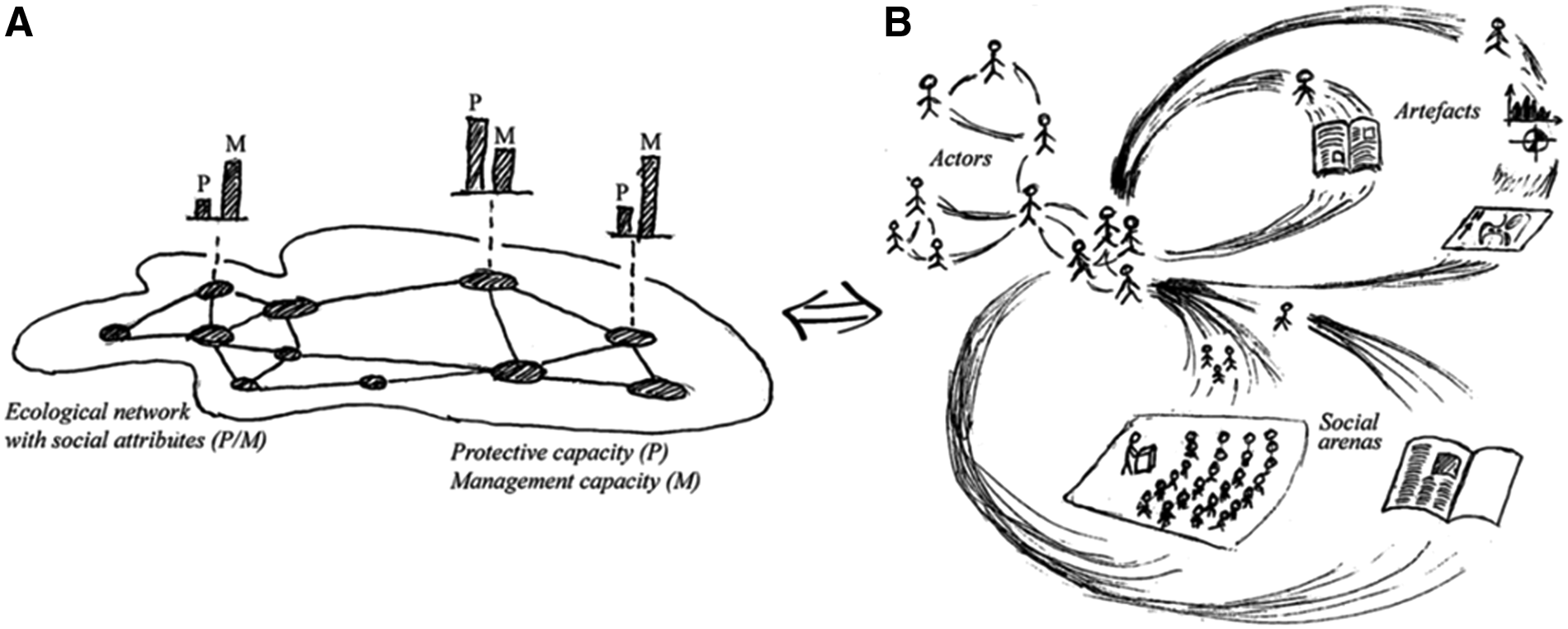
Although Ernstson describes value articulation as a political project, this politics does not contend with issues of possible displacement that could arise from the articulation and restoration of place. Apparently, the “political program” to which Ernstson refers has to do with participatory activities related solely to the creation of narratives about a place's ecological and cultural histories, which, as I argue, are crucial to effecting environmental justice; however, the potential for displacement associated with this kind of environmental decision making is not acknowledged in his theorization.
As well, in their case studies of value articulation projects, including New York City's High Line, Erixon Aalto and Ernstson 15 minimize the gentrification produced by the High Line as an inevitable consequence of market forces awakened by the creation of a narrative about the old rail line turned linear green way: “As with the stock market, expectations arising from the expected outcomes of repurposing the structure into a park…spurred development of the area which in turn gave the story [value articulation] credibility and authority.” The authors are explicit in their view that capitalistic expansion (which in this case happens to involve a displacement subtext) legitimized what for them seemed to be a mostly class and race neutral process of value articulation.
Others have also critiqued the High Line's gentrifying effects; for instance Loughren 16 describes the linear park as an example of “super gentrification” where the repurposing of space “is occurring in a context of privilege.” This depiction is in line with Checker's conceptualization of “environmental gentrification,” 17 which has to do with improving the ecological and environmental features of place, with the aim of attracting the creative moneyed classes. These improvements come with high price tags reflected in inflated real estate costs. Those who cannot afford such prices move away, and those who would have moved to these areas when prices were lower find alternative locations. 18
Central to my project is the value creation and articulation process of PCW as an important socioecological space within the larger metropolitan Atlanta context, and how this framing has been used to spur the creation of biophysical nodes in the form of community and regional parks and other green spaces within PCW. 19 Again, I also address the possible unintended consequences of this sort of value creation, specifically how residents' lack of either real property ownership or the lack of clarity of real property ownership can result in displacement. This analysis is based on a review of online press reports from Atlanta-based magazines and newspapers describing park and other green space installments in PCW from 2013 to 2019 and sociodemographic data from the Atlanta Regional Commission's Neighborhood Nexus database. Also referenced is a survey of PCW residents' (n = 135) perceptions of neighborhood social stressors 20 and open-ended interviews with an employee from The Conservation Fund and a City of Atlanta Police Department lieutenant, a 27-year veteran.
Articulation of Proctor Creek Values
PCW covers 28.6 square miles in northwest Atlanta and has a population of 127,418, the overwhelming majority of which is African American. 21 Six Neighborhood Planning Units 22 are included within PCW boundaries. For the five of these that make up the bulk of PCW, percentage African American ranges from 81.1% to 96.1%. 23 PCW is the only major watershed contained completely within City of Atlanta boundaries (Figure 2). Proctor Creek's headwaters lie beneath some of downtown Atlanta's most impressive architectural landmarks, including the CNN Center and the recently constructed Mercedes-Benz Stadium. The actual Proctor Creek is one of the city's five primary creeks that, in the late 1800’s, were used as “trunk lines” to transport wastewater from the city proper to outlying areas. 24 At that time, the city developed a combined sewer system that carried both stormwater excess and wastewater to open creek beds.

Proctor Creek Watershed. Color images are available online.
In the 20th century, the city augmented the combined sewer system with wastewater treatment facilities that reduced pollution flows into city creeks and streams; however, heavy rain events can still inundate treatment facilities, forcing a release of mixed sewage and storm water into creeks before being effectively treated by the facilities. 25 Decades of combined sewer overflow (CSO) events have resulted in impaired creeks in the watershed with elevated levels of fecal coliform counts. 26 The city has decoupled roughly 85% of its CSO infrastructure but left the system intact in the North Avenue subbasin because of extreme difficulties and costs associated with decoupling in this part of the city. 27 As a result, PCW's North Avenue subbasin is still subject to flooding during heavy rains.
The Vine City and English Avenue neighborhoods are situated in PCW's North Avenue subbasin. Both communities date back to the 19th century. In 1891, the son of Atlanta mayor James W. English purchased land west of downtown, which would eventually become the English Avenue community. It was established as a white working class community, separated by Simpson Rd. (now Boone Boulevard), from Vine City to its South, which had both white and black residents, yet racially segregated neighborhoods. After the Eagan Homes and Alonzo Herndon Homes public housing projects were completed in 1941, there was a noted increase in English Avenue's African American population, and in the ensuing decades whites abandoned the community in droves.
English Avenue's landmark grade school, English Avenue Elementary, was designated as a black school in 1951 as a result of the precipitous decline in white students and their replacement by African American children. In the 1960s and 1970s, urban renewal in the form of interstate highways and convention centers further eroded the communal sense of place that had characterized both English Avenue and Vine City. As suburban communities opened to African Americans in the 1970s, the populations in both these communities declined even more. 29 Small businesses that had catered to the working class in the mid-20th century were gradually replaced by disamenities of place, such as liquor and convenience stores. Also emblematic of this decline was the closing of English Avenue Elementary in 1995.
The overwhelmingly African American and poor residents who remained have had to contend with the pullout of private capital, eroding infrastructure, high rates of vacant and abandoned properties, and crime rates. 30 , 31 , 32 English Avenue earned the infamous moniker, “The Bluff” in recent decades, due to the openly visible heroin trading that occurred there until recently. 33 Related, Atlanta police raided the house of 92-year old Kathryn Johnston in 2006, fatally wounding her, when they mistook the residence for a drug house. The incident evoked outrage as citizens demanded policing changes. 34
In addition to these tragedies, there has also been a history of poor fiscal management on the part of both city officials and nonprofits, ostensibly working to better conditions in English Avenue and Vine City. In December 1994, the city received federal funding from the Empowerment Zone program to help improve economic and social conditions in 34 of the city's poorest communities, including English Avenue and Vine City and other PCW communities. 35 , 36 Atlanta's “Creating an Urban Village” Empowerment Zone project was funded to the tune of $250 million from 1994 to 2002 ($100 million in direct cash and $150 million for employment tax incentives). Critics charge that city administrators dispersed funds to neighborhood nonprofits with dismal fiscal management tract records that were ill-equipped to use the funds in a way to make substantial improvements, or else the money was squandered on pet projects received by inept political cronies. 37 Not surprisingly, these experiences have created a cynicism on the part of many PCW residents.
Despite such daunting circumstances, neighborhood-based groups have worked for decades to effect change in PCW. Key groups are the West Atlanta Watershed Alliance, a grassroots environmental advocacy organization started in 1995 that addresses water quality, green space provision, and environmental justice in west Atlanta. 38 , 39 Also instrumental are the Proctor Creek Stewardship Council, Eco-Action, and various English Avenue and Vine City neighborhood groups. 40 These groups were founded on and are sustained by community activists who engage fully with municipal authorities and others to highlight both the environmental deficiencies and potential in this part of Atlanta.
These organizations are not only platforms for registering complaints but also act as incubators for training citizens on how to participate meaningfully in city planning, to codesign citizen science projects, and to form cross-community collaborations. For instance, Osborne Jelks et al. concluded that a collaborative community-led study of environmental stressors in Proctor Creek “helped community residents to create a place for themselves at planning, code enforcement, and watershed management decision-making tables.” 41 Importantly, all of these activities demonstrate how the watershed's value is articulated in public arenas, the consequence of which is environmental justice in action. 42
As with the High Line, attention by elites to PCW helped to expand value creation and, importantly, backed it with private-sector capital. In 2013, Atlanta Falcon's owner Arthur M. Blank and the City of Atlanta announced that a deal had been reached by the city and the Blank organization to construct a new football stadium for the Atlanta Falcons. The $1.6 billion Mercedes Benz arena would be located within walking distance of both English Avenue and Vine City. 43 , 44 An integral component of this build out included a revitalization of Atlanta's west side communities with particular attention to English Avenue and Vine City. As of 2017, the City of Atlanta and the Arthur M. Blank Family Foundation had contributed $32 million to various west side projects. Other businesses soon followed the example set by Blank and the city. Corporate giants such as Chick-fil-A, The Coca-Cola Company, Delta Airlines, UPS, and Kaiser Permanente have all made significant financial and in-kind contributions to help improve PCW neighborhoods. In terms of public-sector investments, designation of PCW as an Urban Waters Federal Partnership watershed in 2013 brought additional water quality monitoring to west side creeks and streams. 45
As theorized by Ernstson (2013), this construction of ecological and environmental values is reinforced by attention to the historical significance of sites in the watershed. 46 In this way, relevant actors again “pick up” cultural artifacts that imbue PCW with meaning. These sites include the Atlanta University Center, where two of the most noted Historically Black College and Universities in the United States are located—Spelman and Morehouse Colleges. PCW also boasts one of the homes that Dr. Martin Luther King, Jr. lived in as an adult; Booker T. Washington High School, which opened in 1924, and was the first public high school for African Americans in Georgia; and Washington Park, established in 1919, was the first public park opened to African Americans in the city—2019 is its centennial anniversary.
Proctor Creek'S “Parks With Purpose”
PCW value articulation has contributed to either the creation or expansion of four parks in the Vine City and English Avenue communities since 2015. Vine City and English Avenue parks include Lindsay Street, Vine City, Kathryn Johnston Memorial, and Rodney Cook, Sr. The first three were designed by Park Pride, an Atlanta-based nonprofit, and later designated as “parks with purpose” by The Conservation Fund. The Conservation Fund's “parks with purpose” concept grew out of efforts to remedy CSO events that created unsanitary conditions and increase neighborhood green space in both communities. In collaboration with both communities, Park Pride created a Visioning Plan for the Proctor Creek North Avenue Sub-basin in 2010, 47 which called for green infrastructure in the form of parks, green ways, community gardens, constructed streams, rain gardens, and bioretention ponds to be installed over a 20-year period.
The Visioning Plan process began in 2009. At that time, Park Pride was working with the Vine City community to expand a small neighborhood park, primarily for recreational uses. After learning about Park Pride's work in PCW, English Avenue community activist “Able Mable” Thomas asked Park Pride to assist English Avenue with creating a community park to help address CSO flooding and recreation provision. Park Pride agreed but realized that the organization needed the expertise of a land purchasing entity (i.e., The Conservation Fund). 48
The community park goal for English Avenue began to take shape when The Conservation Fund purchased six vacant English Avenue properties in 2014. 49 However, before physical construction of the park commenced, The Conservation Fund enlisted the aid of the environmental justice advocacy group, Resourceful Communities, to help engage the English Avenue community in the actual process of community-supported park creation. Although English Avenue community members had come to trust Park Pride's approach to community engagement, The Conservation Fund had relatively little experience with direct community engagement. Given this context, the Fund recognized the need to demonstrate its collaborative community-centered approach to park development. 50
Resourceful Communities drew attention to the larger place and history of English Avenue, focusing certainly on the roles that institutional racism and disinvestment had played in creating the present-day English Avenue community but also drawing attention to alleged cronyism and community-level fiscal mismanagement. Only after these difficult truths were discussed did the city move forward with park construction.
Completed in 2015, English Avenue's Lindsay Street Park is a 1.2 acre green space containing streambed-like features that allow stormwater to infiltrate soils rather than channel to the sewer system. Central ecological features are a bioswale and rain garden with a 10,400 gallon storage capacity. The park also contains pollinator gardens and serves as a venue for primary and secondary environmental education programs hosted by science and community-based groups. In a similar way, the Vine City Park expansion completed in 2016 and Kathryn Johnston Memorial Park, currently under construction, are also “parks with purpose” that contain obvious recreational features but were also designed to capture stormwater runoff (Fig. 3).
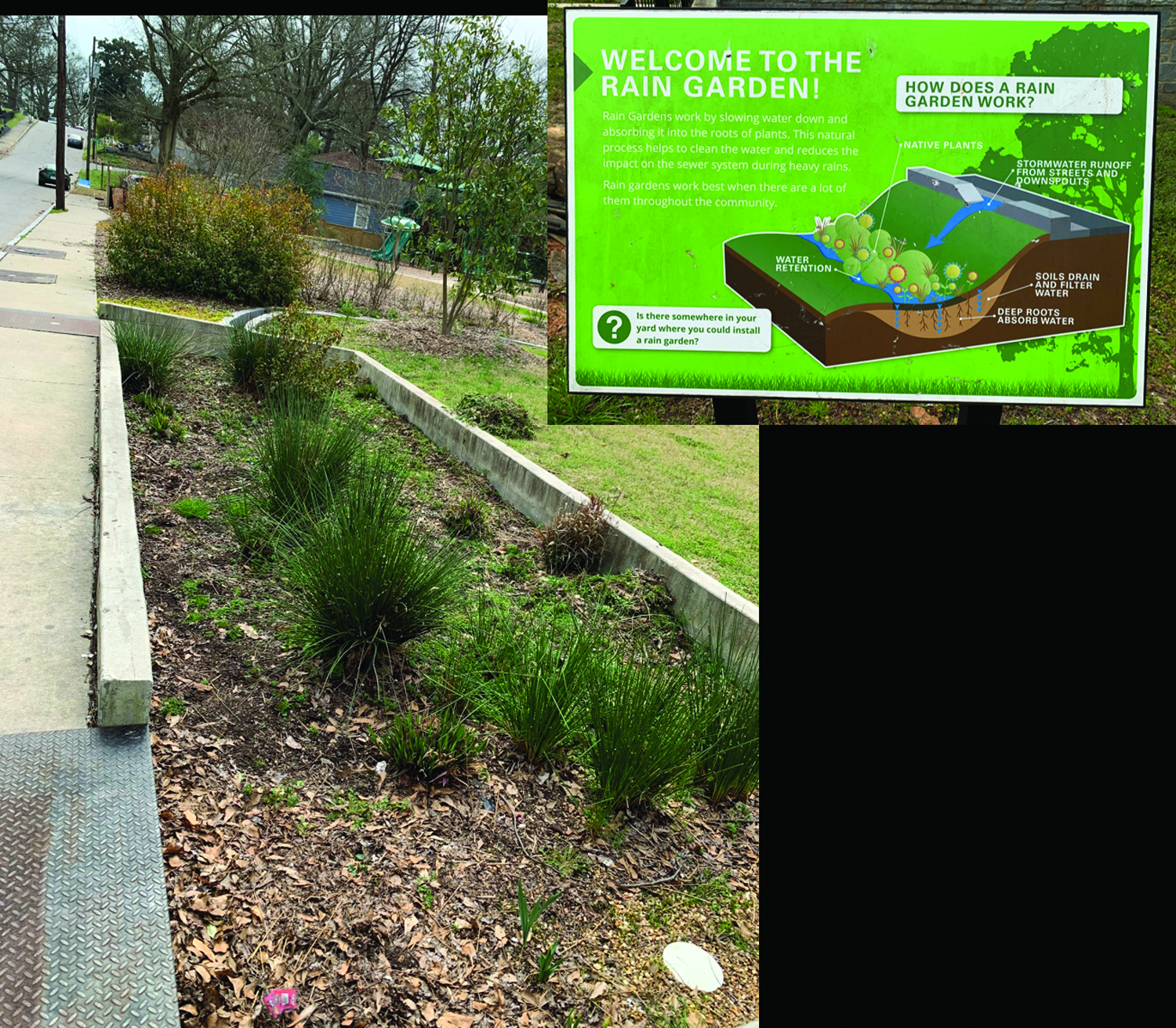
Lindsay Street Park rain garden. Color images are available online.
Rodney Cook, Sr. Park: an Emblem of “The Atlanta Way”
In 2002, roughly 150 Vine City homes were inundated by flooding. Part of that flooded area is currently under construction for the 16-acre $45 million park, Rodney Cook, Sr. Park, which honors the legacy of Atlanta's African American business leaders, civil rights icons, and Georgia's indigenous heritage. 51 The park also pays homage to the original Mims Park located in Vine City, which was designed by the Olmstead brothers at the turn of the 20th century. Mims Park is said to be the first integrated public park in Atlanta and is symbolic of what is referred to as “The Atlanta Way,” 52 or the city's relatively progressive positions on race relations during the Civil Rights era.
The current park is named for Rodney Cook, Sr. who, during the 1960s, defied Jim Crow segregationist conventions by aligning himself with the civil rights movement. The idea for the park reflects one of the last wishes of Cook, Sr. to reestablish a park in Vine City. The venture is now supported by the collaborative efforts of the City of Atlanta Department of Parks and Recreation, the City of Atlanta Department of Watershed Management, The National Monuments Foundation, The Trust for Public Land, and the mayor's office. The Cook park is not a Conservation Fund (“parks with purpose”) site. However, it is similar to the smaller Lindsay Street, Vine City, and Kathryn Johnston Parks in that it also has innovative green stormwater infrastructure, but includes a more substantive retention pond designed to contain 100-year flood waters.
Unintended Green Consequences?
Supporters of Cook park say the magnitude of the green stormwater design features will transform Vine City in much the same way that an eastside park, Old Fourth Ward, revitalized the economic and social milieu of that part of the city. For instance, Rodney Mims Cook, Jr. (son of Rodney Cook, Sr.), seemingly oblivious to the negative connotations of green gentrification, is quoted in a 2018 Atlanta Business Chronicle Interview: “Gentrification will happen [as a result of Cook Park]…tons of jobs are gonna happen, too.…It's gonna impact that area …10 times what the Fourth Ward Park did over there.” 53
Although Cook park is planned as an environmental intervention that will provide much-needed green infrastructure, its potential to displace the working class is apparent and is reflective of Gould and Lewis' 54 conceptualization of “green gentrification,” distinguished from “environmental gentrification” in that the former is instigated by nonlocal entities, whose intention is to improve environmental or ecological functioning of an area with the expectation that housing and other real estate prices will increase as a result.
Indeed, green space improvements in Proctor Creek and other west Atlanta neighborhoods have attracted much media attention, as these additions are being added to a part of the city with historically distinct architectural homes and compact street designs amendable to walking, set against a backdrop of mature canopy cover—all of which appeal to younger white middle/upper income home buyers seeking the cohesiveness of in-town living. 55 The Wall Street Journal recently quoted Atlanta's mayor Keisha Lance Bottoms' admonition to west Atlanta residents, “If you live on the Westside of Atlanta, do not sell your property right now.” 56 , 57
However, the majority of PCW residents are renters, especially those in English Avenue and Vine City. The percentage of owner-occupied households in three key North Avenue subbasin communities (English Avenue, Vine City, Atlanta University Center) is 8.8%, 16.8%, and 20.2%, respectively. 58 In 37 other PCW neighborhoods, only 4 have owner occupancy rates of at least 50%. Various sources also report that either 85% or 80% of properties in English Avenue are owned by nonresident investors, some of whom are international interests who profess little knowledge of PCW's history or current social configurations. 59 , 60 This lack of understanding makes it more likely that gentrification would proceed unimpeded because such investors are less likely to empathize with resident concerns around displacement. Related, a nationwide multiyear gentrification study found clear evidence for renter displacement in gentrifying areas, which portends upheaval for many in these west Atlanta communities. 61
A related problem has to do with property ownership, specifically titles. This is not a question of whether one rents or owns but rather the clarity of real property ownership. In cases where English Avenue and Vine City residents do own their homes, real estate attorneys caution that many property titles are “clouded,” “unclear,” or “tangled.” These descriptors refer to real property classed as a “tenancy in common” or “heirs' property.” 62 In these situations, extended family members (i.e., cotenants) own undivided fractional interests in property, but these interests are undocumented because the names of the many owners typically do not appear on titles. 63 As a result, it can be very difficult to determine who bona fide property owners are.
In urban areas, such properties tend to be derelict and sought after by property speculators adept at paying off tax liens to acquire such property. 64 To this point, a 2016 Atlanta Journal Constitution article highlighted problems with ambiguous property titles in west Atlanta and the problems this presented in terms of owner eligibility for blight remediation programs. 65 The article cites an unnamed “Blank Foundation” source that estimates title problems for as much as 60% of west side properties. 66 The lack of clear title also prohibits these owners from receiving homestead exemptions.
When heirs' property is located in highly sought after real estate markets, such as amenity-rich natural resource rural communities along the south Atlantic coast 67 or in gentrifying cities such as Atlanta, heirs' property ownership may exacerbate displacement vulnerabilities. As stated, this can happen when back taxes are owed. Individual coowners with fractional property interests may also be approached by real estate speculators or developers and who offer to purchase that coowner's interest. If the exchange is made, the new interest holder becomes a coowner with other family members and is entitled to the same access and use rights as other cotenants, regardless of the size of his or her fractional interest.
As a coowner, this new “heir” can also initiate a court suit to legally partition the property so that the heirship is dissolved and each heir receives unambiguous title to a portion of the property. If the property in question is too small to divide in a meaningful way or if for some other reason it is not feasible to physically divide the property, a court may order a partition sale of the property, often at a discounted rate. 68 In such cases, the new, likely cash-rich, “coheir/speculator” purchases the property for the asking price. 69 Because the speculator's ulterior motive was land acquisition and sales (not family land security), the property is subsequently sold at market rate. Any family members who may be living on the property are displaced, forced to leave with proceeds from a below market rate sale of their home. 70
Displacement Remedies
Small neighborhood parks such as Lindsay Street, Vine City, and Kathryn Johnston Memorial are not likely to trigger gentrification, 71 but there are greater concerns about other larger scale west side adaptive reuse projects such as the Atlanta BeltLine, 72 the seven-mile Proctor Creek Greenway, 73 and a former rock quarry being repurposed as Westside Park at Bellwood Quarry. 74 The city is keenly aware of the displacement specter accompanying west side investments and has initiated steps to minimize their impact. The mayor's $1 billion public–private Affordable Housing Initiative, which includes Displacement Free Zone legislation and the Westside Future Fund's Anti-Displacement Tax Fund program ($5 million), is intended to aid socalled legacy homeowners and renters in their ability to remain in their homes as west side revitalization ensues. 75 However, significant pieces of the renovation planned for PCW, such as the Quarry Yards residential and retail development adjacent to the Bellwood Quarry Park, are dependent upon market rate housing. 76 Some amount of displacement seems unavoidable.
The central question now is, can PCW advocates make gentrification concerns a central tenant of value articulation? Until recently, PCW's ecology and cultural history have been instrumental in efforts to create and articulate value, but that narrative must now be expanded to include protections against resident dislocation. Along these lines, Erixon Aalto and Ernstson discuss how protective narratives resulting from value articulation can be expanded into “projective narratives.” The latter moves beyond efforts to recognize and preserve nature/cultural/social aspects of place to a point where imagined futures of a place become as compelling as the natural or sociocultural features actually contained thereon. A narrative about the potential of the place develops, which is different from what is: “…protective stories can gradually become projective when they start changing the very context on which they feed, and in which they are expressed.” 77 New possibilities of place are imagined and materialized.
The environmental and sociocultural values of PCW have been well articulated. Now, to help minimize gentrification creep, an equally evocative antidisplacement narrative needs to be constructed that frames the black exodus from west Atlanta as a gross injustice—in other words, an antidisplacement agenda becomes a logical extension of green space and social cultural preservation in PCW. This assertion is consistent with Anguelovski's 78 and others' arguments that longtime residents of gentrifying places, through their endurance, have earned a “right to the city,” and indeed a right to remain in their neighborhoods, not necessarily because they have made financial investments in these places but because they have invested a good portion of their adult lives working to remake their communities into more hospitable places: “It is the right of the people who inhabit [emphasis added] the city, not of those who own it.” Implied here is a distributional equity that goes against status quo assumptions that the market dictates who gets to occupy a space, or to decide what is fair based on a money metric.
To accomplish this goal of remaining in situ, residents must again enlist the help of influential others such as the city government. As discussed, this alliance has already manifested in the form of the mayor's Affordable Housing Initiative and the WFF's $5 million Anti-Displacement Fund. Also, the Atlanta BeltLine, Inc., has promised to provide affordable housing along the BeltLine, including areas in south and west Atlanta although that organization has been roundly criticized for failing to deliver on that promise (see Immergluck and Balan, 2018). Just recently, however, the organization announced plans to provide $11.9 million in affordable housing adjacent to the BeltLine. 79 Mayor Bottoms is quoted in that article 80 as saying that the aim of this funding is “to truly protect Atlanta's legacy residents from being priced out of the very communities they built.” For now, public sentiment and both public and private dollars undergird PCW's emergent antigentrification projective narrative. Whether this coalition holds in the face of market pressures and changing demographics remains to be seen.
Another way that PCW's future could play out in an alternative manner is by an embrace of gentrification, to some extent. Hamilton and Curran describe how longtime working class environmental activists in Greenpoint, Brooklyn, were able to make use of “gentrifier-enhanced activism,” to bring broader attention to and redress of contaminated waterways in that community. 81 Enlisting the aid of these newcomers helped Greenpoint to avoid absolutist scenarios, where either the environmental remediation continued and the working class was displaced by newcomers or the cleanup was halted (and the waterways remained contaminated) because of fears that gentrifiers would take over. 82 Rather, seasoned activists stood firm in their position that they would remain fully engaged in environmental decision making, but drew on the talents of others to create a sufficiently “green enough” community, 83 thereby creating a synergy and leverage that was more effective in achieving their goals. A subtext in the Greenpoint case, however, is that the coalitions forged were mostly across class lines. In the case of PCW, both class and race lines would need to be bridged, which may prove to be a more daunting task.
Footnotes
Author Disclosure Statement
No competing financial interests exist.
Funding Information
This research was funded by the USDA Forest Service.