




Abstract
Abstract
This essay highlights how a women's grassroots political movement reframed migrant laborers in the minds of white Christians from outsiders to value producers. During the 1950s, Christian women in Wisconsin organized to establish more equitable labor conditions for migrant laborers. Wisconsinite women created religious-based organizations that focused on addressing social, political, and educational concerns. This was a means for them to be politically active despite their marginalization within the predominantly male political realm. Women worked to pass legislation that created summer programs to address the unsanitary and dangerous living and working conditions of migrant farmworkers in their communities. They were motivated by a religious desire to assist migrant families, and, in turn, communities witnessed the economic value of their labor in the community. Despite their wish to do good works, Christian women faced interdenominational conflict in the migrant aid movement. As different denominations used their charity for proselytization, the governor's office pursued a secularized version of their relief efforts.
Introduction
The December 1954 edition of The WCCW Informant, published by the Wisconsin Council of Catholic Women (WCCW), discussed moral issues that beset the religious community. One article told the long history of Catholic women in Wisconsin. Another wrote in support of Native American missions in the state. Nestled in the pages of the organization's routine debates rested something more surprising for 1950s culture—a scathing condemnation of food dyes and pesticides by Mrs. J.F. O'Connell. O'Connell protested the use of “coal-tar dyes” in cosmetics and food. She also excoriated farmers for their “carelessness” in spraying “the new wonder bug-killers on fruits and vegetables.” 1 The next article in the Informant, “Dignity for ‘Strangers within Our Gates,’” highlighted a social justice issue in Wisconsin. The author, Angela Esser, elucidated the moral imperative among Catholic women to improve the working conditions of migrant laborers the fields. Esser stated, “Where you have migrant camps in the community you have a Human Rights project on your doorstep.” 2 How did the WCCW, a politically conservative organization of Catholic women, develop such a strong connection between the natural world and the plight of migrant laborers?
Women had real authority when it came to issues of environmental justice in the 1950s. Although their power may not have been overt, women influenced politics as consumers, in choosing what they purchased for their homes and through grassroots organizations where they established extensive political networks. 3 In addition, women became aware of important environmental debates surrounding the safety of food. Organizations such as the WCCW became cognizant of the fact that food manufacturers added artificial ingredients to their groceries and growers sprayed their fields with chemicals. In turn, they used their expertise and joined with the Wisconsin Governor's Commission on Human Rights (WGCHR) to protect migrant laborers from pesticides and to promote healthier nutrition.
Recent scholarship has shown how Midwestern Catholics transitioned from viewing nature as an oppressive space to a space of social justice. When Irish and South Americans immigrated to the United States, they often remembered nature as a space of serfdom and misery. 4 By the 1930s and 1940s, the Church tried to change this through the National Catholic Rural Life Conference (NCRLC), which created a synthesis between Catholic and environmental thought. 5 In addition to the NCRLC, which still largely existed as a politicized space for men, groups such as the WCCW aided in the transition of Catholic thought toward the environment as a space of social justice. Initially working with state-run organizations, the government eventually grew tired of interdenominational bickering and made the program secular, but for a time, religion was the primary way Wisconsinites were connecting the environmental impact of pesticides to the social justice issue of fair working conditions for migrants.
Discussion
Catholic women created the WCCW in 1915 to “secure mutual counsel on religious, civic, educational, cultural, philanthropic and social welfare activities.” 6 In a 1956 gathering of the WCCW, Mrs. Raymond T. Stark emphasized the mission of this organization. “We gather because we realize…that in unison there is great power for good especially on a State level. If we stand alone and protest or accede, it's like a voice in the wilderness—but the voices of 50,000 women carry tremendous weight and is a potential force in the life of today.” 7 This organization composed of Catholic women, and led by Catholic women, used its platform to promote social welfare projects and to remain involved in state politics.
The WCCW may have been concerned with souls, but they were also fundamentally concerned with material bodies. Many of the WCCW's members were interested in combating legislation that deregulated food safety standards. In a 1952 report on food legislation, the WCCW was outraged by bills that attempted to “place Wisconsin standards below the Federal level of food regulation.” Furthermore, they were distressed by the types of ingredients that corporations added to their consumer goods. “704 chemicals” had been applied to produce with “only 428 are known to be safe.” This made the council see a correlation between “the growing number of mental diseases” and “the many new chemicals used in our foods.” 8
The WCCW also pushed for food manufacturers to use only organic ingredients in their products. In the early 1950s, mothers noticed that bakers replaced “fluid milk, butter, eggs, essential oils, and organic materials,” for emulsifiers in their cakes. 9 Fear of inorganic materials contributed to a larger concern over the use of pesticides, especially the organic synthetic compound Dichlorodiphenyltrichloroethane, commonly known as DDT. Before Rachel Carson made DDT famous in Silent Spring, Catholic women warned families about the dangers of DDT on foods. As WCCW contributor Regina O'Connell wrote in the Informant, “Some of the new chemicals reach our food indirectly through the use of insecticides and fungicides.” O'Connell continues, “It was not realized until recently that DDT will store itself in the body fat and can, eventually, have a cumulative and serious effect on the liver.” 10 This chemical not only impacted the people who ate the fruits but also those who picked the food. As a result, the WCCW's social activism efforts increased for migrant farmworkers in Wisconsin.
Over the course of the twentieth century, migrant laborers found opportunities working on Midwestern farms. Since 1890, Mexican Americans worked as sugar beet harvesters east of the Rocky Mountains. 11 In succeeding decades, waves of Mexican nationals turned to the United States because of political strife during their country's revolution in the 1910s. The peak migration to the Midwest occurred in the 1920s as demand for industrial workers increased. However, the Johnson–Reed Act of 1924, exacerbated by the Great Depression, legalized the deportation of >500,000 Latino laborers in the United States during the 1930s. The yo-yoing effect on migrant labor populations again bounced up with the start of World War II. The draft and enlistment of American men created a significant labor shortage throughout the United States, primarily in the agricultural sector. 12 To fill this void, landowners requested the federal government create a method to readmit Latino laborers back into the United States.
During the postwar period, as landowners increased demand for Latino laborers, most Texas migrants followed a circuitous path on their way to Wisconsin. Migrants typically left Texas at the beginning of the summer and traveled to Montana for the sugar beet harvest. At the close of sugar beet season, migrants traveled to Wisconsin to pick cherries. After their time in Wisconsin, other Great Lakes states needed tomato pickers, so laborers then traveled to Ohio or Indiana, before heading back south to Texas for the fall. 13
In scenic Door County, cherry orchards always needed pickers, but in 1948 the first massive influx of Chicano and Mexican laborers arrived for the summer harvest (Fig. 1). Upon their first entrance into the state, many Wisconsinites became concerned by the flood of outsiders filling their towns and the initial reaction from many of the restaurant owners was to segregate and hang signs reading “For Whites Only—Negroes and Mexicans Not Admitted.” 14 Migrant laborers lived in segregated camps that were rife with illnesses from tuberculosis to sexually transmitted diseases. Regardless of these appalling conditions, business owners did not believe that their customers would be open to sharing spaces with farmworkers.
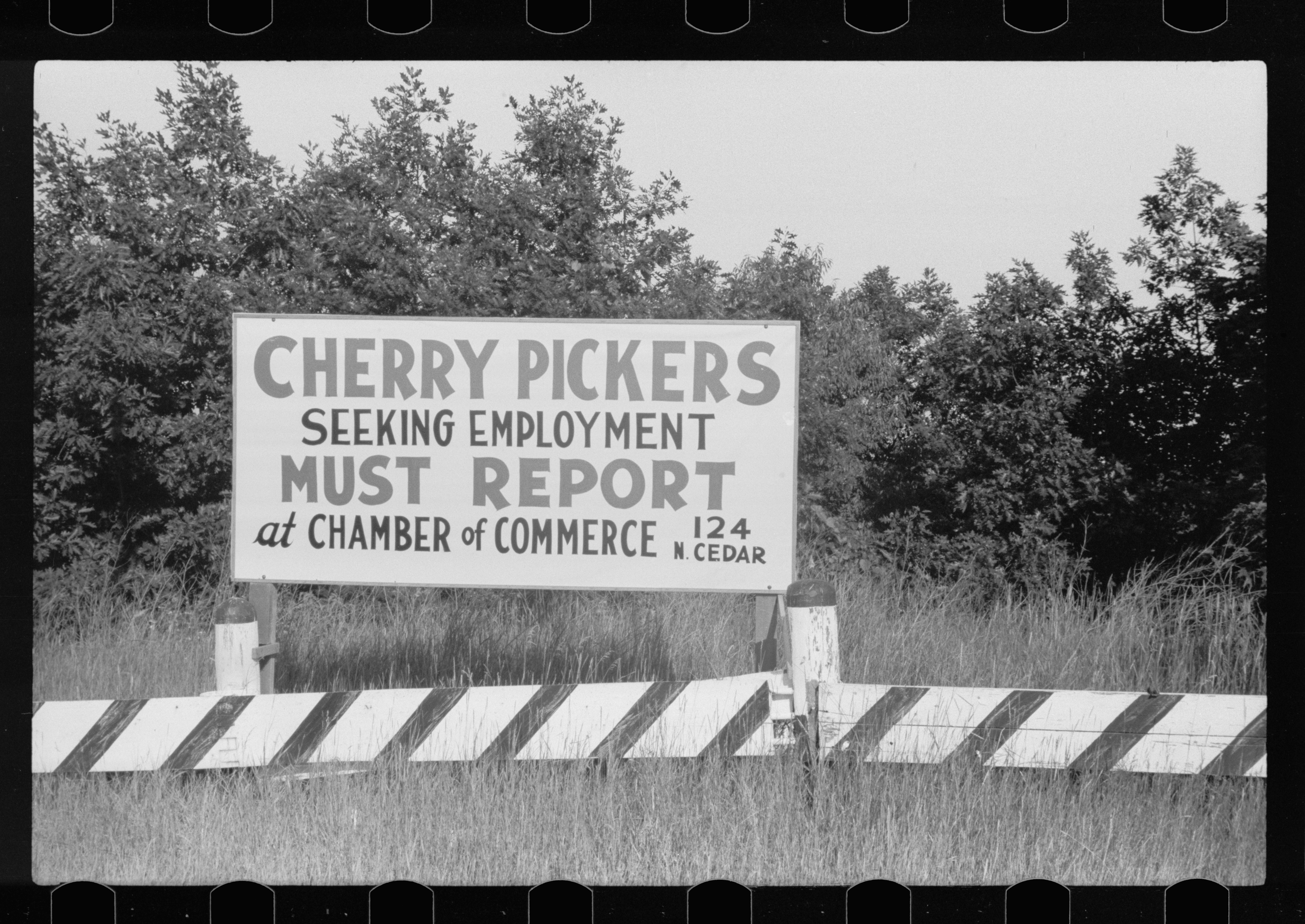
Sign on road into Sturgeon Bay, Wisconsin. Photo by John Vachon. Courtesy of the Library of Congress.
Despite the xenophobia from many Wisconsinites, the WGCHR stepped in due to the importance of laborers for the harvest. The state government created the WGCHR to exert its “energies to the elimination of all discriminatory practices.” 15 During the state's centennial in 1948, the government created this organization because “Wisconsin is a proud state. Out of differences has sprung strength…Of varying religious, national and racial backgrounds, these people have made their contributions… In turn, each one deserves appreciation from the others and the right to live a full life of citizenship.” 16 State officials created this commission with the belief that they could incorporate civic and religious groups to promote its cause. By 1950, Rebecca Barton, the director of the WGCHR, reflected these sentiments and utilized the networks of church women to establish social services for migrant workers and especially for the mothers and children of these families.
The WCCW and the Wisconsin Council of Christian Women worked with the state-run WGCHR to discuss the importance of migrant laborers. Barton held a committee meeting about creating migrant programs to ensure that they would “return from year to year and be satisfied.” A “Miss Bangham” wanted to establish a migrant program “to help Texas Mexicans become better Americans.” 17 In an editorial regarding migrant labor, A.L. Beier, a public servant in the division of public information for Wisconsin, articulated, “If we use these migrants for profit from their labor, there is an obligation to treat them well…Their health, welfare and conduct, then become matters of common concern.” 18 By framing migrant laborers as an essential facet of Sturgeon Bay's economy, Door County residents battled segregation, updated camps, and offered medical care for these families (Fig. 2).

Cherry pickers getting off truck that brought them back to camp, Sturgeon Bay, Wisconsin. Courtesy of the Library of Congress.
The Council of Church Women sought to provide for the needs of migrant families. Church women operated a rummage sale each year for migrant families to have access to newer clothes. The proceeds from these sales went to updating facilities and communal kitchens. Church women from different denominations educated children and offered a schedule that provided them a chance to make crafts, receive religious instruction, and learn English. On the weekends, they organized dances and outdoor recreation at the ballpark. 19 Wisconsin became a desirable destination for migrants because of the activities and opportunities to catch up with their friends and family. 20 Furthermore, the home mission council of Wisconsin brought in film projectors so that families could enjoy movies. These programs sought to Americanize migrant laborers and assimilate them into society.
The WGCHR also wanted migrant laborers to maintain parts of their cultural identity. Barton encouraged grocers in the area to stock foods that Latino families used for their recipes. This had multiple impacts. Grocers that carried staples such as tomatoes, eggs, beans, and spices saw a significant increase in profits during the summer months. One storeowner decided to reopen her shop after the workday was done and “stayed open until one o’ clock, doing a three-hundred-dollar business with the Nationals.” 21 Consequently, migrant laborers provided a boon for the economy, not just by picking cherries but by spending dollars at local businesses. Catholic women held a cooking demonstration where they highlighted Mexican cuisine and migrant women had a chance to highlight their prowess as chefs. This event was a huge success as it built up “the inner feeling of being needed and wanted” in the community. 22
In regard to sanitation, the WGCHR proposed legislation for cleaning up migrant workers' lodging. In 1951, the state legislature and the Board of Health passed Bill 597S that stated growers needed to agree to establish “health and housing standards for these camps and even require penalties for non-conformity.” 23 In Waupun, Wisconsin, Mrs. Harmon Hull reported that the impact of this bill lessened “the necessity for local emphasis on measures to improve housing, sanitation and living conditions” due to aid granted by the state. 24 Barton and her team wanted the state to pass a series of bills using both state and federal funds to increase the quality of life for migrant laborers (Fig. 3).

“These are the children” brochure by the WWC. Courtesy of the Wisconsin Historical Society. WWC, Wisconsin Welfare Council.
Beginning in the latter half of the 1950s, the WGCHR pushed to secularize the human rights commissions due to a dispute brewing between Catholics and Protestants. Even before Wisconsin had sought to improve the conditions of migrant laborers, the Catholic Church maintained a powerful control of the social programs that assisted migrants in Wisconsin. This was a pattern that permeated the Midwest, as priests and lay Catholics established programs and fought for sanitation standards. The Catholic organizations had an advantage over Protestant groups because they already had a structure that unified every region of a state into a single body (Fig. 4). The women of the WCCW developed chapters throughout Wisconsin that could coordinate and assist with issues in any other part of the state. This model worked in conjunction with Wisconsin's five Catholic dioceses in an effort to create a bureaucracy for organizing their charitable works. 25

Image of the 1957 Annual Wisconsin Council of Catholic Women Meeting. Note the districts and chapters throughout the state. Courtesy of the Wisconsin Historical Society.
In contrast, the various denominations of Protestant Christianity created a loose confederacy of women in the Wisconsin Council of Christian Women. Baptists established their own camps whereas Methodists held Sunday schools for migrants, but they did not have the same large-scale coordination as the WCCW. Once the state government endorsed the passage of a human rights commission, Christian women now had the same ecumenical platform to share their collective energies on social and environmental justice issues. Catholics bristled at this notion because they already had a structure in place that could assist migrants, who predominantly identified as Catholic. Why would they need to share their social support and religious programs with Protestants, who in the eyes of many Catholics, wanted to use these programs to convert Latino workers to Protestantism? In a report by the WCCW's Human Rights Committee, they issued a warning about the influence of Protestants. “We must be vigilant,” the memorandum read, “As you know, there are camps in Wisconsin where the Baptist Mission has taken over completely and a report from Minnesota shows that there are two to one non-Catholic against Catholic workers in their camps.” 26
The WCCW rejected the state-run WGCHR's plan to make migrant aid ecumenical. WGCHR worker Ruth Braun complained that Catholics seemed “to think that they are the only ones who can, must or should have anything to do with these families.” 27 In another letter, Braun wrote, “The Catholics have been so used to handling the migrant situation for so long that they resent anyone else's even being interested.” 28 However, Protestants were not blameless for manipulating this state sponsored program. In a letter from Barton to Fr. Richard Gilsdorf, who was the Catholic priest responsible for the diocese migrant ministry, she acknowledged that Protestant ministers sent evangelical “mission workers to staff the schools,” and that they attempted to teach children English with materials that were “more anti-Catholic than pro-Christ.” 29 Consequently, the state stymied attempts by Christian denominations to use state funds and increasingly secularized human rights projects.
These religious groups planted the seeds of environmental justice that took root in the United Farm Workers movement of the 1960s. During the 1960s, the WCCW joined the National Council of Catholic Women. In 1967, the WGCHR merged with the Equal Opportunities Division and the migrant labor camp regulations became represented by the Department of Industry, Labor and Human Relations Safety. 30 One of the changes that persisted through the shifts and tumult was the care and concern of migrants. These organizations of women fought for migrant rights over a decade before the United Farm Workers drew national attention to the abysmal working conditions in the fields. 31 Christian women in Wisconsin had sown the seeds of justice that found new life with Cesar Chavez's call to boycott produce riddled with pesticides. They had already engaged with the imperative idea to help migrant laborers and to provide for their families with safe and chemical-free food.
Conclusion
During the 1950s, Wisconsin Christian women's organizations accomplished something extraordinary. As a politically marginalized group, they put forth concerns about the chemicals in foods and in the treatment of workers disregarded by society. The religious WCCW and the government-funded WGCHR collaborated to ensure that migrant families had access to healthy nutrition, safe housing, and education for their children. Although religion brought women together to pool resources and volunteer to run programs for the less fortunate, quibbles concerning proselytization created controversy and ultimately weakened their ability to promote social and environmental justice. Regardless of the interdenominational conflict that interfered with the migrant camps, it is important to note the efforts that went into welcoming migrant laborers because of the economic boon that followed them. In the words of Sturgeon Bay mayor Stanley Greene, “You can't escape the fact that there are factors that motivate people besides Christian charity. People who object to the color of an extended hand don't mind half so much when it holds a greenback.” 32
In the current political climate where politicians push to build walls, it is important to reflect on the benefits that follow migrant laborers. Their presence contributes to the economy and enriches the cultural flavor of a community. Furthermore, for Christians denying refugees entrance into this nation, the example of 1950s Christian Wisconsinites' response to migrants should embolden religious communities to consider the less fortunate as their responsibility. In exploring the harmful effects of chemicals, religious women also became more compassionate about the laborers who provided their food. It would benefit us to once again focus on the dignity of the “strangers within our gates.” 33
Footnotes
Acknowledgments
I thank Jim Danky, Lee Grady, and Anna Palmer for assistance with research, as well as the anonymous reviewer, Kathleen A. Brosnan, and Courtney Buchkoski for reading drafts of this essay. I would also like to thank Jonathan Senchyne for assistance with research.
Author Disclosure Statement
No competing financial interests exist.
Funding Information
This essay was made possible by the James P. Danky Fellowship in the University of Wisconsin-Madison's Center for the History of Print and Digital Culture and in conjunction with the Wisconsin Historical Society.