




Abstract
Abstract
This study examines the association between park characteristics and frequency of park utilization for exercise and recreational walking. For this purpose, the survey was conducted among adults living in four neighborhoods of Bandar Abbas city, Iran. Five hundred questionnaires were distributed among the participants, of which 442 were qualified to be used for further analysis. Further recorded were the observation data using the Environmental Assessment for Public Recreation Spaces instrument from the parks noted by the respondents (n = 21). Using logistic regression, the findings revealed that park characteristics including facility, amenity, safety, size, and proximity were associated with higher park utilization for exercise walking. In addition, park characteristics such as facility, amenity, safety, esthetics, and proximity correlated with higher park utilization for recreational walking. The findings from the study confirmed the association of park characteristics with exercise and recreational walking. It can be concluded that enhancing the quality of parks can be highly conducive to higher park-based walking activity in the neighborhoods.
Introduction
Exercise and recreational walking, the most common type of physical activity, is mostly observed in public open spaces, 1 which help promoting physical health. 2 However activity levels have become inadequate or even decreased over the recent decades in many countries, 3 including Iran. 4 Providing such spaces with additional features may increase park usage or the amount of physical activity, 5 while the higher frequency of park visitation affects health and well-being. 6 Parks and urban green spaces are important factors for the quality of life and promoting environmental justice. This evidence highlights the significant role of public open spaces in enhancing physical activity levels. 7 However, the rapid growth of cities and urban areas, particularly in developing countries, has reduced the amount of public open spaces (e.g., parks) over the last decades, causing these spaces to shrink or turn into leftover spaces. 8
On the contrary, the mere presence of parks may not motivate people. Park characteristics such as size, safety, esthetics, facility, and amenity have been found to motivate people. The results, however, are inconsistent across communities. 9
Although a growing body of literature has examined the association of park characteristics with the level of physical activity, to the best of our knowledge, this body of work has certain gaps. The majority of studies have examined the influence of nearest parks from the house on the residents' physical activity or parks within specific walking distances, which may not reveal the real park-based activity of residents. 10 People may go to parks outside of their neighborhoods or may go to more than one park for different purposes. Many studies have considered overall physical activities or any type of activity, which may not be necessarily done for physical purposes. 11 On the contrary, a limited number of studies have considered the association of specific park features with any recreational activities in parks. 12 Besides, most of the studies have been performed in developed countries, and there are few studies among developing countries in Asia such as Iran. 13 Therefore, this study aimed to determine the extent to which the proximity of parks to the resident households, number of park features, park size, park safety, and park esthetics in the context of Iranian neighborhoods influence the use of parks for specific type of physical activity, including recreational and exercise walking.
Methodology
Study design and participants
This study was conducted in Bandar Abbas, Southern city of Iran with population of ∼0.54 million, considered as a medium-sized city. The largest neighborhood of the town is ∼1,800,00 m2 and the smallest one is ∼70,000 m2 (The neighborhoods are defined based on the classification of municipality of the town). Four neighborhoods of the town were selected based on the features of their parks (Fig. 1). The size of the neighborhoods is between 600,000 and 160,000 m2. As a coastal city, the coastal line of Bandar Abbas covers some large parks that attract many of the citizens.
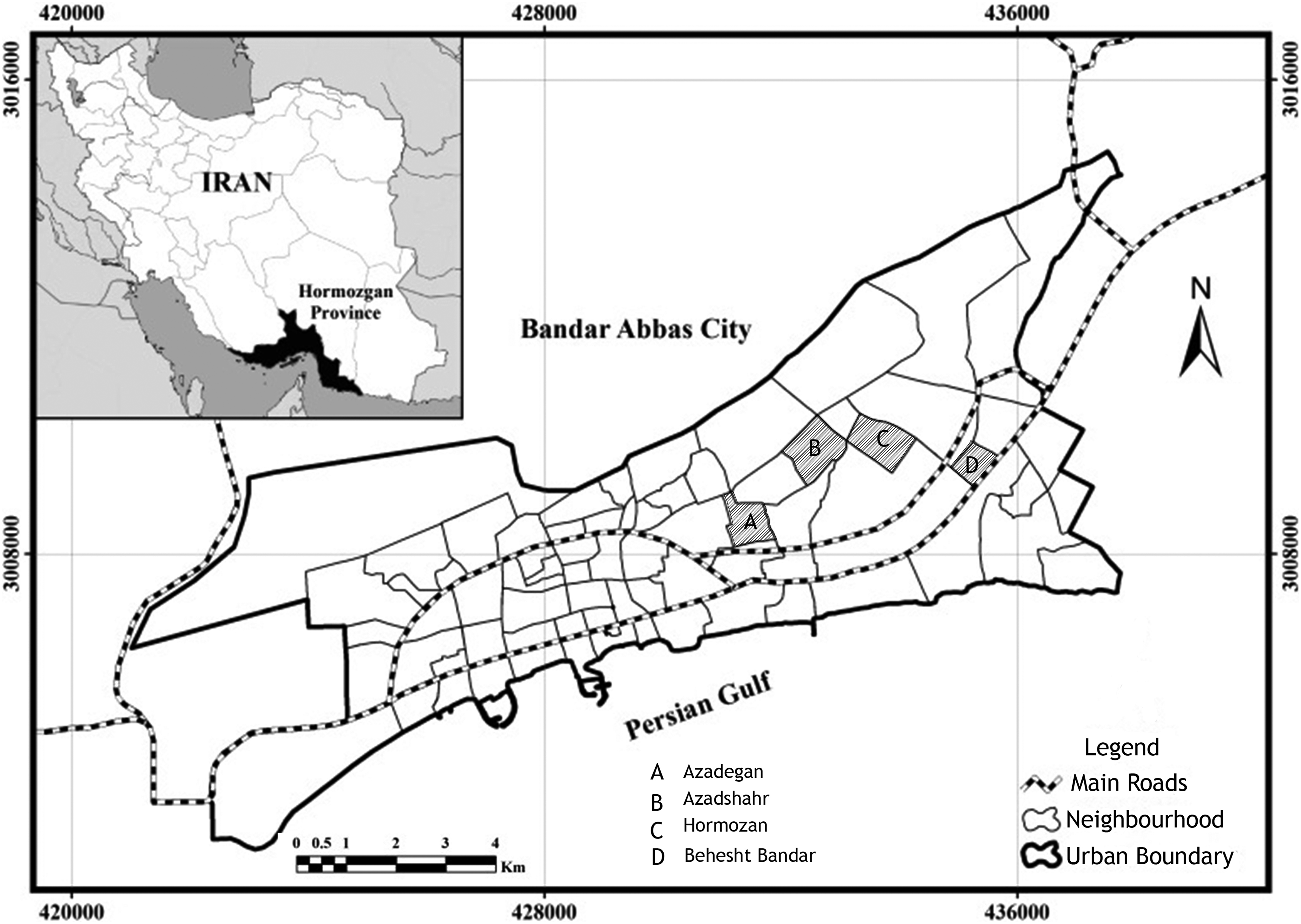
Bandar Abbas city map and location of the selected neighborhood.
Data collection and measures
The survey was conducted from April to May 2016 to evaluate the park-based walking habits of adults living in four urban neighborhoods in Bandar Abbas city. A total of 500 questionnaires were distributed in the 4 neighborhoods based on the number of households living in each area using systematic sampling (Azadegan: 165; Behesht Bandar: 170; Hormozan: 87; Azad Shahr: 78). So first unit in each area was selected at random (the first one that the residents have desire and willingness to participate in the study), and other units were selected systematically. This systematic sample is called kth systematic sample, and k is termed as sampling interval. The systematic sampling allowed the researcher to estimate the distance from the residents to the selected parks in each neighborhood. Two trained research assistants distributed the questionnaires door to door to adults (>18 years old) and explained the purpose of the study. From each selected household, one resident was randomly chosen to participate in the research. After around a week, trained research assistants returned to collect the questionnaires, with only 461 questionnaires collected for further analyses.
Park selection and frequency of park visitation
The participants in two open-end questions were asked to name the most common parks they usually go (on foot or by car) for exercise walking (defined as walking for the purpose of health and fitness) and recreational walking (defined as a type of walking for recreation, refreshing, relaxing, socializing, or taking kids for playing).
After that, the respondents were asked to rate the frequency of park visitation for each purpose (walking for recreation or exercise) separately with a five-point ordinal answering scale “1 being every day to 5 being once a month or less.” The items were reverse coded before the analysis.
Park features
All required data on the parks' features were collected using the Environmental Assessment for Public Recreation Spaces (EAPRS) instrument, which has been shown to have good inter-rater reliability, particularly for facility and amenity presence. 14 The features were categorized into two groups, amenity and facility, for the purpose of recreational and exercise activities. Facility includes features that could increase the chance of recreational and exercise activities in the parks, including walking trail, paths, open space, inflatable game, playground, soccer pitch, basketball and volleyball courts, athletic instrument and bike lane (n = 10). The amenity includes the features that might support opportunities for recreational and exercise activities such as bench, trash can, table, picnic area, shelter, restroom, landscaping, parking lot, sidewalks into parks, drinking fountain, roadways through park and café (n = 12). All the parks noted by residents for exercise or recreational walking in their neighborhoods were audited by two trained research assistants. The inter-rater reliability of the presence or absence of features observed by both raters was 0.76. The features did not vary in cleanliness and condition since the study only considered the count of facilities and amenities in each park.
Attractiveness and safety of the parks
The attractiveness and safety of the parks were subjectively measured by the first author and one of the trained research assistants by observing each park condition separately. The parks that were noted by participants were audited (n = 21). Attractiveness was computed using the mean score of 5 attributes, including the landscape of the parks, the presence of trees, the water features, the presence of any features and cleanliness of the area from litter. The safety of parks was rated from very poor to very good using the mean score of 4 attributes, including lighting, signs of graffiti and vandalism, visibility of park due to the presence of overgrown and shrubs, and visibility of the park from the surrounding roads. The inter-rater reliabilities of esthetics and safety of the parks rated by both raters were 0.83 and 0.80, respectively.
Park size
The information of parks' size for each neighborhood was gathered from the municipality's database (parks defined as a subset of public open spaces, which include spaces for sitting, playing, and socializing).
Park proximity
It was estimated by asking the respondents how long it would take them to walk from their home to the nearest park. This item was adapted from the Neighborhood Environment Walkability Scale (NEWS). 15
Sociodemographic variables
The participants were asked to report the demographic information of their household such as gender, age, the number of kids under the age of 12, and marital status.
Analysis
Questionnaires for the following respondents were excluded from further analyses: the respondents who had missing values in naming the places where they frequently went for exercise or recreational walking (n = 16), and the respondents who were <18 years old (n = 3). Finally, 442 participants remained as the sample participants.
The data were analyzed using SPSS version 22. Descriptive statistics were used to show sociodemographic information of respondents and the frequency of park visitation for each purpose. The multiple logistic regression was used for each of the two dependent variables (frequency of park visitation for recreational walking and frequency of park visitation for exercise walking) to investigate the association with park characteristics. The models for each included sociodemographic variables as control variables. The first model for each included park facility and park amenity (as count of facilities/amenities), the second model included park safety, the third model included park esthetics, the fourth model included park size, the fifth model included park proximity, and finally to determine whether there are five separate processes at work or if all five theoretical models are explaining the same phenomenon, a final set of regressions were run to control for the effects of the other models. In all, there were 12 logistic regression models. The control variables in the regression analyses include gender, age, having kids in the household, and marital status.
Results
Most of the participants considered the parks in their neighborhoods (n = 302). A substantial proportion of the participants (n = 109) noted the coastal parks of the town (the closest coastal park to all the four neighborhoods) as a destination for exercise or recreational walking. Besides, a small number of participants preferred the parks outside of their neighborhoods (n = 31). As shown in Table 1, more than half of the participants were female, with ages ranging between 18 and 76 years, with a mean age of 33.6 (standard deviation = 11.48). Most of the respondents were married and had kids <12 years old in their households. More than 70% of the respondents visited parks at least once in a week for exercise and recreational walking.
Characteristics of Respondents
Some respondents did not respond to the question.
A total of 39 parks were located within their neighborhoods, 15 of which were noted by respondents as the most common destinations for park-based walking activities. The largest regional park of the town covering 2.5 km length of the coastal line, which is the nearest coastal park to all the four studied neighborhoods (average distance from four neighborhoods: 2800 m), was mentioned by many of the respondents as well. In addition, five noted parks were located outside of the neighborhoods.
A total of 8 parks (6 within the neighborhoods, 1 outside of the neighborhoods, and the coastal park) were considered by respondents for exercise walking, while 20 parks (15 within the neighborhoods, 4 outside of the neighborhoods, and the coastal park) were noted as the recreational walking destination. The size of the parks mentioned by respondents ranged from 0.6 to 21.81 hectares, with a mean size of 1.38 hectares.
In the 21 parks, playgrounds were among the most common facilities (in 20 parks), followed by path (in 18 parks), open space (in 15 parks), athletic instruments (in 12 parks), walking trails (in 7 parks), inflatable games (in 5 parks), basketball courts (in 5 parks), and volleyball courts and bike lanes (in 2 parks). Concerning amenities, bench and trash can (in 21 parks), and adjacent sidewalk (in 18 parks) were the most common amenities considered in the parks, followed by roadways through parks (in 15 parks), landscaping (in 14 parks), parking (in 8 parks), cafés (in 3 parks), tables, drinking fountains and restrooms (in 2 parks), and shelter and picnic spaces (in 2 parks). The coastal park and one of the parks within 400 m of the Behesht Bandar neighborhood covered all the facilities and amenities examined in this study. Results indicated that exercise and recreational walking activities were mostly performed in parks where facilities and amenities were provided.
Tables 2 and 3 display multiple regression results, controlling for the demographic variables. The first set of six regressions were run with a frequency of park visitation for exercise walking as dependent variable. The results of Model 1 indicated that the increase in the number of facilities and amenities in the parks rises the likelihood of exercise walking by 1.5 times. Moreover, the results showed that proximity to the parks and safety in parks increased the odds of choosing the parks for exercise walking. Larger parks further increased the likelihood of using parks for exercise walking. In addition, male participants were more likely to select parks for exercise walking. In Model 6, in which all park characteristics are included, the results indicate the association of facility, amenity, safety, size, and proximity with park utilization for exercise walking.
Ordinal Regression Analysis for Predicting Park Visitation for Exercise Walking
p < 0.05; **p < 0.01.
Ordinal Regression Analysis for Predicting Park Visitation for Recreational Walking
p < 0.05; **p < 0.01.
The next set of regressions were run with a frequency of park visitation for recreational walking as dependent variable. The results indicated that higher number of facilities and amenities in the parks increases the odds of using parks for recreational walking by ∼1.2 times. In addition, parks with higher safety and esthetics were more likely to be visited for recreational walking. However, park proximity negatively associates with recreational walking. Older people were more likely to use parks for recreational walking. Model 12 includes all park characteristics, where safety, esthetics, and proximity to parks positively correlate with park utilization for recreational walking.
Discussion
This study investigated park-based walking behavior in residential neighborhoods in Iran, where certain park characteristics were associated with the frequency of park visitation for exercise and recreational walking. It was observed that all the parks within the neighborhoods were utilized for the purpose of recreational walking. However, the parks with specific features and sizes were selected by residents for exercise walking. The difference may be justified by the nature of the walking pattern in relation to the aim of the walkers. People generally prefer accessible and near places, while recreational walking mostly happens during leisure time, when people want to spend their time to refresh or socialize. Visitors tend to prefer larger parks with more activities when spending leisure time with their families or friends. The elderly and those with children in their households may choose nearer parks, but young people may select parks with better facilities.
In support of previous studies, we observed that features such as facilities and amenities increased the likelihood of opting for parks for exercise and recreational walking. 16 This finding suggests that increasing the quality and number of park characteristics may augment park visitation.
Utilization of parks for exercise walking is more common than recreational walking in parks with more park features, while general facilities have a stronger relationship with exercise walking compared with amenities. Better understanding of park facilities and amenities conduces to designing parks within walking distances, determines the park facilities and amenities contributing to specific park-based walking, and helps understand how park-based walking can be improved among residents.
We found that park esthetics associated with higher utilization of parks for recreational walking, 17 but not for exercise walking. This finding suggests that there are more important features than park esthetics for park utilization for exercise walking, while this park characteristic increases the use of parks for recreational walking. In addition, park safety is considered as a great factor for park utilization for both exercise and recreational walking. 18
In line with previous studies, we found larger parks to correlate with increased park use for exercise walking. 19 Six parks, with the smallest one being ∼6000 m2, were highlighted by the participants for exercise walking. Parks designed to increase exercise walking in the neighborhoods should be large enough to raise the chances of exercise walking activity. On the contrary, we found no association between park utilization for recreational walking and park size. 20 Such inconsistency between recreational and exercise walking regarding their association with park size may be due to the different purposes of these two types of physical activities.
Consistent with previous studies, it was observed that proximity was associated with increased park utilization. 21 The coastal park, the largest park of the town, was mostly used for recreational walking than exercise walking. This finding is in line with the results of the previous study, which showed the strong and close association of access to the beach and attractive parks with recreational walking. 22 A substantial portion of recreational walking may be done outside of the neighborhoods and far from households. 23 People may walk farther for recreation comparisons with other types of walking. 24
Findings revealed that men are more likely to use parks for exercise walking than women; however, no association was observed between park utilization for recreational walking and gender. In addition, aging correlated with park utilization for recreational walking, suggesting that older people are more likely to use parks for recreational walking in comparison with younger people.
Strengths and limitations of the study
This study has several limitations. First, it was conducted as a cross-sectional research, which may influence determining the frequency of walking activity. To reduce this bias, the study was conducted in a desirable season for outside walking. Second, the study relied on self-report of residents regarding walking activity, and such reports might entail bias. However, such method of survey is still widely considered as the optimal way for reporting outdoor physical activity. 25 Further studies could also conduct a qualitative research based on the observation of park users regarding park attributes to eliminate the bias of self-report studies. Third, the study chose an objective measurement for park characteristics, as it was found in the previous Iranian case study, which revealed considerable differences between objective and subjective measuring of urban quality. 26 Thus, future studies may consider subjective measurement of urban quality regarding park-based physical activity. Further, it is suggested that other built environment characteristics associated with park-based physical activity, such as neighborhood safety, legibility, and street connectivity, should be considered in the future studies.
What distinguishes this study from other studies on the subject is that it investigated the frequency of park utilization based on different walking activities. Ours is among the first studies in Iran investigating the association of park utilization with objective measurement of park characteristics. The results are generalizable to the parks in medium-sized cities in Iran. The situation in Iranian neighborhoods may not be representative of other neighborhood parks in the world. This research further adds to the evidence based on the determinants of neighborhood parks by incorporating specification of sociodemographics.
Conclusion
The findings of the study indicated that the quality of parks correlates with the level of park-based walking in the neighborhoods. In addition, the way each park feature influences different behaviors may vary. Urban policy makers should consider the quality and proper distance of parks to increase their utilization. Parks should be large enough to increase the chances for exercise walking as well.
In conclusion, park characteristics are associated with exercise and recreational walking, hence the fact that different types of park-based walking activities, and their association with park attributes should be considered to promote physical activity. The important role of coastal parks in supporting park-based walking is also evident in the case of Bandar Abbas city.
Footnotes
Acknowledgment
We are very grateful to residents of Bandar Abbas city who participated in the study.
Author Disclosure Statement
No competing financial interests exist.
Funding Information
No funding was received for this article.