




Abstract
Joint forest management (JFM) involves forestry institution that promotes participatory forest management. This regime started in West Bengal and spread to the other parts of India, and further. Distinguishing feature of this regime is that the ownership of the forests here is retained with the government, but forest fringe communities are involved in forest protection in return for usufruct and benefit sharing mechanisms. It is distinct from community-based forest management (CBFM) in the fact that CBFM regime involves the participating community as owner and manager of the forests, whereas in JFM, the community only has rights to manage jointly with a government agency. The success of JFM in West Bengal, the locale of inception and its most successful examples so far, resulted in the raising of tree cover in West Bengal consistently from 1988 (14.32% of the total geographic area in 1988 to 16.67% in 2009) until the present. Much of this growth happened at a period of time when the overall global trend was a net green cover loss. However, there have recently been mixed reports of JFM success. This article uses a historical comparative method to examine the JFM in India, against global interest in citizen participation in such initiatives. Through comparative case study of contemporary political history, it is argued that forestry conservation initiatives are sensitive to, and also impacted upon, by the overall prevailing sociopolitical system and governance structure in vogue at the time. The forest management regime, therefore, needs to be modified as these realities change over time, for the successful continuance of forest conservation and management initiatives.
Introduction
Joint forest management (JFM), as categorized by Sinha and Suar, 1 involves forestry institution that promotes community-based forest management (CBFM). It is a regime that started in West Bengal (22.5726°N 88.3639°E) and spread to the other parts of India, and further afield. In this system, the ownership of the forests is retained by the government, but forest fringe communities are involved in forest protection in return for usufruct to trees and forest products, and benefit sharing mechanisms. Babili and Wiersum 2 distinguished it from CBFM by stating that the CBFM regime involves the participating community as owner and manager of the forests, whereas in a JFM regime, the community only has rights to manage jointly with a government agency. 3 , 4 The success of JFM had been so overwhelming in West Bengal, the locale of its inception and its most successful examples so far, that it resulted in the raising of the forest and tree cover in West Bengal consistently from 1988 (14.32% of the total geographic area in 1988 to 16.67% in 2009) until the present. 5 Much of this growth happened at a period of time when the overall global trend was a net green cover loss. 6 In recognition of this large-scale success of the JFM in regenerating the degraded forests, the forest protection committees of West Bengal were awarded the Paul Getty Award in 1993. Since that time, there have been mixed reports of JFM success. One report to the contrary has described how one JFM eucalyptus scheme was apparently destroyed by villagers who wanting their land back. 7 Nonetheless, JFM has served as a tool in the hand of the foresters and forest administrators in India for the conservation and management of forests, involving the participation of the forest-fringe people in a convergence of interest over protection.
The performance of JFM has to the most been mixed in the Pan-Indian context. Tripathi and Barik 8 state that the important factors essential for JFM, that is, bringing the forestlands under peoples' control, do not have any relevance in the context of most northeastern states in India. By virtue of the application of the Sixth Schedule of the Constitution of India [Articles 244(2) and 275(1)—provisions for the special administration of tribal areas in Assam (26.14°N 91.77°E), Meghalaya (25.57°N 91.88°E), Tripura (23.84°N 91.28°E), and Mizoram (23.36°N 92.8°E)], 68%–90% of the forestlands are already under the ownership of various communities, individual families, and other traditional tribal institutions. This scenario is markedly different across India, where almost all forestland is essentially government owned. In Uttarakhand (30.33°N 78.06°E), by virtue of the Forest Council Rules of 1931, an attempt to introduce local self-governance to the fragile forests in hilly reaches, a more democratic community forest management (CFM) institution like the van panchayats existed. There JFM was seen as a more authoritarian government-centric model imported from outside the state at the behest of a World Bank funded project, 9 and it was deemed unacceptable to the concerned local populace. Guha 10 substantiates this by opining that old established panchayat forests, hitherto managed by the villagers, are only being brought under the JFM system to enable the government to have a greater say in their management. Therefore, he suggests an attitudinal change among state officials, a retraining and retooling in keeping with the democratic spirit of the age, for the initiative to be successful in the long run 11 (Fig. 1).

Map of India showing location of the States of West Bengal, Uttarakhand, Meghalaya, Assam, Tripura, Mizoram, and the neighboring country of Nepal.
In the face of the widespread support over the indispensability of peoples' participatory dimensions globally, the question arises as to whether JFM is a panacea for the protection and management of forests or is its usefulness specific to the temporarily dynamic sociopolitical context in which it is applied? To understand this, we need to understand the process of evolution of forestry regimes in India, leading to the genesis of the participatory JFM regime.
This review used comparative historical analysis with a case study-based method. Relevant cases from the past and recent contemporary political history were selected. The cases were analyzed against the politicohistorical developments by country.
The Colonial Era and the Genesis of JFM
The British colonial era saw the first recorded implementation of a regulated forestry regime, based upon the principles of scientific forestry and the concept of sustainable yield, put together under the leadership of Dietrich Brandeis, the first Inspector General of Forests in India. This was the well-known scientific forestry regime (SFM). Scientific forestry, as developed in colonial India, led to surveying of the hitherto open forest tracts and their subsequent nationalization to facilitate exclusivity for the purpose of implementation of long-term prospective management (called the working plan prescriptions). Forest areas were demarcated accordingly into working circles, felling series, annual felling coupes, etc. 12 The nationalization of the forests, as a resultant to this British regime, facilitated public exclusivity. Most foresters, even today, attribute the survivability of the extant tracts of forests in India to the success of this scientific regime 13 and a possible resultant avoidance of Hardin's 14 “tragedy of commons.”
The negative consequences of SFM have also appeared in the literature. Gadgil and Guha 15 identified the SFM as the reason leading to the alienation of forest-dwelling tribal and indigenous communities, who were until then managing their forests based upon their traditional environmental knowledge set within social norms and institutions. Khare 16 went further to say that the marginalization of these alienated and dispossessed communities frequently forced them to migrate to cities in search of alternative livelihoods, leading to perpetual penury and suppression in the fringes of urban society. Forest fringe and forest dwelling people, dispossessed of their rights, lost all stake in the fate of these forests and in fact developed animosity toward this resource base, from which they had been dispossessed.
With the fall of the colonial regime (the main support base for the SFM), Indian independence in 1947 saw a revengeful onslaught on forests all throughout India, as is evident from the mass denudations in the 1950s and 1960s, country wide. 17 These losses were different from those resulting due to the diversions of forestland for developmental purposes before the promulgation of the Forest Conservation Act, in 1980. This act had subsequently prohibited diversions without the Government of India's permission. Claims had to satisfy a stringent procedure. However, a larger portion of these hitherto denuded tracts subsequently got rehabilitated, through the peoples' participatory means, after the promulgation of the National Forest Policy (NFP), 1988, and the initiation of a new round of JFM in certain instances.
The British colonial regime in India was framed upon an authoritarian governance structure under its Indian viceroyalty, and was built upon three fundamental pillars, that is, the military, the bureaucracy, and the judiciary. This quasi-bureaucratic authoritarian governance system maintained its structure through the use of force—the police and the military. Accordingly, the so-called SFM, although scientific in outlook, thrived on these aspects of governance—that is, policing and exclusivity as the main thrust in protection and management of forests. Postindependence, with the adoption of democracy as the political basis for independent Indian statehood, a new class of rulers emerged. They had to be elected by the people to stay in power. After expiry of every 5-year term, the sitting members needed to seek re-election to the parliament or the state legislatures, which, in turn, selected the national or state level executives. Hence, they were answerable to the electorate, and responded better to popular sentiments during policy formulation.
After independence from colonial rule, these newly empowered Indian foresters found themselves in a dilemma, with an archaic colonial drafted forestry regime structured on policing and enforcement, with a reality on the ground that was averse to its applicability, thus leading to the mass denudation of forests countrywide. The new rulers were reluctant to provide legislative and policy support to the forest bureaucracy of the time, which could have jeopardized their electoral prospects in the future. Faced with archaic provisions and little governance support, the forest bureaucracy was unable to perform its mandate, the protection of the forest tracts. As a result, several innovative forest protection experiments followed, of which the Arabari experiment of the early 1970s proved to be the most successful and replicable elsewhere. 18 , 19 , 20 , 21
The Arabari experiment inculcated a simple arrangement with the local communities—informal usufruct to forests were vested in local communities. The result was overwhelming. The experimental sal (Shorea robusta) patch in the Arabari range in present day West Medinipur district of south West Bengal stood intact in the face of mass denudation of forests elsewhere, including surrounding tracts. Arabari had created a stake for the participating community in the survival of forests, and an incentive for them to protect the resource within their jurisdiction. The experiment proved replicable over wider geographical areas and sociocultural situations, and subsequently proved to be the precursor of the present day JFM model of participatory forestry regime.
For the first time, the NFP of 1988 took note of protecting livelihood security of the people living in and around Indian forests, along with meeting ecological and environmental objectives. 22 The NFP was eventually followed by and resulted in the promulgation of a circular in June 1990. The term JFM was used for the first time in this circular (No. 6.21/89–F.P. dated June 1, 1990). Today, the term JFM symbolizes these principles as well as the innovative practices evolved in response to them in India.
Poffenberger 23 attributes the successful emergence of JFM committees, especially in south West Bengal, to the synergy of different causes extant at the time of its inception. According to him, the sociopolitical context in the state in the late seventies and early eighties encouraged a pro-people program and was empathetic to community needs. Historically, during this afore-mentioned period, a progressive government was in power in West Bengal, which initially had undertaken several initiatives including land reforms.
The Transience of the Forestry Management Regime
From this analysis, it may be observed that the forest management regimes had been altering along with sociopolitical structures. This finds further support from Babili and Wiersum's study in Tanzania (6°S 35°E), where the evolution of community forestry regimes is associated with multiple processes of change, drivers, and pathways. 24 They establish the sociopolitical backdrop as one of the drivers that affect and change the forestry management regime's evolutionary process.
Scientific forestry was sustained by the British colonial regime in India. After independence, it proved ineffective, as shown by widespread logging and mass denudation in the 1950s and 1960s. The SFM ultimately had to yield to a more participatory regime, which inculcated a degree of grassroots level democratization of governance in postindependence India. Furthermore, space was created for forest-fringe dwelling communities in forest management and conservation. The right of the communities to participate in the management and conservation of the forests was finally recognized.
By the first decade of the 21st century, the picture is somewhat different. A drop in the success of JFM is evident. 25 , 26 From the economic perspective, returns to the participating communities have been too small to sustain their interest. There have been suggestions of linking JFM with the emerging conservation-linked financing avenues such as REDD+, and the Payment for Ecosystem Service regime 27 to add value to their participatory conservation initiatives and hence in sustaining their interest in the participatory forestry management activity. The proposed link up could potentially benefit the participants by providing access to a source of greater remuneration, which is likely to be contingent upon their conservation—linked efforts.
The proposed monetization of forests as an “ecosystem service” may be observed in the post-1991 economic liberalization regime of the Indian Government, which has opened up the economy to private players, and orienting society more toward the market. As markets grew in importance, market-based instruments have started to have been used in natural resource management (NRM) regimes. 28 This once again indicates that the efficacy of forest management regime tools needs to be in alignment with the prevailing sociocultural backdrop and the politicoeconomic system prevalent in society.
Participatory forest management has taken a different path in other countries. Federal agencies in the United States (38°N 97°W) have tried to inculcate participation of indigenous communities in NRM. There is a Tribal Relation Strategic Plan being formulated by the U.S. Forest Service 29 and a National Environmental Protection Agency—Tribal Operations Council established by the U.S. Environmental Protection Agency 30 to carry forth the participatory and consultative processes with the indigenous communities. The indigenous communities view these efforts and the participatory opportunities as a means of empowerment. 31 , 32 , 33 McGregor 34 also touches upon the aspect of global sustainability and the meaningful participation of Aboriginal people by saying “New relationships based on mutual reconciliation and peaceful existence are required.” However, my discussion with William Gillespie, an archaeologist with the U.S. Forest Service (February 23, 2011; Tucson, Arizona), revealed that despite the formulation of some successful instances of comanagement initiatives being implemented by U.S. federal agencies, there is an overall reluctance on part of many such tribes and nations to join them. This popular resistance holds back many of the Amerindian Nations from forging new resource management arrangements with federal agencies. The reasons could be ingrained after many years of distrust.
This is visible in the pattern of forest management in communist China (35°N 105°E), from the period of “Great Leap Forward” to the “Cultural Revolution.” All national resources were nationalized (including forests) and a percentage of forests was handed to village communes for management by collectives. These village communes were in reality the local units of the peasants' wing of the Communist Party of China. Collective forest management was in alignment with the requirements of the command economy, through national plans, under the centralized communist rule in the Peoples' Republic of China (PRC). 35 When PRC began to open up to markets progressively, the collective forests run by village communes also got denationalized/decollectivized, and to a large extent privatized. 36 , 37
Zhang and Teeter, 38 after comparing the development of the extant land tenure system (laws and customs) related to forests in the United States and Canada (60°N 95°W), conclude that this system depends upon, among other factors, the culture, perceptions, and attitudes toward forests and governments, and socioeconomic and political systems. Since developments in the forest tenure have a direct bearing upon the evolvement of forest management regimes, socioeconomic and political systems are important for explaining change in forest management regimes. Zhang and Teeter 39 conclude their study by arguing that examining the evolution of tenure systems (and hence contextually, the forest management regimes) in their historical context would be very useful to the current policy makers (Fig. 2).
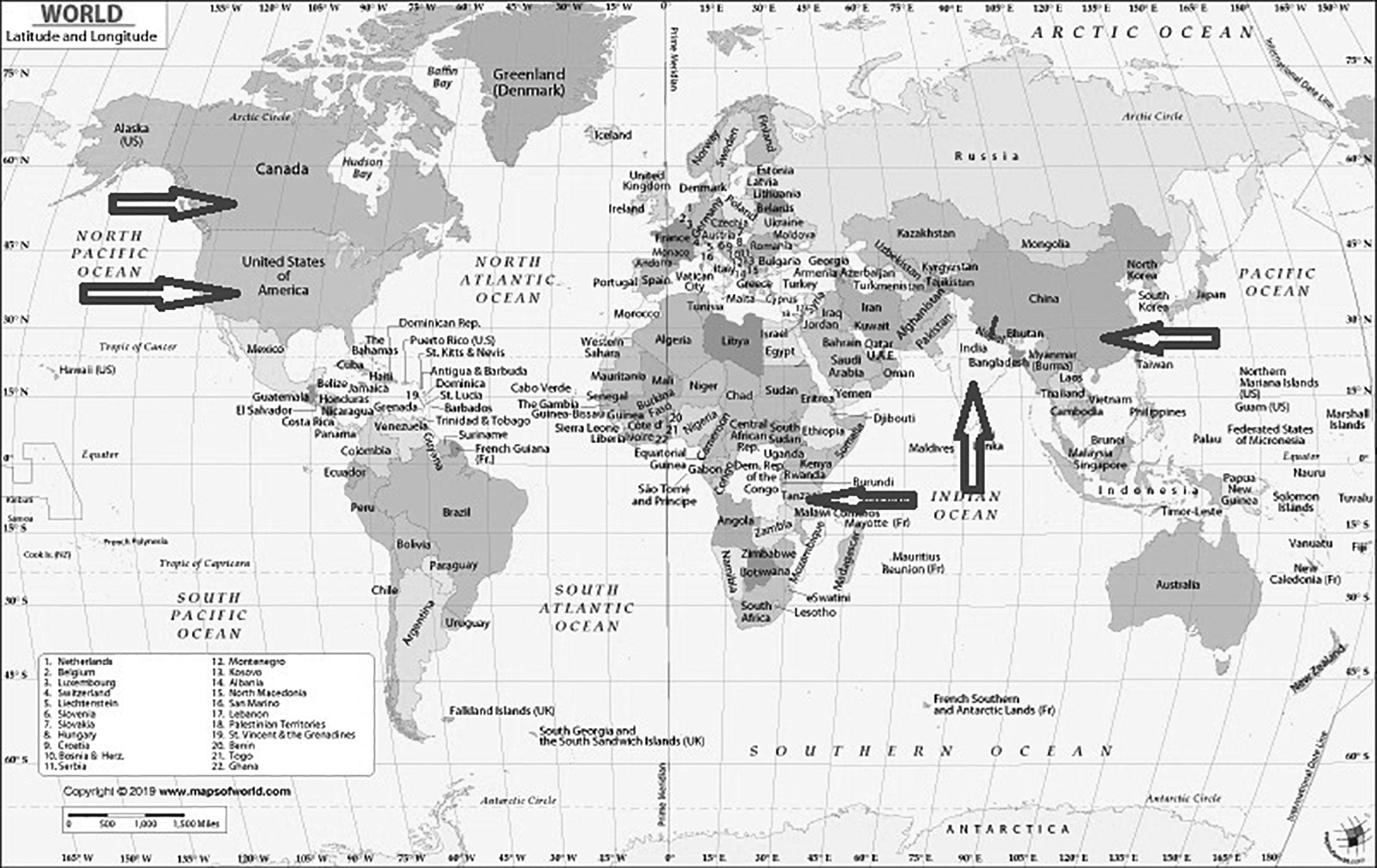
Map of the world showing location of Canada, United States, Tanzania, India, Nepal, and China.
Drawing Parallels from Experiences in Nepal
The CFM model in Nepal (28°N 84°E) involving community forest user groups (CFUGs) has several intercepts with the JFM model. Although the ownership rights lie with the government in both the cases, the CFM in Nepal is distinguished from JFM by virtue of devolving full use and management rights to the CFUGs. CFUGs in Nepal can sell forest products with 100% benefit accrual to the participating community, according to the Forest Act of 1993 and Regulation of 1995. 40 Forest operational plans are also prepared by the communities, but with the technical support from the government foresters, which is distinct from the JFM arrangements.
Historically, the Rana Shahi in Nepal ended with the restoration of Monarchy in 1951. The Rana Shahi was a rule by dynastic group of courtiers, which ruled the Kingdom of Nepal from 1846 until 1951, reducing the monarch to a figurehead and making prime minister and other government positions hereditary. Rana rulers took the hereditary office of prime minister. The dynasty came to power through the 1846 Kot massacre, where 36 members of the palace court including the prime minister and a relative of the king were murdered. Tyranny, debauchery, economic exploitation, and religious persecution characterized Rana rule. 41 This changed in 1951 with the promulgation of a new constitution, when power shifted back to the monarchy of King Tribhuvan under a constitutional monarchy plan. 42 The country followed a monarchical–parliamentary system of governance, until the experiment with democracy was scrapped by the King of Nepal in 1959, replacing it with a partyless “Panchayat” system with the King being at the top of the three-tier panchayat system. As a result of the peoples' uprising of 1989, the monarchy accepted constitutional reforms and the establishment of a multiparty parliament, which sat from 1991. In 1996, a civil war started in Nepal, spearheaded by factions that wanted to replace the constitutional monarchy with a peoples' socialist republic in Nepal. In 2005, the then Monarch of Nepal assumed full executive powers and dismissed the elected parliamentary government. In consequence, a democracy restoration movement started, culminating in the restoration of the parliament in 2006. This house of representatives (i.e., the parliament) subsequently enacted legislation to declare Nepal a secular state and a Federal Republic in 2008, thus abolishing the monarchy.
Forestry in Nepal held a central place in the national politics and its history follows three distinct phases—privatization (until 1957), nationalization (1957 to late 1970s), and decentralization with citizens' active participation (late 1970s onward). 43 , 44 Until the enactment of the Private Forest Nationalization Act, 1957, all forests were controlled by the state-sponsored local functionaries, who served the interest of the ruling elites. 45 After the 1957 Act, the state took control of the forests until late 1970s, when the government acknowledged that the state forest bureaucracy could not protect the country's forests without the active cooperation of local forest-dependent citizens. Efforts to share power over forests with the local people started in 1978 with the institution of Panchayat (local government) Forest Regulations. This move was part of the monarchy-sponsored strategy to thwart growing antipanchayat resistance, by offering people some economic and symbolic spaces in their local panchayat. 46 Donor agencies were also exerting pressure on the government to initiate reforms toward a more decentralized process in the forestry sector (Table 1).
Periodic Phases of Political Developments in Nepal with the Corresponding Impacts in the Forestry Sector Management Systems
CFUGs, community forest user groups.
Forest regime change in Nepal, when analyzed against contemporary political history, shows some coherence. The change process from a premodern feudal society to a relatively modern constitutional monarchy (beginning with the restoration of monarchy) coincides with the end of a feudal forest management regime and the enactment of the Private Forest Nationalization Act, 1957. This state-controlled regime is also reflective of the transition process to an authoritarian monarchic state after 1959. Its failure to protect the forests ultimately led to the solicitation of peoples' participation and the enactment of Panchayat Forest Regulations in 1978. But, as Ojha et al. 47 point out, this change in regime also coincides with state efforts to stem antipanchayat resistance. The peoples' uprising of 1989 was predictable. The newly elected parliament of 1991 legislated policies like the Forest Act of 1991 and the Regulation of 1993, which devolved full benefit accruals and management rights in favor of the CFUGs, thus completing the forest regime transition cycle in Nepal.
Tanzania
Tanzania obtained independence from Britain in 1961, after a relatively peaceful transition of power. The Zanzibar archipelago merged with the mainland in 1964, after overthrowing an Arab monarchy in the Zanzibar Revolution. The merger led to the formation of the present state of Tanzania, under the presidency of Julius Nyerere. With the Arusha Declaration of 1967, Nyerere's first presidency took a turn to the left, after espousing African Socialism (or ujamaa, or “familyhood”). Rapid nationalization followed, of the banks, large industries, and even retailing. The state expanded its reach into virtually every sector.
The resulting bureaucracy multiplied and became cumbersome, creating an environment ripe for corruption. Excessive tax rates damaged the economy. Scarce public funds were misappropriated, and the purchasing power of the population declined at an unprecedented rate. A system of permits (vibali) allowed corrupt officials to collect huge bribes and laid foundation for systematic corruption. 48 By 1979, the economy collapsed, forcing the Tanzanian Government to borrow money from the International Monetary Fund (IMF) and undergo economic reforms. In 1985, Nyrere handed over power to Ali Hassan Mwinyi. In 1995, the country's first ever multiparty election took place, thus transitioning the state from an unitary to a multiparty parliamentary democracy.
In Tanzania, the evolutionary change in the forest management regime has been outlined by Babili and Wiersum 49 as follows:
Citing the case of forests in the Babati district (4.217°S 35.750°E) in Tanzania, Babili and Wiersum 50 state that the history of forest management started with traditional forest management (TFM). TFM is known to have existed in Tanzania on a small scale. 51 It involved traditional (tribal) organizations and socially embedded institutions (Table 2). It included forest allocations for girls, sacred groves, forest under the control of elders, etc. After independence and until the 1980s, TFM was gradually squeezed out by nationalization. The Ujamaa Village Act of 1975 was a profound change. It established village councils that removed the authority of traditional leadership, an enormous change to traditional modes of governance and inspired by Nyrere's socialist sentiments. 52 , 53 The period of bureaucratic and political decentralization that followed also instituted CBFM under ujamaa management. Although the ujamaa system was later disbanded around mid-1980s and the country is now more firmly wedded to market principles, JFM coexists with CBFM outside and within the government-owned forests. Babili and Wiersum 54 say that donor agency support, particularly IMF conditions, has allowed these local entities to coexist.
Periodic Phases with Corresponding Forest Management Systems in Tanzania
Source: Adapted from Babili and Wiersum. 2
CBFM, community-based forest management; TFM, traditional forest management; VFRs, village forests reserves.
In Tanzania, the state and its politicoeconomic governance structures have clear influence over forest management regimes. Under colonial rule, TFM regime existed involving traditional organizations and socially embedded tribal institutions, where left undisturbed. As the state governance moved toward a centralized one-party governance structure, under ujamaa socialism, the prevalent forest management regime also veered toward the nationalization of forestlands and replacement of traditional institutions with scientific institutions. When the economy of Tanzania collapsed in, the government as a result acceded to IMF control that went for the donor-insisted devolution and sharing of power through the initiation of JFM in the Tanzanian forest reserves (Fig. 3).
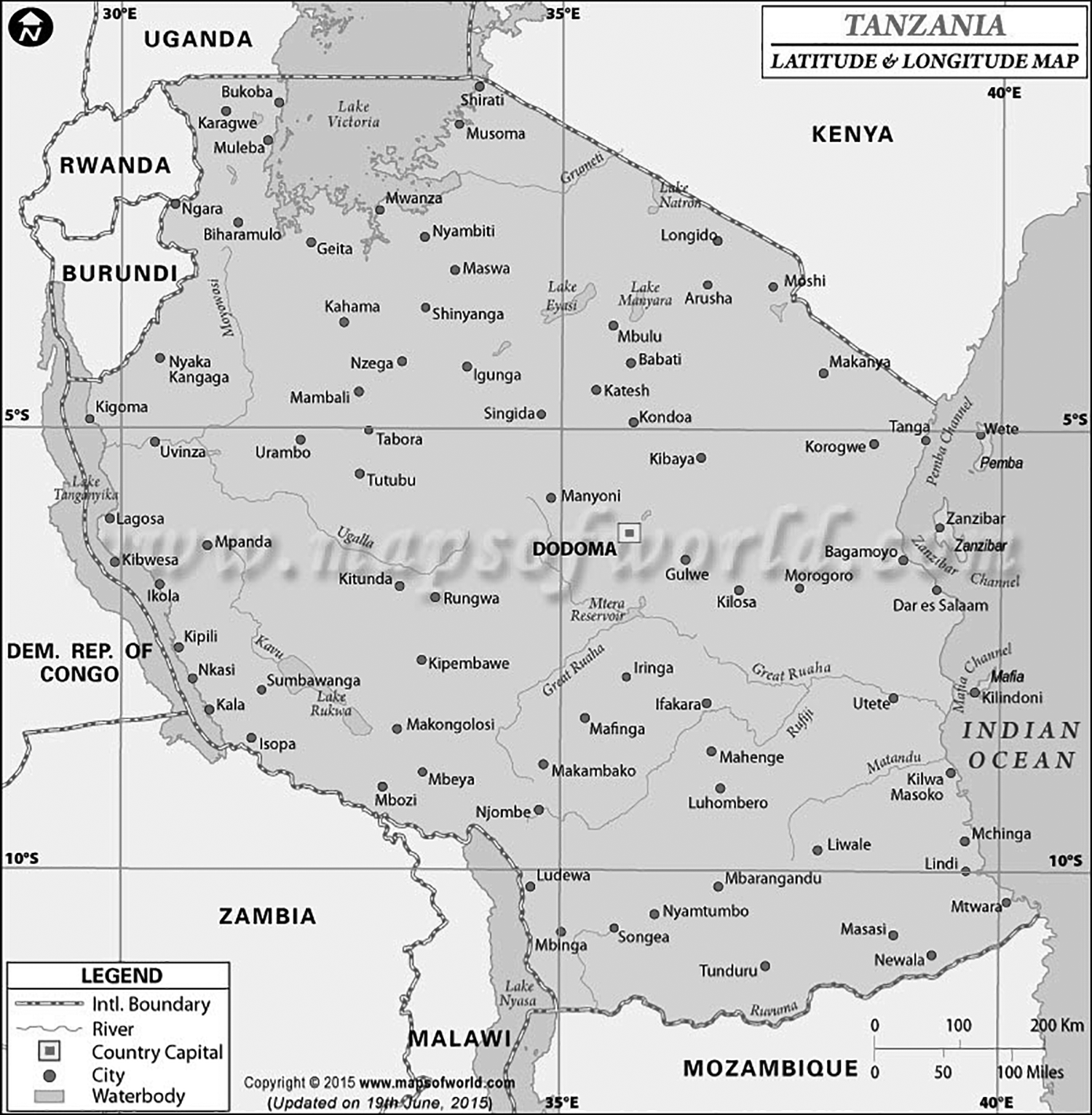
Map of Tanzania.
Conclusion
Based on the analysis, JFM in India may be a potent tool in the hands of forest administrators and natural resource managers only when applied under appropriate circumstances. Its efficiency depends on the prevailing politicoeconomic structure and must, therefore, be adaptive to it. These structures change over time, and the assertion of local voices in the forestry debate ebbs and flows depending on the tolerance of the political regime and those who are employed within it. The tools of JFM should not be rigid and must be implemented on a contingent basis, inculcating changes from time to time, in a manner proportionate to the changing prevailing social, political, economic, behavioral, and ethnocultural reality. That meaningful policy changes are a result of sustained pressure from the social movements. It creates positive resonance within the feelings and emotions of the powerful officials inside the state bureaucracy, sometimes compelling initiatives towards progressive policy changes. 55 JFM, therefore, must also be adaptive to such factors that influence the political economy of the concerning state agent. Only then will JFM be a significant tool for the conservation and management of forests, at least in regions of India where sociopolitical structures of the local governance system permit its relevance toward its perpetuation.
Footnotes
Author Disclosure Statement
No competing financial interests exist.
Funding Information
No funding was received for this article.