




Abstract
More than 330 million people around the world suffer from asthma, a chronic respiratory disease that is produced by environmental conditions such as air pollution, mold, and seasonal change. In Philadelphia, Pennsylvania, high asthma prevalence rates and poor asthma control is attributed to urban air pollution and substandard housing, both of which will be made worse by climate change in the Mid-Atlantic region. Climate change will increase air pollution, worsen indoor environmental conditions, and bring more unpredictable weather, all of which will make asthma more difficult to manage. This article describes a public education project designed to teach vulnerable local communities about climate change and its impact on asthma management. The Climate Ready Philly project provided basic information on the mechanisms of global climate change, presented research on how climate change would impact the city of Philadelphia, and facilitated hands-on activities to help workshop participants learn what they could do to address climate change at home. Our workshops paired healthy homes and energy efficiency strategies, for example, to explore relationships between outdoor and indoor environments, as well as impacts on occupant health. By utilizing climate learning science, our workshops allowed participants to explore relationships between existing health and environmental conditions—such as asthma—and the anticipated impacts of climate change. Using surveys, interviews, and ethnographic data collection, we found that more resources are needed to repair housing infrastructure and help low-income community members access resources that can improve indoor air quality. We conclude by highlighting the need for climate adaptation programs that provide support for housing, in addition to other public infrastructures, which will be needed to reduce the burden of asthma in Philadelphia.
Introduction
Philadelphia is a city that has long struggled with high asthma prevalence rates and poor asthma control among those diagnosed. The city sits directly in the “Northeast Mid-Atlantic Asthma Belt,” one of two “asthma belts” in the United States. 1 Philadelphia County's 3-year asthma prevalence rate for the period 2011–2013 was 19%, which is more than double the national average of 7.6% and almost double Pennsylvania's prevalence rate of 10.1%. 2 Childhood prevalence rates were also nearly three times the national average for childhood asthma, with nearly one in four children in Philadelphia living with an asthma diagnosis. In Philadelphia, housing conditions have been linked specifically to the asthma epidemic, impacting both children and adults. 3 Philadelphia's unhealthy housing stock is compounded by a high poverty rate—about one in four Philadelphia households have median incomes below the federal poverty line. Low-income families are most likely to live in substandard housing and are least able to finance basic building repairs that could alleviate environmental hazards; this exacerbates the vast health disparities present. According to the Philadelphia Department of Public Health's 2018 Community Health Assessment, non-Hispanic black and Hispanic children have asthma-related hospitalization rates that are five to six times higher than that of non-Hispanic white children. 4 Some zip codes and city planning districts are also disproportionately affected, including the River Wards, which borders the I-95 corridor and hosts one of the highest concentrations of industry in the city. These conditions are being made worse by climate change, which not only causes more air pollution but also impacts the city's aged housing stock and infrastructure.
The project we describe in this article—Climate Ready Philly (CRP)—began in 2014 as a community workshop designed to teach people about climate change and how climate change will impact asthma management. CRP was part of a larger citywide climate education initiative, the Climate and Urban Systems Partnership (CUSP), organized by The Franklin Institute, a local science museum. 5 Over a 6-year period, dozens of short-term community climate education projects were launched in Philadelphia; many of these projects reflected new partnerships between community organizations, municipal agencies, and nongovernmental organizations that brought different forms of expertise and resources to table. These wide-ranging projects were anchored by findings from climate learning science that recommended three educational strategies: participation, framing for relevance, and local systems understanding. All CUSP projects, including CRP, utilized this framework.
Each year, the process of selecting CRP workshop topics, locations, and target audiences was informed by participant survey responses, city data of climate-vulnerable neighborhoods (e.g., communities at risk for flooding), and alignment with larger citywide initiatives on climate and health. Our workshops taught participants the basic science of global climate change and its regional impacts but focused specifically on worsening air quality and environmental control practices for asthma care. Our workshops provided participants with strategies that can be applied at home, such as creating a safer alternative to bleach as a household cleaner and monitoring humidity with hygrometers, to address indoor air quality issues that are related to and made worse by climate change. This furthered one of the pedagogical project goals, which was to direct participants to applications in their home environments that helped them understand climate change and its impacts across scales. 6 CRP workshops place the home environment within broader systems of built and natural environments, such as the urban heat island effect and combined sewer system. In effect, this has enabled us to address environmental conditions that worsen chronic disease conditions, such as extreme heat, flooding, mold, air pollution, and energy scarcity while not losing sight of how the home is embedded in larger social systems and infrastructures related to climate change.
In this article, we provide a quick overview of asthma and the long-standing structural issues that intersect with climate change to make asthma more difficult to control. We then describe CRP, a community-based education project designed to teach Philadelphians about climate change, its local impacts on housing and health, and strategies to reduce these impacts in urban communities. We conclude by reflecting on some of the project's challenges, as well as strategies to address chronic disease conditions in a time of climate change.
Asthma and Climate Change
Asthma is a chronic respiratory disease characterized by airway inflammation, and symptoms that include wheezing, coughing, shortness of breath, chest and throat constriction, and an inability to breathe. Asthma is sometimes coupled with allergies—as many as half of all people diagnosed with asthma also suffer from allergies—and symptoms can be triggered by air pollution, smoke, chemicals, animal dander, pollen, mold, sudden atmospheric changes, and dust, as well as exercise and stress. Effective asthma care includes four components, “assessment and monitoring, patient education, control of factors contributing to asthma severity, and pharmacologic treatment.” 7 The Expert Panel Report-3: Guidelines for the Diagnosis and Management of Asthma provides key recommendations for clinicians to address each asthma care component, including approaches to controlling environmental factors by identifying the patient's history of exposures and sensitivities (e.g., to indoor allergens); education to reduce exposure to asthma triggers; and treating comorbid conditions, such as obesity, rhinitis, stress, and depression. 8 Although there are many effective treatment options to manage asthma, changing environmental conditions can make the disease difficult to anticipate and thus control. 9
Climate change will make asthma more difficult to manage because of new regional weather patterns, which will affect local atmospheres. 10 Our project draws on research presented by the U.S. Global Change Research Program report, “The Impacts of Climate Change on Human Health in the United States: A Scientific Assessment,” which has compiled decades of scientific research. Based on this research, our project focuses on four dynamics that are particularly concerning for asthma management. The first is worsening air quality: experts anticipate that, as the city experiences hotter weather during summer months, more pollution will be generated and trapped at ground level because of the urban heat island effect. Second, increasing amounts of precipitation will make mold more difficult to control in indoor environments, particularly in older buildings such as schools and homes that may be in disrepair. Third, climate change will bring more extreme weather events, which go hand in hand with dramatic atmospheric changes, such as air inversions, which can trigger asthma attacks. 11 Finally, climate change is already increasing pollen counts and the length of pollen seasons in Philadelphia; this is particularly problematic for asthma sufferers who also live with seasonal allergies. 12
These climate change dynamics not only exacerbate local environmental conditions that trigger asthma, but they also intersect with Philadelphia's existing housing crisis. As one of United States first metropolitan areas, Philadelphia has some of the oldest most depreciated housing stock in the country. According to research conducted by the National Trust for Historic Preservation, the median age of a house in Philadelphia is 93 years old, which is nearly 40 years older than most homes in other major U.S. cities. 13 Countless studies show that substandard home environments can harbor environmental hazards that pose health risks to inhabitants. 14
Mold is of particular concern based on reports from our workshop participants, who often spoke about persistent mold issues in their homes. 15 A 2007 study found that ∼4.6 million cases of current asthma in the United States may be caused by dampness and mold. 16 Researchers with the U.S. Global Change Research Program have identified mold as a key indoor climate impact, which may be made worse as regional climates become warmer and wetter—as is anticipated in Philadelphia. 17 To date, mold falls into a class of indoor air quality hazards that is largely unregulated. This means that renters and homeowners must use their own resources and knowledge to combat domestic mold. Our workshops sought to address this gap in environmental governance by communicating public health information about mold, how to control it, and when to seek professional help.
Discussion
The CRP project was created and facilitated by experts from four Philadelphia-based organizations—Clean Air Council, Energy Coordinating Agency, Liberty Lutheran, and National Nurse-Led Care Consortium—as well as the Philadelphia Department of Public Health and Drexel University. The collective expertise of the team enabled curriculum development that made connections between climate change as an environmental justice issue, and asthma management. As a project of the Philadelphia-wide CUSP, CRP used “climate learning science” principles established by researchers at University of Pittsburgh Center for Learning in Out-of-School Environments, an informal learning initiative based at the University of Pittsburgh. 18 These principles encouraged the use of practical hands-on activities that allow participants to learn by doing in relation to our presentations; two-way learning, which leveraged in-group discussion throughout our workshops; framing for relevance so that educational content was appropriate for local audience members and responsive to their needs and concerns; and local systems understanding, which emphasized how climate change implicates many different systems, including local weather, energy delivery and use, communication systems, political systems, regional economies, transit infrastructure, and waste streams, for example. 19 This learning framework builds on more than a decade of research that shows how local community knowledge must be drawn into climate education frameworks. 20
Workshop participants
The CRP team facilitated 18 two-hour long workshops between 2014 and 2019. These workshops were attended by >400 community members from nine city planning districts and were held in community centers, public libraries, a senior center, and church Table 1. All workshops were free and open to the public. Workshop announcements were circulated through the Philadelphia Department of Public Health's Health Bulletin newsletter, community health programs, outreach by community organizers at Clean Air Council, through our host locations, social media platforms, and by word of mouth. Given the public format of workshops, our commitment to two-way learning, and the climate learning principles, facilitators needed to be ready to address wide-ranging social circumstances, including homelessness and gentrification, tenant rights and the opioid epidemic, and poverty and economic inequity. This contextual information is important because it bears on the kinds of sociocultural interventions that are needed in public community education in Philadelphia. During group discussion and informational presentations, we linked these sociopolitical issues to climate change when appropriate, using public health frameworks that situate these issues in relation to local environmental conditions (Fig. 1). 21
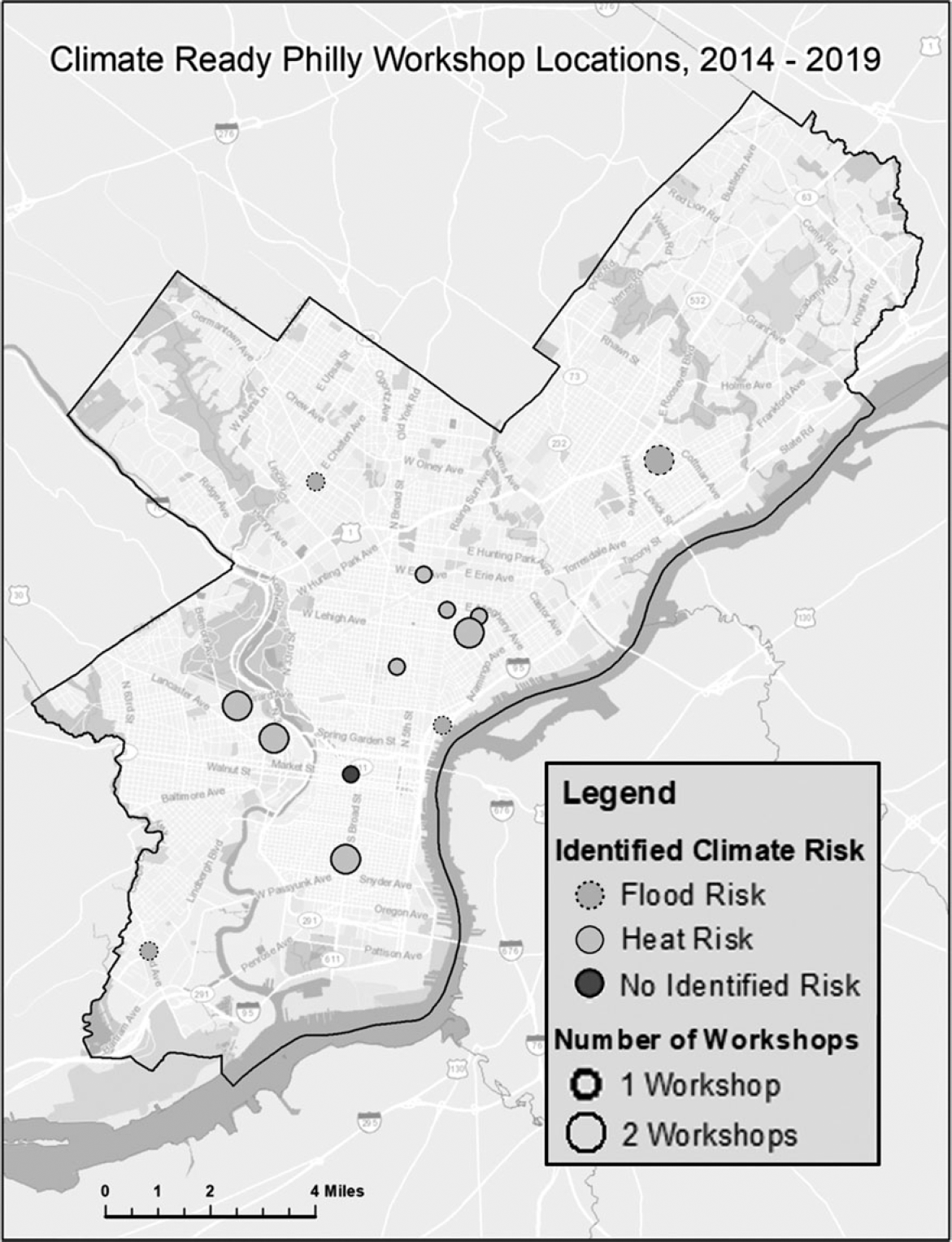
Climate Ready Philly Workshop Locations, 2014–2019. * This is a spatial representation of all Climate Ready Philly workshops conducted from 2014 to 2019. The number of workshops held at each organization is represented by the size of the symbols (ranging from 1 to 2), and the colors of the symbols represent the surrounding neighborhood's identified climate risk. Heat risk is defined as being in proximity to a heat vulnerability priority area as defined by the city of Philadelphia's Heat Vulnerability Index. † Flood risk is defined as being in proximity to an area vulnerable to riverine, coastal, or surface flooding, as defined by the city of Philadelphia's A Guide to Flooding in Philadelphia. ‡
Climate Ready Philly Workshop Partners and Details
More details on each theme can be found on the Climate Ready Philly website, <
Most participants reported that they came to the workshop to learn more about climate change, their homes, and asthma, noting a lack of public programming on this intersection during workshop discussions, surveys, and in-depth interviews. A majority of workshop participants self-identified as African American or Black women >55 years, although racial, ethnic, age, income, and education diversity varied significantly from one workshop to the next. Consistently, more than half of all workshop participants owned their own home. Over the course of the project, which included conversations with participants through workshop discussions, semistructured follow-up interviews, and surveys, we found that housing-related conditions came up repeatedly as a barrier to health. These included microscale flooding, persistent mold, an inability to afford utility bills, and an inability to finance basic home repairs. For example, in our 2018 and 2019 workshops, of 189 participants, 42% had experienced flooding in their home and 38% reported mold in their home. Basements were the most common location for mold problems, followed by bathrooms and kitchens. Coming into the workshops, when asked about mold removal, 64% of respondents reported that they did not know how to get rid of mold. In group discussions, many participants indicated that they used bleach to get rid of mold. When asked about mold prevention, 65% reported that they did not know how to prevent mold. This lack of knowledge, regarding how to handle indoor mold, was the most common reason participants attended our workshops: to learn about mold. In the same workshop years, 2018 and 2019, 80% of participants reported that they or someone they lived with suffered from asthma, allergies, or some other breathing problem.
CRP format
Our workshops communicated basic science information on the mechanisms of climate change, such as the greenhouse effect, using pedagogical tools provided by NASA and the Environmental Protection Agency. This was followed by topical presentations on how climate change would impact indoor and outdoor environments as well as human health. Presentations were interspersed with activities such as group discussion, neighborhood asset mapping, games, and use of The Franklin Institute's climate education kits. 22 In this study we highlight three activities from our workshops, each of which took ∼30 minutes and included a brief, 8–10 minute presentation, group discussion, and activity.
Mold Mystery is an identification game where two images are placed side by side on a presentation slide. 23 Workshop participants are asked to determine which image features mold, and which image is some other substance, for example, soot or efflorescence. Along with images of mold, this is also an opportunity for the facilitator to show an image of water leaks or other characteristics that signal the potential for mold growth and to discuss preventative actions. This game is one of the most popular parts of the CRP workshop, and always generates a lot of discussion and story sharing between attendees. Participants report that it is helpful to see what mold looks like in different contexts, and also to learn that there are many different kinds of mold. The slides also allow the facilitator to discuss how to treat mold issues in the home. If the affected area is small, for example, residents can address it; if the affected area is >1440 square inches, professional help may be needed.
The Mold Mystery game is followed up by a discussion about weatherization, where a facilitator from the Energy Coordinating Agency provides tips and resources for weatherizing homes. This presentation is paired with a hands-on learning climate kit from the Franklin Institute, the Ready Rowhome kit. These kits enable workshop participants to simulate the effects that extreme heat events and heavy downpours have on the physical integrity of their homes and neighborhood blocks. Participants quickly see that the existing built environment on Philadelphia blocks today is insufficient to cope with future climate impacts. However, when control measures such as green infrastructure, rain barrels, and light-colored building materials are added to the model, the urban heat island effect and localized flooding are reduced. These measures help manage indoor air quality as well. For example, reduced backyard and basement flooding will result in fewer opportunities for water and moisture to enter the home, thereby preventing mold and mildew growth. In addition, controlled humidity and temperature can lead to the reduction of indoor allergens such as dust mites. 24
Finally, we have run several different mapping activities over the tenure of CRP. The earliest map-making activity asked participants to make two maps—one of their indoor living environments and a second of their neighborhoods. In both maps, participants were asked to identify sources of asthma triggers, and then to show relationships between indoor and outdoor spaces. For example, if a participant lived next to a busy roadway or an intersection with idling traffic, they would identify this as a source of outdoor pollution that could enter the home, such as through open windows during warmer weather. Another example might be a sewer that consistently floods during storms, causing water to pool in yards and alleyways.
Challenges and recommendations
We identified three key challenges common to participants who attended the CRP workshops. First, our workshops and follow-up data collection show that access to resources is the greatest barrier people face. An inability to repair damage to aged housing stock, or find a program that meets such needs, was frequently reported in surveys, group discussions, and follow-up interviews. Among the few participants with the means to privately hire contractors, some reported spending money two to three times on the same home repair issue, only for the issue to continue. The second greatest barrier is that renters have limited ability to make modifications to their home environment. In every workshop we held, participants who rented their home reported that they were unable to compel their landlords to address housing issues that triggered their asthma. Water leaks and damage, problems with windows, and structural issues were often mentioned. 25 We identify time as the third major barrier to participants addressing climate change in the home. Many people indicated that they simply do not have time to address another thing, on top of all the other components of their lives, many of which they indicated were more pressing than climate change.
Although none of these challenges is particularly surprising, given our target audience and participant community, it is clear that low-income community members need more resources to address the health impacts of climate change, namely asthma and the effects that changing weather conditions will have on housing infrastructure and indoor environments. In light of these concerns, we incorporated participants' suggestions from the postworkshop survey question, “How can the city better prepare for climate change?” and recommend the following for city planners, policy makers, and direct service providers:
Increased support for programming that assists low-income homeowners and landlords to make necessary home repairs and healthy housing improvements. Increased communications to publicize the availability of existing resources for home repairs and improvements. Increased availability of legal services to address landlord–tenant issues and aid in necessary health-related home repairs. Increased education (e.g., public campaigns) around climate change and its impacts on health to continue building the knowledge base among community members and help prioritize climate change resources in citywide policies.
Conclusion
As climate change continues to be a pressing environmental justice and public health issue, climate education and adaptation programs must incorporate the voices of community residents, who are most at risk for climate-related housing and health challenges, when identifying barriers and solutions to inform future planning. The CRP project, rooted in two-way learning, is one model that community groups may consider to guide that process. Through educational workshops from 2014 to 2019, community members received key information on climate impacts on health, particularly asthma, and became more aware of available local resources to address housing and health (self-reported through postworkshop surveys). At the same time, workshop facilitators gained insight into existing public knowledge around climate change and learned about the housing-related challenges faced by communities as a barrier to health, including microscale flooding, persistent mold, unaffordable utility bills, and the inability to finance basic home repairs.
By building a cross-sector team of workshop facilitators that included direct-service staff from community-based organizations, the local health department, and a large local university, the CRP project utilized expertise across several disciplines of environmental and public health. In addition, throughout the project years, CRP facilitators incorporated community members' recommendations in their work to inform existing programming and future planning processes. For instance, an existing healthy homes program in Philadelphia started discussing climate change in conjunction with asthma education, and created resource sheets listing home repair and legal services for program families. Clean Air Council used feedback from workshop discussions to design a 2-year community air monitoring project that responded to concerns related to transportation corridors and scrapyards. The Philadelphia Department of Public Health subsequently incorporated two-way learning techniques into public health presentations, and three additional environmental justice projects were initiated because of the organizational and community networks established through CRP.
We found discussing the impacts of climate change within the content of community members' lives and homes to be effective. Postworkshop survey responses and direct participant feedback indicate that participants benefitted from the information provided, and more importantly, enjoyed being included in these conversations. At several workshops, participants commented on how learning opportunities around environmental topics rarely happen, and they would welcome more workshops in the future.
Beyond the recommended household-level actions to improve indoor air quality and help manage asthma, the CRP project recognizes a broad inadequacy of societal tools to support the maintenance of low-income residences. Climate change will only increase the stresses put on our physical shelters. Any structure unready for climate change will take in more moisture and more pests, negatively impacting occupants with asthma. For those in poverty, the objective is to create sustainable funding streams for home repair. In the case of dealing with landlords, this must include protections against rent hikes for the families the intervention is targeted toward. These tactics also go beyond improving asthma management. A well-maintained home shell wastes significantly less energy than a leaky home—so long as homes are heated by fossil fuels or electricity generated from fossil fuels, investing in basic systems repairs will be an important strategy in greenhouse gas reduction. Interventions at the housing level can mitigate climate change, make homes more resilient to extreme weather, and improve occupant health.
Footnotes
Acknowledgments
We thank the Climate and Urban Systems Partnership network of educators, and all community members who attended our workshops. We also thank all students and staff at the Philadelphia Department of Public Health for providing support at Climate Ready Philly workshops.
Author Disclosure Statement
The Climate Ready Philly project was supported by annual mini-grants through the Climate and Urban Systems Partnership.