




Abstract
Tucked in the northeast corner of Corpus Christi, adjacent to one of the nation's largest ports, lies Hillcrest, a low-income and minority neighborhood clouded by a history of segregation, discrimination, and environmental injustice. The siting of heavy industry—refineries and petrochemical and energy companies—along its northern and western borders and infrastructure—an expansive highway—along its southern border have depressed property values, reducing the mobility of homeowners, and disproportionately subjected residents to noise, air pollution, and noxious odors for decades. Upon the completion of the new Harbor Bridge, which will skirt Hillcrest's eastern border, the neighborhood will be enclosed by industry or infrastructure on all four sides, cementing the isolation of its residents from the rest of the city and perpetuating the long-established practice of unduly inflicting environmental burdens on marginalized and disadvantaged communities. In 2015, civil rights lawyers filed a Title VI complaint with the Federal Highway Administration on behalf of two Hillcrest residents. The complaint, which alleged that the adverse health and economic impacts of the proposed route for the bridge would be disparately shouldered by the neighborhood's large and already overburdened African American population, prompted the creation of the 3-year Voluntary Acquisition and Relocation Program, intended to provide restitution for decades of segregation, discrimination, and environmental injustice. The landmark program offers financial assistance and relocation counseling to participating residents who chose to relocate or financial compensation for homeowners who elected to remain. This program provides a model for civil rights, fair housing, and environmental justice advocates to procure more equitable outcomes for communities beset with racial and environmental injustice.
Hillcrest's History of Racial and Environmental Inequity
Hillcrest bears a long legacy of racial segregation and environmental injustice. During the first half of the twentieth century, Hillcrest housed members of the city's country club—wealthy white residents. Meanwhile, Jim Crow housing policies isolated and entrapped African Americans in Washington-Coles, a blighted neighborhood to the east of Hillcrest. However, because of overcrowding in Washington-Coles, in 1944, the Corpus Christi Housing Authority proposed that African Americans should be allowed to spill over into Hillcrest and a neighborhood southwest of the area to maintain the geographic proximity of minorities, who were primarily industrial workers, to places of employment. The majority of whites fled Hillcrest and the neighborhood became predominantly African American. 1 , 2
Meanwhile, the growth of industry and infrastructure to the north and west of Hillcrest posed adverse health and economic effects on its residents. The port opened in 1926; by the following decade, several refineries dotted the shipping channel. 3 , 4 In the mid-twentieth century, the completion of Interstate 37 established the neighborhood's southern border, furthering its physical separation from the city. 5 Environmental hazards emerged as a concern as early as 1952, when a nearby tank farm exploded, forcing residents to evacuate. 6 In the 1970s, explosions and fires at a natural gas station, oil refinery, and tank farm led to evacuations of Hillcrest residents. Cognizant of the health problems posed by the surrounding industry and infrastructure, over the decades, residents filed numerous class action lawsuits that sought financial compensation for the discriminatory siting of industrial facilities. However, these lawsuits proved largely unsuccessful because of the high burden of proof on plaintiffs, who must prove that a company's operations directly caused adverse health effects. 7 Over the years, residents have documented concerning health issues, including “burning eyes, shortness of breath, vomiting and dizziness.” 8 A 2008 Texas A&M study found levels of benzene—a known carcinogen—in blood and urine samples of Hillcrest residents 280 times that of the general population. 9 Meanwhile, the rapidly encroaching industry and infrastructure, which has significantly reduced property values in Hillcrest, has also diminished the mobility of homeowners, effectively prolonging their exposure to environmental hazards. 10
In 2015, when the civil rights complaint was filed, Hillcrest, home to nearly 500 households, remained a primarily minority neighborhood, with a near-equal composition of Hispanic and African American residents. (Although Hillcrest became a predominantly African American neighborhood in the mid-twentieth century, racial integration resulted in the dispersal of African Americans across Corpus Christi.) As of 2015, 46.7% and 47.9% of the population were African American and Hispanic or Latino, respectively. While the proportion of Hispanic or Latino residents in Hillcrest was slighter lower that of the city as a whole (61.3%), Hillcrest was home to a significantly higher proportion of African Americans—nearly 12 times that of the city (4.0%). Meanwhile, the median income of Hillcrest ($23,616) measured less than half that of the city ($50,658); nearly 30% of Hillcrest's population lived below the poverty level. 11
The Background and Structure of The Program
In the early 2000s, the Texas Department of Transportation initiated plans to reconstruct the Harbor Bridge, citing a need for improved safety, reduced maintenance costs, and enhanced opportunities for economic development. 12 , 13 The new bridge will stand 538-feet tall, a near 300-foot increase that, along with efforts to widen and deepen the ship channel, will allow bigger ships to access one of the nation's largest ports. 14 , 15 The selected route, unveiled in 2014 and initially projected to be completed in 2020, will bisect the Washington-Coles neighborhood and skirt the eastern side of Hillcrest—the last remaining portion of Hillcrest unencumbered by industry or infrastructure—thereby completing the physical isolation of the neighborhood from the rest of the city (Fig. 1). 16 , 17 , 18
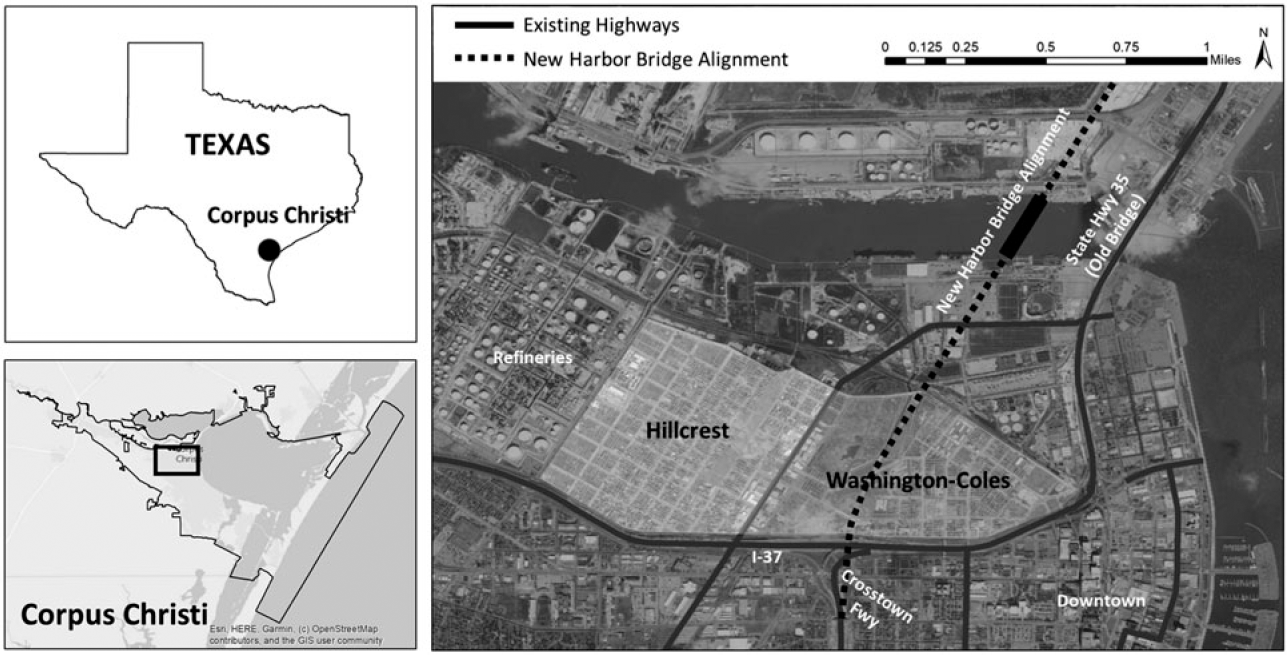
Map depicting the Hillcrest and Washington-Coles neighborhoods, Corpus Christi, Texas. (Source: Esri, DigitalGlobe, GeoEye, Earthstar Geographics, CNES/Airbus DS, USDA, USGS, AeroGRID, IGN, and the GIS User Community, City of Corpus Christi GIS Services, TxDOT).
Wary of the adverse health and environmental effects from the $1 billion project, two lawyers, Erin Gaines and Kelly Haragan, filed a Title VI civil rights complaint in March 2015 with the Federal Highway Administration on behalf of two Hillcrest residents, Rosie Porter and Jean Salone.
19
,
20
Title VI deems discrimination on the basis of race, color, or national origin unlawful for recipients of federal funds.
21
The complainants, which soon also included the Citizens Alliance for Fairness and Progress, a community organization that advocates on behalf of residents in the Hillcrest and Washington-Coles neighborhoods, argued that the new route, financed with federal transportation dollars, would “cause adverse disparate impact—including increased isolation, noise, and air pollution—based on race.”
22
,
23
Specifically, the complaint alleged the Texas Department of Transportation violated Title VI on three counts:
By failing to sufficiently consult with and mitigate the deleterious effects of the new bridge on the primarily minority communities surrounding the route chosen for the bridge. By routing the bridge through a primarily minority community that has borne disparate harm from the previous siting of industry and infrastructure, exacerbating the segregation and discrimination that have long afflicted the neighborhood. By deliberately practicing racial discrimination in the environmental impact assessment by failing to sufficiently include minority communities when soliciting public input and selecting the route.
24
While filed on the basis of the racial discrimination promulgated by the Texas Department of Transportation in its selection of the final route, the complaint simultaneously addressed environmental injustice by emphasizing the disparate siting of industry and infrastructure surrounding the neighborhood, which heightens residents' exposure to environmental hazards. In December 2015, the verdict secured a rare victory for the environmental justice community: the creation of a 3-year Voluntary Acquisition and Relocation Program that offers financial assistance to eligible households, businesses, and churches that chose to participate in the program. 25 Enacted on January 1, 2016, and in effect until May 7, 2019, the four party agreement between the Texas Department of Transportation, the Port of Corpus Christi Authority of Nueces County, the City of Corpus Christi, and the Corpus Christi Housing Authority provides financial assistance and relocation counseling to participating households, businesses, and churches who chose to relocate from Hillcrest and financial compensation to homeowners who elect to remain in Hillcrest. 26 Although households needed to confirm their participation in the program by May 7, 2019, the program remains ongoing until the end of July 2020. 27 Homeowners were presented three options:
The Port purchases the property for its appraised value. The homeowner is eligible for relocation assistance under the 1970 Uniform Relocation Assistance and Real Property Acquisition Act (URA), which dictates that local authorities must ensure displaced households relocate to comparable replacement housing. Replacement housing is deemed comparable if it is (1) decent, safe, sanitary, adequate in size, and affordable and (2) lies in an area “not less desirable or accessible than the former dwelling.” 28 After the appraisal is conducted, the Port calculates the cost of a home comparable to the homeowner's Hillcrest property; the appraised value plus the difference between the cost of a comparable home and the appraised value comprises the buyout amount. For instance, if the Hillcrest property appraises for $60,000 and the sales price of a replacement dwelling is $175,000, then the buyout amount equals $60,000 plus the additional $115,000 for the homeowner to purchase the replacement dwelling, so long as the price of the replacement dwelling does not exceed the limit set by the estimated value of a comparable property. 29
The Port purchases the property and the homeowner retains a life estate in the property, which allows the homeowner to remain in his/her home until death or lease the property for the duration of the life estate. The purchase price of the property represents the difference between its appraised value and the value of the life estate, which is computed using actuarial tables. Upon the death of the last surviving homeowner, ownership of the property reverts to the Port Authority. The homeowner is not eligible for relocation assistance under the URA.
The Port purchases a “restrictive covenant” and “purchase option” on the property for at least $7500. The homeowner may remain in his/her home but may not allow the home to serve as a residence for other individuals (i.e., the homeowner may not lease the property). The Port Authority maintains the option to purchase the property for its appraised value if the homeowner chooses to sell it or upon the death of the last surviving homeowner. The homeowner is not eligible for relocation assistance under the URA.
Meanwhile, renters of residential property are also entitled to receive relocation assistance under the URA should the renter chose to relocate or the landlord(s) chose to sell their property to the Port for its appraised value. (No relocation assistance is provided to landlords.) 30 Rental assistance under the URA is generally issued as a lump sum, as opposed to 42 monthly payments. The amount of assistance represents the total monthly rent (rent and utilities) for the new property minus the base monthly rent for the previous property. The base monthly rent represents the lesser of the total monthly rent or 30% of the average monthly gross household income. For example, if a Hillcrest tenant with a monthly income of $800 paid $200 per month in rent for his/her Hillcrest property and rent for the new property is $350, the lump sum equates to $6300 ($150 per month—$350 minus $200—for 42 months). However, if the tenant paid $300 in rent on the Hillcrest property, he/she will receive a lump sum payment of $4620 ($110 per month—$350 minus $240, or the maximum rent if the tenant had spent no >30% of his/her income on rent—for 42 months). 31
Program Sets Precedent for Redressing Environmental Injustice
This case succeeded scores of largely unsuccessful lawsuits filed by residents over several decades that sought restitution from private companies for the discriminatory siting of industry and infrastructure and the disparate exposure of low-income and minority households to environmental hazards. 32 , 33 Rare are the instances in which households beleaguered by environmental injustice receive compensation for their undue exposure to environmental hazards. 34 The Voluntary Acquisition and Relocation Program encompasses a particularly unique set of outcomes for communities fighting environmental injustice: (1) both the households that relocate and those that remain are entitled to financial compensation, (2) because of depressed property values in Hillcrest and the stipulations of the URA regarding replacement housing, homeowners who relocate acquire higher value properties, allowing those households to build more wealth through homeownership and purchase homes in neighborhoods with lower exposure to environmental hazards, and (3) the buyouts are promulgated by public entities as opposed to private companies. 35 , 36 Another unique aspect of the program is its usage of relocation counseling. The Port Authority, which allocated $20 million to purchase eligible properties and finance the relocation expenses, hired a consulting firm, Del Richardson & Associates (DRA), to assist participants with the process. 37 Establishing a liaison between the Port Authority and Hillcrest residents encourages a more equitable process by equipping households with professionals who promote honesty and transparency and protect households from unscrupulous real estate practices, such as racial steering, to which low-income and minority households are particularly vulnerable. 38
The program serves as a model for planners, lawyers, community development activists, and supporters of environmental justice to procure more equitable outcomes for communities that shoulder a disproportionate burden of environmental hazards. The case integrated a number of players with differing perspectives and/or professional expertise: civil rights lawyers, fair housing advocates, air quality specialists, a community organization, and Hillcrest residents. Such a diverse array of players sheds light on a number of issues, including the community's exposure to environmental hazards, the underrepresentation historically endured by the community, and the deleterious effects of surrounding industry and infrastructure on property values, which have consequently diminished the mobility of households. Calling attention to a variety of issues expanded the ability of the Title VI complaint to address both racial and environmental injustices. 39
Outcomes of The Program
As of September 9, 2019, DRA confirmed the program eligibility of households in 391 parcels; there are 467 total parcels in Hillcrest. More than half of all households in Hillcrest (258) have relocated: 126 homeowners and 132 renters of residential property (17 tenants transitioned into homeownership). The number of households that relocate will increase by the end of July 2020, when all open contracts expire: offers to 71 parcels had yet to be issued, offers to 13 parcels were pending acceptance, 23 closings had yet to be completed, and homeowners in 7 parcels had not yet identified a home to which to relocate. 40 Homeowners have been offered buyout settlements that equate to two or three times the appraised value of their Hillcrest homes. 41 Given the neighborhood's lower and upper home value quartiles of $39,300 and $90,900 in 2016, the majority of Hillcrest homeowners could purchase a home priced between $78,600 and $272,700. (The median home value in the city was $118,900 in 2016.) 42
Meanwhile, households in 103 parcels will definitely not participate in the program: 27 declined the offer, 54 did not opt into the program, and 22 did not supply the eligibility documents necessary to proceed in the program. DRA identified several reasons behind the decisions of homeowners or landlords of residential rental property to opt out of participating in the program. Among homeowners, these include satisfaction with their housing situation in Hillcrest, a lack of consensus among family members, issues with the Hillcrest property (unaddressed liens or clouded titles), barriers to mortgage financing (insufficient credit), anticipation of a better offer, or the inability to locate a suitable replacement property. Landlords cited dissatisfaction with the appraisal offer, loyal tenants, challenges with tenants, and a desire to maintain their rental investment. 43
Limitations of the Program
While the program has been widely heralded as a major victory for the Hillcrest community, it does pose several limitations. The program does little to mitigate against the additional adverse health and economic effects that will likely beset the community as a result of the new bridge. Perhaps the most significant is the upheaval of the Hillcrest neighborhood and its effects on households and the broader community. The residents who relocate may lose ready access to particular institutions—such as businesses and churches—as these households disperse across the city. Hillcrest residents—both those who relocate and those who remain—face the loss of social ties to their former neighbors. Homeowners who opted to remain in Hillcrest may witness a continued decline in property values, further reducing their mobility. Another significant limitation of the program is the forced displacement of renters of residential property if their landlord opts to sell his/her property to the Port. While these renters receive financial compensation, unlike homeowners, they do not have the option to remain in their current Hillcrest homes. 44
Although the relocation counseling firm educates Hillcrest residents on the options available to them through the program, and, if pertinent, assists them with finding replacement housing, without supplementary financial counseling, these residents may land in unsatisfactory housing situations. For example, homeowners who chose to relocate may face increased insurance costs, taxes, and utilities resulting from higher property values. Particularly for homeowners on fixed incomes, increased tax burdens could pose a serious financial detriment and threaten the financial viability of maintaining homeownership. Moreover, finding an affordable and available home proved a significant challenge in the relocation of homeowners, indicating that in cities with a shortage of affordable housing, securing beneficial outcomes for relocating homeowners may prove more difficult. 45 , 46 , 47
Conclusions
Rare are the instances in which the households—often low income and minority—beleaguered by environmental injustice receive compensation for their undue exposure to heavy industry and infrastructure—and, consequently, adverse health and economic effects. 48 The Voluntary Acquisition and Relocation Program, the result of a Title VI complaint against the racially discriminatory siting of Corpus Christi's new Harbor Bridge, reflects a rare victory for the environmental justice community. As Dr. Robert Bullard, the father of environmental justice, stated in a press conference that announced the implementation of the landmark program: “This agreement in Corpus Christi is a milestone. For too long African American communities have shouldered a disproportionate burden of discriminatory environmental and transportation decision-making, including the siting of highways and bridges that divide rather than connect Black residents to economic opportunity. The Hillcrest neighborhood case is a poster child for transportation racism. In response to the Civil Rights complaint, we now have agencies directly addressing and redressing this racism.” 49
The Title VI complaint waged against federal, state, and local agencies represents a joint effort of civil rights lawyers, fair housing advocates, air quality specialists, a community organization, and Hillcrest residents to seek restitution for a historically African American community inflicted with decades of segregation, discrimination, and environmental injustice. The 3-year Voluntary Acquisition and Relocation Program offered participating residents who chose to relocate financial assistance and relocation counseling or, for homeowners who elected to remain, financial compensation. The program has heralded bittersweet results: while the homeowners who chose to relocate have purchased homes two to three times the value of their Hillcrest property, enhancing their wealth and allowing them to relocate to neighborhoods with lower exposure to environmental hazards, the residents who remain face greater exposure to adverse health and economic conditions upon the completion of the bridge. Furthermore, the exodus of former residents, churches, and businesses disrupts the social ties of both past and present community members. However, despite its limitations, the program is the long-awaited child of a decades-long fight waged by homeowners for financial compensation to relocate. The program serves as a precedent for civil rights, fair housing, and environmental justice advocates to procure more equitable outcomes for communities beset with environmental injustice.
Footnotes
Authors' Contributions
All authors have read and agree with the contents of the submission, and all authors have contributed substantially to the work.
Acknowledgments
The authors extend their sincere gratitude to Erin Gaines and Lizzie Shackney at Texas RioGrande Legal Aid and Professor Kelly Haragan at the University of Texas Environmental Law Clinic for their time and expertise. The authors would also like to thank John Henneberger at the Texas Low Income Housing Information Service.
Disclaimer
This work has not previously been published nor is under consideration for publication elsewhere.
Author Disclosure Statement
No competing financial interests exist.
Funding Information
No funding was received for this article.