




Abstract
This mixed-methods qualitative study examined the relationship between community service activity, environmental humility, and participation in volunteer outdoor (i.e., green space) programs. Undergraduate student volunteers (n = 32) participated in a variety of different volunteer and green space programs that were designed to emphasize environmentally sustainable and socially responsible behaviors (i.e., participating in food harvesting programs, community gardening programs, planting fruit tree orchards, and donating foods to local food distribution centers). At the end of the 6-month project, participants were surveyed regarding their opinions of the importance and value of environmentally sustainable programs and perceptions of community connectedness while volunteering in a variety of green space activities. A Pearson correlation test determined a significant relationship (r = 0.517; p < 0.001) between perceptions of community connectedness and a willingness to become actively involved in future environmentally sustainable activities. Results of the study and suggestions for future research are offered.
Whoever exalts himself will be humbled, and the one who humbles himself will be exalted. 1
C
The “Savanna Hypothesis” argues that humans have evolved over millennia to prefer specific characteristics within natural environments that tend to support life and encourage cooperative engagement while avoiding environments that lacked basic natural and organic resources. 8 In short, humans have developed preferences for specific characteristics within natural landscapes and environments that have facilitated survival and overall reproductive fitness. Conservation and protection of basic resources are an organic and fundamental need that humans and all living organisms share; however, modern human activity has increasingly exploited natural resources and pristine environments typically for individual profit (i.e., hydraulic fracking 9 ) and conspicuous private consumption. 10 , 11 Despite the growing interest and popularity in evolutionary and environmental psychology (i.e., evolved psychological mechanisms, socially responsible behaviors, and sustainable environments), little empirical research has been conducted that examines how some psychologically evolved human traits (i.e., humility) may impact and mediate human behaviors that can support and even improve the existence of natural environments.
The purpose of this article is to identify how the human trait of humility is essential not only to human value systems, culture, and social interaction (i.e., community connectedness), but also more importantly how humility plays a critical role in relation to ecologically and environmentally sustainable behaviors and decision-making processes. Recent research has addressed the trait of humility as an important intrapersonal characteristic that facilitates a more accurate assessment of our individual skills and potential as well as our own limitations and weaknesses. 12 Humility has also been identified as an important evolutionary trait in the development of interpersonal and social relationships because humble individuals are universally perceived as less threatening and show a greater capacity to help others in distress (i.e., altruistic behavior) as well as less risk to the group itself. Van Tongeren et al. have also identified different variations or types of humility, depending on the context of situational, experiential, and interpersonal circumstances. For example, “intellectual humility” (p. 464) has been described as a modest assessment “about one's ideas, beliefs, or viewpoints,” whereas “cultural humility” (p. 464) refers to a more subjective and intrapersonal perspective addressing one's own awareness of the limitations (and biases) of their culture. 13
Intellectual humility can also be described as a personal belief system that our views and interpretation of knowledge and the world are subject to vary and change over time based on our experiences and dialogue with others. In addition, intellectual humility reflects our own ability to self-reflect, monitor, and incorporate different viewpoints that are more accurate interpretations of current (and future) world events, such as global climate change and incorporating environmentally responsible behaviors. 14 More importantly, perhaps, is that intellectual humility reflects the internal capacity in recognizing our potential for error in judgments that may modify our views and behaviors through introspective analysis and insight. Cultural humility has become an important concept in a world that has become increasingly polarized through political ideology, dominant Western cultural values, and economic influence. Cultural humility also recognizes and values the importance of multiculturalism and diversity by understanding and respecting those views and opinions among individuals from underserved and marginalized groups.
What is Environmental Humility?
In this study, the term “environmental humility” has been introduced and refers to an awareness of the importance of environmentally responsible behaviors that all community members share and a recognition of the collective impact (both positive and negative) that our behaviors have on the viability and future of natural ecosystems. Environmental humility also more generally refers to an individual respect and appreciation of the finite effects of the natural environment and the impact it has on interpersonal relationships and psychological well-being. Unfortunately, we live in a world today where exploitative human activity is rapidly becoming a threat to the existence of future sustainable environments, 15 where some experts question whether human life can even be supported. 16 Changing human behavior and self-entitlement attitudes, especially when environmentally exploitative behaviors have resulted in financial gain, can often be very difficult and time consuming. 17 , 18 This is especially true when behavioral change is needed to protect broader environmental conditions that may have high costs and do not bring immediate rewards. Oskamp has recognized that the single most serious threat that currently faces our ecosystems involves human activity (i.e., carbon emissions) that will cause irreversible damage to the environment. 19
As a result of this dire prediction, Stuart Oskamp has identified two specific problems or obstacles that have historically prevented environmental change: governments (i.e., large bureaucratic institutions that often lack accountable behavior) and individual human behaviors that are driven by greed, entitlement, fear, selfishness, and fear (p. 177). A primary issue in addressing and preventing serious environmental problems is providing individual access to accurate information and helping communities gain access to a variety of basic resources that can provide for a more universal and sustainable environment. Researchers Fisher and Fisher have argued that behavioral changes are most efficiently addressed through three sequential processes 20 : access to information and education that facilitate an understanding of environmental issues, motivating individual behaviors, and behavioral changes that are designed to reduce threats to the environment Information, Motivation, Behavioral Changes (IMB) (see Figure 1):
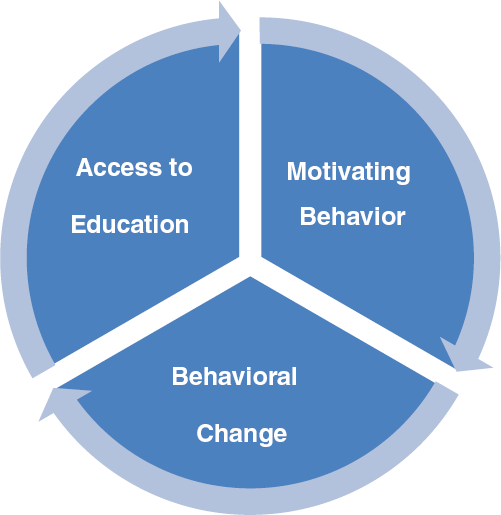
IMB 3-variable theory—causal factors of change. 36 Color images are available online.
Grand Challenges, “Wicked Problems,” and Sustainable Solutions
More recent research has described the role of modern psychological research as a moral imperative in shaping human behaviors to become more environmentally sustainable and socially responsible. 21 Because of the potential catastrophe that may develop as a result of the deterioration of the key environmental resources that are required for human survival, several researchers have recently identified several mechanisms to help modify the destructive impact of human behavior. 22 , 23 , 24 Serious global problems facing the human condition that require collective actions and international cooperation more recently have been referred to as “grand challenges” and “wicked problems.” There are many significant and complex global problems (i.e., “grand challenges”) that impact our natural world and will require a more global, coherent, and intentional approach if we hope to reach the goals of environmental conservation and sustainability. Overpopulation, human trafficking, substance abuse, and global violence remain persistent problems that impact literally billions of people today. Grand challenges have also been characterized as “wicked problems” (p. 343) because of their insidious and malevolent nature that impact significantly larger global populations and have proven to be resistant to any type of a single solution. 25
Organizations and larger institutions (i.e., primary and secondary educational systems) have an advantage in the development of creating a successful culture of change that can embrace greener and more sustainable practices through the development of intentional educational programs that embrace the values and promote healthier and sustainable behaviors.
26
Although many groups of individuals are aware of the serious problems that face the global environment and ecosystems, broader and consistent behavioral changes remain challenging. Current research by Kotter and Schelly et al. cites several specific factors that are responsible for enacting organizational change.
27
,
28
Some of these include:
a. a lack of a sense of urgency, b. failure to create a guiding coalition, c. failure to create a “compelling vision,” and d. failure to institutionalize change within the organizational culture.
Incorporating long-term sustainable behavioral change may require several interpersonal and experiential factors that can enact positive environmental change and help individuals to discover the effectiveness of group efforts that emphasize the benefits of collaboration and positive intergroup contact among community members. Current research has also determined that instituting proenvironmental behavioral change is highly successful when individuals are afforded multiple opportunities to work collaboratively toward goals that they perceive as vital and important. 29 This study explored the efficacy of direct involvement in environmentally sustainable outdoor volunteer programs (i.e., community gardening programs, fruit tree harvesting, and distribution of foods to low-income families) and how these experiences influenced perceptions of community connectedness, willingness to participate in future environmental volunteer programs, and incorporate environmentally responsible behavioral changes (i.e., recycling) within the community.
Methods
Participants
Thirty-two undergraduate students (11 men and 21 women) participated in this study, and ages ranged from 17 to 30 years (M = 19.03; SD = 2.86). The majority of participants identified as Asian (46%), 22% identified as Karen, 16% identified as Hmong, and 16% of the participants identified as African American.
Procedure
Undergraduate students volunteered in a variety of different types of environmental volunteer activities (i.e., community gardening programs, apple orchard harvesting, and cleaning litter from public parks) over the course of 6 months. At the end of the 6-month volunteer program, participants were asked to complete a survey describing their experiences while participating in the environmental volunteer program (Appendix A1). The survey questions focused on the experiences of the participants and how these experiences may have changed their attitudes toward environmentally sustainable practices and their community (i.e., community connectedness) and engaging in similar proenvironmental activities in the future.
Discussion
This study examined how providing different types of community service and environmentally sustainable programs influenced perceptions of community connectedness, environmental humility, and proenvironmental attitudes. When volunteers were provided with opportunities to participate in different types of green and environmentally sustainable activities, they reported a stronger sense of community connectedness that was significantly correlated with an increased likelihood to engage in recycling behaviors. In addition, a significant correlation was found between perceptions of community connectedness and improved understanding of persons from different ethnic groups (r = 0.413; p < 0.01). These findings support previous research 29 where behaviors are more likely to change when individuals are presented with opportunities to participate collaboratively in environmentally sustainable projects (i.e., signing a petition that supports renewable energy initiatives).
The benefits of providing community residents with opportunities to work collaboratively in the development of green sustainable programs (i.e., community gardening and fruit tree harvesting programs) resulted in an increased understanding of ethnically diverse groups as well as an increased likelihood of participating in future sustainable programs. Perhaps one of the more salient findings in the study was the relationship between exposure to outdoor green space environments and the belief that positive changes in the natural world were possible through the development of community service activities (i.e., recycling programs and participation in community gardening programs) (r = 0.447; p < 0.01.). Some of the comments of the participants pertaining to their involvement in green space programs and community service activities included:
I loved meeting people in my community and I was able to make new connections and new friends. It wasn't just the volunteering that made me want to change my lifestyle, but the news and social media (Greta Thurnberg). I think that there were many factors that contributed to my [pro-environmental] lifestyle change.
What I liked about my community service activity service was to get outside and enjoy the natural experience of picking apples.
I liked working with other people while harvesting the apples. It was nice to donate the apples to the elementary schools.
I love the way how people come together to help each other. I used to volunteer at retirement homes for over three years and I could see how people appreciated that I went there to help. I could see that the people needed friends to visit.
This [apple harvesting] event really opened my eyes a lot. I didn't realize that this volunteer activity could benefit the community so much. I think it also helped me and my education.
This study examined how outdoor experiences in natural and green space environments impacted attitudes toward proenvironmental behaviors, community connectedness, and environmentally responsible behaviors such as recycling and food harvesting activities. The results of this study also support previous research that identifies the fundamental importance of direct exposure and access to natural environments and time spent outdoors as key factors that enable participants to discover the numerous physical and psychological benefits of natural and green space environments. 30 Various outdoor environmental programs have been identified as effective experiences that can be used to enhance and expand current indoor educational programs that involve theories from academic disciplines such as biology, environmental science, and ecology. 31 An additional finding in the study was the belief that positive changes in the natural environment were possible through the collaborative efforts of community members, a concept originally described by Albert Bandura as collective self-efficacy. 32 When provided with opportunities of collective engagement with other individuals sharing a common (i.e., proenvironmental) cause, participants reported a stronger belief system that these goals (i.e., reducing waste through increased recycling and increased use of public transportation systems) were indeed possible and attainable through organized group efforts.
Finally, an important finding of the study was the significant relationship between participation in proenvironment community service activities with reports of improved understanding of persons from different ethnic groups (see Table 1). Current research has identified the numerous benefits of positive intergroup contact theory in terms of reduced conflict and aggression and how collective group efforts are instrumental in helping to build neighborhood resiliency. 33 , 34 More recently, community resilience and collective efficacy have been identified as unique intervention approaches in addressing various global environmental problems such as climate change and other environmental disasters. 35 This study illustrated the positive effects of proenvironmental community service activities and how volunteering in these programs provided a greater sense of community connectedness and willingness to participate in future community activities. Effective global environmental changes can only develop when local communities provide more opportunities for individuals to work collectively in their efforts to achieve environmentally responsible behaviors.
Characteristics of Environmental Humility
Correlation is significant at the 0.05 level (two-tailed).
Correlation is significant at the 0.01 level (two-tailed).
Footnotes
Disclosure Statement
No competing financial interests exist.
Funding Information
No funding was received for this article.
Appendix A1