




Abstract
Climate change is causing people to migrate, affecting developing countries' regional development and disproportionately impacting economically vulnerable communities. Low socioeconomic status and limited political power means that migrants suffer from reduced visibility and legitimacy, which increases poverty and economic degradation. Climate migration lacks a comprehensive and universally accepted name or status. Current policies focus on post-impact scenarios and do little to address structural flaws or humanitarian issues associated with state-aid practices. This article asks what role can be played for and by climate-displaced populations. It answers this by looking at climate-induced circular migration in coastal regions of the Global South. It explores spatial planning and governance best practices, seeing them as tools to adapt climate-induced migration to benefit both sending and receiving regions, as well as the migrants themselves. It advocates a pre-emptive regional approach, highlighting the role that traditional knowledge can play in helping people regenerate livelihoods and increase climate resilience by incorporating traditional knowledge into economic and spatial plans. This can contribute to conservation, and strengthen local ownership of identity and culture, which, in turn, can aid rural development strategies at a regional level. The article builds on existing literature, sees migrants as a source of traditional knowledge, and proposes a three-part framework. “Define – Include – Recognize” addresses climate-induced migration by providing a universal definition for the environmentally displaced; includes environmental migration in national and local spatial planning policy instruments; and stresses the need for community-based strategies and pre-emptive planning to make concrete proposals for the material improvement of migrants' lives.
Introduction: Environmental Migration
Global temperatures are expected to rise by 1.5–2°C above preindustrial levels by the middle of this century unless extreme measures are taken immediately to reduce carbon emissions and resource exploitation. 1 The resultant and ongoing melting of glaciers, with attendant sea-level rise, will see an increased visibility of the impact of climate change on the migration of people, including whole communities and settlements from areas subject to environmental change or the extreme weather events associated with it. In the mid-1990s, it was reported that 25 million people 2 had already been displaced due to environmental disasters and Norman Myers predicts this to increase by up to 200 million by 2050. 3 This would mean that one in every 45 people would have been displaced from their original habitat due to climate change. 4 Hence, climate-induced migration has, despite some disagreement among scholars, been termed the human face of climate change. 5
In the context of developing countries, marginalized, deprived populations often find themselves at highest risk. Under weak governance systems, migrants and refugees are pushed into what is known as a negative vulnerability cycle (see Fig. 1), forced to inhabit the informal fringes of urban areas within their own country, or move, invariably illegally, to neighboring countries. Those affected usually receive some initial aid from local agencies to help them to stay where they are but, due to insufficient support, those in lower socioeconomic groups tend to find themselves with no choice but to move, either temporarily or permanently. The systems in the destinations are often exploitative and offer lower quality of life, which often depreciates their socioeconomic status even further. The trauma of loss of land, loss of tangible and intangible assets, as well as the loss of their cultural identity and social ties limits the growth and development of these populations for decades. Limited institutional preparedness and support frameworks exacerbate the vulnerability of migrants. 6
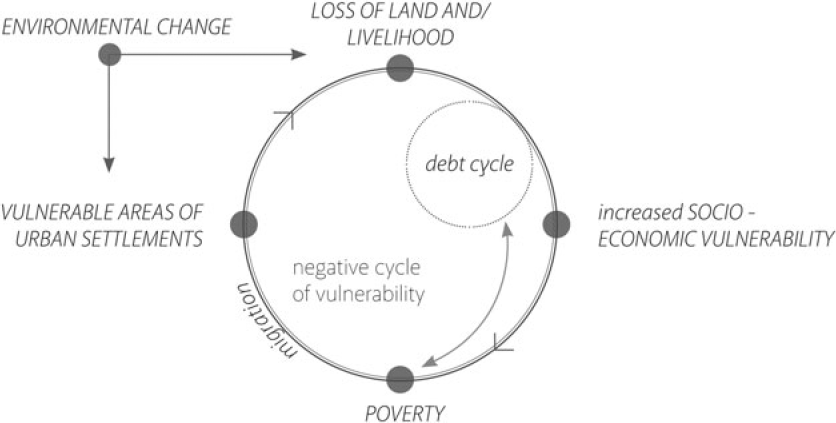
Negative vulnerability cycle.
The methods used in this phenomenological research were a combination of desk research and empirical investigations. It started with establishing key conceptual concepts through scientific literature and discussions with experts working on the issue from across various fields. The literature review highlighted the lack of a cohesive definition for the term “Environmental Migrants.” The consequence of this gap was elucidated through 10 expert interviews and conversations with nonprofit organizations working in the field. Further, the documentaries and secondary empirical research helped describe the challenges faced by the “invisible” migrants. This resulted in the finding that environmental migrants were being pushed to the bottom of the socioeconomic ladder due to the lack of definition, inclusion in governance frameworks, and identity and recognition at the destination. This phenomenon was more profoundly visible in climate vulnerable countries of the Global South, raising a question of climate justice and equity.
To understand the gaps in the current regime, a comparative analysis of the actions taken by countries and multilateral organizations, in response to the ongoing migration across the world, was undertaken. Finally, a site visit to the Ganges-Brahmaputra Delta was carried out to interview the affected people and this established that the phenomenon had been prevalent in the coastal regions of India for decades. This was used to validate the findings of the methods mentioned earlier. These results are elaborated in the later sections.
The Difficulties of Definition
Essam El-Hinnawi placed human mobility in the context of climate change for the first time in 1985 when he coined the term “environmental refugees.” 7 Since that time, scholars such as Norman Myers, Richard Black, and Stephen Castles, as well as international agencies such as the International Organization for Migration (IOM), have criticized this term due to the specific legal definition of “refugees,” as well as published their own versions of its definition. In 2001, Black wrote: “there are as many typologies as there are articles on the subject,” highlighting the lack of a cohesive definition as an initial challenge when addressing climate-induced migration. 8 This lack of definition leads to a reduced visibility and legitimacy for this category of the displaced, further exacerbating loss of identity, culture, and, at times, even citizenship, rendering them stateless. 9
The plight of being stateless often leads to degraded conditions, with ethnic conflict and even war over limited resources. For example, the role of environmental factors in exacerbating the refugee crisis in the Horn of Africa has been acknowledged by the Chief of the United Nations High Commission on Refugees, Antonio Guterres. 10 The trigger for this crisis is yet to be addressed in global and national policy frameworks.
Climate-induced migration also has major repercussions for a region's development. The IOM has established that larger regions, especially urban areas, are subject to more complex development phenomena, such as informal urbanization and “invisible” floating populations. Distress migration followed by circular movement presents a significant floating population that is looking to maximize earnings and the flexibility to return to their homes. Since urban areas tend to be perceived as safer and have parallel cash economies, which make informal employment accessible, they become temporary or permanent destinations. This urban flood has an adverse effect on the densities, food, and water security as well as on the infrastructural capacity of receiving cities. 11 The movement of people in this context remains undocumented and falls outside the scope of governance structures in most countries, yet the development consequences are becoming increasingly important in their agendas.
Further, the economic degradation of affected populations tends to have a severe impact on the economic stability of a region due to increased poverty levels and the diversion of resource allocation to mitigate the rise in poverty and stabilize the labor surplus. 12 This leads to the further emigration of higher skilled classes due to a lack of opportunity; this “brain drain” leads to a hollowing out of a region's economy. 13
A combination of these impacts stunts the development of a region, with the result that developing nations, which tend to be disproportionately affected by climate change, find themselves facing even greater challenges despite their limited contribution to green house gas emissions. This is in addition to their ongoing struggle of trying to achieve basic standards of living for their citizens. 14 To address these impacts of the movement, Dr Joy Sen emphasized the need for a clear definition of migration categories and contextual migration policies. 15
Current Responses
The developing and least developed countries at the frontline of this unfolding disaster have placed a demand for a definition to be able to appeal for climate justice and international assistance to safeguard their populations. However, a review of the global responses to the issue reveals discrepancies in the ideologies of all prevalent transnational institutions, leaving migrants in an undefined legal space. Further, current efforts, actions, and policies tend to focus on post-impact scenarios of sudden-onset disasters. Such refugee and disaster-response regimes have been a constant topic of concern, scrutiny, and innovation in research and practice globally. Scholars from across many fields, including the social sciences, have repeatedly highlighted the structural flaws and humanitarian issues associated with the current top–down, state-aid dependent practices. The concentration of efforts and investment in post-disaster responses involve dealing with huge infrastructural and economic losses but often overlooking the plight of people, who are left struggling to meet their basic physiological needs, without receiving sufficient support to achieve their full potential (as defined by Maslow, Fig. 2). This exposes a clear knowledge gap in pre-emptive and preventive planning for disaster displacement (where pre-emptive means planning in anticipation of a disaster situation).

Adaptation of Maslow's hierarchy of needs (source: authors' drawing).
Due to the complexity and multi-causal nature of environmental migration, it is often brushed under the social science carpet and tagged as being purely economic in nature. Dr. Maudood Elahi and Kevin S. Boiragi 16 highlighted that most migrants end up in slums due to the lack of affordable housing, giving rise to spatial and governance challenges. Its mismanaged, informal nature and the subsequent impact on the host society puts migration in a negative light for scientific, policy, and practice realms. Very few institutions, with the notable example of the Government of Uganda, have begun to recognize the benefits of seasonal or permanent migration and made institutional provisions for the movement. This article seeks to highlight the need for a universal definition for environmental migrants as a prerequisite to understanding their movement patterns, benefits, and needs.
Circular Migration: the Need for Inclusion
Circular Migration has been observed to be a prominent form of adaptation for the environmentally displaced, especially in South Asia. Bustamante points out that migrants alternate their place of residence, often oscillating between origin and destination, until eventually settling down in one of them (legally or illegally) for reasons of age or family concerns. 17 This sees the migrant's career or history as defined by a sequence of loops (see Fig. 3).
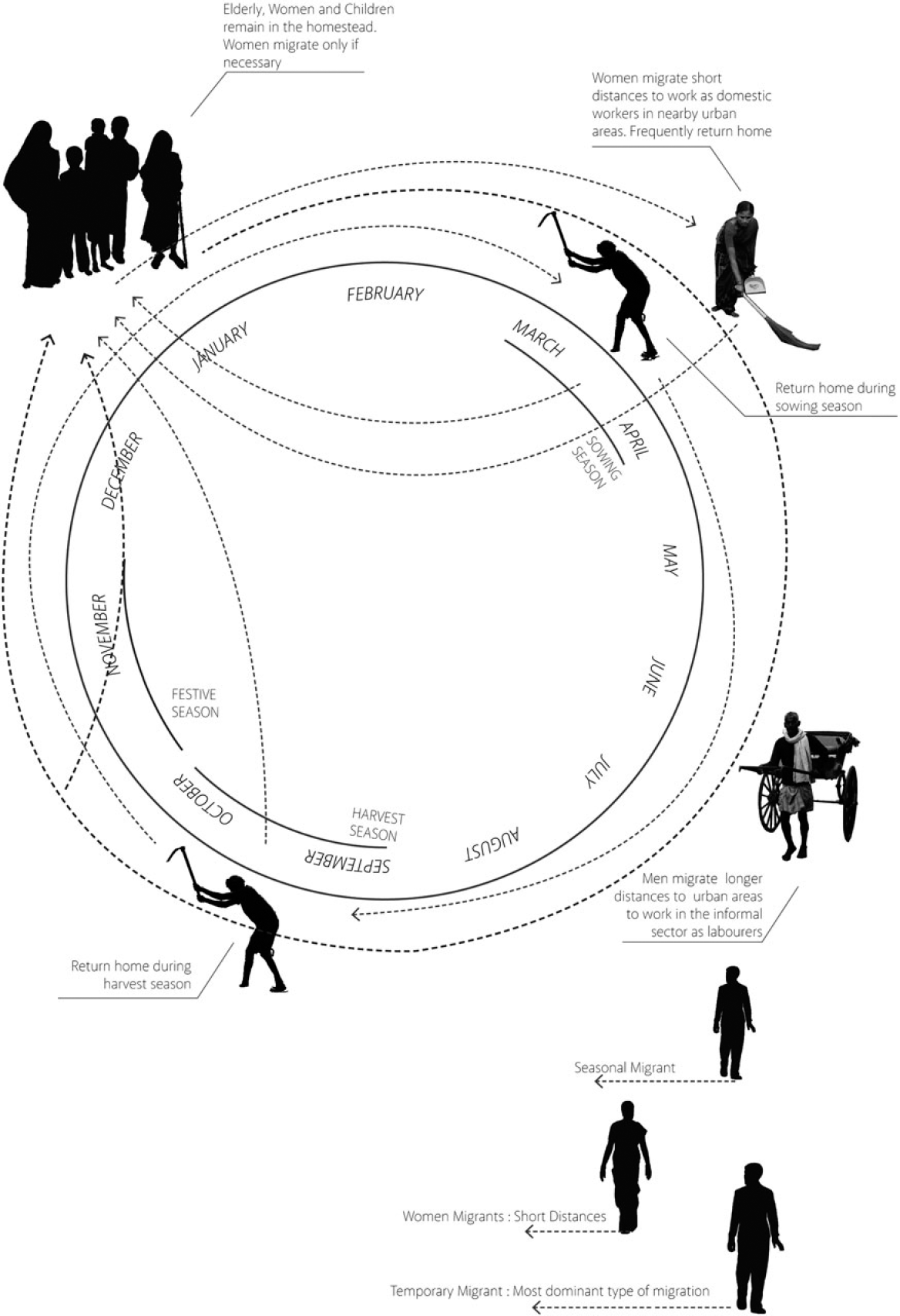
Circular migration in South Asia.
Although definitions tend to focus on international migration, there is increasing awareness of the presence of internal migration as well. This concept, as defined and measured by the United Nations Economic Commission for Europe, is noted for creating a triple-win situation, 18 This means that when it is carried out formally it is beneficial to the receiving region, the sending region, and for the individual migrant. This allows them to take advantage of the cash economies of their host cities to earn money, which they then remit home, where it is used for reconstructing their family's lives. Further, the developmental impact of circular migration is noted to be largely beneficial. The migrants can alleviate labor shortages and contribute to the economic production in the receiving regions while also providing unemployment relief and financial and human-capital support to the sending regions. It is also a way for an individual to attain skills and opportunities to grow. Some formal examples of this are New Zealand's Recognised Seasonal Employer Scheme and Canada's Seasonal Agricultural Workers Program, which allow a circular movement of workers from partner countries to bridge the labor gap in the horticulture and agriculture sectors. 19
Although this strategy has proven to be a successful way of increasing resilience in communities, it puts immense pressure on urban areas. Since this migration is unregistered, migrants are marginalized and subject to a substandard quality of life. Further, families often permanently relocate when they cannot sustain their homestead (especially when they are subject to climate change or extreme weather events), thereby further increasing the pressure on cities. These impacts are limited to the legality of the movement. Illegal movement and informal work expose the migrant to a high risk of exploitation and trafficking, and smaller financial gains. Current policies and strategies fail to include this mobile population in their frameworks, which impacts not only migrants but also the overall development of the regions they move between.
However, there are some scattered good practices of institutional responses worth noting. Bangladesh and India are using livelihood diversification schemes and community disaster training as methods to keep their populations in their original habitats. For example, the national government in Bangladesh has partnered with research institutes to introduce alternate crops and aquaculture practices, which allow farmers to sustain in coastal areas with a high saline content in the water and soil. However, these efforts are still at a very early stage and localized and need considerable intervention to be scaled up to have a regional impact. The preventive measures concentrate on risk reduction as a coping mechanism and fail to factor in the further development of the region. Their aim is the quick restoration of stability in the affected areas, but they overlook the negative impact on growth and development in the larger region or the long-term socioeconomic distress caused by the disaster.
A noted response through inclusive policymaking is the Kampala Convention (2009), an international treaty on internal displacement caused by conflict, natural disasters, and development drawn up by the Africa Union. The treaty has been signed by 40 states and ratified by 25 of them. The objectives are primarily to regulate legal frameworks and policies, both regionally and nationally, to prevent, mitigate, and provide solutions for internal displacement in Africa. The states are required to establish a framework and define responsibilities for all stakeholders for protecting the displaced. 20 The convention provides a standard definition for Internally Displaced Persons and sets out the duties of the state and the relevant stakeholders to protect their fundamental human rights. Further, the states commit to identifying a national body to manage the response to internal displacement. It asks the states to work on prevention of arbitrary displacement and obliges them to conduct vulnerability assessments for the displaced and host communities, for the provision of adequate assistance to both. 21
Lastly, it has been observed that locally embedded and community-based adaptive strategies have been successful in reducing disaster risk and the impacts of displacement. 22 Some of these initiatives are led by communities and non-governmental organizations, whereas others such as the aforementioned initiatives by Bangladesh are supported by municipal and national governments as well as knowledge institutes. However, all these efforts are independent and have varied agendas, which limits their potential use for collaborative and cohesive action for the benefit of the larger region.
Migrants' Traditional Knowledge
Historically, communities that are exposed to and have been battling environmental change for generations possess traditional knowledge, which enables them to survive under harsh conditions.
Traditional knowledge can be defined as the local, cultural, or hereditary knowledge of the people of an area that has evolved out of their interactions and experiences with their natural and built surroundings. It is often a result of experimentation and adaptation techniques undertaken to extract value and survive in these contexts. Largely transmitted orally over generations, this knowledge is a holistic approach to coexisting with the environment. The knowledge and subsequent innovation and practices of the local communities are embedded in the natural environment and direct the use of natural resources and help in the management of the environment. 23 With the recent global shift toward more sustainable practices and resource conservation, the value of this knowledge is being increasingly recognized. Further, the use of this knowledge (beyond conservation purposes) is also an important topic for future research.
Incorporating this knowledge into economic and spatial plans may generate economic activities that can contribute to conservation as well as the strengthening of local ownership of the identity and culture of an area. This, in turn, leads to the creation of economic clusters and plays a vital role in rural development strategies at a regional level. 24 Here, economic clusters have been defined as new economic hubs located between the city and the rural areas. For example: the Bengal region (before the partition of India in 1947) was the largest jute-producing region in the world. It cultivated, processed, and manufactured jute products, such as gunny bags, which are eco-friendly and are a sustainable packaging alternative to plastic. However, due to the partition, and the flooding of the market with plastic, the industry declined.
The use of traditional knowledge in its purest form has, however, also been widely criticized. Icamina (1993), Millennium Ecosystem Assessment (2003), and Warren, et al. (1995) all highlight the fact that to achieve sustainable development, combining traditional and modern scientific knowledge systems is imperative. 25 This has been reinforced by transnational agencies such as the International Union for Conservation of Nature (IUCN) and the World Commission on Environment and Development (WCDE), which emphasize the need to respect the value of the two sets of knowledge to extract their strengths and address contemporary challenges. 26
To achieve this, Boedhidartono argues that traditional knowledge needs to be captured and compiled from its sources beyond the scope of simple cultural documentation. 27 These practices need to be looked at through an operational lens rather than simply as an archival asset. Knowledge integration needs to be promoted through research and management strategies created by using a mosaic of both fields of knowledge. The application of this mosaic to traditional economies such as agriculture and fisheries can create additional economies and will be instrumental in regional growth and sustainable development. Beyond these benefits, however, the acknowledgement, documentation, and harvesting of cultural knowledge will provide an exclusive identity to the local population, recognizing them as valuable assets, instrumental in boosting climate resilience and fostering growth for the region.
In Tuvalu, for example, communities use their traditional knowledge for preserving food, cloud mapping to locate fish and predict natural disasters to adapt to changing conditions. They also applied a traditional law to ban land cultivation and harvesting of marine resources around parts of the island to ensure resource recovery. The Development Fund report on Identifying Sustainable Pathways for Climate Adaptation and Poverty Reduction, called More Than Rain, 28 documents many such instances where traditional knowledge in combination with modern techniques adapts to climate change as well as fosters socioeconomic growth. 29
Community-based initiatives supported by a collaborative institutional framework from both the sending and the receiving regions will allow people to pre-emptively plan their livelihoods and movements. Such pre-emptive planning will not only enhance their resilience in times of disaster but also give them recognition and the opportunity to grow socioeconomically.
Conclusions and Recommendations
Action on environmental migration is hampered by a lack of definition, which could channel actions currently isolated and enable multi-sectoral collaborations across international, national, and local levels. Further, a participatory model could enable national plans to be more effective, international efforts to be more focused, and allow for transferability of local strategies (as in the already mentioned Kampala Convention).
National and regional spatial-planning instruments need to address environmental migration as a key consideration in development plans. Regional livelihood planning can play a key role in streamlining and regularizing the reorganization of the displaced. Development plans can then tap the potential of using population movement for the benefit of a region by optimizing available socioeconomic opportunities and reviving traditional occupations. This will not only be instrumental for growth in the region but also minimize the negative effects of displacement and the violation of human rights by giving migrants a distinct identity.
Lastly, community-based strategies can encourage participatory pre-emptive planning, anticipating rather than reacting to disasters. This enhances community resilience and facilitates socioeconomic growth and development. In many countries, such as Vietnam, Columbia, and China, pre-emptively planned relocation has been conducted for populations under risk; moving them to safer locations by using participatory methods. Although relocation has its challenges and is considered a last resort in any disaster management plan, it is increasingly becoming the only solution for many countries. 30 Alternately, pre-emptively planning for the circular movement of communities, enabling them by fostering their traditional livelihoods, will increase their disaster resilience. Further, if mapped spatially, circular migration will trigger the growth of peri-urban economic clusters and reduce pressure on the saturated urban centers.
As a recommendation, this article proposes a three-part framework to address environmental migration: Define—Include—Recognize. First, it calls for a cohesive universal definition for the environmentally displaced. Second, it is essential to include environmental migrants as key stakeholders in national and local spatial-planning policy instruments. And third, there is a need to recognize the existing strengths of affected populations to channel them into community-based strategies that enable pre-emptive preparedness for disasters.
The complexity of this issue requires a relational approach rather than a deterministic one: for example, permanent resettlement versus one-off infrastructural constructions. Deeper insights into migrants' movement patterns and socioeconomic practices are required to understand the interventions needed in regional-planning instruments. 31 Local perceptions of environmental changes are also essential to plug gaps in international approaches. 32 To support this, international collaborations should be used to foster regions economically, institutionally, and technically for knowledge sharing. Further, for efficient absorption of a population into a larger region it is essential to investigate the needs and possible reactions of the host population. Symbiotic relationships can be fostered to create a mutually beneficial situation for both communities.
Awareness of the concepts outlined in this article will enable nations to better address issues related to climate-induced migration and help them develop cohesive responses to them, which will, in turn, further reduce the detrimental impact on the displaced and their host settlements.
Footnotes
ACKNOWLEDGMENTS
This article is a continuation of the research conducted for the author's Masters in Architecture and the Built Environment (Urbanism Track) thesis. The thesis was deposited in Delft University of Technology's online repository. The complete report and presentation can be found in the following link:
Author Disclosure Statement
No competing financial interests exist.
Funding Information
No funding was received for this article.