




Abstract
The United States Environmental Protection Agency's Superfund program was designed to remediate environmentally hazardous waste sites and, in doing so, inform and engage the public. Awareness of such hazards is essential for residents to be able to take individual and collective measures to protect their health. Although previous research has examined perceptions of the level of knowledge about environmental hazards, what has received less attention in the literature—and is a critical missing piece—is whether awareness of environmental hazards in one's community is explained by socioeconomic status (SES). Drawing on fundamental cause theory and a survey of households in two neighborhoods that are in or directly adjacent to two Superfund sites in Southwest Ohio, this research shows the important and nuanced role of SES in explaining awareness of these risks. Those who rent their home are significantly less likely than those who own their home to know about the Superfund sites even after controlling for other measures of SES and length of residency in the neighborhood. The findings from this research highlight important disparities in awareness of environmental hazards under the Superfund process—a process that was specifically designed to address environmental injustices and subsequently disparities in health risks. Our research also shows that SES is a broad measure that must be disaggregated to acknowledge the tangible mechanisms through which marginalization occurs. We conclude with a discussion of the implications for environmental justice research and for activists and policy makers seeking pathways to procedural justice.
Introduction
Previous research has documented how hazardous waste is disproportionately located in low-income communities and communities of color. 1 , 2 , 3 , 4 , 5 However, less is known about whether there are inequalities in the distribution of awareness of environmental contamination among people who live near hazardous waste sites. Although researchers have documented socioeconomic status (SES) disparities in levels of community knowledge, they often assume that residents are first aware that such hazards exist. The United States Environmental Protection Agency's (US EPA) Superfund Program is designed to address potential disparities in awareness through information sharing and community involvement in the remediation process. Drawing on the fundamental cause theory, 6 this article examines socioeconomic disparities in knowledge of environmental risks among residents in two neighborhoods located near EPA-designated Superfund sites in Southwest Ohio. These neighborhoods face many of the challenges experienced by other postindustrial cities across the United States and can provide a case study for examining the impediments to promoting the right to knowledge in such contexts.
Fundamental cause theory and awareness of local environmental hazards
Empirical research supports the fact that knowledge of environmental problems—influenced by many factors including values, attitudes, and trust in government—leads to increased perceptions of risk and the likelihood of subsequent individual action to protect one's health. 7 , 8 Knowledge of environmental problems is also associated with collective action to address such problems. 9 , 10 Moreover, international human rights doctrines and treaties assert that knowledge is a human right that when upheld supports other human rights, including the right to safety and the right to participation. 11 , 12 , 13 What has received less attention and is a critical missing piece is whether awareness of environmental hazards such as Superfund sites in one's community is mediated by SES.
To explore the relationship between SES and awareness of environmental risk, we draw on the fundamental cause theory. This perspective argues that health inequalities persist because fundamental determinants—specifically SES—are linked to resources such as money, knowledge, power, prestige, and social connections that subsequently influence exposure to the proximate determinants of health outcomes (e.g., diet, exercise, smoking). 14 The fundamental cause theory is supported by previous research that has shown how socioeconomic disparities in knowledge about proximate determinants contribute to disparate outcomes such as lung cancer, 15 , 16 colorectal cancer morbidity, 17 and cardiovascular disease. 18 This research has largely shown that disparities in health outcomes are linked to unequal access to important resources, including knowledge, and can subsequently create or exacerbate health disparities along existing social cleavages. However, the fundamental cause theory is largely absent from research on environmental proximate determinants such as exposure to pollution and environmental toxins. In particular, the fundamental cause theory has not been used to evaluate the relationship between SES and awareness of environmental hazards—a prerequisite for protective action to reduce risk exposure.
The purpose of the US EPA Superfund program extends beyond remediation of the thousands of contaminated sites across the United States. 19 Its purpose is also to uphold the right to knowledge and procedural justice through extensive information sharing, collaboration, and community engagement. 20 However, the fundamental cause theory suggests that fundamental determinants lead to unequal access to procedural justice. If this applies to hazardous waste sites under the auspices of the EPA Superfund Program, we would anticipate that as resources for prevention and engagement became available, higher SES individuals would disproportionately benefit through the accumulation of knowledge and opportunities for individual and collective engagement in the remediation process. Specifically, we ask whether awareness of EPA-designated Superfund sites—knowledge that is essential for protective action and community participation—is distributed equitably among residents regardless of their SES.
Methods
To test whether awareness of environmental risks is equitably distributed, we use a community-based research approach in two adjacent neighborhoods that are home to two separate Superfund sites. This approach involves collaboration between stakeholders through the research process. 21 In this project, community partners played key roles in the survey instrument design, sampling, participant recruitment, as well as the distribution of the results.
Case and site selection
The two neighborhoods chosen for this study are home to two Superfund sites in the Greater Dayton Area of Ohio (Fig. 1). Valleycrest Landfill in Old North Dayton joined the Superfund National Priority List (NPL) in 1994. The Valley Pike Site, which joined the NPL in 2016, is located in the neighboring City of Riverside. Each site contains volatile organic chemicals (VOCs) at levels that pose a potential risk to the health and safety of area residents and businesses. Trichloroethene and tetrachloroethylene—the primary VOCs of concern at both sites—are VOCs that have been linked to health problems such as headaches, lung irritation, dizziness, coordination and concentration problems, nerve and organ damage, and a variety of cancers. 22 At the time this article was published, neither site had reached the construction stage of remediation in which a clean-up plan is implemented. 23 , 24 Therefore, residents remain at a potential risk of exposure to concentrations of dangerous pollutants. A common channel of VOC exposure is vapor intrusion (VI): Vapors from chemical plumes below ground migrate through soil and through cement basements and slabs to accumulate in homes. 25 In designated areas where a clear pathway of VI has been detected, residents can qualify for testing of their homes, and if needed, a mitigation system. A clear VI pathway has been detected at the Valley Pike site, 26 but not at the Valleycrest site, though the risk of such a pathway could occur due to the migration of groundwater contamination that has not stabilized. 27
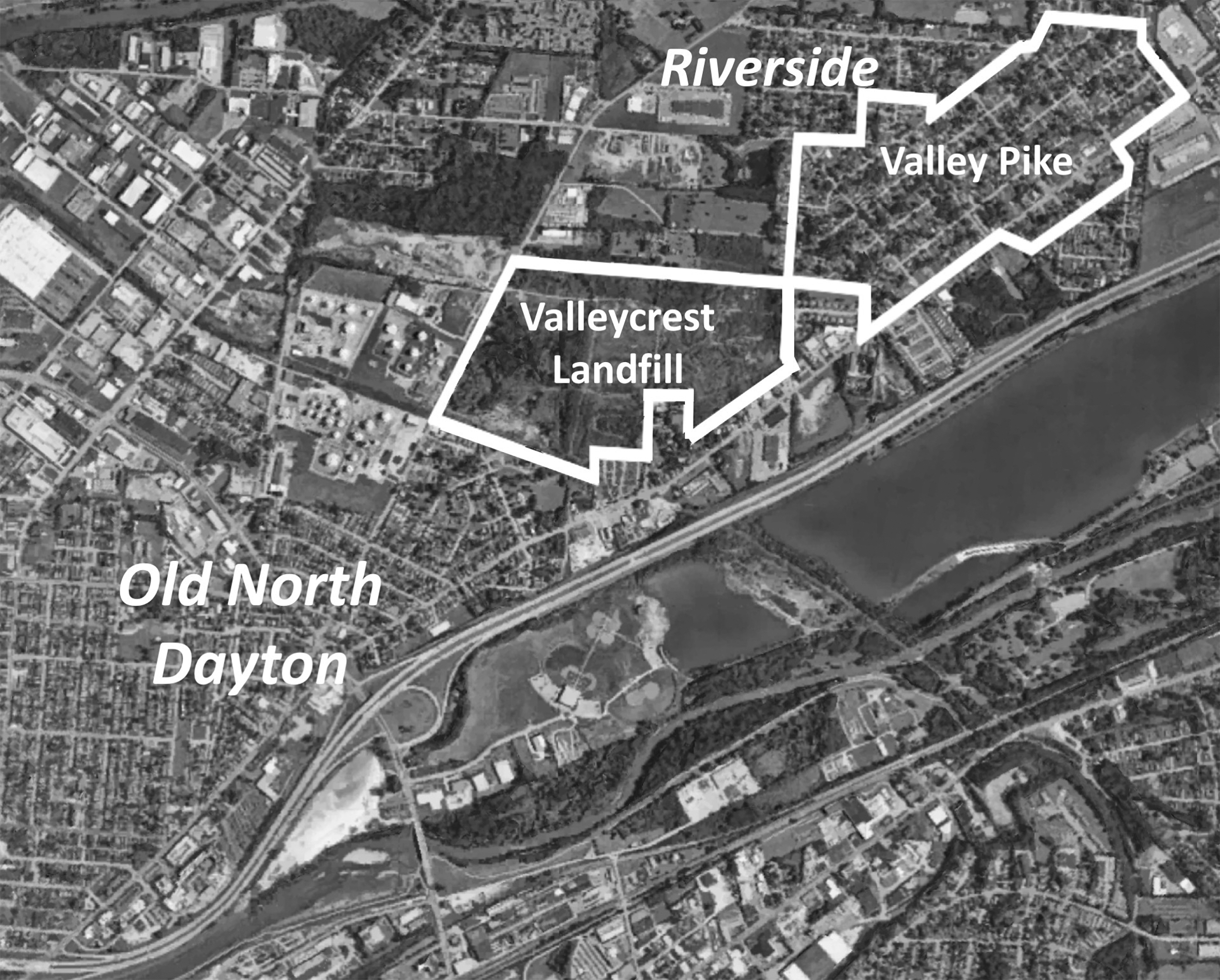
Case study area. Map showing location of Riverside and Old North Dayton neighborhoods. Google Earth,
The residents living in the City of Riverside and Old North Dayton neighborhoods are predominantly working-class and white, with a growing immigrant population in recent years. 28 Approximately 24% of residents older than the age of 25 have less than a high school degree and 29% of the population falls below the poverty line. 29 More broadly, the area has experienced population decline over the past 40 years as a result of the decline of manufacturing and other industrial jobs, suburbanization, and, more recently, the 2008 housing crisis. 30 The neighborhoods included in this study exemplify so many other small and mid-sized postindustrial cities in the United States, with declining populations, low educational attainment, and deteriorated job prospects.
Survey instrument
To design the survey instrument, we conducted exploratory focus groups with neighborhood leaders and activists and solicited feedback from neighborhood meetings during the winter of 2019. Survey questions reflect patterns of common questions or “unknowns” that were of interest to the stakeholders engaged in advocacy around these two sites. A common theme that emerged from focus groups was the desire to know the level of awareness that residents had about these sites. This was especially important given the duration of time since the neighborhoods initially learned of the contamination (especially for the Valleycrest site).
The survey consisted of three sections of primarily close-ended questions: (1) general community concerns, perspectives, and experiences; (2) concerns, perspectives, and experiences specifically related to the three superfund sites; and (3) demographic and socioeconomic information. Because we could not assume that residents would have any knowledge of the contamination or Superfund process, we included a brief description and map of the sites. This description was reviewed for accuracy and objectivity by representatives from the Ohio Department of Health. We shared a draft of the survey instrument with key informants to allow them to provide feedback and suggestions, all of which were incorporated into the final survey instrument. The survey and broader research study protocol received approval from the Institutional Review Board at the University of Dayton in March of 2019.
Sampling method
We distributed the survey via mail (spring 2019) and online (spring and summer 2019). Previous research on environmental remediation efforts suggests that mail surveys are an effective tool for assessing community participation. 31 To achieve a comprehensive household sampling frame, we used the United States Postal Service Office Every Door Direct Mail program to distribute the survey to 1641 households 32 in carrier routes directly over or adjacent to at least one of the Superfund sites. 33 Each household received three mailings: an informational letter, a paper survey, and a reminder letter. The online survey was distributed using Qualtrics software by using an anonymous link included in the mail-survey correspondences and shared through neighborhood associations, a community advisory group, and through the local business association. This approach is in line with recent studies showing increased response rates for mixed-mode survey design. 34
In total, 140 households completed surveys. The low response rate (8.5%) can be attributed to several factors. First, although surveys were sent only to “active” mailing addresses, it is not known how many homes were occupied at the time of mailing. This is a common challenge for mail surveys using mail carrier routes. 35 Second, response rates are generally lower in low-income neighborhoods where fewer residents are homeowners, especially when incentives are not provided. 36 Finally, mail-based data collection ceased after May 2019 when a series of tornados caused extensive damage in the study neighborhoods and surrounding areas.
Variables and measurement
The outcome of interest is whether respondents had any knowledge of the two Superfund sites located in and around their neighborhoods. After reading the section that described the two Superfund sites, respondents were asked “Before you read the section above, how much did you know about the two Superfund sites?” Respondents indicated if they knew “a great deal,” “a good bit,” “some but not much,” “very little,” or “nothing” about each of the two sites. For purposes of our analyses, we recoded these answers into a new dichotomous variable to measure whether or not each respondent had any knowledge of either of the sites (“nothing” = 1, all other responses = 0). We measured SES by using three dichotomous variables: homeownership status (own/rent), educational attainment (high school degree or less/at least some college), and employment status (unemployed or underemployed/full-time, retired, or not looking for work). We also controlled for how long residents lived in the neighborhood (less than 10 years/10 years or more).
Analysis
In addition to descriptive statistics, we use Chi-square statistics and logistic regression to analyze the relationship between self-reported awareness of either of the sites and the independent variables of interest. Odds ratios are produced from the logistic regression models to show the odds of not being aware of either of the sites when compared with the reference category for each independent variable. Models 1–4 present the main effects of each independent variable. Model 5 presents the full model. Models were compared by using Nagelkerke's R2 metrics. To evaluate the logistic regression models, the Hosmer and Lemeshow Test of Goodness of Fit is used. Residual statistics (i.e., DFBeta and standardized residuals) of the final model did not raise any model diagnostic concerns. All descriptive and logistic regression analyses were conducted in SPSS Statistics 24.
Results
Table 1 presents the unweighted and weighted demographic characteristics of the respondents included in the study. 37 The majority of respondents were born in the United States (96.8%) and identified as non-Hispanic white (92.0%). Women were slightly oversampled (60.8% of respondents), as were older respondents (median age of 61). Because younger residents and male residents were undersampled, we use poststratification weights for gender and age. 38 Weighted results of sociodemographic variables show that 30.6% of respondents indicated having a high school degree, GED, or less. Most respondents were either employed full-time or out of the labor force (9.3% were unemployed or underemployed), whereas 28.7% indicated that they rented their home. The weighted data indicated that 37% of respondents had no knowledge of the sites before completing the survey.
Sample Characteristics
N = 120.
Table 2 presents the results from Chi-square tests that examine the relationship between self-reported awareness of either of the sites with measures of SES and length of residency in the neighborhood. Although those who were unemployed or underemployed were significantly less likely to be aware of either site compared with those who were employed full-time, retired, or not looking for work, this relationship was only marginally significant (p = 0.063). This lack of significance—despite the large differences in percentages—may be due to the small share of respondents who were unemployed or underemployed. There was no significant difference in awareness of the Superfund sites by educational attainment (p = 0.396). Within homeownership status, renters were significantly less likely to be aware of either Superfund site (p < 0.001). Finally, those who had lived in the neighborhood for less than 10 years were significantly less likely to be aware of either Superfund site; however, this finding was only marginally significant (p = 0.077). Cramer's V statistics indicated that homeownership status, in fact, had the strongest relationship with awareness of the Superfund sites.
Results from Bivariate Analyses of Whether Respondents Were Aware of the Sites with Measures of Socioeconomic Status and Length of Time in the Neighborhood
N = 120; ***p < 0.001, ^p < 0.1
Table 3 presents the logistic regression models predicting no knowledge of either of the Superfund sites. The cell values present the odds ratios, with the standard errors in parentheses. The main effects are presented in Models 1–4. Compared with homeowners, renters were 7.6 times more likely to not be aware of either of the sites (p < 0.001). And although only marginally significant, compared with those employed, retired, or out of the labor force, those who were unemployed or underemployed were 3.58 times more likely to not know about the Superfund sites (p = 0.056) and compared with those who had lived in the neighborhood for 10 or more years, those who had lived in the neighborhood less than 10 years were twice as likely to not know about these sites (p = 0.066). Educational attainment was not significant (p = 0.460). Of the four main effects models, homeownership status has the strongest predictive power with a Nagelkerke R2 of 0.249.
Results from Logistic Regressions Predicting No Knowledge of the Superfund Sites
N = 120; ***p < 0.001, **p < 0.01; *p < 0.05; ^p < 0.1.
In the full model (Model 5), education remained insignificant (p = 0.401), and the length of residency in the neighborhood (p = 0.751) and employment status lost significance (p = 0.119). In part, the change in the effect of employment status may be the result of such a small share of respondents who were unemployed or underemployed. When holding length of residency, employment status, and education constant, homeownership remained a significant predictor. Holding these other factors equal, compared with survey respondents who own their home, those who rent their home are nearly eight times more likely to not know about either of the sites in their area (p < 0.001). The final model passes the Hosmer & Lemeshow test (3.422, df = 5, p = 6.35), suggesting goodness of fit. Comparison of the coefficients of determination (Nagelkerke R2) across the five models shows that model fit is largely driven by homeownership status. Residual statistics of the final model did not raise any model diagnostic concerns (e.g., all DFBeta values were less than 1 and less than 5% of standardized residuals were greater than 2). 39
Discussion and Conclusion
Thousands of communities around the United States are home to hazardous waste sites that pose a risk to the health and safety of surrounding neighborhoods. The residents of these communities are entitled to the right to knowledge of these risks, and such information is a prerequisite to their ability to take actionable steps in protecting their own health and in participating in a remediation process. 40 , 41 , 42 , 43 Under Executive Order 12898, EPA guidance for environmental justice under the National Environmental Policy Act emphasizes “effective public participation strategies” that “incorporate active outreach to affected groups” as well as “meaningful community representation” that accounts for “diverse constituencies within any particular community.” 44 However, the fundamental cause theory suggests that such procedural justice is unequally distributed along social cleavages, specifically SES. To the authors' knowledge, no previous studies have examined whether Superfund outreach and engagement efforts are equitably reaching area residents regardless of SES. Using a survey of residents living near two EPA designated Superfund sites in Southwest Ohio, we find that awareness of the existence of the sites—awareness that is essential for participation, health, and life—is unequally distributed across SES, and more specifically homeownership status. Even after controlling for other measures of SES and the length of time respondents lived in the neighborhood, those who rent their home are nearly eight times more likely to not be aware of these hazardous waste sites in their communities.
The EPA Superfund program was designed to not only clean up hazardous waste sites but also to fulfill residents' right to knowledge through information sharing and community engagement. There are several different pathways through which homeownership status may be preventing those who rent from learning about EPA designated Superfund sites in their neighborhoods. First, there are no requirements for landlords to inform renters of the proximity of hazardous waste sites. Therefore, if Superfund outreach efforts target the legal owners of residential property, that information may not be shared with renters. In addition, the social benefits of homeownership may mean that renters are less likely to know about environmental risks. Previous research has demonstrated that renters are less likely to participate in neighborhood activism 45 and know fewer neighbors than homeowners. 46 Renters may be more likely to be balancing precarious livelihood strategies 47 and may also have lower levels of investment in and attachment to the community. 48 This has implications for renters' ability to take steps to protect themselves as well as for their ability to participate in broader collective efforts to shape the remediation process and outcomes.
This research also shows that SES is a broad measure that must be disaggregated to acknowledge the tangible mechanisms through which marginalization occurs. In this particular case study, education and employment have minimal to no effect on awareness of these hazardous waste sites, but homeownership does. Homeownership acts as the mechanism through which SES mediates awareness of environmental risks. Future studies should further investigate these relationships, especially since pollution tends to be concentrated in neighborhoods with higher percentages of renter-occupied housing. 49 Research on renters presents unique methodological challenges that are apparent in the limitations of this study (namely the low response rate to the mail survey). These challenges could be potentially minimized by engaging community members in data collection and by using creative approaches for multimodal survey distribution.
Finally, researchers should continue to investigate the pathways through which the fundamental cause theory is realized in environmental justice communities. Inequalities in knowledge about environmental risk, and thus inequalities in access to decision-making processes and protective measures, persist in part because of fundamental determinants, especially those linked to the various components of SES. By disaggregating measures of SES, such research can provide tangible action and policy prescriptions that meet the specifics of residents.
Policy and action implications
This research demonstrates the need for agencies and other groups to conduct additional residential outreach to renters. Such outreach should include information sharing that is carefully tailored to the target audience, reduced in technical complexity, and shared multiple times in different forms. 50 Given the EPA backlog of sites waiting on remediation, such outreach efforts will likely need to be spearheaded by local leaders and state agencies. Policy makers at both state and local levels could also develop new policies to hold landlords responsible for appropriate testing that ensures the health of residents. Local agencies could also develop pathways for renters who wish to have their homes tested for VOCs and other environmental toxins, but are unable to get landlords' permission to do so. Finally, even at sites where a clear VI or other risk pathway has not yet been detected, a precautionary approach should be taken so as not to focus solely on current health risks (or lack thereof) but also potential health risks. 51
Conclusion
The results of this study demonstrate that SES—and specifically, homeownership status—explains disparities in access to information from the Superfund process—a process that was specifically designed to address environmental injustice and subsequently disparities in health risks. This research shows that the fundamental cause theory is a useful tool in understanding the disparate access to knowledge of local Superfund sites. This raises important questions about the Superfund program as a bureaucratic system that can reinforce the inequalities that, in fact, it seeks to address and calls for more equitable distribution of health-influencing knowledge so that all residents—including renters—are able to use that knowledge—if they wish to do so—to take individual and collective action to protect their health.
Footnotes
Acknowledgments
The authors wish to extend appreciation to Dr. Joy Kadowaki and Dr. Felix Fernando for their contributions to constructing and disseminating the survey as well as members of the Greater Old North Dayton and City of Riverside communities. In addition, the authors thank George Gumbert for assisting with data entry of returned mail surveys and Alyssa Miller for helping to assemble relevant literature in early stages of this project.
Author Disclosure Statement
No competing financial interests exist.
Funding Information
Rhubart acknowledges support from the Interdisciplinary Network on Rural Population Health and Aging funded by the National Institute on Aging (R24 AG065159). This questionnaire was made possible through financial support from the Center for Human Rights at the University of Dayton.