




Abstract
This study used the United Kingdom and feed barley as case example to highlight the potential of climate mitigation policies in the global north to create food vulnerabilities in the global south or widen the food gap between the global north and south. Future UK feed barley supply was assessed under the influence of projected climate change, climate mitigation policy scenarios, and population growth. The results showed that land-based climate mitigation policies reduced land area for barley and created large deficits in supply. Using Algeria and Tunisia as exemplar global south countries that rely on barley supply from the United Kingdom and Europe for food and feed, the article concludes that pursuit of land-based mitigation policies, in the global north, which reduce the production of globally important food security crops, can create or amplify food vulnerabilities in the global south. Tunisia's imports, for example, are about 290% of domestic production. These countries need feed barley to maintain high domestic animal production for food and religious needs, which limit meat imports. The asymmetries in technical, economic, and political power between the global north and south imply that the latter could be outcompeted. In serving the climate justice principle of “equitable sharing of burdens and benefits,” the article argues that climate mitigation policies should address (not amplify) the uneven geographical and social impacts of climate change. This principle should be integral to the appraisal of public policies and actions on land-based climate mitigation policies and prioritized in climate justice discourse in a genuine global cooperative framework. This is as urgent as the need for climate mitigation action.
Introduction
The global north–south divide is an industrial–economic development chasm between the so-called developed countries and developing countries. Global north countries are economically and technically advanced, geopolitically powerful and influential, dominate and dictate global resource, and trade flows. Compared with the global south, countries in the global north account for a disproportionately larger share of anthropogenic greenhouse gas emission, which is driving climate change.
However, countries in the global south are known to be highly vulnerable to the adverse impacts of climate change and, therefore, bear a disproportionately larger share of the burdens of climate change. Trade and access to key, globally significant food commodities on the international market, are crucial for the maintenance of food security in the global south, and this access would become even more important as part of the adaptive responses to climate change in the future. 1 Cereals constitute the largest share of dietary energy for both humans and animals and are the most traded crops in the world. 2 , 3
Globally, barley (Hordeum vulgare L.) is the fourth most important cereal crop produced and the largest coarse grain used as animal feed, with feed use accounting for about 53% of total barley produced. 4 World barley production and trade are dominated by global north countries. Currently, Africa and Asia have the lowest self-sufficiency rates, and Africa accounts for about 50% of direct consumption of barley as food. 4 Future demand for barley would increase substantially, with developing countries accounting for 56% of global feed use of coarse grains by 2050. 5 By 2050, global barley production will have to increase by 54% (over 2000 level) to meet projected demand. 6 Clearly, developing countries in the global south would increasingly rely on their global north counterparts for barley supply to meet their food security needs. However, it is known that high latitude countries could benefit from productivity gains under climate change. 1 Specifically, for barley, modeling shows that elevated atmospheric carbon dioxide, with slight warming, could lead to yield gains in northern temperate environments. 7 , 8
The enormity of the adverse impacts of climate change on particularly agriculture and food security, and development in general, makes climate action an urgent and priority issue on the global agenda for human security and development. Global governance frameworks and initiatives, such as the United Nations Framework Convention on Climate Change (UNFCCC), the Paris Agreement, and the Sustainable Development Goal 13 (Climate Action), gave fresh momentum to climate mitigation efforts. Land-based climate mitigation policies and actions aim to increase the sink capacity while reducing the source capacity of activities in the land use, land use change, and forestry (LULUCF) sector. The huge potential of the LULUCF sector to remove carbon from the atmosphere makes it an important target for climate change mitigation policies and actions.
Land-based climate mitigation policies and actions, however, can unintentionally reduce food production and diminish food security. 9 , 10 , 11 , 12 , 13 , 14 , 15 Land-based climate change mitigation activities can compete with food production for resources (such as land and water), divert food from human consumption or feed use to energy production, or divert financial and human resources away from food production. These can diminish food supplies, increase competition for food, and limit food access.14,15 A recent study reported that, by 2050, stringent mitigation policies, implemented evenly across all sectors and regions, would increase global hunger and food insecurity than the sole impacts of climate change, with Africa and South Asia being worst affected. 14 Another study indicated that, by the end of the century, land-based mitigation activities could significantly increase food prices, with Africa and Asia suffering the greatest price effects. 16 These suggest that critical appraisal of climate mitigation policies is necessary to avert the unintended consequence of widening the food gap between the global north and south.
Environmental/climate justice dimension
Justice can be conceived as a non-zero-sum game that aims to maintain or restore harmony and balance between persons, groups, entities, states, or a victor and a victim. In its simplest form, environmental justice addresses matters of equitable distribution of burdens and benefits of (distributional aspect), meaningful involvement of all relevant groups concerned irrespective of socioeconomic background or status (procedural aspect), conscious admission and consideration of the needs of groups affected by (recognition aspect) and the application of precautionary principle in environmental policies and actions. 17 , 18 Similarly, climate justice, as a derivative or subfield of environmental justice, has the same components.
Central to climate justice is the principle of equitable distribution of benefits and burdens of climate change and related policies or actions. This equity-based principle implies that the needs of the most vulnerable are considered in the appraisal of climate actions and policies. To this end, climate mitigation policies or actions in the global north should not unduly disadvantage the balance of physical and economic access to key food commodities on the international market by global south countries. This sensitivity to and explicit consideration of the needs of affected groups, or environmental justice considerations in sustainable initiatives and frameworks has been termed “just sustainability,” 17 which can be referred to as “just climate action” in the context of the current article.
This article is based on two layers of climate injustice. First, as indicated earlier, the distribution of anthropogenic greenhouse gas emissions and the attendant adverse impacts of climate change are geographically uneven. The large emitters are considerably in the global north while tropical developing countries are highly vulnerable and therefore bear the largest share of the burdens of adverse impacts of climate change. These uneven distributions of greenhouse gas emissions and adverse impacts of climate change between the global north and the global south raise issues of significant distributional climate injustice.18, 19 The second layer of injustice relates to the implications of climate mitigation policies and actions in the global north for food security in the global south. As indicated earlier, in northern temperate countries, production of cereal crops such as barley can benefit from productivity gains under climate change.1,7,8
The expectation would be that because barley is a globally significant crop for food security, northern temperate countries would take advantage of the climatic benefit to increase production and maintain surplus to support trade and food security in the global south. 1 Unfortunately, there is some evidence that climate mitigation policies in the global north can hurt food security in the global south,9,10,11,14,15 and this leads to distribution and recognition injustice. This implies the climate justice principle of equitable sharing of burdens and benefits should strongly underpin the appraisal of land-based climate mitigation policies in the global north by seriously considering the geographies and/or demography of groups that are most vulnerable to climate change and food insecurity (and therefore need access to food the most). This is necessary to redress the sense of climate victors versus climate victims and the double whammy effect on the global south.
Central to the environmental justice movement is the effort to redress matters of disproportionate and unjust exposure of vulnerable groups (including minorities and indigenous groups, poor households, and countries) to harm or hazards through policies and actions underpinned by race, ethnicity, colonial, and neocolonial biases. 18 Often, the vulnerability of victims of environmental justice is created by a matrix of forces, which can be historical, structural, racial, and ecological. Historically, colonial powers established a political–economic system in which the colonies produced plantation or cash crops and other industrial raw materials for the colonists while (processed) food commodities were imported to the colonies. This system remains a verifiable and major component of the political–economic system of several developing countries that were colonized.
In addition to the colonial and neocolonial arrangements, asymmetries in industrial–economic development and power over commodities and markets in the international arena have contributed substantially to vulnerabilities to climate change and food insecurity in the global south. For example, heavy subsidies, excessive surplus, and low prices of food commodities and market distortions in the global north have disincentivized investment in agricultural development, rendered local agricultural production uncompetitive, changed the food environment and dietary lifestyles, and created long-term dependence and cumulative vulnerability to food insecurity in the global south. Climate change, thus, will complicate and amplify these vulnerabilities and further climate action should not exacerbate or escalate the already disproportionate burden borne by countries in the global south.
Purpose of this study
This article argues that climate mitigation policies in the global north should address (not amplify) the uneven impacts of climate change and should therefore, not diminish the supply of globally important food security crops. In other words, such policies should not widen the food gap between the global north (climate victors) and the global south (climate victims). As pointed out earlier, studies have shown global cases of adverse consequences of climate mitigation policies for the food security of countries in the global south. There is a need for more national-scale or subglobal case studies to showcase the specificities of the potential for climate mitigation policies in the global north to create or amplify food insecurity in the global south, based on differences in national circumstances and interdependence.
There is a need to show the direct link between trade dependence and how future food supplies, due to climate change and mitigation policies, could lead to increased or new vulnerabilities, albeit hidden, in distal economies to inform the appraisal of public policies and global discourse on the climate justice principle of equitable sharing of benefits and burdens of climate change. Unlike previous studies, this article uses the future barley production in the United Kingdom as a case to exemplify the potential for land-based climate mitigation policies in the global north to create or amplify food insecurity in Algeria and Tunisia as exemplar developing countries in the global south. The article aims to contribute to the emerging evidence and voice for urgently re-examining the transnational impacts of climate mitigation policies in the global north on resilience and food security in the global south.
Methodology
Future supply
The FAO AquaCrop model 20 was used to simulate the grain yield of barley genotype Westminster using projected daily climate data for the United Kingdom under three emissions scenarios (low, medium, and high, hereafter low emission scenario [LES], medium emission scenario [MES], and high emission scenario [HES], respectively) for the 2050s. The LES, MES, and HES correspond to the SRES B1, A1B, and A1FI, respectively. Relevant soil hydraulic data (such as saturated water content, field capacity, permanent wilting point) were obtained from the new Soil Information System database of the European Union (EU). 21 The AquaCrop model was calibrated and validated using data from field-grown barley at the James Hutton Institute (Dundee, United Kingdom) (see 12 ). The initial soil water content was set to field capacity, and no soil fertility stress was assumed for all simulations. Detailed description of the calibration, validation, and future yield simulation can be found in Yawson. 22
Future land area for barley crop in the United Kingdom was derived as a proportion of projected area of croplands in the report by Thomson et al. 23 The United Kingdom has national and international obligations to track, review, and take actions to meet targets on reductions in greenhouse gas emissions. For example, the UK Climate Change Act (2008) targets 80% reduction in greenhouse gas emissions by 2050 (relative to the 1990 baseline). As a result, the United Kingdom has to provide periodic reports on greenhouse gas inventories and projected emissions and removals (with and without policy measures) to serve its obligations under the Climate Change Act (2008), the EU Monitoring Mechanism, and the UNFCCC.
The LULUCF sector, which comprises forest land, cropland, grassland, wetlands, settlements, and other land, presents a major opportunity for removing greenhouse gases from the atmosphere and there are active funding schemes (e.g., under the Rural Development Program) to support afforestation activities. The report by Thomson et al. 23 presented the current projections on the range of potential changes in carbon stocks and emissions by sources and removals by sinks in the future due to activities in the LULUCF sector in response to prevailing UK land use and climate mitigation policies and aspirations. The report by Thomson et al. 23 helps the United Kingdom serve its national and international reporting obligations as indicated earlier.
To this end, three policy scenarios (low, central, and stretch) and two baseline scenarios were jointly developed by key stakeholders such as the Department of Business, Energy and Industrial Strategy (BEIS, formerly the Department of Energy and Climate Change), Defra, and the Forestry Commission, in consultation with the relevant agencies in the UK devolved administrations or member countries. 23 Activities considered as sources or sinks of greenhouse gases in the LULUCF sector included afforestation and forest management, wildfires, land use change (changes in biomass and soil carbon stocks due to non-forest land use change), deforestation, cropland management, grassland management, agricultural drainage, and peat extraction.
The baseline scenarios reflect a continuation of the current practices or trends with no policy interventions and were based on policies related to climate change and forestry in 2009. In the first baseline scenario (BL1), the average of 2000–2009 activity rates in each member country of the United Kingdom (England, Northern Ireland, Scotland, and Wales) was maintained throughout to 2050. In the second baseline scenario (BL2), the forest planting (or afforestation) rate in BL1 is maintained till 2015 and then declines sharply to a low level to capture the influence of stopping the grant support for forest planting and management. In the central scenario, afforestation rates supported by policies and funding in 2014 are maintained till 2021 (where current funding programs are expected to end) and then reduce to 10% of the levels in BL2 to capture a situation where there is no more financial support for afforestation activities. However, rates of activities in non-forest subsectors in 2014 are maintained to 2050.
In the low scenario, policy aspirations regarding climate mitigation and associated afforestation rates are projected forward beyond 2021, with supplemental forest planting to reflect post-2020 policy aspirations. The stretch scenario applies activity rates above the thresholds in the current policy aspirations and funding. In the low and stretch scenarios, forest planting rates increase sharply after 2016, reaches a plateau between 2020 and 2025 but decline from 2040 to 2050. In the baseline (BL) scenarios, planting rates decline sharply after 2015 and remains monotonic (or change insignificantly) to 2050. The central scenario declines after 2015/2016, stabilizes to 2021, and then declines sharply to the baseline level.
In all, the sharpest increases and decreases in forest planting rates occur between 2015 and 2025, implying that the fastest emissions or removals will occur in the short term. In addition, land use conversion is greatest for grassland, but expansion of forest is prioritized over cropland. The level of deforestation is the same across the scenarios to 2040 after which it declines to a low constant rate to 2050. Based on these projections, LULUCF sector in the United Kingdom would likely remain a net sink to the 2050s. Further details can be found in the report by Thomson et al. 23
The projected cropland areas under these scenarios in 2050 were extracted. The cropland area for the two baseline scenarios was similar and was merged into a singular BL scenario, resulting in four scenarios from the climate mitigation study. 23 A fifth scenario (business as usual or BAU) of barley land area was created by the author of the current study, represented by the average area of barley for the period 2000–2012, obtained from the Defra agricultural statistics. In the BAU, the land area of 1,026,000 ha is maintained to the 2050s to reflect a situation where the current area of land for barley is unchanged or unaffected by any policy or market intervention. The land areas and yields were multiplied to obtain total production for the climate change and climate mitigation scenarios.
Future demand
Feed barley demand in the 2050s was estimated as the product of projected population and per capita demand. Population data for the 2050s, under three fertility scenarios (high, low, and constant), were obtained from the UK Office of National Statistics. Projected feed barley demand for the United Kingdom was derived from the Comprehensive Assessment of Water Management in Agriculture 24 for the Organisation for Economic Co-operation and Development (OECD) countries. The International Water Management Institute (IWMI) 24 report provides explicit information on feed grain demand from which feed barley demand for the comparable time slice could be derived, and it incorporates a range of drivers including population changes, incomes, prices of commodities and inputs, and food preferences. The value of projected per capita feed barley demand was multiplied by the value of each projected population scenario to obtain total demand.
Analysis
This study adapted a food balance approach 25 in which food produced is distributed over known end uses based on the Food and Agriculture Organization (FAO) food balance sheet (FBS). The FBS is a major source of data for national and international studies on patterns of food supply and consumption. The FBS is very useful for estimating food shortages or surpluses, projecting future food requirements and providing a basis for policy analysis on food production and trade. 26 Baseline UK FBS was used to derive the barley supplied for domestic use as a proportion of domestic production (83%). Feed use was then estimated at 61.3% as a proportion of quantity of barley supplied for domestic use. These proportions were then used to estimate future supply for domestic use and feed use, respectively, from total barley production (as obtained earlier). The difference between future UK supply and demand was estimated for all population scenarios to determine the implications of UK surplus or deficit for trade and global supply. The FAOSTAT database was used to generate data on two exemplar countries (Algeria and Tunisia) that depend considerably on the United Kingdom and Europe for barley supply and can be affected by future UK production. All the data sets were analyzed in Microsoft Excel.
Results
Projected UK population in the 2050s is highest (82.2 million) under the high fertility scenario, followed by the constant fertility scenario (Table 1). Correspondingly, feed barley demand ranged from 11.3 million (low fertility scenario) to 12.6 million tonnes (high fertility scenario). Because per capita demand increased marginally, the observed high demand is driven mainly by population growth.
Projected UK Population and Feed Barley Demand in the 2050s
Future total barley production was obtained as a product of mean yields under climate change scenarios and land area under scenarios of climate mitigation policies and ambitions. Total barley production was highest under the BAU land use scenario, compared with the climate mitigation land use scenarios, with the highest (7.97 million tonnes) observed under the HES and the lowest under the LES (data not shown). Projected total feed barley supply (derived from quantity for domestic use) for the climate mitigation land use scenarios ranged from 2.81 million tonnes (for the BL climate mitigation scenario) to 3.53 million tonnes (under the stretch scenario) (Fig. 1). The corresponding range for the BAU was 3.36 (LES) to 4.1 million tonnes (HES).

Projected feed barley supply from total barley available for domestic use.
Comparison of future feed barley demand and supply shows large deficits for all population and land use scenarios, but deficits were slightly lower under the BAU compared with the climate mitigation scenarios (Figs. 2–4). For the constant fertility population scenario, deficits in feed barley supply for the climate mitigation scenarios ranged from 8.76 million (stretch, HES) to 9.5 million tonnes (BL, LES) (Fig. 2). For all the population scenarios, the deficits were largest under the high fertility scenario, ranging from 9.0 million (stretch, HES) to 9.8 million (BL, LES) for the climate mitigation land use scenarios (Fig. 3) and lowest under the low fertility scenario (Fig. 4) due to the slightly lower population. The maximum deficit under the BAU for all population and climate scenarios was 9.2 million tonnes under the high fertility scenario and LES (Fig. 3), indicating that maintaining current land area under barley to the future would reduce the deficits compared with the land area under climate mitigation scenarios. The deficits were highest under the LES for all climate change scenarios.
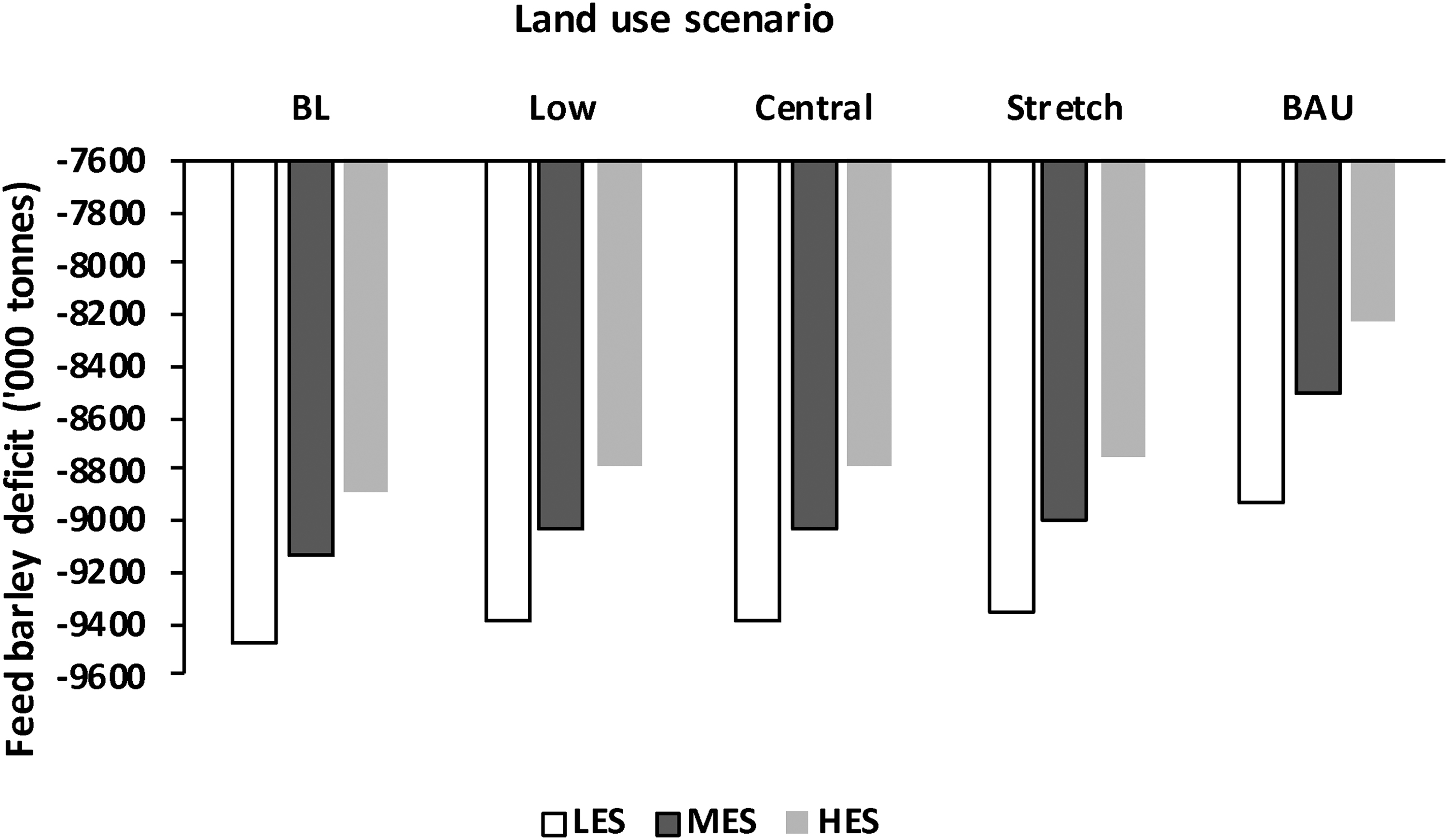
Projected feed barley deficit under the constant fertility scenario.
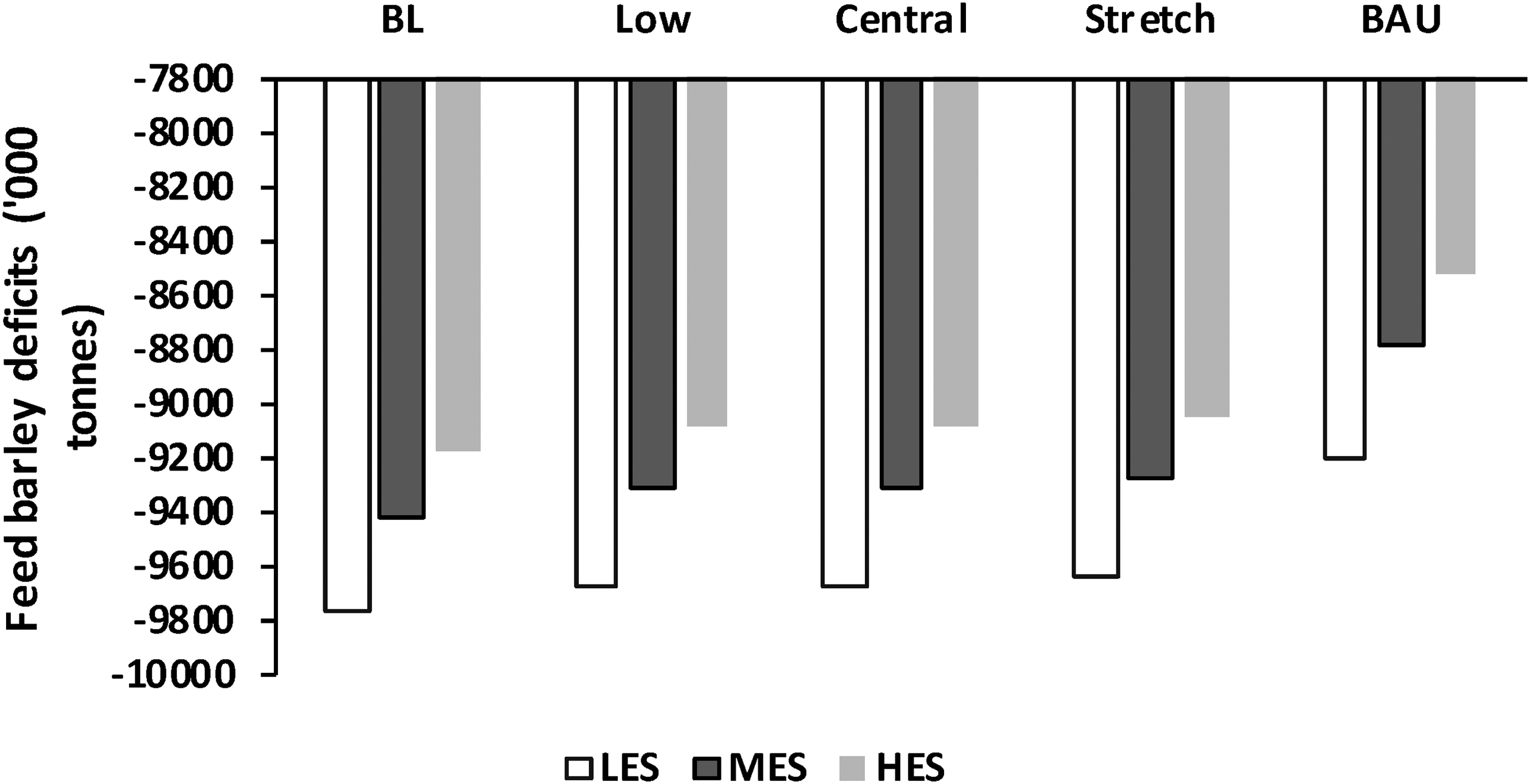
Projected feed barley deficit under the high fertility scenario.

Projected feed barley deficit under the low fertility scenario.
In addition, large deficits were observed even if total barley produced was used for feed, or total barley supplied for domestic use was used for feed (data not shown). An analysis of the trade in barley between the United Kingdom and two exemplar countries (Algeria and Tunisia) was carried out using the FAOSTAT database to highlight how the UK deficits could affect them. Barley was the fifth top food commodity produced in both Algeria and Tunisia, with the top two being wheat and potato in Algeria and wheat and whole fresh cow milk in Tunisia. Barley ranked sixth and fourth among the top 10 food commodity imports of Algeria and Tunisia, respectively. For the period 2010–2016, the two most important sources of barley import to Algeria were France and the United Kingdom (Fig. 5a). For this period, Algeria imported a total of 888,031 and 635,554 tonnes of barley from France and the United Kingdom, respectively. For the same period, Tunisia imported a total of 581,526 and 395,284 tonnes of barley from Russia and the United Kingdom, respectively, with the United Kingdom being the fourth most important source of barley for Tunisia (Fig. 5b).

In addition, total barley production in the latest FBSs of Algeria and Tunisia was 1,499,000 and 289,000 tonnes, respectively (Table 2). Imports accounted for ∼37% and 291% of total domestic supply of barley for Algeria and Tunisia, respectively. Neither country exported barley. Feed use accounted for ∼62% (Algeria) and 86% (Tunisia) of total barley supplied for domestic use, whereas direct use for food accounted for 25% and 6%, respectively. Only about 2% of barley is processed in both countries. There was almost no meat export from these countries. Bovine meat imports were ∼57% and 9%, respectively, of total domestic supply for Algeria and Tunisia. Apart from bovine meat, imports generally account for a very low share of domestic supply of meat.
Supply and Utilization Components of Barley and Meat in Algeria and Tunisia
Discussion
This study assessed the feed barley balances for the United Kingdom as a case to highlight potential impacts of land-based climate mitigation policies in the global north on domestic supply and the underlying impacts on vulnerabilities to food insecurity in developing countries (the global south) using Algeria and Tunisia as examples. The increase in yield from the LES to the HES confirms the viability and potential yield gain of UK barley and is consistent with previous findings.12, 27 , 28 This potential makes the United Kingdom a climate beneficiary. Large reductions in greenhouse gas emissions are expected from the largest emitters, including the United Kingdom. The UK Climate Change Act (2008) commits the United Kingdom to an 80% reduction in greenhouse gas emissions (relative to the 1990 level) by 2050. This, together with other regional and international obligations, including the Paris Agreement, creates conditions for aggressive pursuit of climate mitigation policies and actions.
The United Kingdom is taking climate mitigation actions from several sectors, principally the energy, land transport, housing, and the LULUCF sectors. 30 Yet, projections based on existing and planned policies suggest potential UK climate mitigation gap (inability to meet emission reduction targets). 29 Latest information from the UK Committee on Climate Change shows that power, industry, land transport, and buildings contribute the largest share of total UK emissions, far more than the agriculture and the LULUCF sector, which remains a net sink. 30 However, because the LULUCF sector has a huge potential for removing greenhouse gases from the atmosphere, it becomes a prime target for climate mitigation ambitions.
While the projections of emissions and removals from the LULUCF sector to 2050 show that this sector could remain a net sink, 23 the results in the current study show that pursuit of land-based climate mitigation policies could result in reductions in UK cropland areas, which, in turn, would create large deficits in barley production despite the potential for yield gains from climate change alone. This is confirmed by the lower deficits under the BAU (current land area for barley) compared with those under the climate mitigation scenarios. The BL and low emission (low) climate mitigation scenarios would have the largest effects on reductions in croplands and, therefore, land available for barley production. These are scenarios that reflect the influence of funding support for forestry activities. 23
The results suggest that current or ongoing land-based climate mitigation activities and the pursuit of a low emission pathway, which prioritize expansion in forestry and afforestation activities over croplands, would result in the largest deficits in barley supply. It is noteworthy that the deficits observed in the current study (which is based on the updated inventory and policy aspirations regarding greenhouse gas emissions and removals from LULUCF activities) 23 are larger than those reported previously 11 and are principally driven by the restricted expansion in cropland as opposed to forest land. Because government policy intervention has been the principal driver of agricultural land use change in the United Kingdom, 11 the current study has considerable implications for policies that are sensitive to the principles of climate justice.
The FBS showed that the United Kingdom has 120% self-sufficiency rate and is a net exporter of barley. The United Kingdom was the seventh largest producer and the sixth largest exporter of barley in the world in 2017. Since feed barley is the largest coarse grain used in animal feed, the large deficits in supply observed in the current study have adverse implications for animal production and food security in the United Kingdom. While population growth and preference for meat and other animal products can be managed as part of efforts to reducing the large deficits, 31 the most promising and reliable approaches would be to substantially increase yield per unit area and/or land area allocated to barley, although cereal yields seem to have plateaued in Europe. 32
Faced with these large deficits, the United Kingdom might import feed barley and/or animal products, most likely from the EU 11 to address its food security needs. In the EU, about 21% of barley cropland could be lost to other biofuel crops and barley imports to Europe could increase substantially. 33 The scale of UK imports required to balance the observed deficits would have cascading effects on regional and global supplies and trade, which can adversely affect competitive access by developing countries.
Hidden vulnerabilities in developing countries
Food insecurity can be defined as the risk of adequate food not being available.11, 34 Uncertainty is enmeshed in all aspects of climate change. Because of its multifaceted nature, food security under climate change is riddled with uncertainties, ranging from production, through trade, distribution and access, to consumption. Understanding current trade dependencies and future production in source countries can help identify and analyze uncertainties of supplies in dependent countries. Algeria and Tunisia, such as several other developing countries, especially in the Middle East, Africa, and Asia, rely on barley import from the United Kingdom and other global north countries for feed and food (Fig. 5a, b). This situation could change dramatically under the observed UK deficits and could be worse if deficits occur in major source countries such as France, Germany, and Ukraine or Russia.
Because the United Kingdom has enormous technical, economic, and political capacity to access food regionally and globally, imports by the United Kingdom in the future could mean reduced supplies and competitive access to Algeria and Tunisia (and by extension, the global south). For example, increased UK imports from France, Germany, and Ukraine, which are also major suppliers to Algeria and/or Tunisia, would intensify the competition for these developing countries that are highly sensitive and vulnerable to climate change. Both Algeria and Tunisia are countries in arid North Africa and heavily dependent on barley for food and feed to produce meat and other animal products that supply substantial calories and essential nutrients. Both countries would likely suffer yield or production penalties due to the impacts of climate change on crops and water.
Currently, imports constitute a large proportion of domestic barley supply in these countries, while feed use accounts for the largest share of domestic use of barley (Table 2). Tunisia's imports, for example, are about 290% of its domestic production. These, coupled with the low imports of meat and no export of barley or meat (Table 2), intuitively suggest the importance of feed barley for their domestic animal production and food security. Understandably, these countries might not import large quantities of meat due to religious (Islamic) reasons but need to have high self-sufficiency rate in animal production for the same religious and food security needs. Given that barley is a relatively cheaper coarse grain for feed, it would be reasonable for these countries to continue relying on feed barley as opposed to increased use of alternatives, such as wheat and maize, which can have cascading effect on food prices and access. These countries have a history of violence related to food insecurity. As a result, future deficits in the global north, due to land-based climate mitigation policies, have the potential to undermine food security and stability of peace and order in developing countries.
The United Kingdom recognizes the mutually reinforcing relationship between its national food security and global food security; that sufficient availability and fair distribution of food is a precondition for global stability. 35 The global agri-food system is highly interconnected through trade of surpluses to address deficits in other countries. Climate mitigation policies should be designed to address, not amplify, the uneven social and geographical impacts of climate change. The question is whether, in the interest of climate justice, the global north should be constrained from the pursuit of land-based climate mitigation activities that significantly undermine the supply of key global food security crops and widen the food gap between the global north and south, or reasonable alternatives should be installed to secure vulnerable developing countries that can suffer doubly from both climate change and climate mitigation policies. What is the way forward, in this context, for equitably sharing the burdens and benefits of climate change?
Implications for environmental/climate justice
Article 2 of the UNFCCC states that:
“the ultimate objective of this Convention and any related legal instruments that the Conference of the Parties may adopt is to achieve, in accordance with the relevant provisions of the Convention, stabilization of greenhouse gas concentrations in the atmosphere at a level that would prevent dangerous anthropogenic interference with the climate system. Such a level should be achieved within a time frame sufficient to allow ecosystems to adapt naturally to climate change, to ensure that food production is not threatened and to enable economic development to proceed in a sustainable manner.”
Article 3, Clause 2 states that:
“The specific needs and special circumstances of developing country Parties, especially those that are particularly vulnerable to the adverse effects of climate change, and of those Parties, especially developing country Parties, that would have to bear a disproportionate or abnormal burden under the Convention, should be given full consideration.”
These two clauses set out the foundation of climate justice considerations in climate mitigation policies and actions. Climate justice, in the context of a global north–south divide, connotes the transmission of disproportionate share of burdens associated with climate-related policies and actions in the global north to the global south. 36 This article uses two layers of climate justice relations between the global north and south: (1) the global north are the largest source of anthropogenic greenhouse gas emission, but the global south are the most vulnerable to climate change; (2) global north countries dominating the production of key food security crops such as barley will benefit from productivity gains due to climate change, while tropical global south countries will suffer substantial productivity losses due to climate change. The anticipated productivity gains are expected to translate into surpluses that can be traded to countries with deficits. 1
Food security in developing countries considerably depend on reliable access to key food commodities, such as barley, in the international market and this would be even more important in the future. With globalization and the intricate linkages between food security, trade, and countries, the assessment of the distributional, recognition, and precautionary justice in climate mitigation policies should have expanded scope that transcends national borders. In the current study, Algeria and Tunisia could face the double burden of direct negative impacts of climate change on their food production and constrained access to barley on the international market due to climate mitigation policies in the United Kingdom.
The United Kingdom is a strong trading nation and is technically, politically, and economically powerful than Algeria and Tunisia combined. This, together with its location, gives the United Kingdom regional or geographical and competitive advantage over Algeria and Tunisia under conditions of constrained supply of barley, regardless of the historical ties between France and these two countries. The latter countries can easily be outcompeted. This presents a potential for widening the food gap between the global north and south and warrants the evocation of the climate justice principle of equitable sharing of burdens and benefits.
The results show that pursuit of the climate mitigation policy scenarios in the United Kingdom would significantly bolster the climate benefits of the United Kingdom but amplify the vulnerability of Algeria and Tunisia in a telecoupled sense. The mitigation policies in the United Kingdom (representing the global north) are coupled with economic, financial, social, infrastructural, and technical restructuring that creates new jobs and new economic or financial capacities to access food or alternatives. In other words, the global north countries are leveraging their responsibility to clean the mess of climate change through mitigation efforts to create a new state of development that fundamentally upset, if not alter, the current balance of access to food by the global south. This is inconsistent with the articles of the UNFCCC cited above (as food production in the United Kingdom is threatened, as well as the food security of distal developing economies) and certainly inconsistent with the principles of climate justice as the needs and the impacts of mitigation policies on the most vulnerable global south countries are not considered. There is a need for meaningful involvement, fair treatment of all and equitable sharing of the productivity gains, and the adverse consequences of mitigation policies in the global north. This apparent transformation of global food supply and trade relations should be strongly underpinned by climate justice principles.
While there are no easy solutions to bridging this impending widening of the food gap between the global north and south, the following measures are proposed. First, there is a need for discourse and agreement, as part of global climate negotiations, on securing the future supply of globally significant crops for food security, such as barley and wheat. This is important to serve the expressed ultimate objective of the Article 2 of the UNFCCC. Globally meaningful involvement in this discourse is crucial for ensuring fair treatment and equitable protection of the food security of global south countries.
Second, it is widely agreed that the global north countries need to support those in the global south to implement nationally appropriate mitigation actions. To this end, global north countries can leverage funding for mitigation and adaptation actions to support resilient agricultural transformation and capacity building for developing alternative paths to food security. Linking mitigation and adaptation funding to agricultural transformation in this way can yield parallel benefits to mitigation, adaptation, and food security in the global south.
Third, meat consumption in the global north is already considered high, so maintaining or reducing current levels of consumption in the United Kingdom and the global north can reduce domestic demand for feed use, free significant surpluses for the global market, and benefit both human health and the environment. 31 Fourth, breeding programs to significantly increase yield, resource use efficiency, and adaptation to climate-related abiotic stresses should be prioritized and supported in key producing countries in both the global north and south to boost supply. Finally, countries in the global south dependent on key food crops from the global north should investigate alternatives to these crops and sources of imports, as well as the influence of modifications or adjustments in their own consumption and lifestyles on the vulnerability or resilience of their food insecurity in the future.
In addition, the United Kingdom and the global north could help the situation by reassessing or altering their policies regarding the escalation of the sink–source capacity ratio of the LULUCF sector. Although the estimated climate mitigation gap for the United Kingdom warrants more aggressive mitigation action, in the short term, there are suggestions that an expanded view of economy-wide improvements in material productivity and changes in lifestyle regarding consumption and demand for goods and services could considerably help bridge the mitigation gap. A recent modeling study suggests that additional savings from material productivity could potentially reduce the anticipated emissions deficits of the United Kingdom by 73%. 25 This requires further investigation and attention in climate mitigation policies to ease the pressure on the LULUCF sector.
Next, investigations into the influence of limiting peat extraction for horticultural use and restoration of degraded peatlands should be intensified. Peatlands store considerable amount of carbon, and good management can contribute to limiting emissions. Finally, a mechanism for sharing the dichotomous burden of afforestation and food insecurity between the United Kingdom and global south partners, underpinned by the climate justice principle of equitable sharing of benefits and burdens, can be explored. In other words, shifting food production and afforestation activities to the most efficient regions to balance emission and removal of greenhouse gases. Such a mechanism can additionally support livelihoods and economic, environmental resilience in the global south. In this way, sustainable expansion in croplands, at least from conversion of grasslands, could be planned and managed to reduce production gaps in the United Kingdom or the global north.
Limitations
The current study modeled future yields of barley in the United Kingdom under climate change 18 and used a third party projected future demand for feed cereal. 22 However, the same cannot be said of Algeria and Tunisia for which current levels of trade and consumption from the FBS were used to highlight a possible pathway to exposure to hidden food insecurity. A food balance approach relies on static, time invariant proportions of food supply to different utilization components. Even though this simplifies a very complex problem, the reality is that distribution of food supply over utilization components changes in response to structural and social changes in the economy. For example, the distribution to industrial and feed uses of barley could change depending on market signals or farmer decisions. For the exemplar countries (Algeria and Tunisia), a comparable modeling approach, if relevant data sets are available, would be more desirable and would give a better picture of the scale of impacts of UK or global north climate mitigation policies on these countries in the global south. Such a study, capturing both the current and future conditions of both the United Kingdom (or a representative global north country) and Algeria and Tunisia (or any global south example countries), is necessary to further the exploration and production of evidence on the hidden impacts of climate mitigation policies in the global north on the food security of the global south using specific trade dependencies and vulnerability contexts.
Consequently, the result in the current study should be considered indicative, providing a basis for discourse and further studies, rather than conclusive or prescriptive.
Conclusions
There is an urgent need and a global momentum for pursuing aggressive climate mitigation policies and actions. The current study adds to the emerging concern regarding the unintended or hidden impacts of climate mitigation actions or policies on widening the food gap between the global north and south. Within the limits of the current study, climate mitigation policy scenarios in the United Kingdom could result in reduced croplands in the 2050s, which in turn create large deficits in feed barley supply despite potential yield gains. The global and regional importance of UK barley production, as a representative of key global food security crop largely produced in the global north, implies that the deficits could create or amplify vulnerabilities to food insecurity in developing countries. This was illustrated using Algeria and Tunisia, two desert countries that depend considerably on barley supplies from the United Kingdom and other northern temperate countries to meet internal need for animal production to serve both food security and religious needs. The asymmetries in technical, economic, and political power suggest that these developing countries could be outcompeted, and their food security adversely affected.
This article, therefore, uses a micro-case study to highlight the fact that global south countries could suffer doubly from adverse impacts of global climate change and land-based climate change mitigation policies and actions in the global north. The potential widening of the food gap between the global north and south could have cascading impacts on the geopolitics of food and feed trade, and stability of peace and order. Climate mitigation policies should address (not amplify) the geographically and socially uneven impacts of climate change or narrow the food chasm between climate victors and climate victims. In the interest of the climate justice principle of equitable sharing of benefits and burdens of climate change, global approaches are needed to integrate these telecoupled impacts in the appraisal of public policies on land-based climate mitigation, as well as the discourse on climate justice and negotiations for an equitably food secure world. The need to address this potential widening of the food gap is as urgent as the need for climate mitigation.
Footnotes
Author Disclosure Statement
No competing financial interests exist.
Funding Information
This study was part of a PhD work sponsored by the Centre for Environmental Change and Human Resilience (CECHR, University of Dundee), The James Hutton Institute (Scotland), and the University of Cape Coast (Ghana).