




Abstract
Urban, public green spaces have become part of the worldwide urban planning agenda and form a key component of the quality of life, health, and sustainable environment. However, the benefits of these kinds of spaces are unevenly distributed within cities in relation to the location or income level. In this article, it is evident that the use and quality of public green spaces are often neglected in deprived neighborhoods. This article analyses the structure, the use and perception, and the governance of public parks in La Pradera, a deprived peripheral neighborhood of the Metropolitan Zone of Queretaro, Mexico. The results show that the design and quality of these public green spaces are not a priority in peripheral settlements. Moreover, the case demonstrates that negative perceptions, such as those of danger and discomfort within public parks, discourage utilization by inhabitants. Finally, the design, construction, and maintenance of these spaces are in the hands of real estate companies versus the State that neglects public services, which results in segregation of those individuals who are unable to pay for private goods and services. The development of parks should respond to deliberate planning processes involving citizens as powerful agents.
INTRODUCTION AND CONCEPTUAL FRAMEWORK
A
However, the amount of urban green spaces and their benefits are unevenly distributed within cities in relation to the location of different social classes. 7 , 8 , 9 This means that the socioeconomically disadvantaged and peripheral urban sectors, where the working population as well as racial and ethnic minorities usually inhabit, have less or null access to green spaces when compared with populations with higher purchasing power. 10 , 11 , 12
City municipalities around the world increasingly use smart, green, sustainable, and resilient city discourses as drivers to increase the construction of new green spaces in cities. 13 , 14 Some of the municipalities that favor urban green areas have been allocating or subsidizing green communal land, reclaiming abandoned spaces, promoting green investments, and implementing regulations to incentivize real estate to include green spaces in their projects. Nevertheless, these approaches, instead of benefiting the less advantaged inhabitants, have promoted green gentrification—the displacement, eviction, or social exclusion of the economically vulnerable population and minorities—as a result of the increased land value by ecological/green space initiatives that entrench inequality. 15 , 16 , 17
In this context, recent scholarly attention has been paid to gentrification, real estate speculation, and unequal distribution and access of green spaces, especially in the global north. Nonetheless, little attention has been addressed to the questions: To what extent are the use and quality of green spaces often neglected in relation to users and their contextual circumstances and how green spaces reproduce or exacerbate inequalities in the Global South? 18 , 19
Use and quality are fundamental, especially in new real estate developments, for low-income sectors, which usually lack infrastructure, security, adequate size, or other aspects to incentivize use and reduce bad behaviors. 20 , 21 This is demonstrated in the study by Boone 22 in Baltimore, in which the authors state that although blacks were more likely than whites to live near a park, whites had larger parks. This, coupled with the high population density in disadvantaged neighborhoods, means that small parks become congested, thus discouraging their use.
Lindholst et al. and Anderson et al. suggest that the quality of public green spaces is related to three aspects: (1) structure and functionality (size, location, equipment, vegetation, layout, design, and cleanliness); (2) management, organization, and governance; and (3) inhabitants' perceptions. 23 , 24 , 25 In this regard, Andersson 26 recognizes that more conceptual and empirical work is needed to explain the relationship of these aspects in various contexts to ensure an equitable distribution of ecosystem services.
Studies on the quality and use of green spaces are mostly from the United States, Europe, Australia, and recently China when compared with the few studies carried out in countries of the Global South, such as Latin America, a highly urbanized region (81%) and whose cities show deep-rooted, socioenvironmental urban segregation. 27 , 28 , 29 Mexican cities, such as others in the Global South, have grown rapidly and extensively, under a neoliberal economic model characterized by minimal state intervention and a real estate market with few restrictions. Mexico is the second-place country with more metropolises in the Latin American region. 30 It has gone from 59 metropolitan areas in 2010 to 74 in 2018. 31 The Queretaro Metropolitan Zone (ZMQ), located in the center of the country, is one of the areas whose territory has expanded more rapidly in the last three decades and projected as the first smart city in Mexico, a clear example of green spaces in the context of competitive urbanism. 32
In this article, we analyze the structure and functionality, use and perception, management, organization, and governance of public parks (one of the main components of urban, public green spaces) in La Pradera, a deprived peripheral neighborhood of the ZMQ.
METHODS
We identified two types of green spaces in La Pradera: (1) nine public parks to which the general public has access, the size ranges from 581 to 6450 m 2 and the management corresponds to the real estate company that built the neighborhood; and (2) 52 private areas inside closed housing complexes, they are small spaces (average 200 m 2 ) and generally used by close neighbors for personal activities or to store old things (tires, armchairs, and iron, etc.). In this article, we focus on public parks because they serve most of the population of the neighborhood and allow development of communal life.
The methodology addresses three points about La Pradera's public parks:
Structure and functionality. Public parks were characterized by area (m
2
), equipment (playground, lighting, walking track, benches, basketball court, soccer field, and food stalls), maintenance condition, vegetation coverage, and neighboring infrastructure. We identified the parks by numbering them consecutively (from the smallest to the largest) because no name record was found for four parks. In addition, people named the parks depending on their location (near the school and near the church) or their equipment (park with basketball court), but in an inconsistent way. Use and perception. During May 2019, a face-to-face survey was conducted in 222 households, with a nonprobabilistic snowball sample (on account of the reluctance of inhabitants to answer due to crime). Using the geostatistical framework of the National Institute of Statistics and Geography (INEGI),
33
all the blocks that make up the La Pradera neighborhood were identified. The surveys were first conducted in households located closest to the parks in each block and then continued with people related to the first ones who were willing to participate. All blocks are represented in the survey. Respondents were over 18 years old and living for at least 1 year in La Pradera. The objective was to know the preferences and perceptions of the inhabitants regarding public parks, frequency of use, activities organized by institutions (exercise classes, sports, and art, among others), and activities carried out by users. A section was included to characterize the dwellings of each respondent. The survey followed academic research ethics (we followed procedures of the scientific research ethics committee of the Autonomous University of Querétaro, including training all survey team staff, human subjects protection and ensuring the protection and security of data). Management, organization, and governance. A focus group was conducted in July 2019. Through neighborhood social networks, the existence of a neighborhood committee for the maintenance of public parks was identified; using the same platform, the leaders of the committee were contacted and summoned. The group consisted of a total of 10 adult (35–50 years)—women and men—representatives from the neighborhood committee. We collected data on the formation, organization, participation, and management of the neighborhood committee in the last 5 years. None of the participants had answered the survey.
Case study
Querétaro is a medium-sized city that has experienced a significant urban sprawl since the 1990s, forming a metropolitan area made up of four municipalities: El Marques, Huimilpan, Corregidora, and Querétaro. In particular, the municipality of El Marques (projected as the starting area of the smart city project, Querétaro) shows a marked growth in the last two decades in correlation with the development of industrial parks. This has generated the rapid rise of social housing areas for the working class population, characterized by small (75 m 2 ) and few green spaces, as an example of territorial clusters with competitive real estate markets.
This research focuses on the public parks of La Pradera, a 10-year-old neighborhood considered the fastest growing area in El Marqués municipality. It is located in the northeast periphery (20°38′58.71″ N, 100°20′29.92″ W) of the city of Querétaro with an area of 956,343 m 2 (Fig. 1). It is a housing area for the working class and service provider population of 8816 inhabitants with low educational levels and predominantly young families.
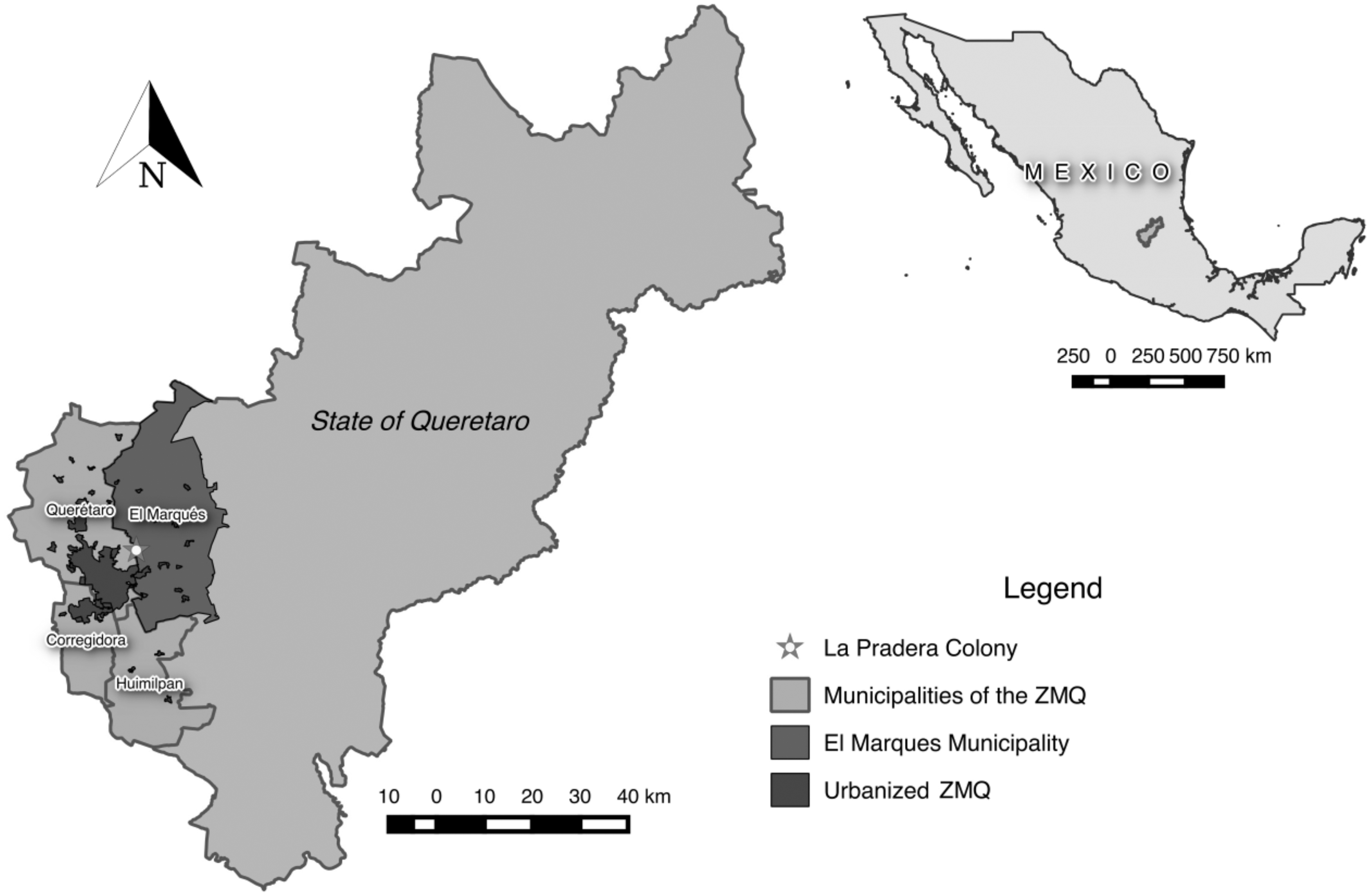
Location of La Pradera neighborhood at the ZMQ (star figure), urbanized metropolitan zone (black), municipalities of the ZMQ (light gray), including the El Marques municipality (dark gray). ZMQ, Queretaro Metropolitan Zone.
RESULTS
Structure and functionality of public parks
Before characterizing the parks, it is important to mention that 35.9% of those surveyed live in independent houses with a garden of 7 m 2 on average; 29.58% live in independent houses without a garden; and 31.13% live in apartments or enclosed housing complexes with gardens or small, common green spaces.
From the nine public parks characterized in this work, as shown in Table 1, it is evident that except for the three largest parks, the parks in general are in poor condition and have little equipment, poor lighting, no vegetation, and no organized activities.
Structure and Functionality of Public Parks in La Pradera
The parks were numbered from the smallest to the largest area. (1) Poor maintenance means overgrown wild grass and bare soil, broken walking tracks and/or playgrounds, and debris and garbage; (2) medium maintenance involves functional equipment, bare soil, or overgrown wild grass; and (3) good maintenance means the infrastructure is in good condition and the vegetation cover is well tended. The main organized activities reported are physical exercise, classes for older adults and women, sports classes for children, and catechism.
Use and perception of parks
Of those surveyed, 66% make use of the parks in the neighborhood, the remaining 34% do not attend them and prefer to visit other recreational spaces (private gyms or commercial plazas) or move outside the neighborhood to other parks in the city, which offer state recreational activities and programs. Those who do attend do not visit the park closest to their homes, but rather parks that provide the most services and have more furniture, trees, and activities. The most frequently mentioned parks are the # 9 (41%), 7 (37.2%), and 6 (28.7%) parks, which best comply with the aforementioned, in contrast to the park mentioned the least—the # 3 (1.5%) park.
With respect to activities carried out in the parks, it was found that the main activities are walking, spending time with family and/or friends, relaxing, and playing sports (Fig. 2). It is noteworthy that activities related to physical and mental health and social relationships are performed most frequently. Other activities were less frequently mentioned.

Activities carried out in the public parks of La Pradera. Each respondent was able to indicate more than one activity.
Concerning the inhabitants' perceptions of public parks, they mentioned positive and negative aspects (Table 2). With regard to the positive aspects, the most mentioned were green spaces that offer the possibility of exercising and social relationships, although air quality and temperature regulation were also mentioned. Of those surveyed, 86% said parks were important in their neighborhoods and it would be desirable to have more. In relation to the negative aspects, the lack of shade stands out, which makes the parks very hot; responders expressed that parks can be only used early morning or late afternoon when the sun is down. However, responders also frequently highlighted the fact that at night, parks are dangerous due to the lack of light. Both arguments limit the time that parks can be used. The condition of parks, such as equipment in bad conditions, dirt, and lacking of nature, also has a negative influence on the user's perception. Another negative aspect associated with parks is that they are used for illicit acts such as drug sales and consumption, gang meetings, and assaults. These activities are associated with young people, in contrast with the lack of organized activities for this sector of the population.
Positive and Negative Aspects of Public Parks in La Pradera
The percentage of references made by respondents to each aspect is indicated; each respondent was able to mention more than one option.
Management, organization, and governance
In La Pradera, both public parks and other public services are managed not by the municipality, but by the real estate company that built the neighborhood. This occurs because it has not yet been municipalized, which means that the real estate company responsible for its construction has not delivered the equipment and facilities to the City Council, intended as public services. When colonies are municipalized, the City Council is responsible for their conservation and maintenance. In the case of La Pradera, municipalization was not carried out because the real estate company was declared bankrupt before construction of all sections of the neighborhood park was completed 5 years ago. This meant that some of the public services, in particular water and waste collection, are in the process of being leased and privatized to be managed by third parties. Other services such as the maintenance of public parks or roads are in the hands of a real estate company constrained by a lack of monetary resources to make investments in maintenance. The lack or delay of municipalization has become the norm rather than the exception in new neighborhoods (high and low income), which leave the management and governance of public services in the hands of the private sector, as opposed to the old city where the municipality organizes and provides such services.
Facing such scenarios, in the last 4 years, some residents of La Pradera have organized themselves to form a committee of voluntary neighbors to manage their public parks. The group consists of 10 permanent members who have taken on the role of making direct requests to the municipality for maintenance of public parks (e.g., pruning wild grass, painting equipment, and installing lights, among others). Whenever a new petition is presented, this committee calls for neighborhood meetings to collect signatures and organizes collective clean-ups. The arrangements have been made for the largest public parks (6, 7, 8, and 9) and the basketball courts (5), which are the most popular. However, the responses from the municipalities tend to be time-consuming and sometimes even negative (for example, the request for irrigation) given the lack of municipalization and the municipality's own inability to maintain urban green spaces (due to lack of infrastructure, personnel, and investment). The residents emphasize that the real estate company only complied with the amount of green spaces (4% of the total area) because of construction regulations for the Marques Municipality (2007–2009), which clearly indicate this requirement. Yet, the real estate company did not include vegetation and/or equipment. The committee members recognize that participation has been low so far, with a predominance of mothers. They indicate that an increase in the number of neighbors involved in the process will also increase the possibility of demanding good quality green spaces as well as working on dignifying the parks by themselves; however, for now, there is a lack of interest in these spaces from both neighbors and authorities.
DISCUSSION
The results of this research show that despite an increase in regulations and urban planning standards, which demand the inclusion of urban green spaces within buildings, the quality of these spaces is disregarded, mostly in peripheral or low-income settlements, which diminishes their use. La Pradera clearly illustrates that the lack of equipment, vegetation, maintenance, and organized activities in public parks hampers their use. This indicates that the mere presence of public green spaces does not guarantee their use and the delivery of their multiple social benefits and ecosystem services. 34 In fact, results demonstrate that inhabitants' negative perceptions, such as those of danger and discomfort (heat and lack of cleanliness and equipment) within public parks, discourage their utilization.
These findings are consistent with the literature that states that neighbors are more likely to increase their attendance in public parks if they perceive them as pleasant and safe, if they find programs and activities, and if the size is adequate for the flow of people. 35 , 36 , 37 However, in the cities of the Global South, quality decreases as one moves away from the center toward the periphery or deprived areas. 38 In such neighborhoods, despite inhabitants recognizing their public parks as deficient, they consider them important for physical health activities, relaxation, and social relationships. These are urban, cultural ecosystem services with a positive impact on the quality of urban life, and the perception of these services can act as a gateway to manage multifunctional, urban green spaces with residents and urban planners. 39
The results also show that the latter point related to the management of public parks between residents and government and/or urban planners is a key challenge. The case of ZMQ reinforces literature that points out that the increase of public green spaces in less affluent or peripheral neighborhoods in cities of the Global South has become an instrument to either fulfill the international standards/city visions (e.g., smart, sustainable, livable, and others) or to absolve the leading actors taking decisions over the forms in which cities grow, particularity in Latin America, where the private sector plays a pivotal role in the construction of cities. 40 Indeed, in the presented case, the real estate company complies with construction regulations related to the amount of public green spaces in hectares, but it neglects quality in relation to the context and needs of inhabitants. What is more, situations such as the bankruptcy of private companies in the case of ZMQ have become ways of excluding both, the municipalities and the real estate companies, from the responsibility of maintenance and quality of these spaces.
In addition, the fact of not including inhabitant voices in the design and delivery of public green spaces becomes a way of dispossession of citizens, mainly of the less advantaged sectors of the urban population. 41 The results show that the lack of a more inclusive and participative governance process in relation to public spaces in cities is based on the vested interests of a few, for example, of the private sector that prioritizes efficiency and economic revenues versus inhabitant needs and the city's environmental services. This governance dynamic acts to the detriment of the less advantaged urban sectors, which reproduces social inequalities.
Based on these findings, it is argued that environmental injustices—inequalities related to green areas and environmental services in cities—are found not only in the quantity and distribution of green spaces but also in their design and quality. Moreover, the study shows the correlations among the structure and functionality (size, location, equipment, vegetation, layout, design, and cleanliness) and inhabitants' perceptions, which tend to be less positive when conditions are inadequate, reducing use and benefits of green spaces. Besides, there is also a relationship between the management, organization, and governance of public spaces; when the governance and management of such areas are strongly in the hands of the private sector, reducing State involvement (a quintessential neoliberal goal 42 ), despite green spaces' multiple benefits, these are not designed, delivered, or integrated as part of the citizen's needs, particularly of the less advantaged sectors; it results in the segregation of those individuals who are unable to pay for private goods and services. 43
It is worth mentioning that the case of the ZMQ shows that participation and initiative of neighbors in managing green spaces are valuable, but need the recognition of citizens as powerful agents in the planning process of cities. The fact that they take responsibility of managing maintenance, use, and activities of parks in their neighborhoods, with no/little support from the state and without adequate channels for participation and negotiation, makes this activity a burden rather than a powerful pathway for integrating their views and needs in the city planning. The development of parks, far from being a technical process, should respond to deliberate planning processes that involve policy formulation, citizen participation, and nature-based solutions. 44 , 45
CONCLUDING REMARKS
Making cities more resilient, equitable, and sustainable requires highlighting social injustices and promoting access to good quality green spaces within participatory governance schemes.
This research challenges the assumption that by merely encouraging and measuring green areas—accessibility, distribution, and/or per capita square meters in a city—ecosystem benefits, particularly those associated with healthy social interaction, physical activity, recreation, and psychological well-being, will be delivered. This article demonstrates that when the quality of the design and inclusive governance and management of green areas are neglected, expected benefits are not achieved; on the contrary, social injustice becomes ingrained.
Facing this scenario, efforts of different levels and actors, from international organizations to municipalities, including guidelines and regulations for integrating public green spaces into urban development and planning, need to be strengthened. On the one side, it is important to recognize that positive perceptions and quality of green spaces are affected by the lack of participatory and inclusive governance processes. The absence of municipal authorities, citizens, and experts in different fields within the planning, implementation, and ongoing management of green areas in cities narrows the process to only comply with limited regulations (such as amount of green spaces versus adequate, safe, and multifunctional parks, corridors, and others). Moreover, when projects are merely driven by the real estate companies (private sector), they will tend to prioritize efficiency and/or economic benefits over social, ecological, or cultural aspects. In consequence, the quality of the habitat deteriorates instead of improving as new public spaces (green areas) are associated with violence, dumps, or other negative aspects.
The aim of inclusive, safe, resilient, and sustainable cities, as guided by the New Urban Agenda and the Objectives for Sustainable Development, urges constructing participatory processes that not only deliver quality of infrastructure in cities but also contribute to social justice by redistributing benefits and burdens of urban development.
Footnotes
ACKNOWLEDGMENTS
The authors would like to thank the data collectors' team.
AUTHOR DISCLOSURE STATEMENT
No competing financial interests exist.
FUNDING INFORMATION
This article was financed by the Secretary of Public Education through project UAQ-CA-137 “Urban exclusion, precariousness, and socioenvironmental conflict processes, study case La Pradera neighborhood, Queretaro, Mexico.” The project was supported by Universidad Autónoma de Queretaro.