




Abstract
The Deepwater Horizon disaster inflicted untold damage on humans and the natural environment in the U.S. Gulf Coast. Less discussed is that British Petroleum (BP) was prosecuted and found guilty of environmental crimes that contributed to this catastrophe and received the largest criminal penalty to date in a federal environmental prosecution. While this prosecution gives the impression that the federal government rigorously prosecutes environmental offenders for crimes that often impact fenceline communities, the goal of this article is to explore the broader picture of the prosecution of environmental crimes in the Gulf Coast and to assess the validity of that picture. Through content analysis of criminal prosecution summaries, we explore all prosecutions of environmental crimes stemming from the U.S. Environmental Protection Agency's criminal investigations during the period 1983–2019. We analyze prosecutions from Alabama, Florida, Louisiana, Mississippi, and Texas. Results suggest that 400 cases were prosecuted in these states since 1983. A total of 758 defendants were prosecuted, resulting in cumulative monetary penalties exceeding $1 billion (excluding BP's $4 billion fine), over 19,000 months of probation, 4784 months of incarceration, and almost 24,000 hours of community service. These broader numbers reflect only about 10.8 annual prosecutions across five states and, excluding a few large penalty cases, suggest a need for greater enforcement resources and criminal prosecution in the region to deter environmental crimes and protect vulnerable communities.
INTRODUCTION
Most of the research and public attention on Deepwater Horizon focused at the time, as it does today, on the health effects on humans and the natural environment following this terrible and avoidable catastrophe. Less discussed is the prosecution of the responsible parties for their role in causing the disaster. The federal government decided to prosecute British Petroleum (BP) criminally for their actions. BP pled guilty in the U.S. District Court for the Eastern District of Louisiana to 11 counts of felony manslaughter, one count of felony obstruction, and violations of the U.S. Clean Water Act (CWA) and Migratory Bird Treaty Act (MBTA). 1 BP admitted in court that the two highest ranking supervisors onboard the Deepwater Horizon negligently caused the death of 11 individuals and did not take the necessary steps to secure the Macondo Well, which resulted in a massive explosion and subsequent oil spill. The company also admitted that it obstructed the U.S. Congress by withholding documents and providing false information to obscure the gravity of the oil spill in the Gulf. For their actions, the company was sentenced to pay the largest criminal penalty for an environmental crime in U.S. history of $4 billion in addition to serving 5 years probation. 2
Transocean was also prosecuted for their role in Deepwater Horizon. The company pled guilty to violations of the CWA. They admitted in federal court in New Orleans that employees aboard Deepwater Horizon acted under the direction of BP supervisors in a negligent manner when they failed to fully investigate oil and gas flowing from the Macondo Well that led to the subsequent blowout. On February 14, 2013, the company was sentenced to pay $400 million in criminal penalties and serve 5 years probation, as well as settle a separate civil consent decree. 3
Deepwater Horizon is unique among environmental crimes for many reasons, including the public salience attached to the case, the scope of the problem, and that the federal government sought criminal prosecution for a major multinational company for an environmental crime and won an extremely large settlement. Unlike this case, most environmental crimes go unnoticed by the national media and very few crimes result in criminal prosecution. 4 If such crimes are punished, they are often done so through civil actions, such as fines, administrative penalties, or consent decrees, and rarely are they as measurably significant. 5
Individuals living in fenceline communities know all too well that the federal government rarely intervenes on their behalf to stop acute or chronic environmental crimes that poison their communities. Regulatory remedies are often lacking and legal restitution rare. If they are to receive protection from polluters, they must rely on state and federal enforcement efforts to get polluters to comply with existing laws, even if those are inadequate to secure their health and safety. 6 The goal of this article is to explore the overlooked phenomena of the federal prosecution of environmental crimes in the Gulf states. In the aftermath of Deepwater Horizon and its significant impacts on communities of color and the natural environment in the Gulf, we seek to explore the history of federal criminal enforcement efforts in these states since the institutionalization of the criminal enforcement process in 1983 through 2019. Criminal prosecution is the big stick meant to punish the worst environmental offenders. We examine all 400 criminal prosecutions stemming from Environmental Protection Agency (EPA) criminal investigations over 37 years in Alabama, Florida, Louisiana, Texas, and Mississippi to explore charging and sentencing patterns. We hope to shed light not only on the highly salient cases, such as Deepwater Horizon, but also on trends over almost four decades that affect communities in the Gulf.
ENVIRONMENTAL JUSTICE AND THE EPA
Environmental crimes are serious and remain widespread in the United States. An estimated 40 percent of deaths around the world can now be attributed to various environmental factors, especially organic and chemical pollutants. 7 Yet, such crimes perpetrated by organizations and individuals are not often conceptualized as being as serious or devastating as traditional forms of offending. 8 Corporations often go to great lengths to promote a green image in the media, regardless of their toxic behaviors on the ground. 9 Communities living near heavy industry, chemical dumps, and other toxic hazards know all too well that environmental crimes happen daily, often with the knowledge of regulators. Low-income persons of color are disproportionally affected by these crimes. 10
Highly salient, environmental crime prosecutions such as Deepwater Horizon are exceedingly rare in the United States. Most environmental crimes go undetected or unreported. 11 The nature of the federal regulatory regime puts fenceline communities at great risk for both acute and chronic environmental crimes from nearby industry. Most of the regulatory enforcement apparatus has been devolved to the states for compliance monitoring and permitting for many important federal environmental statutes. 12 Underfunded state environmental regulators often lack budgetary and staff support to properly police their responsibilities, and some states provide significant variances to industry or have political environments hostile to regulation. 13 Communities can pressure regulators and self-monitor for pollution, but the politics of risk assessment and enforcement leave them limited resources to prompt or expect significant action from regulators. 14 Given that most environmental crimes are not explosions or one-off events that draw significant public attention, but chronic and often unseen hazards that permeate into fenceline communities and cause irreparable harm over time, they receive little national media attention and it is easy for regulators to overlook them. 15
Unfortunately, for environmental justice communities, the EPA has always succeeded more by setting regional standards to control major environmental threats or creating general frameworks for permitting the design of hazardous waste laws, air permits, and construction of publicly owned treatment works (POTWs), etc., than regulating at the level of the firm. As a technology-forcing agency, EPA has recognized its limited ability to police polluters and has devolved much monitoring and permitting authority to the states in key areas, grandfathered existing stationary sources of pollution, and focused on best available control technology or maximum available control technologies when new sources are constructed or modified. When it comes to air and water pollution in particular—major sources of problems for fenceline communities—at the level of the community or firm causing problems in that community, EPA more likely than not will fail to remedy the problem. Competing mandates from revolving parties in Congress and the presidency make progress by the most diligent administrations difficult, and state environmental regulators are often incapable of taking up the slack, particularly in specific enforcement cases dealing with well-financed and connected polluters. 16
In the case of toxic waste dumps, the issue that brought environmental justice to the national stage, EPA has few enforcement remedies today to mitigate the ongoing problem for fenceline communities. 17 While the Resource Conservation and Recovery Act (RCRA) creates a national framework for cradle-to-grave regulation of hazardous waste and regulates solid waste, it does not sufficiently address the liability for toxic dumpsites. The Comprehensive Environmental Response, Compensation, and Liability Act, also known as the Superfund, empowers EPA to create a master fund to clean up orphaned hazardous waste sites that are abandoned or to find responsible parties to remediate the site. 18
The Office of Superfund Remediation and Technology Innovation administers the Superfund and the National Priorities List (NPL) that prioritizes contaminated sites in need of remediation. Today, 1335 sites have been placed on the NPL and 51 sites are currently proposed to be added. 19 While the Superfund was created in response to the Love Canal tragedy caused by Hooker Chemical's malfeasance and ineptitude by local government, other long-standing sites, such as the Valley of the Drums, placed on the NPL in 1983 have still not been completely remediated. 20 Love Canal was not fully remediated to EPA standards until 2004 and the quality of that remediation is in dispute. Congress allowed the tax on industry, which helped support Superfund, to expire in 1995. The agency has collected $7.9 billion in special accounts outside of the Superfund Trust Fund set aside to find responsible parties for orphaned accounts, spent $4.5 billion on site cleanups, and has $3.4 billion reserved at the time of writing for future site cleanup. 21 The collective thrust is that the Superfund is woefully inadequate and underfunded as a tool to manage toxic waste sites near fenceline communities; the same can be said regarding the CWA, Clean Air Act (CAA), and enforcement of other federal statutes.
PROSECUTING ENVIRONMENTAL CRIMES
Early on in its formation, EPA realized it had an enormous set of tasks for which it had to choose certain priorities. Creating a framework for storage, transport, and disposal of hazardous waste through RCRA was a major accomplishment, as were the regulation of mobile and stationary sources through the CAA to improve ambient air quality and the funding and regulation of POTWs and solid waste under the CWA. The agency realized that it would also have to permit and enforce this regulatory regime through a partnership with the states, which would prove challenging. EPA focused on setting minimum standards and giving states discretion for issuing a variety of permits as well as affording them increased compliance monitoring and enforcement responsibilities.
EPA realized in the 1970s that many regulated entities would resist enforcement and willfully break the law. The agency needed additional enforcement authority to deal with willful, chronic, and knowing violations of federal law. A total of 25 federal environmental crimes were prosecuted before 1982. 22 In 1981, the Office of Environmental Enforcement was created, now called the Office of Enforcement and Compliance Assurance. The following year, the Department of Justice's (DOJ) Environmental Crimes Section was formed. 23 By 1988, Congress granted EPA full law enforcement authority—it now had a bigger stick. 24 Today, the Criminal Investigation Division (CID) employs enforcement staff across 40 locations throughout the United States. 25 The Office of Criminal Enforcement, Forensics, and Training works to investigate environmental crimes and provide forensic support. 26 The Division is positioned as America's Environmental Crime Fighters, and special agents carry firearms. 27
Yet, prosecuting environmental crimes can be costly, the CID is understaffed, and EPA must rely on cooperation with the DOJ or U.S. Attorneys' Office to prosecute offenders. The burden on the government is higher in criminal cases, where guilt must be proven beyond a reasonable doubt that the defendant committed the crime for which they are charged. A civil standard is lower based on a preponderance of the evidence standard that the crime alleged is more likely true than not. These factors result in most enforcement matters being handled through a civil process. 28 Civil enforcement actions can result in various punishments such as civil penalties, injunctive relief, settlements or Administrative Orders on Consent, mitigation plans, or Supplemental Environmental Projects. 29
EPA pursues criminal prosecution for violations of the law that appear willful and knowing and involve intent. In light of the significant penalties assessed to BP and Transocean for their crimes that led to the Deepwater Horizon disaster, what is the nature of criminal prosecution of environmental crimes on the Gulf Coast? Are such prosecutions frequent, and what are the outcomes? Below, we attempt an answer to these questions through content analysis of all 2588 federal prosecutions of environmental crimes that stemmed from EPA investigations since 1983. As the last resort for serious infractions of environmental crimes that may impact fenceline communities, understanding the nature and scope of criminal enforcement is imperative if we are to comprehend the totality of the enforcement regime and what it has accomplished historically. The result is the first analysis of environmental crime prosecutions occurring in the Gulf Coast area since the institutionalization of the criminal enforcement regime.
DATA
We gather data from the EPA's Summary of Criminal Prosecutions Database. We do so by EPA fiscal year that runs from October through September. 30 We collect all cases occurring from the beginning of the dataset in 1983 to the end of calendar year 2019. We select out all cases occurring in the five Gulf states, including Alabama, Florida, Louisiana, Mississippi, and Texas. From the 2588 total cases in the history of the database, we extract all 400 cases occurring in these states for the analysis. We use a straightforward content analysis strategy similar to summative content analysis. 31 We cannot discern all meaning and context from the prosecution summaries, but try to interpret these variables in the context of what is happening in the case and to tabulate them accordingly.
Our coding protocols were developed to extract the following variables: case summary; fiscal year of the case; number of defendants; docket number; state listed for the prosecution; major federal charging statutes (i.e., CWA, CAA, and RCRA) or if charged as a state-level crime, nonenvironmental criminal charges, such as false statements, mail fraud, conspiracy, and obstruction; and punishments assessed to all individual and company defendants in each case. Punishments include probation measured in total months; incarceration measured in total months; fines and other monetary assessments and penalties such as restitution, payments, fees, and special assessments measured in nominal U.S. dollars; community service measured in total hours; home confinement measured in total months; and community corrections measured in total months.
We created our coding protocols to increase intercoder reliability in a few ways. We coded data until Fiscal Year (FY) 2005 to better understand patterns and styles of data entry until we ran into most of the available situations with the data. We piloted a protocol with two coders for 4 weeks with a weekly trial run until intercoder reliability exceeded 90%. Most errors after this point were with the penalties, particularly complex penalties assessed to multiple defendants. Two coders analyzed cases independently, with one of the authors reviewing spreadsheets for disagreement; consensus was then developed over the discrepancies. Total items coded divided by the level of agreement were ∼95%. 32
The data contain a few limitations. First, EPA employees entered the data in myriad styles over the years. While the basic structure stayed the same, sometimes the summaries were very short, others long, and in some instances, they used official press releases exclusively or summaries and press releases. Second, we cannot discern the role of the prosecutor in these cases. Both authors worked as participant observers in a major federal environmental crime prosecution, and we realize the role of the prosecutor, as well as cooperation with state and federal agencies, is invaluable, but impossible to know with these data. Third, we cannot be certain whether EPA included all cases in the criminal prosecution universe that stemmed from their investigations or otherwise, but we suspect this is a fairly comprehensive account and a representative one. Finally, we ended data gathering by the end of calendar year 2019 and did not finish analysis for the full FY 2019.
Even with these limitations, our dataset provides the most substantive insights to date on the history of federal criminal enforcement actions on environmental crimes in the Gulf Coast. Analyzing some 400 cases allows us to explore the history of these prosecutions over time and space. This approach helps us to answer valuable questions about the government's efforts to prosecute serious crimes in the region and how these efforts have evolved over time.
RESULTS
We begin the analysis as presented in Figure 1, which examines total prosecutions by EPA fiscal year across all five Gulf states. The first prosecution was settled in 1985, with only a dozen cases completed in the 1980s. A total of 106 prosecutions were completed in the 1990s, 117 in the early 2000s, and 165 from 2010 to 2019. The annual high point was 25 in FY 2012 with an average of almost 11 per fiscal year. Total prosecutions across all five states since 1983 equaled 400. Over 37 years and five U.S. states, this is arguably not a terribly large number of prosecutions for the federal government to undertake.
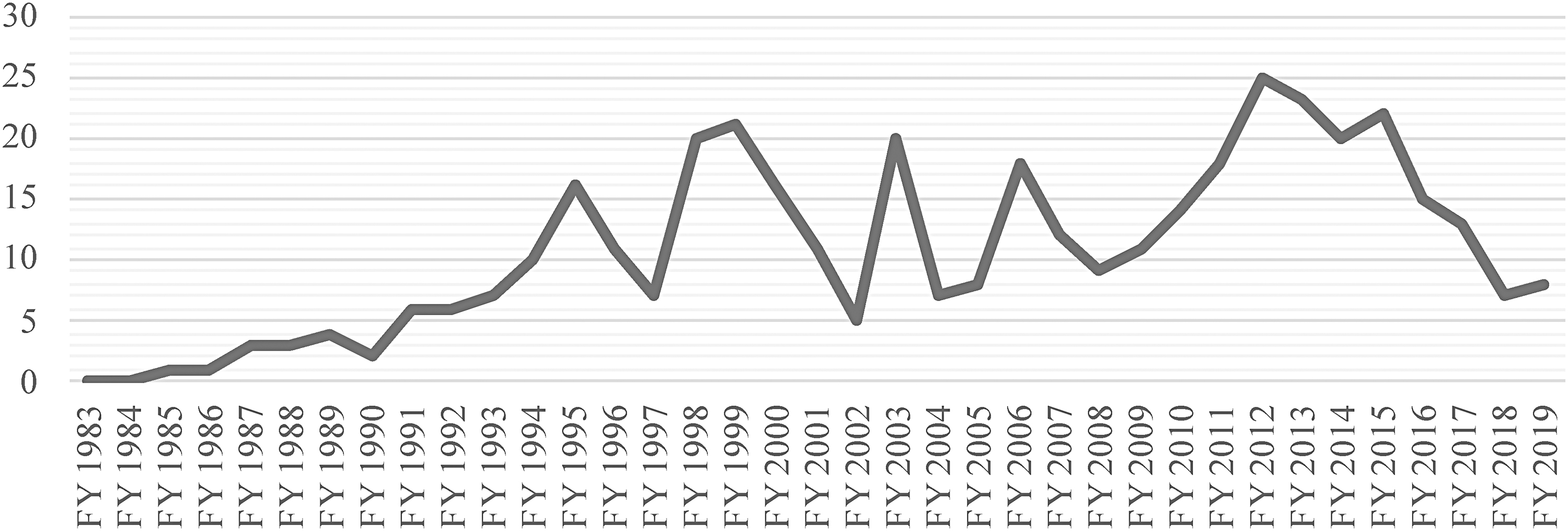
Total criminal prosecutions by fiscal year in the Gulf states since 1983. Source: EPA Summary of Criminal Prosecutions Database. EPA, U.S. Environmental Protection Agency.
Figure 2 examines total prosecutions in the Gulf states since 1983. Total prosecutions in Alabama equaled 25. A total of 110 prosecutions were settled in Florida, 117 in Louisiana, and 26 in Mississippi. The most cases were settled in Texas at 122 prosecutions.
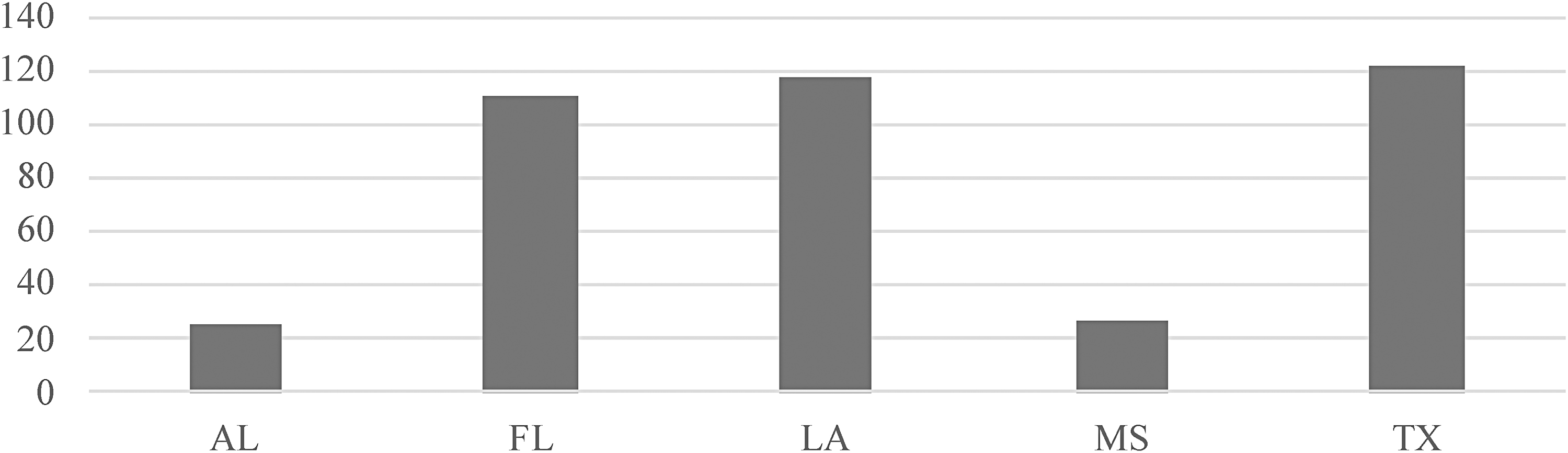
Total criminal prosecutions by state since 1983. Source: EPA Summary of Criminal Prosecutions Database.
In Table 1, we explore charging patterns by state since 1983. We examine the total number of cases by state focused on major federal environmental statutes, including the CWA, CAA, RCRA, Toxic Substances Control Act (TSCA), and Federal Insecticide, Fungicide, and Rodenticide Act (FIFRA). 33 Beginning with the CWA, federal prosecutors settled eight cases in Alabama, 28 in Florida, 62 in Louisiana, 13 in Mississippi, and 25 in Texas for a total of 136 cases. CAA prosecutions totaled 59, with 2 in Alabama, 22 in Florida, 8 in Louisiana, and 27 in Texas, with no cases settled in Mississippi. RCRA cases totaled 7 in Alabama, 17 in Florida, 8 in Louisiana, 4 in Mississippi, and 29 in Texas for a total of 65 cases. Only three TSCA and 21 FIFRA prosecutions have been completed since 1983. While prosecutors can charge under more than one federal statute, total cases here equaled 284. We also find that 42 cases, or about 11% of the cases, ultimately focused exclusively on state-level environmental crimes.
Charging Patterns in Federal Environmental Crime Prosecutions by State Since 1983
Source: EPA Summary of Criminal Prosecutions Database.
CAA, Clean Air Act; CWA, U.S. Clean Water Act; EPA, U.S. Environmental Protection Agency; FIFRA, Federal Insecticide, Fungicide, and Rodenticide Act; RCRA, Resource Conservation and Recovery Act; TSCA, Toxic Substances Control Act.
Table 2 examines common, nonenvironmental criminal charges in Gulf Coast prosecutions since 1983. The four most common categories include false statements, conspiracy, fraud, and obstruction. These charges may be linked to an environmental charge (i.e., such as giving false statements on an official report), but we separate these out to look at cases where defendants were charged with these criminal acts. We provide the total number of each and percentage relative to overall prosecutions in the table. Defendants can be charged with more than one of these charges in a particular prosecution.
Common Criminal Charges in Criminal Prosecutions in the Gulf States Since 1983
Source: EPA Summary of Criminal Prosecutions Database.
The category for false statements includes giving or providing false statements, claims, and information; falsification of records; creating false documents; and submitting false statements to a bank. False statements in any of these forms were the most common nonenvironmental charge in the prosecutions. We find that 76 prosecutions contain at least one charge of false statements or 19% of all prosecutions. Conspiracy includes general conspiracy and conspiracy to distribute cocaine, wire fraud, and money laundering. We find in 62 cases or 16% of the prosecutions that at least one defendant was charged with conspiracy. Fraud includes mail, tax, bank, computer, wire, and general fraud, as well as theft by fraudulent conduct. We find that 28 prosecutions or 7% of all prosecutions contain at least one charge of fraud. Obstruction includes general obstruction and obstruction of justice. We find in 13 prosecutions or 3% of the overall prosecutions that at least one defendant is charged with obstruction.
Tennie White was prosecuted in Mississippi for creating false water sampling reports. The owner of Mississippi Environmental Analytical Laboratories, Inc., White was prosecuted for submitting false reports and giving false statements to federal investigators during a criminal investigation and charged with obstruction. 34 An example of a conspiracy prosecution was that of DSD shipping. Charged in a seven-count indictment in Alabama in 2015, the company and its codefendants were charged with violations of the Act to Prevent Pollution from Ships, conspiracy, obstruction of justice, and witness tampering. The defendants were convicted by a federal jury and the company was sentenced to pay a $2.5 million fine. 35 Specialty Environmental, Inc., and Riad Barakat Alkhatib were charged in January 1998 in Florida with fraud, tampering with a monitoring device, and violations of the CAA. In November 1998, the company was sentenced to 60 months probation and ordered to pay a federal fine of $500,000. Alkhatib was sentenced to 60 months probation. 36
Figure 3 examines total penalties assessed to individual and company defendants in the Gulf states since 1983. 37 We break these down by monetary penalties including fines, assessments, fees, and restitution; probation in total months; incarceration in total months; and community service in total hours. In 263 cases, individuals were assessed monetary penalties at sentencing. Total penalties exceeded $284 million. In 176 cases, companies were assessed monetary penalties at sentencing, totaling over $766,538,395. In 250 cases, individuals were assessed probation at sentencing, totaling 13,429 months. Companies were assessed probation in 126 cases, totaling 5603 months. In 140 cases, individuals were sentenced to incarceration, totaling about 4784 months. Additionally, defendants were sentenced to serve 23,702 hours of community service, 333 months of home confinement, and 358 months of community corrections.
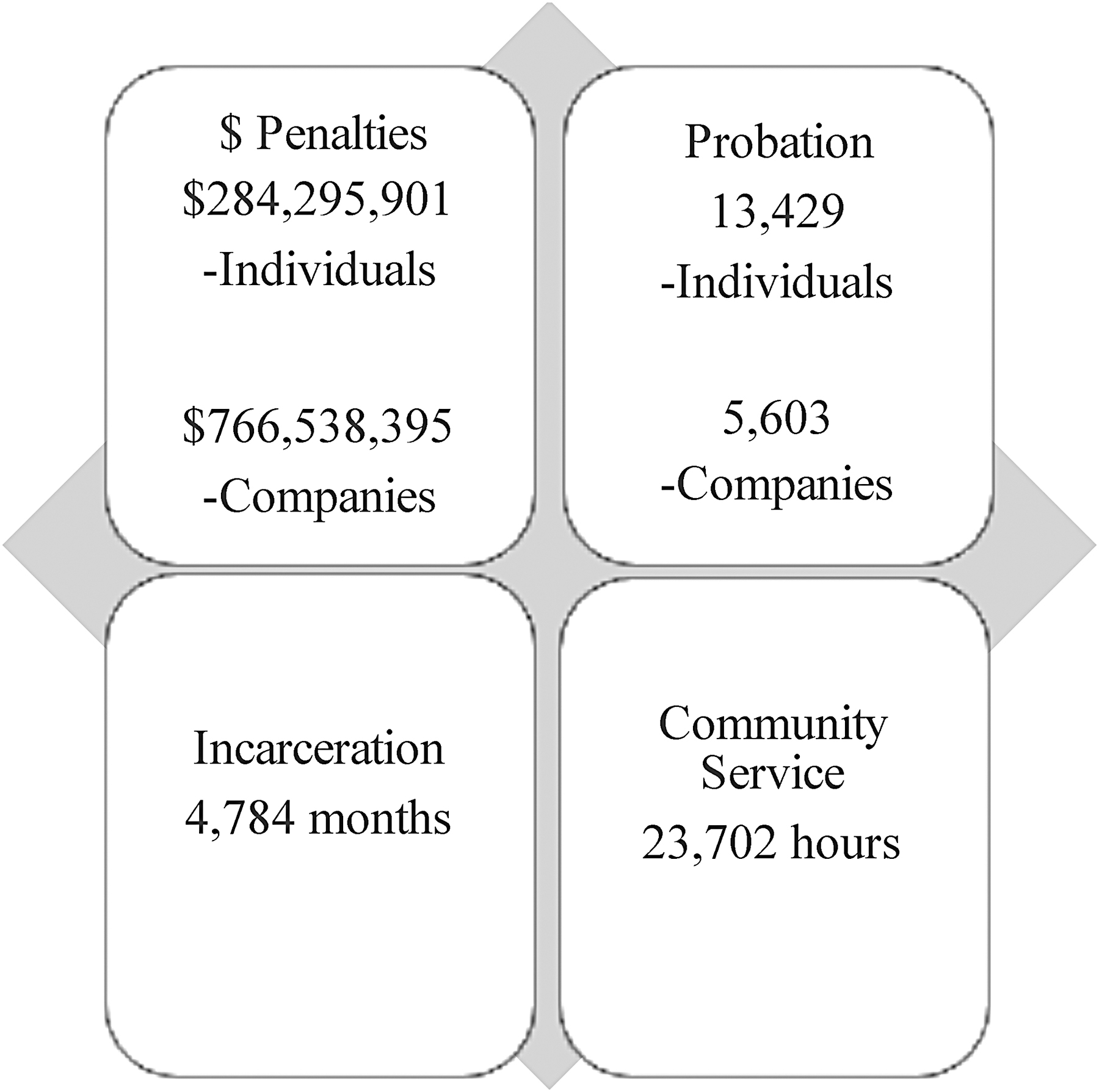
Cumulative penalties assessed in criminal prosecutions in the Gulf states since 1983. Source: EPA Summary of Criminal Prosecutions Database. Note: Excludes the $4 billion BP fine. BP, British Petroleum.
When excluding Transocean's $400 million criminal penalty in the Deepwater Horizon case, total corporate monetary penalties amount to ∼$366 million. This and BP's Deepwater Horizon conviction are outliers. The next largest fine was $50 million against BP for their negligence in the Texas City Refinery disaster on March 23, 2005, where an explosion killed 15 workers and injured 170 others. 38 Refrigeration USA was charged in Florida in 1996 for violations of the CAA, conspiracy, tax evasion, and smuggling. The company and its codefendants unlawfully imported in excess of 4000 tons of freon (also known as CFC-12). The defendants avoided $22 million in excise taxes and submitted false bills of lading to EPA. The company was ordered to pay penalties totaling $37,372,826. 39
Koch Industries was prosecuted for failing to install proper equipment that could have prevented harmful benzene emissions that were released into the atmosphere in 1995 at their West Plant Refinery in Corpus Christi, Texas. The plant is located near a fenceline community. Koch was sentenced to pay $20 million in fines and community projects. 40 Craven Laboratories and its president Don Craven and other employees were indicted in Texas in 1992 for submitting false pesticide residue tests for manufacturers. The company was sentenced in 1993 to pay over $19 million in fines and restitution and serve 60 months probation. 41
DISCUSSION
Findings from the study shed light on the history of federal criminal enforcement in the Gulf Coast since 1983. Our findings show that prosecutors completed 400 cases in the last 37 years as a result of EPA investigations. The CWA was the most prevalent charging statute used to convict environmental criminals in the region. Roughly, a third of all prosecutions hinged on CWA charges. This pattern was followed by the RCRA (16% of prosecutions) and CAA (15% of prosecutions), as well as fewer cases from FIFRA and TSCA.
Many cases involved criminal charges in addition to or related to environmental crimes. In almost one in five prosecutions, at least one defendant was charged with false statements, 16% with conspiracy, 7% with fraud, and 3% with obstruction. Prosecutions, on the whole, track upward over time with the institutionalization of the process in the early 1980s, and annual prosecutions increased dramatically as prosecutors and investigators learned to work together to gather evidence, pursue charges, and convict criminals. The high point for prosecutions was reached in the Obama Administration and these numbers have steadily fallen over the past 4 years. We see this ebb and flow over time, but no dramatic increase in one particular congressional or presidential cycle.
Prosecutors were successful in prosecuting hundreds of defendants over the last 37 years. They also managed to win big penalty cases, such as the Deepwater Horizon prosecution. That, however, is an anomaly in the Gulf Coast. While thousands of months of probation and incarceration were assessed, alongside over $1 billion in monetary penalties absent the BP ruling, which added another $4 billion, the total penalties and number of average cases over time are not exceedingly high. These numbers likely reflect an agency doing its best with limited resources to coordinate and cooperate with federal prosecutors to pursue criminal cases when the will, human, and budgetary capital are available.
CONCLUSIONS
At less than 11 annual prosecutions across five Gulf states, environmental criminals seem to have little to worry about in terms of being criminally prosecuted and convicted for their crimes. Some of the deterrent effect may be found more in highly salient cases such as BP, but one can argue that the effect size is likely small. 42 Our findings paint a somewhat bleak picture for fenceline communities seeking redress from environmental harms through a criminal process.
The other perspective on these findings is to place criminal enforcement in the context of the overall environmental policy and enforcement universe. EPA is beset by a regulatory universe of excruciating magnitude. In many cases, the agency is not even sure of the number of regulated entities covered by particular federal statutes. As an example, EPA regulates pesticides, but rarely tests their efficacy or health effects. The agency also can only estimate the number pesticide manufacturers, importers, exporters, applicators, and distributors under its purview. 43 The devolved system of monitoring, permitting, and enforcement to the states is a necessary evil with forces the agency can only control on the margins. Permitting authority for the CAA and CWA has also devolved to the states over time.
Another example might be the EPA's authority under the Safe Water Drinking Act, which gives it regulatory power over 170,000 public water systems. 44 Yet, given limited enforcement staff and the agency's notoriously bad track record for testing pesticides and chemical substances or developing acceptable exposure levels for many of the items we consume or are exposed to on a daily basis, could it reasonably be expected to police many drinking or storm water systems with all of the chemicals, pharmaceuticals, and industrial waste that make their way into POTWs everyday across the United States? Of course, the answer could be yes, but it is often no or a conditional yes.
For fenceline communities in the Gulf Coast, the limited number of prosecutions over time and space suggest that this tool is likely of limited value for redressing existing or previous harms. EPA does better when it sets national permitting frameworks or tackles a specific problem, such as reducing SO2 emissions from coal-fired power plants. If there were better political consensus in Washington over the importance of stronger environmental policies and regulations, EPA would likely make much better progress over time. Instead, they often waffle between administrations persisting and doing their best between Democratic and Republican regimes. 45
In our own experience working on a multiyear federal environmental crime prosecution under the CAA and MBTA, we saw the extreme amount of personal dedication and resources needed to challenge industrial polluters in court. We witnessed the value of hardworking administrators who are often panned at community meetings as laggards or ambitious only to the extent they might get a job in the private sector by cozying up to industry; in fact, we saw both examples. We have also seen the myriad ways in which state environmental regulators are unmatched for their opponents. Environmental regulation costs wealthy people and corporations money, and this policy area has always been one defined by legal and political maneuvering and animus more than cooperation. 46
A crucial step in enhancing the criminal enforcement apparatus is to simply hire more enforcement-focused staff. If one considers that the CID only employed 175 criminal enforcement agents in 2012 for the entire country and that number fell to 154 by 2015 and then further declined to 145 by 2019, one might argue these outcomes we find are fairly impressive. 47 Overall, EPA workforce numbers have decreased with increased responsibility, moving from 17,000 in the 1990s to a high of 18,110 in 1999, to a slow decline down to 14,172 today. While the agency's nominal budget has increased (adjusted for inflation), it has, with one exception, slowly declined over the past 15 years. 48 Hopefully, the broader public will begin to see their own self-interest in supporting policies that mitigate climate change as well as protect fenceline communities. Cleaning up the air, toxic waste, and water through regulations will go a long way toward improving both ends, but technology can only do so much; someone must enforce the laws.
Footnotes
AUTHOR DISCLOSURE STATEMENT
No competing financial interests exist.
FUNDING INFORMATION
The authors received no funding for this research.