




Abstract
Numerous early environmental justice studies found a positive correlation between minority populations and exposure to toxins, air pollution, and other contaminants. More recent scholarship expanded the field of environmental justice to include the connection between race and unequal access to environmental amenities, such as parks, trees, and green spaces. This study builds on the more recent scholarship by testing the relationship between public parking availability and beach usage rates for people of color (POC). The study makes use of parking availability data and a novel demographic beach survey to explore the connection between race and beach access along a 20-kilometer stretch of beach in Palm Beach County, Florida. Beach surveys were conducted using the SOPARC (System for Observing Play and Recreation in Communities) methodology over 5 consecutive days (March 7 to 11, 2020). The study finds that in general parking limitations significantly reduce beach usage and disproportionately impact beach usage for POC.
BACKGROUND
Through the mid-20
As property in proximity to the beach became scarcer and more valuable, African American residents who lived in the periphery of white communities were pushed into less desirable inland areas. The most prominent example of this happened in 1912 when an entire African American community on the Island of Palm Beach, known as the Styx community, was evicted and all its structures were leveled. Over 2000 African American residents of Palm Beach were forced to leave their homes and move inland. 3
By the mid-1960s, legally enforced segregation laws were weakening their grip on the area, but racially divided housing patterns had become well established. 4 In a pattern that repeats itself in coastal communities, wealthy, mostly white, property owners occupied the most desirable real estate along the coast, often establishing gated communities that restricted access to the beach. POC primarily resided inland 5 and were restricted to a relatively small number of public beaches that provided readily available public parking.
Today, Article X, Section 11 of the Florida Constitution provides all members of the public a legal right of access to Florida beaches situated below the mean high tide line. 6 Although the “public trust doctrine” of the Florida Constitution assures lateral access to the beach (access to a narrow strip adjacent to the water), perpendicular access is often denied by private security guards at gated communities and legally enforced parking restrictions at mostly white coastal towns. In sum, although the law grants a legal right to the beach, historical circumstances and legally enforced access restrictions often provide no practical way for POC to access large sections of beach. 7
LITERATURE REVIEW
Early environmental justice research focused on racial and economic disparities in exposure to environmental harms, such as toxins, air pollution, and other contaminants. 8 This research linked unequal exposure to environmental harms to mortality rates and other negative health outcomes. 9 A growing number of environmental justice studies explore unequal access to built and natural environmental amenities, such as urban parks, 10 trails, 11 and playgrounds. 12
Whether exploring unequal exposure to environmental harm or unequal access to environmental amenities, the environmental justice literature has increasingly focused on the role of local planning and zoning processes in determining environmental justice outcomes. 13 In the United States, most decisions regarding the location of polluting facilities, built environmental amenities, and access to natural environmental amenities are made by local government officials. Environmental justice scholarship provides researchers a powerful lens through which to explore the consequences of unequal political influence at the local level.
One area in which political imbalance likely translates into environmental justice outcomes is access to public beaches. Local planning officials determine parking availability, beach access points, and other factors that influence where, when, and who has access to public beaches. The first major study to examine the environmental justice implications of public beach access was Montgomery et al. 14 This study modeled beach accessibility through a geospatial approach that involved population weighted distances to beach access sites. The Montgomery et al. study found that beaches are more accessible to neighborhoods with a higher proportion of non-Hispanic Whites. This important work concluded that neighborhoods with higher percentages of Hispanics and socioeconomically disadvantaged residents have limited beach access.
Two additional studies of beach access by Kim and Nicholls 15 (also implementing a geospatial approach) estimated beach accessibility in the Detroit Metropolitan Area. This research found statistically significant relationships between access and population density, median housing value, elderly population, and nonvehicle ownership, but no statistically significant relationship between race and beach access. To date, no studies have explored the environmental justice issue of unequal beach access through direct observation of beach users.
RESEARCH QUESTIONS
This study builds on the earlier research of Montgomery, Kim, and Nicholls to explore unequal beach access for POC. With large sections of the coast providing no convenient public parking and with the vast majority of POC living beyond convenient walking distance to the beach, the study predicts that areas with little or no public parking will experience reduced beach usage in general and that parking limitations will disproportionally reduce beach usage for POC.
DATA AND METHODS
The primary focus area of this study is a 20-kilometer strip of beach in the northern most section of Palm Beach County (Florida), between the Jupiter Inlet and the Lake Worth Inlet (also locally known as the Palm Beach Inlet). The political boundaries include the municipalities of Palm Beach Shores, Riviera Beach, North Palm Beach, Juno Beach, and Jupiter Beach. To reduce the risk of confirmation bias, this section of Palm Beach County was chosen because it contains more public beach access points than the southern section of the county, making it a more difficult location to support the study's claims of racial inequality in beach access.
Parking data were collected through satellite images available through Google Maps and confirmed through site visits to the area. The racial composition of beachgoers was estimated using an adapted version of the SOPARC (System for Observing Play and Recreation in Communities) methodology. SOPARC is a validated direct observation tool for assessing people and environmental characteristics in recreational settings. 16 The tool was developed by the RAND Corporation (with the support of Active Living Research, a national program of the Robert Wood Johnson Foundation) as a way to systematically study recreational activity by groups in outdoor settings. More than two dozen peer-reviewed journal articles have been published using the SOPARC methodology. 17
To implement the tool, the 20-kilometer study area was broken down into 67 smaller target areas (i.e., beach segments), each segment was ∼300 meters in length. Using the SOPARC methodology, pairs of assessors simultaneously and independently observed the racial appearance of beachgoers, categorizing beachgoers as Caucasians or POC based on racial appearance. The POC category includes beachgoers who appeared Black, Asian, dark-skinned Latinos, as well as any beachgoers whose racial identity was not clearly Caucasian. Assessors underwent training and were instructed to include subjects in the POC category if the racial identity of the subject was ambiguous. The POC category was intentionally left broad, so as to not underestimate the minority beach going population. Using these two broad categories (Caucasian and POC), a lead assessor made use of hand-held clickers to tally the observed racial composition of beachgoers while walking each 300 meters beach segment. Simultaneously, a second quality control assessor made independent observations using the same methodology. The interobserver agreement for race was >97%.
Beachgoers were defined as any person on the sand adjacent to the beach, on piers and jetties extending into the water, or in the water (no more than waist high). People on staircases (leading to the sand) were not included as beachgoers and people who were submerged in the water (more than waist deep) were not included, as accurate observations were not possible for people in this situation. Each segment of the 20-kilometer study area was monitored on five separate occasions: twice on the weekend and three times during the work week (March 7–11). Eight assessors were divided into four teams of two. The four teams consisted of a “primary assessor” and a “quality control” assessor and were assigned to observe the beach segments along one-fourth of the study area, with the four teams combining to cover the entire 20-kilometer study area each day. Throughout the 5 days of the study, assessor teams were shuffled so that each team member covered the entire 20-kilometer stretch of beach at least once and each team member worked with all members of the research team at least once. All observations were made between 10:00 am and 1:00 pm. A total of 335 beach segment observations were taken. The observed racial composition of beachgoers was then compared with the available public parking within 300 meters of the target area. Additional observations were recorded regarding weather conditions, time of day, and day of the week. 18
FINDINGS
Table 1 presents the descriptive statistics for the study's key variables. Here we see that on average there were 44 public parking spaces within 300 meters of each beach segment, and the number of spaces varies widely by segment. The beach segment with the most parking spaces had 419 parking spaces, whereas 63% of the beach segments had no public parking within 300 meters. The average temperature during the observation periods was slightly >73°, with sunny conditions occurring during 44% of the observations and 34% of the observations having temperatures >75°. The relatively cool and cloudy conditions help explain the relatively light beach attendance in general during the 5-day observation period, with an average of only 17 people per beach segment, but does not explain the disproportionately low beach attendance of POC (on average 1.44 POC per 300-meter beach segment). Fully 72% of the beach segments had no POC during the observation periods and on average POC only comprised 5% of the total population on beach segments.
Beach Segment Observations
POC, people of color; SD, standard deviation.
Figures 1 and 2 graphically show the bivariate relationships between parking availability and beach use by racial groups. For both Caucasian beachgoers and POC, the availability of public parking has a statistically significant relationship to beach use. For both Caucasians and POC, there was less than one chance in a thousand that the relationships shown in Figures 1 and 2 occurred by chance. The coefficient for Caucasian beachgoers was 0.19 (estimated that every five parking spaces translated to one additional Caucasian beachgoer). For POC, the coefficient was 0.02 (estimating that every 50 parking spaces resulted in one additional person of color at the beach). A visual comparison of the figures suggests that the absence of any public parking spaces (0 on the x-axis) had less of an impact on Caucasians than POC. This relationship will be explored in more detail in the following analysis.
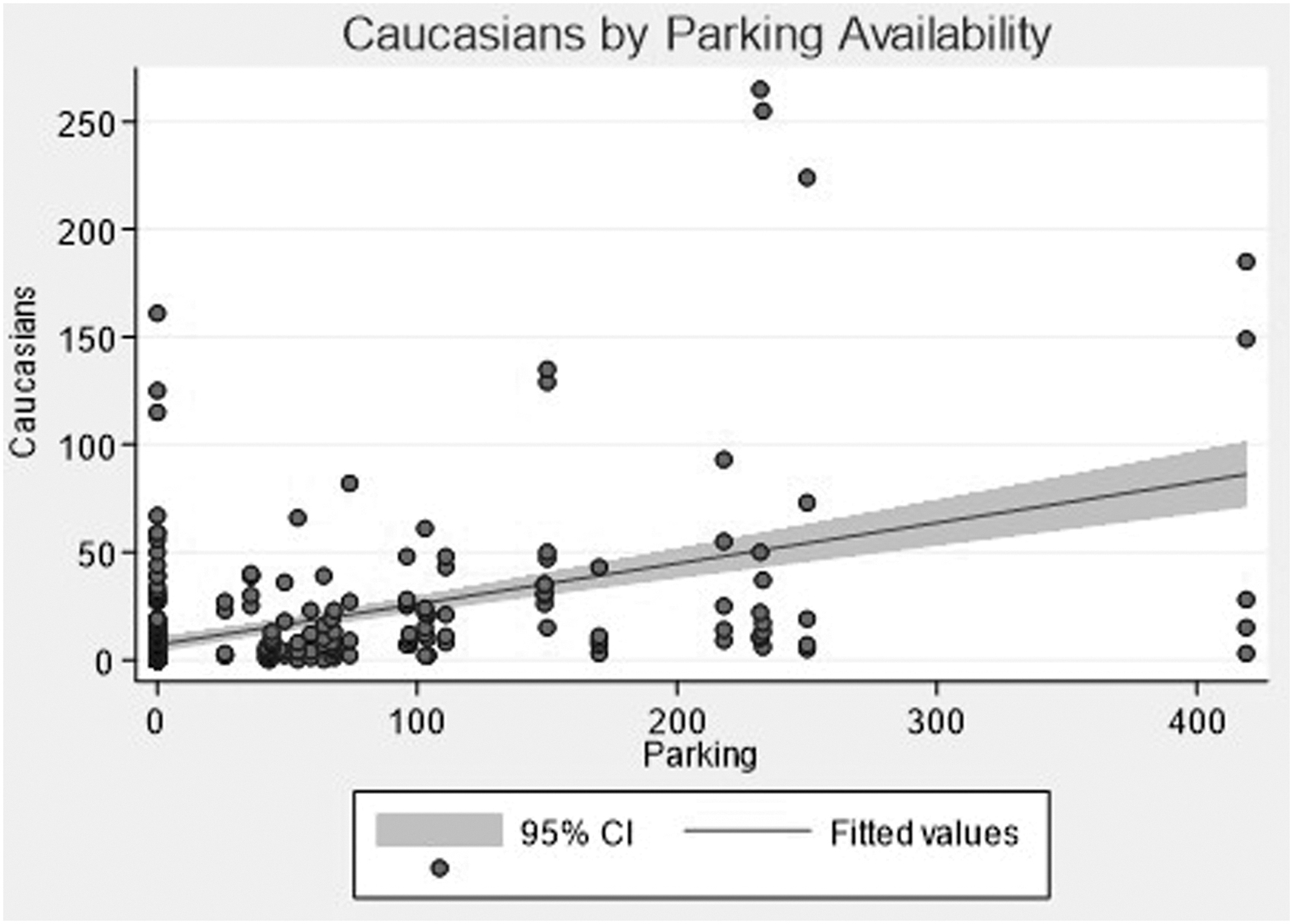
Caucasian beach attendance by parking availability.

People of color beach attendance by parking availability.
Table 2 reveals that in the absence of public parking, Caucasian beach attendance averaged 7.95 people per segment. For POC, the absence of public parking resulted in less than one person (0.28 people) per beach segment. Stated differently, the study finds that on beaches without public parking, there were virtually no POC (roughly one person of color per mile of beach). Access to public parking results in a 12-fold increase in the number of POC (from 0.28 to 3.40 POC per beach segment). Although the presence of parking also increases the estimated number of Caucasian beachgoers (7.95–27.90 per beach segment), the increase was a more modest 3.5-fold increase.
Beach Usage by Parking Availability and Race
Difference in means (t-tests) for all categories by parking availability found statistically significant relationships at the 0.000 level.
In the beach segments without public parking, 44% were vacant of Caucasian beachgoers. The absence of public parking resulted in 87% of the beach segments having no POC present. When public parking was available, only 3% of beaches were vacant of Caucasians. Public parking dropped the beach vacancy rate for POC from 87% vacant to 45% vacant. At beach segments with parking, POC comprised 11% of total beachgoers. When parking was not available, the percentage of beachgoers who were POC dropped to 2%. In sum, the vast majority of beach segments (87%) without public parking were vacant of POC, POC were present at the majority of beaches with public parking, and the ratio of POC increased when parking is available. For both Caucasians and POC, the relationship between parking access and beach attendance was statistically significant at the 0.000 level.
Table 3 displays four separate multivariate count models for beach usage. 19 With the introduction of a weather-related control variable and a dummy variable that distinguishes between surveys that were conducted during the weekend and the weekday, we see that both parking variables have a statistically significant impact on beach attendance. For both Caucasians and POC, parking availability (measured as the total number of spaces available and a dummy variable for spaces available versus not available) has a statically significant impact on beach usage. The coefficients for the parking variables in the count models for POC are roughly twice as large as the corresponding coefficients in the count models for Caucasians. Each of the models estimates that there is less than one chance in a thousand that the relationship between parking and beach usage is happening by chance.
Negative Binomial Count Models by Parking Availability and Control Variables
p < 0.05, **p < 0.01, ***p < 0.001.
DISCUSSION
On its surface, this study finds strong evidence that parking availability impacts beach usage in predicable ways. In general, limited parking results in fewer beachgoers. Beyond this relationship, the study also reveals the disparate impact of parking restrictions on POC. For POC, the absence of public parking virtually eliminates the presence of POC at beach segments, resulting in less than one person of color (0.28 people) per beach segment. These findings are an important compliment to the findings made possible with traditional geospatial tools for analyzing environmental justice issues.
The use of direct observation data, as is implemented in this study, opens up new research possibilities for those interested in environmental justice issues. This methodology is particularly well suited to help researchers and urban planners better understand the environmental justice implications of beach access decisions. For example, the approach can be used to test whether paid parking requirements (parking meters and paid parking lots) have an unequal impact on beach use for POC. The approach could be combined with water quality monitoring data to explore whether POC are being “funneled,” through parking restrictions, to beaches with comparatively low water quality. Likewise, future analysis could explore whether beaches near coastal inlets that experience variable water quality conditions (water quality that generally improves at incoming tides and diminishes at outgoing tides) experience a “daily gentrification” in which the racial composition of beach users changes with tidal conditions.
Further analysis could also untangle the possibility that reverse causality is responsible for the relationships found here. That is, the chance that high beach usage resulted in the creation of public parking, rather than the reverse direction of the relationship that is assumed in this study. The timing of the creation of gated beach communities and other legally enforced parking barriers is also important from an environmental justice perspective. If obstacles to beach usage were implemented in the 1950s and 1960s as a reaction to legal desegregation in public spaces, it would suggest that the racial disparities that we see in this study are less a matter of chance than an outcome of racially motivated design.
The policy implications of this line of study for local planning and zoning officials warrant further discussion than space allows here. The study casts doubt on whether the “public trust doctrine” (which assures lateral access to the beach) is being implemented effectively and in a racially unbiased manner. Possible policy solutions, such as increasing parking availability, providing increased horizontal beach access points, or providing some version of public transportation to areas without parking access, should be explored. Moreover, the political opposition to proposals that expand beach access should be studied, as they are likely to reveal the political imbalance that perpetuates environmental justice issues.
CONCLUSION
In sum, this study reveals the relationship between parking availability and the racial composition of beachgoers. Future research is needed to untangle the political mechanisms behind these findings. Likewise, future research should test the prevalence of the relationship at other locations and under different conditions. The disparate impact of parking availability for POC should be of special interest for local government planners, especially those who seek to understand the environmental justice implications of their planning and zoning decisions.
Footnotes
ACKNOWLEDGMENTS
This study was made possible through the Environmental Leadership Program of Gettysburg College's Eisenhower Institute. The author thanks the Eisenhower Institute, Gettysburg College, and Seiden/Levi Fellowship program for their support. Micaylah Bowers, Erin Boyle, Kevin Ganjon, Alex Economou-Garcia, Connor Heath, Corinna Kelly, Susan Ramirez, Nick Silvis, and Christopher Trilleras comprised the environmental leadership research team that assisted in design of the study, implemented the fieldwork, and completed data entry. Lauren Cole served as the program manager for the Environmental Leadership Program and participated in the fieldwork. The author would like to thank John Polga Hecimovich for his technical assistance with the data analysis.
DISCLAIMER
All findings are those of the primary investigator and the research team and do not reflect the official position of any organization.
AUTHOR DISCLOSURE STATEMENT
No competing financial interests exist.
FUNDING INFORMATION
The research team s fieldwork was funded through the Environmental Leadership Program of Gettysburg College's Eisenhower Institute.