




Abstract
We apply an environmental justice lens to synthesize knowledge of disparities experienced by Hurricane Harvey survivors based on race/ethnicity and socioeconomic status (SES) across the disaster phases. We focus on the Texas Gulf Coast, which hosts the largest petrochemical industrial complex in the United States and experienced Harvey-induced flooding in 2017, precipitating a natural-technological (na-tech) disaster. We review studies that have examined race/ethnicity- and/or SES-based disparities in each of Harvey's phases (i.e., mitigation, preparedness, physical impacts, health impacts, response, and recovery). Before Harvey, racial/ethnic minority and low SES populations had constrained access to resources for mitigating flood/hurricane hazards and exhibited less disaster preparedness relative to White and higher SES populations. The physical and health impacts associated with Harvey disproportionately affected minority and low SES groups. In addition, minority and low SES populations experienced heightened challenges in responding to and recovering from Harvey. Disparities documented within each phase of Harvey likely cascaded across this event for minority and low SES survivors, accumulating disadvantage in a manner that compounded their experiences of injustice. Patterns of na-tech disaster injustice in Harvey reflect preexisting racial/economic segregation and inequality along the Texas Gulf Coast and mirror patterns observed in Hurricane Katrina. Such disaster injustices derive from features shared by many U.S. Gulf Coast communities, including the presence of weak planning institutions, exploitative industries, degraded environments, spatial segregation, and stark inequalities. Thus, ameliorating regional disaster injustices requires tackling those root causes, while simultaneously improving organizational capabilities for disaster mitigation, preparedness, response, and recovery.
INTRODUCTION
Environmental justice (EJ) research examines the intersection of environmental quality, social hierarchies, and structural processes that produce unequal distributions of environmental benefits and burdens. 1 EJ emphasizes the conviction that “all people and communities are entitled to equal protection of environmental and public health laws and regulations.” 2 EJ research originated in the U.S. South, 3 a region susceptible to weather-related hazards 4 and considered by some to be a national sacrifice zone because its minority and poor communities have long been targeted by pollution-emitting industries and waste dumping. 5 This reflects the U.S. national pattern of environmental injustice. 6
Hurricane Katrina (2005) led EJ researchers to examine injustices associated with natural disasters. 7 Katrina disproportionately impacted Black residents, even after accounting for income. 8 While a hurricane triggered the disaster, its disparate effects were produced by preexisting social injustices. 9 The social dimensions of environmental injustice—most notably racial/ethnic marginalization and poverty—are the same factors that generate social vulnerabilities across the phases of disasters in the United States. 10 Social vulnerability encompasses the “characteristics of a person or group and their situation that influence their capacity to anticipate, cope with, resist and recover” from the adverse consequences of disasters. 11 In the U.S. context, race 12 and socioeconomic status (SES) 13 have been identified as salient dimensions of social vulnerability. After Hurricane Andrew in 1992, Black and Hispanic neighborhoods in Miami, Florida, experienced more damage and slower recovery times. 14 The same outcomes were observed for neighborhoods with lower median incomes in Galveston, Texas, after Hurricane Ike in 2008. 15
Despite the overlap, studies of social vulnerability to disaster and environmental injustice have remained largely separate. In this article, we apply an EJ lens to the phases of a U.S. Gulf Coast disaster to synthesize knowledge and inform future research. We use Hurricane Harvey—which hammered the Texas Gulf Coast in August 2017—as a case study to examine how social vulnerabilities materialized across the phases of a major disaster. Our results document the accumulation of environmental injustices based on minority race/ethnicity and low SES across the phases of the disaster. While other axes of inequality are associated with social vulnerability to disasters and environmental injustice (e.g., disability, gender, sexuality), we focus on race/ethnicity and SES since they are fundamental dimensions of environmental injustice that have received focus in numerous studies of Harvey. See Table 1 for a summary of reviewed studies.
Studies Related to the Disaster Phases of Hurricane Harvey in the Texas Gulf Coast Region: Research Questions and Results
FEMA, Federal Emergency Management Agency; PTS, post-traumatic stress; SES, socioeconomic status.
BACKGROUND: HURRICANE HARVEY AND EJ IN REGIONAL CONTEXT
Hurricane Harvey made landfall near Rockport, Texas, in August 2017 as a category 4 hurricane. Meteorological conditions then stalled the system over the Texas Gulf Coast for 4 days, causing historic levels of rainfall and unprecedented flooding. 16 Parts of Greater Houston experienced ∼48 inches of rainfall. 17 Sixty-eight deaths and an estimated $125 billion in damage were directly attributable to the hurricane, making Harvey the deadliest Texas hurricane since 1919, and the second costliest U.S. hurricane after Katrina. 18 An estimated 336,000 residents experienced power outages and nearly 200,000 structures were inundated by floodwaters. 19
The Texas Gulf Coast hosts the largest petrochemical industrial complex in the United States in terms of thousands of barrels produced per year. 20 The region's petrochemical industrial complex was severely damaged by Harvey. 21 The petrochemical industry developed in Greater Houston, in part, because the area is notorious for its “plan-less, free enterprise” growth, 22 as it is the only major metropolitan area in the United States without zoning. 23 Urbanization there is a product of a laissez-faire philosophy that views zoning as a violation of private property rights. 24 Thus, rather than being guided by social planning, racialized capitalist forces have driven growth, leading to environmental problems that disproportionately affect socially marginalized groups. 25 For example, due to the lack of zoning, numerous poor minority communities are located in close proximity to the ship channel, the major conduit for petrochemical industrial activity. 26 In comparison with Amsterdam, the Netherlands—which is physically susceptible to flooding but renowned for its land use planning—Houston has developed much more urban area within high-risk flood-prone zones (∼26% of the total area), and has thus created built and social environments that are at much greater risk to climate change-related hazard impacts. 27 Hurricanes are conventionally categorized as natural hazards, but those occurring along the U.S. Gulf Coast—such as Katrina, Rita, and Harvey—reveal that meteorological events may precipitate cascading impacts in regions in which land use planning is weak and toxic industrial infrastructure is concentrated, generating natural-technological (na-tech) disasters. 28 A na-tech disaster occurs when a natural disaster, such as a hurricane, results in technological malfunction, such as the unplanned release of hazardous materials, and poses an environmental and health risk for the surrounding community. 29 Na-tech disasters can severely impact human health. 30
Numerous EJ studies of the area impacted by Harvey have documented racial/ethnic and socioeconomic disparities in the distribution of various environmental hazards and risks, such as toxic waste facilities, 31 air pollution, 32 accidental releases of toxic chemicals, 33 and flood risk. 34 For example, the studies in Bullard's classic book Dumping in Dixie showed that people of color and poor communities in Houston suffered disproportionately from facility siting decisions associated with municipal landfills and incinerators. A household-level study in Greater Houston found that Hispanic and Black residents experienced greater cancer risks from hazardous air pollutants (HAPs) than Whites; that homeownership and the desire to live among people culturally similar to oneself were associated with higher risks among Hispanics and Blacks, but with lower risk among Whites; and that disparate cancer risks from HAPs experienced by Hispanics and Blacks were attributable neither to dampened risk perceptions nor the desire to live close to work. 35 Another household-level study in the Houston area conducted before Harvey found that Hispanic immigrants were disproportionately exposed to federally designated 100-year flood risks (compared with other racial/ethnic subgroups), after adjusting for a range of contextually relevant factors. 36
INJUSTICE ACROSS HARVEY'S DISASTER PHASES
Methods
We reviewed prior studies examining race/ethnicity and SES in relation to Hurricane Harvey's disaster phases of mitigation, preparedness, physical impacts, health impacts, response, and recovery (Fig. 1). 37 To identify relevant studies, we searched based on each of the disaster phase terms (“mitigation,” “preparedness,” “physical impacts,” “health impacts,” “response,” and “recovery”) plus “Hurricane Harvey” and/or “Houston” and/or “Texas Gulf Coast” using Web of Science and Google Scholar. We searched for research published from immediately after Harvey through mid-August 2020. For “mitigation” and “preparedness” only, we expanded the search in two ways based on the logic that applicable studies for the “mitigation” and “preparedness” phases were primarily conducted before Harvey. First, we expanded the time frame to up to 10 years before Harvey (2007) as patterns reported in studies any earlier than 2007 would have questionable applicability to the Texas Gulf context at the time of Harvey. Second, we expanded the search terms to include “hurricane,” “flood,” “hazard,” and “disaster” (while excluding “Hurricane Harvey”). Multiple authors conducted searches in parallel to ensure that we identified relevant studies.
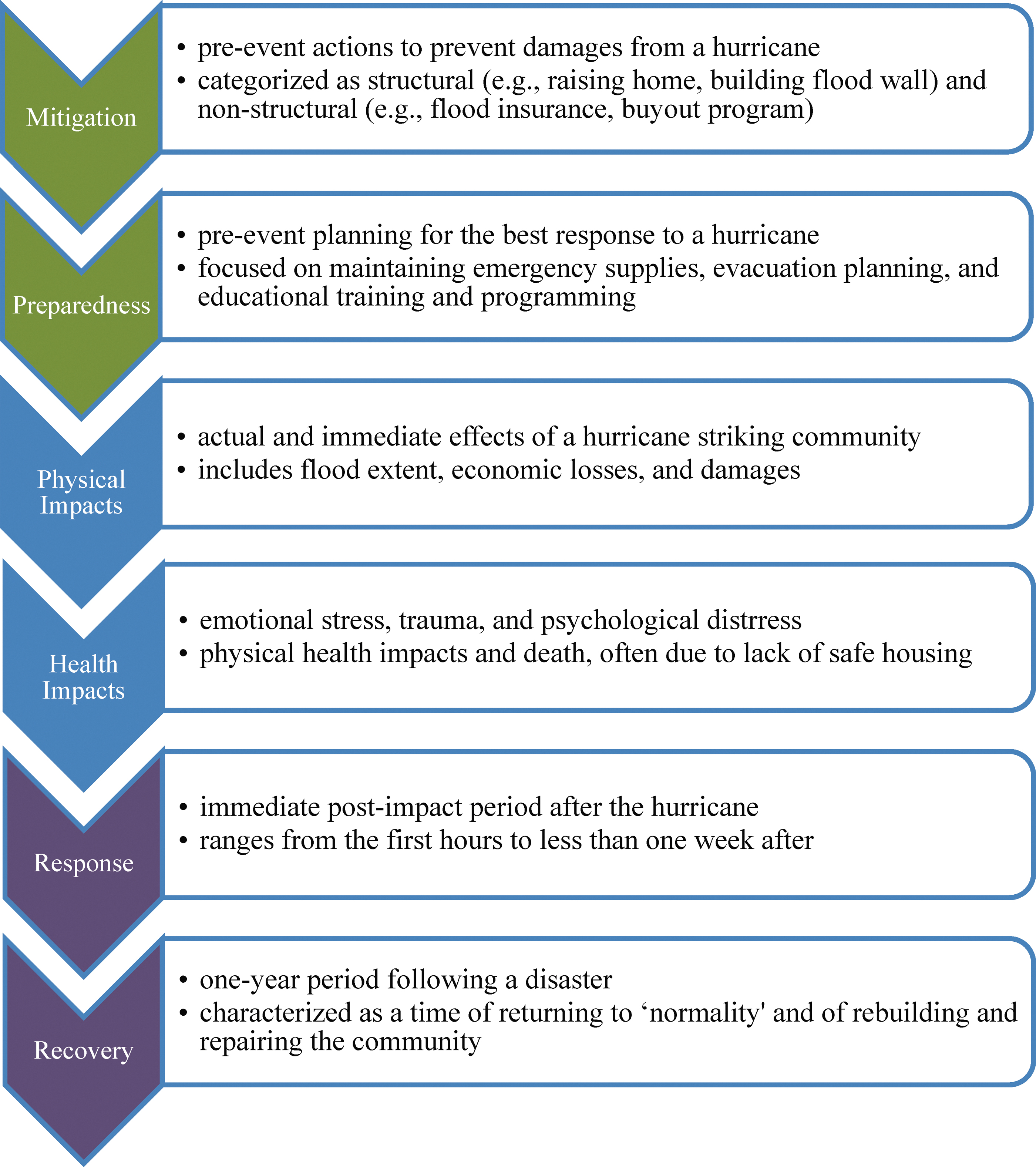
Disaster phases of Hurricane Harvey. 94
The studies we reviewed operationalize race/ethnicity and SES using a variety of measures, at individual, household, or small area (e.g., census tract) levels. Measures of race/ethnicity included White (non-Hispanic); Hispanic/Latinx, Black (non-Hispanic); Asian (non-Hispanic); and other race or multiple races (non-Hispanic). Some studies including the Hispanic/Latinx population examined subgroup categories, including Mexican Americans as well as Hispanic/Latinx people who were U.S.-born, foreign-born citizens, and noncitizens. A few studies combined all persons of nonwhite races (e.g., American Indian/Alaska Native, Native Hawaiian/Pacific Islander) and Hispanic/Latinx ethnicity into one minority category. Measures of SES included income, poverty status, unemployment status, receipt of public assistance, housing unit/property value, educational attainment, housing tenure (renter- vs. owner-occupancy status), female-headed household status, lack of telephone services, mobile home occupancy, and lack of access to a vehicle.
We do not address whether race versus SES (class) was the most salient determinant of disparities across the phases of Harvey because entrenched patterns of residential segregation have bound the two dimensions of inequality together across the study region. 38 For example, in Greater Houston, the correlation between median household income and the percentage of the population that is of minority race/ethnicity (i.e., Hispanic/Latinx and/or of any nonwhite race) is negative and very strong at the neighborhood (i.e., census tract) level. However, we do report results from the few studies that have examined interactions between measures of race/ethnicity and SES because those results speak to the possible amplification or attenuation of Harvey-related disparities.
Mitigation
Before Hurricane Harvey, there were racial/ethnic and SES disparities in mitigation actions. Among households at risk of flooding in Greater Houston, foreign-born Hispanic households implemented significantly fewer mitigation actions compared with non-Hispanic Whites. 39 Non-Hispanic Whites were more likely than racial/ethnic minorities to have flood insurance in Greater Houston 40 and in Harris County, TX. 41 Before Harvey, federal buyout programs were used in Harris County to mitigate flood risks. While historically more common in White working-class neighborhoods, recent buyouts have been more likely to affect Hispanic residents. 42 Evidence suggests that when buyouts occurred in affluent White neighborhoods, the zones were typically transformed into parks that could also alleviate flooding. Buyout zones in lower income minority neighborhoods were more commonly left derelict as empty lots. 43
Few studies have examined SES-based disparities in pre-Harvey mitigation actions. Research in Greater Houston indicates that households with higher (vs. lower) property values were more likely to adopt structural and nonstructural mitigation strategies.44,45 Community residents with higher (vs. lower) property values and longer (vs. shorter) housing tenure were also more likely to voluntarily purchase flood insurance when they lived outside of designated flood zones. 46
Preparedness
Before Harvey, racial/ethnic minorities were less likely than Whites to take general disaster preparedness actions. Foreign-born Hispanics in Greater Houston were less prepared for disasters compared with non-Hispanic Whites (e.g., having evacuation plans or emergency supplies). 47 Immigrants may face challenges due to fears of deportation reducing participation in disaster preparedness planning and difficulties accessing preparedness information in non-English languages. In southern Texas Gulf Coast counties, Mexican Americans reported reduced hurricane preparedness compared with non-Hispanic Whites. 48
Reduced economic resources available to people of low SES limits their capacities to prepare for disasters. Along the southern Texas Gulf Coast, households with higher (vs. lower) incomes and education levels reported increased hurricane preparedness. 49
Physical impacts
Racial/ethnic minority households and neighborhoods in Greater Houston experienced more extensive Harvey-induced flooding than White households and neighborhoods, controlling for income. 50 Neighborhoods with higher Hispanic/Latinx composition along the Texas Gulf Coast were proximate to a higher density of petrochemical facilities reporting toxic releases due to Harvey, 51 and neighborhoods with higher proportions of people of color hosted more Toxic Release Inventory (industrial) facilities, which could result in increased exposure to contaminants from hurricanes, floods, and other disasters. 52
Socioeconomically deprived households and neighborhoods in Greater Houston also experienced more extensive flooding, accounting for race/ethnicity. 53 Census tracts with higher proportions of residents in poverty were proximate to a higher density of petrochemical facilities reporting toxic releases due to Harvey; this association was stronger when the neighborhood was predominately Hispanic. 54
Health impacts
Evidence with regard to racial/ethnic disparities in mental and physical health after Harvey is mixed. Being non-Hispanic Black (vs. non-Hispanic White) was associated with four times the odds of having post-traumatic stress (PTS) after Harvey among a random sample of Greater Houston residents, but the study found no racial/ethnic disparities in physical health impacts. 55 A study of a broader sample of Texans directly threatened by Harvey found no racial/ethnic disparities in mental health. 56 Another study relying on a small convenience sample to examine mental health also found no evidence of disparities. 57 Black, Hispanic, and other race respondents living in Texas Gulf Coast counties were significantly more likely to report food insecurity post-Harvey than were White respondents. 58
Low SES has been linked more consistently than race/ethnicity to worse post-Harvey health. Higher income was protective against PTS symptoms and physical health problems. 59 Households with higher incomes or individuals in possession of an advanced degree were less likely to report food insecurity post-Harvey. 60 Five months after Harvey, Texans directly affected by Harvey with graduate/professional degrees reported better mental health than those without these degrees, and those living in mobile homes (vs. single-family) reported worse mental health. 61 Harvey-related job loss also doubled individuals' odds of having PTS. 62 Households that reported economic instability (i.e., loss of a job or income due to Harvey) experienced greater odds of food insecurity post-Harvey compared with households that reported economic stability. 63
Response
Black and Hispanic households in Greater Houston experienced disproportionately greater unmet needs during and after Harvey (e.g., inadequate place to sleep, lack of electricity or transportation) relative to White households. 64 Foreign-born noncitizen Hispanic householders experienced significantly more unmet needs compared with foreign-born citizens and U.S.-born Hispanic householders. 65
Disruption of transportation routes during Harvey reduced the ability of some residents to evacuate or seek emergency assistance. In a study of two watersheds in Greater Houston, those living in Greens Bayou, a community primarily composed of racial/ethnic minorities, experienced more transportation disruption to hospitals and fire stations than did those in Brays Bayou, a predominantly White area. 66 However, multivariate analyses within the two bayous found that census block groups with higher proportions of Black and Hispanic (vs. White) residents experienced less transportation disruption. 67
There were SES-based disparities in the use of social media to obtain information in the response phase. During and immediately after Harvey, people used social media to relay information and request support in response to the overwhelmed 911 system. 68 Researchers found a digital divide in Twitter usage during Harvey, which left socioeconomically marginalized residents without access to information. Residents with low incomes, female-headed households, those in mobile homes, and those without an automobile used Twitter less. 69 Greens Bayou (aforementioned) is also characterized by lower income residents and experienced more severe transportation disruption than did the more affluent Brays Bayou. 70 Research using smartphone data showed that residents living in areas with higher mean levels of education evacuated due to Harvey at higher rates than those living in areas with lower levels of education. 71 Households with lower (vs. higher) incomes experienced more unmet needs during and after Harvey. 72
Recovery
Findings generally highlight racial/ethnic disparities in recovery, with minorities faring worse. Racial/ethnic minority residents in Harris County experienced greater electrical, water, transportation, and communication service disruptions post-Harvey than did White residents. 73 Racial/ethnic minority (vs. White) residents reported higher levels of hardship (e.g., longer duration of service disruption and less ability to withstand service disruption) due to these post-Harvey disruptions. 74 Census blocks in Greater Houston with greater concentrations of minority racial/ethnic (vs. White) residents received less financial assistance from the Federal Emergency Management Agency (FEMA). 75 In contrast, interviews with the Texas Gulf Coast residents indicated that Latinx people were more likely than non-Hispanic Whites to report feeling that their lives had returned back to normal three months after Harvey. 76
Lower SES households struggled to a greater degree than more affluent households after Harvey. Higher income households experienced shorter recovery times post-Harvey than lower income households. 77 Five months after Harvey, lower (vs. higher) income households reported significantly less complete recovery, 78 despite their higher likelihood of receiving recovery assistance. 79 Lower (vs. higher) SES residents experienced greater hardship from disruptions in electrical, water, and communications systems post-Harvey. 80 Cleanup and rebuilding progressed more slowly in lower (vs. higher) income neighborhoods along the Texas Gulf Coast. 81
Limitations
Our review examined only published and peer-reviewed studies, which excludes conference abstracts, investigative journalism, and government reports. We focused our review only on race/ethnicity and SES, which overlooks other known dimensions of social vulnerability to disasters (e.g., gender). We also concluded our search in August 2020, meaning studies published after that time are not included.
CONCLUSION
When taken together, the research we reviewed provides evidence of disparities based on minority race/ethnicity and low SES for each phase of the Hurricane Harvey disaster. Minority and low SES households experienced constrained mitigation and preparedness before Harvey, greater exposures and more impacts during Harvey, and heightened challenges during response and recovery in Harvey's aftermath. Racial/ethnic minorities experienced more hardship across all phases of the Hurricane Harvey disaster. These racial/ethnic disparities are partially, but not entirely, explained by low SES and reflect entrenched patterns of racial/economic segregation and inequality across the U.S. Gulf Coast region, in which socially marginalized groups have been denied the resources needed to prepare for and recover from disasters. 82
The environmental injustices based on minority race/ethnicity and low SES evident across the phases of the Harvey disaster align with patterns found across other disaster events nationally and globally, 83 as well as Hurricane Katrina on the Gulf Coast. 84 The parallels with Hurricane Katrina in particular are striking, given the patterning of environmental injustice and the na-tech character of the events. Flooding and a lack of access to transportation to evacuate in response to Hurricane Katrina impacted the racial/ethnic minority and poor residents disproportionately. 85 Hurricane-damaged areas in New Orleans were disproportionately home to Blacks and households in poverty. 86 Before the storm, one-quarter of New Orleans residents relied on public transportation, and Katrina disrupted public transportation service, stranding many transportation-disadvantaged residents in the city. 87 As has been the case following Harvey, socially disadvantaged groups experienced barriers in the recovery phase following Katrina. 88 Moreover, based on preexisting patterns of environmental injustice associated with the petrochemical industrial complex, which spans across the U.S. Gulf Coast (excluding Florida), the fact that toxic contamination burdened socially marginalized populations in both Katrina and Harvey was unsurprising, such that we should expect similar na-tech disaster injustices in future Gulf Coast hurricane events. Hence, the patterns revealed here, while alarming, are unfortunately not anomalous.
The literature in fact suggests that such disaster injustices are predictable in contexts such as the U.S. Gulf Coast, characterized by weak planning institutions, powerful and socioenvironmentally exploitative industries, degraded environments, spatial segregation, and stark inequalities. Perhaps the only anomaly lies in mixed results for race/ethnicity and mental health following Harvey, since the broader literature has more consistently associated minority racial/ethnic status with worse postdisaster mental health outcomes. 89 Discrepancies across the handful of studies examining race/ethnicity and mental health post-Harvey, however, are likely an artifact of the limited number of studies post-Harvey in combination with varying study designs (e.g., random vs. convenience sampling). The study analyzing a population-based random sample aligned with the literature 90 and found evidence of disparate outcomes. 91
It is likely that the disparities documented within each phase of Harvey cascaded across this na-tech event for many minority and low SES survivors, accumulating disadvantage in a manner that compounded their experiences of environmental injustice, especially among those for whom minority racial/ethnic status and low SES intersected. However, no research conducted on Harvey to date has examined disparities across multiple phases of the disaster or from an intersectionality perspective. Nor have studies focused on the multifaceted (unjust) impacts of Harvey as a na-tech event. In fact, very few studies have focused on social disparities associated with any na-tech dimension of Harvey. We recommend that future research on disasters along the Gulf Coast seriously investigates the technological elements of such events. Future research should also engage new conceptual frameworks that facilitate assessment of cumulative impacts and social disparities in relation to a broader range of socioenvironmental impacts stemming from na-tech events. For example, researchers could examine the disparate livelihood impacts of hurricane-induced toxic petrochemical pollution in fisheries and agricultural sectors. These impacts were not captured by the published research on Harvey, but reflect plausible, complex human/environmental outcomes of Gulf Coast na-tech events. To enhance understanding of how experiences of disadvantage and oppression may interact across na-tech events, future studies along the Gulf Coast should examine how injustices cascade across phases of disaster and intersect based on multiple dimensions of inequality. Adapting Pellow's EJ life cycle analysis approach would be useful for fostering such understanding. 92
Knowledge generated through studies of Harvey has practical implications for future Gulf Coast disasters. To address cascading and intersecting disaster injustices, EJ praxis should focus on intervening in early phases (mitigation, preparedness), as addressing those needs has the potential to dampen impacts during and after events. For example, more mitigation actions taken before Harvey resulted in fewer physical health problems and adverse experiences, lower PTS, and faster recovery post-Harvey. 93 Such interventions should be premised on the expectation that contemporary disasters—especially those in contexts such as the Gulf Coast—will be na-tech events, due to the absence of land use planning and the deep embeddedness of the petrochemical industry's toxic infrastructure across socially marginalized communities in the region. This suggests the need for Gulf Coast EJ scholarship and praxis to more fully address the deep and complex interlinkages of the entrenched petrochemical industry and climate change (including the amplified frequency/magnitude of hurricanes, sea level rise) across the increasingly threatened Gulf Coast human ecosystems.
Footnotes
AUTHOR DISCLOSURE STATEMENT
No competing financial interests exist.
FUNDING INFORMATION
No funding was received to complete this project.