




Abstract
Mississippi's growing poultry business, including industrialized farms and meatpacking plants, raises a number of concerns regarding public health and environmental justice. Using hot spot analysis, we analyzed the totality of Mississippi's industrial poultry farms and meatpacking plants to assess whether these types of facilities were disproportionately sited in communities of color and/or low socioeconomic status communities at the census tract level. We used zero-inflated regression modeling to determine the strength of the associations between environmental justice variables and the location of industrial poultry farms and meatpacking facilities at the state level. This study produced mixed results but indicated that tracts featuring industrial poultry farms had higher percentages of people in poverty than tracts determined to be coldspots or insignificant for industrial poultry farms. Higher percentages of people in poverty and without health insurance reside in census tracts featuring meatpacking facilities. Our analysis found no obvious correlation between communities of color and industrial poultry farms, demonstrating that the Mississippi poultry industry is more closely correlated with class-based inequalities than with racial/ethnic inequalities. The unequal distribution of industrial poultry production across the state of Mississippi has the potential to produce inequitable health outcomes for the state's low-wealth communities.
Introduction
Over the past century, industrialized animal agriculture has emerged due to the consolidation of the meat industry. 1 The vertical and horizontal integration occurring among the once disparate animal agriculture and meatpacking industries has allowed a handful of companies to maximize profits. 2 This consolidation has led to rapid industrialization of meat production, resulting in a decrease of small family farms and an increase of large industrial operations. 3
Independent farms have become less common, with many farming businesses now being run by multinational corporations. 4 In many instances, while animal production is carried owned and managed by independent families, management processes are dictated by contractor, which takes the form of the corporate processor. 5 From 1935 to 2012, the number of farms in the United States decreased by over two thirds, whereas the average farm size nearly tripled in the same period. 6 In Mississippi specifically, the number of commercial broiler companies within the poultry industry has dropped from more than 35 in the 1930s to 6 in 2019. 7
As this industrialization continues, concentrated animal feeding operations (CAFOs) have replaced smaller, independently owned farms. 8 These operations are characterized by the confinement of livestock in limited amounts of space, keeping them confined for at least 45 days out of the year in an area with no vegetation or greenery. An industrial farm must hold more than 100 animal units to be considered a CAFO, holding animals until they are transported for slaughter. 9 The combination of increased mechanized production in tandem with contractual arrangements between producers and processors has led to animal agriculture shifting from traditional agriculture to those resembling more industrial purposes. 10 The consequences of this shift have led to increased environmental inviability. 11
Evidence from the past two decades suggests that the development of CAFOs puts nearby communities at a higher risk of adverse health effects as a result of exposure to heavy metals, fertilizers, pesticides, and animal waste. 12 , 13 Chemical emissions from CAFOs including nitrates, carbon dioxide, methane, and particulate matter have also been recorded. 14 , 15 , 16
Manure production from CAFOs ranges from 2800 tons to 1.6 million tons, with some large farms producing significantly more waste than some U.S. cities. 17 Although a portion of waste can be disposed through the use of fertilizer, a significant percentage of the waste is stored in treatment lagoons, holding pits, and concrete pits; therefore, emissions from the degrading manure and from the livestock digestive processes can escape into the atmosphere and adversely affect air quality in surrounding communities. 18 Additionally, this can cause nutrient imbalances in nearby bodies of water. 19 When phosphorus and nitrogen from animal manure travels into rivers and streams, issues such as harmful algal bloom, hypoxia, and cyanobacteria can arise, threatening human health. 20 , 21 , 22
Manure disposal from CAFOs often involves applying waste directly into the soil, leading to nutrients such as phosphorus and nitrogen to leak into groundwater. 23 CAFOs have been shown to generate excess nitrogen, above the federal standard, with chicken farms making up 82% of operations exceeding the acceptable nitrogen levels. 24 This nitrogen can be transported in drinking water as nitrates, which can cause severe health problems including methemoglobinemia, hypertension, infant mortality, goiter, stomach cancer, thyroid disorder, cytogenetic defects, and birth defects. 25 , 26
Extensive research has been performed on the environmental and health effects of swine CAFOs across the country. Industrial swine operations have been found to emit inhalable odorant chemicals such as hydrogen sulfides, ammonia, and volatile organic compounds (VOCs) into the atmosphere, which have been linked to chronic hypertension and degradation of quality of life. 27 Employees of CAFOs experience some of the highest rates of respiratory symptoms associated with these emissions. 28 Studies have also shown individuals living within close proximity to CAFOs experienced increased rates of upper respiratory symptoms, asthma, irritation of the nose and eyes, and lung and nasal allergies. 29 , 30
In addition to exposure to chemical emissions, research has demonstrated that CAFOs expose nearby communities to a number of harmful microbes. Several studies have examined the effects of poultry CAFOs on local communities, showing that ∼25% of CAFO employees report respiratory problems, thought to be caused by exposure to endotoxin, a family of bacteria known to be present in high concentrations, specifically in chicken CAFOs. 31 , 32 Poultry litter is a known carrier of bacteria such as Escherichia coli and Staphylococcus, which can contaminate nearby waterways and groundwater, putting nearby communities at risk of associated health conditions. 33
Industrial poultry farm emissions are in many ways similar to those produced by hog CAFOs. 34 , 35 Both hog and poultry farms have been shown to increase the amounts of antibiotic resistant bacteria in local ecosystems and waterways, as well as the emission of dangerous airborne pollutants, specifically VOCs. 36 , 37 , 38 Furthermore, studies have shown that exposure to chemical pollutants such as ammonia and nitrates are higher for areas within close proximity to both hog and poultry farming operations. 39 , 40 , 41 , 42
Furthermore, research has shown that communities of color and low-income populations are disproportionately burdened by CAFOs, putting them at a higher risk of adverse health effects. 43 , 44 A previous study in Mississippi found that industrial hog farms were 3.64 times more likely to be located in areas with a Black population over 29%; in addition, areas with a high percentage of Blacks and more than 25% of residents living in poverty had 2.4 times as many operations. 45 Similarly, in North Carolina, researchers found that of the residents living within close proximity to active hog farms, more than 33% were Black and 21% lived below the poverty line. 46 These communities may have been disproportionately burdened due to a lack of economic and political resources to prevent siting of these operations. 47
Because of this, community groups in North Carolina filed a Title VI Civil Rights complaint with the Environmental Protection Agency (EPA) alleging that the state's permitting system for swine CAFOs and the agency's monitoring plans had resulted in the violation of Title VI and EPAs implementing regulations in 2014. 48 A 2013 study found a correlation between CAFO dense areas in Ohio and high percentages of Hispanic populations, indicating that many communities of color were disproportionately affected by these operations. 49
A 2016 investigation regarding the environmental justice concerns of swine production in Iowa concluded that residents proximal to operations were not traditional environmental justice communities, but the distal effects of surface water contamination could have health repercussions on communities who did not directly benefit economically from animal agriculture. 50 Because of this, these communities are more likely to experience negative health effects and economic impacts due to living in close proximity to these farms.
Environmental injustice is also prevalent in the meatpacking industry. A 2020 survey found that nearly 50% of all meatpacking workers in the United States were Hispanic, whereas nearly 25% were African American. In total, more than 50% of all workers were immigrants. 51 Since the beginning of the meatpacking industry in the United States, dangerous workplace conditions have been a concern. Minimal pay, extremely long hours, and tedious tasks create a hostile workplace and increase risk of physical injury. 52
The annual rates of job turnover in meatpacking facilities can be as high as 84%, so high that companies tend to report monthly turnover rates as opposed to annual rates. Additionally, reports of wrongful termination of employees that suffer from workplace injuries are common. Although the meatpacking facilities analyzed in this study do not solely process poultry, these facilities play a large role in creating additional environmental justice and health concerns for workers and residents who reside near the plants.
Extensive research has been performed in recent decades on the implications of industrial hog farms on public and environmental health. However, there have been limited studies performed on the same implications for industrial poultry farms. In 2018, 433 industrial poultry operations operated in the state of Mississippi—a number that has stayed consistent since 2011. 53 In this study, we used sociodemographic data for census tracts in conjunction with hot spot analysis to examine the disproportional distribution of industrial poultry farms and meatpacking facilities across the state of Mississippi near non-White and low-wealth communities.
Methods
Data related to dry litter and industrial poultry farms in Mississippi were obtained from the Mississippi Department of Environmental Quality. 54 The names and addresses of facilities with the National Pollution Discharge Elimination System permits were geocoded based on facility or town name as determined by the geocoding program Geocodio. Topographically Integrated Geographic Encoding and Referencing shapefiles for Mississippi were downloaded from the United States' Census Data portal. 55
The presence/proximity of poultry farms served as the dependent variable for analyses. These files were then spatially joined with sociodemographic features from the 2018 American Community Survey 5-year estimates data obtained from the Census. 56 The sociodemographic features included: (1) percent Black/African American; (2) percent non-White Hispanic; (3) percent foreign-born population; (4) percent individuals without a high school (HS) diploma; (5) median household income; (6) percent below poverty; and (7) percent homeownership. We obtained spatial data for all meatpacking and packing facilities in Mississippi from the United States Department of Agriculture (USDA) Meat, Poultry, Egg Inspection Directory. 57 The addresses of each facility were geocoded into coordinates, which were then converted into individual points in ArcGIS 10.7.
We categorized census tracts, industrial chicken farms and meatpacking facilities—as well as other point features—based on proximity. Census tracts that contained industrial poultry farms or meatpacking facilities were designated as “site” census tracts and compared with non-site census tracts. We also conducted buffer analysis of sociodemographic and point features using radii of 0–0.5, 0.5–1, and 1–5 km around each census tract boundary, which sited an industrial poultry farm and/or a meatpacking facility. The buffers were chosen based on previous environmental justice analyses, which used similar buffer classifications. 58 , 59 , 60
These census tract categorizations were then stratified by “rural” (more than 50% rural housing units) or “urban” (more than 50% urban housing units) designations based on urban and rural housing unit data from the 2010 Census. ArcGIS 10.7 was used to find these census tract classifications. These were then compared with sociodemographic statistics to draw correlations between the distance from industrial poultry farms and meatpacking sites versus socioeconomic status and race/ethnicity.
We conducted a hot spot analysis using the “Optimized Hot Spot Analysis” test for industrial poultry farms and meatpacking facilities in Mississippi to find areas with large concentrations of industrial poultry farms and meatpacking plants. 61 , 62 We calculated summary statistics for demographics of industrial poultry farms and meatpacking hot spots and coldspots to understand the populations in closest proximity to these facilities. We then compared the mean differences between both industrial poultry farm and meatpacking hot spots for all sociodemographic variables.
A negative binomial regression was performed to determine if there was a statistically significant relationship between sociodemographic variables in census tracts, such as percent African American, versus the proximity/presence of industrial poultry farms. 48 This test was performed to account for the large amount of census tracts, which contained no CAFOs, which caused a skewed distribution of data within the independent variable.
Using the 2010 Rural–Urban Commuting Area codes taken from the USDA, we classified each census tract binarily as either rural or non-rural to understand how rurality affects the distribution of CAFOs. To remove any collinearity, which we determined to be a variance inflation factor value of above 5, we removed percent below poverty under 18 from the regression. The regression could not be performed on meatpacking facilities due to there being an insufficient number of facilities. Total population by census tract was used as a logarithmic offset to control for the differences in population between each census tract.
The negative binomial regression was tested against a Poisson regression with the same variables to determine if the negative binomial test was an improvement on the standard Poisson regression. The Akaike information criterion (AIC) of the negative binomial test was 803.97, which was lower than the Poisson regression's 1308.9 AIC value, suggesting that the negative binomial model has a relatively better goodness of fit. A likelihood ratio test between the two models was also performed to test the suitability of the negative binomial test. The p-value was lower than 0.05, which suggests that the negative binomial test is a statistically better fit than the Poisson regression.
Results
With regard to the siting of industrial poultry farms and meatpacking facilities near or within communities of color, this study produced some notable results. Areas of Mississippi that have high concentrations of African American residents are primarily on the western border of the state, as shown in Figure 1a. The census tracts with high percentages of African Americans overlap heavily with those census tracts with high percentages of people below the poverty line, as shown in Figure 1b.

However, as displayed in Figure 1a, these areas have very few meatpacking facilities and even fewer industrial poultry farms than in the central part of the state. Most industrial poultry farms are located in second and third quartile census tracts for percent Black (17.8%–65.5%). Meatpacking facilities are more evenly dispersed throughout the state, with a higher number being found in census tracts with the highest percentages of African Americans (65.6%–100%).
Figure 2a shows percent African American in only the census tracts featuring industrial poultry farms in the state. Site tracts were located primarily in the southeastern part of the state. We did not observe an upward trend in the distribution of farms in site tracts as percent African American increased, rather, the number of poultry CAFOs were almost equally distributed between each quartile.
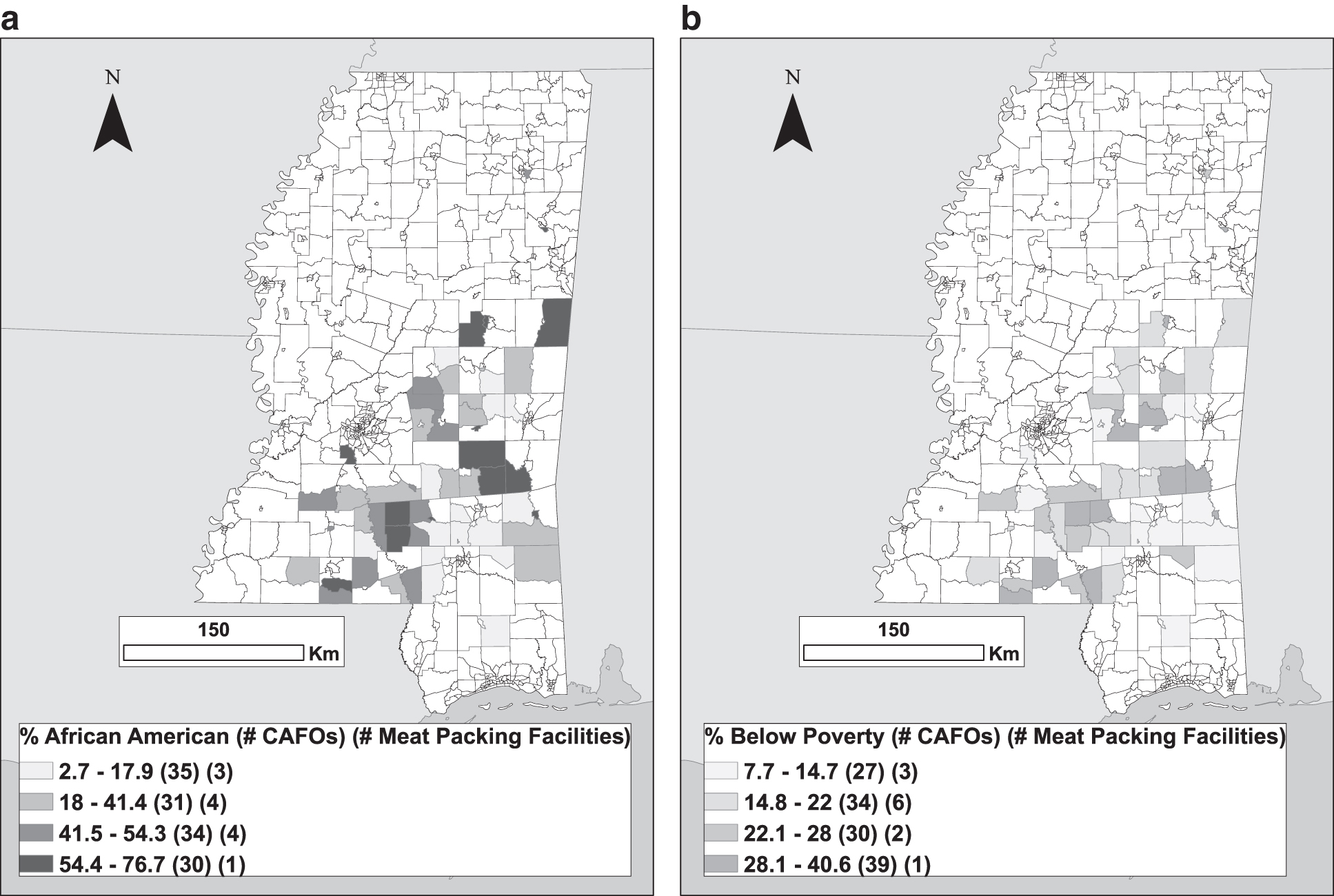
Table 1 displays the results of the hot spot analysis for industrial poultry farms and meatpacking facilities in the state of Mississippi analyzed against sociodemographic factors. Hot spots for meatpacking facilities had a higher percentage of Hispanic residents than those that were insignificant. Table 2 displays the sociodemographic analysis of census tracts that either feature an industrial poultry farm or are within a 1, 2, 5, or >5 km radius from one of an industrial poultry farm. Census tracts within a 2 km radius of industrial poultry farms and census tracts within 2 km of meatpacking facilities had the highest percentage of African Americans (51.7%), around 9.0% higher than the state average. Percent Hispanic was highest in tracts more than 5 km radius away from industrial poultry farms and lowest in industrial poultry farm site tracts (3.37% and 1.41%, respectively).
Hot spot, Coldspot, and Insignificant Census Tracts in Mississippi for Meatpacking Facilities and Industrial Poultry Farms, and Their Associated Sociodemographic Composition
HS, high school.
Sociodemographic Composition of Census Tracts that Contain Industrial Poultry Farms and Meatpacking Facilities, and Census Tracts Within 1, 2, 5, and >5 km of Industrial Poultry Farms and Meatpacking Facilities in Mississippi
Table 2 also displays the sociodemographic analysis of census tracts that either feature a meatpacking facility or are within a 1, 2, 5, or >5 km radius of a meatpacking facility. Tracts within a 2 km radius of a meatpacking facility had the highest percentage of African Americans (55.2%), 12.5% higher than the state average. Meatpacking site tracts had a higher percentage of Hispanic residents than non-site tracts, followed by tracts within a 2 km radius (4.56% and 3.23%, respectively). Table 3 displays the sociodemographic analysis of site and non-site tracts for both industrial poultry farms and meatpacking facilities. Meatpacking site tracts had a higher percentage of Hispanic residents than meatpacking non-site tracts (4.56% and 2.85%, respectively).
Distribution of Sociodemographic Features, Industrial Poultry Farms, and Meatpacking Facilities by Site, Non-Site, and Statewide Designation in Mississippi
Table 4 shows the negative binomial regression analysis for industrial poultry farms in the state of Mississippi. While this analysis provided several statistically significant results, the negative binomial model demonstrated only slight associations. For every one unit increase in the percentage of Hispanic people, the rate for industrial poultry farms would be expected to decrease by a factor of 0.813 (p-value 0.031), while holding all the other variables constant. Increases in population density and median household income were also significantly correlated with decreases in the presence of poultry farms, but at the incidence rate ratios of 0.997 and 1.00, respectively (Table 4).
Negative Binomial Regression Model for Census Tracts that Contain Industrial Chicken Farms and Associated Sociodemographic Characteristics
With regard to the connection between industrial poultry farms and socioeconomic status, this study demonstrated a strong linkage between the presence of sites and low socioeconomic status indicators. Areas on the map (Fig. 2b) that correspond strongly to poverty tend to be further from the industrial poultry farms and meatpacking facilities than areas that have the lowest rates of poverty. 10.7% of the farms are located in census tracts with high percent poverty (31%–81.7%). Similarly, 32.1% of the meatpacking facilities are located in the same high poverty tracts.
Table 1 shows that tracts that were industrial poultry farm hot spots had a higher percentage of those with less than a HS diploma than tracts that were determined to be industrial poultry farm coldspots (17.8% and 14.1%, respectively). For meatpacking facilities, hot spots had a higher percentage of those with less than HS than insignificant tracts (19.6% and 17.2%, respectively). Meatpacking hot spots had the highest percentage of those younger than 18 years living in poverty of all census tracts analyzed (35.0%).
Industrial poultry farm hot spots had the highest percentage of those below the poverty line (25.2%), 2.84% higher than industrial poultry farm coldspots. Percentage of homeownership was 9.82% higher in industrial poultry farm hot spots than industrial poultry farm coldspots. Finally, the lowest median household income can be found in tracts that are hot spots for meatpacking facilities, followed closely by industrial poultry farm hot spots ($37,812 and $38,372, respectively).
Table 2, which displays the results of the buffer analysis, demonstrates that industrial poultry farm site tracts had the highest percentage of those with less than a HS diploma (19.1%), 1.77% higher than the state average. Furthermore, tracts within a 2 km radius of an industrial poultry farm had the highest percentage of those in poverty, followed by those further than a 5 km radius (26.3% and 23.7%, respectively). The highest percentage of homeownership was determined to be industrial poultry farm site tracts (65.0%), 10.0% higher than the state average.
Additionally, meatpacking site tracts had the highest percentage of those with less than a HS diploma (18.8%), followed closely by tracts further than 5 km from a meatpacking facility (18.0%). Tracts within a 2 km radius of a meatpacking facility had the highest percentage of those below the poverty line (26.5%), which was higher than the state average (23.2%). Meatpacking site tracts and tracts within a 2 km radius had the highest percentage of people without health insurance, 0.30% higher than the second highest (13.8% and 13.5%, respectively). Meatpacking site tracts had the lowest median household income ($41,027) of all meatpacking tracts analyzed.
Table 3 compares site census tracts vs. non-site tracts for both industrial poultry farms and meatpacking facilities, and demonstrates that for both industrial poultry farms and meatpacking facilities, site tracts had a higher percentage of those with less than a HS diploma than non-site tracts. Industrial poultry farm non-site tracts had a higher percentage of those below the poverty line than site tracts (24.4% and 22.1%, respectively).
Industrial poultry farm site tracts had a higher percentage of homeownership than industrial poultry farm non-site, meatpacking site, and meatpacking non-site tracts (65%), which was 9.95% higher than the state average. Both industrial poultry farms and meatpacking site tracts had lower median household incomes than the respective non-site tracts. In addition, industrial poultry farm site tracts had the lowest median household income of all tracts analyzed.
In the negative binomial model (Table 4), it was found that as population density and percent Hispanic increase, it increases the likelihood that a census tract will not contain any industrial poultry farms.
Finally, results were notable with regard to the aforementioned trend in the animal agriculture industry toward consolidation and integration, as farms and meatpacking facilities were often clustered in the same census tracts. Figure 3 shows that hot spots census tracts were clustered together in the middle of the state, with a majority of the hot spot tracts at 99% confidence limit. Coldspots for industrial poultry farms were more dispersed than the hot spots. Most coldspots were statistically significant (90%–95% confidence level) and were clustered in two different areas in the state. The two identified poultry CAFO coldspots were located in urban areas on the western side and southern coast of the state.

Optimized hot spot analysis of meatpacking facilities and industrial poultry farms by census tract in Mississippi.
We also observe a significant overlap between the census tracts that were hot spots for meatpacking facilities and industrial poultry farms, although there were far fewer meatpacking hot spots than industrial poultry farm hot spots. The hot spots were clustered in the middle of the state (95% confidence). There were no recorded areas of the state that are coldspots for meatpacking facilities.
Discussion
We analyzed the relationship between the location of industrial poultry farms in the state of Mississippi and their proximity to low-wealth communities and communities of color. The results of this study indicate a relationship between the location of industrial poultry farms and low-wealth communities, but no obvious trend between poultry farms and communities of color. These findings are inconsistent with results gathered from previous research in the state of Mississippi, which have found industrial farming operations to be located with close proximity to both low-wealth communities and communities of color. 63
In recent decades, studies have investigated the negative health and environmental impacts of industrial hog farming operations on local communities. Emissions from these operations contain harmful airborne pollutants, which can have been shown to increase rates of allergies, congestion, and respiratory irritation, specifically asthma. 64 , 65 , 66 , 67 Poultry CAFOs release high levels of nitrogen waste into the air and local waterways, resulting in excess exposure by residents of nearby communities. These communities have reported serious health consequences including birth defects, hypertension, infant mortality, and thyroid disorders as a result of this exposure. 68
Although this study did not examine the public health effects on communities located close to poultry CAFOs, the results of this study suggested a trend in vulnerable populations. The statistical and spatial analyses found that industrial poultry farms are more likely to be located in areas where there are large percentages of the population living in poverty. Socioeconomic indicators including median household income, educational attainment, and percentage living in poverty were used to draw these conclusions in this study. These results are consistent with previous studies investigating low-wealth communities and industrial hog farming, determining that areas of low socioeconomic status are common sites of CAFOs. 69 One study determined that in many cases, low-income areas are targeted by large farming operations to site CAFOs, as there is often no political pushback from the local communities. 70
Percentages of homeownership were determined to be higher in census tracts featuring both industrial poultry farms and meatpacking facilities than those that are non-sites. Homeownership may be an inaccurate indicator of socioeconomic status and instead serve as an indicator of rurality versus urbanity. Rates of homeownership have been shown to be higher in rural areas. 71 This would explain why there are high rates of homeownership in census tracts featuring industrial poultry farms, as CAFOs have been determined to primarily burden rural communities. 72 Prior research regarding the spatial distribution of meatpacking facilities in the United States has shown that the number of these facilities in rural areas has increased in recent decades. 73
An association between meatpacking facilities and census tracts of low socioeconomic status was also found. These results are consistent with previous studies suggesting that meatpacking facilities across the country are disproportionately located in areas with high rates and indicators of poverty. 74 , 75 The trends regarding vulnerable populations and proximity to meatpacking facilities are less well-researched than trends associated with CAFOs in the United States.
This study did have limitations. An Anselin Local Morans' I test was performed, which indicated that the number of CAFOs in census tracts were spatially autocorrelated. Specifically, CAFOs tended to cluster in rural areas outside the main urban centers. However, this study did not utilize spatial regression to fully address spatial autocorrelation.
Another limitation of this research is its reliance on secondary data. Because of this, we were unable to groundtruth the locations of CAFOs nor understand how these facilities interact with the landscape and produce risk of exposure. This study relied on proximity measures to CAFOs to approximate risk of exposure as opposed to modeling any direct health effects associated with industrialized animal agriculture.
Utilizing health data in this study would add an additional dimension to the analyses. The addition of air and water quality sampling would further cement any connections between proximity to CAFOs, exposure to contaminants, and associated health effects. Additionally, some census tracts were not representative of normal residential populations. For example, the southern coast of Mississippi in the Gulfport-Biloxi area contained a large air force base, an international airport, and a large industrial area. These census tracts had very low homeownership rates due to the presence of temporary/military housing, yet the populations were not insignificant enough to remove entirely.
This study demonstrated that low-wealth populations are disproportionately burdened by Mississippi's industrial chicken farming industry. This investigation relied on an ecological study design. Future research employing cohort study designs has the potential to show direct health effects of industrial chicken farming on low-wealth populations. 76
Conclusions
The unequal distribution of industrial poultry farms and meatpacking facilities across the state contributes to a legacy of environmental injustice within industrial animal agriculture practices. There was found to be a positive correlation between the level of poverty in an area and the likelihood of that area featuring an industrial poultry operation. Unlike conclusions drawn from extensive studies on industrial hog farming, the location of industrial poultry farms was not found to have a significant correlation with communities of color.
The results of this study suggest a need for future research including careful monitoring of emissions, including frequent air and water testing to help reduce exposures and prove health of fenceline communities. Increased monitoring will result in better analysis of the disproportionate impact that the meatpacking industry has throughout Mississippi. This research provides evidence pointing toward CAFOs causing nearby communities increased risk of adverse health effects, and the policy suggestion recommended is to develop an equitable solution to minimize the harmful effects of exposure to heavy metals, fertilizers, pesticides, and animal waste.
Recommendations include efforts to mitigate air and water pollution in affected communities. This can be performed by addressing irregularities and inconsistencies in state CAFO regulations with regard to environmental impact. 77 Adherence with the proposed Farm System Reform Act, for example, would provide uniform stringency and environmental impacts. 78 This legislation promotes a moratorium on current CAFO expansion, and eventually a process to eliminate CAFOs. 57 Additionally, CAFOs are required to be permitted under Clean Water Act regulations, but this practice has been undermined by the industry. 79 Environmental advocates have pushed for CAFOs to be regulated under the Clean Air Act due to their emissions. 80 Support for policies such as these has the potential to mitigate the harm and environmental injustices associated with the Mississippi CAFO industry.
Footnotes
Author Disclosure Statement
No competing financial interests exist.
Funding Information
This study received no funding from any funding sources.