




Abstract
Communities in close proximity to petrochemical and industrial pursuits are at particular risk of anthropogenic hazards. It is vital for these communities to have an effective and functioning warning system to receive critical information in a timely manner to prevent negative public health outcomes. There is growing evidence that not all communication strategies produce equal results and that a locally involved strategy that takes into account communal needs and social spheres can fare better than traditional methods. This cross-sectional study collected data from the city of Deer Park, TX, following a petrochemical fire at the Intercontinental Terminals Company that seeped carcinogenic compounds into the neighborhood and initiated several shelter-in-place commands along the Houston Ship Channel. This study (n = 126) evaluated where individuals received warnings from and what effect this had on their willingness to follow the emergency instructions. Of the sources of emergency communications—radio, social media outlets, outdoor warning sirens, friends and family, or the CodeRED® system—an increase in willingness to shelter-in-place was only significantly shown when individuals heard from family or friends (p-value 0.02) and through social media sources (p-value <0.001). Our findings suggest that cities need to become part of the information sphere before having a disaster. Including residents and participants in educational and outreach efforts poised at improving adherence to health and safety improves overall outcomes, especially in regard to public health measures.
Introduction
Communities in close proximity to petrochemical and industrial pursuits experience increased risk of exposure to pollutants in the air, soil, and water. 1 , 2 , 3 In addition to such environmental exposure risks, many communities are vulnerable to rare but potentially catastrophic anthropogenic hazards in industrialized areas, such as fires 4 and chemical spills. 5 Texas leads the country in hazardous events, further Texas is witnessing an increase of disasters associated with industry in recent years, and local residents are increasingly exposed to acute and chronic health conditions created by such anthropogenic disaster events. 6 , 7 These trends are exacerbated within minority populations who shoulder an undue burden of exposure to hazardous compounds and poorer health outcomes compared with the majority groups. 8 , 9 These exposure trends underscore the importance of proper and effective early warning systems and community right-to-know measures to better safeguard the health of these vulnerable communities.
Despite understanding the heightened risks of living in these areas, many cities have not implemented safeguards and emergency notification systems that alert residents when anthropogenic disasters do occur, nor do they perform needs assessments within communities to ensure effective communication channels. However, while research has highlighted the need for proper warning systems, 10 few studies emphasize the importance for rapid assessment of warning system effectiveness following major anthropogenic disasters.
To better understand where and how individuals receive warnings following a major and unanticipated disaster and their willingness to follow safety recommendations, this research presents a cross-sectional study conducted in the city of Deer Park, TX, following the Intercontinental Terminals Company (ITC) petrochemical fire in 2019. Specifically, this research examines (1) how communities receive emergency warnings following a major disaster, (2) their willingness to follow official instructions (i.e., shelter-in-place), and (3) whether individuals are more likely to observe emergency guidelines if they receive such instructions from official sources or from within their own social sphere.
Background
ITC petrochemical fire (2019)
In the early hours of Sunday March 17, 2019, a fire started at the ITC petrochemical plant in Deer Park, TX, which rests along the highly industrialized Houston Ship Channel (HSC). Over the next week, 15 chemical storage tanks housing volatile organic compounds, such as naphtha, toluene, xylene, and benzene, caught fire or were damaged, requiring a massive effort for first responders and a 4000-foot smoke plume above the city of Houston. 11 During this time, multiple shelter-in-place commands were issued, as pollutants were discovered in the community at levels unprecedented outside of occupational settings. The HSC has a high density of chemical industry, varied emission sources, and is a source for air toxics during normal conditions. 12 The region's abundance of chemical plants and refineries has resulted in major chemical explosions in the past, including the 1997 ethylene explosion at a Shell Chemical Company. 13 Communication with the public regarding the contents of the tanks was not immediate or transparent. Runoff associated with the firefighting foam, containing per-and polyfluorinated substances (PFAS), flowed into Tucker Bayou, which ultimately empties into the HSC and the Gulf of Mexico. 14
The Deer Park community received communication about the incident from the radio, social media outlets, outdoor warning sirens, friends and family, and the CodeRED® system. The CodeRED system alerts the public about severe weather warnings, evacuation notices, shelter-in-place orders, and missing children alerts. However, this system has presented its own problems partly because residents are required to opt-in and vulnerable populations, such as the elderly, have not signed-up to participate in adequate numbers. 15 , 16 While various city, state, and Harris County Public Health officials were involved in disseminating information, the after action report indicated that communication was inadequate. Incidents such as the ITC fire emphasized the lack of central systems for notifying the public about emergencies. Recommendations from the after action report suggested an increase of social media presence and the release of video clips to improve disaster communication. 17
The Gulf of Texas, known as the U.S. petrochemical corridor, contains four of the country's largest oil and gas refineries and thousands of chemical companies in the United States. Houston's lack of zoning rules intensifies the community's potential exposure to toxics and disproportionately impacts the minority and socially vulnerable populations. Repeated disasters can erode the community's trust of pollution-intensive industries. 18 Environmental health hazards, such as heavy polluting industries, are likely to harm an individual's psychological and physiological well-being. 19 The perceived risk and chronic stress from these environmental disasters have been linked to poorer health outcomes. 20 The cumulative impacts of both environmental and health risks are found to be a significant influence on health inequities. 21 Moreover, socioeconomically, minority, and disadvantaged populations experience higher morbidity and mortality rates due to the cumulative effects of exposure to environmental stressors. 22
Risk communication and importance of officials warning
Risk communication refers to the social process of exchanging information about the nature of a risk, potential impacts, and risk reduction strategies that can minimize damage or loss of life, with the intent to promote protective behavior in information recipients. 23 , 24 , 25 Risks are not always perceived the same by affected populations as they are by risk experts, so risk communication seeks to bridge those knowledge or information gaps. 26 , 27 , 28 , 29 However, risk communication can be difficult to implement effectively when information exchange between laypersons and experts does not consider differing risk perceptions between individuals within a community or perceptions to different hazards.22,25 Risk perception, which describes how people identify and measure risk based on information they have about that risk, 30 does not always match calculated risk, or “real” risk. 31 For example, an individual living in a major evacuation zone may not evacuate during a hurricane if they have past experience with the hazard and do not feel they are in danger, despite officials warning to do so. 32 The disconnect between risk perceptions “real” risk can also occur due to knowledge about a risk (or lack thereof), cultural, social, and ethnic contexts, biases from media sources, information sources, previous hazard experience, vested interest, and perceived benefits from partaking in risky behavior. 33 , 34 , 35
Furthermore, risk perception alone does not influence protective-action decision making. People look for and process several different types of information when making those decisions, including personal hazard experience, official warnings, environmental cues (e.g., can they physically see the hazard?), social cues (e.g., how are their friends, family, or neighbors reacting?), and perceived self-efficacy (e.g., do they feel they have the resources or ability to carry out specific protective actions). As a result, risk communication efforts must be tailored to specific communities or populations and different hazard events and take individual risk perceptions, residents' hazard knowledge, and their perceived responsibility to mitigate or protect against hazard impacts into account. 36
In many instances, the focus of research is on how and when residents make the decisions to evacuate or why they choose not to, rather than placing the research focus on passive protections actions such as sheltering-in-place (SIP) and related risk communication messages. There is a critical need to better understand individual and community SIP behavior, as the need for such actions is on the rise. This approach is an alternative, passive protective action in contrast to evacuation, which is classified an active protective action. 37 SIP is often thought of as a backup to evacuation, but there are instances where SIP is a more appropriate protective response, 38 especially if SIP is the only feasible option to reduce risk (i.e., COVID stay-at-home orders or lacking resources to evacuate) or when evacuation is potentially riskier than SIP. 39 , 40 SIP is also common during major disasters where structural damage or protecting one's home is a major concern, even if official warnings suggest other actions. 41 For environmental disasters, particularly those related to airborne hazardous chemical releases, SIP is often recommended by emergency managers as the first protective action people should take, as opposed to evacuating. 42 Studies such as Tarkington et al. and Kinra et al. have demonstrated that SIP can significantly reduce chemical exposure to outdoor contaminants, as going outdoors or leaving the area might put residents at greater risk or exposure to the chemical release. 43 , 44
Risk communication and information sources
The key influencing factor for both risk perception development and risk communication effectiveness is information. 45 Where people get information, what information sources they trust, how they receive (or reject) information, how information is influence by social or cultural contexts, and what information is gleaned from their own environment are factors that all critically influence how people perceive risks and choose to engage in protective action decision making. For example, official sources may disseminate risk information about disasters through knowledge campaigns and public outreach, both of which are needed in conjunction with one another to be effective. If the information provided to the public is not developed in a way that can successfully be processed into knowledge, such public information (and outreach) efforts have failed to educate the public about that risk. 46 Furthermore, the quantity of warning systems can have a positive impact on individuals, receiving multiple warnings may increase the willingness to adhere to instructions. 47
Understanding how information is gathered, processed, trusted, and acted upon can help risk communicators disseminate personalized information that effectively encourages behavioral change in a given place, even if residents have not yet detected a threat. Types of risk communication include public education and outreach or official warnings. Official warnings, such as shelter-in-place warnings, are risk communication strategies that typically address imminent threats that require immediate protective action. In contrast, public education often refers to information dissemination campaigns aimed at influencing preparedness and response behavior before a disaster occurs. The intent behind such education campaigns is to modify behavior during a disaster event, many of which are often successful.
For example, the Deer Park Local Emergency Planning Committee (LEPC) has implemented public education measures to educate the public about SIP using a mascot named Wally Wise Guy. Wally Wise Guy is a turtle mascot who was created in 1994 to specifically teach residents in Deer Park, TX, about SIP during hazardous chemical releases events. 48 There have been conflicting data on the effectiveness of using playful imagery and mascots as they may downplay the level of hazard. 49 However, through longitudinal community surveys, researchers have also demonstrated that even when threat awareness has decreased, mascots such as Wally Wise Guy that residents trust as a credible source of protective action information related to SIP can reinforce certain protective action narratives to the degree that they become the intuitive response for residents during a chemical release event. 50
While Wally Wise Guy is an example of a formal risk communication information source trusted by residents in Deer Park, TX, a growing body of evidence suggests that communities often trust information coming from within their social spheres more than official reports from state and national sources during disaster events, and they trust local agencies more than national ones. 51 , 52 Social capital theory states that through a set of shared values, resources, and cultural norms, groups can often more effectively work together and initiate change. 53 Furthermore, the hazard literature has found that strong social capital can moderate the impacts of climatic and other anthropogenic hazards and shape adaptive capacities and recovery trajectories for impacted communities. 54 Strong social support and capital have also been shown to improve response to disasters, as was found by researcher Zakour through a small study (n = 67), which found that those with reported strong social support were significantly (p < 0.001) more likely to follow warnings and evacuate before Hurricane Katrina made landfall in 2005. 55 A more recent study by Liu, Zhang, and Zhang (2020) examining the influence of social capital on protective action perceptions toward hazardous chemicals (particularly ammonia) in the Haidian District, Beijing, found that friends and family social capital influences protective action perceptions as these groups typically exhibit higher level of trust. 56
The importance of understanding how communities will react, and which information sources are most trusted, is emphasized by the reality that swift compliance following major natural or anthropogenic disasters improves public health outcomes. The findings that support intersocial trust and willingness to abide by instructions through these circles is often explained through the risk perception and social capital theory.
Methods
Site location and population
Deer Park is a small city with a population of 33,748, located in the Houston Metropolitan Area within Harris County, TX. Founded in 1892, it was recognized as a settlement after 1928 when the Shell Oil Company established the new refinery in the town. However, it started flourishing after 1960s when refineries and various industries—including manufacturers of plastics, paper products, carbon, concrete products, and alkali materials—began to settle in the area, making the northern part of the town predominantly industrial. 57 Growing steadily, the City of Deer Park now houses ∼12,000 homes and an approximate 34,000 residents along with several supporting public institutions. As of 2017, the Deer Park neighborhood comprised 14 block groups, excluding the northern industrial area, which is the source for the sociodemographic data.
Air toxics are particularly concerning in the Greater Houston area, as the region contributes to a quarter of nation's refining capacity and is one of the largest petrochemical compounds in the world. 58 Akin to other communities along the HSC, the neighborhood of Deer Park is susceptible to high risks and health impacts arising from exposure to hazardous substances, aggravated by frequent occurrences of natural disasters. 59 In the recent years, the neighborhood has experienced toxic spills worsened by flooding, 60 , 61 oil spills, 62 , 63 and chemical fires, adding to its usual perils of degrading air quality. The predominant land use within Deer Park and locations of all the facilities that report to EPA's Toxic Release Inventory are shown in Figure 1. There are 18 sites within the city boundaries and several others that directly or indirectly affect the public health and safety.

Locations and land use classification of Deer Park, TX.
The racial makeup of the city is predominantly non-Hispanic white (63.2%) followed by the Hispanic population of any race (32.2%). The median household income of the residents of Deer Park ($78,391) is about one-third higher than that of City of Houston, which is atypical of environmental justice communities, although this is, in part, due to a small portion of the population with a significantly larger income. Both the old-age dependency ratio (19.3) and child dependency ratio (41.9) (computed as the ratio of population older than 64 vs. population between 18 and 64 years, and the population younger than 18 vs. population between 18 and 64 years, respectively) are marginally higher than that of City of Houston (15.5 and 38.8). In terms of households, the predominant type is single-family homes, about 77% of the total households.
Questionnaire and data collection
A Community Assessment for Public Health Emergency Response (CASPER) method from the Centers for Disease Control and Prevention (CDC) was utilized to collect a representative sample. Thirty zones were randomly selected within the city and seven homes within each zone were selected to be approached, zones were spread throughout the entirety of the city. The goal for any CASPER is to complete 210 interviews, which has been shown to be generalizable to the target community regardless of population density. 64 Trained survey teams walked public roads within the borders of the residential sections of the city during three data collection days in the fall of 2019. Homes that were completely fenced off, abandoned, or were deemed unsafe by the interview team were the only homes not approached during the canvasing. Community partnerships assisted with creating the information sheet and dissemination efforts. The EpiAssist program at the Texas A&M University Health Science Center School of Public Health 65 was chosen to help with the survey collection. Logistical coordination, as well as community relations, was managed by the Texas Environmental Justice Advocacy Services (TEJAS). Teams were assembled that consisted of two or three individuals, including graduate students from the EpiAssist program, as well as trained faculty members. Individuals who were younger than 18 years were excluded from this research.
The questionnaire collected information on where and if respondents received warnings during and following the ITC fire, if they chose to follow commands to shelter-in-place due to toxic levels of air pollutants, and perceived levels of social support. Furthermore, demographic information, tenure living within the community, if they had experienced an event similar to the ITC fire before, and perceptions of environmental risk from proximity to industry were collected. Interview-led data collection was approved by the Texas A&M University Institutional Review Board (IRB2019-0777M).
Statistical methods
Descriptive statistics were calculated for each variable. Multiple logistic regression was utilized to assess the relationship between willingness to follow commands by SIP and individuals' source of those commands (radio, social media outlets, outdoor warning sirens, friends and family, or the CodeRED system). Regression coefficient, standard error, and corresponding confidence intervals were reported. Statistics were calculated using STATA 15 (College Station, TX) and Microsoft Excel (Redmond, Washington).
RESULTS
Contact was made with 176 individuals, of these 127 agreed to complete the survey for a response rate of 72.16%. However, one individual completed <5% of the form so was removed from analysis for a total of 126 participants in the study. The characteristics of the participants (Table 1) show a close approximate from census data. Roughly 47% were males, 53% were women, and the non-Hispanic white population accounted for 71% of participants. Nonwhite Hispanic groups consisted of 16% of the group and African American, and other categories combined only accounted for 13%. The largest category (49%) of individuals was between 36 and 55 years old with an overall mean age of 53.
Distribution of Study Respondents by Gender, Race/Ethnicity, Age, and Tenure Within Neighborhood
Values may not equal 100% due to rounding.
SD, standard deviation.
Individuals could have heard the warnings through a variety of sources, including the radio, social media outlets, outdoor warning sirens, friends and family, or the CodeRED system. There were 26.9% (n = 34) of individuals who claimed to have received no warnings at all during and immediately following the fire. While there is an outdoor warning siren, many participants claimed to not be able to hear it from their homes location or that the siren often runs tests and that some participants thought that the actual warnings were just the test runs. Most individuals heard about the imminent danger and warning through social media outlets (46%) while the outdoor sirens had the least effect with only 15.2% of individuals hearing and believing it. Radio, the CodeRED system, and friends/family all had a rough parity of a little >20% of individuals receiving information through these channels. The news stations were the second-most effective with nearly 35% of individuals discovering the details and subsequent warnings and commands (Fig. 2).
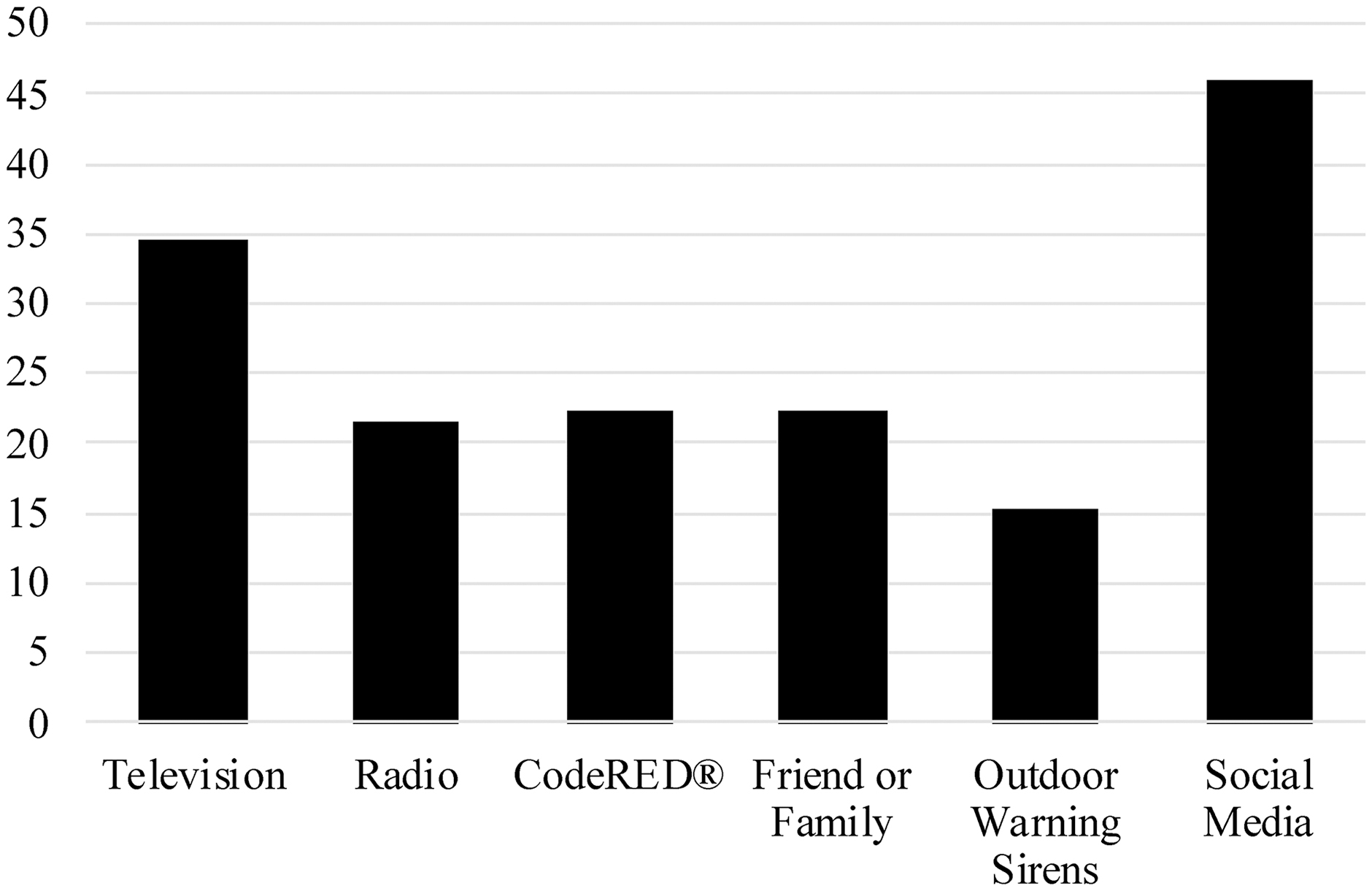
The ways participants received warnings.
In addition to receiving and understanding warnings and specific commands poised to protect public health, individuals need to trust and act on those warnings. The ways in which participants received these commands greatly impacted their willingness to follow through with the instructions and properly shelter-in-place (Table 2). While individuals seemed generally willing to shelter-in-place, those who heard the outdoor sirens were less likely to follow those commands than from any other source. Furthermore, the only significant findings were when individuals received their information from within their own social spheres. An increase in shelter-in-place was shown when individuals heard from family or friends (p-value 0.02) and through social media sources (p-value <0.001).
Multiple Logistic Regression Comparing Individuals Willingness to Follow Commands and Shelter-in-Place by Source of Warning
Statistically significant p-value <0.05.
Discussion
Our cross-sectional study was designed to evaluate where individuals received warning messages from and their resulting willingness to follow instructions following a major anthropogenic hazard in the small city of Deer Park located along the HSC. The findings of this research suggest that individuals are more willing to follow suggested actions, such as SIP, when they receive that information from within their own social sphere (social media and direct contact with friends and family). These results continue a growing body of evidence that local organizations and social networks are significantly more likely to enact needed action from communities, as opposed to official warnings from government or national institutional sources. Several risk communication theories examine how risk is communicated and then acted upon from several perspectives, including how, in the absence of risk knowledge, individuals may engage in protective actions that mirror others, that may help elucidate these findings. 66 , 67 How people cognitively evaluate the magnitude and consequences of a risk, and what characteristics of risks motivate people's choice to engage in protective action need to be better understood and taken into account with proper management of risk communication following natural or anthropogenic hazards.
The strength of this study lies with the clear immediate danger presented by the ITC fire, as well as the rapid acquisition of data performed in this research. Furthermore, partnerships with local organizations and institutions, and their assistance with data collection, ensured that language and cultural boundaries did not pose a problem in receiving quality information. A response rate of 72.6% (127/126), a high proportion within a geographically small city, further demonstrated the interest within the area around environmental health and disaster response issues. This study has several important limitations. Despite the relatively high response rate, a small total number of participants completed the survey, reducing our statistical power and our ability to adjust by multiple confounders. Our data included an overrepresentation of non-Hispanic white respondents and comparison between behavioral difference among race and ethnicity was not included here. This research would have benefited from having comparative information from another impacted neighborhood, which did not have the benefit of predisaster educational outreach programs (such as Wally Wise Guy), to allow for a comparison to evaluate its effect on SIP adherence.
Conclusion
Our findings support and build upon the research that suggests cities need to become part of the information sphere before having a disaster. There is a growing body of evidence calling for the community to be involved with public risk communication efforts. 68 Including local residents and participants in educational and outreach efforts poised at improving adherence to health and safety improves overall outcomes, especially in regard to public health measures. 69 , 70 Furthermore, this has been shown within environmental justice communities located along the petrochemical corridor and the HSC specifically. 71 There is still a need to better understand the role that technology, social media, misinformation, and issues surrounding personal and communal power play in ensuring a proper response to acute critical hazards. Research targeting specific vulnerable groups, such as those older than 65 years, should be completed. A higher priority must be placed on boosting the efficacy of local responses to disaster by focusing on both the role of social capital and the degree of trust and credibility of official sources responsible for risk communication. This is particularly important for disadvantaged, vulnerable socioeconomic communities, where social capital plays a large role and trust in governmental sources is lower. Future research must further explore these connections and findings by performing additional surveys in other minority/majority, vulnerable communities to examine the efficacy of risk communication both before and in response to disasters.
Footnotes
Author Disclosure Statement
No competing financial interests exist.
Funding Information
The National Academies of Sciences Engineering and Medicine. Gulf Coast Early-Career Fellowship Number 2003412.