




Abstract
This article represents the first time that a rigorous evaluation of Environmental Protection Agency's (EPA's) current definition of environmental justice has been undertaken. This is a matter of some significance. Definitions not only reflect the historical understanding of an issue at the moment of formulation but can also affect practice. EPA's 30-year-old definition was actually formulated when its office had the “environmental equity” moniker. Hence, this article addresses the distinctions between equity and justice when examining the definition. In addition, it will speak of the definition's scope. This article concludes with suggested enhancements to the current definition and proposes a new working definition.
Introduction
Heretofore, there has never been a systematic evaluation of the U.S. Environmental Protection Agency's (EPA) definition of environmental justice (EJ). It is time that we do so. Indeed, this is not a trivial matter. EPA's definition of EJ is perhaps the singularly most cited in existence today. Not only have all federal agencies adopted the definition or a variation of it formally, but most the >40 states who have EJ statutes, policies, or programs have done so as well. 1 In the opinion of this author, the definition has shortcomings that can create barriers to sound and productive EJ practice. As interest grows in EJ nationally, the use of this definition will likely proliferate. Among other things, this includes potential codification within the language of proposed legislation at all levels of government. Getting this right sooner rather than later is also not a trivial matter.
It is important to note that the following discussion of EPA's EJ definition reflects the rapidly deepening nature of the understanding of the practice of EJ and the imperative to establish fundamentally sound foundations for its practice. EJ is really a new and emerging area of endeavor, perhaps only some 30 years in the making. Hence, it is an incredibly dynamic area. We are all learning as we grow and mature our practice in ways that establish high-quality foundations for both theory and practice.
EPA's current definition is as follows:
Environmental justice is the fair treatment and meaningful involvement of all people regardless of race, color, national origin, or income, with respect to the development, implementation, and enforcement of environmental laws, regulations, and policies.
2
This definition was developed and codified in 1992 with the establishment of EPA's Office of Environmental Equity. It has two prongs, that is, fair treatment and meaningful involvement. The EPA website goes on to say: “This goal will be achieved when everyone enjoys: (1) The same degree of protection from environmental and health hazards, and (2) Equal access to the decision-making process to have a healthy environment in which to live, learn, and work.” 3 Notably, it was codified before the issuance of President William J. Clinton's Executive Order (E.O.) 12898 on EJ in 1994. 5
This article provides background on the genesis and evolution of this definition, and focuses on three areas:
distinctions between equity and justice concepts in the current EJ definition, implications of the current definition of EJ for EJ practice, and scope of the current definition of EJ.
I conclude by putting forward some proposed enhancement to the definition of EJ.
Environmental Equity Versus EJ
To fully understand the evolution of the EJ program, it would be helpful to familiarize ourselves with several key concepts. The first are the concepts of equality, equity, and justice. Equality generally refers to equal opportunity and the same levels of support for all segments of society. Equity goes a step further and refers to offering varying levels of support depending upon need to achieve greater fairness of outcomes. Justice refers to the elimination of systemic barriers. These concepts are lucidly illustrated in Figure 1. 5
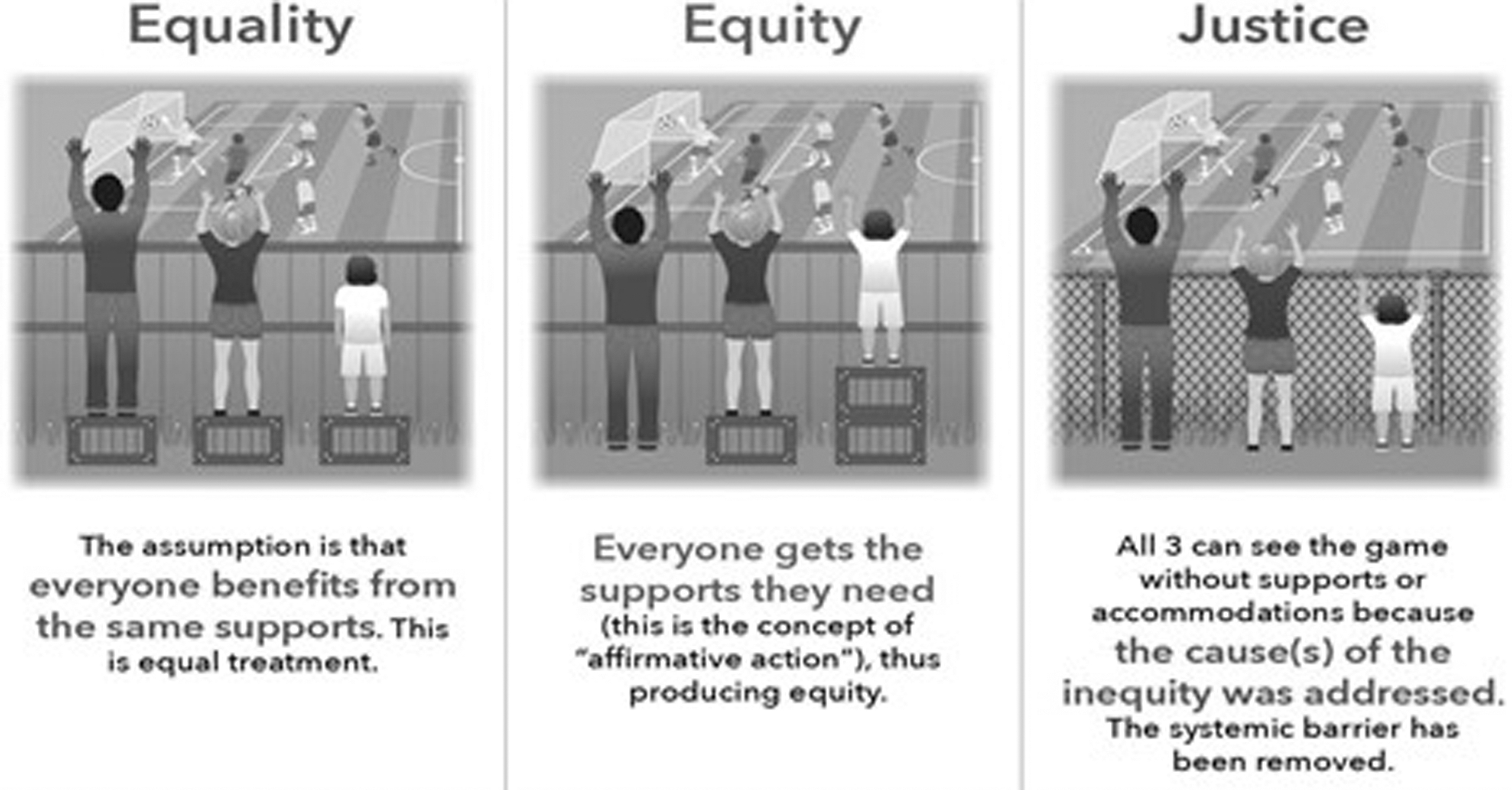
Distinctions between equality, equity, and justice. Source: MobilizeGreen.org. 4
The first question that these distinctions bring to mind is: How has the EJ movement historically addressed the distinctions between equity and justice? It should be recognized that the current definition of EJ was formulated in 1992, when EPA's Office of Environmental Equity was established. In the early 1990s, a debate raged regarding the concepts of environmental equity and EJ. EJ movement advocates, then and now, have always pushed for a “justice” lens. This has been an ongoing sentiment, expressed through positions on issues such as the precautionary principle, cumulative impacts, pollution prevention, shifting the burden of proof, and addressing disproportionate impacts.
In 1994, the Clinton Administration changed the name to the Office of Environmental Justice. However, none of the underlying definitions was changed and they continue in place through the present. In many respects, EPA's EJ definition is an equity one and the same ideas still pervade throughout its ongoing work. We now discuss its implications for EJ practice.
Implications for EJ Practice
The confusion between equity and justice is compounded by the concurrent need to account for disproportionate impacts. This section discusses the implications of these concepts for EJ practice. E.O. 12898's most important phrase is the call for each federal agency “to identify and address, as appropriate, the disproportionately high and adverse environmental and human health effects of its programs on minority populations and low-income populations.” As indicated earlier, the codification of the current EJ definition took place before the formulation of the disproportionate impacts concept. Moreover, E.O. 12898 never defines disproportionate, and this gap remains a major conundrum for EJ practice both at the federal level and beyond. In fact, it is a term rarely used in agency documents, with terms such as “communities with EJ concerns” or “overburdened communities” generally being used as substitutes. A thorough discussion of this subject is provided in my article on “Confronting Disproportionate Impacts and Systemic Racism in Environmental Policy.” 6
E.O. 12898 also never addressed the issue of how “disproportionately high and adverse effects” were to be addressed. To address this gap, President Clinton issued a memorandum accompanying E.O. 12898 directing federal agencies to use environmental and civil rights laws to address these effects. 7 In 1996, the National Environmental Justice Advisory Council, largely at the impetus of Professor Richard Lazarus, provided a set of recommendations about the use of environmental laws to address EJ issues. In January 2000, a scaled down version of a legal opinion on the subject was issued by former EPA General Counsel Gary Guzy at the end of the Clinton Administration. 8 It was not until 2011 that General Counsel Scott Fulton, under the Obama Administration, issued the Plan EJ 2014 Legal Tools document. 9 This represented the definitive comprehensive opinion on ways that EPA programs in all media can use environmental statutes to address EJ issues.
Scholarship by EJ researchers in the area of taxonomies and definitional elements of EJ is also another good resource for understanding the implications for EJ practice. Ana Baptista advanced the idea of “structural justice” in her PhD thesis on state agency (and federal) EJ practice. 10
Baptista's work focuses on integration of EJ within state agencies. She is a scholar with roots in community activism, who conducted her scholarly research subsequent to and concurrent with her community activism and policy advocacy. Hence, her analysis is enhanced by her broad understanding of community perspectives as well as her own efforts to advance EJ practice. Among other things, “Just Policies?” makes two major contributions.
The first is the observation that virtually all EJ practice in government agencies has stagnated at the point of procedural justice. In essence, the default approach to addressing EJ concerns is to conduct more public participation. Over time, this invariably devolves into pro-forma box-checking exercises—more public meetings, but no changes in outcomes…
Baptista's second major contribution is articulating the concept of structural justice. Her discussion is framed through the lens of a taxonomy of key elements of EJ. In “A Taxonomy of Environmental Justice,” Robert Kuehn posited four elements: procedural, distributive, compensatory, and social justice. David Schlosberg added recognitional justice, which speaks to the social norms, language, and mores that mediate our relations with those who are denigrated and less well off. To these, Baptista added structural justice, a concept which is deeply rooted in issues of race and the structural processes that perpetuate racism through government decisions and interactions with people of color communities.
If the goal is to address EJ in terms of systemic and structural issues of inequity in U.S. society, we are definitely falling short. Virtually all EJ practice has been confined to the procedural justice element, with EJ defined as solely consisting of more community involvement. This is inevitable if there is no understanding of the substantive core of such concerns speaking to the need for a systematic and rigorous way to operationalize the concept of disproportionate impacts. 11
Baptista's study insightfully pointed out the limitations of government agency practice in that most practice stops at the point of procedural efforts, consisting of additional public participation in the main.
We can now see the confluence of real-life practice and definitional understandings of EPA's current definition of EJ. Figure 2 shows the definitions of the terms “fair treatment” and “meaningful involvement” that are currently displayed on the EPA website. 12
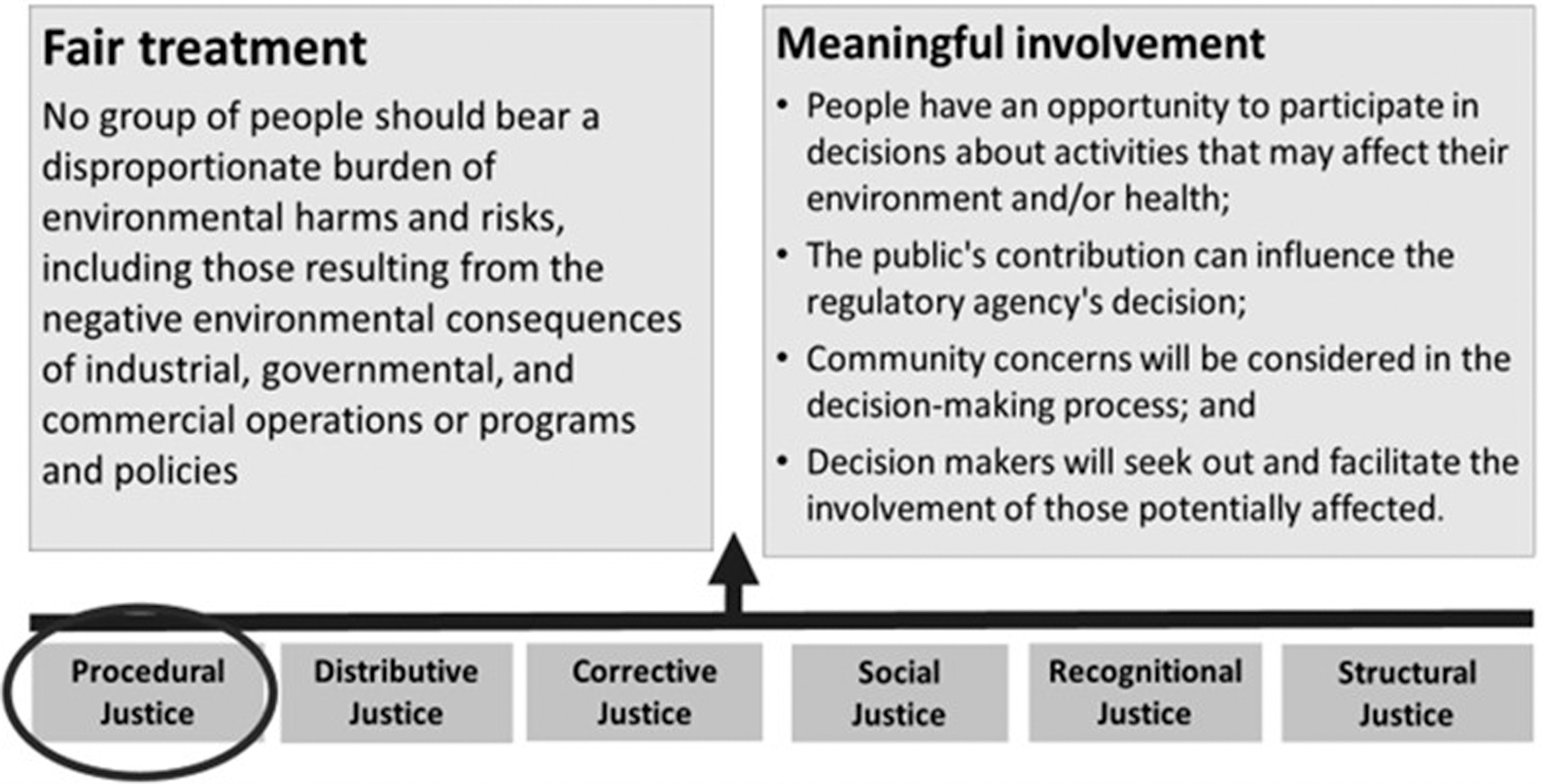
The imbalance in understanding and implementing fair treatment versus meaningful involvement.
First, the definition of fair treatment is actually incorrect from a justice perspective. Most EJ advocates and community members will vociferously differ with the idea that EJ is achieved when “no group of people should bear a disproportionate share of the negative environmental consequences resulting from industrial, governmental and commercial operations or policies.” EJ integration is not merely about equalizing the burden of environmental harm. What if there is a harm that EPA or another government agency decides not to address, and everyone is harmed equally? Does that mean that the EJ practitioner believes the problem is sufficiently addressed? What if the policy or decision results in the distribution of benefits? What about addressing the accumulated harms of the past that are primarily concentrated in the same communities? A justice perspective means the prevention and mitigation of environmental harm, identifying and addressing policies and practices that contribute to disproportionate impacts, and the elimination of systemic barriers to health and sustainable communities for all people.
Second, there is a gross imbalance between the detail by which meaningful involvement is discussed as compared with the generally vague discussion of fair treatment. The red circle highlighting the procedural justice element is meant to illustrate Baptista's conclusion that current EJ practice by government agencies has mostly stagnated at that juncture. An important context for this discussion is my goal of diagnosing and offering a pathway for overcoming that stagnation. To do so requires correcting the imbalance in the conceptualization and practice of EJ that has reduced it to community involvement only. Not only has conducting more public participation been the default approach to addressing EJ concerns, most practitioners, including government officials, actually define EJ practice as consisting of public participation only. Moreover, most EJ practitioners find it difficult to explain what it means to move beyond mere meaningful involvement into effectively achieving fair treatment.
Although both fair treatment and meaningful involvement are fundamental and must be implemented concurrently, not understanding how to identify, characterize, and integrate disproportionate impacts has essentially left the EJ practitioner rudderless. As a result, most EJ practitioners have been operating without an analytical framework to guide how they will assess and act upon what they have heard during the community involvement process. Without such an analytical framework, one will never fully implement the items delineated in the definition of meaningful involvement. Essentially, EJ practice has stagnated at the point of doing more community outreach but is unable to know how to assess and act on what is heard in the process. The default response for EJ issues has devolved into a perfunctory “box to be checked” exercise. 13
Finally, equity should be an important goal within the definition of EJ. This involves the provision of greater attention and resources to areas of EJ concern. On the federal level, consideration of EJ as one factor for targeting compliance monitoring is low hanging fruit for incorporating equity when addressing disproportionate impacts in the regulatory arena. EPA's Office of Enforcement and Compliance Assurance did this in the context of a comprehensive approach that considers EJ concerns at every stage of the enforcement and compliance life cycle, from setting priorities and planning investigations to resolving enforcement actions. 14
Recent developments in state practice have begun to demonstrate the power of this approach in the area of resource allocation. In 2012, California enacted Senate Bill 535, which mandated that 25% of the state's Greenhouse Gas Reduction Fund benefits disadvantaged communities. This has amounted to billions of dollars. 15 As of 2019, total proceeds from the Greenhouse Gas Reduction Fund amounted to $12.4 billion, of which at least 25% has benefited disadvantaged communities. Illinois passed the Future Energy Jobs Act and directed the Solar for All program to also allocate 25% of funding to “environmental justice communities.” New York's Climate Leadership and Community Protection Act mandated 40% of the renewable energy program to benefit communities with EJ concerns. Another important action is California's Safe and Affordable Drinking Water Fund, which allocated $130 million during FY2020–2021 to help implement the Human Right to Water. 16
Before moving on to discussing the scope issue, I want to highlight Jill Harrison's groundbreaking research in her book From the Inside Out: The Fight for Environmental Justice within Government Agencies.
Harrison's work stands out as a truly groundbreaking piece of social science scholarship on EJ practice within government agencies. Nearly a decade of research on the inner workings of EJ interactions within federal and state agencies formed the basis for the book. Such analysis of the “interactive dynamics among agency staff” had received no attention previously in the EJ literature. Environmental agencies were generally characterized as “black boxes,” opaque to outsiders and devoid of any sense of the actual narratives shaping deliberation on issues. Thus, From the Inside Out can also be described as a work that pierced the veil and illuminated actual agency thought processes. Because she captured key discursive elements of real-life narratives, Harrison provides a body of information that is both rich and authentic. 17
Utilizing and building on Harrison's methodology, future research could explicate the thinking processes between the larger definitional understanding of EJ and how it gets carried out in policy and program implementation, all of which would be part of the next generation of EJ practice envisioned in my “Confronting Disproportionate Impacts and Systemic Racism in Environmental Policy” article.
Scope of the Definition of EJ
I now address the issue of the phrase “development, implementation and enforcement of environmental laws, regulations and policies.” The current “environmental” frame being applied is likely to be interpreted as the major statutes that govern EPA. However, the actions of all agencies, as well as the laws governing them, affect the environment and public health. From decades of practice, we have seen the resistance or inability of other federal agencies to embrace EJ as part of their mission. Perhaps a broader articulation of what EJ is, reflected in key legislative and policy documents, can move us in the correct direction. Hence, my formulation would be “laws, regulations and policies that affect the environment and/or public health.”
Again, this is not a trivial matter. A critical and necessary step toward creating truly healthy, sustainable, and equitable communities is making sure that all government agencies see the distribution of environmental benefits and burdens as an important part of their mission. Nowhere is this need more evident than the multifaceted issues related to the disproportionate impact of the coronavirus disease 2019 pandemic on people of color, low-income, and indigenous communities. Heretofore, federal agencies largely interpreted EJ to be issues they will address through reviews pursuant to the National Environmental Policy Act or Title VI of the Civil Rights Act of 1964. In fact, they do not see EJ as an integral part of their mission. I am reminded of the instance of a former director of the Centers of Disease Control, when responding to the question of how the agency should address EJ, said that “environmental justice is EPA's issue.” However, that and other agencies' work exerts immensely powerful influence on the ways in which environmental benefits and burdens are created, organized, perpetuated, or experienced in society. In 2019, the Governmental Accountability Office (GAO) made recommendations for federal agencies to develop strategic plans for EJ. 18 If federal agencies are going to carry out GAO's recommendations in a truly meaningful way, they need to articulate what EJ means in the conduct of their core missions. Changing the scope of the EJ definition to “laws, regulations, and policies that affect the environment and/or public health” can initiate meaningful conversations about how to do so.
Conclusion: Proposed Enhancements to the Definition of EJ
I conclude this article with some proposed enhancements to the definition of EJ, based on several decades of practice and assessment of positive and negative aspects of that practice. The proposed new working definition begins to utilize the core concepts discussed in this article, including those related to both equity and justice.
The fair treatment and meaningful involvement of all people regardless of race, color, national origin, or income with respect to the development, implementation, and enforcement of laws, regulations and policies that affect the environment and/or public health. Environmental justice strives to ensure the equitable and just distribution of resources and benefits in a manner that prioritizes communities experiencing the greatest inequities, disproportionate impacts, and unmet needs. It also strives to prevent and mitigate environmental harms and burdens, identify and address policies and practices contributing to disproportionate impacts, and eliminate systemic barriers to the achievement of healthy and sustainable communities for all people.
I am humbly putting forward these suggestions for enhancing the definition of EJ in hopes of stimulating a systematic examination and discourse on this issue. As I noted, achieving a deeper understanding of the definition of EJ can have important implications for EJ practice and is not a trivial matter.
Footnotes
Author's Note
A true pioneer in the arena of environmental justice, Charles Lee was the principal author of the landmark report Toxic Wastes and Race in the United States, organized the First National People of Color Environmental Leadership Summit, and helped to spearhead the emergence of EJ federal policy. The author is currently the Senior Policy Advisor for Environmental Justice at the U.S. Environmental Protection Agency. The ideas put forth in this article are the author's own. They do not represent the views of the EPA or any agency in the federal government, and no such representation should be inferred.
Author Disclosure Statement
No competing financial interests exist.
Funding Information
No funding was received for this article.