




Abstract
The expanding reach of urban greening across the United States and beyond often materially and immaterially impacts communities of color, leading to displacement and decreased access to new urban amenities. While many scholars point to the persistence of racial inequality, we observe the urban greening orthodoxy in urban planning and development as evidencing a deeper strain of environmental injustice bound up in the legacy and continuance of White supremacy. In this article, following the prompts of the Black Lives Matter Movement to enact life-affirming Black geographies, we call for decolonizing the green city and for an emancipatory spatial imaginary to enact green justice. Reflecting on the development of the 11th Street Bridge Park in the predominantly Black Anacostia neighborhood in Southeast, Washington, DC, we ask how urban greening can enact a more emancipatory green justice. We use this case example to trace the contours and constraints of current greening and equity logics and practices and contend that decolonization and emancipation fundamentally require new spatial planning practices. While the green project is deployed as an “intentional” equity-centered infrastructure, it is limited in its ability to embrace multiple forms of land recognition, redistribution, control, and reparations and to develop green practices that engage with the history of a multilayered geography of dispossession and include cultural and symbolic recognitions of networks of resilience and care. We thus argue for a more emancipatory spatial imaginary in urban planning that more directly confronts White supremacist forms of dispossession, centers resistance to anti-Blackness, and articulates a geography of reparations through decolonizing settlement patterns at multiple geographical scales.
Introduction
Since 2013, the Black Lives Matter (BLM) Movement has made “ideological and political intervention[s] in a world where Black lives are systematically and intentionally targeted for demise.” 1 While BLMs interventions draw attention to the brutality of ongoing police violence against Black bodies, as a movement it also directs our attention to how this violence undergirds racial/spatial formation, 2 , 3 the ongoing lives of plantation logics (that is, the perduring exploitation, devaluation, and disenfranchisement of Black communities and bodies), 4 , 5 and the broader environmental risks faced by Black residents. 6 None of this of course is a new reality, and both BLM and environmental justice movements draw on the long history of anti-racist, abolitionist, and civil rights organizing that has exposed and resisted the expansion of racial capitalism as the founding directive of the United States. In this article, we connect the historical lineage of liberation movements with the current moment of environmental injustice, racialized displacement, and aesthetic placemaking 7 , 8 , 9 , 10 to critically engage the potential links between the BLM Movement and an emancipatory green justice, with the prospect for reparative, just Black landscapes that “respond to the needs of” Black folks' “lives, their communities, their families.” 11 (p. 23)
A decade ago, Park and Pellow clearly demonstrated how racially exclusive practices firmly ground environmental privilege through local policies and planning decisions. 12 Their work opened up new scholarly pathways for identifying inequities in green space benefits and demonstrated the racialized dimensions of access to nature, which are fundamentally shaped by the de-valuation, invisibilization, and exploitation of non-White landscapes and the unquestioned Whiteness of policy and planning. Further scholarship has shown how capital accumulation is bound up in urban greening interventions that are made possible by processes of land devaluation and green rent gaps, 13 , 14 green dispossession and accumulation, 15 green exclusion, 16 and green gentrification and displacement. 17 , 18 Recent urban re-naturing projects, including New York City's High Line park, Chicago's 606 rail-to-trail park, San Francisco's redevelopment of Hunters Point, or East Boston's green and resilient waterfront, demonstrate the fraught nature of urban greening within larger racialized contexts and within development agendas that have yet to fully confront, much less attend to, the deeply racialized nature of development in the United States.
Indeed, the expanding reach of the “green turn,” 19 , 20 as underpinned by alliances among municipal planners, elected officials, and private real estate developers, often occurs at the expense of racialized minorities' right to place. 21 , 22 , 23 Thus, access to green amenities often comes to be perceived as undesirable for low-income minorities, what some have called Green Locally Unwanted Land Uses, 24 who are often faced with the conundrum of accepting possibly unjust greening or living with untouched gray landscapes (when not with both). 25 For instance, if left uncoupled with ambitious affordable housing or inclusionary zoning goals, less affluent Black and Brown residents are forced to choose between greening investments and its linked potential of displacement versus continued lack of access to green amenities. While many rightly point to how this binary constrains communities of color in persistent traps, 26 we also observe this as evidencing a deeper strain of White supremacy and its current binds with development and greening.
Yet, this green planning orthodoxy is also increasingly met by civic resistance and mobilization to enact more just green futures. Here, housing justice groups, environmental justice organizations, and residents are organizing for more inclusive, community-centered alternatives, putting anti-racism, anti-gentrification, and anti-displacement at the center of their action. 27 , 28 Most recently, voices for more radical alternatives—both in academia and in civic practice—have emerged at the intersection of racial justice and housing and land rights. In this article, we analyze the confluence of greening anchored around justice and claims for more emancipatory, green justice illustrated through the lens of the Washington, DCs 11th Street Bridge Park project in the predominately African American Anacostia, a neighborhood of Southeast, DC. Our analysis draws on ongoing research in Washington, DC, including 30 semi-structured interviews conducted in 2019 and 2020 with neighborhood residents, community activists, and local nonprofits, and asks: How can urban greening enact a more emancipatory green justice? The materials, arguments, and quotes presented below are directly building on these interviews, their thematic coding, and their further analysis.
This article offers both some theoretical reflections around a more radical, emancipatory green justice and empirical analysis. We argue that environmental justice in urban greening is not only about more equitable green access or benefits, 29 , 30 , 31 it also requires emancipatory green justice, 32 that is, acknowledging and addressing the racialized repercussions of such projects and the ongoing ways that Whiteness is implicated in this orthodoxy. By putting the BLM Movement in conversation with environmental justice and urban planning, we argue for an emancipatory green justice and an associated spatial imaginary that (1) confront White supremacist forms of dispossession (historical and ongoing), (2) center resistance to anti-Blackness, 33 and (3) articulate a geography of reparations, 34 including material and immaterial green reparations 35 through decolonizing settlement patterns at multiple geographical scales. We situate our arguments both within the resistant histories of Black place-making 36 and this particular political moment, exploring how one case illuminates the progress achieved and the work left to do. In other words, we echo how Du Bois' conceptualization of double consciousness is both a critique of White supremacy and a vision for centering anti-racism as spatial praxis with material and symbolic dimensions and repercussions. 37 , 38 , 39
Racialization and Dispossession in Re-Naturing Cities
Recent justice debates around urban greening highlight the multiple dimensions of displacement, including housing loss and social–cultural erasure. We know that those who experience racial and economic inequality are the first to be displaced by luxury real estate developments accompanying greening and/or by higher rental costs in their greener neighborhoods. 40 , 41 , 42 , 43 , 44 Furthermore, municipal and private greening interventions can flatten racial landscapes, undermining residents' sense of belonging in nature and their neighborhood and (re)producing erasure and trauma through sociocultural and emotional loss. 45 , 46 , 47 , 48
Exclusion and dispossessions can also materialize when urban greening overlooks Black residents' experiences in what have been and are violent, discriminatory and segregationist landscapes. 49 , 50 , 51 , 52 In particular, the BLM Movement and scholars such as Pellow, 53 Rios 54 , and Shabazz 55 direct our attention to the surveillance, criminalization, and coercion of Black bodies in public space and the compounding life threats and risks of environmental harms, what Ranganathan 56 has referred to as “environmental unfreedoms.” 57 More recent spatial esthetic and design interventions 58 , 59 or the exclusion of cultural and artistic practices 60 within previously disinvested neighborhoods and/or communities of color 61 are their own forms of violence, which can not only undermine equitable access to nature but also codify its use within what Lipsitz calls a White spatial imaginary. 62
Together, these experiences highlight Du Bois' insights regarding the spatial hegemony of Whiteness and what Brand calls the “spatial impacts of racial oppression” and the “locally contextualized racial processes.” 63 Importantly, recent scholarship argues that urban greening is increasingly representative of the socio-spatial practices of White supremacism 64 , 65 and settler colonialism, including land grabbing, frontier-driven value capture, landscape conversion, and exclusion of non-White land practices. 66 , 67 , 68 Previously forgotten Black landscapes in places such as Dallas (West Dallas), New Orleans (Tremé), San Francisco (Hunters Point), and Washington, DC (Anacostia) suddenly acquire value for planners and developers aiming to create new green ventures and build luxury homes next to restored waterfronts, greenways, multipurpose parks, and so-called resilient shorelines.
Although profit is accrued by injecting economic and financial value to previously “invisible” land and landscapes, as Black communities become ideal sites for greening, the projects behind that “green vision” simultaneously overlook the racialized histories on site while also cashing in on Black culture. 69 , 70 , 71 In other instances, community-centered green spaces, such as informal gardens or temporary green spaces, are made undesirable. 72 , 73 Seemingly contradictory, both dimensions are critical to understanding how the BLM Movement is instrumental to deepening environmental and racial justice claims within urban planning and policy making, particularly as it attends to the historical and current spatialities of anti-Blackness. We suggest, however, that the material and immaterial dimensions of Black landscapes—their histories of contamination, dis- and underinvestment, violence and exclusion and their practices of contestation of new (green) developments—offer a liberatory and emancipatory imagination as well as a deep critique of the contemporary experiences and spatial practices of White supremacy.
Constructing Radical Green Alternatives: Anti-Subordination and Emancipatory Greening
Building on the recent literature in emancipatory greening, we articulate a broader proposal for how new greening practices can (1) question these experiences of domination, subordination, racial stratification, dispossession, and oppression (and the institutions around them); (2) articulate and build emancipatory spaces, geographical formations at the intersection of land, resources, and nature; and (3) propose new institutional arrangements, sociocultural practices, and policies controlled by historically marginalized groups (Fig. 1). 74 , 75 This proposal fundamentally moves away from the ongoing “afterlives” of slavery 76 or what McKittrick 77 calls “plantation futures” to realize a “Black sense of place.” Of fundamental importance is that a more just green city cannot materialize without ensuring prosperity, well-being, and security for racialized minorities 78 and without transforming urban land from a site of private wealth accumulation for a few to a site of shelter, care, and prosperity for those who have suffered from White supremacy.
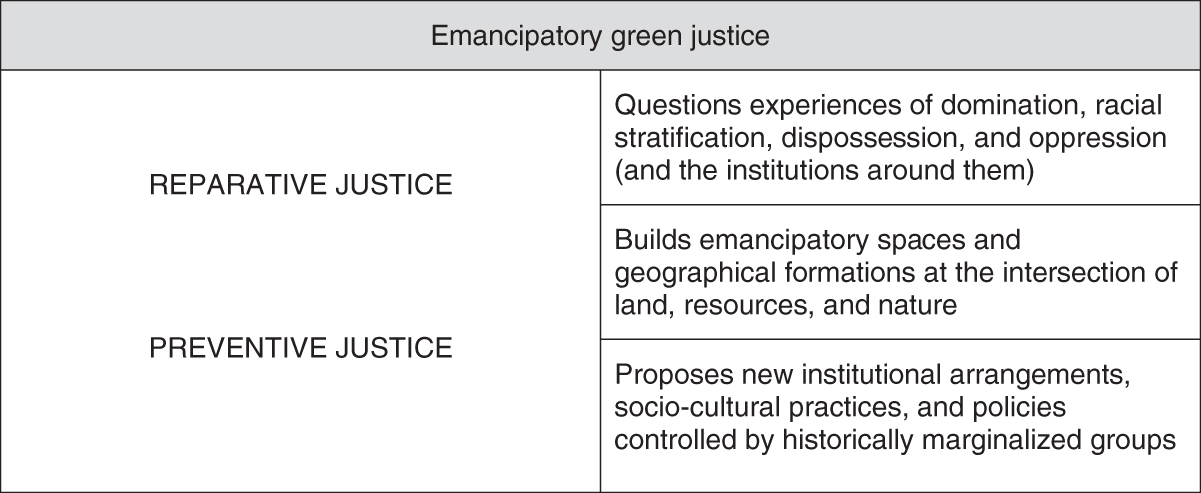
Pathways towards emancipatory green justice.
Such an emancipatory pathway requires reparative (or restorative) justice lenses to ensure that green interventions openly acknowledge and address histories and geographies of oppression and exclusion through healing and spaces of refuge. 79 , 80 , 81 ,82 In relation to the environment of cities in particular, we refer here to historic environmental harm, such as legacy pollution, land dereliction, and institutional neglect. 83 In that process, critical researchers and green planners have a role in exposing the racial and social formations of undervalued, gray, and unsafe landscapes and uncovering the historic production of precarity and trauma. 84 Relatedly, emancipatory greening requires reparations for those whose land has been stripped away, exploited, and re-captured through cycles of investment, de-investment, and re-investment. 85 It must also allow for mechanisms that will redistribute land for vulnerable residents to help them economically secure sustainable homes and communities. 86 , 87
Last, preventive justice is also a base for guaranteeing emancipatory green justice. What we mean here by preventive justice is that urban greening should include the support of practices that prevent or reduce risk of harm—present and future, 88 and recognize that racialized minorities face differentiated and compounding risks in view of environmental bads (climate risks, inaccessible greening, and violence in public space) in comparison with privileged groups. 89 Preventive justice should also protect racialized minorities against the frequent coercion and criminalization of their practices and behaviors in ways that inform just green design solutions and policies—as BLM demand. 90
With all these principles and values explicated, we now analyze below how they might materialize in practice. We question whether urban greening comes close to building radical just and green alternatives, even when projects or interventions claim to center environmental equity and justice. We assess and reflect on what emblematic green and equity-focused interventions such as Washington, DCs 11th Street Bridge Park project tell us about the possibility of an emancipatory green practice.
The 11th Street Bridge Park in Washington: An “Intentional” Equity-Centered Green Project
Anacostia, in Southeast Washington, DC, has been the home of African American residents almost since the foundation of the city. It was a plantation during the eighteenth and nineteenth centuries before becoming the first African American settlement of freedmen after 1867. It was also a thriving business community before being impacted by urban renewal demolitions in 1954 that scarred Southwest, DC, and relocated African American residents to Anacostia. 91 Many Black residents were forced to move to concentrated public housing units, including in the 444-unit public development known as Barry Farm. In the 1970s and 1980s, many Black working-class families also lived in subsidized rental units for working-class residents built throughout Southeast. 92 The social cost of housing segregation and urban renewal became quickly rampant with the highest poverty rates in the District of Columbia (33% in 2015). 93 Today, despite soaring gentrification and social inequality through Washington, DC, 94 , 95 the population of Southeast, which includes Historic Anacostia, is still 95% African American. 96
In 2014, after decades of social and racial stigma, local and national attention came to Anacostia when the New York City-based architecture firm OMA revealed its “avant-garde” design for a $50–$60 million green bridge meant to improve physical and social connections between the two sides of the Anacostia River while offering new recreational and green spaces to both communities. While the project brings together public (i.e., Anacostia Waterfront Initiative), private (i.e., Capitol Riverfront BID), and nonprofit (i.e., Anacostia Watershed Society) actors that have been active since the 2000s in the revitalization of the lineal Anacostia park and the cleanup of the Anacostia River, the project is touted as a strong nonprofit equity-driven initiative. 97 It is by no means meant to reproduce the green gentrification and displacement that the New York High Line or the Atlanta Beltline have triggered (Fig. 2). 98 , 99

Current state of the 11th Street Bridge and renderings of the future project.
First, the 11th Street Bridge Park's main social equity backbone is its 2018 Equitable Development Plan (EDP) 100 developed after what the nonprofit organization behind it, Building Bridges Across the River, characterized as a comprehensive and resident-driven planning process in which all stakeholders were “intentional” in building an equity-driven project. As a result, the project includes resident-centered workforce training and development as well as support to local businesses to promote the revival of the business corridors adjacent to the Bridge Park (including Martin Luther King Jr. Avenue). It privileges creating Black-centered economic opportunities for both working-class and middle-class residents. Those efforts reflect the need for new green assets to be strongly associated with resident-centered economic development and income-generating ventures to achieve environmental justice for racialized minorities. 101
Second, the EDP is built around the creation of the Douglass Community Land Trust (CLT) and community-controlled housing and business development. This model includes the construction of affordable housing through the nonprofit purchase of existing land and buildings as well as technical help and training toward Black homeownership. The CLT uses, among others, the provisions of the city's Tenant Opportunity to Purchase Act (TOPA) and District Opportunity to Purchase Act (DOPA), legislations and builds partnerships with local lenders and nonprofit developers (i.e., MANNA and Local Initiatives Support Corporation) for down payment assistance. TOPA helps renters to buy their building and have their purchasing offer prioritized over external ones, whereas DOPA provides the District of Columbia with the opportunity to purchase buildings of five or more rental units, as long as 25% or more of those rental units are deemed as “affordable.” 102 Through a partnership with MANNA, the EDP has also initiated a home-buyer's club, as a peer support group and a homeownership counseling program, to allow African American residents to become homeowners (only 20% of all homes today are owned by residents). Last, part of the CLT aims to designate 250–350 units to preserve affordable rental housing for residents in the 30%–50% area median income range. Just in the last 3 to 4 years, Building Bridges Across the River has secured $54 million of funding toward those programs and others linked to environmental education, the arts, and culture.
Overall, the CLT aims at preventing displacement from gentrification, ensuring permanent affordability by guaranteeing that housing subsidies remain within homes, and building some home equity for families. All in all, Building Bridges Across the River is capitalizing upon the esthetical, environmental, and recreational attractiveness of the 11th Street Bridge Park proposal to steer financial resources to Anacostia and realize its CLT model.
Enacting Radical Green Justice in Anacostia
The limits of intentionality and unfinished redistribution
While equitably generous compared to other U.S. green city projects, the DC 11th Street Bridge Park project is perceived as limited due to its enactment of emancipatory green justice. Residents and housing justice groups in our interviews highlighted that the CLT model plays some role in building financial equity and, in turn, potential class mobility, but they also noted its shortcomings. For instance, in the CLT model, residents do not own both their homes and the land. With an interracial and intergenerational wealth gap that has further grown over the past decades in the United States—the median White families are projected to own 86 times more wealth than Black families over the next 5 years, 103 —owning both land and homes as a community and family asset is central to addressing the magnitude of this gap. Moreover, interviewees reported that the number and pace of units acquired by the CLT to keep them under permanent affordability are lower than the rate of displacement. Critics also point at the relatively small number of families who might be able to afford a mortgage for a home held by the land trust. The CLT is still embedded in market-based land and housing acquisition logics that respond to complex real estate, finance, redevelopment, and administrative constraints and slow in its execution, whereas private real estate developers, in the meantime time, flip homes and redevelop land much more easily throughout the community. Another challenge for the CLT management and for broader anti-displacement work is the expiration of low-income housing tax credit units and other subsidized housing units to help working-class residents stay in place, which interviewees regretted. The main point here is that the dispossession process is underway in Anacostia, and the CLT is a relatively small intervention in the big sea of gentrification and displacement in Washington, DC.
The bridge park project—and some of the CLT—is also funded by White financial institutions, including banks such as JP/Morgan Chase, which do not fundamentally change who holds economic power in Southeast. Furthermore, Anacostia is home to a $60.8 million Tax Increment Financing project, in theory aimed at funding redevelopment in “emerging neighborhoods” 104 but broadly hailed as a gentrification instrument that privileges high-end development and developers' interests, 105 , 106 , 107 as the much criticized Reunion Square project in Historic Anacostia illustrates. The city's Ward 8 political district, where Anacostia is located, is also hosting two other major development projects with strong displacement “potential,” especially through green gentrification: the mixed-use commercial and residential complex at St. Elizabeth's and a pedestrian and transit-oriented mixed-use redevelopment, Poplar Point, which will feature a new 70-acre park and bike lanes, but will only set aside 10% of units for affordable housing.
A smaller neighborhood development that has nonetheless triggered much debate about its role in gentrification is the Busboys and Poets café (opened in March 2019), a local chain restaurant and bookstore featuring African American food, art, and literature, which is also supporting the 11th Street project. A local resident and activist explained: “Busboys was getting a pass because they do a lot of work around culture as far as, you know like pictures of Ghandi on the wall and they do a lot of stuff around activism and social justice so it looks like it's bringing culture but everywhere Busboys opens up gentrification comes behind.” While a new place such as Busboys offers new social gathering spaces for residents, the food is not affordable to many in Anacostia. A housing organizer explicated how when the initial Busboys was started in a once Black community that eventually gentrified, it was frequently for the first 5 years by “majority blacks, but then who is there now [mostly white customers]?” Some Anacostia residents fear the Bridge Park, the Busboys chain restaurant, and new housing developments signal that their time in this African American neighborhood is limited.
Some residents and housing activists also regret that the 11th Street Bridge Park plays a role in “activating” the commodification of greenness and diversity together, and the profit-driven consumption of race and ethnicity through new cool retail and restaurants (even if those, such as Busboys and Poets, embody Black achievement). 108 The bridge project might thus be facilitating a new green dispossession and displacement frontier, materialized by the words of developers (Interviews 2019) projecting their vision for the Eastern side of the river as a “destination for residents from across the city” and their goal of “go[ing] in early to emerging neighborhoods […] ready for redevelopment and to buy property and redevelop it and re-tenant it.” In Anacostia, housing prices are also likely to exclude a sizable proportion of African American families given that median sale prices have multiplied by 2.5 between 2014 and 2018. 109 Overall, critics of the bridge argue that the new green and gray infrastructure physically paves the way for and financially legitimize such private developments in the neighborhood and for future green gentrification. Enacting the green bridge does to some extent reflect what Du Bois first advanced as a liberal egalitarian model, 110 and which he later critiqued: a limited and unfinished redistribution of greening, financial resources, and home and land ownership throughout Washington, DC.
For a radical, emancipatory green justice
In response to or as alternatives to more limited social equity, local groups are articulating more radical, emancipatory principles and intersectional actions for urban justice, including making connections between health, housing, policing, and the environment. For example, self-identified radical housing organizations such as Organizing Neighborhood Equity (ONE DC) aim to “exercise political strength to create and preserve racial and economic equity” and build new institutional arrangements. They follow the participatory democracy goals and principles of civil and human rights activist Ella Jo Baker, with a radical vision for “addressing structural causes of poverty and injustice, an orientation that stemmed from deep analysis of race, power, and the economic, political, and social forces.” 111 In practice, throughout DC and in Anacostia as well, ONE DC uses direct action to organize with tenants and resist landlords' and developers' displacement tactics, and convert tenant buildings into cooperatives, as a ONE DC organizer once shared in an interview (2019). One such project is the Black Workers and Wellness Center in Anacostia, an incubator for alternatives to low-paid employment via worker cooperatives, collectives, and small businesses created, owned, and operated by Black workers. 112 It is a place to build political power by discussing the intersection of place of race and work and improved working conditions and benefits for Black residents. Other residents are asking for more worker-owned businesses and development “from the inside, as a local organizer articulates”: “If you want to bring Busboys to this area make it a worker-owned center, you know about inclusive development, do development that's going to develop the community and not just buildings and not just, you know really work from the inside out […]. We can be running the businesses, we could be building the homes, we could be keeping the place up, it could be a city within a city, just like Black Wall Street back in the day.” Such initiatives and claims do not undermine the role of the CLT, yet further build out the political organizing of residents and propose new institutional and economic arrangements for political power.
Other civic actions for an emancipatory green justice include those that can secure a right to place (to stay and return) and land reparations for African Americans. Here, the lawsuit filed in 2018 by Attorney Aristotle “Ari” Theresa aims to guarantee residents' right to return as part of the current redevelopment of the Barry Farm public housing complex into a mixed-use, mixed-income transit-oriented development, which is anchored around open space, new public infrastructure, and recreation areas. 113 The $1 billion lawsuit also demands that there is sufficient housing and large units to house future and former tenants with children. The plaintiffs protest against the elimination of 163 two- to six-bedroom units, which results in what they see as discrimination against residents' family status and the exclusion of 150 former Barry Farm families who will be unable to return to the property once the redevelopment project is inaugurated. Last, Theresa has also included a reparation claim for gentrified and pushed out Anacostia residents by arguing that “Barry Farm residents were injured 'cause they were getting pushed out, they were injured cause they were living in horrible conditions and the idea is to get them some kind of remedy. […] People were displaced. Barry Farm just was like the most egregious example of everything wrong with zoning” (Interview 2019) (Fig. 3).
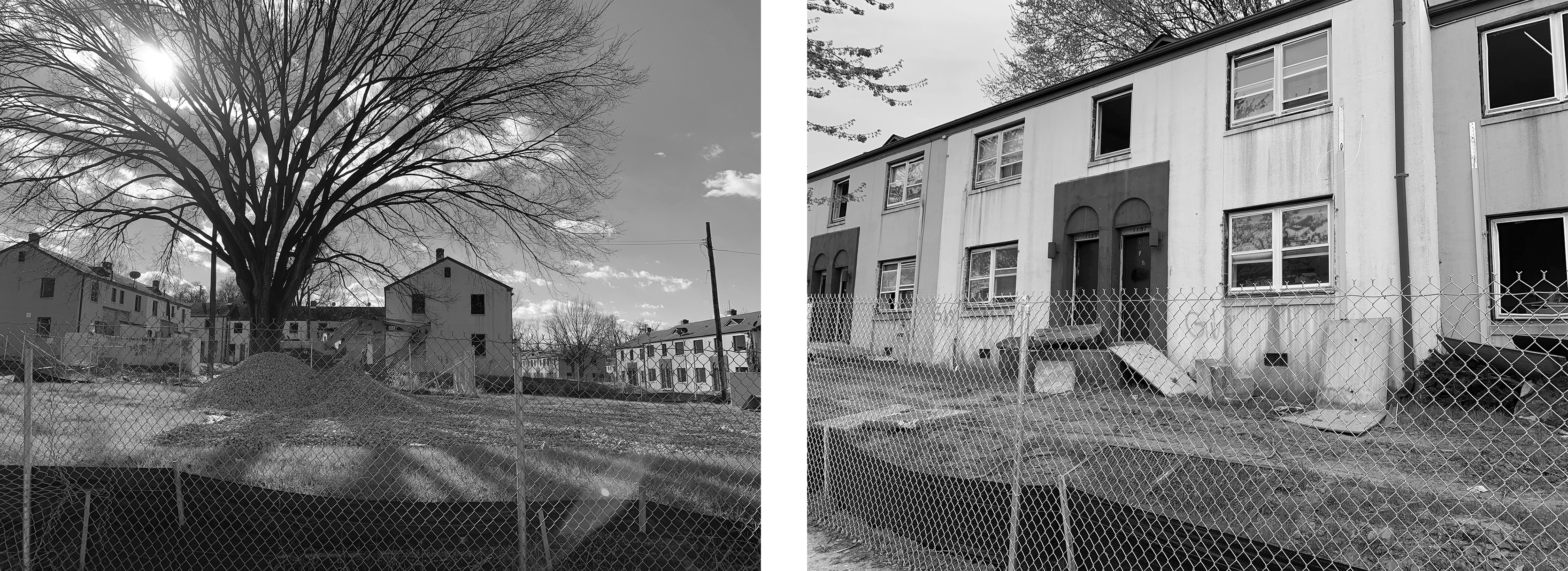
Demolition of the Barry Farm public housing development in 2019.
Other, often older, activists and leaders East of the river are also tied to historic Black power and abolitionist movements, from which they build their organizing and storytelling through abolitionist discourses. For instance, Bruce Purnell of the Love More Movement, a community-based resource that offers support for seniors and youth—is a fifth-generation descendant of abolitionists who were station masters in the nineteenth century Underground Railroad. Purnell, who is a trauma counselor by training, adopts a transformative justice approach. Given that residents East of the river are prone to overpolicing and criminalization by the carceral state, Purnell focuses on de-escalation and the cultivation of transformative justice spaces for victims and perpetrators of violent harm so as to scale back the need for intervention by police and criminal justice system. Purnell also helps to foster mutual aid networks and resilience for seniors, who are among the most vulnerable to environmental and climate vulnerabilities. In this way, the work of Love More is at the intersection of abolition and environmental justice. Similarly, Black churches such as Union Temple Baptist Church, community centers, and senior gatherings are centers of gravity for community building and cohesion. During times of weather emergency, residents mobilize those networks to bring food to vulnerable families or offer childcare. As residents shared “People offer each other all sorts of in-kind support in times of crisis; they look after each other's kids, share rides, check in on each other. Now, how do we strengthen those bonds?—Instead, there's the city's response, which is almost always to bring in outside people and groups in to help” [cited in Ranganathan and Bratman 114 (p.16)]. As Pellow has written, abolition ecologies suggest the need to critically engage carcerality (that is, the high imprisonment faced by racialized minorities in jails and prisons as well as their residence in proximity to on unabated contaminated sites that constrain their lives), criminalization, and environmental racism together, and spatially, so as to forge alternative futures in place. 115
Thus, enacting emancipatory green justice—that is, a more radical form of environmental justice—in Anacostia requires a new abolitionist politics of environmental justice. 116 It requires an official, formal acknowledgement of who originally settled in the area, who built ties with the natural landscape and how, and who resisted displacement despite waves of racialized land grabbing, abandonment, and conversion. As Heynen and Ybarra have written, drawing on Gilmore's (2017) abolition geographies framework, abolition emphasizes “the importance of place-making as we think about prefiguring liberation” and emancipation. 117 At the same time, radical, emancipatory green justice needs to be further supported by changes in broader spaces and through structural shifts in resources, beyond the immediate vicinity of Ward 8, the 11th Street Bridge Park, and beyond the contours of the CLT. Some housing activists and neighborhood leaders have actually argued for the need to convert the $50–$60 million investments for the bridge itself into substantive funding for community-initiated green projects and enterprises, and other minority-driven and Anacostia-based developments and buildings throughout Wards 7 and 8, the city's predominately African American sections. In that sense, building Black community and family prosperity are central, especially through projects that do not “bring development to the neighborhood” but are initiated from within broader African American networks. Federal or state governments could also create a birth fund for racialized minorities that would help them secure wealth to be used for such enterprises, especially green enterprises that would create greater social and environmental resilience.
In addition, alternative voices in Anacostia have emerged for a different type of greening, one that is truly inclusive of diverse forms of Black placemaking and relations with nature and that values heterodox practices. Those would take place as part as the renovation of the existing Anacostia Park and Trail East of the river and through de-carceral community-led greening projects. Such voices remark that the Anacostia River was, during Jim Crow laws, the only recreational place for Black families to be allowed to swim, fish, or find refuge. They highlight the need to recognize how Black residents' placemaking occurs outside normalized, accepted, or official cartographies of power in the context of intersectional precariousness. 118 And yet, as presently conceived, the 11th Street Bridge Park project risks marginalizing existing racialized landscape of placemaking, everyday resistance care in a community previously unmapped and seen as undesirable. Relatedly, working-class Black families might feel controlled, unwelcomed, or even out of place in the recreational green, “cool” so-called multicultural events organized through the bridge park initiative. Those spaces might become disciplining landscapes for African Americans, as other nature-centered projects have highlighted. 119 , 120 Other residents denounce that they might even have to work for the 11th Street Bridge Park to not be displaced by the waves of development coming to Anacostia. As a resident reported (Interview 2019), “I will be good enough to serve you slurpies and hotdogs at the river festival, but not to live there.” In that sense, his words illustrate the enduring effect of plantation economies in racialized neighborhoods (Brand 2020).
Thus, in an abolitionist framework, more emancipatory green spaces should be encouraged in Anacostia, as some housing activists demand, so that people can spontaneously use those spaces to tell stories—some uncomfortable ones—to render residents visible and meaningful and provide them with positive relationships of care and recognition. 121 In contrast, if race can only be brought in a comfortable, positive, and esthetically manicured manner through “avant-garde” green design, and cool recreation, a green politics of “diversity” and “inclusion” risk displacing residents. 122 Thus, an alternative to current urban greening plans for Anacostia is through healing and care, through which the river would be reimagined and revived from and for the residents themselves. Such practices would follow preventive justice principles, focused on avoiding harm. Green justice would also mean to use and make sense of abandoned, forgotten areas, highway passageways, “vacant” land, and unexpected usable spots for greening by and for vulnerable residents provided those projects also guaranteed and control and ownership to residents or community leaders.
Such transformations would enact Du Bois's liberation phase beyond direct transformations within a specific, prescribed physical space and bring different placemaking experiences together. They would also support the urban space as a site “where the social, material and symbolic needs of nondominant groups are met and where alternative futures are imagined,” 123 (p.3) thus enacting the liberatory potential of Du Bois's second sight, redefining the “problem” as White supremacy and thereby not only critiquing how Whiteness takes place, but also moving toward a spatial development praxis that is not rooted in anti-Blackness.
Conclusion: Environmental Justice Through Decolonizing the Green City
In sum, the 11th Street Bridge Park project does advance an equity-centered green planning agenda, with a strong commitment and intention to building community partnerships. However, the broader developments and changes that it has paved the way for accelerate vulnerability to green gentrification and displacement. This new green infrastructure also risks making and the restored and greened Anacostia River and its surroundings an increasingly White and only selectively Black racialized green space.
More specifically, the project in Anacostia overlooks the deep segregationist and exclusionary legacies of racial settlement and their ongoing manifestations. First, while the CLT model is designed to secure permanent affordable housing, its pace and structure of implementation is unlikely to address the deep and growing intergenerational and interracial wealth gap, nor secure permanent affordable rental housing to enough working-class residents living in a fast gentrifying neighborhood. Second, much of the CLT is financed by international finance groups likely attracted by the prospects of rebranding Anacostia, and there are already private developers and investors capitalizing on the sustainability and greening of the 11th Street Bridge Park project through high-end large-scale real estate projects—many of them with a green flair. In contrast, Black and workers-owned businesses and commercial ventures remain limited, thus further anchoring plantation economies in Anacostia. Third, even though the project highlights memories of a racial past through cultural activities and artistic renderings, it illustrates how racialized economic inequalities allow a certain type of greening and sustainability to be deployed, colonializing formerly undesirable lands, activating “cool” and “fun spaces,” while risking invisibilizing and excluding heterodox, dissonant, or informal greening and land uses. In that greening, more emancipatory proposals such as land reparations also remain underdiscussed.
We thus argue that the 11th Street Bridge Park in its current embodiment reinforces the false binary of urban greening (and eventual displacement) versus historic (and current) underinvestment while leaving green reparative justice limited. Like the BLM Movement, the project points to the deeper and ongoing lives of racial capitalism that is made in and through space and the particular ways that anti-Blackness is often made manifest through development hegemony in the twenty-first century. In contrast, and again following the BLM Movement and their demand for affirming Black lives and landscapes, decolonizing The Green City would involve centering land recognition, redistribution, control, and reparations and developing new land arrangements as necessary to an emancipatory and environmentally just landscape. It would also first mean to engage with the history of a multilayered geography of dispossession and exclusion and include new cultural and symbolic recognitions of networks of resilience and care. It would allow for new institutional arrangements and the construction of alternative political power inspired in Black radical traditions. Last, it would enact justice in newly amplified and life-affirming, emancipatory Black geographies.
Footnotes
Author Disclosure Statement
No competing financial interests exist.
Funding Information
This research contributes to the Maria de Maetzu Unit of Excellence grant (CEX2019-000940-M) at the Institute for Environmental Science and Technology. Isabelle Anguelovski would also like to acknowledge the support of the ERC Starting Grant GreenLULUs (GA678034) and the Naturvation (730243) research project.