




Abstract
Inequitable access to healthy food has been associated with a variety of adverse health outcomes. In the United States, prior studies have suggested that low-income and racial minorities are more likely to reside in neighborhood with unhealthy food environments than their high-income and white counterparts. We examined the relationship between residential segregation, food deserts, and food swamps in the St. Louis Metropolitan Statistical Area. We observed that neighborhoods with high levels of black segregation were approximately four times more likely to be food deserts or swamps than neighborhoods with low levels of segregation, after adjusting for population density. Neighborhoods with high levels of income segregation were approximately three times more likely to be food deserts or swamps than neighborhoods with low levels of income segregation. In this policy brief, we propose mobile food truck programs, community education programs, and healthy food tax breaks and credits, particularly for locally owned and operated food suppliers. Targeted interventions aimed at improving physical, social, and economic environments, particularly for residents of segregated communities, should be the key components of policy response to inequitable food environments.
PROBLEM
Neighborhood food environments have been associated with a variety of chronic disease-related risk factors and outcomes, such as poor-quality diet, obesity, diabetes, and cardiovascular disease. 1 Of particular interest to researchers and policy makers has been inequitable access to healthy food, a phenomenon often associated with food deserts and food swamps. Food deserts are neighborhoods with poor access to healthy food such as fruits, vegetables, and other nutritious selections, 2 whereas food swamps are neighborhoods where unhealthy energy-dense food offerings, such as fast food, inundate healthy food offerings. 3 , 4 Although the mechanisms are unknown, it is postulated that inequitable neighborhood food environments lead to neighborhood-level disparities in disease risk and health outcomes by differentially influencing the food purchasing behaviors and consumption patterns of local residents. 5
Several U.S. studies have documented inequities in neighborhood food environments, with both food deserts and food swamps more likely to be located in low-income and nonwhite neighborhoods.2, 6 , 7 These income and racial inequities may be the result of residential segregation. Residential segregation is the degree to which two or more groups live separately from one another. 8 From the twentieth century onward, residential segregation in the United States has been, in part, a reflection of discrimination and structural racism. For example, restrictive housing practices and policies, such as restrictive covenants, redlining, and unequal access to federally backed housing assistance and home loans, have led to disparate neighborhood environments, disinvestment in low-income and minority communities, and subsequent disparate access to environmentally related health promotion resources. 9 , 10
In this case study, we examine the relationships between segregation and residential food environments in the St. Louis Metropolitan Statistical Area (MSA), a region with well-documented black–white and income disparities in health outcomes. 11 We first examined whether there were associations between measures of racial and/or income segregation and unhealthy food environments, such as food deserts and food swamps, using census data and data from the U.S. Centers for Disease Control and Prevention's Modified Retail Food Environment Index. We then provide case examples that illustrate potential solutions in the St. Louis MSA, and discuss how findings may inform policies for engaging key stakeholders and promoting equity in neighborhood food environments.
FINDINGS
We conducted a cross-sectional analysis of the residential food environment and residential segregation in the St. Louis MSA. 12 This analysis used publicly available data and was exempt from human subjects review by the REDACTED institutional review board. Residential food environment was assessed using the 2011 modified Retail Food Environment Index (mRFEI), a measure of the percentage of healthy and less healthy food retailers within a census tract. 13 The mRFEI score range is from 0 to 100, with a 0 score indicating a food desert (there are not any healthy food retailers [supermarkets, large grocery stores, produce stores, or supercenters] within the census tract), and scores between 0 and 5 indicating a food swamp (the census tract contains many convenience stores and/or fast food restaurants relative to the number of healthy food retailers). Census tract-level racial and income data were obtained from the 2010 to 2014 American Community Survey (Table 1). 14 Approximately 77% of St. Louis MSA residents were white, and at 18%, African Americans were the largest minority group in the region.
Census Tract Characteristics of the St. Louis Metropolitan Statistical Area (n = 427)
We used census tract-level data to determine black isolation, a measure of racial segregation, and poverty isolation, a measure of income segregation. 15 These isolation measures have been described in previous publications. 16 , 17 In brief, isolation measures detail local patterns of segregation across a region by estimating the probability of a particular population group member meeting another member of the same group within a neighborhood. Instead of using the percentages of populations belonging to a particular group (e.g., percentage black and percentage living in poverty) as an indicator of residential segregation, these isolation measures are spatial in nature and take into account how populations are spread across neighborhoods (i.e., census tracts) in a region. The formula for calculating black isolation, for example, is

where ct i is the composite population count of the total population in area unit i, cb i is the composite population count of the black population in area unit i, CT is the total population in area unit i, and CB is the total black population in area unit i. The poverty measure from the American Community Survey is determined by thresholds set by the U.S. Office of Management and Budget and based on household income before tax. Census track-level poverty data were used to calculate poverty isolation:

where ct i is the composite population count of the total population in area unit i, cp i is the composite population count of the population living in poverty in area unit i, CT is the total population in area unit i, and CP is the total population living in poverty in area unit i. Isolation measures range from 0 to 1 and were categorized from lowest (Q1) to highest (Q4) quartile groups. Figure 1 displays maps of racial (Fig. 1a) and income (Fig. 1b) segregation in the St. Louis MSA.
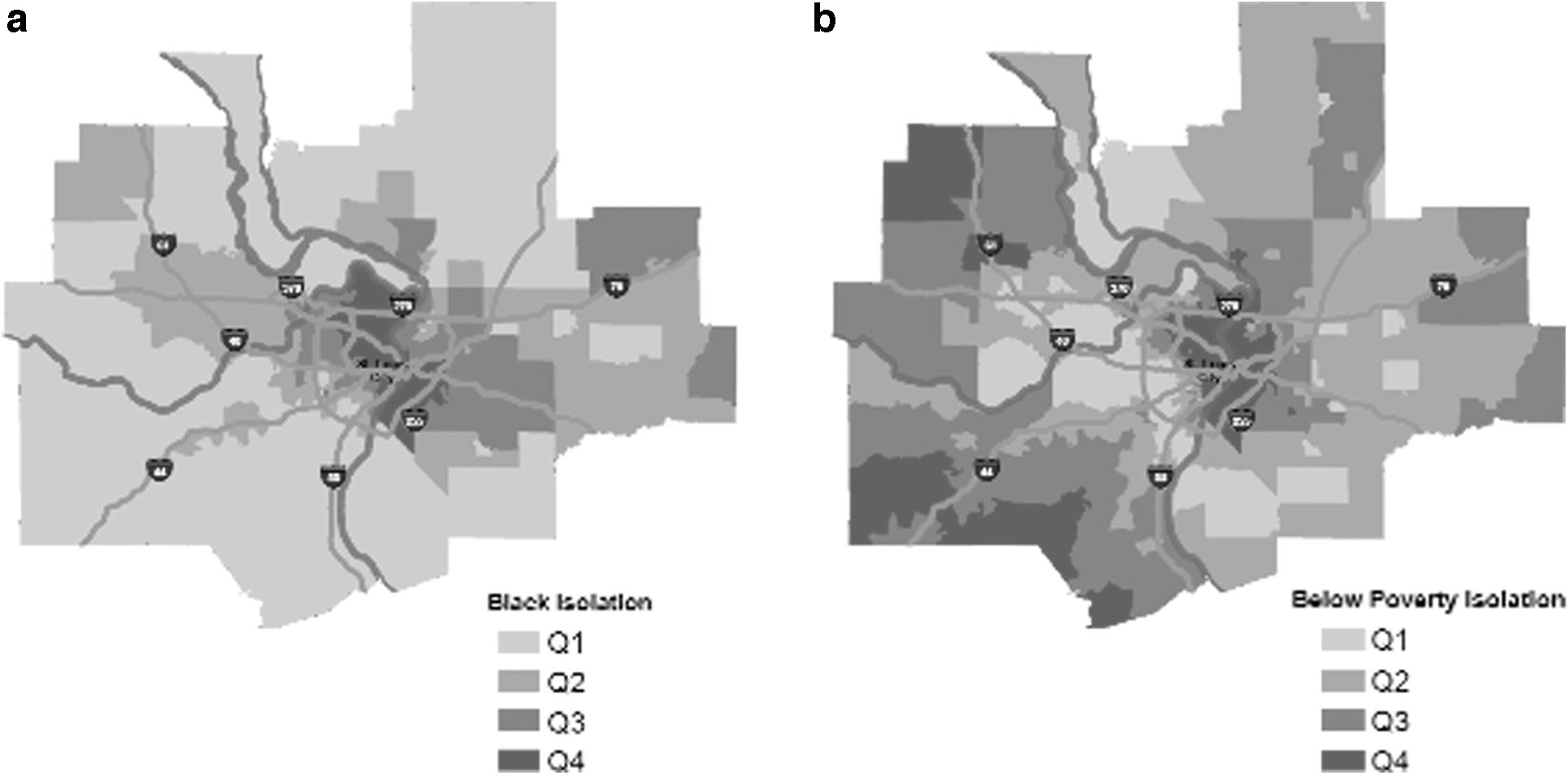
Maps of racial
Approximately 20% (n = 89) of census tracts in the St. Louis MSA were food deserts (mRFEI = 0) and an additional 5% (n = 20) were food swamps (0 < mRFEI <5). Both racial and income segregation measures were associated with unhealthy food environments. After adjusting for population density, census tracts with the highest proportions of black segregation were four times as likely to be foods deserts (adjusted RR [ARR] = 3.59, 95% CI = 1.73–7.44) or food swamps (ARR = 3.89, 95% CI = 1.29–4.53) than those with the lowest proportions of segregation (Table 2). Census with high levels of income segregation was approximately three times more likely to be food deserts (ARR = 2.67, 95% CI = 1.28–5.59) or food swamps (ARR = 3.16, 95% CI = 1.64–6.08) than those with the lowest proportions of income segregation. Although a causal relationship could not be determined because of the lack of temporal data in this cross-sectional analysis, our findings suggest that both racial and income segregation were associated with the food retail environment. In addition to examining the mechanisms linking segregation to unhealthy food environments, future study should explore the attitudes and policies that uphold residential segregation in the St. Louis MSA. In the remainder of this policy brief, we focus on reducing access to unhealthy food in segregated neighborhoods.
Association Between Census Tract-Level Racial and Income Segregation and Unhealthy Food Environments
Percentage of census tracts for the analytic subgroup that was food desert census tracts.
Percentage of census tracts for the analytic subgroup that was food swamp census tracts.
Adjusted for population density.
POLICY ALTERNATIVES
The adverse health consequences of food deserts and food swamps overlap, as both have been associated with diet-related chronic disease outcomes, such as obesity and diabetes.1, 18 In the United States, significant attention has been focused on efforts to eliminate food deserts by improving access to healthy foods. However, research has shown that there are several health problems that cannot be effectively addressed by targeting only food deserts (neighborhoods with insufficient access to healthy food) and ignoring the influence of food swamps (neighborhood with excess access to unhealthy food). In the case of obesity, for example, it has been shown that food swamps are better predictors of neighborhood obesity rates than food deserts. 19 Thus, policy interventions aimed at reducing chronic disease-related health disparities should focus on reducing food swamps, in addition to improving access to healthy foods.
Food swamps can be eliminated by incentivizing higher healthy-to-unhealthy food sales ratios using multilevel taxes. Higher taxes for unhealthy food products and lower taxes for healthy food products could attract customers to purchase more healthy food, thus increasing the ratio of healthy-to-unhealthy food being sold in segregated neighborhoods over time. However, policymakers should be aware of the potential unintended consequences of these pricing policies. Although lowering taxes and prices for healthy food could improve access to healthy food for residents of segregated neighborhoods, increasing taxes on unhealthy food could place an unequal burden on the residents of these neighborhoods, particularly residents of low-income and poverty-segregated communities.
Another way to alter the healthy-to-unhealthy food ratio is to disincentivize unhealthy food sources and stores through the modification of zoning laws. Theoretically, the use of permits to encourage the entrance of healthy food sources could shift the healthy-to-unhealthy food ratio and effectively contain the long-term growth of food swamps. Inviting small-scale healthy food retailers, such as farmers' markets and food trucks, to segregated neighborhoods could also shift this food ratio by increasing healthy food availability and promoting the consumption of healthy food. 20 In the St. Louis MSA, for example, Metro Market, a nonprofit mobile farmers' market operating out of a donated city bus, operates in the segregated northern neighborhood of St. Louis, and City Greens Market, a nonprofit grocer founded by a group of local women, provides access to fresh and affordable produce in a food swamp in southeast St. Louis. 21 , 22 Healthy corner store initiatives, public–private partnerships that increase the availability of healthy options in food deserts and food swamps, have been implemented in communities across the United States. 23 However, evaluations of these healthy corner store initiatives have yielded mixed results with respect to long-term consumption patterns. 24 , 25 , 26 , 27
In addition to laws and regulations, community education programs may be an effective way to discourage unhealthy food choices and promote nutrition literacy. Nutritional education programs, for example, could teach local residents efficient and budget-friendly meal plan strategies. In the St. Louis MSA, City Greens Market holds in-store cooking classes and cooking demonstrations, and Gateway Greening, a nonprofit that promotes sustainable urban agriculture projects, provides educational programs on urban agriculture and gardening.22, 28 These programs have the potential for sustained impact. In the short term, local residents are introduced to additional healthy eating strategies; in the long term, healthy food environments may be sustained through continued engagement.
Improving the overall social environment of a neighborhood is also an approach to constructing a healthy food environment. Social environmental factors, such as community norms and behaviors, have the potential to influence food consumption. For example, studies have shown that reducing violent crime and vacancy rates could reduce the fear and social separation that residents of these communities experience, which, in turn, could reduce unhealthy food purchasing and consumption behaviors. 29 , 30 Furthermore, as our current analysis of the St. Louis MSA has shown, there are strong associations between neighborhood racial composition and access to healthy food retailers. For policymakers seeking food equity, targeted interventions aimed at improving physical, social, and economic environments, particularly for residents of segregated communities, should be key components of any policy response.
POLICY RECOMMENDATIONS
Unhealthy food environments should be recognized as not just a static problem, but rather as a constantly evolving live system that depends on the sustained supply and demand of unhealthy food and beverages. Therefore, potential shifts in the system should bring changes to the business modes and lifestyles of consumers and sellers. To address the needs of residents who live in neighborhoods with high levels of racial and/or economic segregation like the St. Louis MSA, we proposed mobile food truck programs, community education programs, and healthy food tax breaks and credits, particularly for locally owned and operated food suppliers.
Food truck programs will ensure equitable accessibility by directly delivering healthy food and meals to local residents of racial and income-segregated neighborhoods. Resident engagement in menu planning, multiple healthy food options, and a range of operating times should be critical components of any food truck program in segregated communities.
In addition to mobile food truck programs, community education and gardening programs will enhance residents' awareness of healthy neighborhood food and beverage options and promote sustainable healthy food choices. When designing these educational programs, organizers should take into account the social environment and everyday experiences of local residents. Methods and mode of instruction should be tailored to the needs of local residents, and educational materials should be disseminated through a variety of mediums, including pamphlets, posters, cooking demonstrations and workshops, and broadcast and social media.
For consumers, a healthy food tax credit would incentivize spending on healthy food and beverages. Unlike policies aimed at curbing consumption of unhealthy products, such as soda taxes, healthy food tax credits would allay the cost concerns customers have when considering healthy food options. 31 The Double Up Food Bucks program, for example, provides financial incentives to Supplemental Nutrition Assistance Program customers for fresh fruit and vegetable purchases. 32 For food suppliers, such as corner and grocery stores, tax credits for newly established locally owned and operated stores in highly segregated neighborhood would incentivize healthy food offerings.
To develop effective evidence-based initiatives, new policies should be pilot tested in small areas of the target region before full implementation. After implementation, policies should be regularly monitored and evaluated. However, there is a paucity of large-scale quantitative investigations that directly evaluate food selection and related outcomes. In this brief, for example, we have highlighted several initiatives in the St. Louis MSA; however, they are yet to be evaluated for impact and scalability. Candidate outcomes for evaluations include purchasing patterns, dietary patterns, and neighborhood indicators of diet-related chronic conditions, such as obesity.
Given the history of racial discrimination in the United States, policymakers must consider the social and economic consequences of systemic racism and the influence these consequences may have on food access throughout the production–consumption chain. Karen Washington, cofounder of the Black Urban Growers organization, has argued that the entire food system, inclusive of race, geography, and economics, should be considered when examining food access. 33 Washington has been credited with popularizing the concept of food apartheid, because, unlike the term, food desert, which focuses only on access, food apartheid takes the whole food system into account. We were unable to evaluate food apartheid in the St. Louis area because, at present, there are no known consensus measures for food apartheid. However, any policy addressing food access should also take into account barriers that are specific to residents of racial and income-segregated neighborhoods. These barriers include perceived and actual systemic discrimination, employment and income constraints, limited access to farm subsidies and bank and housing loans, and limited access to affordable and timely transportation. In addition to the implementation of policies that enforce antidiscrimination laws and promote mixed land-use and mixed-income housing, these systemic barriers can be addressed through targeted support for groups who have been historically discriminated against. This support involves elevating, amplifying, and addressing the needs of a community in a manner that promotes residents as active drivers of solutions, rather than passive recipients. The engagement of residents as active participants in all levels of decision making will be critical for developing and sustaining healthy food environments.
Footnotes
AUTHORS' CONTRIBUTIONS
C.C.E. was involved in conceptualization, methodology, software, validation, formal analysis, investigation, writing–original draft, and writing–review and editing, supervision, and funding acquisition. R.T. contributed to conceptualization, methodology, formal analysis, investigation, writing–original draft, and writing–review and editing, supervision, and funding acquisition.
AUTHOR DISCLOSURE STATEMENT
No competing financial interests exist.
FUNDING INFORMATION
No funding was received for this study.