




Abstract

Introduction
Economic resilience constitutes a critical component of climate change resilience because climate change will profoundly impact the American economy. 1 Market forces, technological innovation, and efforts to mitigate climate change through a clean energy transition are collectively rendering certain jobs obsolete and creating new jobs. Climate and energy industry professionals, scholars, and policymakers must proactively incorporate equity considerations into policies that support the energy transition to minimize disruption and create economic opportunity for marginalized groups. The primary focus of this piece is how the Biden administration can approach building an equitable clean energy workforce, since clean job creation and workforce development are important mechanisms for expanding economic opportunity and building resilience.
Background
A hallmark of President Biden's climate action plan is an equitable clean energy workforce that can support a postpandemic recovery and help the United States meet greenhouse gas emissions reduction goals. 2 Biden has asserted that his administration will catalyze the creation of high-quality union jobs in the clean energy sector that pay livable wages and expand pathways to the middle class. 3 The “clean energy workforce” collectively refers to individuals working in energy efficiency, renewable energy, clean vehicles, clean storage, and grid modernization as defined by the 2020 U.S. Energy and Employment Report (USEER) and Environmental Engineers (E2). 4
Biden has also emphasized a commitment to incorporate equity considerations in all federal policy initiatives. 5 A commitment to equitable clean energy job creation and workforce development is particularly necessary given the current state of the clean energy workforce. Both women and ethnic minorities are under-represented 6 among the 3.3 million Americans in the sector compared with occupations nationally. 7 This is unfortunate given that clean energy jobs pay average hourly wages that exceed national averages by 8%–19%, 8 meaning access to these jobs could enhance quality of life for many working in low-wage occupations.
In addition, ∼50% of clean energy sector workers have not attained education beyond a high school diploma and yet still out earn similarly educated workers in other industries. 9 This is particularly true for energy efficiency and renewable energy production occupations. 10 Researchers have estimated that the transition to a clean energy economy will necessitate ∼320 unique occupations—focusing on energy efficiency, renewable energy production, and environmental management. 11 Hence, it is probable that diversified job opportunities emerge from the transition, offering access to well-paid jobs without pervasive educational barriers.
Although the Biden administration has committed to equitable clean energy workforce development and job creation, several interim milestones need to be achieved for this goal to be actualized. Most fundamentally, the Biden administration must explicitly define equity and then translate that definition into actionable workforce development policy proposals. The term “workforce development” in this article refers not only to direct job training, career support services, and employment matching, but also the broader economic strategy of equipping working age adults and youth with qualifications to meet the current and future needs of a specific economic sector. This article offers commentary on how the federal administration can define equity and implement an equitable policy approach to clean energy workforce development.
How can equity be defined?
Equity, in a policy context, is generally understood to mean equal access to public policy benefits and services, consideration in public policy design, and participation in policymaking processes. In this context, it is useful to disaggregate types of equity for more precise analysis. Leveraging a framework from an Environmental Science and Policy journal article on payments for ecosystem services 12 and then modified for climate adaptation policy, 13 three types of equity emerge: (1) distributive equity, (2) contextual equity, and (3) procedural equity (Table 1).
Types of Equity for Climate Action Planning
The definitions in Table 1, taken from a climate policy context, provide a foundational framework for use in the planning, design, and implementation of clean energy workforce development efforts. The tripartite definition of equity can be useful in two ways: (1) identifying communities facing inequity in the current energy system to prioritize them for clean energy workforce development initiatives and (2) designing workforce development-related interventions that address multifaceted dimensions of existing inequity.
How could the Biden administration integrate this conception of equity in clean energy workforce development?
The first application of the tripartite definition of equity is important because it helps to answer the question: who should be prioritized in an equity-oriented workforce development initiative? Although there is no decisive answer to this normative question, public policymakers could consider prioritizing communities, defined both geographically and demographically, who have been disadvantaged by the current energy system and policymaking paradigm.
To the Biden administration's credit, the President has already assembled a racially and geographically diverse environmental justice (EJ) Advisory Council of experts to help government officials determine how to improve the geospatial identification of those facing the highest cumulative EJ burden. 14 In addition, President Biden created a Justice40 initiative, codified in executive order (EO) 14008, which specifies that 40% of all benefits from climate and energy-related investment must flow to disadvantaged communities identified through the improved geospatial identification effort and allocated by government officials based on the EJ Advisory Council's recommendations. 15
More specifically, the EO states: “The recommendations shall focus on investments in the areas of clean energy and energy efficiency; clean transit; affordable and sustainable housing, training and workforce development; the remediation and reduction of legacy pollution; and the development of critical clean water infrastructure.” 16 If the current administration aims to reckon with myriad inequitable conditions across American society, this is an important step in the right direction. However, in addition to an explicit focus on targeting EJ communities with new investment and programs, the administration should also examine (1) why historic federal actions on EJ have failed and (2) other instructive markers of inequity, including the prevalence of energy affordability challenges and historic exclusion from energy and environmental policymaking.
Analysis of historic failure to address environmental injustice
Conducting postmortem analysis of why the past several decades of EJ efforts led by the federal government have failed 17 to meaningfully reduce disparities or deliver promised benefits 18 is an important first step in any administration. The first Office of EJ in the U.S. Environmental Protection Agency (EPA) was established in 1992 and the first EO aiming to address EJ was issued in 1994 19 and yet, many of the issues that necessitated their creation persist today.
David Konisky of Indiana University has pointed to many issues to explain this phenomenon, including the lack of a legal mandate for the EPA to address unequal pollution burdens, the lower rate of both federal and state inspections and lighter penalties when offending pollution sources are in low-income neighborhoods and communities of color, EPA's declining enforcement rates, and the underuse of Title VI of the Civil Rights Act of 1964, which is a mechanism that can block federal funding to entities acting in discriminatory ways. 20 In essence, there are many aspects of current federal mechanisms to address environmental injustice that are ineffective, discriminatorily administered, or simply underutilized.
If the administration focuses primarily on the allocation of new investment, and not rectifying systemic inadequacies in federal institutional processes, then environmental injustice may persist even as workforce development efforts and other resources are deployed to targeted communities. Finally, if the emphasis is exclusively placed on addressing distributive inequities through providing economic opportunity to those who have experienced disproportionate environmental injustice, but not contextual inequity through reforming the insufficient enforcement of environmental protections, then environmental injustice will persist, and equity will not be achieved.
Additional instructive markers of inequity
In addition to the targeting of communities facing environmental injustice, there are pervasive energy affordability issues in the United States that should also be centered in the conversation. During the pandemic, shutoff moratoria temporarily prevented an astounding 179 million Americans from losing utility service in late 2020. 21 This is notable given that the National Bureau of Economic Research (NBER) determined that utility disconnection moratoria reduced COVID-19 infections by 4.4% and mortality rates by 7.4% between March and November 2020. 22 Tragically, however, the same NBER analysis found that a counterfactual policy scenario, which extended shutoff moratoria policies uniformly nationwide instead of sporadically, could have reduced infection rates by 8.7% and deaths by 14.8%. 23 These facts affirm the reality that the current energy system, and utility system more broadly, fail to work for everyone.
A necessity for human life, economic advancement, and physical security—safe, affordable, and reliable energy—is not guaranteed in the United States. Furthermore, this issue of energy affordability does not impact the whole population in an indiscriminate way. There is evidence to suggest that certain demographics—including low-income populations and ethnic minorities 24 —are disproportionately energy burdened, or spending greater shares of their income on energy. For example, a working article by Lawrence Berkeley National Labs found that black households have higher residential energy expenditures than white households in the United States, even after controlling for income, household size, home-ownership status, and city of residence. 25 The article concluded that the racial gap was likely explained, in part, by differences in housing stock and energy efficiency investment. 26
In essence, the distribution of energy insecurity in the population is not only a type of distributive inequity, it also is a direct result of contextual inequity in energy efficiency program access and housing quality. As the administration determines which communities to prioritize for clean energy jobs, it should consider populations who are insufficiently served by the current energy system, as measured by high energy burden, persistent utility arrearages, and lack of access to the benefits of energy efficiency programs. In addition, since energy efficiency jobs constitute 70% of the national clean energy workforce, 27 there is a case to be made that those least served by the energy efficiency industry should be explicitly prioritized in the next wave of employment opportunities in the industry.
Finally, when it comes to energy and environmental policymaking, the voices of low-income populations and people of color have been historically ignored or actively excluded. For example, a 2016 investigation by the U.S. Commission on Civil Rights found that the EPA's Office of Civil Rights had dismissed 9 out of every 10 complaints of environmental discrimination and had never formally identified a violation of Title VI of the Civil Rights Act. 28 The new administration must work to reform the underlying procedural issues that result in an agency that does not achieve its stated mission. Furthermore, historically marginalized communities should not only be included in clean energy workforce development initiatives, but also be empowered to plan, implement, and evaluate such policy initiatives.
The Biden administration should also draw guiding principles from proponents of energy sovereignty, a school of thought and social movement that centers human beings and communities in decision making about the sources, scales, and structure of the energy system. 29 Although the Biden administration created an EJ Advisory Council to help democratize the decision-making process and center under-represented perspectives in energy policy, the Council is entirely advisory and their recommendations nonbinding. Hence, the mere existence of the Advisory Council does not guarantee a degree of procedural equity or human-centered energy policymaking, but the extent to which their feedback is meaningfully incorporated into policy and processes perhaps can. In conclusion, the Biden Administration should work to (1) rectify the mistakes of previous federal administrations on addressing environmental injustice and (2) incorporate additional aspects of inequity, including energy affordability issues and historic exclusion from decision-making power, into the framework for identifying and prioritizing target communities.
How can considerations of equity be integrated into clean energy workforce developments and tailored to each group's needs and vulnerabilities?
This section aims to pinpoint recommendations, drawing from policy precedents and other sources, to discuss what clean energy workforce development initiatives with distributional, contextual, and procedural equity could look like in practice.
“Whole-person approach” and wraparound services for vulnerable subpopulations
Targeting communities that are disproportionately environmentally or energy burdened and socioeconomically vulnerable will require supportive services to accommodate other manifestations of distributive and contextual inequity. For example, communities dealing with the trauma and mental stress of poverty and systemic discrimination may also have high levels of mental health issues, interactions with the criminal justice system, or other complex circumstances that impact employment. Workforce development initiatives should leverage a “whole-person approach” 30 that recognizes each program participant's intrinsic dignity, regardless of economic output or life circumstance, and acknowledges the adversity they face. This model holistically supports participants while also seeking to match the individual with a high-quality job and/or career path that can provide a livable wage.
One example of this “whole-person approach” to clean energy workforce development is exhibited by the Rising Sun Center for Opportunity, a California-based nonprofit. 31 Its stated mission is to “build career pathways for economic equity and climate resilience.” 32 It uses an employer-driven model of workforce development that focuses on training and placing women, youth, and individuals in re-entry into in-demand clean energy careers. The model provides training, wraparound services (e.g., services for mental health, substance abuse disorders, and trauma-informed care), case management services, and career services (e.g., addressing employer relationships, retention support, and job placement). 33
The distinct “whole-person approach” of Rising Sun provides integrated services that support an individual to overcome obstacles impacting not only their employment but overall health and well-being. Rising Sun also respects the dignity of participants, partners, and employers by using a participatory design that uses feedback to adapt and improve its model. 34 In terms of sector focus, the nonprofit places individuals in building and construction, energy efficiency, and residential building decarbonization. It also works collaboratively with unions to direct individuals into pre-apprenticeships for the union building and construction trades, to help ensure that they can access jobs with livable wages and benefits.
Although the federal government cannot necessarily replicate the very tailored services of this small nonprofit organization, it can support the “whole-person approach” to workforce development, invest in establishing and scaling similar programs or models, and cluster funding in communities to enable supportive services for physical and mental health, in addition to direct workforce development investment. Just as Rising Sun supports individuals in the reentry process, the federal government can also proactively create workforce development initiatives that include career pathways for people who have been incarcerated or interacted with the criminal justice system.
In addition, learning from Rising Sun's model, which provides paid training programs for youth trying to get into the clean energy industry, the federal government could emphasize “earn-and-learn” programs 35 that pay participants during job training. This model can mitigate underlying economic barriers that make it infeasible for people to participate in unpaid job training programs even when they lead to higher paid careers. Finally, Rising Sun leverages genuine relationships with community-based organizations and other partner institutions to make its model work; the federal government could prioritize funding for similarly structured collaborative partnerships and prioritize bids for government contracts that reflect similar community-informed innovations.
Workforce development through community development
Clean energy workforce development cannot occur in a silo, as the ability to obtain and retain a high-quality job is contingent on other factors such as access to reliable transportation. The Biden administration should synchronize direct job training investment with other supportive community development investments to create enabling environments for economic advancement. Notably, Biden's EO and the informal blueprint of the American Jobs Plan, his proposed climate package, already include housing, transportation infrastructure, and various forms of human capital investment. However, it is imperative that these different types of investment are not disbursed in disparate or piecemeal ways, but instead allocated in a holistic and synchronized way that is tailored to each community's unique needs.
The California's Climate Investment Program allocates funding from the state's cap-and-trade program using a CalEnviroScreen (CES) tool that identifies the most environmentally burdened and socioeconomically disadvantaged census tracts. 36 The program notably delivers not only workforce development programming but also aims to address interrelated contextual inequities that shape socioeconomic vulnerability, including affordable housing development, energy efficiency measures, transportation, low-income weatherization, water infrastructure, and natural disaster response and readiness. The CES is one example of holistic community development investment that complements direct workforce development.
However, although the CES has notable elements, in terms of enabling distributional equity-oriented resource allocation, it is important to note some of the criticisms it has received: omission of race/ethnicity indicators, inability to assess pollution impacts on workers not working where they live, omission of climate impacts and resilience considerations, critiques about the appropriate unit of geospatial analysis, and so on. 37 These elements demonstrate that even equity-oriented interventions should be scrutinized for improvement and adapted based on feedback from impacted communities.
Diversifying unions and mainstreaming antibias commitments
President Biden's commitment to the creation of union jobs in the clean energy workforce makes sense given the typical benefits of union membership to the average worker—increased wages, stronger labor protections and higher wealth accumulation. 38 Research by the Center for American Progress Action Fund found that the typical worker covered by a union contract has almost twice the wealth of a nonunion worker and that this boost to wealth is even more significant for nonwhite workers (Fig. 1). 39
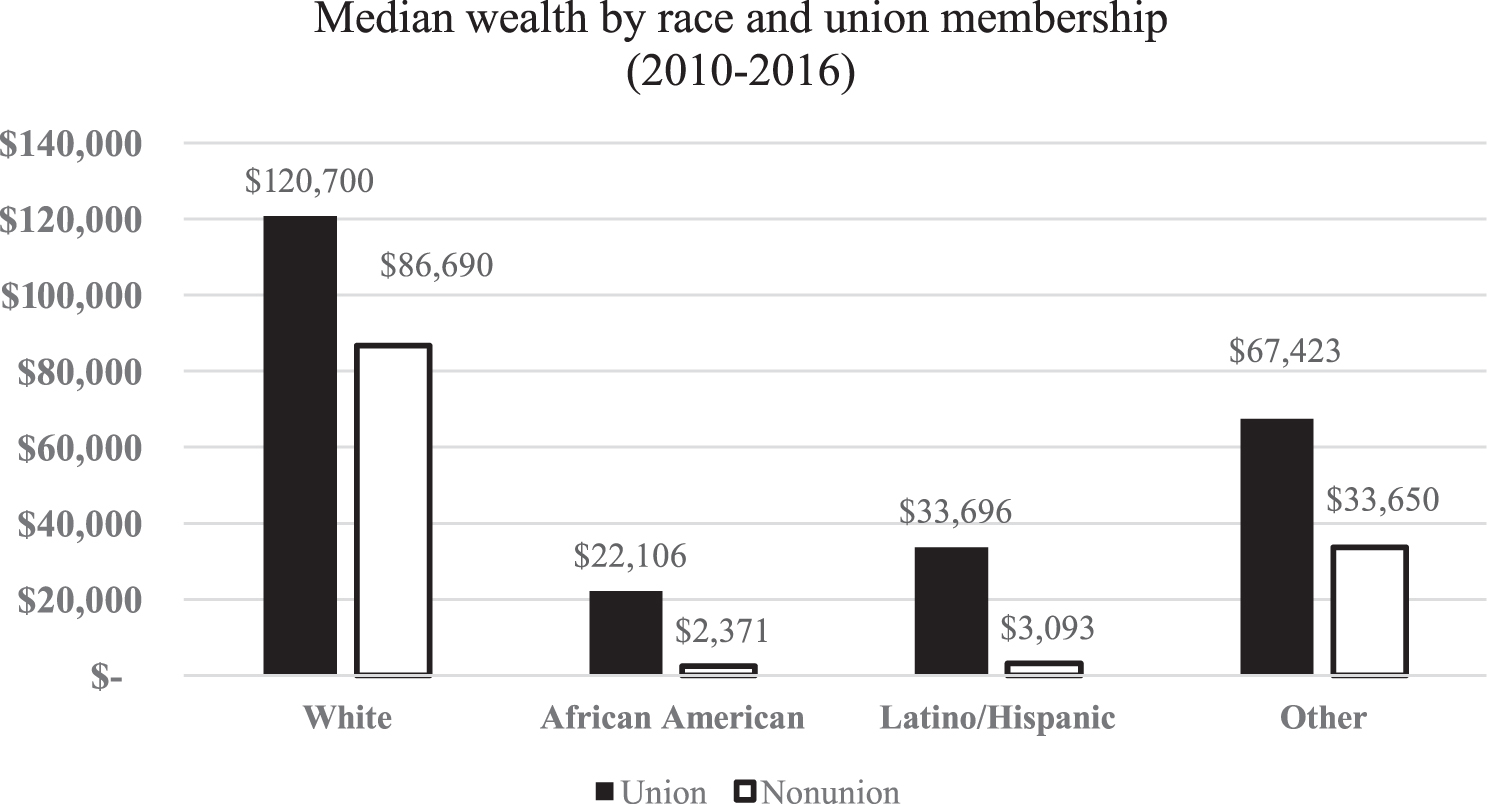
Median wealth by race/ethnicity and union membership, 2010–2016. Median wealth comparison from Center for American Progress, “Union membership narrows racial wealth gap.”
However, there are still barriers to accessing union membership. For example, many clean energy jobs are classified in the building and construction sector, and construction unions have historically been found to operate in racially discriminatory ways and blatantly attempt to exclude nonwhite members. 40 This finding is particularly significant because if unions are the central mechanism through which federally sponsored clean energy industry apprenticeships, training and job placement take place, it is imperative that unions are receptive and inclusive to historically excluded groups, including women and ethnic minorities. The federal government can play a role in requiring more transparency and accountability in the recruitment, operations, and leadership of unions to ensure that they are not behaving in racially exclusive and discriminatory ways.
Culturally competent engagement and co-creation of workforce development solutions
Clean energy workforce development initiatives with procedural equity proactively engage the intended beneficiaries of the intervention in the design, implementation, and evaluation of the policy intervention, so that they are active co-creators. The Just Transition Fund is a nonprofit that emerged in response to the Obama administration and combines philanthropic funding with targeted technical assistance to local governments and communities to support workforce development in Appalachian coal communities. 41 The Fund uses a collaborative community-driven model of transition planning, grant making, and economic diversification strategy development in coal communities that enable meaningful collaboration.
The Fund also facilitated an innovative learning tour in German coal country, so that American coal community members could learn from peers' experiences and think creatively about their own economic destiny. 42 The German transition model respected and memorialized the cultural identity of workers from the coal industry by repurposing former work sites in culturally respectful and community-informed ways: creating a UNESCO world heritage site from a former mine, transforming a steel-making facility into a nanotechnology hub and recreation area, transitioning the focus of a company from making gearboxes for mines to gearboxes for wind turbines. 43
This is noteworthy because the government and other stakeholders found ways to minimize disruptive displacement of community members and respect both the preferences and identity of the people most directly impacted by the energy transition. The Biden administration should strive to emulate this type of procedural equity when establishing workforce development initiatives.
Conclusion
Although the Biden administration has made strides toward an equitable climate action plan, it still must work to define equity in practice and then apply it to policy proposals related to clean energy workforce development. The aforementioned tripartite definition of equity, which includes contextual, distributive, and procedural equity, can be instructive in this effort. In terms of putting equity into practice, the Biden administration should think about how to equitably target communities for benefits and resources and how to equitably design workforce development initiatives. To begin, the Biden administration should conduct postmortem analysis on why decades of EJ efforts have failed and work to reform the institutional processes that thwarted their success.
The Biden administration should also use other markers of inequity, such as energy affordability challenges and historic exclusion from energy and environmental policymaking, in addition to indicators of environmental injustice to target communities for federal benefits and initiatives. Finally, to design equitable workforce development initiatives, the Biden administration should (1) support a “whole-person” approach to workforce development, (2) implement workforce development through community development, (3) work to diversify unions and mainstream antibias commitments, and (4) emphasize community-informed and co-created workforce development initiatives.
Footnotes
Acknowledgments
Nick Dreher, Policy Director, at the Midwest Energy Efficiency Alliance an integral part of the development and review of this article. Lilli Garza provided supporting research. Hannah Morrey Brown also provided technical editing and feedback to refine the article.
Authorship Confirmation Statement
I, Reine Lauren Rambert, confirm that I am the sole author of this article.
Author Disclosure Statement
No competing financial interests exist.
Funding Information
No funding was received for this article.