




Abstract
Residents in Central Appalachia face the emotional, physical, and financial impacts of the energy independence goal that the United States has been pursuing for the past several decades. In this region, extractive industries have historically been supported by powerful energy lobbies, tax breaks, and legislation that disregard environmental protections, resulting in the construction of a reticular energy infrastructure across Appalachia. We investigate this neoliberal policy environment by sharing the experiences of West Virginian residents living along gas pipelines, gathered via walk-along interviews and photovoice. Two main legal and economic pressures, the extensive legal fees needed to fight efforts to build natural gas pipelines on private land and the threat of eminent domain, emerge from our findings. Using the lens of environmental justice, we show how neoliberal policies strongly endorsed and supported by the state, combined with a deeply rooted nostalgia for energy development, have positioned West Virginia as a site of acceptance for unconventional energy extraction. Ultimately, we argue that neoliberalism has brought about legal and economic stressors that force many West Virginia landowners to accept extraction and its many byproducts.
INTRODUCTION
Environmental justice is centered around the idea that all people, independently of their intersectional identity, need to be included in the development, implementation, and enforcement of environmental regulations. 1 The central tenets of neoliberalism, however, including de/re regulation, free trade, the primacy of private property, and privatization, are often in direct opposition to the goals of environmental justice.
Regulations and how they influence cultural constructions of profit and access to land are crucial to understanding the reality of energy extraction in the United States. Accordingly, energy independence touted by several U.S. administrations is one of the many manifestations of a neoliberal energy agenda that has resulted in environmental injustice across the nation. 2 This article adds to these strands of environmental justice research by bringing to the forefront the lived experiences of West Virginians who have been exploited and even victimized by a regulatory neoliberal system that has historically favored extractive industries.
Representations of Appalachia are often framed through social or political understandings, casting the region and its residents as its own distinct place within the nation, 3 or an isolated area within a larger whole, 4 resulting in exploitation in the name of progress–similar to dynamics in other areas colonized by Western powers. 5 A focus on exploitation does highlight the impact of neoliberal policies on already vulnerable rural communities; however, it simultaneously conceals stakeholders within the region that enable these policies. 6 Central Appalachia has been a key area for coal mining, hydraulic fracturing, and, most recently, gas pipeline development. The region's history with natural resource extraction and the continued dominance of extractive industries make it a ripe site for analyzing the outcomes of neoliberal economics.
Hydraulic fracturing started in the late 2000s in West Virginia. Since then, technological advancements, heightened demand, and favorable policies have allowed for a production boom requiring the export of gas surplus. 7 Notably, neoliberal policies at both state and federal levels have not only supported gas extraction, but have also made it even more financially profitable for company interests in an area of the country where most people do not have a gas line connected to their homes. 8 , 9
Ironically, given surplus production and lack of local demand, local and federal authorities have promoted the construction of pipelines as a job-creating opportunity for areas historically plagued by high unemployment. 10 Complicit politicians with a vested interest in the oil and gas industry have supported this development through tax cuts and legislation that disregards environmental protection and conservation, resulting in the construction of spiderweb-like energy infrastructure across Appalachia. 11
In this article, we investigate the neoliberal policies driving energy production in West Virginia. We highlight the factors that result from and contribute to neoliberal policies that force residents to concede access to their land and to accept the risky environmental and personal impacts of gas pipeline development. Grounded in interviews with 34 West Virginians, we show that even though many residents are opposed to gas extraction activities on their property, eminent domain and exorbitant attorney fees effectively render them powerless in challenging powerful, government-supported energy corporations.
Ultimately, we conclude that West Virginia is a site of forced acceptance because state and local institutions, in the name of economic development, have supported risky extraction activities at the expense of local, often poor, landowners who do not have the means to resist the environmental injustice perpetrated against them. This study shows how policymakers and companies backed by neoliberal regulations can effectively work against environmental justice and the prospects of a just economic transition to a diversified, sustainable economy.
Fracking: Coal 2.0 in Appalachia
Hydraulic fracturing has placed the United States among the world's leading producers of natural gas. 12 This has been made possible through unconventional gas extraction in several shale basins, including the Marcellus in Central Appalachia, 13 the largest U.S. shale gas formation. The Marcellus has a projected supply of 45 years' worth of U.S. gas consumption. 14 Hydraulic fracturing has increased exponentially since the early 2000s: In Pennsylvania (West Virginia's northern neighbor) since 2005, more than 15,000 extraction permits have been conferred. 15 In 2020, U.S. gas pipelines and distribution lines length amounted to almost three million miles. 16
This energy sprawl has profoundly changed the landscape of central Appalachia, with environmental, social, and economic repercussions. 17 Water and air pollution have been reported in relation to hydraulic fracturing, with health impacts including increased rates of cancer, fatigue, and respiratory, gastrointestinal, immunological, and endocrine issues. 18
Additional risks are generated by pipelines, including landslides, leaks, and explosions, all of which can lead to water and air contamination. 19 These environmental and health impacts often cannot be resolved due to a lack of resources in the areas that are most directly affected. 20 Further, income increase in areas with ongoing shale gas extraction is minimal. 21 Taken together, these negative outcomes challenge commonly held conceptions that unconventional energy development is economically convenient and worth heightened risks.
From an environmental justice perspective, earlier literature shows mixed results in applications of distributional environmental justice, which focuses on whether race and poverty play a role in the placement of hydraulic fracturing or pipelines. 22 , 23 Research on procedural environmental justice, that is, the participation and inclusion of a diversity of stakeholders in decision making related to hydraulic fracturing in the United States, has brought to light the disenfranchisement of local citizens due to a highly fragmented and complex regulatory process.19, 24
To contextualize these reports, we analyze the lived experienced of residents in the gas hollers of Central Appalachia. Local and federal policy on hydraulic fracturing and pipelines is the latest manifestation of a long relationship between the energy industry and politicians in Central Appalachia. This bond is the most apparent in minimal environmental regulation and enforcement, which also signifies the neoliberal nature of this regional resource curse. 25
Unconventional oil and gas extraction is, in fact, solely regulated by local states in the United States, exempting it from most federal environmental regulations, which falls in line with neoliberal policy trends originating in the 1980s of devolution and state preemptions. 26 Fragmented and contradictory neoliberal regulations have found a particularly fertile ground in Appalachia, where land has historically been concentrated in the hands of a few out-of-state companies 27 and where boom-and-bust extractive cycles create a consistent need for jobs.
Since the 2000s, Appalachia has experienced growing unemployment due to industrialization and globalization, leaving the region unemployed and environmentally contaminated. 24 This has left rural communities working to attract new investments—including another round of boom-and-bust cycles in the form of unconventional oil and gas extraction.
Complicating this economic and political web is the space that energy development holds in the region's (and state's) collective memory. Despite the environmental effects of, among other practices, surface mining and mountaintop removal, many residents in resource-rich areas view energy development with much pride. Much of this pride is rooted in a rich history of organized labor and a sense that energy production is integral to the success of the United States as a whole; additionally, powerful stakeholders promote a “coal heritage” that emphasizes a hero's narrative of energy extraction and glosses over the material repercussions of extraction. 28
Over time, this has culminated in a shared sense of nostalgia that coalesces around place- and industry-based pride and blames economic losses on regulations, 29 thereby strengthening positive perceptions of neoliberal regulatory roll-backs.
Given these collective cultural attitudes and compelling industry arguments regarding economic opportunity, policymakers from both sides of the aisle in West Virginia were able to create a regulatory environment where (as elsewhere Mayer and Malin 24 ) deregulation and re-regulation favored corporations and essentially eliminated citizens' and environmental authorities' possibilities to challenge corporate forces. Surrendering oversight over unconventional oil and gas extraction in return for minimal corporate taxes and maximum environmental damage 30 has left regular citizens unable to defend themselves and their property.
METHODS
Grounded in a participatory photovoice project with 34 residents of West Virginia carried out in 2020, this study, approved by the West Virginia University institutional review board, was designed to gather accounts of landowners in rural areas living in close proximity to major pipelines and feeder lines, including the Atlantic Coast Pipeline, the Mountain Valley Pipeline, and the Rover Pipeline. Participants engaged in walk-along interviews 31 and photovoice, 32 sharing their lived experiences along pipelines through photos and recollections.
Participants shared photos to reflect on legal processes, economic shifts, and other related concerns during interviews. Interviews were transcribed and shared with participants for an initial round of member-checking 33 so that preliminary data could be confirmed, detailed, or rectified. After this, transcriptions were inserted in NVivo, a qualitative analysis software where they were coded according to emerging themes. The ones used for this article are: access to land for development, eminent domain, financial concerns, tensions, and expertise.
Each of these themes was associated with the photos shared with the participants as they were discussing those specific topics. Direct quotes for each theme were listed and then brought together in a summative analytical text that was used as the foundation for a second round of member checking, a further analytical and validation step, 34 through a focus group held via Zoom in November 2020. Eight people, each of whom had direct experience with pipeline development on their property or in their community, participated.
The focus group was, as the earlier interviews, transcribed, inserted in Nvivo, and coded according to the same aforementioned themes. The following sections draw on these findings (see also Carlson and Caretta 35 ), outlining how eminent domain and exorbitant legal fees have cultivated spaces of forced acceptance of neoliberal policies in West Virginia.
Spaces of forced acceptance
The eminent domain is the right given by the Federal Energy Regulatory Commission to companies to take private land for Commission-authorized use (including inter-state gas lines) if the company and property/mineral owner do not reach an easement agreement. 36 Several interviewees were subjected to eminent domain and had no alternative other than to relinquish their land to the pipeline company. All interviewees were opposed to this legal practice, as companies, in the best neoliberal deregulatory fashion, were allowed to profit from people's land under the guise of national development and security.
To add insult to injury, once pipeline construction happens, the land under which the pipe has been laid becomes unusable, whereas owners have to keep on paying taxes on it. When acquiring the right to assert the eminent domain, the company also gains control over the timber on the land and landowners cannot make profit selling what is being removed from their land. Figure 1 shows a wide swath of land impacted and an example of how much lumber can be destroyed in the right of way during construction of the pipeline.
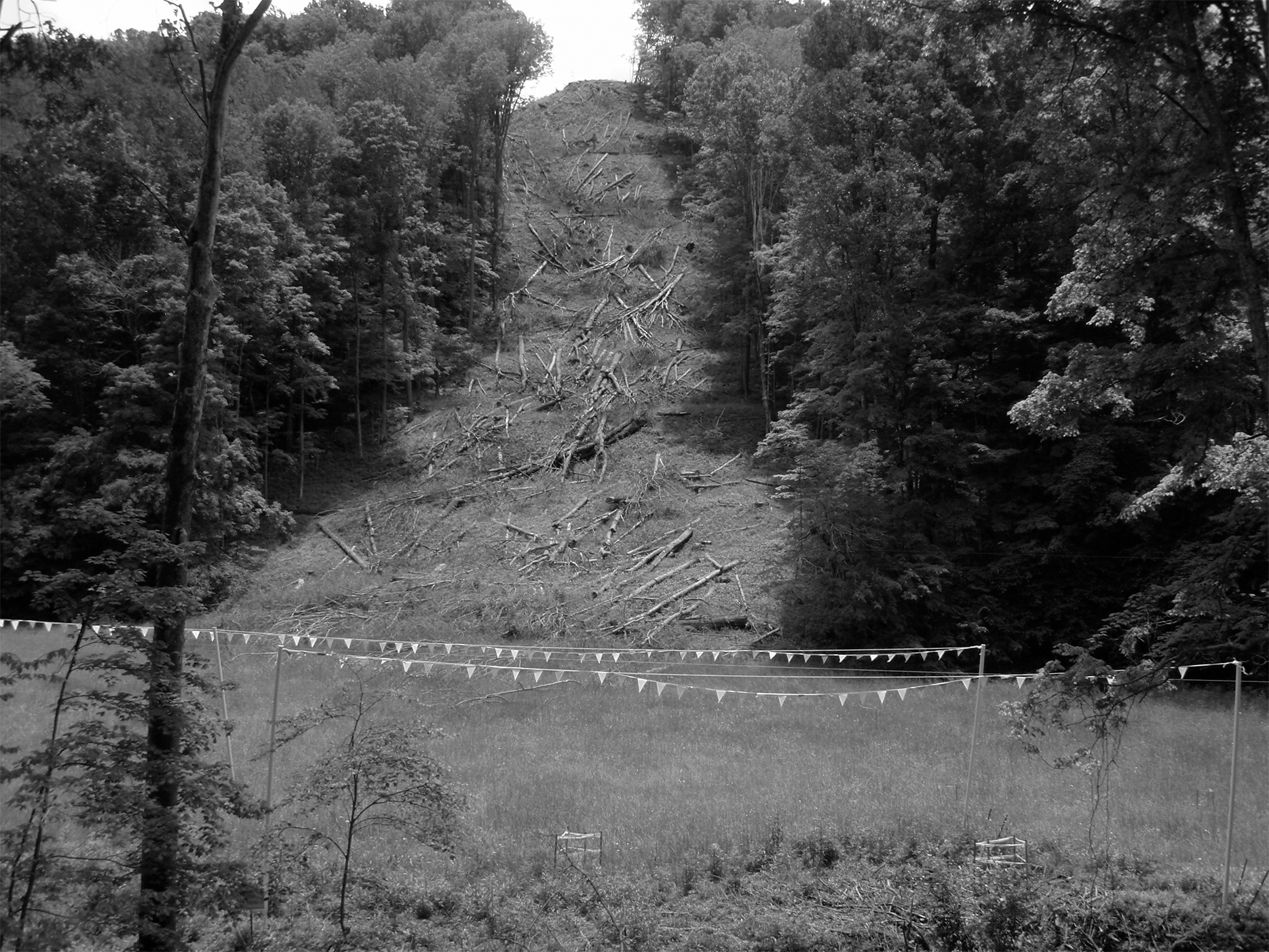
Timber destroyed along path of pipeline during construction (Credit: Interviewee 7).
All interviewees subjected to eminent domain reported that they felt that this regulation is used by companies as a threat when landowners decide to hold out and not sign a lease for right of way to the company, as this participant explains:
A lot of the people are intimidated … the whole eminent domain thing, and especially, what is the concept of immediate take? As soon as they file eminent domain, they take it, start up the equipment. ‘We don't need to wait to negotiate anything.’ (Interview 8)
For many participants, the eminent domain and seizure of their land is the worst-case legal scenario, because it renders the landowners powerless, speeds up the construction, and limits the financial settlement (i.e., once the eminent domain is enacted and land is condemned, there is no more financial negotiation possible). There was a unanimous sense among interviewees that companies are too powerful and have seemingly endless financial and legal resources, therefore discouraging landowners to pursue extended legal action and pushing them into resignation:
Well, I signed the contract. They gave me a choice. Either sign it or do the eminent domain. And my lawyer advised me that I didn't want eminent domain. (Interview 21)
Because they want to avoid the worst-case scenario outlined earlier, landowners often prefer to negotiate with companies for right of way rather than having their land condemned, since at least some affordances can be garnered from granting the company the right of way, rather than being forced into the eminent domain—for example, in avoiding the condemnation of their land through the eminent domain, landowners might be able to receive some compensation for the inevitable damage that heavy equipment will do to their land and access roads, as Figure 2 poignantly shows.

Evidence of damage to land by heavy equipment, including holes in hillside and deep grooves, as well as timber damage (Credit: Interviewee 6).
Repeatedly, interviewees shared accounts of feeling pressured to sign legal agreements with companies allowing access to their land to build out networks of pipelines; and then, once they had signed, they felt that their rights and wishes were usually gravely disrespected. Perhaps more alarmingly, participants demonstrated through their experiences and their photos that real, irreparable damage had been done to their property. These damages, in addition to the legal and financial pressures mounted by market-based thinking, create incredibly fraught situations for landowners.
Faced with the threat of extended legal battles, which cost a lot of money for a family or a single individual, many landowners shared that they chose to settle, since they could not imagine being able to win against corporations with seemingly endless resources. And for those who did choose to pursue legal action, the processes were drawn-out, expensive, and disenchanting:
We were the first and last ones to fight them, and then people saw what was going to happen to them, and they just didn't have—it cost us money to get lawyers. Lawyers ate us up. (Interview 6)
According to this interviewee, their legal battle had community repercussions: Neighbors were scared to fight the company after seeing how difficult, expensive, and disenfranchising the legal battle for their case had been.
Although participants were incredibly concerned with the environmental changes they had noticed on their property (see also Caretta et al. 37 and Turley and Caretta 38 ), in addition to the tactics taken by companies to secure access to their land, many also pointed to the larger changes that pipeline development had brought to their communities.
Individual financial gain, rather than community-wide prosperity, seemed to be a primary motivation for some community members, contributing to a rift in communities already facing heightened environmental risks from pipelines.
Instead of sharing, instead of going to your neighbors with milk and pigs and helping each other. They're more or less, ‘how can we make money?’ There's a construction business in our area that is doing good. They joined up with the gas people and now they [sic] making like a million dollars a month or something. What he does is he puts 12 stanchions in his field for RVs. He gets $1200 dollars a month per worker on each stanchion, right? While his neighbor, that he's known for generations, has a dirt floor in his kitchen. Why don't you put a stanchion in his yard? Why aren't you thinking? You could put one a month in every neighbor's yard and make the whole community benefit. (Interview 16).
This interviewee links a desire for personal gain to a multigenerational culture of extraction—a culture that has led to a sense that one's family well-being is dependent on the faith of their employer, or the company with which they have signed a contract. Neoliberal policies that amplify the power of corporate entities and chip away at community agency have resulted in not only the privileging of individual profit over other concerns, but also shifts in relationships between neighbors, further shaping the experiences of landowners hoping to build coalitions within their community.
IRB
West Virginia University IRB Approved protocol no.: 2005994768A001 with the title “Supporting Community Capacity-Building Against Extractive Interests Through Place-Based Visual and Narrative Inquiry.”
DISCUSSION AND CONCLUSION
Gas pipeline development in West Virginia illuminates the intersections between financial inequity, legal complexities, and legacies of extraction. Many participants noted how West Virginia's long history with extractive industries has shaped contemporary reactions to hydraulic fracturing and pipeline development: “Generations of people living in this same place, they are complacent, they are used to West Virginia being a coal state. And so, for companies to come in and extract other resources is just part of their environment” (Interview 10). Neoliberal policies combined with a deeply rooted nostalgia for energy development have positioned West Virginia as a site of acceptance for unconventional energy extraction; in this article, we argue that particular legal and economic pressures shape the daily lives of West Virginia landowners, solidifying their acceptance of extraction as an aspect of daily life.
This study shows how environmental injustice, perpetrated at the expense of a class of mostly white disenfranchised landowners, makes West Virginia a site of acceptance. The neoliberal regulatory regime grounded on the primacy of market-based thinking and corporate profit has brought about structurally forced coercion against local residents who do not have the means to resist, and so they succumb to environmental injustice.
Accordingly, from a distributional environmental justice perspective, we contribute to the argument that class—that is, poverty—influences where hydraulic fracturing sites and pipelines are placed. 39 , 40 From a procedural environmental justice standpoint, we add evidence to the lack of citizens' participation in decision making related to hydraulic fracturing in the United States due to regulatory processes that are complex and fragmented. 41 , 42
In this article, we show how neoliberalism, which ideologically implies that those who own land also have power, empowers corporations, effectively forcing landowners into a state of coerced acceptance. This study highlights the importance of class in conversations about environmental injustice, as historically disenfranchised rural populations have become victims of yet another round of natural resource extraction under the shroud of relatively cheap gas and possible (often fleeting) economic opportunity.
The financial inequities between individual landowners and massive corporations, combined with tension between environmental stewardship and resource-driven environmental practices, create spaces where landowners are forced to surrender to the whims of financial giants. Financial stress and the complexity of extended legal processes bolster inequities and feed into a long history of extraction in West Virginia. In all of this, the state plays a crucial, active role in supporting and expanding corporate profit through favorable regulations that allow the industry to exercise its meta-power by taking advantage of people's limited financial resources to structurally coerce them to accept gas extraction on their property and temporary employment (see also Malin et al. 43 ).
West Virginia is a site of acceptance because, many institutional powers in the state support risky extractive activities in the name of economic development and, hence, effectively work against environmental justice and the prospects of a just economic transition away from extractive industries and towards a more diversified economy. Understanding these circumstances is crucial to explore how the internalization and institutionalization of market-based thinking erect significant barriers to meaningful and transformative social change around climate justice and other environmental justice issues.
Footnotes
ACKNOWLEDGMENTS
The authors want to thank all the participants to this research who spent their time on this work. This work is dedicated to the memory of Mirijana Beram, who was a fierce environmental defender of West Virginia's beauty and a friend of the authors.
AUTHOR DISCLOSURE STATEMENT
No competing financial interests exist.
FUNDING INFORMATION
This research was funded through a grant to Caretta from the Heinz Foundation and through a grant to Caretta and Carlson from the West Virginia University Humanities Center.