




Abstract
Background:
Infrastructure, land use, zoning, and permitting decisions have long perpetuated patterns of environmental racism in the United States. These decisions and their underlying public participation processes often place undue demands on overburdened and historically excluded or disinvested communities who must repeatedly mobilize and engage to protect their well-being.
Materials and Methods:
In 2020, the Environmental Health Research-to-Action (EHRA) team joined with Literacy Work's Clear Language Lab (CLL) and staff at the Michigan Department of Environment, Great Lakes, and Energy (EGLE) to identify opportunities for increasing plain language in environmental decision-making processes. This entailed (1) CLL-led content review of sample documents (e.g., public notices), (2) EHRA-led focus groups with environmental justice leaders and legal advocates, and (3) CLL-led focus groups with adult English learners.
Results:
Themes from focus group analysis suggested that documents were perceived as intentionally biased, unnecessarily technical, and without clear directions on how and why to participate. The content review revealed opportunities for improving plain language in documents with regard to (1) audience and content, (2) organization and cohesion, (3) accessibility, (4) literacy, (5) language, and (6) process.
Discussion:
New versions of existing documents were generated. Many EGLE staff have worked toward plain language in public communications, providing models for colleagues and other agencies nationwide.
Conclusion:
Decades of grassroots mobilization has led to a recent increase in state- and federal-level resources and capacity to address environmental racism in the United States. Plain language can make decision-making processes transparent, and should be inherent in all agency-led public participation opportunities.
INTRODUCTION
Environmental decisions have long perpetuated patterns of environmental racism in the United States, leading to social, economic, and health inequities. According to Bullard, environmental racism “refers to any policy, practice, or directive that differentially affects or disadvantages (whether intended or unintended) individuals, groups, or communities based on race or color.” 1 These decisions lead to disproportionate cumulative impacts, wherein pollution sources are often colocated, releasing multiple pollutants and affecting quality of life and health in numerous ways. 2 This often means undue demands on residents of overburdened communities to mobilize and engage in agency decision making to safeguard community health.
Legally, decisions at all levels of government often require public participation. 3 Environmental protection in the United States occurs through a complex system of federal, state, and local rules. Significant federal policies, such as the Clean Air Act and Clean Water Act, give much authority to states in implementation. Public comments are frequently sought on regulations, rules, plans, permits, and laws.
For instance, when a facility requests a permit to install new equipment or processes that may increase pollution, the public is sometimes invited to provide public comments. Public comments can strengthen environmental decision-making processes and outcomes by providing the lead agency with facts or perspectives they had not previously acknowledged or addressed. However, they can also offer commenters a false sense of power in affecting decision outcomes.
According to the U.S. Environmental Protection Agency (EPA), environmental justice (EJ) is, “the fair treatment and meaningful involvement of all people regardless of race, color, national origin, or income, with respect to the development, implementation, and enforcement of environmental laws, regulations, and policies.” 4 One possible way to ensure meaningful involvement toward EJ is to improve access to environmental decision making by frontline communities through the use of plain language (Table 1) in decision-making documents. 5 , 6 , 7
What is Plain Language?
At the federal level, the Center for Plain Language independently assigned the U.S. EPA a “D” for organizational compliance and a “C-” for writing quality. 8 Plain language is also at the core of environmental health literacy, which is “an emerging area of study that incorporates content and strategies from environmental, health, and social sciences to promote the understanding of the ways environmental contaminants affect health.” 9
The potential of environmental health literacy to improve EJ, particularly through the use of plain language strategies, has been overlooked in public participation for environmental decision making. Plain language, alone, certainly does not guarantee positive, impactful, or meaningful processes. We suggest that government agencies' efforts to ensure plain language can help illuminate power imbalances underlying EJ issues and make decision-making processes more transparent and accountable for affected communities. In this article, we reflect on the role of plain language in creating content used in government public participation processes, analyzing and offering recommendations to improve environmental health literacy in one government agency in Michigan.
MATERIALS AND METHODS
This project was initiated by the Environmental Health Research to Action (EHRA) team in consultation with Literacy Works Clear Language Lab (CLL) and in partnership with the Michigan Department of Environment, Great Lakes, and Energy (EGLE). EHRA is a community–academic partnership focused on building skills and intergenerational knowledge in environmental health, community-centered science, and policy advocacy to address cumulative environmental exposures in Dearborn and nearby communities, as described in
Deemed exempt by the University of Michigan-Dearborn Institutional Review Board (HUM00175064), we conducted this study in 2020. In early 2020, representatives from EHRA, the CLL, and EGLE met to review various public-facing documents used in environmental decision-making processes, such as public notices, project summaries, a How to Participate Public Handbook, and a document titled, Public Hearing: What you Need to Know. The CLL facilitated discussions about the type and purpose of documents, existing efforts toward plain language, and a basic content review.
In summer 2020, the EHRA team held focus groups with EJ leaders, legal advocates, and adult English learners (Table 2), and all were compensated $50 for their time and contributions. In May and June 2020, the EHRA team conducted two 1.5-hour semistructured focus groups—one with eight EJ leaders in southeast MI and another with three environmental legal advocates. Owing to the COVID-19 pandemic, we held these focus groups virtually over Zoom, which were recorded and transcribed.
Focus Group Prompts
EGLE, Michigan Department of Environment, Great Lakes, and Energy; EJ, environmental justice; NAAQS, National Ambient Air Quality Standards.
In late summer, CLL presented preliminary updated EGLE documents in a final focus group with five adult English learners over Zoom to test documents for clarity. Using Google's Jamboard tool, participants reviewed 10 boards with snapshots of various documents—original versions and some drafts—that had been updated based on earlier focus groups and the content review.
Members of the EHRA research team transcribed the focus group recordings and conducted thematic analysis. 10 , 11 Researchers analyzed focus group data for key themes related to plain language and public participation. Researchers coded for the following elements of plain language: audience and content, organization and cohesion, accessibility, and literacy. 12 , 13 Researchers also coded for comments about process and language, as questions about plain language, in the context of this study, illuminated how written materials signal information about the public participation process in environmental decision making.
Over the summer of 2020, the CLL worked iteratively to develop new versions of several EGLE documents using plain language best practices and addressing issues identified by focus group participants. Also, the EHRA and CLL team met with EGLE multiple times to discuss focus group findings and potential plain language changes with regard to agency priorities, feasibility, and capacity. A final report was generated in the fall of 2020 and shared with EGLE, and staff coordinated a related presentation with EHRA and EGLE partners at their inaugural EJ conference in spring 2021. 14
Findings
Here we report the findings from the content review and focus groups with EJ leaders and legal advocates. We do not share themes from the adult learners who were not fluent in English, but minor tweaks were made based on their feedback and are reflected in the final documents shared with EGLE. Several examples are included to show how plain language strategies and participants' feedback, in combination, might be addressed.
Audience and content
EJ leaders reported that public-facing documents were written in a way that did not prioritize information residents would want or need to know regarding environmental health to engage in decision making. They reported that there was typically little to no mention of potential health effects or cumulative impacts, for instance, even in general terms (e.g., PM2.5 is associated with asthma and other breathing problems).
Participants discussed how maps or a visual representation would be helpful to show where the facilities under consideration were in relation to their homes and other places in their community, such as schools, as well as in relation to other nearby pollution sources. Participants reported that although EGLE may not have the capacity or requirement to conduct health analyses, acknowledgment of related community concerns was often lacking in written materials.
Content review of project summaries and permit applications raised additional concerns about the choice of content. For example, one Permit to Install Project Summary explained that by adding a new piece of equipment, “This reduces the oxygen that is available for combustion which results in lower temperatures.” It was unclear whether this is good or bad for the environment and health to a layperson. In this same document, it read, “Our review shows that the proposed emissions would be less than the NAAQS [National Ambient Air Quality Standards] for nitrogen oxide and particulates of 10 or 2.5 microns. These proposed emissions are also below our state levels as well.”
However, there was no mention of whether emissions would remain below the other NAAQS. They may, but the specificity of these pollutants and omission of others were confusing to focus group participants. Most agreed that the graphs in Figures 1 and 2 could be included in a full project report or permit application with additional information about interpreting them, but they were not understandable in a standalone way as presented in the sample project summary that was designed for the general public.

Ozone concentrations in Kalamazoo.

PM2.5 concentrations in Kalamazoo.
As EJ leaders explained, the choice of what to include and exclude can indicate bias. They explained that the amount of technical information about environmental changes or implications without explanations in plain language suggested a bias toward industry. One person explained, “I mean, how you going to give somebody something that they can't understand and say, ‘Well, we gave them notice,’ but you giving him something you know they can't understand.” For many, the failure to speak to community priorities felt intentional, like, “…maybe it's on purpose. Just like redlining was purposeful,” and it is the “way the system was designed.”
During the focus group with EJ leaders, a discussion also took place about how plain language is needed for everyone in the context of environmental decision making—not just frontline residents experiencing cumulative impacts but also decision makers, agency staff, and other leaders. In particular, one person described the challenges of communicating more broadly about the content of EGLE's decision-making documents:
And so it's hard, I mean it's very difficult. I mean we even have state legislators, they don't know this stuff. It's up to us to educate them, and of course, we have to educate the city, then we have to educate the county, then we have to educate the health director.
Plain language may enable community–agency communication and cross-sector communication.
Organization and cohesion
The content review revealed many ways that document organization could be improved or standardized to achieve plain language. Although EGLE was in the process of addressing this, no uniform template was previously used for similar documents, such as public notices, which would allow community members to expect consistency and structure in future notices.
Also, organization of the content matters for understanding. As one EJ leader noted when reviewing an original project summary from EGLE, “Too long…Disordered…Unclear purpose…It goes from talking about diesel fire emergency and then it's back talking about other things. It doesn't coincide.Going from one place to something else.” Oftentimes, appropriate introductory information was missing, such as the document's purpose or key concepts or terms (e.g., NAAQS). In addition, there were many ways to include plain language strategies more so, such as headers, bullet points, white/negative space, and shorter paragraphs. Sometimes similar types of content (e.g., contact information) were spread across a document rather than placed in one spot, which would make it easier to find consistently.
Accessibility
The content review also revealed many opportunities for increasing the accessibility of EGLE documents. There was no use of alt text, for instance. (Alt text is a description of images, figures, graphs, and tables that allows screen readers to access the represented content. Alt text also describes an image if bandwidth does not allow an image to load.) Appropriate descriptions for hyperlinks were often missing, and these are needed so that readers can find information if links are broken or materials are printed. Also, one recent public notice (Fig. 3) was provided online as a PDF of a copied document, which meant it could not be read using a screen reader to read the text for those with visual impairments.
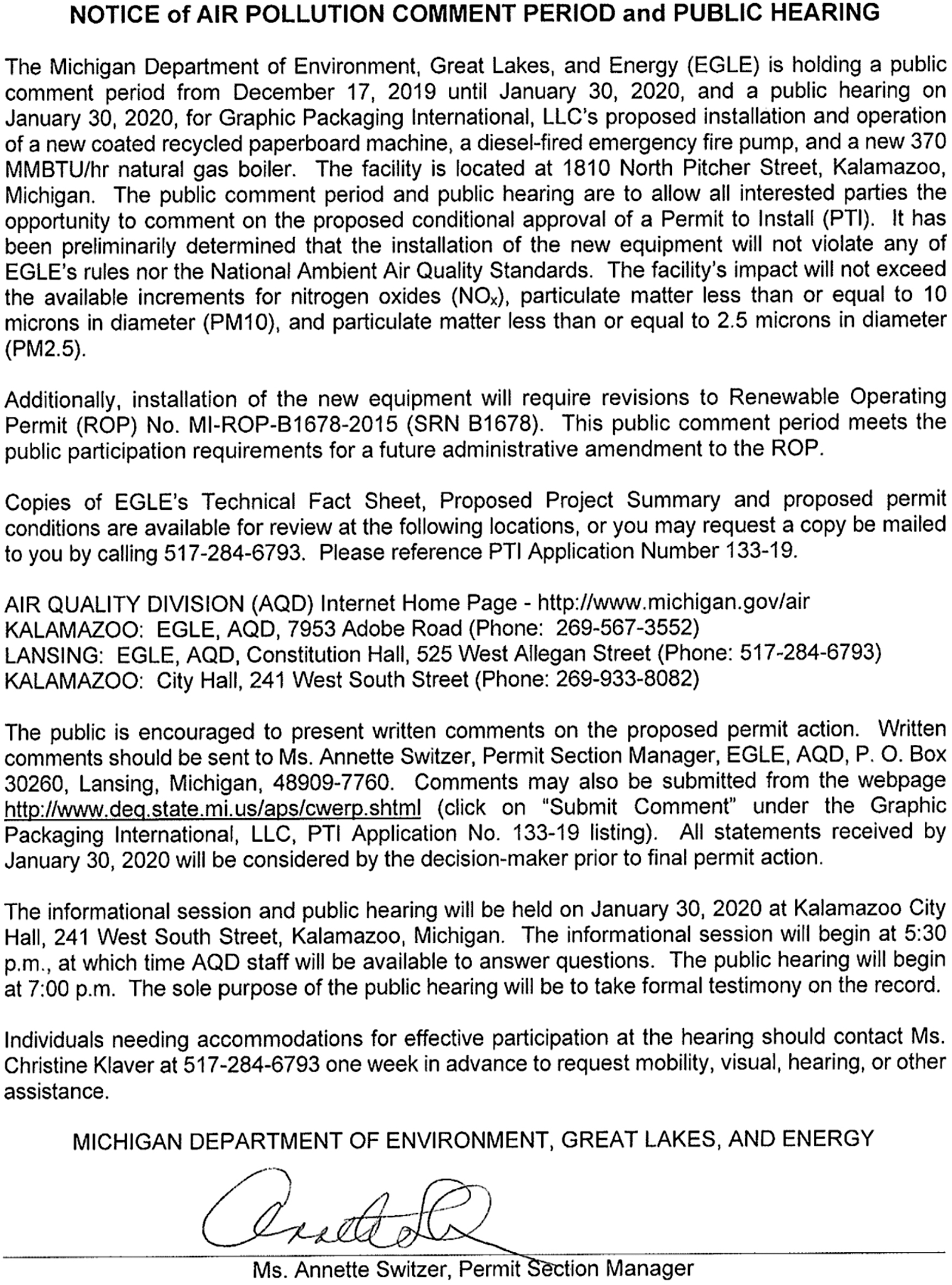
Sample notice before applying plain language strategies.
Literacy levels
Focus group participants expressed that many documents were highly technical, which was an added barrier to public participation for those with lower literacy levels. Many elaborated:
So, it's difficult reading, and if people don't know, they're going to push it aside because they don't understand and can't comprehend it. …they have to realize, a lot of information jumbled together overwhelms somebody….like BTUs. I forgot what BTUs was, and I notice stuff. And, I would forget. What is MMBTU? You see what I'm saying? The verbiage, the actual language that is used, the words that are used—if they were smaller, you know? Not because, you know, we're too dumb to understand or we can't Google them ourselves, but because it makes it easier for our minds to process it right then and there.
Although some of the information is necessarily technical, EJ leaders pointed to several examples of where clarification or simpler word choice was possible.
Content review using various readability tools aligned with this feedback. For example, a random 1100-word excerpt from EGLE's Public Involvement Handbook was written at a level for a high school-to-college range reader, depending on the readability tool applied. Another document about how to file a Freedom of Information Act (FOIA) request was at an 11th–12th grade range.
In addition to word choice, documents contained complex sentence structures, such as seen in an FOIA document: “The time frame estimate is not binding upon the Department, but the Department shall provide the estimate in good faith and strive to be reasonably accurate and to provide the public records in a manner based on this State's public policy under section 1 of the FOIA, MCL 15.231, and the nature of the request in the particular instance.” When reviewing documents together during the focus groups, participants repeatedly commented on the need to explain materials using more commonly understood terms.
Language
There was much concern from EJ leaders and legal advocates that a failure to use plain language and translate materials means there are additional barriers for many, particularly those whose primary language is not English. At the time of this study, EGLE had a draft Limited English Proficiency (LEP) Plan open for public comment and some focus group responses reflected this plan, such as this one:
…you know you can request a document to be translated and they'll do that, but they know that you know, certain areas are Spanish-only or Arabic-only and they know this information is located on the Census website, and it's very easily accessible. So, why not send notices in the language of the—you know—of the people that are there? You know, why not include that in the [LEP] Plan? Why does it have to be requested by the people…You send out the postcard and say “This is permit to install” in Arabic and English on the backside or something. You know? So, yeah, it's definitely a disparity that it's very blatant, and they know this.
Another EJ leader explained how a delay for translation could create additional barriers for public participation given the short time frame often allowed for reviewing documents and developing comments, as they said:
If you know this permit is taking place in an area that is predominantly Arabic-speaking, why not just offer English and Arabic notice automatically? Like why wait for someone to have to be behind the ball and asking you to go through all of the process…but you can just do that upfront and instead of wasting time because by the time that that gets to the community members, it's pretty late in the process anyway.
EJ leaders explained that plain language is a prerequisite for translation whereby it is easier to accurately translate common words than highly technical information.
Process
EJ leaders and legal advocates also reflected on the ways the process for commenting felt fruitless. Short timeframes, highly technical information, and limited influence combine to make the public participation process frustrating for many (Table 3). Participants noted that most people would not know how to effect substantive change in the permit without specialized expertise, support from technical or legal experts, and more experiential knowledge of the process. EJ leaders and legal advocates noted that oftentimes EGLE must approve the permit by law, and public participation documents could better explain what can and cannot be accomplished in a specific public comment process.
Perception That Public Participation Process Is Fruitless—Statements from Focus Group Participants
EJ leaders also discussed the challenges of advocating on multiple issues due to cumulative impacts—not just those interactions with EGLE but also with various agencies. As one participant explained, “One year we were having so many hearings, we had three in one day for three different companies—in the same spot. I mean you're dealing with people that are vulnerable people. Dealing with people that are aged. Dealing with people that are sick. And, then you're giving them all this information.” Furthermore, EJ leaders and legal advocates noted that the process is frustrating because some issues are not in EGLE's jurisdiction (e.g., associated truck traffic, odors). Many explained ways that public participation documents could better reference other agencies or resources to potentially address these separate but related community concerns.
Legal advocates also raised concerns about the process used to respond to FOIA requests required to access some public information or data, which may be helpful for informing public participation in environmental decision making. One participant explained, “I know even within the last few months, I probably submitted five FOIAs with three different kind of format requirements. One of them had a template to use. One of them gave you no template to use. Right? And the other one you did online. So, it's just the idea that you know, across not even agencies, but even maybe divisions within a state department…”
They discussed a range of high fees ($700–$40,000) associated with FOIA requests as a barrier for grassroots or nonprofit organizations trying to advocate for environmental health. As communities organize to address EJ concerns, one legal advocate explained that, “I think FOIA is one of the most important, incredible tools for just the general public.” Clear and transparent processes for FOIA are part of meaningful participation.
DISCUSSION
This study provides lessons for agencies interested in incorporating plain language intentionally into public participation processes for environmental decision making. Figures 4–7 provide visual examples and Table 4 draws on plain language practice and key findings with a list of relatively simple recommendations for agencies. Of course, agency administrators and management must commit to critical assessment of existing materials and related policies and processes, as well as work toward deeper shifts in organizational culture.
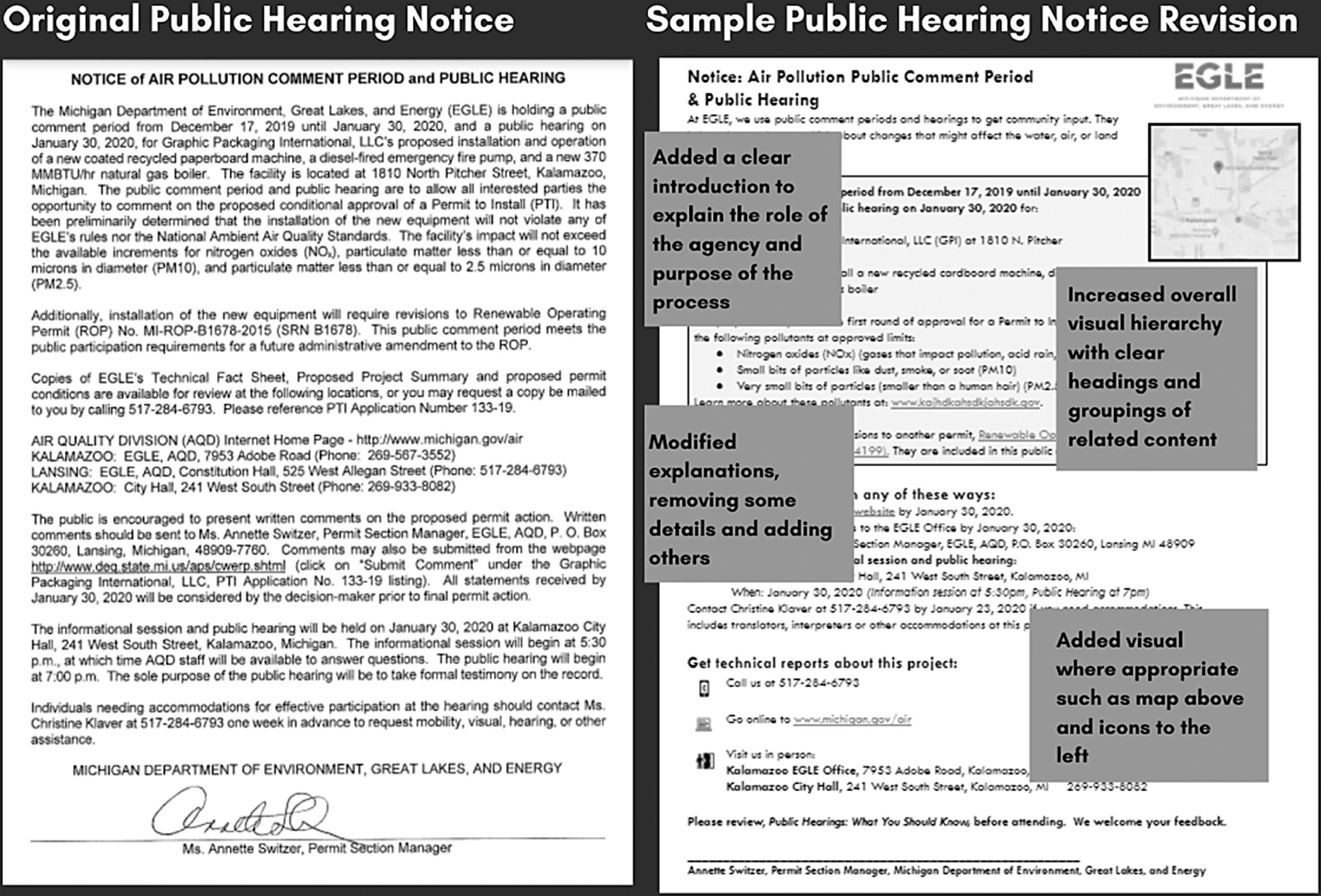
Before and after versions of Public Hearing Notice modified to include additional plain language strategies and address participants' feedback. EGLE, Michigan Department of Environment, Great Lakes, and Energy.

Before and after versions of How to Make a Freedom of Information Act Request modified to include additional plain language strategies and address participants' feedback.

Before and after versions of Proposed Project Summary (p. 1) modified to include additional plain language strategies and address participants' feedback.

Before and after versions of Proposed Project Summary (p. 2) modified to include additional plain language strategies and address participants' feedback.
Recommendations for Improving Plain Language in Environmental Decision Making
Long, Adam, and Long, Ben. “Hemingway Editor.” <
Readable. “Take Control of Your Content with ReadablePro.” <
“Free Readability Formulas: Free Readability Tools: Readability Calculators.” <
This study was conducted in the first several months of the COVID-19 pandemic's emergence in the United States, and this influenced study context in a few ways. The pandemic created new barriers and opportunities for public participation as federal, state, and local agencies were forced to pause in-person hearings or events and shift online. Although this was not the focus of the study, it raised new perspectives on what meaningful participation looks like, particularly as it relates to access to technology to view or read documents or attend meetings.
The California Environmental Protection Agency and California Natural Resources Agency quickly launched an event Online Environmental Engagement: Building Our Skills Together that laid out many key resources and strategies for this study, which may be relevant even when it is safe to gather in person again and hybrid strategies are likely to become common. 15 For this study, the COVID-19 pandemic affected our ability to conduct in-person focus groups and, perhaps, review more and different documents with additional residents of frontline communities and communities less impacted by cumulative risks, which may have also been informative.
Also, this qualitative study focused primarily on documents related to air quality and can only offer a snapshot of the overarching issues of environmental health literacy, public participation, and environmental decision making in the United States. Examination of documents related to other environmental issues with other staff, agencies, or regions would likely have led to additional insights.
Quantitative scales are under development for examining environmental health literacy for documents that involve reporting out environmental exposures or issues to the public, 16 , 17 , 18 , 19 but none are known to exist that focus on environmental decision-making documents and processes, which may be particularly relevant in addressing environmental racism. As there are 10 defined attributes of a “health literate organization,” 20 perhaps these can be adapted (Table 5) and applied for environmental health literate organizations.
Attributes of an Environmental Health Literate Organization
Adapted from Brach et al. 20
Our findings on plain language and meaningful participation should be considered in states' LEP plans and their implementation to increase potential for EJ. As already mentioned, this study was conducted when EGLE had a draft LEP open for public comment, which has since been finalized with a response to public comments.
21
,
22
As EJ leader Samra'a Luqman explained at the 2021 Michigan Environmental Justice Conference in her panel presentation:
“ I said right now I'm going to poison you but call me if you need an English translation…that's essentially what the state is doing right now. ”
”
As this study's findings imply, by starting with plain language, translation efforts will likely be more effective. Although agencies may not have the capacity to translate long permit applications into multiple languages, LEP efforts could accommodate many people by offering public notices or access to staff members in common languages spoken in frontline communities without specific requests and processes that shorten the public participation timeframe for non-English speakers. LEP requirements are an issue of civil rights codified in the United States by Title VI of the Civil Rights Act of 1964, Title VII of the Elementary and Secondary Education Amendments of 1967, and Executive Order 13166: Improving Access to Services for Persons with Limited English Proficiency signed by President Clinton in 2000, among other policies. 23 , 24 , 25
Also, as we consider plain language more broadly in society, it is worth examining the term “Limited English Proficiency.” Although it is used by the U.S. Department of Education's Office for Civil Rights, it is problematic as it indicates a deficiency in our multicultural society where multilingualism is not valued or normalized.
Ultimately, plain language is a prerequisite for EJ. EJ thought leaders have developed various frameworks that consider distributive (i.e., just outcomes), procedural (i.e., just public participation and decision-making processes), epistemic (i.e., valuing various forms of knowledge), and structural justice (i.e., just policies, institutions, and systems), all as part of EJ. As Lee explains, EJ practice often gets stymied and stuck by overfocusing on procedural elements. 2 On the surface, a discussion of plain language appears to fall solely into this same area of EJ focus—procedural justice. And, we do offer suggestions for improving procedural justice through this research.
However, the themes emerging from these focus groups and the content review show how plain language illuminates structural issues that are embedded in our organizational cultures and systems. For instance, EJ leaders discussed how plain language would enable them to more effectively educate decision makers and support cross-sector and interagency conversations and collaborations as a central EJ practice. Study participants' discussion of bias in documents and “the way the system was designed” highlights the reality that our underlying laws are not a means of granting us rights to protect ourselves and the health of the environment, particularly for frontline communities experiencing cumulative impacts.
Parts of the Clean Air Act, for instance, are essentially a pollution permitting scheme, granting a right to pollute to industry. As such, procedures and systems are structured for its intended beneficiaries (i.e., companies hoping to emit) and rely on highly technical language. Plain language approaches can reveal this more clearly, and inform efforts to organize for more precautionary rights-based approaches to environmental protection that consider cumulative impacts.
We are not the first to call on environmental agencies to use plain language. For decades, EJ leaders have recommended agencies address related barriers to public participation. For instance, the National Environmental Justice Advisory Council issued recommendations in 1996, with an updated version in 2012, of Model Guidelines for Public Participation. 26 More recently, per President Biden's Executive Order 14008: Tackling the Climate Crisis at Home and Abroad, the White House Environmental Justice Advisory Council (WHEJAC) was established and tasked with offering recommendations on the Justice40 initiative, a Climate and Economic Justice Screening Tool, and revisions to Executive Order 12898. The 92-page WHEJAC report references the need for plain language or translated materials in multiple instances. 27
CONCLUSION
Although plain language may appear simple in concept, agencies actually face many barriers to its implementation. Public participation that considers plain language means a process that centers the needs and priorities of frontline communities with increased ease for translation as well. To address EJ, agencies must reflect on how and why they are soliciting public participation in environmental decision making. Of course, there are capacity challenges for doing this work well, but as with all EJ-related efforts, administrations and agency directors can choose to prioritize their commitment to addressing environmental racism. Systems must be designed to enthusiastically encourage and support public participation, not deter it, and anything less will continue to perpetuate systems of inequity.
Footnotes
ACKNOWLEDGMENTS
We greatly appreciate the partnership of EGLE staff who are working hard to improve plain language throughout the agency, including Jennifer Acevedo, Michelle Bakun, Amanda Bosak, Liz Browne, Jenine Camilleri, Mary Carnegie, Jenifer Dixon, Grace Kuan, Erin Moran, Sandra Philpott-Burke, Chad Rogers, Erin Russell, Anita Singh, Mark Snow, April Wendling, Keisha Williams, and Ariel Zoldan. We also appreciate the support of Regina Strong and Katie Lambeth who are working to address EJ through their respective roles at EGLE. They were all committed to this project from the beginning and engaged in critical review of agency documents and processes. Finally, we thank the participants of the three focus groups for openly sharing their perspectives and wisdom.
AUTHOR DISCLOSURE STATEMENT
No competing financial interests exist.
FUNDING INFORMATION
This research was supported by a grant from the University of Michigan-Dearborn.