




Abstract
Background:
In the least densely populated residential neighborhood of Chicago, deindustrial brownfields are being repurposed into sites of outdoor recreation and green spaces. This article explores the subjective experience of park development on one of these sites, focusing on how the socioeconomic contexts of the neoliberal city creates complex and ambivalent experiences of green space development.
Methods:
Data regarding residents' and community leaders' perceptions of park development emerge from digital and in-person participant observation, analysis of Chicago-area newspapers, and two rounds of interviews conducted in 2015–2017 and 2020–2021.
Results and Discussion:
Due to the continued presence of private-public partnerships and industrial activities on the Southeast Side, I find that park development on the Southeast Side of Chicago produces feelings of ambivalence rather than uninhibited enthusiasm for new parks. I suggest that this ambivalence about deindustrial land uses is characteristic of the neoliberalization of American communities. Given patterns of disinvestment and privatization in deindustrialized cities, certain land use debates summon neither passionate commitment nor vehement resistance simply because they cannot address the accrual of structural problems.
Conclusion:
Leveraging public–private partnerships to renovate deindustrial landscapes into sites for outdoor recreation nonetheless allows locals to emphasize why certain places near their homes are worth rendering visible once again.
INTRODUCTION
On a windy Earth Day, I joined a group of Southeast Chicago birdwatchers on a walk through a marshland. My companions pressed binoculars to their eyes, pointing out a green heron there, a gull here—and could that be a rare least bittern in the distance? The National Audubon Society considers this 3000-acre patchwork of marshlands on the Southeast Side of Chicago an “Important Bird Area” vital for songbird and waterfowl migrations across the highly urbanized southern region of Lake Michigan. 1
However, the land we cross is hardly wilderness as commonly conceived. A gangly great blue heron glides past stationary tugboats posted outside warehouses and new industrial buildings. Birdsong is interrupted by the distant din of an interstate highway and the clatter of nearby railroad tracks. Rubble of long-closed steel mills punctuates the horizon. We stand on liminal landscapes haunted by the twin ghosts of industrial pasts and contemporary brownfield transformations (Fig. 1).

Fieldwalk in April 2017. Photo by author.
Before these landscapes, were nesting grounds for waterfowl, they held steel mills and their ancillary industries (Fig. 2). For a century, tens of thousands of local residents walked to work from millgate neighborhoods. With the late-twentieth century collapse of the industry, dozens of former industrial properties eroded into “abandoned, idled, or under-used” brownfields where “expansion or redevelopment is complicated by real or perceived environmental contamination,” according to the U.S. Environmental Protection Agency. 2

City of Chicago, Illinois, with the Southeast Side in box. © OpenStreetMap contributors.
In the 1970s, federal rules established in the wake of multiple cases of industrial waste contaminating drinking water or seeping into houses required that the redevelopment of brownfields for residential use be preceded by thorough remediation. The soil of formerly industrial properties must be tested, cleaned, sealed, retested, and, in some cases, left fallow before being reused for houses, schools, or commercial businesses. 3 Because remediation can take decades and cost millions of dollars, properties can lie vacant for years and drive down property values. 4
In Chicago, deindustrialization's bankruptcies brought the transfer of private property ownership—and liability—to the public sphere. An amalgam of federal programming and city bureaucracies took responsibility to either clean up or limit access to polluted properties. Ironically, due to systematic defunding of city government agencies, the remediation and reuse of these brownfields relied once again on private capital through public–private partnerships (PPP)—“cooperative ventures between the state and private business” that leverage capital's interest in competition and capacity for investment to solve public problems. 5
When this cost-sharing approach is applied to brownfield remediation, proponents argue that public incentivization of private investment in marginalized land allows governments to transform liabilities into revenue-building opportunities. Critics suggest that such formal relinquishment of decision-making processes to capital exacerbates environmental injustices. To maximize profit, and without regulatory counterbalances, capital will always seek to externalize its risks to minimize costs. 6 Public incentives, such as PPP, can encourage industrial capital's race-to-the-bottom search for efficiency, thus reproducing environmentally overburdened neighborhoods.
In Southeast Chicago, the opportunities and tensions of PPP delimit two possible reuses of brownfields. First, the City of Chicago offers publicly funded tax breaks, loans, and grants to attract new, “lighter” industries to claim cheap and vacant brownfield properties on the Southeast Side. 7 This intentional reindustrialization of already polluted properties by landfills, recycling plants, storage depots, and fertilizer manufacturers, also known as circular land management, addresses the dual challenges of mass deindustrialization and increased environmental regulations constraining how postindustrial properties could be reused. 8
Since the 1980s, reindustrialization has offered bureaucrats an avenue to transform vacant land into taxable and job-producing businesses while keeping more financially valuable “greenfields” from entering a city's brownfield cycle. 9 In a ward where 23% of families earn an income below the federal poverty level and the pre-COVID-19 unemployment rate was more than three times that of the city average, new employment is a shared goal for policy makers and residents.
And yet, as every year brings new proposals for more polluting companies to move to the neighborhood, many Southeast Side residents are resisting, finding that the cost–benefit balance of circular land management falls short. 10 In this majority Black and Brown community, activists identify their community as a site of environmental racism rendered a sacrifice zone—a location that has been permanently impaired by environmental damage and economic disinvestment. 11
Recently, an alternative reuse of brownfields has emerged: the renaturalization of vacant properties into public parks, sites for outdoor recreation, and habitat restoration. 12 In 2010, the Chicago Park District (CPD) announced a goal to administer more than 2000 acres of nature space on the Southeast Side, framing their goal in terms of reclaiming vacant lands and resisting harms of reindustrialization. The city has since acquired and completed initial remediation on eight brownfield properties that today comprise one quarter of the 8800 acres of land owned or managed by the CPD. 13
Brownfields developed into parks are often those with characteristics that would be challenging to develop into other uses—vacant lands with rising marsh waters, tricky land tenure arrangements, or immovable remnants of steel mill building foundations. And yet, the hiking paths and public benches are scattered around these properties are just as contingent on neoliberal logics of private partnership as are new industries. 14 On the Southeast Side city parks website, the CPD acknowledges 30 private donor organizations. 15 The CPD might organize the logistics of remediation and lawn mowing, but funds to create and maintain parks require significant investment from companies, philanthropists, and volunteers.
At face value, parks and industry seem binary: Vacant fields tend to be transformed into either green spaces or new industries, with one of those options obviously more aligned with environmental justice than the other. However, using the case of one of the most popular—and privately funded—park development projects on the Southeast Side, this article explores the sentiments of ambivalence regarding the transformation of brownfields into parks.
Drawing from interviews, participant observation, and document analysis, I find that Southeast Chicago stakeholders—volunteers, staff, and political leaders directly involved in brownfield redevelopment—offer brutally honest assessments of both costs and benefits of park building in a neoliberalized city. I suggest that, since both reindustrialization and park building employ similar funding schemes and exist in the same context, they share in common an incapacity to solve fundamental problems characterizing disinvested, deindustrialized cities.
To make this argument, I leverage the sociological concept of ambivalence. Rather than an individualized, psychological malaise, ambivalence is a sentiment “built into the structure of social statuses and roles,” according to Robert Merton. Roles, interests, and values collide with contradictory social structures to “result in mixed feelings and compromise behavior.” 16
Michael Carolan's application of this concept to environmental issues offers an apt link to brownfield redevelopment in neoliberal cities. Ambivalence, in Carolan's view, is a “product of our sociological and ecological embeddedness” and thus “an unavoidable condition of being a social actor” in modern environmental and socioeconomic contexts. 17 Complex forms of land ownership, liability, and private investment characterize Southeast Chicago. On these neoliberal landscapes, private capital often controls the fates of marginalized lands and the neighborhoods that surround them. Thus, stakeholders experience a complex relationship with neoliberalism and environmental justice. Neither green spaces nor polluting industries can exist without coordination between private capital and public governance.
METHODS
As part of a broader project on placemaking in long-deindustrialized communities, I collected ethnographic, interview, and historical data applicable to this paper over two stages. First, while living in Chicago from 2015 to 2017, I attended union meetings for retired steelworkers, community nature walks, and public park events. I traversed landscapes with participants, inviting them to show me places of significance to their identities and experiences of place and economic change.
During the COVID-19 pandemic (2020–2021), I conducted follow-up research focused on park development through digital methods. I attended seven public meetings in Chicago via Zoom and analyzed social media posts regarding contemporary conflicts over land use and development, and I drew from profiles, quotes, and interviews by community leaders and residents highlighted in Chicago-area newspapers. I collected and analyzed dozens of city reports, policies, and proposals about PPP, park development, and brownfield remediation.
In both original and follow-up research, these ethnographic interactions and secondary source material seeded my access to 50 interviews with residents and community leaders, of which ∼20 discussed park development. I consider this subset of interviews for this article. These studies were reviewed and exempted by my universities' Internal Review Boards.
These data allowed me a multifaceted approach to understanding perceptions of park development from stakeholders invested in brownfield repurposing—community members attending public meetings, non-profit leaders and members, and political representatives. Although the centrality of private capital for reuse of brownfields is invisible to park visitors, the neoliberal logics of land use costs and benefits emerged in interviews and participant observation.
RESULTS: THE CASE OF BIG MARSH
In the early 2000s, two companies had a vision for a philanthropic investment in the city of Chicago (Fig. 3). Recreational Equipment, Inc (REI), the outdoor recreation gear cooperative, and SRAM, a bike part manufacturer, approached the CPD expressing interest in funding the creation of a car-free park for recreational cyclists to coast along several miles of asphalt trails with jumps and a pump-track—a circular paved path with artificial hills that mountain bikers and skateboarders use to gain speed and practice jumps.

Big Marsh Park is surrounded by wetlands (blue dots), roads, and railroad tracks. © OpenStreetMap contributors.
Company representatives initially proposed a park located in the center city, but city planners instead offered them a property on the Southeast Side. This 300-acre plot of land was once a waste and slag dumping site for Acme Steel, a company that went bankrupt in the 1990s. The city had struggled to manage this land for decades, as rising marshland waters surfaced a high level of chemical seepage. As de facto owners of this abandoned property, the city shouldered liability for residual pollution until the 2000s when it capped and sealed the waste with topsoil.
In 2015, the philanthropic branches of REI and SRAM took over this large plot of land from the city. Organized through the companies' coordinated nonprofit Friends of Big Marsh Park, these two firms paid for the construction of off-road bike tracks, a hiking trail loop, and access roads over the next 2 years. Funding and management structures for Big Marsh Park reflect the increasingly privatized models of urban governance. Big Marsh Park's total budget—including salaries for two paid staff and costs for construction and programming—is 95% funded by private companies. The remaining 5% comes from maintenance work completed on an as-needed basis by the CPD.
Even land tenure and asset ownership are navigated across public and private lines. The full-time head of Friends of Big Marsh formed by the park's founding companies is Paul*,
18
a white man in his late 30s. In a phone interview, he said:
The way the bike park development works right now is that when we built the asphalt pump tracks last year, Friends of Big Marsh built the pump tracks—we applied for and received access permit from the Park District, and we hired the contractors. Any plans for what we want to build need to be approved by the Park District, you're going to ask the landowner. And then, when we build it, we then donate it to the Park District.
Likewise, the environmental education center located on CPD-owned land in the park is also partially privately funded. The Ford Calumet Environmental Center was initially enabled through a grant from the City of Chicago, but its buildings were completed through donations by a nearby Ford factory as part of a community benefits agreement. 19 The Environmental Center, which opened in fall 2021, offers birdwatching excursions, a gallery of local artist's nature-themed paintings, and educational programming for local public schools (Fig. 4).
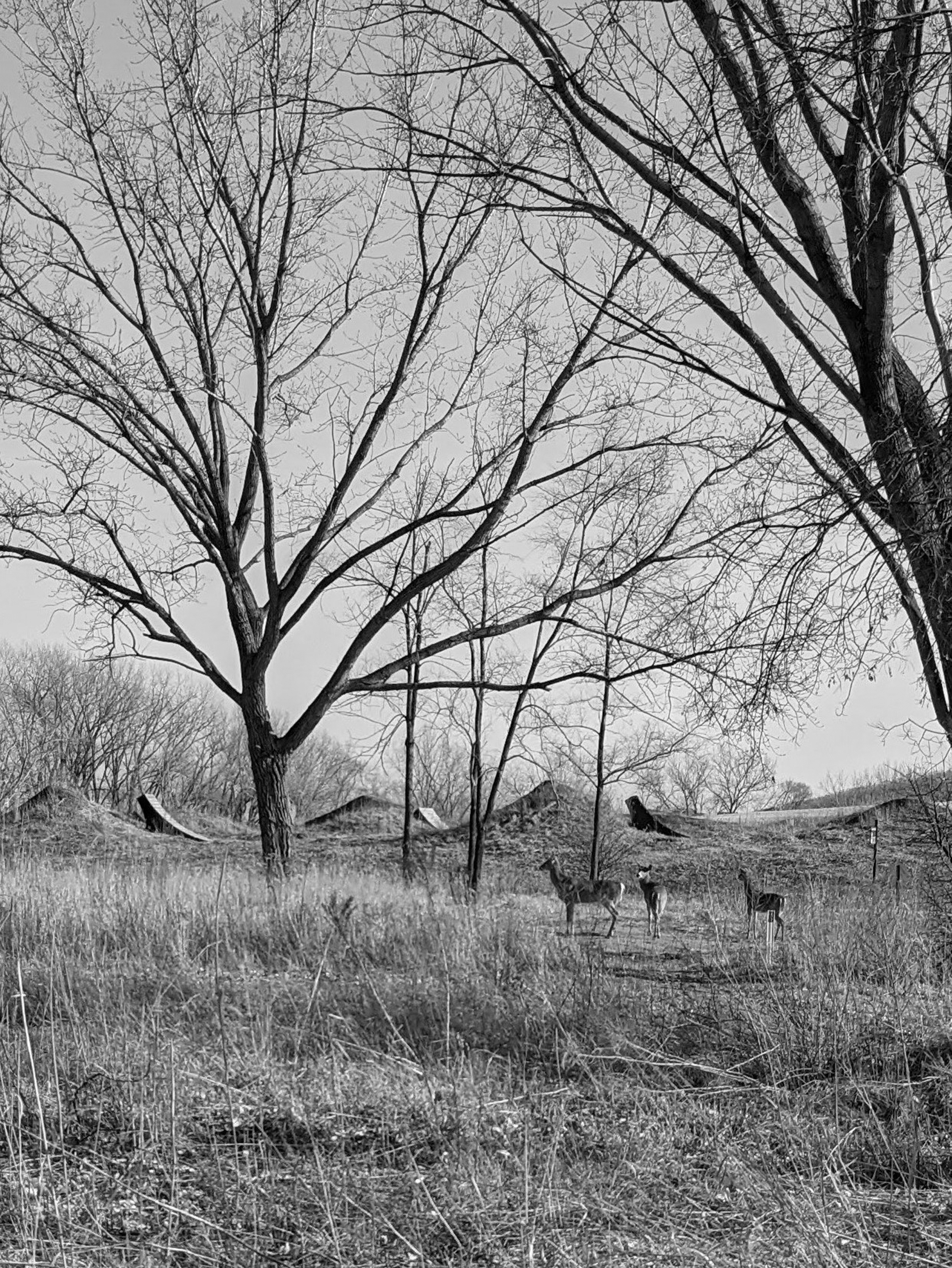
White-tailed deer graze between bike jumps in Big Marsh Park.
When reflecting on this ongoing park project, residents and community leaders did express enthusiasm that parks such as Big Marsh might, challenge the practice of circular land use. In 2011, a local environmental leader told a journalist, “here on the Southeast Side of Chicago, all we get is more industry. So, what we're hoping is that by preserving these ecological gems that eventually they become our assets. Perhaps we could do eco-tourism here, bring people from outside of the community to our community.” 20
Similarly, in public meetings that I attended and in half of the interviews that discussed park development, residents voiced hope that eco-tourism might contradict the trend of reindustrialization by turning properties “where there's nothing” into destinations for outdoor recreation. Perhaps the Southeast Side could become known for outdoor activities ranging from “heart-pumping adventures like rock climbing and mountain biking, to more passive activities like fishing, birding, or trail walks,” as pitched by the website for Chicago parks on the Southeast Side. 21
I heard similar themes from Roy, a stocky white man more at ease with binoculars than on a bike. Each year, he joins hundreds of members of the Chicago Audubon Society for its annual Calumet Marsh Bird Survey to count breeding marsh birds in protected wetland habitats. He told me in a one-on-one interview that he liked the new bike park even though “it wasn't my idea having a bike park there,” being “in that category” of naturalists who would be more inclined to leave vacant lands untouched in an urban region where “there's such little habitat left anymore.” He held up his hand in a caveat.
“But we have been—for 20 years!—endeavoring to get it cleaned up and more inviting to members of the community. You see other areas of the city getting all the benefits, like up on North Side,” he pointed his chin northward, toward the skyline barely visible in the distance. “The 606 and the Lakefront and downtown and everything,” he said, referring to a multi-million-dollar investment in several new park projects in the city center. “And, we're saying, ‘Hey, look at this remote area out here. Look at how degraded it has been,’ and, ‘Don't we deserve something out here? At least clean things up.’ So, I think it's a good thing in that regard, that we're finally getting some attention down here.”
Further, Roy argued, the development of public green space countered the dominant narrative of the region as industrial. “We no longer have to just look at ourselves as a polluted end of the line for everything that the city wants to get rid of. [We want] to rebrand ourselves, to be the playground of the city instead, and a place where people can come out and camp, fish, and hike and bike ride, and things like that. Why not?” 22
By mid-2021, Big Marsh Park came to represent that alternative vision of the Southeast Side for which Roy and many of his fellow community members had expressed hope. According to the data provided by Friends of Big Marsh, the number of cars entering the park increased by 400% between 2019 and 2021—from an average of 30 cars a day to 122 cars per day. In August 2021, the park had a peak day of 349 cars. 23
Park popularity offers evidence that this park is attracting visitors excited to use this former brownfield as a “playground” rather than a dump. Doubtless, this form of neoliberal brownfield redevelopment offers greater opportunities for equity, access, and new narratives of environmental goods rather than another generation of environmental sacrifice. However, those who discussed green spaces often stopped short of offering enthusiastic support for new outdoor recreation sites.
Sources of ambivalence about parks
Stakeholders consistently critiqued two limitations to park development: (1) it's ineffectiveness in addressing regional economic problems and (2) impotence against physical barriers to access stemming from past and present industrial land uses. Disappointment in the capacity of parks to repair economic problems emerged most pointedly in interviews. On the smallest scale, parks' proponents had hoped that increased traffic to Big Marsh would produce noticeable economic gains to local businesses. Drivers might spend money at gas stations and buy lunch from the smoked seafood shack on the bridge over the Calumet River. Birders from north Chicago, Indiana, and the suburbs who participate in the Christmas bird count may grab pre-dawn coffee from corner diners.
Certainly, for those gas station owners, food shack cooks, and waitresses serving coffee, an increased customer base is welcome. However, at this stage of data collection, any aggregate economic boon from those small economic injections is negligible. 24 Bicycling, birdwatching, and educational activities are essentially free, and the Southeast Side offers no notable hospitality industry to house overnight visitors. 25
Employment was a second theme of economic failure linked with parks development. Juanita,* the head of the citywide Friends of the Parks, group reflected on this tension. Her board wrestled with contradictions between “our base that just wants a pretty park” and locals on the Southeast Side who “care more about, ‘right, yes, I'd like more parkland—but I want a job!’” Parks demand very few employees. Friends of Big Marsh pay their director and one assistant to coordinate programing and apply for grants. The CPD hires people to perform maintenance and build parks, but those employees live in neighborhoods across the city. Even work performed by hyperlocal land trusts or organizations requires teams of merely three to five employees.
Even larger-scale structural shifts, such as increased property values that typically characterize neighborhoods with attractive green spaces, have failed to materialize. In economically depressed neighborhoods, gentrification is a double-edged sword, capable of displacing vulnerable residents even as it brings an influx of much-needed capital investment to marginalized communities.
Past research on urban parks suggests that this problematic and promising side effect of green space development should be rippling through the Southeast Side. For instance, Essoka demonstrates that green spaces attract higher-wage residents whose willingness to pay for housing prices out incumbent residents. 26 Elliot, Korver-Glenn, and Bolger identify how most gentrifying investments occur adjacent to parks on deindustrial land located in center cities. 27 These causal links between park creation and the displacing effects of residential and commercial redevelopment that outprices low-income renters and mom-and-pop shops are so concerning to many urban residents that Gould and Lewis found that some may collectively resist “green gentrification” through public forums and protests. 28
Contrary to these patterns, the Southeast Side has experienced little gentrification. At first glance, this might be surprising—the verdant marshlands, sparkling lakefront views, and inexpensive housing seem a siren's call to wealthy newcomers seeking good residential and commercial investments. However, even with low population density and access to nature, the Southeast Side is not attracting wealthy residents.
When I asked Paul whether he and his team at Big Marsh were concerned that their park would exacerbate gentrification, he said, “I don't want to be naive, right,” but gentrification is “not at a point where it's come up consistently” in community meetings or in conversation with his local Big Marsh volunteer board. Paul reflected, “I'm sure somebody would disagree with me, but the far Southeast Side is still sort of outside of most of the gentrification network in Chicago.” The neighborhood claims a 15-mile commute to downtown with little public transportation, the city's only industrial river, and houses tucked between power plants.
Housing price data back up Paul's intuition. For decades, the neighborhoods surrounding Big Marsh and other natural areas have maintained some of the lowest housing prices in the city—this even with the pandemic-driven, national price hike for houses in less densely populated regions. 29 Similarly, the neighborhood's elected representative to city council, told me with a laugh, “I don't at all think that we're gentrifying South Chicago.” The most the region could hope for was a “shot in the arm” to get some economic stimulation, she said.
In short, if parks and recreational spaces are evaluated solely based on their economic contributions to the 10th Ward, they fail cost–benefit assessments. Ambivalence emerges when park development fails to solve material problems.
Issues of access emerged as a second reason for locals' ambivalent relationship to park development. Since the mid-1800s, the Southeast Side of Chicago has been reorganized, dissected, and cordoned off to prioritize capital over social life. At the turn of the century, marshy rivers were corralled into canals and cemented into docks, and open fields were crisscrossed with industrial-sized railroads and streets. When companies were open, steel workers walked to work via footbridges and pedestrian paths. However, with deindustrialization came liability, locked gates, and a mess of restrictive land tenure arrangements, toxic properties, off-limits waterways, and convoluted public transportation routes. Although park development is often framed by stakeholders as a welcome reduction of land available for industrial sacrifice, both land uses are stitched together with neighborhoods in a patchwork of deindustrialized landscapes. Contemporary reindustrialization collides these marginal, “unintentional landscapes” of historical capitalism, as geographer Matthew Gandy put it, to create issues of infrastructure and access for residents on the Southeast Side. 30
At Big Marsh, private capital investments from REI and SRAM could do little to repair locals' embeddedness in landscapes made for and by capital. Paul is one of the most vocal critics of the problem of accessibility. “The only reason there's a 300-acre park for the City of Chicago … is because it's sort of not in the most accessible place.” His lips formed a thin line in concentration as he explained the logistical problems of the park's location. The street leading to Big Marsh Park from the East Side neighborhood “dead-ends at the tracks. It's officially railroad property.”
The railroad companies are nervous about liability issues if kids cross the tracks, he said, but biking on the main road has its own problems. “It's really hard for local kids to access the Big Marsh bike park from the East Side (one of the neighborhoods on the Southeast Side). They have to bike six miles to get to the entrance of a park that is, geographically, three-quarters of a mile from their neighborhood.” Since bicycling to the park from residential neighborhoods in the 10th Ward is so difficult, it creates an awkward class and age stratification for users of the park. At a public meeting, Carlie, a young white woman who volunteers with a local teen group to coordinate group rides to the park, voiced concern on that they have to either “risk heavy traffic” and flat tires or cycle “miles out of their way” to safely get to the bike park. Young people and those without access to cars may feel excluded from their own park.
In this majority Latino/a and African American neighborhood, issues of accessibility offer local residents racially inequitable imaginaries of nature. As Carolyn Finney articulates, who feels like they belong in natural landscapes set aside for “recreation, scenic viewing, scientific understanding, [and] education” reflects American histories of racial exclusion. 31 Even though volunteers and staffers for Big Marsh's programming intentionally reflect the region's African American and Latino residents, the park's embeddedness in an active, industrial sacrifice zone seems to still structurally exclude and symbolically alienate many locals. A few interviewees bluntly stated that Big Marsh Park was too hard to get to and, as a bike park, probably wasn't “for them.” Two others mentioned concerns about performing outdoor activities in one of the parts of the city, with the highest concentrations of particulate air pollution. 32
And then there's the views. Everywhere you turn, vistas of industry obscure the horizon. Large and busy roads funnel trucks past neighborhoods; electricity plans groan and crackle; ammonia from a fertilizer manufacturer wafts over houses on humid days; and, even looking out at Lake Michigan, plumes of emissions from the last steel plant in Gary, Indiana fog the horizon. At a public meeting about a proposed pocket park along the banks of the Calumet River—accessible only via a small towpath between two industrial buildings—one resident, Maria, a Latina in her mid-50s, said, “our Calumet River has a hard landscape. It's discouraging that we can't have a pretty view.” Another participant in this meeting—Sheila, a white woman in her 60s—complained that “we do have all the wildlife, we just don't have a chance to stop and see it.”
Unlike new industries, parks do not actively produce environmental injustice. However, they can still fail to create justice. Parks such as Big Marsh might feel most accessible to residents who do not live in the midst of the sacrifice zone of active industries, who can drive around infrastructural problems and leave when the pollution feels oppressive. Yet, decades of powerful environmental justice activism by residents of the region's African American and Latino communities resisting new industries have called for decreased environmental harms and increased accessibility to local ecological gems. 33
The persistence of local exclusion from greenspaces troubled Paul, the director of Friends of Big Marsh. He explicitly linked anti-reindustrialization environmental activism with the potential environmental good of parks, stating that his “hope is that the people who have been part of the environmental justice movement”—those fighting against new industrial land uses, in particular—“can benefit from access to green space in their backyards. I think [parks] can be about equity!”
DISCUSSION: AMBIVALENCE AND THE NEOLIBERAL CITY
Neoliberal relations condition ambivalence over land uses. Land use on the Southeast Side of Chicago has always been contingent on capital's presence or absence: steel mill properties were organized and then abandoned, remediated and reinvested in, or left vacant based on the availability of private investment.
My interviewees may not have explicitly linked their assessments of park developments to neoliberalism, but PPP were always a taken-for-granted context undergirding the limited menus of options for brownfield redevelopment. Capital might reproduce environmental harms by siting a new, polluting plant on already polluted lands, or it may enable brownfields to be cleaned and returned to the community. Local residents have few avenues for meaningful engagement in much of these initial land use decisions, rendering ambivalence the dominant sentiment.
Once underway, park development can be a blunt weapon against the pervasive residues of decades of economic displacement, austerity, and spatial marginalization within the city. Big Marsh Park remains in a polluted area, with access limitations and an incapacity to directly solve the pervasive problems of economic depression. Outdoor recreation and habitat restoration do not provide jobs or infrastructure, nor are local property values or commercial avenues benefiting from the economic “goods” of gentrification.
However, to riff on Margaret Thatcher's famous quip about there being “no alternative” to neoliberal trade policies, stakeholders in my case feel that, given the disinvestment of their neighborhood, there is no good alternative for brownfield reuse that exceeds the harm reduction potentials of parks. For these reasons, park development calls forth neither open-handed acceptance of nor active resistance to the continued centrality of private actors in renovating public spaces. 34
Beyond the case of park development, an emerging body of literature suggests that across rural and urban contexts, ambivalence is characteristic of and conditioned by the paradoxes inherent to neoliberalism. Mullenbach et al. note contradictions entangling responses to survey questions about possible park development in St. Louis neighborhoods. 35 Respondents simultaneously supported symptoms of gentrification while also supporting preserving neighborhoods from displacing effects. Land uses in rural settings similarly reflect contradictory preferences. Stephanie Malin observes how, because experiences of environmental injustice were emmeshed in economic benefits from unconventional oil and gas drilling in Colorado, stakeholders felt confused and powerless. 36 Colin Jerolmack demonstrates how rural Pennsylvanian landowners who were initially enthusiastic to allow fracking on their land grew disillusioned as they observed capital's infractions on their privacy and personhood. 37 These disparate studies hold in common a thread: a grim acknowledgment that private capital holds tremendous power over land uses in contemporary America.
CONCLUSION
If ambivalence is a consequence of a neoliberal context of constrained options, what is the potential consequence of collective ambivalence to land use? Sentiments of disenfranchisement from the decision-making process about what to do with local brownfields or alienation from green spaces ostensibly created for all residents may make the neoliberal basis for land decisions even more taken-for-granted. However, let us flip the framing.
A recognition that ambivalence is not merely a symptom of neoliberal decision making but might further exacerbate inequality calls for intentional inclusion of local stakeholders in the process of not only reusing brownfields but also diagnosing larger-scale structural problems that might limit access to those properties. In turn, outdoor recreation that builds on existing landscapes can challenge those both inside and outside a community to reimagine what a deindustrialized place can become.
Already, more attention seems to be encouraging the city to pay attention to environmental justice concerns, to send funds to repair crumbling infrastructures, and to infuse new grant money into a “forgotten part of the city,” as Louisa told me. In turn, perhaps more car traffic to Big Marsh or newspaper editorials about the tensions between industries and wild lands will lend a megaphone to the roots of ambivalence that characterize park development. Even with its limits, leveraging private funds may yet allow locals to emphasize why certain places are special, sacred, and worth rendering visible once again.
Footnotes
ACKNOWLEDGMENTS
Thank you to the audiences at Drexel University's Science and Technology Studies' Works in Progress seminar and the American Sociological Association's environmental justice roundtables. Katrina quisumbing king offered indispensable feedback. The author is the most indebted to the residents of southeast Chicago.
AUTHOR DISCLOSURE STATEMENT
No competing financial interests exist.
FUNDING INFORMATION
Research was supported by grants through the University of Wisconsin-Madison's Department of Sociology, the Rural Sociological Society's Dissertation Award, and The Antelo Devereux Award for Young Faculty, Drexel University.