




Abstract
In December 1974, the National Park Service established the Cuyahoga Valley National Recreation Area (CVNRA) in northeastern Ohio as part of a nationwide effort to increase the amount of green space available to urban residents. Today, the Cuyahoga Valley National Park (CVNP) comprises ∼33,000 acres, and its combination of historic artifacts, nature trails, and recreational amenities attracts over 2.2 million visitors annually. As is the case with many units in the national park system, the typical park visitor to CVNP is white, highly educated, and older. While the park's management has dedicated considerable time and resources to Diversity, Equity, and Inclusion programs over the past 40 years, CVNP still struggles to attract visitors who reflect the diversity of the surrounding area. Drawing from archival data, including CVNP long-range and annual interpretive plans, as well as interviews with past and current staff members, we examine some of the ways CVNP officials attempted to engage a more diverse audience in the past, determine why early efforts to attract a more diverse visitor profile were unsuccessful, and explore what challenges remain today.
INTRODUCTION
Noting that more than 80% of the U.S. population now live in urban areas and that cities “present a higher density and more diverse population,” current and former officials with the National Park Service (NPS) increasingly recognize the value of urban parks when it comes to attracting a younger and more diverse audience. 1 In their 2018 call-to-action, The Future of Conservation in America, Gary Machlis, former NPS science advisor, and Jonathan Jarvis, director of the Park Service during the Obama Administration, argue that the future of conservation in general—and support for national parks in particular—depends on making the movement “relevant to all Americans, especially the more diverse millennial generation.” 2
According to Christine Lehnertz, former director of the NPS Pacific West region: “Urban parks are going to be the Park Service's entrée to people now and into the future. … I think the Park Service has an opportunity to reach people through cultural parks in urban areas.” 3 The recent promotion of urban parks by NPS administrators is not a new phenomenon. Rather, it is the latest in a long succession of attempts by the Park Service to engage with urban residents and broaden its constituency.
During the 1960s and 1970s, the NPS sought to provide urban dwellers with greater access to parks and open space. In response, Congress added several units to the National Park System that were located near large population centers. Among these was Cuyahoga Valley National Recreation Area (CVNRA), known today as Cuyahoga Valley National Park (CVNP). While CVNP ranks among the top 10 most visited “national parks” in the United States, evidence suggests that the unit is not serving all residents of the region. 4
A 2015 survey indicated that the typical CVNP visitor was “whiter, older, and more educated than the American public and the residents of Northeast Ohio as a whole.” 5 This has been the case despite officials at CVNP investing considerable time and effort over the past 40 years to diversify its audience. This study examines some of the ways CVNP officials attempted to engage with Black, Indigenous, and People of Color (BIPOC) communities—especially African Americans—in the past to determine why early efforts to attract a more diverse visitor profile were unsuccessful and to explore what challenges remain today.
METHODS AND DATA
We used archival methods and semistructured interviews to complete this study. 6 The principal archival data available were the park's long-range interpretive plans (LRIPs) and annual interpretive plans (AIPs). LRIPs focus on the park's goals for the future and include a long-range summary of past interpretive programs and future interpretive goals. LRIPs were produced in 2003 and 2008. AIPs summarize interpretive programs from the previous year and plans for the upcoming year, including yearly strategies for achieving park objectives. AIPs were available for the periods 1981–1990 and 2003–2018. When asked about the 13-year gap in available AIPs, park personnel stated that it was likely no plans were created during this interval, as the main focus of the period would have been on the development of the park's facilities.
We also interviewed six current and past CVNP employees (IRB 20-E-276), all of whom have been involved in efforts to diversify park visitation and create a more inclusive space. Interviews were conducted remotely via Zoom and ranged from 1 to 2 hours in length based on interviewee availability. Interviewees were asked about their role(s) as a park employee; the Diversity, Equity, and Inclusion initiatives they were involved in; and their perspective on how CVNP can reach a more diverse demographic in the future. Interview subjects included three white females, one white male, one black male, and one black female. Employment tenure at the park ranged from 2 to 28 years.
The study was conducted between April 2020 and May 2021 and was subject to several limitations. For example, due to the COVID-19 pandemic, all interviews had to be conducted remotely. Also, in September 2020, the Trump Administration issued executive order 13950 mandating that federal agencies halt all language, trainings, projects, and work related to Diversity, Equity, and Inclusion (Exec. Order No. 13950, 2020). A few interviewees described how this delayed their work, as they had to pause ongoing projects and initiatives. Interviews for this research were also delayed, and one interview conducted in December 2020 had to be limited in scope and depth. In addition, NPS employees may have been less likely to discuss park failures and weaknesses due to personal investment in these projects or to project a positive image of the Park Service.
Future studies could provide a new perspective on this research by connecting with former participants of CVNP programs to understand their impact, or by interviewing local residents about their perceptions of the park.
BRINGING PARKS TO THE PEOPLE
Over the past 150 years, the National Park System has expanded to include over 400 units with 19 distinct classifications, including national parks, monuments, seashores, recreation areas, battlefields, trails, and other designations. It is administered by the NPS, which was established in 1916 to manage these resources on behalf of the American people. 7
The purpose of national parks has evolved over time. Initially, the goal was to preserve dramatic and monumental landscapes, as well as foster a sense of national pride. As the system expanded, the mission of the NPS broadened to include protection of landscapes of historical, cultural, and scientific interest. 8 In 1962, the Outdoor Recreation Resources Review Commission (ORRRC) determined there was an urgent need for more recreational opportunities close to urban areas. The Park Service—building on efforts begun in the 1930s—then advocated for new units close to urban areas in what became known as the Parks to the People movement. 9 The creation of the Gateway National Recreation Area near New York City and the Golden Gate National Recreation Area in San Francisco, both in 1972, demonstrated the Park Service's commitment to the effort. 10
Today, the NPS manages units in 40 of the 50 most populated metropolitan areas in the United States, and 36% of the system's total visitation is concentrated in urban units. 11
With the same purpose in mind, the NPS established CVNRA in 1974. 12 Located between Akron and Cleveland, the unit achieved national park status in 2000 13 (Fig. 1). Today, CVNP comprises ∼33,000 acres—including 22 miles of the Cuyahoga River, historic canals and settlements, a scenic railroad, and more than 50 square miles of forested land with 140 miles of trails—and attracts over 2.2 million visitors annually, making it one of the most visited national parks in the system. 14
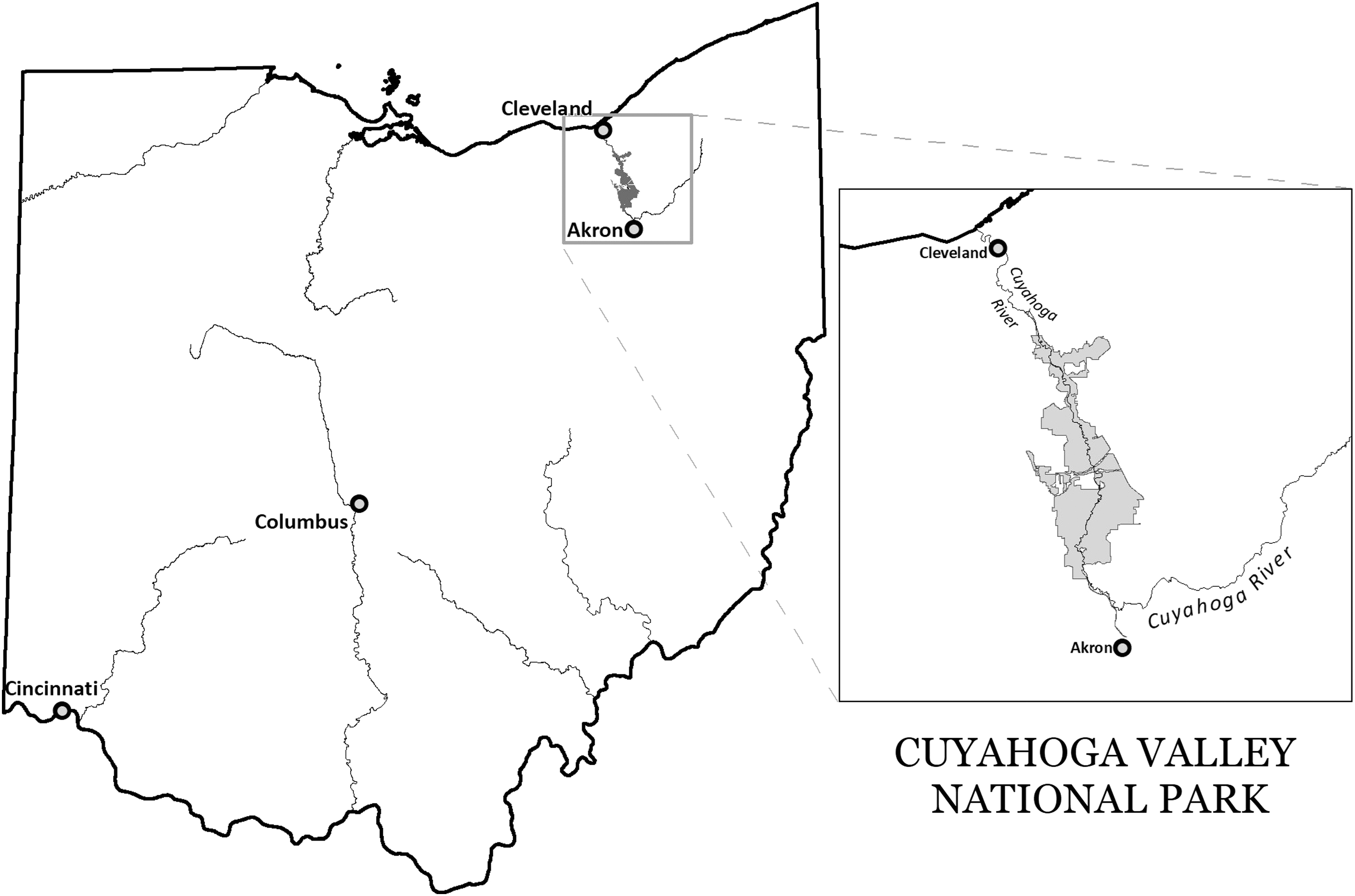
Cuyahoga Valley National Park. Cartography by Sean Hollowell. Sources: State boundary and city data from U.S. Census TIGER Line Datasets (2019); river data from USGS NHD; park boundary from NPS Land Resources Division. Retrieved from the NPS Open Data GIS viewer. CVNP, Cuyahoga Valley National Park; NHD, National Hydrography Dataset; NPS, National Park Service; USGS, United States Geological Survey.
ACCESS AND EQUITY
Demographic data show that young people, urban residents, and people of color are less likely to visit national park units. 15 African Americans, in particular, are the least likely group to recreate outdoors, engage with conservation groups, or work in the land or wildlife management fields. 16 In a 2008 survey, African Americans were the most underrepresented ethnic or racial group at national park units, accounting for just 7% of visitors, followed by Hispanics at 9%. 17 This demonstrates that the National Park System is underserving certain segments of the population. Considering that the majority of the U.S. population will be nonwhite by 2042, attracting greater participation from BIPOC is essential to ensuring the future of the national parks. 18
The underrepresentation of BIPOC at national parks, most notably African Americans, should be viewed through an environmental justice lens, as this segment of the population is not sharing in the health and recreational benefits offered by these spaces, which are intended for use by all. 19 We situate this study at the juncture of distributional, procedural, and interactional justice, placing particular emphasis on the latter two. 20 While the NPS sought to improve access by adding units close to population centers, it did not necessarily pursue this strategy with distributive justice explicitly in mind. Seeking to increase the numbers of visitors, including BIPOC, the NPS often ignored the history and experiences of those it was attempting to attract. In so doing, it failed to address issues of procedural and interactive justice.
A variety of factors contribute to a lack of use by African Americans of all types of park spaces. 21 A history of exclusion, segregation, and racism often prevented African Americans from developing a lasting connection to public lands. Scholarship on urban parks and state parks is relevant to this research as the study area, CVNP, is an urban national park with characteristics similar to these other types of park spaces. For example, urban parks in Baltimore, Maryland, restricted the recreational activities of African Americans until desegregation was achieved in the 1950s. 22 State parks in the South were off-limits to African Americans until 1937, when some parks began introducing segregated facilities. 23 Although national parks are federal entities, desegregation in all national park units was not achieved until 1942. 24 Examples such as these highlight the unequal treatment that African Americans experienced on public lands during the 20th century.
Another factor that influences visitor frequency is distance to park spaces. A history of residential segregation in the United States has resulted in an unequal distribution of parks by race, influencing who is able to visit most often. In their examination of the geographic accessibility of national parks, Weber and Sultana discovered that white populations have the greatest accessibility, followed by African Americans, whose accessibility is only 19% of that enjoyed by whites. 25 A similar trend can be observed in urban areas, where research has shown that white residents typically have greater access to more park space compared with African Americans. 26 While park distribution varies by race and income level, so too does park quality. 27
Cost is a barrier that prevents many African Americans from enjoying outdoor recreational activities. 28 As of 2015, black men make an average of 22% less income than white men, and black women earn ∼11.7% less than white women and 34.2% less than black men. These gaps have continued to grow since the early 1980s. 29 As Mills discusses, visiting remote national parks requires the ability to afford travel expenses and take time away from work, which creates a barrier to participation. Activities such as mountain biking or rock climbing require substantial investments in gear, which also prevents lower income individuals from participating. Even a simple activity such as traveling to a local park for a hike often requires expenses such as gas and entrance fees. 30
A 2018 survey conducted by the Outdoor Foundation found that 48.2% of outdoor recreation participants in the United States had incomes of at least $75,000. 31 Although public lands are, by definition, open to all, financial constraints create a barrier that prevents many from enjoying their benefits. 32
Psychological factors may also discourage African Americans from visiting parks. The underrepresentation of African Americans in park spaces and on the staffs of recreation agencies, coupled with prejudicial attitudes and stereotypes held by some white park employees, fosters the perception that outdoor recreational activities are primarily white activities. 33 The same is true of outdoor media outlets. In an examination of 44 issues of Outside magazine across 10 years (1991–2001), Finney found that out of 4602 pictures containing people, 103 featured photos of African Americans, most of whom were well-known male athletes in urban areas. 34 Collective memory of emotional trauma in the outdoors—a lasting impact of slavery and race-related violence—is also cited as a psychological impediment that deters African Americans from visiting parks at the same rate as whites. 35
In addition, increased surveillance, the presence of uniformed rangers or police, fences, gates, and signage can promote “an intimidating, authoritarian, or unwelcoming image about who belongs and who will be protected—or not.” 36 Thus, a variety of obstacles can make park spaces unwelcoming to the nonwhite user and frustrate efforts to achieve interactive justice.
DIVERSITY INITIATIVES AT CVNP
In the sections that follow, we draw on Park Service documents and interviews with park personnel to better understand (1) how early initiatives may have discouraged African Americans from visiting the park and (2) the issues that stand in the way of attracting a more diverse audience today. More specifically, we focus on park programming, staffing and recruiting, commitment to change, storytelling, and measuring success.
Park programming
The interpretive plans from the 1980s offer a unique look at CVNRA's initial approach to engaging with diverse audiences. Descriptions of the park and its resources from this era frequently mentioned its urban surroundings, and how the park's proximity to large, diverse population centers, such as Akron and Cleveland, was a unique asset. Park plans from the early 1980s describe CVNRA as a park for “all people” and emphasize the importance of engaging with “traditionally nonpark users” to help them “feel welcome and comfortable.” 37 Interviews with long-time employees noted the emphasis placed on outreach and inclusion, especially to “underserved communities” during this era. Optimism and good intentions notwithstanding, the 1987 plan identified a lack of park use by visitors from urban areas, many of whom were unaware of the park's existence. 38
While the importance of appealing to a diverse, urban demographic was clearly understood from the outset, park officials may have struggled to develop effective strategies that would improve the situation. The Special Populations Day Camp and Junior Ranger initiatives are illustrative of the Service's ineffective approach to diversifying its visitor profile.
Programs for “special populations” targeted visitors who were underrepresented in park visitation or had limitations that prevented them from fully utilizing the park's resources. In the eyes of park managers at the time, this category included the elderly, mentally and physically disabled, sensory impaired, and “inner city disadvantaged minorities.” 39 One program developed specifically to connect with “special populations” was the Special Populations Day Camp. It is unclear when the program started and ended, but records indicate it operated from at least 1980 through 1990, with funding shortages impacting program activities in certain years. This camp featured hiking, recreational activities, and crafting, and its intended audience included the “elderly, handicapped, and inner-city youth” 40 (Fig. 2).
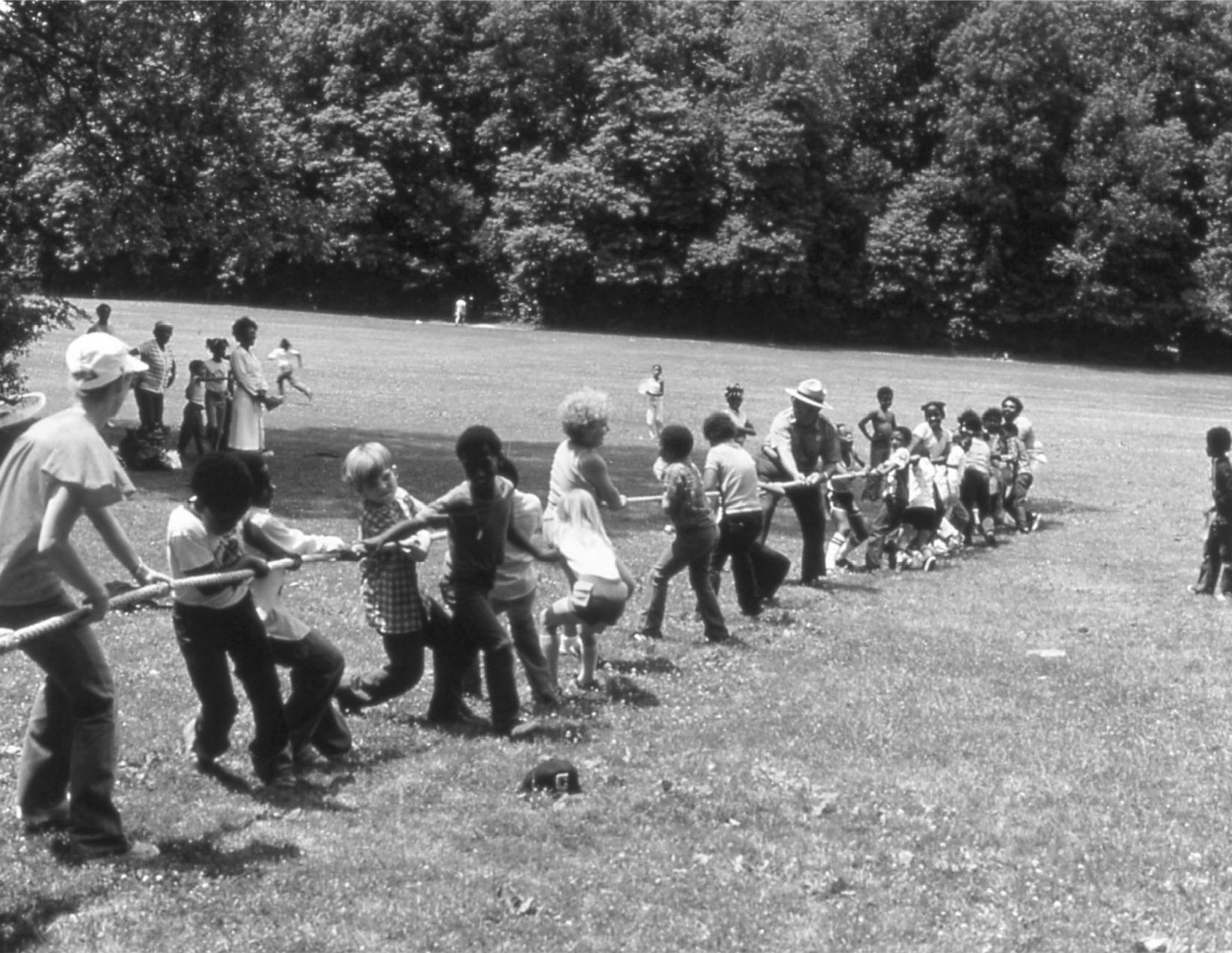
Activities during an “urban outreach” program at CVNP, 1981. Courtesy of the CVNP archives.
By combining these diverse groups into a single category, the need to provide additional services to meet a specific group's requirements was lost. Likewise, the term “special populations” may have offended and alienated some people, further limiting the efficacy of the initiative.
CVNRA inaugurated the Junior Ranger Program in 1988, offering two-night backpacking trips for “inner city disadvantaged children.” 41 Park rangers led the trips, which were designed to introduce children to the park, teach them outdoor skills, and provide them with a “traditional national park experience” 42 (Fig. 3). The program changed in the 1990s, transitioning from backpacking programs focused on “disadvantaged” audiences to a day and overnight camp model. According to a long-time staff member, this shift occurred due to budget cuts and a realization that backpacking-specific programs could “create a pretty negative experience for someone who's never been in the outdoors.” Along with the change in content came a change in participation. By 2013, park officials observed that Junior Ranger program attendance consisted largely of suburban audiences, and through this program the park was no longer reaching “communities underrepresented in park visitation.” 43

Meal cleanup during a Junior Ranger program at CVNP, 1988. Courtesy of the CVNP archives.
Two recent programming initiatives have proven more successful. Get Up, Get Out & Go! is a popular urban health and wellness program developed in collaboration with local community members. Launched with the goal of reaching “underserved urban populations,” the program involves engaging with youth and their families at park sites with the ultimate objective of helping them cultivate a positive relationship with the park. 44 The program began in Akron and then expanded to Cleveland in 2012. 45 In 2008, CVNP piloted its “Teacher-Ranger-Teacher” program, which involved bringing in teachers from the region for a summer-long program. Due to its success, the park institutionalized the program and obtained funding to offer summer school programming for students from Akron Public Schools, with the aim of improving graduation rates. A 2017 examination of graduation data for former program participants found that these students graduated at higher-than-average rates. 46
Staffing and recruiting
Every interviewee mentioned the importance of hiring a diverse staff to help the park be viewed as less of a “white space,” and combat stereotypes of Park Service employees as all white. One African American seasonal employee mentioned how diverse staff members are likely to bring friends and family to the park, which would extend social networks into diverse communities. During our interview, a long-time African American employee recalled his experience working a session of Get Up, Get Out, & Go!
They all ran to one side. “Oh my god, there's a black ranger.” I was like wow. They ran off the bus, ran to me because they had never seen a black male in uniform that looked like them. I had dreads, I had braids back then. I was, my hair is locked now, but had a beard and everything. I didn't look like the cliché park ranger, but that just showed them, those kids something different that they probably would have never seen in their life possibly. So, I stuck around, and I continue to stick around to change the culture, change the imagery.
His experience shows how a more diverse CVNP staff could help to confront stereotypes and change the face of the Park Service to better represent the country as a whole. In a similar vein, one long-time white staff member described how interacting with and working alongside an African American employee inspired her to confront some of her own biases and improve her appreciation of the importance of diversity.
Several staff commented on the need to address “pervasive racism” within the institution to recruit and retain diverse staff members. One employee described how an African American coworker quit after being profiled by the park's own law enforcement while eating lunch in his vehicle. “We police the hell out of the park,” he added. “It's a police space. It's a federal space that is surveilled.” He further described how for a first-time visitor, or perhaps someone who does not speak English, understanding the rules of the park may not be very straightforward, and being reprimanded by law enforcement can create an unpleasant experience. “The problem is with white behavior,” another staff member commented. “We didn't fundamentally understand that we would need to change.”
In an attempt to create a more welcoming and inclusive space, Visitor and Resource Protection Rangers at CVNP are changing the way they manage park situations, emphasizing resource protection and visitor education over strict law enforcement, and enrolling in antibias training.
In 2020, an African American staff member had some fellow white employees approach him to ask for help with creating a more diverse and inclusive space. He accepted and was reassigned to a new position working on Diversity, Equity, and Inclusion for CVNP and its partners. While this staff member was willing to participate, it is important that the park not expect its BIPOC staff members, by nature of their identification, to be involved in this work. Nonetheless, this move indicates that park officials recognize the need for new voices at the table to promote change.
The process of hiring new employees was frequently mentioned as an impediment to recruiting a diverse staff. Current policy dictates that the NPS give preference to internal candidates from other park units, as well as other government employees, which limits the opportunities for new faces. They are also required to post jobs to the USA jobs hiring portal, which can be confusing to use for the first time. Another stumbling block is that many entry level NPS positions are seasonal, meaning that staff members must possess the financial means to support themselves for the rest of the year. This part-time employment limits who can get a foot in the door with the NPS. The interview process was also described as a barrier to hiring diverse candidates. A long-time African American employee described how questions such as “Do you like hiking?” would be asked in an attempt to recruit “parky” candidates. “Everybody don't have to like hiking to work for the National Park Service,” this employee stated. “And they may not even like green space, but they may be an advocate for it.”
The NPS acknowledges that the lack of diversity in its workforce is a problem. While the agency cannot change a federally mandated hiring system, steps are being taken to widen the pool of applicants. Recent efforts at CVNP include recruiting from local colleges and universities, sending representatives to career fairs, and offering USA jobs portal coaching sessions. The park is also extending more paid internships and paid positions to high school students in an effort to introduce local populations to the park at a younger age. In addition, the park is in its third year of hosting an intern from the Historically Black Colleges and Universities Internship program, which includes a paid internship in a national park, a week-long career seminar, and coaching sessions for applying to federal jobs.
Commitment to change
Creating the momentum for change is another challenge—and a necessary first step—in CVNP's efforts to become a more inclusive space. Some interviewees described how creating change first requires a realization that change is needed. “We are our biggest barrier,” an African American staff member mentioned. “We have to start by being honest with ourselves; we have to be honest about our limitations.” For some employees, the need for change is evident. For others, especially long-time employees, it can be difficult to see the need to change long-established methods for managing the park. In addition, an employee discussed how Cuyahoga Valley is already of one of the most visited parks in the system, and the staff are stretched very thin. Therefore, the need to advocate for change can be overshadowed by the need to make ends meet.
Once there is an established need for change, a secondary challenge is ensuring continued pursuit of that goal. A staff member described how oftentimes the park would set a goal, take some steps to meet it, “but then something else happens, and then we shoot towards the next shiny object.” Another employee described how a few years ago, they gathered several times with community members to find out what their needs and desires were, but no actions were taken as a result of these sessions. While all interviewees agreed that the majority of the staff saw diversity as important, it is also apparent that they do not always move beyond discussing the issue.
Storytelling
Interpretive exhibits and activities provide staff with an opportunity to share knowledge about the valley's history with visitors. There is a growing movement today to ensure that history is told from a diversity of perspectives. In the early interpretive plans from the 1980s, the only mention of collecting or sharing African American stories is in relation to Camp Mueller—one of just four African American-owned and operated camps in the country that happens to be located within the boundaries of CVNP. The camp opened in 1938 and is run by the Phillis Wheatly Association, a social service organization based in Cleveland.
By 2003, the park was offering an annual program focused on the history of the Underground Railroad in the Valley. At this time, there was also a push to conduct research on the additional aspects of African American heritage to better integrate these stories into all aspects of the park's history.
As Dietsch et al. point out, “transgressions” such as these “offer stories of hope and pride for minoritized communities in the context of nature” because they challenge the narrative of nature as a white space. 47 A staff member who has worked to develop the park's interpretive media since the 1990s described how she realized there were many significant untold African American stories in the Valley. She has since been working to disseminate these accounts. She is striving to center African American stories at the park, and in doing so impart a more complete version of the valley's past. “We need to celebrate our 50th [anniversary] through the lens of people of color's experience in the Valley. We need to take the opportunity when we're shining the light on ourselves to have this conversation.”
Measuring success
Measuring success at the CVNP remains a challenge due to lack of data on park visitation. The 1981 interpretive plan identified development of an “Existing Visitor and Potential Visitor Profile” as a priority, with a special focus on understanding the needs of “minorities, elderly, handicapped, and other Special Populations.” 48 While this goal was mentioned frequently throughout the 1980s, there is no evidence this research was ever conducted. Instead, park staff relied on “eye-balling” to gather data about its visitors. 49
Surveys were eventually distributed in 2005 and 2015 and the results indicated that CVNP was not meeting the needs of everyone in the region, as diverse audiences were greatly underrepresented in overall park visitation when compared with white visitors. 50 Staff members interviewed for this research mentioned that this survey is not done often enough, and that there is and always has been a lack of understanding of who is visiting the park. One employee argued that the park needed a more in-depth method for understanding the true impact of its programs, which goes beyond gathering statistics and data.
Nevertheless, the past few years at CVNP have been transformative for Diversity, Equity, and Inclusion. In 2017, for the first time, the interpretive plan included a statement on social justice. The park also acknowledged its role in contributing to the greater community and helping “the community advance in achieving its goals.” 51 The park has recognized the need for change and is working to include new voices in the conversation to better understand how they can realize it.
CONCLUDING THOUGHTS
It is important to acknowledge that exclusion of BIPOC from public lands is a structural issue deeply embedded in the fabric of the United States, and that some of the reasons why CVNP may not be appealing to diverse populations are beyond the control of park staff. The park's landownership history also may complicate efforts to diversify visitation.
Because the Cuyahoga Valley was already inhabited when the park was established, properties had to be acquired from private landowners, which is oftentimes a complex and unpopular process. According to one park employee, this may have resulted in “a lingering sort of resentment and suspicion of the park and the NPS.” The park also is surrounded by suburban neighborhoods that are predominantly white, and many of these neighborhoods have a history of being unfriendly to people of color. For these reasons, one interviewee suggested that the park may have gained a reputation for being an exclusive white space.
Despite the restrictions posed by the COVID-19 pandemic and executive order 13950, as well as the limited number of interviews we were able to conduct, our results suggest a path forward for the Park Service. To succeed at its Diversity, Equity, and Inclusion goals, it is clear that CVNP needs to invest its resources in better understanding BIPOC experiences visiting the valley and identifying what it can do to help these groups feel welcome and safe. CVNP also needs to better understand BIPOC communities' historical connection to the valley so that it can more effectively align park amenities and recreational activities to meet their needs. 52 While CVNP has long strived to reach diverse audiences, its methods have not always been based on the needs and preferences of the audiences it attempts to reach.
Thus, CVNP might benefit from conducting its visitor preferences survey on a more frequent basis with an enhanced focus on the needs and perspectives of local park users. Similarly, park managers should consider hosting focus groups or community forums in target communities to improve understanding of park user perspectives and to evaluate and update policies and programs. In addition, CVNP should continue working to increase staff diversity by making the hiring process more straightforward and accessible. Finally, park staff must work to acknowledge and confront personal biases that may be impeding progress.
A central challenge in the park's Diversity, Equity, and Inclusion efforts is shifting from having good intentions to creating true impact. While CVNP has endeavored to become a more welcoming space, it remains a work in progress. National parks are a resource, and their staff must continuously strive to serve all segments of their community. Only in this way can they fulfill the true purpose of the national park system: “To be clear: a clean, healthy, and sustainable environment, anchored by parcels of lands and waters protected from despoliation and able to be enjoyed by all citizens unimpaired for future generations is an essential part of the American birthright.” 53
Footnotes
ACKNOWLEDGMENTS
We gratefully acknowledge the cooperation and assistance of the dedicated staff at CVNP. Also, we wish to thank the two anonymous reviewers for their constructive comments and suggestions.
AUTHOR DISCLOSURE STATEMENT
No competing financial interests exist.
FUNDING INFORMATION
No funding was received for this article.