




Abstract
Background:
Collaborations between community groups and academics within a university-managed research model (UMRM) can sometimes negatively impact a community, whereas community-owned and -managed research (COMR) can ensure collaborations remain committed to addressing issues of environmental injustice.
Methods:
Project Confluence leveraged the benefits of UMRM (i.e., access to research grants, interdisciplinary networking) to support the design of COMR projects. We take Project Confluence as a case study to explore the experiences of participants within this hybrid research model project. In this article, we detail iterative steps taken in Project Confluence to facilitate collaborative processes needed to address environmental justice challenges. We then reflect on participants' feedback on this hybrid research model through qualitative data analysis of 12 semistructured interviews.
Results:
Participants' feedback can be grouped into three main themes: flexibility versus structure, face-to-face versus virtual interaction, and interteam connections. Participants argued that flexibility presented its own challenges and hoped for more structure to guide the activities. They also agreed that while virtual meetings were necessary during the pandemic, the collaboration would be more successful if they were in person. Finally, they enjoyed being within an UMRM umbrella, but wanted to “see how collaborations could collaborate.”
Conclusion:
For future deployment of hybrid research models, we suggest that the UMRM umbrellas provide more structure around the mechanics of collaboration, but be adaptive to the needs of the community groups that lead the COMRs. In addition, although COMRs can organize online, we suggest UMRM meetings take place in person to facilitate better interteam collaboration and support.
INTRODUCTION
Collaborations between communities and academics for addressing environmental justice exhibit a demonstrated potential for enhancing community benefit from engagement and increased rigor, relevance, and reach of academic research. Communities bolster the reach of studies by providing context that is vital to understanding disproportionate impact and can distribute findings through key nontraditional venues that are underutilized or unreachable by academics. 1 Financially sustaining collaborative efforts past pilot projects is crucial for generating community relief from environmental injustices through these alliances.
This can be referred to as providing “soil money” for ongoing partnerships, whereas “seed money” is conceptualized as the initial project funding. This additional support serves to preserve relationships and allows community members to be elevated to the status of research partners rather than just study participants. In addition, “soil money” encourages long-term relationship building that allows community members to be elevated to the status of research partners rather than just study participants.
This acknowledged status allows for colearning and can prevent academics from making prescriptive causal claims about communities and the challenges they face. 2 Likewise, initiatives executed by these partnerships are often the only approaches that see lasting changes since this method of collaboration allows communities to develop a sense of ownership over the intervention and independently carry out its implementation in the long term. 3
Previous research has argued that university-managed research models (UMRMs) in some instances can negatively impact a community because the community does not have control over their projects, which means they may not be able to prioritize resolving a local environmental justice issue over other objectives. 4 Today, community-owned and -managed research (COMR) provides the foundation needed to move participatory approaches into innovative collaborative domains that solve issues of environmental injustice. 5
However, the question we unpack in this article is worth considering: What are participants' reflections on a hybrid university- and community-managed research approach that aims to address issues of environmental justice? To that end we describe the hybrid approach used in the Project Confluence 6 case study and analyze the experiences of community group managers, academics, and students who participated in these collaborations.
Project Confluence and motivation
Project Confluence leveraged the benefits of UMRM (i.e., access to federal research grants and interdisciplinary networking) by nesting the design of COMR projects within a larger project umbrella. We wanted to explore how a hybrid approach could engage with long-term strategizing for obtaining “soil money” as well as in-the-moment hyperlocal solutions to environmental justice challenges. The activities within the four teams of community groups and academics are “partnerships” for addressing issues of environmental justice. 7 , 8 The interactions between team members in Project Confluence also reflect a coproduced and emergent understanding of participatory research. 9
The four community groups at the heart of Project Confluence are motivated by the challenge of solving environmental, climate, and energy injustice. Such challenges are often tied to poverty, race, and a lack of technical resources, 10 which are concerns for each of the four teams who participated in this project. In the following section, we describe these four teams as a collective case study and how we studied their experiences with collaboration. We then thematically analyze the feedback we received from participants about their experience within a hybrid COMR and UMRM organized collaboration. In the conclusion, we suggest some potential ways forward for community groups and academics who wish to emulate the structure we developed in Project Confluence.
ITERATIVE METHODS
The core task of Project Confluence created four collaborative teams between community groups and academics as they created a Collaborative Challenge Assessment (see Collaborative Challenge Assessment). We used iterative stages that strived for a balance between facilitating the work of these teams while taking an ethnographic approach and studying the way in which the collaboration unfolded. In the following sections, we provide a description of each of these steps.
Search for community groups: August–November 2020
The science behind assembling teams for addressing social challenges is still relatively new, but we focused primarily on allowing individuals to participate in Project Confluence by self-assembling teams with limited guidance from the authors. 11 To begin, we established a set of community groups focused on resolving environmental, climate, and energy injustice issues in the region through our existing networks and Google searches. In total, we contacted 28 community groups relevant to the study.
Community group interview and selection: November–December 2020
Through unstructured interviews over Zoom, we asked the community groups what their scientific and engineering challenges are for resolving environmental, climate, or energy justice issues in the region. In the end we selected four community groups and their challenge morphed over time to become the focus of the teams discussed hereunder (see Table 1).
List of Community Groups Participating in Project Confluence
Search for academic partners: January–March 2021
Based on the challenge put forth by the four community groups, we utilized our networks at Arizona State University (ASU) and searches on the ASU directory to find academics who exhibited the expertise relevant for solving that challenge. In total, 51 academics were contacted with a basic introduction of a community group and a description of their challenge. They were invited to an informational Zoom meeting with a community group to learn about each other's backgrounds. Seventeen academics participated in the Zoom call and 11 academics agreed to join the projects with 3 of the 11 academics participating with more than one team.
Collaborative team formation: March–May 2021
Teams were led by one to two individuals from the community group. Later in the project, two undergraduate students and one graduate student were added. The teams began the collaboration primarily through e-mail and Zoom meetings. On May 19th, we held the first Project Confluence all-hands meeting, where we introduced the project goals of developing the two deliverables (discussed in Memorandum of collaboration and Collaborative challenge assessment) and the budget available to each team. Teams were provided with a budget of $10,000 total: $5,000 to loosely cover the salary expenses of the community groups and $5,000 to loosely cover equipment or other costs accrued by the academics.
The 50/50 split of the budget intended to ensure that all participants felt equally valued. How the budget was spent was determined through consensus. Monthly all-hands meetings began on May 19th to facilitate interteam connections that we discuss hereunder. All but one was conducted through Zoom. In addition, monthly team meetings were scheduled with each of the teams to facilitate the completion of the deliverables, all of which were conducted on Zoom. Virtual meetings have become crucial modes of engagement within collaboration since the beginning of the COVID-19 pandemic, 13 and is an important factor in our analysis hereunder.
Initial interviews: March–October 2021
Semistructured interviews were conducted with all participants. We included questions that were directly related to the participant's personal background and how that might relate to their interest in collaboration and addressing issues of environmental injustice. The protocol included three parts: (1) work background and experience with collaboration, (2) personal background, (3) reflection on Project Confluence and motivation for participating. Interviews were conducted through Zoom and recorded to allow automated transcripts, but this material is not discussed in this article.
Memorandum of collaboration: May–August 2021
The starting point for Project Confluence is that participants come with diverse perspectives, access to resources and networks, education, motivations, and goals. Building upon earlier conventions, 14 the first deliverable for the teams was writing a memorandum of collaboration (MoC) that acknowledges this diversity and creates a framework for engagement. This would be critical to the team's success in completing their second deliverable (see Collaborative challenge assessment). Although there was no firm structure required for the MoC, participants were provided with examples. 15 In addition, teams were asked to create a timeline and budget justification. These were meant to help the teams plan how they would use the money and the time needed to complete their second deliverable.
Collaborative challenge assessment: September–December 2021
The collaborative challenge assessment (CCA) was a collaboratively created product that assesses and plans a roadmap to address the community group's challenge. While inspired by “technology needs assessments,”
16
we intentionally steered away from the word “needs” because of its “deficit” connotation and encouraged participants to draw upon an asset-based approach.
17
Participants were provided access to documents similar to a CCA,
18
but were encouraged to create a document that was useful to addressing the challenges faced by the community group. We suggested that the CCA should answer the following:
What needs doing to address the challenge identified by the community group? Why? How might things get done? Using what resources?
19
There were no formatting or page limit requirements imposed on the creation of the CCA, and all of the teams submitted a draft by January 18th, 2022. The completion of the CCA serves as a valuable roadmap for the community group to lead the team members over the coming years. At this point in our iterative steps, Figure 1 visually captures the relationships between different actors and activities within Project Confluence when COMRs are nested within the umbrella of an UMRM.
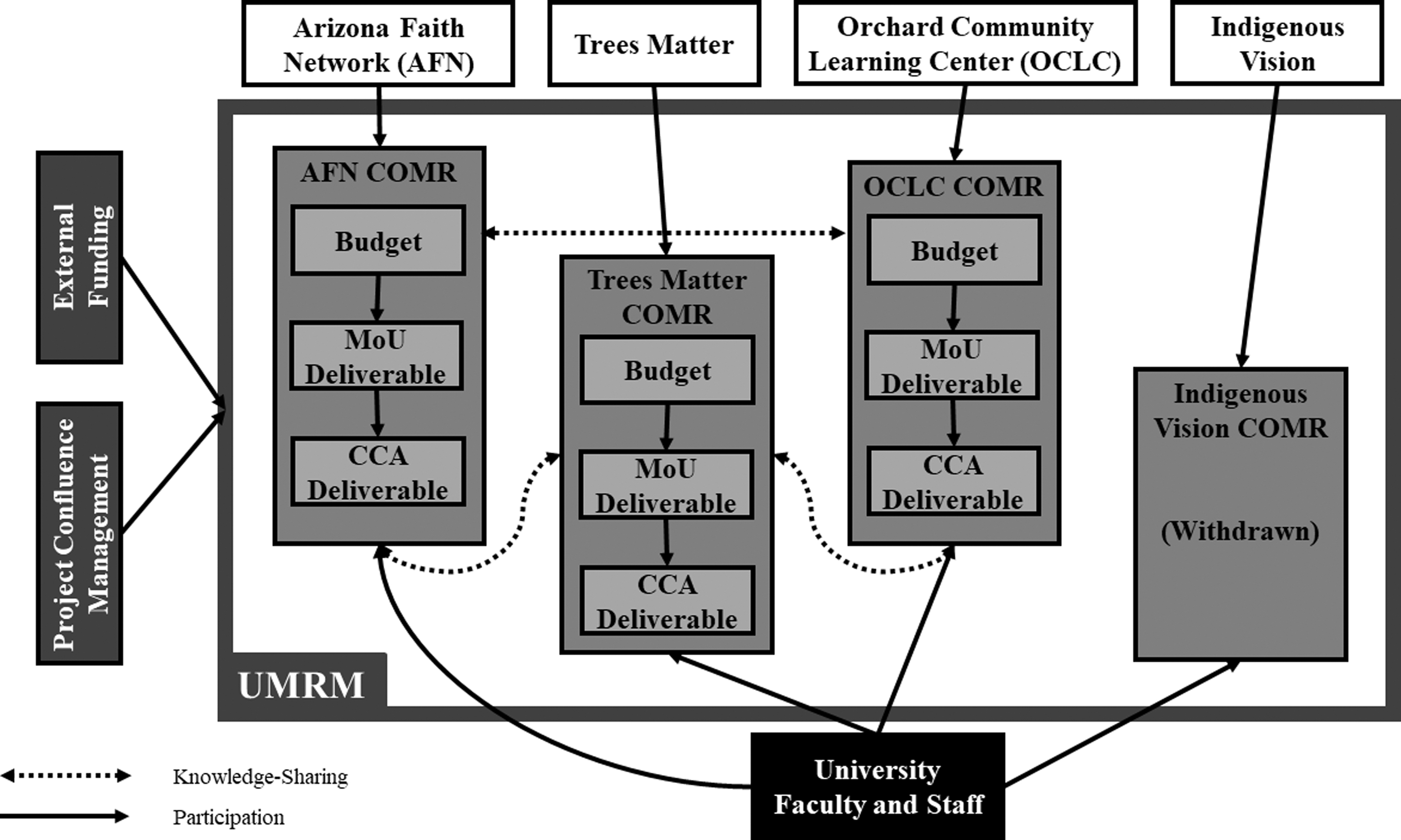
Collaborative relationships when COMRs are nested within an UMRM. CCA, collaborative challenge assessment; COMRs, community-owned and -managed researches; MoC, memorandum of collaboration; UMRM, university-managed research model.
Follow-up interviews: January–February 2022
After a close analysis of the precollaboration interviews as well as the ongoing discussions in the all-hands and monthly team meetings, we designed a follow-up interview protocol that aimed to answer remaining gaps of information that would support our preliminary analysis. This included questions about the importance of societally impactful research, the meaning and value of collaboration, and changes in participants' views on collaboration. We also asked evaluative questions about creating the MoC and CCA, as well as what they thought about Project Confluence as a whole.
Interviews with 12 participants ranged from 35 to 60 minutes. Interviews were recorded through Zoom and automated transcripts were edited for consistency and clarity. We used a qualitative data analytical approach to explore the major themes that emerged from the interviews. 20 In the following section, we explore the feedback that participants shared with us regarding the way a hybrid research approach unfolded.
EXPERIENCES OF THE PARTICIPANTS
Participants' experiences can be grouped into three main themes, flexibility versus structure, face-to-face versus virtual meetings, and interteam connections.
Flexibility versus structure
Participants described to us a tension and need for balance between flexibility and structure. They describe flexibility as the openness to approach their challenge in any way and structure as the mechanics that should guide collaboration so that it fits the overall objectives of the UMRM. As already described, Project Confluence remained open ended and placed a lot of decision-making power within the COMR. This trickled down into how teams managed their activities and contributions. Jose Becerra, an undergraduate engineer at ASU helping the Orchard Community Learning Center (OCLC) team, expressed his surprise and pleasure at the leniency allotted to his participation:
You're not ordered to work a certain hours per day, it's like a mutual agreement. During the summer it was hot, so days would be cut short. So, it's just a little lenient working with people you know.
However, the large majority of participants explained to us that the degree of flexibility they faced was a challenge to getting projects moving. For instance, Samuel Markolf, who is assistant professor of civil and environmental engineering at University of California Merced and collaborated with the Arizona Faith Network (AFN) team, helped us understand the complexity of providing so much agency to the teams.
I think the biggest challenge was really getting started and wrapping our heads around…what to do with all that freedom. I don't think that's necessarily a bad thing, and in many ways it's a good thing. I just think that was a hurdle that needed to be sorted out in the earlier stages of the process.
A common refrain was that we needed to make it more explicit that this stage of collaboration was meant to be exploratory, which is why the flexibility was necessary. As Aimee Esposito, executive director of Trees Matter, explained, grasping the fact that early stages of collaboration could benefit from a more conceptual planning stage was not intuitive for her or her organization.
I think the hardest thing was prioritizing Project Confluence in our schedule because it was so flexible, but also there were specific things that needed structure. And I don't know if that's a good or bad thing, but I wasn't used to that way of doing it. I don't know if I would do that again without having that structure.
Continuing with that idea, we also had participants who explicitly highlighted the structure we did put in place for guiding Project Confluence as a good aspect. Professor of sustainable engineering and the built environment at ASU, Rebecca Muenich, felt the structure we used worked across the different kinds of collaborations within Project Confluence and not just for the OCLC team.
It is structured and not structured, which I think is good. Having the requirements of the MoC and the CCA, provided some structure, so that it wasn't just collaborate and good luck, which could have been the approach.
Overall, participants felt that flexibility presented its own set of challenges and often desired more structure in how the collaboration should unfold. We encourage future hybrid models to draw upon the structure used by community groups to organize their daily work in COMRs, which could offset the vagueness found in academic discussions of engagement or participatory research. Adapting to the way community groups operate also places more decision-making power in the hands of the community group so that they are not exploited by the potential harm that can come from an UMRM model.
Face-to-face versus virtual interaction
The COVID-19 pandemic ensured that Project Confluence had to develop collaborations through virtual interactions on Zoom. Most participants only met in person twice and two participants never attended any in-person events. Participants said they now recognize that it is possible to collaborate virtually, but also agreed that the results would have been better in person. In interviews they described different costs and benefits associated with face-to-face and virtual interactions. When we asked professor of practice at ASU's School for the Future of Innovation in Society, Darlene Cavalier, about the aspects that were difficult about collaboration within the Trees Matter team, she mentioned that
…it's made more challenging by the fact that we were never able to meet face-to-face, mostly because of COVID…it would have accelerated the pace of the project if there were in-person meetings. So, there's nothing we could have done about that.
Still, Darlene also explained that the virtual nature of this collaboration made it possible for her to participate at all since she is based on the east coast of the United States due to other responsibilities. This was the same situation for Sam who was able to participate with the AFN team from Merced. Yet, Sam too felt an in-person element was missing from his experience with the collaboration:
I would love to go to a cooling center and see it in action…just see on the ground what are the issues that come up, what challenges emerge, and how are they addressed.
Participants also provided examples of how they became dependent upon scheduling Zoom meetings to complete tasks. Dan Stanton, who is head librarian of the humanities division at ASU library, told us that the Trees Matter team “…didn't do a whole lot offline. We sent e-mails, things like that. Mostly, I think we would get together and just hash things out over Zoom.” The dependence on Zoom perhaps explains why some participants, like Becca, were concerned about “Zoom fatigue”:
I'm zoomed to a T at this point. Two years of zoom. So, the in-person meeting at ASU was a lot better. Probably because it was just easier for me personally to engage with people in-person.
A number of participants described how much they appreciated the in-person all-hands meeting we organized at an outdoor restaurant on ASU campus. When asked about what did not work well within Project Confluence, John Wann, executive director of OCLC, also compared the meeting at ASU with the Zoom meetings:
I really enjoyed that in-person experience. But the zoom meetings with the whole group have been less substantive or less meaningful or less relationship developing…[At the same time] I'm glad to know about those other projects.
Although Zoom may have made collaboration duller and was not amenable to relationship building, John recognized that it allowed for interteam connections. As we came to find, scheduling in-person meetings for all participants within the UMRM was tricky. It often required us to plan 2 months in advance. In addition, Zoom became the easiest way to organize a meeting within the COMR even with little notice. We recommend, when it is safe to do so, that hybrid research places a greater emphasis on the COMR model that prioritizes face-to-face meetings and visits to the community affected by our research.
This will also ensure that academic participants are not just waiting in the “ivory tower” for the data to arrive, a common occurrence within UMRM models, but are also personally engaged with the environmental justice challenge that the community is facing. In addition, to make Zoom a tool to facilitate relationship building, it could be beneficial to request team members to schedule brief (15–30 minutes) 1-on-1 meetings that can be for getting to know each other at a more personal level. By evaluating this dynamic using the Tuckman model, 1-on-1 meetings could promote the necessary process for members to reach the “norming” phase of team development, which would allow for more transparent and meaningful engagement. 21
Interteam connections
Regardless, John helped us recognize that when COMRs are nested within a larger UMRM, it could be beneficial to allow for more cross-pollination between teams to
…see how collaborations could collaborate. So that what one team is doing is supporting another team. Because if you have three or four teams around the table, then you might pick up something from another one but you're not really working with them…so it's information but it's not as much operational.
The interteam connections that did emerge were an unanticipated benefit of Project Confluence. The teams were all organized around resolving environmental justice in the region in different ways, but it became clearer to us over time that they could reinforce each other's work. When asked what could be improved about Project Confluence, Paulina Vu, program manager at Trees Matter, explained that
…it was nice to see a lot of like-minded individuals from all walks of life even if we're not working on the same project at all. If we take it a step further, it would be super interesting to see if there was some way our projects could affect each other too.
Many participants appreciated the nesting of COMR projects within a larger UMRM umbrella and wondered how more connections could be made across the COMRs. For instance, when we asked Elise Smith, who joined the AFN team while wrapping up her MA degree in public administration at ASU, about the unique aspects of Project Confluence she said
Oh, I liked having the interactions with the other groups that were involved. I do feel when you have one main entity that is supporting many projects, often there is limited crossover between them. But it is exciting to hear what they're doing and I think that's definitely something that can easily come about with this format.
At a more abstract level, Elise's fellow AFN team member, Melissa Guardaro, Assistant Research Professor at the Global Institute of Sustainability and Innovation at ASU, explained that she enjoyed how Project Confluence
…tried to do four projects, because I think that this science-technology interface with community is so different depending upon what the context is. I thought that was really cool to try to have different projects that you can explore and evaluate as things unfold.
Elise and Melissa bring up important points of consideration for organizing COMRs within an UMRM. With the right amount of guidance, it is possible to “see how collaborations could collaborate” thereby allowing the individual projects to benefit from being part of the larger UMRM. Therefore, we recommend hybrid models draw upon the UMRM approach that has its strength in facilitating interdisciplinary connections. This will help the community groups scale up from the hyperlocal focus that is typically found within COMRs, thereby making the results of their project relevant to other communities that face similar challenges.
CONCLUSION
The need for a hybrid approach to be adaptive is one of the key takeaways from analyzing the experiences of participants in the Project Confluence case study. In future hybrid research models, we suggest that the UMRM umbrella draw upon the organization structure used by community groups to support the mechanics of collaboration and be adaptive to the needs of the individual COMRs. This would allow flexibility to be applied where it is needed, rather than integrated as foundational principle, since flexibility creates its own set of challenges that need to be mitigated. In addition, we recommend that future collaborative research models consider the costs and benefits of becoming dependent on virtual meetings.
Our findings suggest that it is possible that individual COMRs can handle day-to-day operations virtually, but that regular in-person meetings should be encouraged when it is safe to do so. When possible, all-hands meetings under the UMRM umbrella can be in person to facilitate better interteam collaboration and support. As a conclusion, the evaluative lens we brought to the umbrella has benefits for the COMRs, but we envision community groups properly supported with “soil money” fulfilling the role played by a university.
Future research should compare the costs and benefits of having a hybrid research approach managed by government agencies, community groups, or private funders. Overall, we believe that the hybrid research model of Project Confluence offers many advantages for collaboration between community groups and academics that are addressing issues of environmental justice and hope that future projects can learn from our experience.
Footnotes
ACKNOWLEDGMENTS
First and foremost, we thank all of the participants in Project Confluence for supporting this research and always providing honest feedback. We also need to thank the School for the Future of Innovation in Society at Arizona State University for hosting this project. Finally, we thank the entire re-Engineered Lab for all of their feedback and insight that helped improve this article.
AUTHORs' CONTRIBUTIONS
E.S. contributed to conceptualization (support), data curation (lead), formal analysis (lead), investigation (lead), methodology (equal), project administration (equal), supervision (support), validation (lead), writing—original draft (lead), and writing—review and editing (lead). M.M. was involved in data curation (support), formal analysis (support), writing—original draft (support), and writing—review and editing (support). J.L.B. carried out conceptualization (support), investigation (support), and methodology (equal). D.M.A.K. carried out conceptualization (lead), funding acquisition (lead), investigation (support), methodology (equal), project administration (equal), supervision (lead), writing-review, and editing (support).
AUTHOR DISCLOSURE STATEMENT
We have no known competing financial interests or personal relationships that could have appeared to influence the work reported in this article.
FUNDING INFORMATION
The research for this article was funded by a National Science Foundation grant (No. 2016108).