




Abstract
President Biden's Justice40 policy directs federal agencies to take measures to ensure that at least 40% of the benefits of energy and environmental infrastructure, climate resilience, housing, and workforce investments are truly realized by communities who have endured generations of government disinvestment and racial and economic discrimination. The path to achieving Jutice40, however, is not a given. The path faces a gauntlet of obstacles. We will discuss what it will take in the United States to set Justice40 in motion: the institutional commitments, internal systems, and capacity building necessary to drive significant benefits to frontline communities. By examining climate investments including the Infrastructure Investment and Jobs Act, the previously proposed Build Back Better plan, and its enacted successor, the Inflation Reduction Act, we recommend lessons for implementing Justice40 now and any future initiatives—local, state or federal—with similar goals.
INTRODUCTION
President Biden's Justice40
Justice40 has been influenced by New York State's 2019 Climate Leadership and Community Protection Act, 3 and it reflects traditions in organizing and policy worldwide that aim at equitable procurement, investment, and resource allocation. The intention is to improve the conditions of people who have suffered from racial, ethnic, economic, gender-based, and other forms of discrimination—reversing decades and centuries of discriminatory patterns and impacts that have had major economic, social, cultural, and health-related consequences for diverse communities.
Critically, Executive Order 14008 requires federal agencies to define (1) who “disadvantaged” communities are; (2) what “benefits” mean; and (3) which programs and investments must meet the Justice40 standard. Much has been written about the Climate and Economic Justice Screening Tool (CEJST) used to classify disadvantaged communities and the overwhelming frustration of community leaders that the tool does not explicitly consider race. 4 Our focus here, however, is on the transparency of CEJST and the capacity, structures, and practices of federal and state agencies needed to oversee Justice40 investments.
What will it take in the United States to set Justice40 in motion? To define what we mean by setting in motion, we introduce the metaphor of an hourglass. The hourglass shape represents an obstacle to achieving Justice40. We describe the current issues with the hourglass shape of Justice40, providing examples of how these impact frontline communities. For the issues we identify, we propose corrective actions that are needed to equitably implement the Infrastructure Investment and Jobs Act (IIJA), the now passed Inflation Reduction Act (IRA), and other federal funding allocations.
Setting Justice40 in motion must entail the full realization of shifts in environmental, health, economic, and other outcomes felt at the community level. Justice40's scope is clear in its application to five types of investments. The investments span 7 broad program types and at least 20 federal departments and authorities (see Table 1 above).
Justice40 Jurisdiction 61
Covered programs also fall under federal government units and authorities including: Appalachian Regional Commission, Corporation for National and Community Service, Corps of Engineers—Civil Works, Delta Regional Authority, Denali Commission, NASA, and National Science. CFR, Code of Federal Regulations; OMB, Office of Management and Budget.
These investment areas and covered programs define the reach of Justice40, but the Justice40 Executive Order and subsequent guidance left the critical term “benefits” undefined. Benefits encompass investments, but they should also address quality jobs, community resilience and vibrancy, financial security, and wealth generation opportunities. For example, local ownership of the means of energy generation through small-scale or community-owned solar can build community wealth, contribute to financial security and quality jobs.
The hourglass problems
In an hourglass, the top and the bottom have lots of volume. The middle part has the least volume, which allows the sands to slowly move from top to bottom. When the hourglass is turned over to start the time, the sands that are able to get to the middle of the hourglass will arrive first into the bottom. The speed at which the sands drop to the bottom, and how many sands do so at roughly the same time, depends on the dimensions of the hourglass. If the hourglass is suddenly turned over onto the other side, the small amount of sands that are now at the top will quickly drop back to where they came from.
Regarding Justice40, the hourglass may be roughly interpreted in this way. At the top of the hourglass is the space where government, philanthropy, and other dominant actors are. In this space live the powers and influence of the federal government. The sands are all of the funds, assets, and resources that are intended to get to the bottom. At the bottom of the hourglass are all of the communities who have been fighting every day for their continuance and sustenance while enduring generations of environmental injustices.
The middle of the hourglass is the thinnest part by volume; this is where we find the people, institutions, and organizations that connect the communities directly to the funds, assets, and resources of Justice40. The middle of the hourglass either enables or hinders the speed and equality of movement of the sands (Fig. 1).

The hourglass problem. The hourglass on the left represents a shape that enables a steady flow of benefits to frontline communities. The top of the hourglass on the right represents the current reality, with sparse benefits dammed up by a narrow funnel of agency and institutional capacity.
When the middle of the hourglass has little volume, it is like what too often happens when state and local technical and fiduciary capacities and workforce development programs are insufficient to deliver on Justice40. Members of the White House Environmental Justice Advisory Council (WHEJAC) caution that
Such investments would foster more activity at the county, city, and state levels that is trusted by communities and led by community knowledge. Such activity can widen the middle of the hourglass. Justice40 is about investments in infrastructure resulting in improved health, economic, well-being, educational and environmental outcomes at the community scale. But to achieve a massive transfer of benefits, the hourglass needs to be blown again. A narrow hourglass structure ignores the people, institutions, and organizations that stand between benefits and communities; an hourglass structure makes it hard for investments to count.
We find the federal government has three critical gaps for ensuring the guidelines of Justice40 are met through standard appropriations, IIJA, Build Back Better (BBB)'s successor, IRA, and any future stimulus or climate funding. These gaps are not only limited to federal agencies, but they are also perhaps even more pervasive in many states but have been subject to minimal scrutiny. Consistent with important work on Justice40, 7 we propose a number of ongoing, foundational structures and practices that governments at all scales should adopt to ensure a Just Transition.
PROBLEM 1: THE HOURGLASS IS TOO OPAQUE TO SEE IF THE SAND IS FLOWING
Quantifying how infrastructure funding flows from federal to state to local agencies can be a challenge to and a burden on frontline communities. Without enough trusted allies to look out for the needs of people who Justice40 intends to serve, federal funds are more likely to be exploited by more privileged entities and communities, private industry, and philanthropy.
This issue was clear in the BBB bill. While initially hailed by many mainstream environmental and climate organizations for historic climate investments, 8 it took deeper investigation of the 1200-page bill to determine that BBB would have funneled the majority of benefits to profitable companies and to communities that rank among the least disadvantaged. 9
The IRA is substantively similar to BBB, although its overall climate funding was reduced from $550 billion to $369 billion. Researchers at Princeton University's REPEAT Project, for instance, found that IRA would reduce U.S. greenhouse gas emissions 42% below 2005 levels by 2050, compared with 46% under BBB. 10 The most significant change is the reduction of tax credits for clean electricity generation in IRA. Still, just four clean electricity and clean manufacturing line items combine for more than $180 billion, or roughly half of the climate-related allocations in IRA. 11
Programs for mitigating pollution, climate resilience, and expanding Tribal and low-income access to clean energy are generally earmarked for tens or hundred millions of dollars—orders of magnitude less than the major tax credits that will not directly benefit marginalized communities.
Another concern is the opacity of the hourglass, which hides how the ultimate distribution of funds often diverges from the intended recipients. But these failures are rarely illuminated, and many perceive that concern for equity ends once funding allocations are announced and enshrined in statute, without recognizing how inaccessible certain sources can be to frontline communities. A prime example was BBB's intention to foster $20 billion to a loan guarantee program for Tribal nations to develop renewable energy through the Tribal Energy Loan Guarantee Program (TELGP). 12
It is unclear whether this increase was actually recently achieved through IRA. In the language of the federal government, this program was originally authorized by Section 503 of the Energy Policy Act of 2005. The Department of Energy can provide loan guarantees for up to 90% of the unpaid principal and interest due on any loan made to a federally recognized Indian tribe, Alaska Native Corporation, or tribal energy development organization for energy development, up to a maximum of $2 billion in loans at any time.
The first solicitation for this program came in 2018. However, according to journalist Benjamin Hulac's interviews of Indigenous energy experts and research, there have been no loan guarantee commitments since the TELGP solicitation was first issued. 13 Indeed, Tribes and Indigenous organizations must invest hundreds of thousands of their own dollars to assess the feasibility of the energy project requiring finance to get loans in the first place and endure bureaucratic bottlenecks and delays that have long hampered federal programs being able to truly serve Native peoples.
Moreover, many potential applications are in need of capacities and land bases for launching energy projects, and they can face discrimination when they are pegged wrongly as simply having inadequate administrative systems for managing energy projects. 14 Thus, adding a theoretical $20 billion in inaccessible loan guarantees was a dubious attempt to fulfill Justice40. This increased funding is again like sands at the top of an hourglass with incredibly narrow volume for the sands to pass through to the bottom.
Other sources of opacity stem from the CEJST, 15 which computes a binary designation of whether each census tract is disadvantaged or not. This approach fails to note the difference between a tract in St. Louis, MO, which exceeds 15 of 21 thresholds of disadvantage (more than any of the other 78,000 census tracts in the United States) and a tract in South Beach, Miami, FL, which receives the same designation, on the basis of crossing the linguistic isolation threshold alone.
In addition, the data CEJST relies on has one or more missing values for 40% of the census tracts. 16 Data sources have other technical issues with the frequency of updates, different spatial resolution and estimation methodologies. None of these issues are readily disclosed to the users of CEJST, however. The tool allows for communities who experience disadvantage to fall through the cracks and remain unrecognized for the sake of accessing Jusice40 benefits.
Setting Justice40 in motion is harder than it might seem at the outset. Formula funds have to be tracked in the same way that supply chains need to be assessed to third and fourth tiers if a product can be said to meet environmental and labor standards throughout the lifecycle of its production and recycling or disposal. Deciding which indicators and thresholds should be used by the CEJST, which currently identifies 29% of U.S. Census Tracts as disadvantaged for the purposes of receiving Justice40 benefits, has been a contentious exercise that sparked significant debate among justice advocates and activists.
Solutions to problem 1: the hourglass is too opaque to see if the sands are flowing
Ensure transparent data access and reporting—agencies are not uniformly reporting on their implementation of Justice40. At minimum, such reporting should include:
. Dedicated Justice40 webpage, with a prominent link from agency homepages.
Schedule of all public meetings, including upcoming opportunities, agendas, presentations, minutes, attendees, and supplemental resources.
Decisions concerning covered programs and funding types.
Dashboard tracking covered programs and investments, how much was ultimately received by disadvantaged communities by program, and metrics on applications received and accepted for competitive funding. California offers a model approach to evaluating direct investments and benefits in disadvantaged communities, which ensures that secondary benefits, like overall reductions in air pollutants from electric vehicle (EV) tax credits received by wealthy households, are not counted toward the minimum legislative funding allocations. 17
Mitigate data gaps—agencies do not have all of the necessary data to prioritize investments to disadvantaged communities. With additional data, agencies might decide to consider layers of disadvantage, prioritizing investments in communities that exceed the most CEJST thresholds or by considering other emerging data layers, such as considering vulnerability to utility shutoffs when making investments in distributed generation and storage, energy affordability, urban tree canopy, and air quality improvements.
Establish a process for communities to self-certify—more than 40% of U.S. census tracts have data missing for one or more of the 21 CEJST thresholds. Data voids are preponderant in Tribal communities and other frontline communities that have been excluded by consistent data measurement processes. These communities are often the epicenter of disadvantage and must have a clear and simple process to self-certify so that they are not penalized by the ongoing trends of invisibility and erasure.
Consider cumulative impacts—burdens associated with energy, climate impacts, housing, transportation, and legacy pollution may be managed in silos, but they do not operate that way. Exceeding multiple CEJST thresholds dramatically increases the toll of these burdens, as do a series of high scores (e.g., 70th–89th percentiles) that do not exceed thresholds. The Office of Management and Budget (OMB) should issue guidance for how agencies consider cumulative impacts.
PROBLEM 2: A TRICKLE OF SAND FOR FRONTLINE COMMUNITIES
If the sands in the hourglass represent Justice40 benefits, what has been proposed in legislation, including IIJA and Internal Revenue Service, does not meet the Justice40 standard. The distribution of many of the benefits from these bills will still perpetuate decades of energy and climate injustice. Against Justice40's goal, large corporations and whiter and wealthier communities are poised to be the primary recipients.
The majority of climate funding in BBB and now in IRA comprised tax credits for investor-owned utilities and buyers of expensive electric cars. In a race to decarbonize, too many policymakers and environmentalists have failed to see the inseparable relationship between climate change and social injustice. Based on our knowledge, treating these twin dilemmas as isolated systems has only exacerbated both.
Investor-owned utilities (IOUs), 18 as opposed to municipally or cooperatively owned utilities, operate as monopolies under state Public Utility Commissions. Despite scant mechanisms for democratic governance, they supply upwards of 70% of America's electricity and natural gas and receive guaranteed returns on investment of around 10%. 19 , 20 The IOUs are poised for massive investments in new solar and wind farms, transmission line improvements, and yet unproven experiments to suck carbon directly out of the air. 21
These changes may cut carbon, but fail to benefit frontline communities given rampant racial and income disparities. 22 In the IRA, utilities are still the big winners. Even tax credits for carbon capture and sequestration, which is almost universally opposed by frontline community-based organizations, garner $3.2 billion, dwarfing the $0.5 billion allocation for a host of Tribal renewable energy, electrification, and climate resilience investments. 23
Many of the IRA benefits to frontline and low-income communities are theoretical. While it is possible for a household to secure $14,000 in upfront rebates for heat pumps, weatherization, and other electrification measures, $7500 for an electric vehicle, and upwards of $10,000 for rooftop solar and battery back-up, availability of more than $30,000 in financial incentives may do little to increase their adoption by the people they are intended to serve.
Currently, Black and Native households spend 50% more of their income on energy than whites with the same incomes. 24 , 25 Limited or ineffective marketing, education, availability of qualified contractors and service providers, and financing services can put even lucrative incentives out of reach. As many as one in three households face unaffordable bills and dangerous power shut offs for nonpayment in communities of color. 26
Expecting these households to entertain solar or a new EV while facing these dire situations is unreasonable. Regarding pollution exposure, Black households, in particular, face 50% more exposure to particulate matter than whites, and in California, Latinx households are seven times more likely to live in the most polluted census tracts than whites. That exposure is the source of increased rates of asthma, cancer, and even preterm births (Fig. 2). 27 , 28 , 29
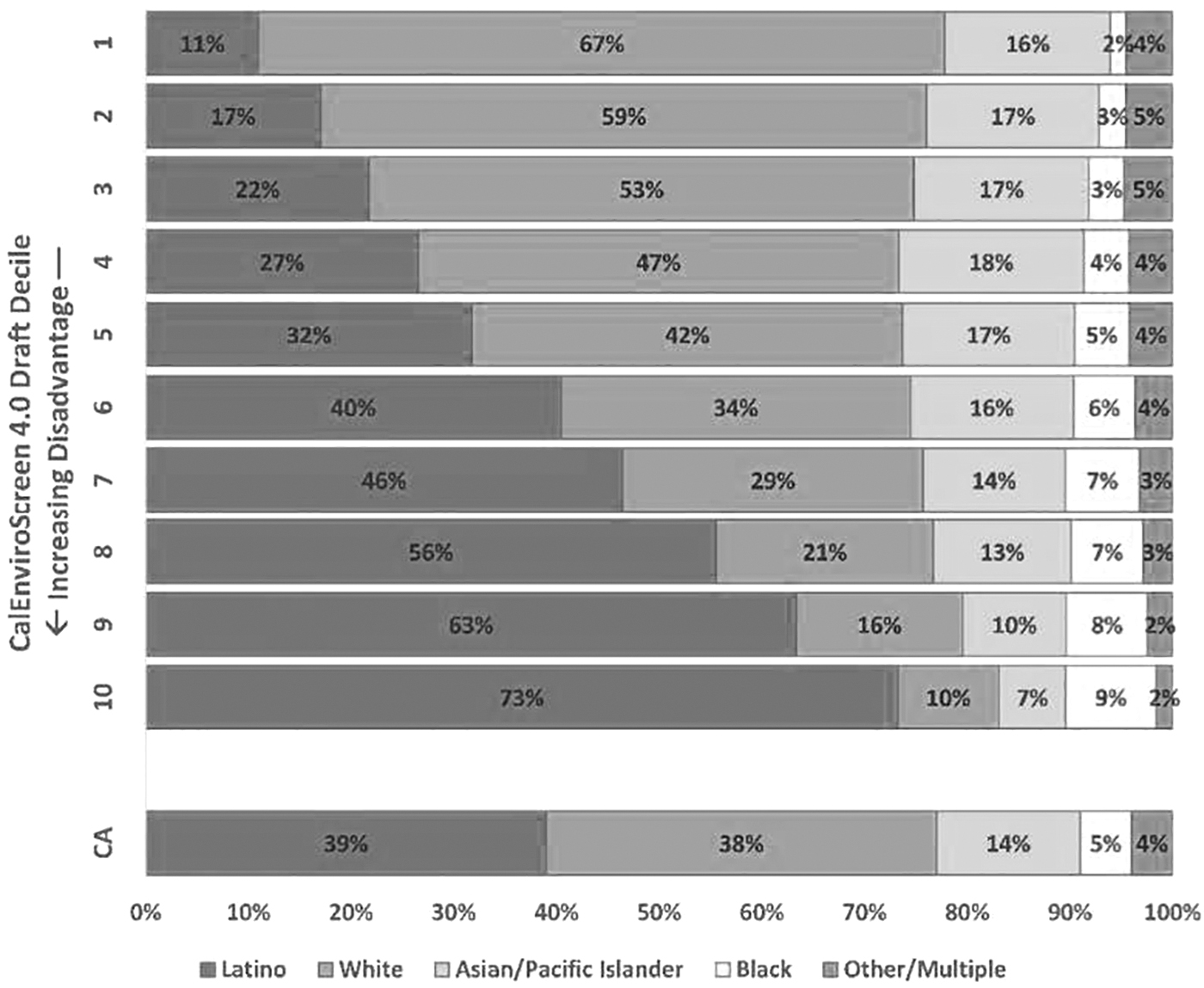
Racial makeup of each decile of the Draft CalEnviroScreen 4.0 score.
These disparities are unsurprising, given historical redlining and infrastructure spending. Interstate highways were driven through Black neighborhoods and business centers. 30 The Rural Electrification Administration “skipped” many Tribal nations. 31 Coal plants and other fossil fuel infrastructure were intentionally located in Black, Brown, and Indigenous communities and those with lower incomes that had fewer resources to resist. This list is barely scratching the surface of historical injustices that have persistent impacts.
All attention should center on ensuring that the implementation of IRA and design of future climate bills do not repeat history. Real benefits reaching frontline communities will also achieve effective and durable carbon reductions. Justice40 is a policy for reducing carbon quickly through redressing past injustice. At least 40% of the benefits from BBB climate investments must flow to disadvantaged communities. Forty percent should not mean “exactly 40% of the Congressional funding allocations.” Substantially more than 40% of the financial investments will likely be needed to close equity gaps by 2050.
Some energy efficiency programs, for instance, generate only ⅓ of the energy savings for low-income participants 32 compared with wealthier customers. In this scenario, it would take 67% of the investments to achieve 40% of the benefits. Exceeding the 40% floor is clearly justified.
Consider Detroit's O'Shea Solar Park, which was billed as “Detroit's first urban solar array and sustainability-infused park.” 33 Landscape improvements were touted, community meetings were held in a local church. DTE Energy took credit for neighborhood development but only paid $25,000 total for a 20-year lease of 9.6 acres. 34 Neighborhood residents, meanwhile, saw no discernible benefits but faced a 25% increase in electricity costs from 2015 to 2019. 35 As IOUs continue a history of co-opting community solar, 71,000 DTE customers had their power shut off in the last year. 36 , 37
Or consider the case of the Yurok Tribe's efforts to electrify its energy system and pursue renewable energy, as documented by Catherine Sandoval. Lacking access to electricity, the Yurok Tribe has sought to create better electrical infrastructure for economic and health purposes and to end reliance on diesel and wood pellets for energy. Electrification would also generate capacities for improvements in government services and tribal programs, ranging from economic development to cultural vitality.
Sandoval shows that many of the policies of the California Public Utilities Commission for supporting such efforts assumed that data were available on Tribal needs and that Tribes currently had access to the electric grid as well as other key infrastructure, such as adequate electric wiring, transportation, clean water, and telecommunications. Sandoval writes that “Addressing electricity access gaps on Native American reservations requires more than money; it requires making electricity access on reservations a priority. Many tribes such as the Yurok do not have substantial financial resources from gaming and other businesses to fund electric grid expansion projects costing tens of millions of dollars. 38 The federal government, states, the private sector, philanthropy, and non-governmental organizations should support tribal efforts to procure safe, reliable, and sustainable energy access at just and reasonable rates” 39
O'Shea Solar Park and the Yurok Tribe are not isolated instances—a concern shared by the originally 26 member WHEJAC. The WHEJAC emphatically recommends that Justice40 benefits must include community empowerment and lasting, institutional benefits: pollution reduction, workforce development, restored land sovereignty, new minority-owned community development financial institutions, and opportunities to own new clean energy systems. 40 , 41
In WHEJAC public meetings spanning 2021 and 2022, members have also called attention to the fact that Justice40 should not neglect the outcomes of the remaining 60% of benefits, particularly if that funding, such as siting of a lithium mine for electric car batteries, results in harm to frontline communities. Some have dubbed this concern “Injustice60.” We read the WHEJAC as calling for holistic, restorative approaches for past wrongs that ensure the future well-being of frontline communities.
The IRA is an ideal test bill for applying the Justice40 mandate, as most of its line items, such as BBB, can be clearly assessed for whether they would be likely to provide direct benefits to disadvantaged communities or not. 42 The IIJA provides a harder forum for this, and one that to achieve the Justice40 objectives, will require even greater thoughtfulness on the part of federal agency managers and state and municipal funding recipients.
The bill, which is comprehensively summarized by the Brookings Federal Infrastructure Hub, contains 158-line items, ranging from the almost invisible $10 million for “pollinator-friendly practices on roadsides and highway rights of way” to $140 billion for the national highway performance program (14,000 times more money than the pollinators get). 43
Brookings Institute describes the bill as “primarily a transportation law,” which allocates $591 billion of a total $864 billion for transportation, including $361 billion for traditional roads and bridges. But, more optimistically, they note a dramatic expansion of 100+ new federal programs and greater emphasis on competitive funding. The proliferation of new programs created by IIJA offers the potential to address a wide range of community needs and environmental justices, although the funding levels of many of these new programs are relatively small.
Spreading IIJA investments thinly complicates Justice40 oversight and increases the likelihood that “communities that are marginalized, underserved, and overburdened by pollution” will not receive “historic and long overdue investments.” 44
Solutions to problem 2: a trickle of sand for frontline communities
1. Adopt the California standard that requires direct benefits to disadvantaged communities, rather than indirect benefits, be used to determine whether the Justice40 standard has been met.
2. Create a process that enables frontline communities to define the benefits that are most important. Benefits vary depending on the needs and priorities of each community, and, in keeping with the Jemez Principle “Let The People Speak for Themselves,” 45 communities should the ones who determine whether benefits sufficiently repair environmental injustices.
3. Develop methodologies to ensure that the greatest share of investments benefit the most severely burdened and historically marginalized communities—such methodologies could be shared across agencies, with specific adaptations based on the particular agency and program.
4. Maximize any discretionary or competitive benefits that flow to frontline communities. While much of IRA and IIJA funding allocations are governed by the statutes, agencies at all levels of government still have levers to require that potential recipients center equity and justice in how they deliver the benefits of these investments.
PROBLEM 3: THE MIDDLE OF THE HOURGLASS IS A BOTTLENECK
Even if we make the hourglass more transparent and commit to allocating sufficient benefits to frontline communities, those sands in the hourglass must still pass through the highly constricted middle of the hourglass. There is not nearly enough empowerment of the people, organizations, and institutions that are needed for the massive transfer of resources, assets, and benefits that Justice40 calls for. This lack of capacity results in a narrow bottleneck that prevents benefits, including those already authorized in legislation, from reaching frontline communities.
The Council on Environmental Quality (CEQ) is tasked with coordinating Justice40 across all agencies under the White House, which include agencies such as the Department of Interior that have multiple federal organizations within them. Yet only about a dozen staff members in CEQ, as far as we understand, are tasked in various ways with carrying out this charge.
The WHEJAC now has less than its original 26 volunteers and currently a few federal resources are devoted to its efforts to advise dozens of federal agencies on Justice40. Within large agencies such as United States Department of Housing and Urban Development and U.S. Department of Agriculture that have annual budgets in the hundreds of billions, only a handful of people are typically involved in Justice40 implementation, a role that is often added to their existing job description.
Consider how this compares with other federal advisory committees established under the Federal Advisory Committee Act. The 2014 National Climate Assessment had a 60 member federal advisory committee and a team of over 300 experts, including authors and full time management and technical staff. Their report was thoroughly and iteratively reviewed at different stages by the public, other experts, federal agencies, and the National Academy of Sciences.
In July 2021, OMB issued guidelines requiring federal agencies to take a number of interim actions to begin implementing Justice40 principles immediately, even if more robust guidelines and tools were on the horizon. 46 Among these interim requirements, each agency was required to come up with a process for measuring how benefits to disadvantaged communities would be quantified and for establishing tracking mechanisms and targets for many of their existing programs and investments.
We found scant evidence that such requirements have been fulfilled, with the exceptions of the Department of Energy (DOE) and Department of Transportation (DOT), which have the benefit of senior White House appointees offering extensive backgrounds in energy justice at DOE and significant Justice40 backing from Secretary Buttigieg at DOT. 47 , 48 No other agencies have made this information public, if it exists at all, nor has OMB. The OMB did not respond to an email request for this information.
In a search for specific state-level efforts to mobilize their own staff toward coordinating with the federal government on Justice40 implementation, we identified a single resolution, in President Biden's home state of Delaware, to create a Justice40 Oversight Committee. 49 Washington State passed its Climate Commitment Act in May 2021, which aligns with Justice40 criteria that 40% of benefits flow to disadvantaged communities. 50 As of April 2021, New School's Tishman Environment and Design Center identified 14 states that had adopted definitions of environmental justice or disadvantaged communities, which is valuable preparation for receiving and disbursing Justice40 funds. 51
But for the most part, at least from information readily available to the public, state efforts to ramp up for and align with Justice40 are limited. The consequences are mixed. For IIJA, which comprised primarily formula funding, states will receive funding regardless of whether they intend to embrace the spirit of Justice40. States like Texas have a history of leaving federal funding to address environmental justice on the table. 52 In January 2022, 16 Republican governors wrote to President Biden to caution against “Excessive consideration of equity, union memberships, or climate as lenses.” 53
More sternly, the governors admonished: “Your administration should not attempt to push a social agenda through hard infrastructure investments,” and others have observed that many state and local agencies have already demonstrated their unwillingness to comply with Justice40 requirements. 54
Whether resulting from a lack of will, preparation, or staffing and institutional capacity, many state agencies function as an especially tight pinch point in the current hourglass. The scope of available funds outpaces the ability of federal and state agencies to meet Justice40 requirements by an order of magnitude. Already states have been slow to spend the $195 billion allocated to them under the American Rescue Plan Act, 55 and funds from the 2009 American Recovery and Reinvestment Act may have exacerbated economic and employment disparities. 56
Without serious intervention to counter this pattern and address the excessive constriction in the middle of the hourglass, we can expect much needed benefits to build up like a wall of water behind a dam.
The guidance necessary to ensure equitable distribution of climate funding is apparent in California's Greenhouse Gas Reduction Fund. The California Air Resources Board (CARB) lists 47 statutes that have been enacted since 2012, including 9 in 2021 alone. 57 The majority of these policies direct funding allocations establishing funding minimums for communities and further defining benefits at both community and household levels.
Others policies, however, are deep in the weeds: “collect and analyze data on behavioral change” (AB 1261, 2021), “workforce standards that fleet purchasers would need to meet in order to be eligible to receive incentives from CARB for new drayage and short-haul trucks” (AB 794, 2021), and “authorizes quarterly loans from the Underground Storage Tank Cleanup Fund to the Safe and Affordable Drinking Water Fund” (SB 115, 2020). 58 At the federal level, similar policies and guidance should be emerging as Justice40 evolves and matures, but many of the interim milestones required by Justice40 are in various stages of progress. Some benchmarks, such as the release of an Environmental Justice Scorecard and agency definitions of Justice40 benefits, are now more than 6 months past their statutory deadline. 59
Solutions to problem 3: the middle of the hourglass is a bottleneck
1. Establish deep, authentic, and lasting relationships with frontline communities, so that communities drive investment priorities—too often communities are slotted in for a miniscule sliver of a process, expected to participate in a complex, burdensome proceedings without a sense for how their involvement will shape outcomes. Sustaining meaningful dialogue and relationships with frontline communities when no immediate decisions are pending builds trust for when such periods arise.
2. Uphold the requirements of Executive Order 14008. Despite the new challenges that Justice40 poses to existing agency processes and staff, all statutory deadlines and requirements must be fulfilled. The Executive Order provides a vital pathway for accountability; frontline communities require transparent implementation to see how the promised benefits are being delivered.
3. Rethink how Justice40 can be integrated in every agency decision-making and operating process. Justice40 requires extending beyond investment decisions. Agencies should consider how to structure requests for proposals, how to maximize competitive funding allocations for Justice40, and how to ensure that the benefits of climate and infrastructure investments are fully accessible to frontline communities. This may entail providing technical assistance and seed funding and minimizing burdensome technical and financial requirements to participate.
4. Provide trainings for agency staff and greater allocation of staff time to manage Justice40 related projects—having a holistic understanding of the spirit of Justice40 and the right questions and approaches to consider is essential. Individual managers oversee whether a program has maximum benefit for disadvantaged communities and avoids investing in activities that could be considered Injustice60.
SETTING JUSTICE40 IN MOTION
If the experience of the interim Justice40 guidelines is predictive, we are concerned about how well Justice40 priorities will be integrated in the implementation of IIJA and other federal investments—especially now with the passage of the IRA. Just as there will be hundreds of new programs and thousands of local and state agencies involved in implementation, the quality of Justice40 application will depend upon how well Justice40 requirements are passed down to and abided by decision makers.
Guidelines and expectations need to be clearly communicated and reinforced, training sessions and ongoing technical assistance need to be provided, and accountability mechanisms must be in place. The aims of Justice40 must first be grasped and taken to heart by thousands of implementers before this vision can be delivered thoughtfully and holistically. This is the demanding task of widening the middle of the hourglass that cannot be underestimated.
Good policy guidance is essential for IIJA and IRA to have a chance at resembling a world where Justice40 makes a visible difference. Sustained leadership—both bottom up, mid-level, and top-down—must be available to serve every community and ensure that IIJA and future investments uphold the Justice40 vision.
We can learn lessons from the work done to connect Justice40 to federal investments, especially now that states and federal agencies are rapidly ramping up to receive funds from IIJA and IRA. Using the shape of the hourglass, we ask: (1) Do we have enough resources (sand) that is available to distribute from top to bottom? and (2) Is the middle sufficiently wide for these resources to actually flow through in time? We use the hourglass metaphor to clarify shortcomings of the implementation of Justice40 and propose remedies that account for the lessons of past failures.
We have demonstrated that close attention must be paid to the trajectory of these massive vehicles for overhauling infrastructure and systems of energy generation and climate resilience. As money from IIJA and IRA flows into federal agencies, local and state governments must be in lockstep with one another to meet Justice40.
There needs to be exceptional guidance, clarity, and support for these decision makers and program implementers to courageously define and operationalize “at least 40% of the benefits,” guided by holistic and restorative approaches. Embracing the letter and spirit of Justice40 is necessary for our survival. Rebuilding authentic relationships and repairing trust with frontline communities should be the basis of the mechanics of decarbonization.
Brookings notes that “It's not an exaggeration to say that IIJA has the power to fundamentally touch every American community.” 60 The sands have been loaded into the top of the hourglass, but will they flow through? Many IIJA and IRA investments will endure for a century or more. And these investments, despite their historic magnitude, are just two streams in a mosaic of funds that must comply with Justice40.
There are precious few months remaining in which the bottleneck of the hourglass can be widened. If it does not, the sands of IIJA and IRA will drip through to communities ready to seize their benefits and fail to reach those, like many Tribes, that are not positioned to capitalize on particular financial instruments.
Footnotes
AUTHOR DISCLOSURE STATEMENT
No competing financial interests exist.
FUNDING INFORMATION
No funding was received for this article.