




Abstract
In this introduction to the special issue, we consider the state of theory and scholarship around environmental justice activism. We examine trends in environmental justice (EJ) research, observing that much work has been done on sites of resistance—where collective organizing or mobilization rejects or limits environmental harms and related policy decisions. However, relatively little work has been done on sites of quiescence or ambivalence—where people may not mobilize against or fight environmental harms. Similarly, sites of acceptance—where groups actively mobilize to support risky industries or other forms of extractivism and exploitation—remain under-explored and under-theorized. These gaps have important impacts, including a lack of inquiry around the ways neoliberal ideologies and policies may have shaped EJ activism. This special issue aims to address these gaps, and this introduction works to theorize and conceptualize a spectrum of EJ action. Specifically, we make two contributions toward better understanding sites of resistance, acceptance, and quiescence in EJ studies. First, we identify a range of pathways that implicate communities in forms of environmental (in)justice. We identify particular mechanisms of resistance, quiescence, and acceptance related to each pathway. Second, we present a framework to facilitate nuanced analyses about what communities reject or accept. Communities may, after all, respond to extractivism and neoliberalism as distinct, rather than always congruent, processes. We include previews of each article in the special issue, identifying how they contribute to these analytical and theoretical advancements. We relate these observations to real world EJ concerns and the need for urgent, just, and transformative social change.
INTRODUCTION
Humanity faces colliding existential challenges—climate crises, rampant biodiversity loss, rising authoritarianism, and ongoing violence of colonial, extractivist systems. It is easy to get defeated by the heaviness of these crises. It is harder to remain actively hopeful and to see that we also live at a zeitgeist moment for environmental justice (EJ). Collective action around climate justice, Indigenous-led approaches to decolonization and ecological healing, and community-(re)building centered around regenerative and distributive principles offer just a few examples of systemic changes geared toward building more environmentally just systems. 1 , 2 , 3 , 4
These approaches attempt to counteract environmental injustices created by systems of racial, neoliberal capitalism. Hundreds of studies show, overwhelmingly, that communities of color, poor communities, and other minoritized groups are disproportionately exposed to environmental pollution and hazards created by industrialized, militaristic, and capitalist systems. These groups are also systematically excluded from accessing environmental “goods” such as open space and clean air and from influencing regulatory decisions about environmental issues.
EJ activism has become increasingly common in response to these inequities. 5 , 6 As activism expanded, so did the field of EJ research. 7 , 8 From its more quantitative beginnings, the field evolved to examine historical drivers of environmental inequalities, intersectional environmental injustices, and relationships to ongoing systems of racial capitalism and settler colonialism. 9 , 10 , 11 , 12 , 13 , 14 , 15 , 16 , 17 , 18 , 19 , 20 These advancements enriched the field, adding more complex portraits of EJ issues. Nonetheless, “sites of resistance” continued as major foci of EJ studies, regardless of outcomes. 21 , 22 Researchers focused on David and Goliath stories where powerless, marginalized communities fought industrial giants and won. 23 , 24 Other scholarship focused on communities that took on such battles but lost, illuminating ways that capital circumvents and undermines community resistance. 25 , 26 , 27 , 28
Sites of resistance refer to collective organizing or mobilization to reject or limit environmental harm and related policy decisions. However, sites of resistance are but one outcome along a continuum. By focusing primarily on sites of resistance, researchers miss opportunities to understand more fully how neoliberalism and other structures shape environmental activism and what the associated consequences are. Recent literature in EJ studies has focused not only on sites of resistance, where communities resist harmful industries and practices, but also on sites where people's actions lean toward acceptance. 29 , 30 Specifically, a growing body of studies focus on why mobilization fails to materialize in situations where injustice is clear. 31 , 32
With this in mind, this special issue makes two contributions toward better understanding sites of resistance, acceptance, and quiescence. First, in the Pathways of Environmental Injustice and (In)action section, we draw upon sociological theory to identify a range of pathways that implicate communities in forms of environmental injustice. We identify specific mechanisms of resistance, acceptance, and quiescence related to each pathway. Second, in the Varied Community Responses to Extractivism and Neoliberalism section, we present a framework to facilitate nuanced analyses about what communities reject or accept. Specifically, we recognize that communities may respond to extractivism and neoliberalism as distinct, rather than always congruent, processes.
PATHWAYS OF ENVIRONMENTAL INJUSTICE AND (IN)ACTION
We consider the processes of resistance and acceptance as complex, plural, and varied. There is much to learn along the spectrum of EJ activism, then, rather than simple dichotomies of resistance and acceptance.
As described in Table 1, we argue that this spectrum includes at least three overlapping but distinct pathways through which exploitative or extractive projects move forward, despite potential environmental injustices. Distinct factors or mechanisms shape each pathway. Figure 1 illustrates the spectrum of community responses to environmentally unjust initiatives. This ranges from effectual resistance (where EJ is protected or advanced, a la sites of resistance) to active acceptance (where environmentally unjust activities proceed unimpeded or supported by affected groups, a la sites of acceptance). The middle zone of passive or coerced acceptance—where sites of quiescence and ambivalence emerge—represents important spaces that have become a central focus of this special issue.

Spectrum of community responses to environmental injustice.
Pathways of Environmental Injustice
Effectual resistance
At one extreme, we locate processes of “effectual resistance.” Here, sites of resistance mobilize and defeat an initiative that would have created or perpetuated environmental injustices. Community organizing, demands for procedural equity, and (often) sustained coalition-building help these efforts. Communities often reject neoliberal approaches to policymaking, with their goals and solutions deviating from market-based, private, or deregulated ones.
In this special issue, we see these outcomes reflected in Shadaan's article, where sites of resistance emerged to counteract neoliberalized, individualized approaches to creating healthy workspaces in favor of more collective strategies. In addition, Carerra et al. show how water contamination in Flint, MI, is not simply the outcome of neoliberal programs imposed on a passive public. Instead, active counter-responses have emerged through civic science and community-based research that empowers communities to enact systemic changes.
Ineffectual resistance
Next, we find processes of “ineffectual resistance.” Here, people mobilize sites of resistance, but activists are unable to sustain activism or block environmentally unjust initiatives. Numerous factors influence these outcomes, including spatial isolation, persistent poverty, faith in corporate self-regulation, or long-term entanglements between industry and community economies. At times, environmentally unjust actions move forward due to unequal power dynamics between communities and elites.
In such cases, resistance may not be widespread—or a community may be divided in its resistance to or acceptance of the project. 33 In other cases, there may be widespread resistance to environmental injustice(s), but this may be met with forms of cooptation, coercion, and disenfranchisement that are too great to counter. 34 , 35 (Later, we discuss related cases from this issue.)
Passive acceptance: sites of ambivalence and quiescence
This gets us to that rich middle zone. Here, “ineffectual resistance” gives way to “passive acceptance,” where individuals or communities allow harm to move forward, often with limited engagement on the issue. Quiescence or ambivalence can play important roles in these spaces. We define quiescence as “the absence of collective activism in the face of deprivation or injustice, especially under conditions in which one might reasonably expect protest to occur.” 36 Ambivalence, or contradictory or mixed responses to a pending harm, helps shape these outcomes as well.
Rural sociologists have long sought to explain why some communities passively accept extractive, industrial, exploitative, or otherwise risky development. 37 , 38 , 39 , 40 , 41 McAdam and Boudet have found that effective and sustained mobilization against energy projects is relatively rare. 42 They also argue that social scientists tend to select on the dependent variable by studying instances of mobilization rather than examining why social mobilization is so uncommon. Yet, sites of ambivalence and quiescence are not as systematically explored in the EJ literature.
Many mechanisms shape quiescence, including gender norms, past regulatory failure that compels communities to distrust government, and industry malfeasance (including suppression of criticism). For example, research has found multiple drivers of non-mobilization or “quiet mobilization” passively supporting unconventional gas drilling. 43 , 44 , 45 Other research has examined how negative environmental health impacts can limit women's capacities to mobilize organized resistance. 46
Several studies in this issue examine sites of quiescence or ambivalence. Bell et al. interrogate public responses to a large, controversial natural gas pipeline project in Appalachia, asking whether people impacted negatively resist, accept, or quiesce. They find that social networks, from neighbors to social media, create conditions for quiescence or resistance. Harrison and Contreras examine California's attempts to make the state's cap-and-trade air quality program more attuned to air pollution's inequitable impacts. They find that the law's implementation became a site of quiescence to neoliberalism, despite its counter-neoliberal potential, because of industry's subtle influence in policy implementation processes.
Lequieu focuses on ambivalence to new green spaces proposed in Chicago's South Side. She attributes people's ambivalence to decades of toxic contamination, ongoing land use debates, and acceptance of neoliberal, public–private partnerships to facilitate park construction. Greenberg's study explores sites of ambivalence toward coal production in southern West Virginia, an area stereotyped as uniformly “pro-coal.” However, Greenberg finds that people hold ambivalent attitudes, reflecting conflicting opinions about the industry's trustworthiness and economic influence.
Edging into active acceptance, Lapegna and Kunin find that sites of ambivalence can become coerced or forced sites of acceptance in the context of herbicide application on the Argentine Pampas. They identify several intersecting factors that coerce sites of acceptance, including: people's ambivalence about risks, their tendencies to downplay herbicides' risks given other environmental contamination, and their perceptions that herbicide use links to national sovereignty and individual rights.
Active acceptance
Finally, we arrive at sites of acceptance, or processes of “active acceptance.” Here, communities actively support environmental activities that create or exacerbate environmental injustice. 47 , 48 , 49 , 50
One form of active acceptance occurs when individuals or communities argue for extractive or exploitative practices on principled grounds, conveying ethical reasons for initiatives. This often results from internalized neoliberal norms. People often reject environmental regulations while supporting corporate self-regulation; prioritize economic development above other concerns; or advocate for privatization of communal resources.
Groups mobilizing active sites of acceptance may perceive commodity markets for goods such as uranium, oil and gas, or coal as part of their social fabrics or community identities. 51 , 52 In the name of efficiency, marketization, and urgency, individuals and institutions also argue for or embrace top-down, non-inclusive policy processes that may neglect equity and justice. 53
For instance, in this issue, Caretta et al. show that various factors drive acceptance of unconventional energy extraction in West Virginia. These include the costs of legal representation to fight pipeline construction on private land, state-sanctioned eminent domain, neoliberalization of environmental governance, and community nostalgia for energy development. Likewise, Jalbert et al. also show the significant role that the state and powerful industry lobbying efforts can play in creating “forced sites of acceptance.” Here, trespass bills criminalizing civil disobedience against petrochemical pipelines help strengthen the petro-state and create narratives of support for national security and economic prosperity that fortify sites of acceptance.
Another form of active acceptance is based on strategic rationales, where individuals or communities see personal or group enrichment in embracing extractive or exploitative processes. Related scholarship in the neo-Gramscian tradition elucidates processes of negotiated consent, where actors that embrace forms of environmental injustice are rewarded with material, institutional, and ideological concessions from those in power. 54
Some communities, because of historical and current forms of exploitation, settler colonialism, displacement, and economic injustice, may lack other economic opportunities and thus actively embrace harmful projects. 55 , 56 Simultaneously, those with power utilize concessions and environmental blackmail to quell forms of dissent.
Overall, compared with the abundance of research on sites of effectual resistance, EJ scholarship would benefit from more thoroughly identifying and explaining community pathways to environmental injustice—and specifying drivers and consequences. Doing so will strengthen EJ scholarship's ability to more fully characterize environmental social movements, their links to other intersecting systems of oppression, how well they can address environmental injustice, and why they sometimes fail to do so. 57 , 58 , 59 , 60 , 61 , 62 Research that examines complexities along this spectrum leads to innovative empirical observations—including how environmental politics often reproduce systems of privilege and inequality—while amplifying policy relevance and real-world reach of related social science.
VARIED COMMUNITY RESPONSES TO EXTRACTIVISM AND NEOLIBERALISM
Extractivism and neoliberalism are two core political projects that undergird environmental injustice and that communities variously resist and accept. Although extractivism and neoliberalism often go hand in hand, we argue that they must be treated as analytically distinct entities. To be clear, there is much overlap and nesting between these two forms of dominance. Fossil fuels are often developed through market-centered approaches, now within distinctly neoliberal contexts. Extractive industries often have outsized influence compared with disempowered publics divided by social hierarchies. This is by design: Neoliberalism privileges investor power while reducing public citizenship to individualized market access.
However, communities may resist extractivism while accepting neoliberalism, and vice versa. It is perfectly feasible that neoliberalism could endure as part of a renewable energy economy, for example. Indeed, there are already signs that this is the case. 63 In Figure 2, we map out relationships between these concepts. On one axis, the degree of acceptance of extractivism; on the other, the degree of acceptance of neoliberalized regulation (often corporate or industry self-regulation).
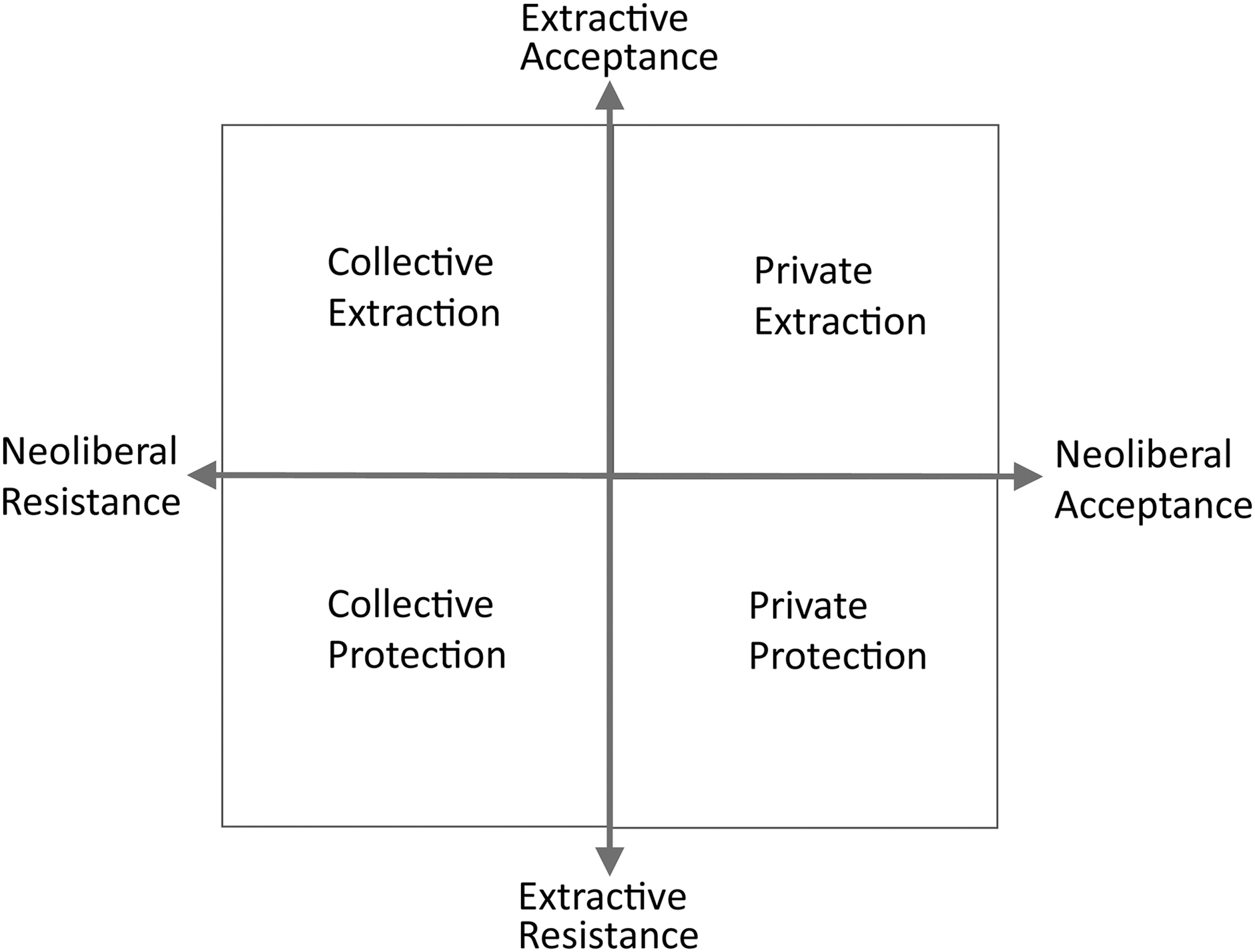
Varied community responses to extraction and neoliberalism.
On the first axis, we use the term “extractivism” broadly in relation to fossil fuels, other natural resources, land development, and labor exploitation. Extractivism refers to processes that extract value in an exploitative fashion from land, ecosystems, individuals, and communities—with forms of environmental slavery such as hog farming's extensive racialized impacts as just one stark example. 64 , 65 This approach recognizes that environmental injustice extends beyond mining and other extractive sites, to the spaces where people live, work, play, and pray. 66
The second axis characterizes degrees of acceptance of neoliberalism. Sites of acceptance often thrive in neoliberalized systems, where ideologies and policies nurture and normalize market-centered, regulation-averse orientations. Neoliberal ideologies privilege private property ownership and rights, free trade, de- and reregulation, financialization, and corporate-friendly state systems that redistribute wealth upward and devolve governance downward or into the hands of companies.
Neoliberal policies protect private property owners; remove social protections, especially environmental and labor regulations; devolve regulation from federal to state or municipal authorities; privatize and marketize everything from water to clean air; and strip away people's social safety nets such as affordable housing, childcare, education, or universal health care. Neoliberalism has become hegemonic in the past few decades and defines major political–economic systems, while also being culturally powerful 67 , 68 —often to the detriment of social, economic, and environmental well-being and equity. 69 , 70 , 71
Scholars have demonstrated that neoliberalization is a fundamentally racial project, whose advocates use race-neutral economic framings to protect the racially unequal status quo from redistributive demands of movements for civil rights, EJ, and decolonization. 72 Scholars of racial capitalism have taken this line of inquiry further, demonstrating how racist hierarchy and domination are intrinsic to capitalism. That is, racial inequalities, environmental and otherwise, are best understood not so much as accidental aberrations but instead part of how capital accumulates power and profit. 73 , 74 , 75 , 76
Through its connections with white resentment and white nationalism, industry actors and their political supporters can use neoliberal rhetoric to help foster sites of acceptance or create conditions that nurture their mobilization. 77 , 78
More systematic research into these outcomes is vital for many reasons, not the least of which is to explain why people might mobilize sites of acceptance that, on the surface at least, seem contrary to their well-being. Karl Polanyi—an economic historian whose work has been re-popularized lately—examined capitalist economic systems and the ways corporate and other actors “disembed” market systems from social and environmental protections through processes such as deregulation and privatization of land. 79 Polanyi posited that when economic markets are disembedded from their social and ecological contexts, people experience social and ecological dislocation.
People's lives and environments feel volatile and unstable, and they feel exposed to the unpredictability of global markets. In turn, Polanyi proposed, people would counter social dislocation by mobilizing what he called “double movements,” attempting to “re-embed” markets into their social and ecological contexts through stricter environmental and social protections, industrial accountability, and the cessation of oppressive systems.
Neoliberal ideologies and policies have created intense social dislocation. 80 , 81 Based on Polanyi's observations, we would expect sites of resistance to counter neoliberalism's rampant ecological destruction and dislocating effects of deregulation and privatization. However, outcomes are not as simple as double movements (or sites of effectual resistance) that inevitably rein in disembedding.
In fact, researchers have demonstrated how neoliberalism can configure social movement logics in ways that undermine their abilities to address environmental injustices. Much scholarship that examines how neoliberalization shapes social movements and the associated implications for EJ has done so with regard to extractivism in the context of hazardous industrial production systems. 82 , 83 , 84 , 85 , 86 For instance, Ottinger has shown that the broader cultural and material terrain of neoliberalism channeled residents living around an oil refinery into dropping their opposition to the facility and supporting industry-friendly practices. 87
Other research has examined how neoliberalization circumscribes social movements' abilities to address environmental injustices in non-extractive contexts, too. These include: alternative farming 88 , 89 , 90 , 91 ; international environmental agreements 92 ; wetlands, forest, and biodiversity conservation 93 , 94 ; urban greening 95 , 96 ; EJ policy implementation 97 , 98 ; climate resilience planning 99 , 100 ; and scholar activism. 101 This research demonstrates that activists can reinforce neoliberal discourses, practices, and rollbacks—undermining prospects for EJ within and beyond industrial activity. Crucially, such research demonstrates how broader political economic and cultural forces of neoliberalism configure activism in ways that further legitimize neoliberal approaches to environmentalism.
Scholars working to describe and explain varied pathways toward environmental (in)justice should identify the degree to which mobilized groups resist extractivism and neoliberalism. As illustrated in Figure 2, community responses to these two distinct political projects may be understood as four ideal types: private extraction, collective extraction, private protection, and collective protection.
First, “private extraction” refers to community responses that accept—either passively or actively—both neoliberalism and extractivism. These communities accept ideological and political norms related to the primacy and value of de-regulated markets, while also allowing privatized processes of extraction and exploitation to move forward despite negative ecological and social impacts. One example is community acceptance of hydraulic fracturing in highly unregulated and market-dominated contexts. 102
Another is widespread support for renewed uranium production in communities still facing uranium's fatal environmental legacies. 103 , 104 In this issue, we see elements of this in articles by Caretta et al. on (private) natural gas pipelines and eminent domain and in Jalbert et al.'s examination of trespass laws and the “petrostate.” The role of the state and the ways that sites are coerced and influenced by neoliberal policies remain important considerations to examine further.
Second, “collective extraction” refers to community responses that elevate public or state-based (non-neoliberal) extraction that ultimately facilitate environmental injustices. Scholars such as Kallis argue that alternatives to neoliberalism, such as socialism, may be more environmentally friendly, but this is not necessarily the case. 105 Communist and socialist political approaches often go hand in hand with large-scale infrastructural projects to extract resources to facilitate rapid economic growth. 106 State-owned energy companies and utilities are common examples of collective extraction, whereas governments at smaller scales may use their influence, laws, and assets to take ownership of extractive industries for the financial benefit of local publics.
For example, the Southern Ute tribe in the United States has gained wealth relative to other tribes in the region by building collective ownership of its natural resources through development of five energy companies to develop oil, gas, and coal-bed methane extraction. 107 The energy revenue is invested into its Growth Fund, estimated to be worth $4 billion. 108 As such, under certain conditions, collective extraction may bring financial and labor benefits to historically marginalized social groups. However, these gains come at the potential trade-off of EJ and health.
In this issue, we see elements of this in Lapegna and Kunin's article on Argentinian sites of acceptance around herbicides. These sites formed amid state and institutional supports for herbicide use and solidified through various trade agreements and policies. Greenberg examines the Appalachian region and sites of ambivalence around coal. Coal companies are privately owned in these cases, of course. But their long regional histories and perceived links to community social fabrics highlight the importance of examining the interstitial spaces where private industries can be perceived as quasi-public or deeply rooted in regional cultural and social histories.
Third, “private protection” refers to community responses that seek to counter extractive activities—but do so largely by leveraging the market as a tool of social and ecological protection. For example, in this issue, Shadaan discusses how a neoliberal response to the exploitation of nail salon workers emerged in Toronto, Canada. This model relies on market incentives, rather than state action, to encourage consumers and nail salon owners to be responsible in how they treat workers. She argues that in this model, “Worker protections become voluntary, an option for salon owners and a choice for consumers.”
As an alternative to this neoliberal approach to remedy exploitation, Shadaan argues that nail salon workers themselves have identified collective-oriented protections as part of a broadened politics of care. Also in this issue, Harrison and Contreras examine ways in which communities resist extractivism but actively endorse or acquiesce to neoliberal approaches in the process of doing so. Lequieu's article on ambivalent responses to preserving green and open spaces in Chicago's South Side also emphasizes these kinds of responses, especially given people's acceptance of public–private partnerships, one of the hallmarks of neoliberal policymaking.
In line with the vision of nail salon workers that Shadaan puts forward, “collective protection” refers to community responses to environmental injustice that counter extractive and exploitative activities by leveraging public resources, rights, and responsibilities for collective benefit. We argue that of these four types, only collective protection constitutes an EJ approach and aligns with effectual sites of resistance we describe above.
Much of the field of EJ is oriented to simultaneously challenging the two forms of domination. On the one hand, EJ movements have stood strong against extractive industries that disproportionately harm Black, Indigenous, people of color, and other marginalized social groups. On the other hand, the EJ movement and related scholarship has called for an environmental politics that centers the voices, concerns, and perspectives of a disenfranchised public, and that challenges the colonization of public spaces by market actors. In this issue, in addition to Shadaan's work, we see these approaches in Carerra et al.'s analysis of counter-hegemonic civic science in Flint, Michigan.
CONCLUSION
As the articles in this special issue demonstrate, the variety of ways that neoliberalism and extractivism shape environmental (and other) movements need to be more systematically explored. Such research can inform policy and community organizing across scales and help identify solutions to global socio-environmental crises at a critical time. But to reach these insights, researchers need to explore the spectrum of EJ action—from sites of effectual resistance, through ineffectual resistance and passive acceptance, all the way to active acceptance—and build explanations across empirical contexts.
Scholars need to interrogate the contexts and conditions in which sites of acceptance emerge instead of sites of resistance, where these outcomes blend and change over time, and what factors drive resistance, quiescence, or acceptance of environmental destruction and risk.
At the same time, varied responses to extractivism and neoliberalism deserve more rigorous examination. Often, instead of normalizing neoliberalism's central ideologies and privileging markets, groups mobilizing sites of resistance tend to reject these hegemonic principles. However, sites of resistance may not always be driven by rejection of neoliberal norms. They may also, of course, take place in relation to general extractivism or exploitation outside of industrial sectors.
Given this, social scientists need to more deliberately interrogate multi-dimensional spaces in between, which can be productively examined along the spectrum of action we offered earlier and axes of groups' relationships to extractivism and neoliberalism.
This special issue focuses on two overarching questions: What happens to environmental social movements that emerge in neoliberal contexts? And what are the associated impacts related to EJ? Of course, these remain empirical questions to be tested across places, spaces, and times. This special issue begins to build systematic inquiries in that direction. We present studies here that get into the messiness of these questions, especially for researchers focusing on the under-explored “middle zone” where quiescence or ambivalence may emerge.
To this end, we include studies that showcase how to examine additional drivers creating pathways for sites of resistance, quiescence, and acceptance as they relate to two main projects of domination—extractivism and neoliberalism.
We offer, then, what we hope are useful, malleable conceptualizations that can be applied across time, space, and various contexts. These conceptualizations include our spectrum of community responses to environmental injustices, where we can start to observe and measure mechanisms that drive effectual resistance versus active acceptance, for example. And through which researchers can appreciate the rich “middle zone” to better understand the conditions driving those kinds of action. These conceptualizations also include our model of varied community responses to extraction and neoliberalism, which can help researchers avoid generalizations and present the nuances in their research findings.
We hope these offerings, as well as the studies included in this special issue, help researchers gain more systematic understandings of processes of action related to environmental injustices. Ultimately, though, we hope this issue is the most useful for the communities and policymakers working to realize EJ in the face of multiple crises.
Footnotes
AUTHOR DISCLOSURE STATEMENT
No competing financial interests exist.
FUNDING INFORMATION
This research was supported in part by the following: the Department of Sociology and the Center for Environmental Justice at Colorado State University and the Departments of Sociology and Environmental Studies & the Office of Faculty Affairs at the University of Colorado-Boulder.