




Abstract
The United States Environmental Protection Agency (USEPA) is responsible for the oversight of the federal Superfund program. Through the Superfund program, the USEPA remediates and redevelops the nation's most hazardous sites. Due to disenfranchisement and less political power, minority populations and lower income communities are the most common demographics near Superfund sites. With a focus on environmental justice (EJ), the USEPA attempts to ensure fair treatment of all demographics regarding environmental matters. Yet, the residents of these historically disenfranchised neighborhoods are often economically displaced by a whiter and wealthier demographic once a Superfund site is remediated. Displacement can be attributed to gentrification causing increases in property values. When the marginalized residents—who suffered the brunt of industrial development—are displaced, rich homeowners benefit by acquiring redeveloped property. Within Pensacola, Florida, the American Creosote Works, Inc. Superfund site is planned to be redeveloped into a passive park. The surrounding neighborhoods are predominantly lower income or belong to a minority population. Through a case study, we address the potential for gentrification-caused displacement. Potential issues of environmental injustice are illustrated to better understand the shortcomings of the Superfund program. The purpose of this article is to point out a deficiency in the current USEPA standards of environmental injustice pertaining to displacement. This article concludes that the USEPA has issues of reactivity and needs to implement safeguards to ensure EJ after USEPA operations have ended.
INTRODUCTION
Toxic waste sites are becoming a nationwide phenomenon, with the worst cases being monitored by the United States Environmental Protection Agency (USEPA) through the federal Superfund program. The passing of the Comprehensive Environmental Response, Compensation and Liability Act of 1980 orchestrated the founding of the Superfund program. 1 From an environmental justice (EJ) perspective, the Superfund program is marred by issues of racial prejudice, gentrification-caused displacement, and lengthy remediation efforts. The USEPA has a fundamental principle of EJ defined as “the fair treatment and meaningful involvement of all people regardless of race, color, national origin, or income with respect to the development, implementation and enforcement of environmental laws, regulations and policies.” 2 Yet, the Superfund program has continuously violated this ideal through displacement, which low-income and minority populations have disproportionately suffered. 3 , 4 , 5
EJ only became a central point of the Superfund program after the Executive Order (E.O.) 12898 was passed in 1994. 6 Within these first 14 years of execution, the federal program racially prioritized Superfund sites in white neighborhoods. To elaborate, remediation efforts were rare in black neighborhoods during the early 1980s. 7 Despite efforts to make the Superfund remediation process more racially equitable, low-income households and racial minorities unduly suffer from gentrification-related displacement. 8 , 9 , 10 For example, the Gowanus Canal Superfund site received the designation in 2010. 11 , 12 Upon being slated for redevelopment, the area's demographics became richer, more educated, and whiter. 13
As hazardous waste sites are addressed by the USEPA, it is important to consider what happens after the USEPA turns over remediated properties. This article argues that Superfund remediation has the potential to produce unfair socioeconomic conditions and even reinforce long-standing disparities for underfranchised citizens—particularly citizens who are a racial minority. This article aims to examine how EJ is considered by the USEPA when facilitating remediation and cleanup efforts of Superfund sites. This examination was conducted through a local case study of the American Creosote Works (ACW) Superfund site in Pensacola, Florida (Fig. 1). By examining the active remediation of the ACW site and the related USEPA documents, this article contextualizes the EJ challenges facing the federal program. Within the case study, we place a particular emphasis on analyzing the ACW site's immediate spatial influence over community demographics, gentrification, and the risk of forced displacement.
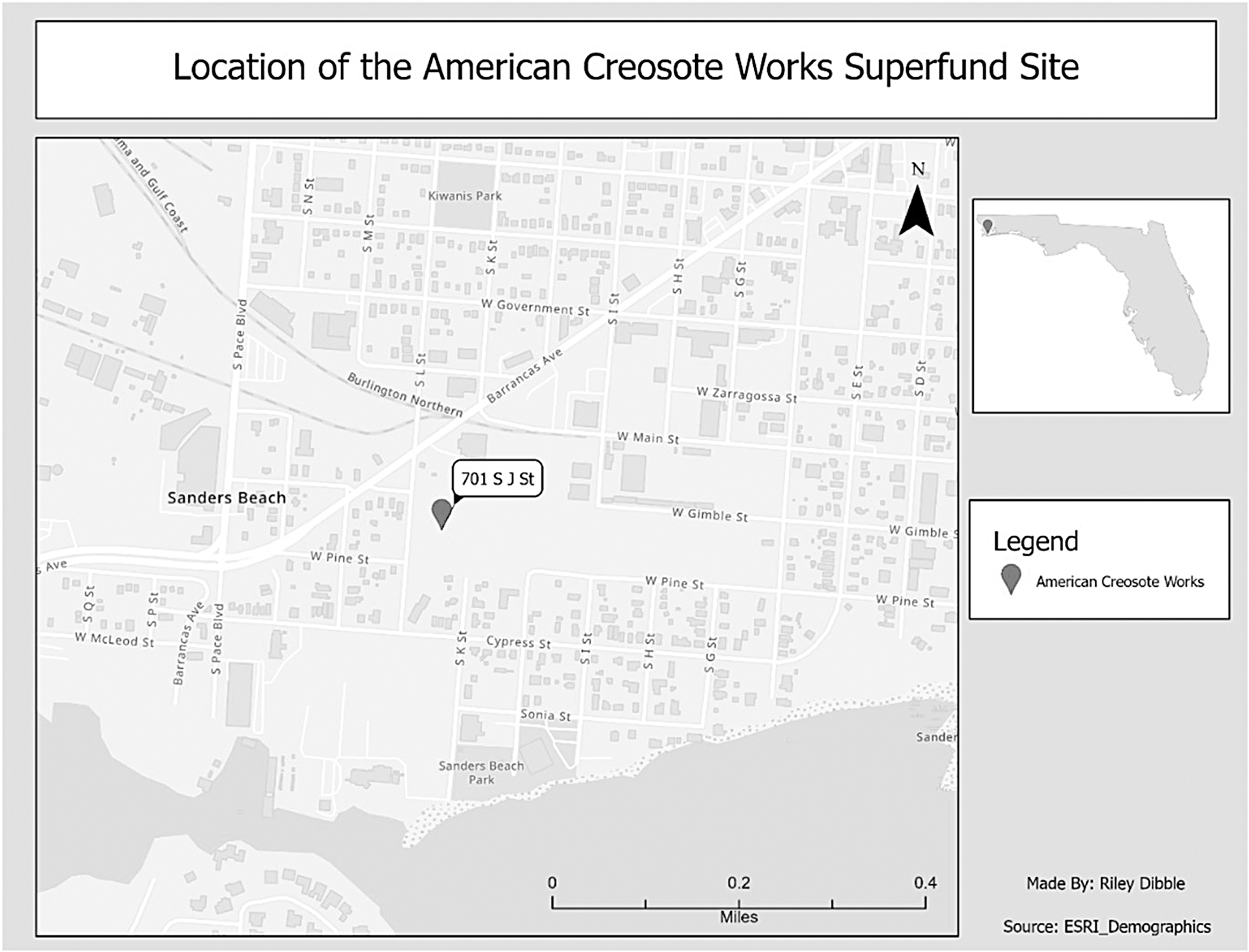
Location of the ACW site. ACW, American Creosote Works.
ACW site contextualized
Within the outskirts of Downtown Pensacola, lies a toxic waste site known as the American Creosote Works, Inc. (Pensacola Plant) Superfund site. The ACW Superfund site, located at 701 J Street Pensacola, FL 32502 (Fig. 2), joined the National Priority List in 1983 due to contaminated groundwater and soil. 14 Contamination within the ACW Superfund land parcel originates from the site's original operation as a wood-treating facility between 1902 and 1981. 15 The usage of pentachlorophenol and the formation of related dioxins eventually impacted the surrounding soil and groundwater. This contamination caused the USEPA to list the previous wood-treating facility as a Superfund site. 16 Since 1983, joint efforts between the USEPA and the Florida Department of Environmental Protection have attempted to begin remediation and protect the public and environment from further harm. 17 The goal is to redevelop the site into a passive park. 18

Map of parks near the ACW site. The parks were geocoded from an address bank provided by the city of Pensacola, FL. 27
To determine the necessary remediation and response actions, the USEPA conducted baseline risk assessments (BRAs) in 1989 and 1993. Overall, these two BRAs found there was a risk to human and environmental health. 19 Later in 2009, the USEPA performed an ecological risk and health assessment, which was later addended in 2014. While dioxins and furans are expected to have a minimal impact on land and aquatic ecosystems, human health is directly threatened by exposure to contaminated soil. 20 These reports guided UESEPA experts who later developed the 2017 sitewide Record of Decision (ROD). The ROD established remedial action objectives. 21
As per the 2017 sitewide ROD, the main cleanup measures include building a barrier wall around the source of dense nonaqueous-phase liquid (DNAPL), treating the DNAPL off-site, removing any off-site contaminated soil, and stabilizing on-site soil. 22 Potential human exposure was limited by installing fencing and restricting the drilling of wells. 23 Overall, the remedial process has been time-consuming with the primary remedial investigation starting on August 18, 1983; however, the final remediation project was decided on September 7, 2017. 24 The site has secured funding for remedial actions through the passing of the Bipartisan Infrastructure Bill. 25
Community involvement and notice
To facilitate community conversation and awareness, the USEPA has long published public notices in the Pensacola News Journal. 26 In addition, the USEPA has site documents publicly available online and at the University of West Florida's John C. Pace Library, which serves as the project's repository. 28
Accordingly, the USEPA held public meetings to determine local interests in the reuse planning process for the ACW site beginning in 2003 and reassessed in 2010 and 2016. 29 , 30 , 31 These dialogues ensure that the project's goals match communal expectations. At a meeting held on December 12, 2016, 35 community members attended and reconfirmed the passive park proposal. 32 Interestingly, community dialogue has not always been positive. In November 2020, residents reported worries over the slow cleanup process. They expressed that the ACW site is not well-maintained and might be causing health issues due to the contaminated soil. 33 Despite these concerns, the USEPA has maintained strong engagement with the community and support for the passive park.
Passive park proposal
The USEPA primarily serves as the facilitator in determining the ACW site's future reuse. To elaborate, the USEPA does not select a Superfund's site redevelopment goal—that power belongs to the local government. 34 In 2000, a Pensacola News Journal article expressed positive interest from residents and business owners to develop the ACW site into a passive park. 35 Likewise, the city of Pensacola has expressed intent to develop the ACW site into a passive park. 36 This idea has continuously maintained community support and is the most likely future land use. Accordingly, the USEPA has designed remediation efforts around the passive park proposal to accommodate the expected future land usage. 37
As per the USEPA, a passive park can be defined as “parks that support passive or low-intensity recreation.” 38 With numerous benefits, green spaces are valuable assets for a municipality. The benefits include economic development, improved physical and mental health among park visitors, space for recreational activities, and increased property values. 39 , 40 The potential for community investment and growth increases exponentially as park access and distribution tend to be poor in low-income and minority populations. 41 Within a half-mile walking distance, only two parks exist near the ACW site: Kiwanis Park and Sanders Beach (refer to Fig. 2). As such, the proposal of a park seems desirable. Nevertheless, potential harm exists—which we elaborate upon in the sections to follow. 42
REVIEW OF RELEVANT LITERATURE
EJ literature has consistently maintained that there is a correlation between race, income, and Superfund sites. 43 , 44 , 45 , 46 In summary, low-income communities and minorities have disproportionately suffered from being near Superfund sites. 47 , 48 Further research has examined the socioeconomic factors that have historically shaped the marginalized neighborhoods that are all so common around hazardous waste sites—a trend that persists in the modern day. As of September 2020, the demographics of near-Superfund site populations are likely to be marginalized. Specifically, 49.8% of communities within 1 mile of a Superfund site belong to a racial minority despite racial minorities making up 39.4% of the total American population. 49 However, a major shortcoming of EJ literature on Superfund sites is that many fail to articulate how indirect institutionalized discrimination can cause more socioeconomic issues of gentrification-caused displacement.
Stretesky and Hogan believe vulnerable populations are most likely to reside in locations near Superfund sites due to varying forms of indirect discrimination. 50 These differing forms include economic forces, structured choice, and past socioeconomic instances of racism. 51 This idea of applying indirect discrimination to Superfund sites was applied by Stretesky and Hogan in 1998; however, later literature lacks this framework. 52 To better understand indirect institutionalized discrimination, this article relies on the definition established by Feagin and Eckberg. 53 As per Feagin and Eckberg, indirect institutionalized discrimination pertains to “organizationally or community prescribed practices, motivated by neither prejudice nor intent to harm, that nevertheless have a negative and differential impact on members of a subordinate group.” 54
Based upon this definition, the positive intentions of Superfund remediation can have varying shades of indirect discrimination due to the potential harm of gentrification. Gentrification is when an area undergoes economic development and will likely experience a demographic shift. 55 , 56 This phenomenon can lead to the economic development of local municipalities and increases in resident wealth. 57 Yet, gentrification has the potential to displace marginalized communities as these populations often lack the strong socioeconomic influence necessary to advocate for equitable treatment. 58 As seen at the Superfund remediation of Gowanus Canal, cleaning and redeveloping a previous hazardous waste site into an environmental amenity can gentrify surrounding neighborhoods. 59 , 60 To clarify, the land in propinquity to revitalized spaces becomes a prime development sector and often attracts wealthy homeowners. 61
While economic growth can be beneficial for a neighborhood, the primary adverse concern of gentrifying communities is a white demographic shift that replaces the poorer and racial minority communities who are forced out by rising living costs and property taxes. 62 , 63 , 64 Between 2000 and 2010, the demographics shifted to reflect a more wealthy, educated, and whiter population—despite a minute increase in population. 65 Notably, the area became 13.4% whiter, while displacing 1.8% of black residents and 41.8% of Hispanic residents due to increased living costs. 66 , 67 In 2009, the average home in the Gowanus Canal was valued at $630,500; however, the median home price rose to just under $1.5 million in 2015. 68
Current literature pertaining to the Gowanus Canal criticizes the act of gentrification-caused displacement; however, the literature fails to reflect on how the aftermath of remediation can be indirect institutionalized discrimination. Curran et al. point out that EJ and gentrification have a complex relationship. 69 Yet, they do not frame gentrification-caused displacement through the indirect institutionalized framework this article is utilizing. By specifying a focus on the aftermath of Superfund remediation for the initial residents, this article argues that the potential displacement from a good-natured endeavor brings communal harm through the form of indirect institutionalized discrimination. It is the opinion of this article's authors that the instances of environmental injustice present after the redevelopment stage of the Superfund program are a consequence of indirect discrimination.
A common theme within EJ literature pertaining to the federal Superfund program is recommending that the USEPA reevaluate its policies or instill more regulatory oversight. Older literature generally focuses on providing solutions to aspects of direct discrimination including corruption, unfilled procedural equity, and slow progress. 70 , 71 , 72 Corruption came when President Ronald Reagan, who had an immense dislike of the new program, appointed officials to the USEPA who made “sweetheart deals” with the responsible polluters in what is now known as the “Sewergate” scandal. 73 These deals allowed the responsible parties to avoid the full extent of responsibility; instead, partial site cleanups were allowed. 74 , 75 Accordingly, the requirement to make the polluter finance the cleanup was mitigated. 76
The lack of EJ within the early Superfund program can be partly attributed to the finding that EJ only became a priority for the Superfund program after E.O. 12898 was passed in 1994. 77 , 78 This order mandates the protection of environmental and human health from adverse federal actions with a focus on vulnerable populations. 79 , 80 These cases show direct institutionalized discrimination because the USEPA's lax standards allowed for inadequate Superfund site remediation. 81 Similarly, the USEPA has historically expressed racial biases by prioritizing Superfund sites in white neighborhoods. 82 Direct institutionalized discrimination is affected by an organization's informal attitude and official ordinances. 83
As seen through the Gowanus Canal example, environmental injustice is a complex issue that pulls from both direct and indirect sources. Previous literature has provided critique and study of the USEPA's historic direct discrimination; however, the more modern focus on displacement has not commonly framed these issues through the indirect framework. The literature surrounding the Gowanus Canal and similar Superfund sites has put forth ideas of more regulatory oversight or better housing policy to address displacement. 84 , 85 The issue with these recommendations is that they do not truly establish how the USEPA's direct and indirect discriminatory actions correlate to environmental injustice within the complex socioeconomic network encompassing Superfund sites, surrounding residents, and property developers.
METHODS
We achieved the purpose of this article by examining the socioeconomic conditions of census block groups near the ACW site (refer to Fig. 1). The technical aspect of our spatial analysis utilized ArcGIS Pro and accessed demographic data from the 2018 American Community Survey. 86 To isolate the nearby census block groups, we created a 1-mile buffer around the Superfund site to identify and then extract the census block groups. This process resulted in eight census block groups that became the leading points of our study. Specifically, we assessed the minority population counts, median household incomes, and average property values of these census block groups. We decided on census block groups as the scale of analysis because these units better reflect community conditions than larger units such as census tracts. 87
We analyzed the eight census block groups for racial minority population percentages, median household incomes, and average property values based on precedent for gentrification-caused displacement as identified in the literature review. 88 , 89 As the ACW site has not yet finished redevelopment, the potential home value and property tax increases were theoretically based on information provided by Crompton and Tax Rates. 90 , 91 This article is aiming to contextualize the potential EJ issues at the ACW site through an indirect institutionalized discrimination framework. Therefore, further readings of USEPA documents on the ACW site were analyzed to provide an overview of the site and assess if safeguards are in place to protect against gentrification-caused displacement. It must be noted that the 2003 redevelopment plan referenced in other USEPA documents was unable to be sourced.
RESULTS
Demographics
The area around the ACW Superfund site primarily houses minority populations who are low income (refer to Tables 1 and 2). From Figure 3 and Table 1, five census block groups have a total minority population of more than 50%. In this article, we define minorities as all people who do not identify as non-Hispanic white. These five census block groups include 120330001001, 120330003002, 120330004001, 120330021002, and 120330022002 (refer to Fig. 3). Overall, 53% of the people living within 1 mile of ACW Superfund belong to a minority population.

Map of minority populations near the ACW site.
2018 Minority Population Percentages
Includes white Hispanics.
Census Block Groups and Income
FDIC, Federal Deposit Insurance Corporation.
Based on Pensacola's median income of $48,686 in 2018, seven census block groups are low income as set forth by the 2018 income limits defined by the Federal Deposit Insurance Corporation (FDIC) (refer to Table 2). 92 , 93 For the Pensacola-Ferry Pass-Brent area, the low-income limit for one-person households is $36,550, and two-person households have a low-income limit of $41,750. 94 Notably, the singular nonlow-income census block group, 120330023001, is predominantly a non-Hispanic white community. Overall, 9141 residents are in the low-income census block groups, of which, 5317 residents belong to a minority population translating to ∼58.17% of the low-income census block groups belonging to a minority population.
Concern for displacement and gentrification
Upon redevelopment, the area surrounding the ACW site may undergo gentrification due to potential growth in the property values of adjacent land parcels. 95 , 96 While increased property values do not guarantee that an area is undergoing gentrification, these increases are an indicator. 97
The relationship between gentrification and displacement relies on new community investments attracting wealthier residents. As the ACW site is located within Census Block Group 120330003001, a marginalized community, this census block group is a leading point of discussion (refer to Figs. 3 and 4 and Table 3). The findings and associated statistics in this section are theoretical. They are meant to present the explicit necessity of awareness the USEPA must adopt to avoid environmental injustice due to the remediation and redevelopment of the ACW site.

Map of median incomes near the ACW site.
Census Block Group 120330003001 Demographics in 2018
In 2018, the median income of Census Block Group 120330003001 was $31,570 and had an average home value of $170,603. 98 Opposingly, the city of Pensacola's median 2018 income was $48,686. 99 The city of Pensacola is in Escambia County, Florida. Escambia County's annual property tax is 0.76% of a property's assessed fair market value. 100 This statistic translates to Escambia County residents paying, on average, 2.09% of their annual income on property taxes. 101 By utilizing a combination of the aforementioned statistics and values, we calculated the approximate annual property tax for Census Block Group 120330003001 for 2018 to have been $1,296.58. Meaning, the residents of Census Block Group 12033003001 paid 4.11% of their annual median income on property taxes, which is almost double the percentage for an Escambia County resident on average (Table 3). Should the implementation of the park continue without any safeguards for low-income residents, the area becomes susceptible to gentrification.
To clarify, there is probable cause to expect urban redevelopment to increase property values and the associated property taxes. 102 The low-income residents of Census Block Group 120330003001 may become financially burdened and unable to live in jurisdictions subject to property tax increases. 103 , 104
Of the eight census block groups, the residents living in Census Block Group 120330003001 are the most likely to face significant home value increases. After the passive park is redeveloped, abutting properties may surge in value by up to 20%. 105 While not an adequate determiner for individual property parcels, the median home value of the census block group can be used to estimate home values after redevelopment. After redevelopment, the adjacent parcels' projected home median property value is $204,723.60. Based on this figure, the new estimated average property tax in Census Block Group 120330003001 will be $1,555.90—4.93% of the area's median income (Table 3).
The concern for gentrification is correlated to the projected home value increments as the increases in property taxes on these homes may price out long-term residents whose personal incomes would not have commensurately increased. Moreover, residences bordering the corridor reserved for the construction of the park are not the only dwellings susceptible to economically fueled displacement. Property values within two to three blocks of the passive park may rise between 5% and 10%. 106 The dichotomous nature—the potential for both negative and positive effects—of gentrification should compel urban planners and local government officials to consider the socioeconomic goals of a region. The appreciation in housing prices and property tax revenues enables local governments to invest more in neighborhoods. 107 However, these same increases can drive out long-term low-income tenants. 108
Presently, the socioeconomic conditions near the ACW site reflect the overall national conditions around other Superfund sites involving displacement. 109 , 110 , 111 The displacement that occurred after the redevelopment of the Gowanus Canal Superfund is notable for the ACW site due to similar demographics and reuse proposals. 112 , 113 At the Gowanus Canal Superfund site, long-term residents could not afford the increased property taxes and moved away. 114 In addition, the more expensive homes barred lower income residents from moving, in Gould and Lewis. 115 The population in Gowanus Canal was originally lower income and predominantly belonged to a racial minority group. However, the area gentrified, and the residents became increasingly more affluent and white. 116
Similar to the selected redevelopment project for the ACW site, the Gowanus Canal underwent a greening process that influenced nearby property values. 117 Due to the numerous similarities between site conditions and green developmental goals, the Gowanus Canal establishes a precedent of gentrification-caused displacement that applies to the ACW site.
In summary, the adoption of a passive park can increase property values in areas with significant amounts of low-income or minority households. These new home values may elevate the local property taxes and further financially burden local homeowners who may be unable to pay and elect to move out. Eventually, a more privileged demographic will move in. The current demographics in the regions surrounding the ACW site have the potential to be driven out by rising home prices and be replaced by wealthier residents (refer to Table 2) Notably, the most financially affluent census block groups near the ACW site are all white. All the census block groups with a predominant minority population are low income (refer to Table 2).
This finding is significant as the data suggest that the areas close to the ACW site will likely gentrify to have a whiter and wealthier demographic due to the lack of affluent minority populations. Overall, the socioeconomic conditions within a 1-mile radius of the ACW site convey a concern for the displacement of vulnerable residents. Currently, the true impact of gentrification-caused displacement cannot be determined as the passive park has not been realized. Therefore, property values have not yet increased.
DISCUSSION
Achieving and promoting EJ has been the USEPA's fundamental goal ever since E.O. 12898 formally defined EJ. 118 However, the current USEPA narrative of EJ within Superfund remediation is one of reactivity. To elaborate, Superfund remediation is a reactive process that treats past issues of environmental injustice without considering provisions or safeguards to protect vulnerable residents against future instances of environmental injustice. After the remediation of the Gowanus Canal Superfund site, the previous residents became unable to afford the gentrifying property values and were displaced. 119 Based on precedent for gentrification-caused displacement and the potential for such to occur at the ACW site, the main shortcoming within the formal regulatory process of Superfund remediation is an apparent limitation that does not consider how current USEPA actions can cause future issues of social inequality. This lack of consideration is indirect institutionalized discrimination as, despite the USEPA's good intentions, they are harming marginalized communities.
The purpose of this section is not to propose new policies but to point out an indirect institutional deficiency in the current USEPA standards of EJ as it relates to community displacement in marginalized neighborhoods. The issue is not that the USEPA is not cleaning up Superfund sites. Rather, the USEPA has failed to protect residents after the remediation and redevelopment of a nearby Superfund site finishes.
EJ seeks to guarantee that no singular population suffers a disproportionate amount of exposure to environmental hazards. 120 Within the Superfund program, EJ means protecting vulnerable communities living in proximity to the toxic waste sites. In particular, populations living near Superfund sites tend to be lower income and belong to an ethnic or racial minority. 121 , 122 The lower income status of these neighborhoods is what makes them prone to displacement. We must note that some Superfund sites are in rural or semiurban areas with low-value land. Accordingly, some of these regions are stigmatized for residential redevelopment, and gentrification is not likely; although the low land value is one of the very reasons these sites are initially targeted for commercial or industrial development before becoming Superfund sites. 123
Through displacement, vulnerable communities become additionally troubled as they do not gain the opportunity to enjoy the improved neighborhood and instead are forced by gentrifying property values to move into new areas—which may have worse conditions. 124 The potential negative consequences of gentrification oppose the fundamentals of EJ. The issue with gentrification is that the USEPA has not implemented safeguards to protect vulnerable residents from displacement. There was no mention of displacement of gentrification or displacement within the USEPA redevelopment site documents for the ACW Superfund site. 125 , 126 Gentrification may bring economic development to a region. Yet, gentrification may displace vulnerable populations when safeguards are not present—a weakness of the USEPA's current Superfund program. The lack of safeguards and no mention of the possible drawbacks of Superfund redevelopment suggest an oversight of achieving the USEPA's goal of EJ.
CONCLUSION
Currently, there exists a paradoxical nature of realizing EJ in the Superfund remediation process. The USEPA protects from immediate harm but fails to consider the potential longer term impacts of reuse and redevelopment. Without safeguards for vulnerable residents, gentrification-caused displacement will continue and further burden marginalized populations. In this sense, the current application of EJ is reactive and does not guarantee that those who suffered will be the ones to enjoy the benefits of redevelopment. To truly achieve EJ in the Superfund program, the USEPA needs to adopt a more proactive approach that considers how actions can impact residents postremediation. This approach can be framed through an indirect institutionalized framework as presented in this article.
Overall, this case study's importance is to show that while the USEPA does significant work in remediating Superfund sites, the agency is not without shortcomings. The lack of displacement safeguards makes communities, such as those surrounding the ACW site, more susceptible to rises in property values and the associated taxes. Despite the present reactivity of the Superfund program, the ACW site has benefited from USEPA involvement. For the USEPA to improve its capability to help vulnerable communities, the USEPA must adopt proactive policies and measures that offer protection even after the USEPA has concluded operations. In September 2022, the USEPA Office of Land and Emergency Management—which has oversight for the Superfund program—published an EJ action plan in response to federal government directives for federal agencies to seek and promote EJ in all their operations. 127
Sadly, this report contains only one mention of the word gentrification. Granted this mention is in the report's section on Equitable Redevelopment and Community-Wide Revitalization in Superfund Redevelopment work as a negative impact of Superfund redevelopment. However, such awareness of the potential for environmental injustice post-Superfund site redevelopment needs to be more front and center in not only USEPA publications but in actions as well.
Footnotes
ACKNOWLEDGMENTS
We would like to thank the Kugelman Honors Program and the Department of Earth and Environmental Sciences at the University of West Florida for their support of the honors thesis research that produced this article.
AUTHORs' CONTRIBUTIONS
R.D.: Conceptualization, methodology, investigation, writing (original draft and editing), project administration, and funding acquisition.
K.N.O.-D.: Methodology, investigation, writing (review and editing), supervision, project administration, and funding acquisition.
AUTHOR DISCLOSURE STATEMENT
No competing financial interests exist.
FUNDING INFORMATION
This research was funded by the University of West Florida: Kugelman Honors Program. The views expressed in this work are ours and do not necessarily represent those of the University of West Florida or its Board of Governors.