




Abstract
Community-based organizations (CBOs) that provide drinking water for human consumption ensure access to water in rural areas and urban peripheries. However, the Colombian governmental institutional system sensu lato underestimates the role of these organizations, their water ontologies, and their community character. Those CBOs have grouped themselves to claim justice as recognition for their ways of management and more equitable access to water as a common good, human right, and vital element. This article is aimed at making explicit the conceptions of justice underlying CBOs and their associations in the public arena. Thus, 156 CBOs grouped into 2 associations in Valle del Cauca region were investigated: AQUACOL (Association of CBOs providing drinking water and sanitation services) and FECOSER (Federation of rural community-based drinking water suppliers). The research was participatory and included both quantitative and qualitative methods. The findings show that many CBOs, in addition to offering access to water and an adequate supply service, also seek to protect/conserve ecosystems related to water supply. Thus, we found the coexistence of struggles for social and environmental justices in the political field, which also shows the heterogeneity of different conceptions of justice in the CBOs. However, their associations, AQUACOL and FECOSER, claim for social justice issues with emphasis on the recognition of their work. AQUACOL focuses on its role as water service provider for human consumption, whereas FECOSER includes a broader vision of water, so this organization also claims for environmental justice issues. Meanwhile, AQUACOL is moving from claims of social justice to those of environmental justice encouraged by the conflicts that emerge in the territory. Finally, in the territory and organizations observed, the dimension of justice is dynamic and different conceptions of it coexist from the individual level, across to CBOs, and their associations. The relationship between community water management and social justice is also evident, but given the conflicts of interests in the territory, there is a differential extension toward claims of environmental justice from the two CBOs associations studied.
INTRODUCTION
In Latin American and Caribbean countries 1 , 2 , 3 , 4 as well as in Africa, 5 , 6 the provision of public services (drinking water and sanitation) in rural and informal settlements at urban centers is carried out mainly by community-based organizations (CBOs). In Colombia, the latest estimate is up to 12,000 of such organizations according to Residential Public Services Superintendency, 7 but this figure may be much higher “… given that the country has got 1,102 municipalities with approximately 30,000 rural villages, where some of them may have more than one water service provider …” 8
These CBOs promote community water as a collective management model at the local level. 9 This model arose to the need of population to access water, and as a response to the limitations of the State to meet such basic need. 10 , 11
This model was promoted by the State and international organizations in the past; however, 12 from the 90s in the last century, it was dismissed by neoliberal discourses and practices upon the argument that this form of management is outdated. 13 Such biased argument relies on the assumption of greater efficiency coming from private utilities for the provision of water and sanitation services (W&SS). 14 Nonetheless, the same efficiency argument is consistent with the global economic powers that favor the processes of grabbing, privatization, and accumulation of capital based on offshore natural resources, such as water.
In this way, community processes are often confronted with global economic and political powers that validate a hegemonic vision of life, water, and its uses throughout many territories in the world. 15
To counteract such powers, CBOs have grouped together to strengthen themselves and gain recognition for their ways of water management. This is also both a process of articulation and a strategy of resistance to tackle the privatization and profit-making policies of the neoliberal model applied to water resources. 16 , 17 , 18 This articulation process emerged in Latin America and the Caribbean in the 1980s, 19 while for the case of Colombia, this took place between the late 1990s and early 2000s. 20 The articulation process is combined at different geographic scales (i.e., local, regional, national, and transnational).
Thus, the CBOs located in Valle del Cauca region have joined AQUACOL (Association of CBOs providing drinking water and sanitation services) or FECOSER (Federation of rural community-based drinking water suppliers), the case studies in this article. Both organizations are second-level associations: “group of grassroots organizations that inherited a status of regional representation to make visible the requests coming from its bases.” 21 These associations, in turn, are articulated at the national level to COCSASCOL (Confederation of Organizations for Water and Sanitation Services of Colombia) and the REDNAC (National Network of Community Water Supply Systems of Colombia), respectively. At the transnational level, these associations have been linked to CLOCSAS (Latin American Confederation of Community Organizations for Water and Sanitation Services) and Red VIDA (Inter-American Surveillance Network for the Defence and Right to Water), respectively.
The main claim from CBOs is for the recognition of their unique features (i.e., community nature, located in rural areas or urban peripheries, composed of peasants, farmers, and/or ethnical identity subjects) with their own worldviews and ways of water management. For this reason, CBOs groups carry out political advocacy actions before governmental institutions from the water and sanitation sector to participate in the construction and development of legal and regulatory frameworks for drinkable water management; thus, looking for their legal recognition as a valid model for drinking water service provision.
This shows, on the one hand, the injustices faced by CBOs and their associations and, on the other hand, the strategies implemented by these organizations to address them. However, the construal on the agency capacity of CBOs and their associations has been primarily focused on the provision of water as a technical-operational issue and its political incidence as only a feature related to water governance; nonetheless, such construal disguises the goal of the actions and demands of these organizations, that is, the realization of justice.
Current literature on the relationship between community water management (CWM) for human consumption and justice is rather scarce, as there are mostly publications that address justice indirectly, and focused on: (1) injustice situations that cause conflicts around CWM, 22 , 23 , 24 the privatization policies of W&SS, 25 , 26 , 27 , 28 or regulatory frameworks that ignore this form of management. 29 , 30 , 31 , 32 (2) Organizational processes that fight for justice via collective actions for the realization of the right to water, 33 , 34 , 35 , 36 or associativity as a defense strategy for this form of management. 37 , 38 , 39 , 40
However, the understanding and discussion about justice have been present in the western tradition of political and moral philosophy since the classics, across the moderns and up to the contemporaries. Different ethical theories have conceptualized justice as a cardinal virtue, as a moral sentiment, as a duty or moral correctness to be observed regarding others, or in utilitarian terms, as the best possible outcome for the greatest number of people. For most of the western tradition, the category of justice has been at the core of regulating social relations among human individuals and groups alike.
Nonetheless, the extension of justice, toward other beings or expansion of the moral community, is a recent turn, dating from mid twentieth century. This turn deals with the moral consideration toward sentient beings other than humans, and such debate on justice considerations toward other nonhuman beings is an ongoing discussion. Alongside the development of the justice category, some adjectives have helped to qualify it, such as: social, distributive, retributive, procedural, and restorative/reparative justice.
In this sense, recognition, representation, and redistribution are the three dimensions of social justice proposed by Fraser and are taken into account in this article to analyze the justice dimension. 41 Meanwhile, these dimensions have been taken up for the theoretical nurturing and understanding of environmental justice by different authors. 42 , 43 , 44 , 45 The original three-dimensional model of justice proposed by Fraser is an intent to deal with complex justice problems arising from the globalization process where the nation-state justice systems fell short when mostly transnational economic powers disturb the social dynamics in specific contexts. Therefore, the dimensions of representation and recognition—aside of distribution—open new spaces in the political arena for the who and what of justice. It is precisely in the who dimension of this Fraserian model of justice where new collective subjects find a space for their vindications of justice as recognition, and as valid political subjects with their specific struggles.
Thus, environmental justice was initially understood as an extension of social justice to the environmental field, but it has gradually earned its own dynamics by becoming a “… statement about the crucial nature of the relationship between environment and the provision of justice itself ….” 46 However, the same author argued that the environmental justice field has expanded and it is very dynamic, and nowadays includes the material relationships between vulnerability, the disadvantaged, and the environmental conditions in which human experience is immersed.
In this same line, Pellow argued that studies on environmental justice and their conceptual development may be classified as the first and second generation. The former is focused mainly on environmental inequality including the categories of class and race, while the latter go beyond distribution issues and take on board other social categories, such as gender, sexual orientation, and species 47 ; thus, environmental justice nowadays is a growing and more complex field of study. The second-generation works are known in the literature as critical environmental justice studies. 48
In contrast, original conceptions of justice from indigenous communities around the world include their knowledge, principles, and values, and so expand justice among human subjects to embrace a whole set of natural entities. 49 In this sense, the western conception of environmental justice gets nurtured and developed by these indigenous visions that epistemologically rely upon the inextricable socioecological relationships between humans, the spiritual realm, and nature. 50 Thus, it might be argued that the founding anthropocentric conception of western environmental justice is becoming influenced by the indigenous epistemic-ontological turn that slowly moves it toward an ecocentric view.
Therefore, environmental justice that had been generally focused on the distribution of environmental goods and polluting loads experienced by different human population groups—mainly those in low-income and/or belonging to ethnic groups—now extends to justice for all beings of Creation, 51 “… not only because threats to their existence threaten ours, but because justice among the beings of Creation affirms life …” 52
In this way, environmental injustice not only focuses on the responsibility of social institutions for the unfair distribution of environmental goods and burdens, but also on the capacity of privileged social groups to constrain the socioecological contexts or horizons of meaning of other vulnerable social groups and thus experience the world responsibly toward other humans, the spiritual realm, and ecosystems. 53
Environmental justice was born as a social movement, and such feature has blossomed and diversified toward several social movements and academic works directly related to specific environmental injustices depending on the biophysical entity affecting collective subjects. 54 Thus, justice has been gradually qualified as climatic, food, energetic, and water justice.
In relation to water justice, Boelens et al. criticize the prescriptive universal theories of water justice by pointing out to a need to understand it from the perspective of how it is experienced and defined by individuals or collective subjects in specific contexts. 55 Therefore, water justice may be understood as “… the interactive societal and academic endeavour to critically explore water knowledge production, allocation and governance and to combine struggles against water-based forms of material dispossession, cultural discrimination, political exclusion and ecological destruction, as rooted in particular contexts …” (Boelens, 2015: 34). 56
Based on the above, this article is aimed at making explicit the conceptions of justice underlying CBOs that provide water services for human consumption and their associations in the public arena.
METHODS
According to demographic projections for the year 2022, the population of Valle del Cauca region in southwest Colombia is estimated in 4.6 million inhabitants, 85.6% living in urban areas and the remaining 14.4% living in small towns and scattered rural population. 57 The water quality risk index (WQRI) is a key parameter in this context to judge water quality management by different service providers including CBOs. Thus, WQRI is an indicator that judges water quality for human consumption in Colombia based on its physicochemical and microbiological features. The WQRI comprises the following water quality parameters: color, odor, taste, turbidity, pH, free residual chlorine, and total and fecal coliforms. The compounded calculation of WQRI from these parameters yields a range of values related to a risk category for a given water: 0%–5% (no risk water); 5.1%–14% (low-risk water); 14.1%–35% (medium-risk water); 35.1%–80% (high-risk water), and 80.1%–100% (unacceptable-risk water). 58
The averaged WQRI for the region is 19.9% 59 ; however, this figure is 0.42% for small municipalities in the urban areas and 48.3% in the rural areas. 60 These differences between WQRI values evidence the gap between urban and rural areas, with the former having access to safe water (no-risk water) for human consumption, while rural areas do not (high-risk water). There are public and private water utilities providing drinking water services in most urban areas, but in rural zones, CBOs are predominant, 61 with an estimate of 1,015 of such CBOs in Valle del Cauca region alone. 62
However, there is an ongoing associativity process of these CBOs in this part of the country, and there are two such associations, namely AQUACOL and FECOSER. AQUACOL was created in 2000 after a sustained process of empowerment and technical collaboration of several CBOs with academia (i.e., Cinara Institute at Universidad del Valle). Thus, AQUACOL is aimed at contributing to the improvement of drinking W&SS provision by the CBOs, and it has a current membership of 37 such organizations (see the location of these by color codes in Fig. 1).

General location showing regions and municipalities.
FECOSER was created in 2007 by several CBOs after a collaboration and empowerment process with a Colombian NGO: the Major Peasants Institute (IMCA). Moreover, these CBOs also took part in a regional governmental program on Rural Water Supply (PAAR) aimed at increasing the rural water supply coverage in the region. Hence, FECOSER is aimed at safeguarding water as a fundamental right for life and contributing to water resource conservation. FECOSER currently has a membership of 124 CBOs (see the location of these by color codes in Fig. 1).
This was participatory action research aimed at involving the recipient population in the production of knowledge about their own reality that allows them to influence the decisions affecting their daily lives. 63 , 64
The criteria that guide participatory action research are set out in three basic principles. The first is that the problem to be investigated is defined, analyzed, and solved by the social groups themselves. The second that the goal of participatory research is not only about the progress of science but the transformation of reality; and third, that in the process of knowledge production a higher level of awareness of reality is realized. 65
These principles rest on epistemological, political, and methodological assumptions. Epistemologically, it is proposed that the separation between the researcher and the object of study disappears. Regarding the methodological, the community is the manager of the research process due to its systematic link with the knowledge of reality, and in relation to the political, its purpose is the transformation of the social order in which the subjects operate.
Thus, a research team was formed for each organization, made up of the researcher and members of AQUACOL (10 members) and FECOSER (8 members), respectively. The researcher promoted the execution of the investigation and acted as coordinator of the process, but the decisions about the research were made within each team, who took part in: (1) problem definition by participants; (2) co-design of tools (survey, number of participatory workshops, selection of interviewees); (3) data gathering (survey application and documentary review); (4) data processing and analysis (both quantitative and qualitative data from survey and workshops); (5) production of reports on CBOs characterization, and organizational trajectory of AQUACOL and FECOSER. In addition, each research team undertook a training course on quantitative research methods and tools. As a corollary, the use of results for different purposes was agreed among AQUACOL, FECOSER, and the research team.
The members from these teams carried out the research activities. However, few other members from each association participated also in the activities. The representatives from each association (AQUACOL and FECOSER) for this research were selected via internal discussions and procedures within their general assemblies. Thus, around 10 members of the management boards of each organization and about 12 people from CBOs associated to FECOSER, plus 4 members of AQUACOL's advisory committee were appointed. The fieldwork and data gathering campaign run from January 2018 to December 2020, whereas the documentary review was extended up to December 2021 since new regulations related to CWM came out during this period.
This research was carried out via the integration of both quantitative and qualitative methods; this integration enriches and sharpens the comprehension capacity of the researcher. 66 Besides, this complementarity allows for a more integral perspective of the phenomenon under observation and yields wider and more diverse data. Therefore, an assortment of techniques and designs from both approaches, quantitative and qualitative, was put in place.
Quantitative approach
We use the Poll Design 67 by running a survey aimed at knowing the main features of water management from the CBOs affiliated to AQUACOL and FECOSER, respectively. A total of 122 surveys were applied to CBOs affiliated to FECOSER (98.4%) out of a total membership of 124. Meanwhile, 34 surveys were applied to CBOs affiliated to AQUACOL (91.2%) out of a total membership of 37. Notice that both samples were representative from each association's total population. In this sense, each association has a diversity of associated CBOs, hence of water supply systems, and by having samples size close to the actual populations size (98.4 and 91.2%, respectively), the representativity to capture key features was guaranteed.
The survey applied to each CBO had two sections: first, the organizational and administrative aspects of the CBO were filled out during a visit to its premises; second, an inspection of the water supply system from the households up to the intake point was carried out to assert environmental and technical features of CWM. The first section was answered by members of the board of directors from the CBOs, mainly by those holding the positions of presidents, secretaries, treasurers, or administrators. Meanwhile, the second section was answered by the plumbers or operators from the CBOs.
The surveys were coded and processed in Excel spreadsheets (MS Office 365, V16), and their analysis considered the dimensions of CWM: organizational, administrative, technical, and environmental. Based on the data gathered, a report to characterize the water management of the CBOs linked to AQUACOL and FECOSER was produced. This served as a starting point for the identification of problems and alternatives to the strengthening of CBOs by their associations.
Qualitative approach
Within this approach, we use the Narrative Design. 68 This technique makes possible to get closer to the subject's constructions of her/his own experiences for a given historical context. Thus, we looked for an in-depth comprehension of both recognition and disregard situations experienced by CBOs, and how these led to struggles for their justice vindications. For the latter, 4 participatory research workshops were run with the main boards of AQUACOL and FECOSER, respectively; 30 semi-structured interviews were applied to key stakeholders within the water and sanitation sector, representatives from CBOs taking part in local, regional, and national groups, and NGOs linked to AQUACOL and FECOSER (Table 1).
Features of Interviews and Interviewees
AQUACOL, Association of CBOs providing drinking water and sanitation services; CBO, community-based organization; CWM, community water management; FECOSER, Federation of rural community-based drinking water suppliers.
Moreover, documentary analysis and participatory observation completed the qualitative techniques set. Documentary revision and analysis were applied to institutional archives (i.e., national regulations and policies related to the water and sanitation sector, minutes of the National Community Water Management Board), and CBOs associations materials (i.e., minutes of meetings from AQUACOL and FECOSER's governing bodies, projects reports executed by these organizations, and websites of associations of other CBOs).
The participatory observation sought to deepen the understanding of the organizational dynamics, their development and context, and the relationships within and with other exogenous organizations and institutions through the involvement of the researcher in the routine activities and the significant key events of AQUACOL and FECOSER. The researcher also took part in the institutional and academic scenarios in which these associations participate.
She also participated in the monthly meetings of the boards of directors and the annual general assemblies of both associations; in the annual meetings of CBOs at the national level, as well as in informative and training activities run by academic institutions, NGOs and the water and sanitation sector bodies in which AQUACOL and FECOSER were present. During the COVID-19 pandemic, the activities of the associations were developed virtually due to mobility and contact restrictions, so the observation was carried out in such spaces. The participant observation occurred in different scenarios and was guided by the description of physical spaces, the characteristics of the participants and their interactions; these features were all recorded in a field diary.
The workshops and interviews were recorded, transcribed, and thematically coded in Atlas Ti (License key: 8F980-2B58F-43EA5-2UZY1-009DV; V8), based on the topics addressed in the interviews. Meanwhile, the documentary review was recorded in two matrices: The first related to the regulatory framework, where the type of Law, Decree, or Ruling was identified, followed by a general description of it, as well as features related to CWM. The second matrix comprised the information from other documents—minutes of meetings, reports, and websites—specifically on actions, contributions, limitations, and threats to CBOs.
All the information gathered allowed for the identification of actions and claims of these organizations, their contributions, and the diverse threats they face throughout the experiences of injustice, as well as the struggles these organizations undertake in their search for justice.
RESULTS
Main features of AQUACOL and FECOSER
Table 2 shows the main data for AQUACOL and FECOSER membership in terms of number of CBOs, household connections, population served, and size of water supply systems.
Features of AQUACOL and FECOSER Membership
CBOs that filled out the survey.
hh, household.
Although both associations gather community-based water management organizations, there is a strong difference in the number of their affiliated CBOs but most importantly in their size and spatial distribution. Thus, FECOSER gathers mostly small-sized water supply systems located predominantly in scattered rural villages, whereas AQUACOL assembles mainly big-sized water supply systems located largely in congregated small towns. These differences speak about the diverse difficulties and challenges faced by these associations first with their own water users, and second with the formal governmental institutions in charge of the water supply service control and water quality surveillance.
The self-view from CBOs (within both associations) shows that the roles of community water managers and public service providers coexist. Therefore, 50% and 81% of CBOs see themselves as community water managers in AQUACOL and FECOSER, respectively; whereas the vision of public service providers is 44% and 7% for CBOs at AQUACOL and FECOSER, respectively. There is also a minor percentage of CBOs where both self-views are compounded, this is, 6% and 11% for AQUACOL and FECOSER, respectively.
Role of AQUACOL and FECOSER as caretakers of common goods
AQUACOL and FECOSER are CBOs associations concerned with the provision of water for human consumption via a CWM model. However, both associations see themselves as going beyond their restricted role of service providers. From surveys results, more than 98% of CBOs in both associations stated that water is a human right.
There is heterogeneity among CBOs regarding water as a human right. For some CBOs, water as a human right means equitable access in terms of quantity, quality, and continuity for human beings. 69 Meanwhile, for others, water as a right and common good is not only intended for human beings, but it is also extended to other forms of life “… Self-management is the path to collectively access water and guarantee it to each person, animals and plants alike, and it also fights for the water to preserve its habitats, and its right to free-flowing through the territory …” (REDNAC, 2020: 9). 70
However, 62% of CBOs affiliated to AQUACOL value water as a common good, 26% as a resource, and 12% as both. Meanwhile, for FECOSER, the percentages for those same categories are 70%, 5%, and 25%, respectively. An example from the latter percentage shows the compounded valuation of water as follows: “… Water is a resource because she gives us all of the essential for living but it is also a common good because all of us have the right to her ….” 71
Another dimensions of work for these organizations beyond the functional role of water service providers have to do with the ecological and sustainability aspects. In this regard, more than 75% of CBOs at AQUACOL and FECOSER carry out conservation and protection actions for their freshwater resources and micro-catchments. Thus, they take care of pesticides use, reforestation with native species, protection of fauna and flora, and protection of water springs. Meanwhile, about 68% and 45% of CBOs from AQUACOL and FECOSER also develop environmental education processes aimed at the efficient use of water and care of water streams and catchments, respectively. However, policy tools such as efficient water use plans are more present in AQUACOL (59%) than in FECOSER (25%). This shows a more formal relationship as service providers for the former, but these plans also contribute to water sustainability in both cases (Fig. 2).
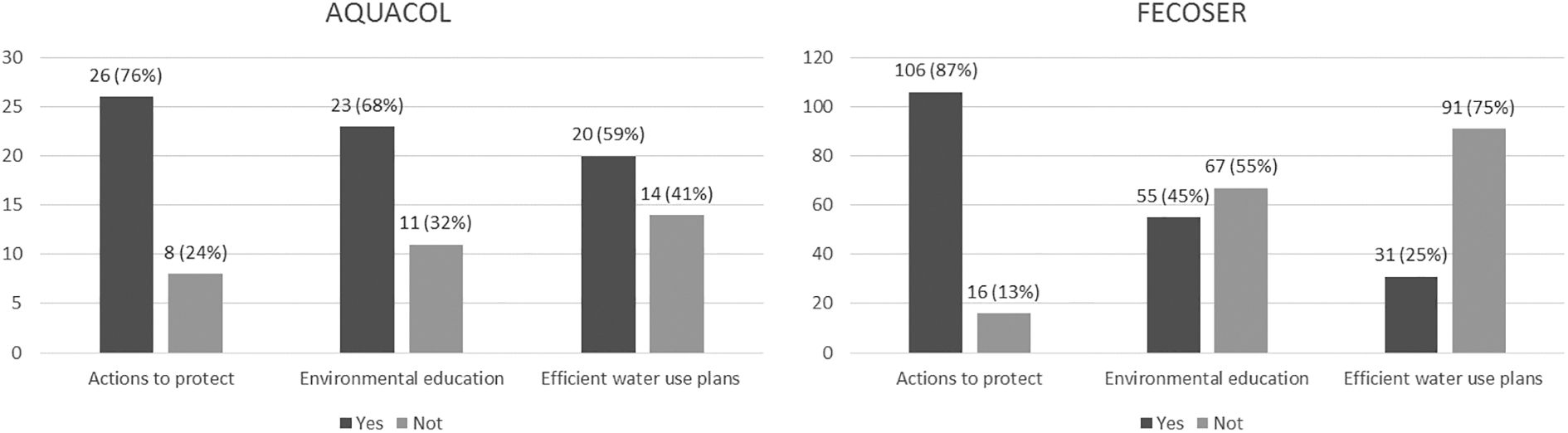
Environmental actions—community-based organizations from within AQUACOL and FECOSER.
The higher percentage of protection and conservation actions for water sources compared with the percentage of actions derived from environmental education processes and efficient water use plans shows that CBOs give higher priority to those actions in line with their traditional practices (which are incorporated into their repertoires of action), rather than those drawn from formal processes in which the planning logic, especially written, is required for the formulation of plans and projects.
CBOs also engage in the resolution of conflicts within their territories. From the CBOs that display conflicts in their communities (67% of those in AQUACOL and 69% of those in FECOSER), 91% and 97%, respectively, mediate in their resolution. These conflicts are of various kinds, ranging from disagreements between neighbors to the defense of their territory against the affectation of common goods. Thus, CBOs carry out actions of resistance and denunciation against the contamination of their waters, the presence of extensive monocrops, and agro-industrial activities that affect water resources.
For example, the CBO Association of Users of the Village Las Palmas and Tres Puertas, located in the municipality of Restrepo in Valle del Cauca region, filed a Popular Action (legal mechanism) against the Regional Environmental Authority, Smurfit Kappa Company of Colombia, and the Municipal Administration—Local Government—for the violation of their collective right to access clean water and a healthy environment due to the negative effects on local water streams caused by logging on protection areas. Hence, the High Constitutional Court ruled in favor of the CBO and its community. 72 Consequently, the actions from CBOs are not strictly limited to the management and distribution of water for human consumption, but also seek for the preservation of a management model that promotes collective and solidarity action within their territories.
Struggles for different dimensions of justice in the Colombian context
This section of results is based on narratives belonging to individuals who portrait the collective construction of their CBOs regarding different justice dimensions and claims. Such claims arise from the struggles they face within the economic and institutional context of Colombia. CBOs face various situations of injustice, which can be classified into environmental, financial, and political-legal. The first is related to the permissiveness of environmental authorities when granting licenses or permits for the realization of extractive, infrastructure, or urban projects in key ecosystems where CBOs are in first place. The second refers to the low investment from local governments to the strengthening of CBOs or investments out of context to tackle their needs. The third is related to the demands from governmental institutions for the surveillance and control of W&SS who do not recognize the community character of these organizations.
CBOs face the above-mentioned environmental and financial injustices directly or by creating associations at the local level. The latter happens because powerful stakeholders that generate injustices are located and make decisions on local territories where natural resources such as water are present. Some CBOs are successful such as the one quoted earlier, and few others such as the associations of CBOs from the municipalities of Trujillo and Tuluá, who have established agreements with local governments for the allocation of resources to the strengthening of the CWM model. 73 , 74
However, several other CBOs have not had any achievements; for example, in the municipality of Ginebra, there was recently a public investment in out-of-context infrastructure for water treatment, 75 whereas in the municipality of Riofrío, the Smurfit Kappa Company of Colombia keeps on buying land for extensive logging, 76 or in the municipality of Calima-Darién where avocado monocrops are swiftly increasing. 77 In the meantime, political-legal injustices are confronted by CBOs through their associations at the regional and national levels because the regulatory framework and public policies for water supply and sanitation in the rural areas of Colombia are implemented from the national level.
In this sense, AQUACOL and FECOSER struggle for recognition of the CWM model to supply water for human consumption in rural and periurban settings. This happens because current Colombian regulatory framework favors entrepreneurial organizations such as public and private water utilities but disregard other forms of water management such as the community-based model. The following statements give an account of the inappropriateness of the current Colombian regulatory framework: “… Water governmental institutions want us to fit in an XL shirt model, but we are S size, no way we can fit in ….” 78 “… The CWM model is not well seen by the global economic model because we are concerned with providing a good service at minimum costs, thus, we do not care about profitability. Moreover, we pursue water management based on the logic and real needs from people in the territories …” 79
The above-mentioned reasons explain why AQUACOL and FECOSER have been carrying out political advocacy for more than 20 years, in search for the recognition of their form of management, an activity that has intensified in recent years since the creation of a Dialogue Board with the Vice Ministry of Drinking Water and Sanitation (national institution in charge of rural water supply and sanitation in the country). This board was created in 2019 to “… build participatory improvements in public policy and facilitate coordination with other entities …” 80
Some progress has been made in this board by amending few rules and make them more coherent with the reality of water management in rural and periurban areas. 81 At the same time, CBOs national associations, to which AQUACOL and FECOSER belong, are seeking for a specific law for CWM for human consumption. These CBOs associations are currently working on the blueprint of such specific law project that will be put through the coming congress sessions and by taking advantage of the new government's program based on a vision of water-centered planning. 82
Although AQUACOL and FECOSER fight for the recognition of their form of management and share a space of political advocacy, this qualitative research also shows differences regarding the importance of water and conservation of catchments for both associations. Thus, for AQUACOL, a wider discussion on water and catchments appeared in the past 5 years due to the arising of diverse socioenvironmental conflicts in the territories, which in turn disturb CWM.
The current chairman of AQUACOL states the following: “… water related conflicts have multiplied on the field since water quantity and quality are more threatened every day. This has made us to think in a more integrated fashion, thus, worrying not only from the intake to down waters but caring of the whole catchment ….” 80 Other representatives from AQUACOL highlight that the environmental dimension was not present from the beginning of the association since the initial priority was on the introduction of sustainable technologies for water treatment. However, this narrow view has evolved with the advent of climate change and the environmental crisis.
Regarding FECOSER, right from the beginning there has been a wider vision of water where it becomes an articulating element, as worded by one of its members: “… we work and integrate around water, she is central for us, in fact, it is our heart and soul ….” 81 Therefore, the conservation and efficient use of this common good is a dictum for FECOSER's members. In ethical terms, they point out and understand that: “… water is lent to us by nature, and we must return it back to her in the same conditions …,” and “… water is a subject we relate to, is also a common good, and is not a commodity. We keep in touch with her because she is transversal to all our processes, it is the essence and allows us to live ….” 82 It must be noticed that FECOSER has historically had a view of water as subject, and such view is now vindicated by the biocentric turn in contemporary legal theory. The latter has helped CBOs to influence and regain the attention from institutions toward water.
The findings from this research show the existence of injustices caused first, by a regulatory framework that disregards alternative water management models for human consumption different from those of formal water utilities whether public or private; and second, there are conflicts of values because within the CWM model water is valued as a human right, a common good, and not as a commodity. Therefore, multiple socioenvironmental conflicts arise in the territory.
DISCUSSION
Access to water in rural villages, such as those supplied by the CBOs associated to AQUACOL and FECOSER, can be seen as an effort by the communities themselves to solve a basic need. However, it can also be construed as an attempt to guarantee a basic right that has been neglected by the State. Thus, to the neglect of this right underlies a lack of recognition of peasant populations as citizens; so, the claims of this population to access water as well as the strategies to its self-supply can be also understood as a call for justice in the political arena. Consequently, almost all CBOs consider water as a human right since everyone ought to have the right to it. In this sense, the justice to which this claim appeals is distributive because it is about everyone being able to access and use water equitably.
However, in the discourses on water as a right, there is an evident heterogeneity in terms of the subjects of justice; for some, this focuses on human beings, while, for others, the subjects of justice embrace natural entities too. The first vision is consequent with the official discourse promoted by the United Nations, whereas the second is closely related to the developments of indigenous environmental justice that also claims justice for natural entities. 83
While CBOs are formed to ensure access to water, their associativity processes (i.e., AQUACOL and FECOSER) struggle for political and legal recognition from the governmental stakeholders to get access to social justice. Associativity can be understood as a strategy to get participatory parity in the process, so that CBOs through their association make visible their voices and claims for CWM as a legitimate model to care for water and provide water-related services. Therefore, participatory parity via associativity may be framed within the representation dimension of social justice, and this is the political component of justice as theorized and argued by Fraser. 84 A corollary from this is that the associativity process integrates, strengthen, and make visible the worldviews (i.e., ontologies) and justice claims from CBOs.
In addition to the social justice dimension, both organizations pursue environmental justice claims, AQUACOL since 2017 and FECOSER since its origin as mentioned in the Results section. For AQUACOL, its claims are related to the degradation of natural entities from an instrumental ethics perspective (conservation of aquatic ecosystems as mean for human ends), whereas FECOSER recognizes water as a subject entailing an ethics-of-care perspective. The differential claims for justice that arise in these two organizations are related to the original model of each organization, that is, to the characteristics they acquire from their genesis. 85 AQUACOL has prioritized water quality in the provision of the service, whereas FECOSER has focused its efforts on the defense of water and territory. The expansion of AQUACOL's claims can be related to the eco-territorial turn in organizational processes, 86 where environmental issues are increasingly joined to other demands.
However, the empirical evidence gathered in this research makes evident the coexistence of different ontologies of water and systems of values within and across the CBOs from both associations (AQUACOL and FECOSER). In this sense, we argue that at least two ethical frameworks coexist: an ethics of care for water as a common good, and a utilitarian ethics for water as a resource, meaning that water is a mean for human welfare. By contrast, the utilitarian valuation of the hegemonic vision from state institutions reduces the value of water to an economic good, which very often lead to a sort of instrumental ends (i.e., economic efficiency, water markets and trade, water grabbing, to name just a few).
In these two associations also coexists a view of water as common good. However, Roca-Servat and Botero-Mesa argue and warn that water as a common good has been taken up by the hegemonic neoliberal rhetoric as “one profitable common good,” and this leaves out the original meaning of this concept based on the economics of solidarity and the collective community processes. 87 AQUACOL and FECOSER are in line with the original meaning of water as a common good.
The dynamic interaction of these water ontologies, systems of values, and ethical approaches in the social arena generates injustices that lead to struggles and conflicts in specific territories. The process by which such injustices are generated comes out from differential political and economic power positions within specific sociopolitical contexts, where powerful actors impose their water ontologies and value systems on those in disadvantage who will in turn experience injustices as a result. This can be understood as an attempt to erase the relations network that some communities or groups hold with natural entities. Whyte 88 explains this from the “colonialism of settlers,” a category that accounts for the structure of oppression based on the interference of one society upon another and its elimination. Despite Whyte uses this category to account for the relations between settlers and indigenous communities, it can be also extended to other social groups that are considered minorities or vulnerable, and onto whom the vision of the hegemonic society is imposed.
The attempt to homogenize the forms of relations between human beings and of these with natural entities has spread differentially in rural populations according to their geographical characteristics. Thus, smaller, and truly rural villages develop more organic Human: Nature relationships (care oriented), whereas congregated bigger towns may develop more functional relationships with nature (services oriented). These relations may be influenced by the segmented water management views portrayed from central governmental institutions. The water service for human consumption in congregated bigger towns is under the Ministry of Housing, City and Territory, and its emphasis is on water quality and its management. Consequently, the identification of some of these CBOs as water service providers prevails. The latter is due to the institutional view hold over them and supported by the national Law 142/1994 where they were named as such.
The denomination of service providers is more deeply rooted in the CBOs of AQUACOL, due to their greater interaction with governmental institutions, since they are subject to control and surveillance for supplying drinkable water to a greater number of users located mostly in congregated small towns. This restricted denomination for their actions has led the CBOs to re-signify their identity, and for this reason, their associations promote that of community managers instead, which also includes the defense of water as a right and common good, the protection and conservation of basins and the resolution of different conflicts present in their territories.
Meanwhile, in rural villages, water management is also under other institutions watch such as the Ministry of Environment and Sustainable Development, and the Ministry of Agriculture, which portrait mixed visions of water for conservation and food, respectively. Another factor influencing the above-mentioned relationships is the cultural dimension arising from the sense of place where people are interconnected via in situ interactions with diverse environmental entities, being water a central entity for their good living. 89
From a social standpoint, the care-oriented relationship contributes more to identity building while the instrumental contributes more to trading relationships. These relational differences may in turn influence the diverse claims for environmental justice already mentioned. Despite these differential relationships among humans and nature, the distinctive social foundation is that of community.
Conversely, those claims for environmental justice are plausibly related to the CBOs self-visions. Thus, in AQUACOL, there is a predominance of the water service provider vision centered on the fulfillment of such function; meanwhile, in FECOSER, there is a preponderance of community-based water organizations with a more relational understanding of water as a natural good, that is, of an end in itself. From an ethical standpoint, it may be argued that both AQUACOL and FECOSER depict an anthropocentric view since human subjects are the ultimate end.
Nonetheless, there are emerging views in some members from the CBOs who portrait features of a biocentric ethics. This may be a key step to move toward a socioecological justice framework in the future if the environmental crisis and socio-environmental conflicts keep on raising. Finally, and based on the findings herein, there is a constellation of intra (among CBOs and their associations) and interrelations (among CBOs associations and governmental bodies) that bring about a sustained process of social negotiation toward the remediation of a whole sort of injustice situations.
CONCLUSIONS
As shown by gathered data and the Discussion section, the dimension of justice is dynamic and different conceptions of this coexist from the individual level, CBOs, and their associations. Thus, the relationship between CWM and social justice is evident, but given the socio-environmental conflicts in the territory, there is a differential extension toward claims for environmental justice from the two CBOs associations studied herein.
AQUACOL, FECOSER, and their associated CBOs put forward diverse claims for social justice, which may be understood and analyzed by the theoretical model of justice proposed by Nancy Fraser. In this sense, water as a common good and water as a human right are vindications of fairness in terms of distribution (i.e., social justice). Likewise, the struggles for recognition of their unique features against the disregard from governmental institutions, and their fights for participatory parity to reach a successful political representation, are means to take part in the democratic construction of fairer regulatory frameworks and public policy tools for the CWM model.
The findings also show emerging views of a biocentric ethics in some members of the CBOs. Such views seem to be related to endogenous Human: Nature relationships coupled with the growing extent and intensity of the environmental crisis and its concurrent socio-environmental conflicts. However, such ethical views may be the foundation to build a more robust and inclusive socioecological justice framework that also cares for nonhuman entities and sustainability. It must be noted that indigenous environmental justice already encompasses socioecological justice considerations, and this is a framework that may strengthen the western environmental justice field both in theory and in practice.
The CBOs are mainly valued for their contribution to assure the human right to water in rural and peri-urban areas, with an emphasis on the water quality they supply to users as if this were solely a technical-operational issue. However, the CBOs must be seen as collective actors who struggle for different dimensions of environmental justice, and in particular for water justice.
The ultimate goals of these associations and their struggles go beyond the achievement of more inclusive and fairer legal and public policy tools. They are, at the same time, struggling for keeping communal ways to manage water, human relations based on solidarity and mutual support, the search for common goods and respect for nature. In summary, they fight for collective-life projects as an alternative to withstand the hegemonic and standardizing life model of global capitalism.
Finally, this research is an attempt to look at justice dimensions and its concomitant struggles within the use of water for human consumption and its social actors in the Colombian context. However, the view from governmental institutions, who play a central role in this specific water use, is missing and ought to be researched in next stages. Moreover, the community social actors (CBOs and their associations) involved in this research may gain a better understanding of the political dimension of their work, and in so doing, improve their struggle strategies and strengthen the associativity process for the realization of such endeavor.
Footnotes
ACKNOWLEDGMENTS
We thank AQUACOL and FECOSER for sharing their worldviews, knowledge, experiences, struggles, and hopes and for showing us that other forms of life are possible. Below, we express our gratitude to the funding bodies that contributed to this research, including this publication.
AUTHORs' CONTRIBUTIONS
C.B.-M. conducted the research. C.B.-M. and M.P.-V. jointly conceived, discussed, and equally contributed to the analysis, writing, and editing of this article.
AUTHOR DISCLOSURE STATEMENT
No competing financial interests exist.
FUNDING INFORMATION
This article is framed within Carolina Blanco Moreno's doctoral research “Associativity for the strengthening and recognition of Community Water Management in Valle del Cauca, Colombia,” supervised by Prof. Mario Perez at CINARA Institute, Cali, Colombia. This doctoral research was funded by MINCIENCIAS, Colombia (Call 727, 2015). This publication was supported by the Water Security and Sustainable Development Hub financed by the GCRF (Global Challenges Research Fund) of Research and Innovation of the United Kingdom (subvention No. ES/S008179/1).