




Abstract
In this article, we articulate a praxis of environmental justice education (EJE). Formal and informal environmental educators have been slow to join the EJ movement and to consider their roles and responsibilities with educating for EJ. We interrogate the role of whiteness in environmental education and attest that whiteness is a significant stumbling block that impedes the EJ movement in education. We describe whiteness as a historical, social, and political construct and consider how whiteness impacts environmental education through the exclusion of explicitly racial and class-based environmental concerns and through the shaping of the ideology of individualism that structures systemic injustices. Ultimately, we articulate an EJE praxis as a teaching paradigm that operates from the premise; we must both understand and disrupt the unfair distribution of resources and pollution on communities of color, poor communities, and other living beings.
INTRODUCTION
For this special issue on the First National People of Color Environmental Leadership Summit, we share our thoughts and perspectives as environmental justice (EJ) educators. At the summit, the 17 Principles of Environmental Justice gave definition and guidance for the EJ movement, which has been taken up by many disciplines, 1 such as social work, 2 sustainability, 3 and law, 4 to name a few. To this point, both K-12 education (i.e., schools and educators) and informal environmental educational leaders have been slow to join the EJ movement and to consider their roles and responsibilities with educating future leaders and thoughtful coinhabitants of the earth with an EJ perspective. For example, a review of mainstream environmental education curricula for grades 6–12 in the United States found that curricula rarely explicitly address EJ issues. 5 Given that the majority of those who create environmental education curricula are White and middle class, this should not come as a surprise, since this demographic is less likely to have firsthand experience with environmental injustices. 6 Given this context, we interrogate the role of whiteness within environmental education and identify ways that whiteness has served as a stumbling block that impedes the EJ movement in education.
WHITENESS AS A CONSTRUCT
In this section, we describe whiteness as a historical, social, and political construct and consider how whiteness impacts environmental education through the exclusion of explicitly racial and class-based environmental concerns and through the shaping of the ideology of individualism that structures systemic injustices. The terms “whiteness” and “white racialized identity” refer to the way in which whiteness is an ideological and normative construction that (re)constructs power and privilege through racialized discourses and processes. Thus, in the United States, racial identities are constructed as binaries, in which White people serve as the standard against which all other groups are judged.
Understanding race in the United States also relies heavily on whiteness. 7 Throughout the history of America, whiteness and the acceptance of White racial identity have been legally constructed as property 8 and have fostered a culture in which non-White people are viewed as inferior or abnormal. White people benefit from this White-dominated culture as a social mechanism because they can navigate society while also feeling and being seen as a legitimate or normative person. 9 White people do not often have to think about their racial identity because they live in a culture where being White is rarely acknowledged but is truly status quo. 10
“Whiteness” does not necessarily refer to White people, 11 meaning that the institution and privilege of whiteness can be upheld by institutions and people regardless of racial identities. Whiteness is a socially and historically constructed concept that normalizes domination and oppression through locating power within the persons and institutions that uphold whiteness. The ideology of whiteness does not need to rely on rational justifications for implementing racist practices and policies, which can even occur at the expense of White people. 12 For example, many poor White communities suffer from environmental injustices; however, racism and segregation often limit communities’ imaginings and actions, which might otherwise build solidarity and develop solutions while working with communities of color. 13 Whiteness in U.S. society wields enormous authority over others 14 and maintains a system skewed toward White people. According to Nicholas (2010), whiteness ought to be considered “not simply a category of identity, but as a position of power formed and protected through colonialism, slavery, segregation, and oppression” (p. 4). 15
Not all White people embody whiteness because it is not a racial identity but rather a construct of White privilege’s actions and performances. 16 It is possible, although not common, to identify as White without adhering to whiteness norms or participating in them but only through extremely rigorous and ongoing bias evaluation and retraining. White people are subject to whiteness because it is to their benefit, and White people must disown or disidentify with whiteness to fight for racial justice. 17
With this understanding of whiteness, environmental educators can learn to see beyond race by recognizing race as a shifting, complex sociohistorical construct rather than a biological or static one. EJ educators must acknowledge that racialized identities continue to be imposed on people of all backgrounds as a result of historical shifts in power as they examine environmental injustices. As we are assemblages of many different things, race does not define who we are, but it is always a part of us, and for White people, this must be (at the very least) acknowledged. This understanding of whiteness leads us to better understand the impacts of whiteness in environmental education and education overall.
Whiteness as property
One of the tenants of critical race theory is whiteness as property. Cheryl Harris (1993) coined the term “whiteness as property” when she described her grandmother’s light skin tone as being able to appear White when she left the south. 18 Harris describes the interrelationship between racialized identities and property and highlights how land property was made into something that White individuals could possess, safeguard, characterize, use, appreciate, and accumulate. Due to the social construction of race, White people—historically only White males—gained access to the “unalienable rights” that are guaranteed by the U.S. constitution but are denied to “others.” Property was legally constructed as White male ownership of both land and women (of all skin tones). Thus, property came to be equated with whiteness and became interchangeable as a criterion for ownership and/or control through varied processes and institutions that sought to maintain power, property, control, and wealth for White communities (e.g., as seen in redlining practices).
Whiteness as property has a powerful ongoing impact on land ownership and use in both private and public places. On the one hand, White individuals’ requirements, wants, and admittance to land that is assigned for use as a public good (such as district, state, and federal parks) are a given. On the other hand, people of color have been excluded and erased from natural areas and leisure activities 19 due to a variety of factors, including the precedent set by White people in the past, the ongoing violence against people of color in the United States, and the history of chattel slavery. This racialization of spaces in the United States20 feeds stereotyping of neighborhood properties and public spaces as desirable or not and curtails non-White accessibility to certain spaces (i.e., redlining and gentrification) and activities in natural settings.
Whiteness as property was a deliberate alteration in people’s relationships with the land (i.e., ideologically distinct from Indigenous people’s engagement with the land and in which property could only be owned by White men).21 People’s relationships to land became (re)constructed within an ideology of individualism through the individualistic, White male model of land ownership. Individualism serves to desensitize those with privilege to both systemic injustices and “the unjust benefits of social privilege” (p. 197). 22 Ultimately, individualistic responses to concerns for environmental sustainability and EJ severely constrain and threaten these efforts. 23
WHITENESS IN ENVIRONMENTAL EDUCATION
In this section, we examine how whiteness as property has implications for EJ and environmental education. Much of the practice and research on environmental education in formal education settings, even that which focuses on EJ, rarely attends to whiteness within environmental education or acknowledges how minoritized communities have had their environments constructed to adversely impact the health and well-being of their communities. 24 The environmental education movement was intended to bring awareness to environmental issues. At the same time, it was led by White men, which served to further embed the ideologies of whiteness, patriarchy, and capitalism into the natural world while also (re)writing and enacting the societal injustices associated with these ideologies into humans’ relationships with the natural world. 25
The hegemony of whiteness in the United States has embedded dominant ways of being, feeling, and acting within institutional spaces that uphold the norms and power of whiteness. 26 Such normative ideologies must be embodied by people of all backgrounds to thrive and maintain acceptability within spaces, including environmental institutions and nature places. With whiteness so embedded as the hegemonic norm of mainstream environmentalism through embodiment, discourse, and institutional practice, it is no surprise that whiteness is also culturally dominant within environmental education. Most environmental education programs in U.S. schools are often conceptualized by and for a normative audience of White and middle-class learners and their families.27 Unstated, but found in the hidden curriculum, 28 is how environmental programs are marked by a racialized class system that serves to exclude marginalized populations. 29 We view environmental education as being sociohistorically situated within the nexus of mainstream environmental movements. Notably, as Stapleton argues, the mainstream environmental movement and the EJ movement have emerged through very different historical processes and in response to differing conditions and relationships between humans and the natural world.30 While the mainstream environmental movement has been “shaped and inhabited primarily by white people” (p. xii),31 the EJ movement has been led by people of color and, significantly, in response to environmental injustices. What is notable here, then, is that when curricula ignore or erase the historical movements of people of color—namely those of the EJ movement—the curriculum gets (re)claimed and (re)enacted as a racialized text that embeds whiteness through normative ways of being in and engaging with the natural world.
Whiteness manifests in environmental education in a variety of ways. Not the least among these involves the conditioning of expected pro-environmental behaviors that involve regulating individuals’ actions in everything from behavior in outdoor natural places to personal/individualized “green” behaviors that are purportedly environmentally sustaining/able (e.g., reducing consumption and recycling). 32 Placing the onus of responsibility of the environmental crisis on individuals aligns with whiteness as property as we outlined above. Whiteness can also be viewed in environmental education through the ways in which various programs celebrate their outreach efforts for children of color while (seemingly) unknowingly highlighting issues of access. For example, “outreach” to learners of color is accomplished by sharing pictures of learners engaged with environmental programming, typically on White-led environmental organizations’ websites. 33 Environmental educators and nonprofits promoting environmentalism are often unaware how insulting and long-lasting their outreach positioning is to people of color, 34 that is, to be paraded and advertised typically for White people to feel good about the engagement of learners of color. Environmental educators also unwittingly exclude people of color when they develop forms of participation acceptability within norms of whiteness, such as prescribing acceptable and safe engagement, which position communities of color in disempowering ways, 35 or with discourses of exclusion such as when “invasive species” are associated with transnational youths’ countries of national origin. These actions reinforce deficit ideologies of marginalized populations by constructing them as unknowledgeable outsiders. At the same time, such actions activate the White savior complex as follows: marginalized children must be taught by White educators to appreciate distal spaces. 36
To deconstruct whiteness within environmental education, we propose that educators must develop a praxis of EJ. While the term environmental justice education (EJE) is not new, we provide insight into our conceptualization of EJE. We press that all spaces learners occupy are environments, not just distal outdoor spaces. EJE has the potential to be a decolonizing educational practice that decenters whiteness. 37 In an extensive review of research we conducted, we found that not only is EJ rarely taught in schools but also there is little research that operationalizes the pedagogies that support EJ. 38 Only 47% of the articles (n = 11) provided a definition of EJ, typically based on the Environmental Protection Agency’s definition or that of EJ scholars like Dr. Robert Bullard. Research that explores EJE pedagogies centers the EJ movement, considers the affective aspects of learning EJ concepts, and engages in transformative action. It is interesting to note that, since the meaning of the term “EJ” can vary widely within the field, it can be difficult to comprehend how EJ was connected to educational teaching approaches and outcomes in articles. We specifically sought to understand EJE in this study. In total, we found that 18% (n = 3) of the articles gave specific descriptions for EJE, and 82% (n = 14) used the term without explicitly defining it. Because of this, the impact of EJE is frequently misunderstood, which can lead to an ambiguous understanding of its meaning. This creates the conundrum that EJ and EJE are rarely defined within education, and as a result, many are unsure if they are engaging in the EJ movement. In addition, we found that many of the studies on EJE rarely utilized and defined other terms such as environmental racism, 39 environmental classism, and environmental justice.
The link between the studies we reviewed and our conceptualization of whiteness as a barrier to enactment of EJE again goes back to the roots of the EJ movement; notably, very few of the empirical studies even cited the First National People of Color Environmental Leadership Summit—18% (n = 3)—to define or explain EJ to educators and academics. 40 Influenced by the Civil Rights movement, Robert D. Bullard, a Black sociologist who is considered the father and leader of the EJ movement, coined the term “environmental justice.” 41 Bullard noted a willful and purposeful strategy governments use to create sustainable, walkable, clean, and safe urban communities utilized in primarily White neighborhoods. 42 Bullard described how White people, afforded privilege, are more likely to live in environmentally healthy areas. This focus on whiteness and privilege, along with the framing from the Leadership Summit, has been largely ignored in EJ curriculum and empirical research on EJE in K-12 classrooms or reduced to a list of social determinants that may influence certain locales.
CONCLUSION
Given the historic and current construction of whiteness in environmental education in the United States as we have outlined above, we conclude here with a concrete approach for EJE that we believe is applicable to both formal and informal educational programming. EJE praxis is a teaching paradigm that operates from the premise that we must both understand and disrupt the unfair distribution of resources and pollution on communities of color and our nonhuman relatives (i.e., plants, animals). A second premise is that all learners must have access to fair treatment for healthy living and learning environments.
Furthermore, our conception of EJE praxis is an approach where educators and learners maintain a personal commitment to challenging environmental injustices that begins with their/our reflection on positionality related to whiteness as a culture of power (Fig. 1). EJE praxis is rooted in the tradition of “praxis” in education, which refers to the deeply personal and interpersonal work involved in justice-oriented teaching practices, or as Freire refers to it, “reflection and action upon the world in order to transform it” (p. 52) 43 . EJE recognizes the historical and contemporary impact of racism and classism on communities of color and poor communities. It upholds that intersectional injustices can have negative impacts on communities as marginalized identities are additive. EJE must honor the roots of the EJ movement in content and practice by honoring communities and centering the voices and perspectives of marginalized individuals and communities. EJE develops an understanding of the interconnections between humanity and the environment and recognition of the systemic environmental injustices that exist in and are caused by capitalist lifestyles and the global economic and spatial injustices that benefit economically wealthy societies and unjustly impact economically vulnerable communities. 44
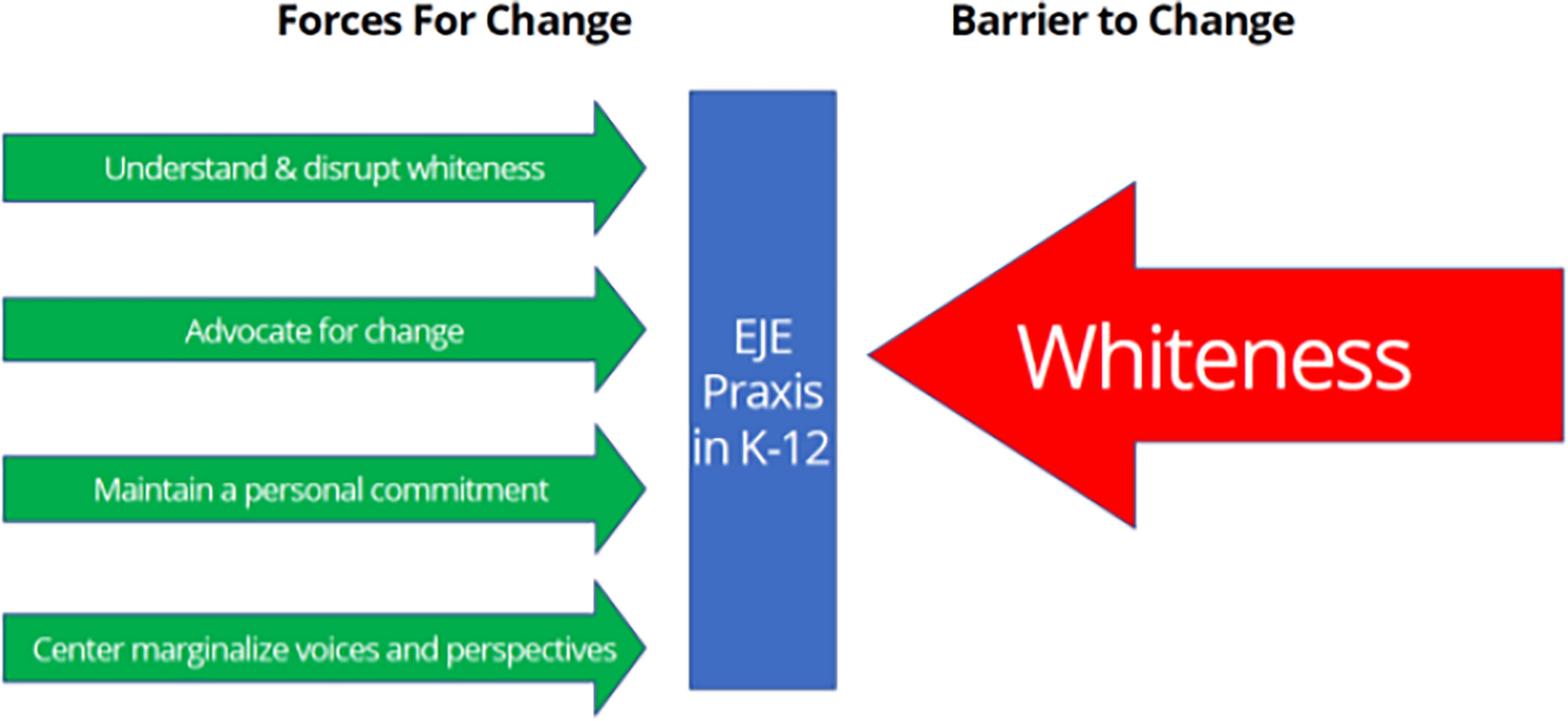
EJE praxis forces for and against change. EJE, environmental justice education.
These understandings lay the foundation for teaching and understanding environmental racism and classism. Ultimately, EJE must also seek local and global responses to transforming spaces, which lay the foundation for hope. Learning about EJ concepts can be emotionally traumatic due to the enormity of EJ concerns, and thus, we argue that it is thoughtless to teach EJ without providing opportunities for just transformation (see also Cachelin & Nicholsi, 2022). 45 We close with several reflection questions for environmental educators and learners who are interested in disentangling whiteness within environmental education.
Guiding questions to disrupt whiteness to enact EJE for all learners
How does my racial identity impact how I view and understand the environmental needs of communities of color and poor learners and their communities?
What do I know about my local community, both its history and contemporary EJ issues (i.e., Flint, Michigan, water crisis, and high lead exposure)?
How have I critically examined the ways my profession has reified whiteness to maintain education disparities and environmental injustices?
What groups am I connected with that help me stay actively engaged in understanding my profession and the needs of my local communities of color and poor community members?
Footnotes
AUTHORS’ CONTRIBUTIONS
M.L.M., A.S., and K.H. contributed to developing the community voice perspective and the writing of this article to describe its use and impact.
AUTHOR DISCLOSURE STATEMENT
No competing financial interests exist.
FUNDING INFORMATION
No funding was received for this article.