




Abstract
State-level environmental justice (EJ) policies have traditionally focused on defining EJ areas solely based on community-level socioeconomic characteristics, potentially overlooking overburdened communities due to omitting environmental factors. In response to President Biden’s Executive Order 14008, which emphasizes the “fair treatment” and “meaningful involvement” of overburdened communities to address environmental and health disparities, this article introduces a dual approach to EJ area identification. We first comprehensively review 14 states with EJ policy frameworks to understand how they define EJ areas. Subsequently, we propose the concept of “EJ duality,” which advocates for a dual approach that simultaneously assesses socioeconomic and environmental disparities to identify EJ areas. To illustrate the practical advantages of the dual approach, we provide a case study of Chicago, highlighting its potential to address the limitations associated with the conventional unidimensional approach. We recommend that state-level agencies adopt this more equitable approach to identify and prioritize measures for EJ areas.
Keywords
PROBLEM
President Biden’s Executive Order 14008 (E.O. 14008) Tackling the Climate Crisis at Home and Abroad urges federal agencies to prioritize aid to communities overburdened by environmental issues. 1 These communities primarily consist of racial and ethnic minorities, indigenous peoples, and low-income populations who have historically faced marginalization and are at a higher risk of adverse environmental health outcomes. 2 However, there are two significant challenges to the nationwide implementation of Biden’s E.O. 14008. First, states vary in how they define environmental justice (EJ) communities in legislation. Second, they often exclude environmental burdens (EBs) from the definition of EJ communities or do not explicitly define them. Indeed, most states use a unidimensional approach that solely considers socioeconomic criteria.3,4,5
This policy brief first reviews how states define EJ areas in their policy frameworks. Second, it proposes a dual EJ area identification approach. Third, using Chicago as a case study, it provides a simplified demonstration of applying the dual approach to identify overburdened communities. This demonstration shows the importance of ranking EJ communities and how a dual approach that simultaneously evaluates social disparities (SDs) and EBs can better identify and prioritize resources for the most overburdened communities. Overall, we recommend that state-level governments implement a dual approach for EJ area identification to prioritize the distribution of resources to the most impacted communities.
STATE-LEVEL ENVIRONMENTAL JUSTICE AREA DEFINITIONS
As of 2022, 14 states have either a statutory or a regulatory EJ policy framework.6,7 We reviewed the EJ area definitions of all these states, including California, Colorado, Connecticut, Illinois, Maryland, Massachusetts, Minnesota, New Jersey, New York, Oregon, Pennsylvania, Rhode Island, Virginia, and Washington. This selection may exclude some states with more recently enacted EJ laws or departmental policies. In the next section, we first introduce our main critique, which is the exclusion or lack of an explicit definition of EBs. We then highlight two additional issues that emerged from the analysis: the trade-off between legal authority and administrative flexibility and the unit of analysis for EJ area identification. Overall, our findings emphasize the need for an enforceable, detailed, and coupled socioenvironmental EJ area identification process.
Exclusion or lack of explicit definition of EBs
SD and EB are key criteria for EJ area identification that state-level governments must evaluate in tandem. If states use a unidimensional approach and define EJ areas solely based on socioeconomic factors, they can unintentionally omit communities with significant EBs. As a result, definitions that solely focus on SDs make it challenging to prioritize overburdened communities and do not ensure that ameliorative resources reach the most environmentally impacted communities. Thus, such definitions can perpetuate inequality.
Our analysis shows that 5 of the 14 states solely use SD criteria and exclude EB criteria. We found that the other nine states use socioeconomic factors and EB criteria in their EJ area definitions, thereby applying a dual approach (Table 1). However, five of them broadly define EBs as “cumulative impact.” The EJ policy framework does not include detailed and measurable indicators and methods. Additionally, the use of cumulative impact to define EJ areas remains unclear. Even states claiming to consider EBs need to identify detailed and measurable indicators for uniform implementation of their statutory or regulatory policies.
State-Level Environmental Justice Policies with Environmental Justice (EJ) Area Identification Criteria
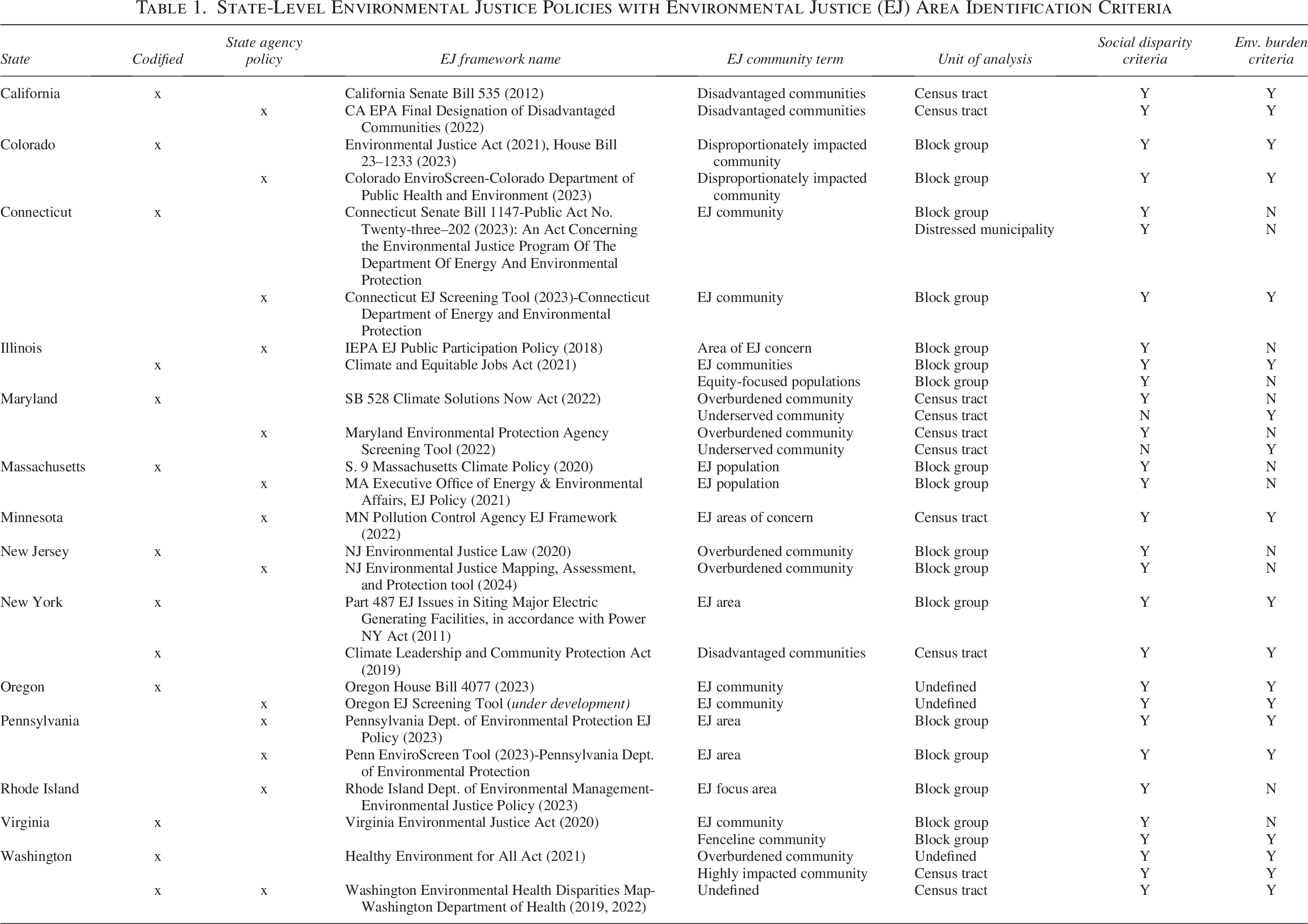
California, Maryland, and Virginia are the only three states explicitly defining their EB criteria. For example, California’s disadvantaged community definition incorporates a cumulative impact index known as CalEnviroScreen 4.0, which includes several EB indicators such as PM 2.5, diesel PM, lead, pesticides, and cleanup sites. 8 Virginia’s definition of fenceline communities as areas of EJ priority intervention includes EB criteria in terms of proximity to a major source of pollution. 9 Maryland’s overburdened community definition includes EB indicators such as PM 2.5, ozone, hazardous waste proximity, and proximity to brownfields, among others. 10
Trade-off between legal authority and administrative flexibility
Nine states have codified EJ community definitions into law (Table 1). In contrast, five states include their definition in state agency policy (e.g., a regulatory policy) (Table 1). There are three main reasons states should codify EJ definitions into legislation. First, codifying EJ into law creates a stable and consistent framework that can withstand change in administration and agency priorities. Second, enacted EJ laws have higher legal authority, giving communities and individuals greater power to hold government and other entities accountable for noncompliance and potentially leading to more effective environmental protection and remediation. Third, EJ laws apply EJ uniformly across the state, ensuring that all relevant state agencies and departments adhere to the same criteria when implementing their programs and policies for EJ communities. This foundational balance directly impacts the precision and application of EJ area identification, steering us to the next critical aspect.
Unit of analysis for EJ area identification
The unit of analysis is a critical aspect of defining EJ areas regardless of the level of governance (federal, state, county, and municipality). States that adopt smaller geographical units of analysis are able to more precisely identify EJ communities. A greater level of precision ensures that resources and interventions are distributed equitably across the communities most impacted by EBs. Census block groups (BGs) are the smallest unit of analysis available to assess socioeconomic demographics. For this reason, they are to be preferred over census tracts, which are larger geographic units and can unintentionally omit smaller areas with EJ concerns. Nine of 14 states use census BGs as the unit of analysis (Table 1). California, Minnesota, Maryland, Oregon, and Washington use census tracts as the unit of analysis.
STAKEHOLDERS OF CONCERN
In light of the trade-off between legal authority and administrative flexibility highlighted in the prior section, our recommendation for a dual approach to EJ area identification specifically targets state legislators. Government agencies will then take on the task of implementing the dual approach and defining the procedures to measure SD and EB. Environmental NGOs and advocacy groups, EJ organizations, and residents of EJ communities have long played a central role in EJ policy making and should be involved in the process of defining SD and EB according to local characteristics and needs. 11 They are the primary beneficiaries of EJ policies. Changes in the definition of EJ areas directly affect the level of resources available to them. Businesses and industries are the primary targets of EJ policies. If a dual approach leads to the identification of new EJ areas, they might face additional restrictions and permit denials. Local governments will have to comply with the state-level designation of EJ areas and adapt their policies. Finally, we recognize environmental policy and EJ researchers as stakeholders since they have provided increasing support to both government agencies and communities12,13 and can offer new data and methods to account for EB and SD.14,15
POLICY ALTERNATIVES: IMPROVING EJ AREA IDENTIFICATION METHODS WITH A DUAL APPROACH
Identifying EJ areas with a unidimensional approach results in a broad spectrum of classifications. 16 The unidimensional approach can overlook areas with significant EBs, undermining the need to prioritize them for relief measures. Similarly, it introduces the risk of allocating resources to low-priority EJ areas, which are experiencing low EB.
A dual approach for EJ identification
To address these limitations, EJ area definitions should meet the EJ duality requirement to advance EO 14008 priorities by conjointly examining SD and EB dimensions. To achieve the EJ duality requirement, we use a coincidence matrix as an assessment tool and an approach to identify EJ areas.17,18 By doing so, we can more accurately identify socially disadvantaged communities disproportionately impacted by EB. The unidimensional approach, relying on thresholds and attribute tests, creates a binary system for classifying areas as either meeting or not meeting EJ criteria. This approach lacks the nuance to prioritize areas based on the severity of their EB. A common characteristic of many unidimensional applications is that they require the transformation of the original variables into an ordinal scale (e.g., CalEnviroScreen and CDC/ATSDR EJI use the percentile rank transformation). 19 This practice alleviates the impact of outliers but eliminates the original measurement scale and replaces the magnitude differences between observations with a simple ranking order. This transformation is necessary to combine the original variables with different measurement scales (e.g., mg/L and Km or rail lines) and derive a score from them. 20 The suggested dual approach offers a more refined classification, with each segment indicating areas that differ in EJ rankings, determined by specific levels of EB and SD. This approach does not require percentile transformation or the multiplicative or additive combination of variables, thus maintaining the magnitude of the disparities.
To compare the issues raised by implementing the unidimensional EJ area designation with a dual approach, we use Massachusetts’s 21 three basic criteria thresholds to classify BGs in Chicago (Table 2). 22 We selected Massachusetts’ criteria for this demonstration due to the detailed policy documentation regarding SD thresholds provided by the state. We obtained socioeconomic variables from the American Community Survey (ACS) 2015–2019 5-year-estimate tables. 23 For this demonstration, we used the number of toxic release inventory (TRI) reporting facilities 24 at the BG level as a proxy for an EB indicator. 25 As mentioned above, BG is the smallest unit for socioeconomic data from the ACS and provides better precision than the census tract in identifying high-priority areas. 26 In this simplified two-dimensional demonstration, the coincidence matrix identifies 54.56% of BGs as EJ areas based on Massachusetts’s criteria thresholds; none encompass any TRIs (i.e., SD/non-EB areas). Only 34.75% of the BGs are classified appropriately as non-SD/non-EB areas and 7.21% as SD/EB areas. Notably, 3.47% of BGs do not have an EJ designation despite containing TRIs (i.e., non-SD/EB areas), which does not meet the EO 14008 mission to prioritize overburdened communities. Other EB indicators, such as brownfield locations and rail hubs, generated similar results (not shown). This simple assessment with the coincidence matrix underscores the limitations within the unidimensional categorization for implementing and evaluating EJ policies. In addition, it demonstrates the flexibility of the proposed approach since it does not require the transformation of the original variables into percentile ranks, which is the standard approach for deriving many of the EJ indices. 27
Assessment of the Singular Binary Designation of Environmental Justice Block Groups (BG) in Chicago
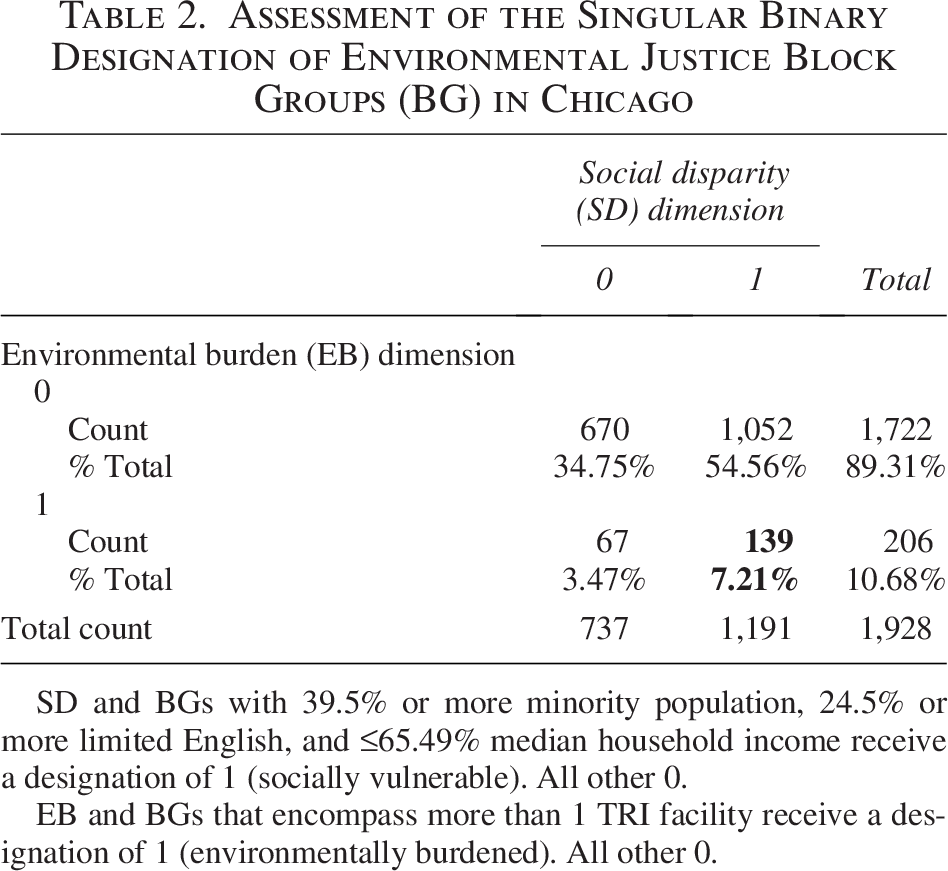
SD and BGs with 39.5% or more minority population, 24.5% or more limited English, and ≤65.49% median household income receive a designation of 1 (socially vulnerable). All other 0.
EB and BGs that encompass more than 1 TRI facility receive a designation of 1 (environmentally burdened). All other 0.
We constructed a second demonstration using a single SD variable (median household income [MHI] for Chicago households) and TRIs as the EB indicator. This dual classification approach revealed that only 10.70% of BGs satisfied the EJ duality requirement. This approach offers a more refined identification process by using SD and EB criteria and can define a simple relative intensity scale (e.g., very low, low, high, and very high). This approach allows state agencies to prioritize relief measures and address the needs of the most overburdened EJ areas (e.g., very high for both criteria). In Chicago, BGs with the highest SD and EB levels, characterized by the lowest MHI and the highest number of TRIs, stand out as the most socioeconomically vulnerable. In addition, BGs with the lowest EB and highest SD levels warrant inclusion in long-term plans to prevent the sitting of EBs due to their socioeconomic vulnerability. As illustrated in Table 3, another significant advantage is the flexibility to use different measurement scales for each dimension, such as the ratio for TRIs and the ordinal for the MHI.
Application of a Dual Approach for Classification of Environmental Justice Block Groups (BG) in Chicago
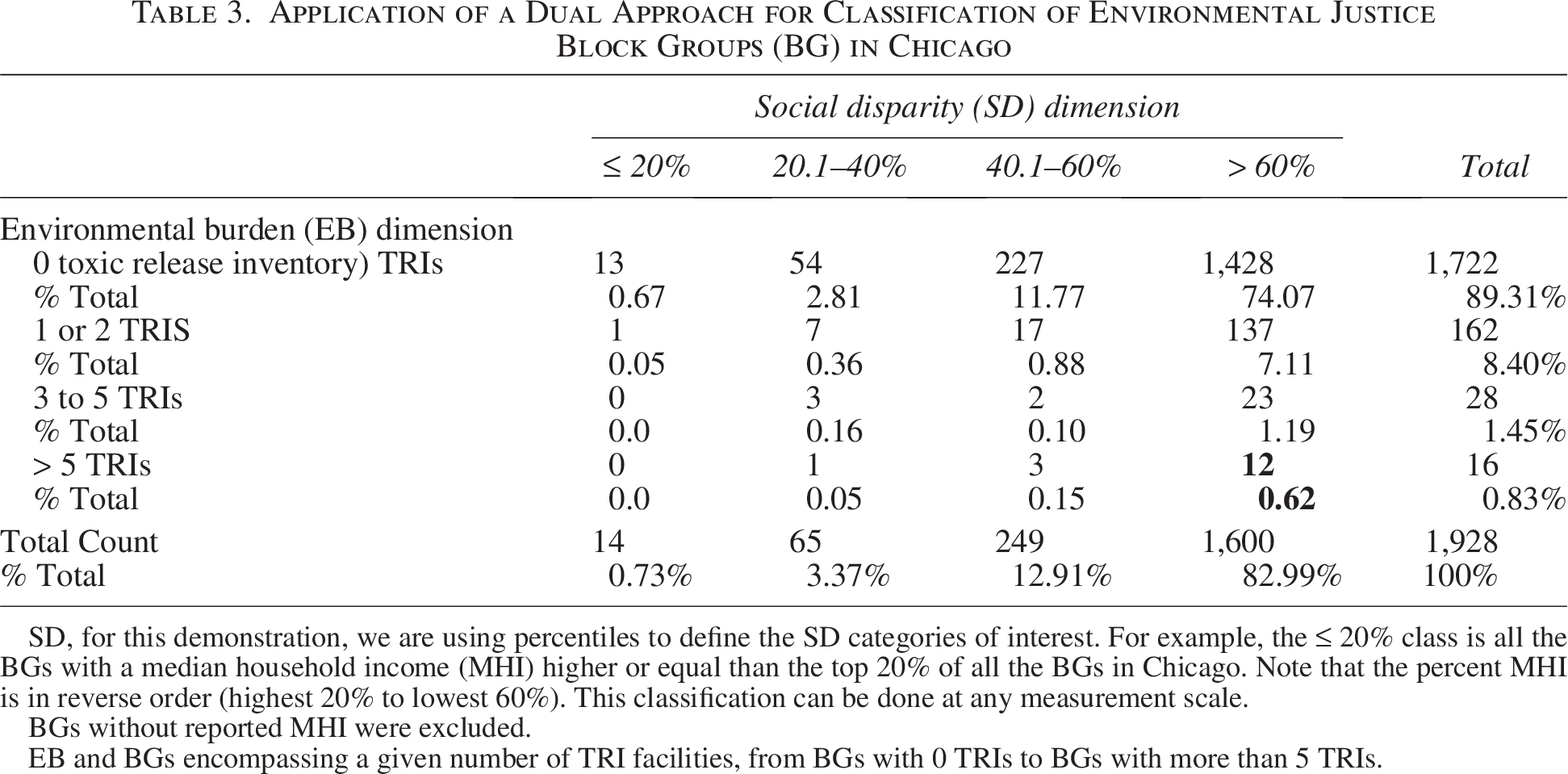
SD, for this demonstration, we are using percentiles to define the SD categories of interest. For example, the ≤ 20% class is all the BGs with a median household income (MHI) higher or equal than the top 20% of all the BGs in Chicago. Note that the percent MHI is in reverse order (highest 20% to lowest 60%). This classification can be done at any measurement scale.
BGs without reported MHI were excluded.
EB and BGs encompassing a given number of TRI facilities, from BGs with 0 TRIs to BGs with more than 5 TRIs.
While this simple demonstration used only one SD and one EB variable, policymakers can refine this method by selecting multiple variables that meet the EJ duality requirement in the form of EB and SD indices. This approach fulfills the EJ duality requirement and establishes a prioritization scale that government agencies can use to allocate resources equitably. In addition, it provides a refined visualization of the joint distribution of SD and EB, thus providing the information needed for tiered interventions (e.g., areas with very high SD but average EB).
POLICY RECOMMENDATION
Our review of 14 state-level EJ olicy frameworks and area identification practices shows that most states omit an explicit definition of EBs to identify EJ areas. Several states only define socioeconomic criteria and use large geographical units of analysis, potentially omitting environmentally overburdened communities or including nonoverburdened communities. We argue that for states to achieve federal EJ policy priorities of equitably distributing resources and effectively reducing environmental disparities, they must incorporate both SD and EB characteristics into EJ area identification at the legislative level. Our analysis of Chicago’s BGs demonstrates the advantages of this dual approach. We acknowledge that a blanket threshold for SD criteria may not be appropriate as each state has unique social geographies. We, therefore, recommend that state-level agencies implement this approach and identify EB and SD based on their states’ unique characteristics and in cooperation with local communities. The adoption of a dual approach across states would increase states’ alignment with the goals of Executive Order 14008 and enhance the government’s ability to address environmental injustices and allocate resources fairly.
AUTHORS’ CONTRIBUTIONS
M.B., J.L., M.S., and M.C. conceptualized the analysis. M.C. designed the methodology. M.B., J.L., and M.S. analyzed policy data. M.C. and P.B. analyzed and visualized hazards data. MB. administered and prepared the article. All authors reviewed and edited the article.
Footnotes
ACKNOWLEDGMENT
The authors would like to thank the Public Health GIS program of UIC for their financial support.
AUTHOR DISCLOSURE STATEMENT
The authors declare no potential conflicts of interest with respect to the research, authorship, and/or publication of this article.
FUNDING INFORMATION
No funding was received for this article.