




Abstract
Communities with environmental justice concerns are best positioned to drive effective local decision making. The Repair Lab Practitioner-in-Residence (PIR) program supports grassroots activists as they identify and implement policy solutions to environmental justice issues affecting their communities. Here, we describe the Repair Lab PIR program through a case study, the residency of two local grassroots environmental justice activists, who are advancing policy solutions for toxic coal dust mitigation from coal export terminals in the Southeast Community of Newport News and Lambert’s Point, Norfolk in Hampton Roads, Virginia. We summarize the history and context of the coal dust issue, ongoing activism and community preferences in both communities, and obstruction and inaction by the state of Virginia. We present the approach of the Repair Lab PIR program, which prioritizes action over research and foregrounds community expertise in decision making. Coal dust mitigation is political, technical, and emotional, and we discuss the available solutions and production of media that both document and affect change. In the Southeast Community, we are pursuing a new nuisance ordinance through the Newport News City Council, and, in Lambert’s Point, we are supporting ongoing advocacy and legal efforts, with the two approaches based on differences in local organizing and priorities and navigating the limitations on the powers of local governance in Virginia. Finally, we share challenges encountered to implement and sustain the Repair Lab PIR program within a university.
INTRODUCTION
Environmental injustice is driven and maintained by the exclusion of the people and experiences of affected populations from democratic processes. Residents with environmental justice concerns face an array of barriers to pollution mitigation and adaptation through policy. This reinforces existing systems of power and oppression and further limits the influence of community preferences in decision making. Academic institutions are positioned and resourced to navigate these challenges. However, academic environmental justice research currently tends to privilege technical expertise, serve disciplinary intellectual and professional concerns, and lack genuine community engagement—producing more research as opposed to less pollution. 1 In response, we developed the Repair Lab Practitioner-in-Residence (PIR) program to support individuals and teams as they envision and implement community-backed policy solutions around environmental justice issues that affect them.
Residents and community organizations with concerns around air pollution mitigation and adaptation must navigate a confusing and opaque set of obstacles to identifying their legal and policy options. Information is stored across local, state, and federal agencies, corporations, and nonprofits and held as local knowledge, with materials often being jargon filled or not publicly available. The result has been to augment the power of bureaucrats and influential private interests, limiting community participation in decision making and diminishing political accountability. 2 In opposition, the Repair Lab PIR program works to create community-centered policy making by providing concerned residents with the time and resources to reflect and respond to the complex challenges facing their communities. Studies have shown that those involved in decision-making processes are more likely to support and facilitate the implementation of decisions they participated in creating.3,4,5 The Repair Lab PIR program prioritizes community preferences for action rather than the generation of more research. A recent surge in environmental justice funding and academic and governmental agency activity has focused on air monitoring and other studies. 6 However, substantial research investments can fail to produce meaningful improvements in air quality. 7 They can also consume community resources through participatory processes wherein residents spend hundreds of hours in meetings, identifying problems and developing plans that are mostly unenforceable through specific policies at any level. 8
Here, we describe the Repair Lab PIR program, which is funded and hosted at a university, through a case study of the residency of two local grassroots environmental justice activists who are confronting coal dust pollution in the historically and predominantly African American neighborhoods of the Southeast Community of Newport News and Lambert’s Point in Norfolk, Virginia. First, we discuss the context around coal dust pollution locally, including the related organizing in the Southeast Community and Lambert’s Point and the frustrating and inadequate response from the state. We then present the Repair Lab PIR program generally and the current PIRs involved in this case study. We describe our specific approach to developing community-centered and supported policy solutions that are responsive to political contexts municipally and in Virginia, our media and communication strategies and products, and the status of this project. Finally, we reflect on the structural barriers that limit community participation in ostensibly democratic processes and institutional barriers we have and continue to face doing this work within the university.
PLACE AND PROBLEM
The Southeast Community in Newport News and Lambert’s Point in Norfolk are located along the James and Elizabeth Rivers in the region of Hampton Roads, Virginia. Hampton Roads is home to a natural deep-water harbor that is protected against the weather, with facilities along the harbor waterfront comprising the Port of Virginia. The Port of Virginia includes the largest naval base and shipbuilding and repair facility in the world; it is also the largest U.S. exporter of coal. 9 Coal mined in Appalachia is transported to Hampton Roads by rail for export through one of three terminals: Dominion Terminal Associates and Kinder Morgan Bulk Terminals in the Southeast Community and Norfolk Southern Corporation Terminal in Lambert’s Point. Residents in both neighborhoods share complaints of inaction around coal dust pollution, including its constant nuisance to homes and gathering spaces, with many buildings bearing the distinctive black coating of coal dust, and the dangers of coal dust exposure on their health.
Southeast Community, Newport News
The historically and predominantly Black Southeast Community of Newport News, also known as the East End, developed alongside industrial activities at the harbor, including the coal terminal, which was established in the late 1800s by railroad magnate Collis P. Huntington. The area drew many displaced African Americans whose farms and homes had been repossessed by the Commonwealth following the Civil War. Coal is staged for export today in massive piles upwind of the Southeast Community (Fig. 1). Interstate 664 (I-664) encloses the neighborhood on two sides and serves as a visual but not a physical barrier between the coal terminals and Southeast Community. There is a range of awareness around the coal dust issue, with some residents deeply concerned about its impacts and others for whom the coal dust is news. This is, in part, because of the spatial heterogeneities of airborne dust and the presence of other pollution sources, for example, industries around the shipyard and I-664, which have heavy diesel freight traffic and are often cited so as to diminish residents’ concerns about coal dust specifically. In 2005, the Peninsula Health District Virginia Department of Health reported that Southeast Community residents visited the emergency room for asthma at a rate double that of both Newport News and Virginia 10 (while this study continues to be cited in the literature and media, a copy of the document could not be found). There has been no community consensus around a single solution, but residents would like action taken to mitigate coal dust and its effects on their health and well-being.11,12 There are common expressions of frustration with the lack of opportunities for meaningful participation in decision-making processes and hopelessness around the issue, with stories of politicians and other decision makers refusing to act. Community organizations—the Southeast CARE Coalition, Virginia Black Leadership Organizing Collaborative (VA BLOC), and EmPower All—are working on the coal dust issue; however, it is not their only focus, with coal dust often mentioned in the same breath as neighborhood disinvestment, gentrification, other pollution sources, and desire for economic opportunities.
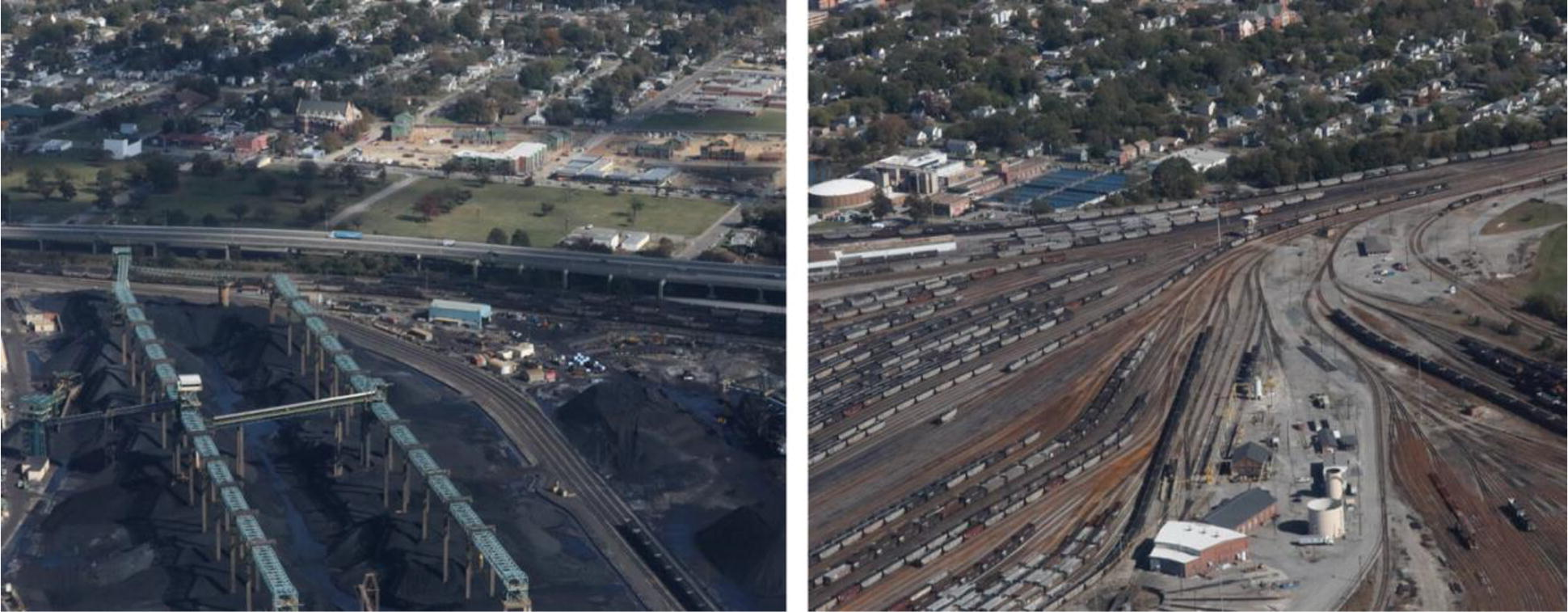
Photographs of areas of the Newport News Southeast Community (left) and Lambert’s Point in Norfolk (right) with the coal export terminals in the foreground.
Lambert’s Point, Norfolk
Lambert’s Point developed as an unofficial company town for Norfolk Southern terminal workers in the late 1800s. Also a historically and predominantly Black neighborhood, today coal-filled train cars move noisily through the neighborhood at all hours of the day and night, offloading directly onto ships, with houses and an outdoor sports complex located along the railyard fence line (Fig. 1). Residents’ complaints of coal dust impacts on their property, well-being, and health are nearly identical to records from 30 years ago, when, in 1992, the Virginia General Assembly was compelled to create the Joint Subcommittee Studying Measures to Reduce Emissions from Coal-Carrying Railroad Cars. 13 However, the Subcommittee has since taken no action to mitigate coal dust, accepting assertions by Norfolk Southern that the air quality is fine and covering coal cars is prohibitively expensive. Further advocacy by New Virginia Majority has been necessary to compel Norfolk Southern to comply with requirements to submit annual reports on dust emissions mitigation measures. Community organizing around coal dust has been led by New Virginia Majority and the Virginia Chapter of the Sierra Club, with community support coalesced around institutionalizing requirements for Norfolk Southern to cover coal-carrying rail cars and dumpers under the slogan, Cover the Coal.
Coal dust pollution
Coal storage, transport, and mining emit toxic dust that harms communities and workers.14,15,16,17,18,19 Coal dust is produced through physical processes that wear on the brittle rocks to generate coal particles that are then uplifted to the atmosphere by winds. Coal dust is lost from the atmosphere by deposition, which affects water and soil quality and causes a nuisance to residents who report needing to constantly clean black dust films from the outside and inside their homes and cars and change air filters. 20 Airborne dust is regulated by the U.S. Environmental Protection Agency (EPA) by size, with coal dust largely consisting of PM10 (particulate matter with a diameter <10 μm) and including PM2.5. Coal dust contains toxic metals, for example, arsenic, lead, mercury, and cadmium, causing health effects at levels below National Ambient Air Quality Standards (NAAQS).21,22,23,24,25 Because airborne coal dust is episodic (it is process and wind driven) and localized (dust has a short atmospheric lifetime), coal dust pollution may not exceed time-integrated PM10 and PM2.5 NAAQS. This presents additional challenges to communities with coal dust concerns, who therefore require non-NAAQS pathways to coal dust regulation. Approaches have included local ordinances banning coal transport and storage in Oakland 26 and Richmond, California, 27 although Oakland’s ban has since been overturned in the courts, 28 a permit renewal challenge in Curtis Bay, Maryland,29,30 and a successful challenge to a new coal terminal permit on the grounds it would undermine state-level coastal management in Plaquemines Parish, Louisiana. 31
Grassroots organizing
Grassroots coal dust activism has helped push environmental justice onto Virginia’s political agenda and compelled related efforts at the Virginia Department of Environmental Quality (DEQ). In 2011, the Southeast CARE Coalition publicly called on state and local governments to research toxic environmental pollution, including coal dust and the associated health impacts in the Southeast Community. 32 In 2015, Southeast CARE Coalition and New Virginia Majority joined Appalachian Voices and the Federal Policy Office of the West Harlem Environmental Action for Environmental Justice (WE ACT), creating the Virginia Environmental Justice Collaborative (VEJC) to coordinate and support environmental justice work across the state. Southeast CARE Coalition partnered with academic researchers and the EPA to produce an assessment of environmental and health concerns in the Southeast Community, in which coal dust was listed by residents as a top issue.33,34 Continuing pressure from grassroots activists, including those involved in the coal dust issue in the Southeast Community and Lambert’s Point, received widespread attention, reaching then candidate for governor, Terry McAullife, who was persuaded to include environmental justice on his campaign platform. As governor, McAuliffe issued two executive orders reflecting recommendations from the VEJC to incorporate environmental justice work into several state departments, including the DEQ, 35 and to establish the Virginia Advisory Council on Environmental Justice (VACEJ) to provide independent guidance to the Executive Branch on an action-oriented approach to environmental justice in state decision-making. 36 These were the first official environmental justice-related efforts in Virginia in over 20 years, and community efforts around coal dust were central to this success. The VACEJ included members of the Southeast CARE Coalition, and, at its inaugural meeting on December 18, 2017, the Council identified five pressing environmental justice issues in the state—coal dust was one. 37
Tidewater Air Monitoring Evaluation (TAME)
DEQ has never maintained PM10 or PM2.5 regulatory monitoring in the Southeast Community or Lambert’s Point; however, ongoing community calls for dust mitigation prompted the agency to develop a research study on coal dust air quality known as the Tidewater Air Monitoring Evaluation (TAME) that was funded by the EPA in 2020. TAME project goals are to characterize PM10 and PM2.5 mass concentrations as relevant for NAAQS compliance, measure PM10 metals composition, conduct a health risk assessment in partnership with the Virginia Department of Health, determine whether there is a need for ongoing monitoring, and inform future DEQ Strategic Plan objectives of improving air quality and engagement in communities designated as underserved. 38 TAME has experienced multiple years of unexplained delays, and the research study is yet to start. 39 The most recent public communication from DEQ indicates a downscaling in the scope of the proposed monitoring and still no stated timeline. 40
The 2020 Virginia Environmental Justice Act 41 requires DEQ to meaningfully involve residents of the Southeast Community and Lambert’s Point in TAME. The DEQ has requested some community feedback and responded to audience questions during TAME community information events; however, the limited information has largely flowed from DEQ officials to residents. For example, the current DEQ monitoring plan in the Southeast Community emphasizes regional measurements, with one PM10 sampler planned within the neighborhood, one at the neighborhood’s northern edge, and one that will be located outside of the Southeast Community. This is despite DEQ-invited community feedback to prioritize monitoring in the south and west of the neighborhood close to the terminals. 42 Community involvement in TAME includes DEQ efforts to install PurpleAir sensors in the Southeast Community and Lambert’s Point at residences and community buildings, with volunteers bearing associated electricity and data costs. PurpleAir sensors are a brand of low-cost nephelometer, a device unable to directly detect the majority of particles larger than PM2.5. 43 Here, DEQ is providing residents who have concerns around dust with sensors that do not measure dust and generate air quality data on issues expressly other than dust. DEQ officials have presented PurpleAir observations as part of community information events without accurately explaining their limitations. 44
State environmental justice response
Issues with TAME reflect a broader weakening of environmental justice priorities at DEQ. When the Virginia Environmental Justice Act was passed during the administration of Governor Ralph Northam, the DEQ responded by creating an Office of Environmental Justice with an Environmental Justice Director position acting as a liaison between residents and officials and facilitating diffusion of environmental justice considerations throughout state activities. Renee Hoyos was the first to occupy this position. After watching the office diminished under the administration of Governor Youngkin (elected in 2022), Hoyos resigned, explaining that it was clear that environmental justice was not a priority at the agency and having observed specific instances of community members not being informed or included in the full cycle of decision making as required by the law. 45 As of 2023, the DEQ Office of Environmental Justice has been downgraded to an office overseen by the Director of Cross-Media Programs, with Hoyos’s former position as Director since eliminated. This sends a message of government indifference and decreased prioritization of environmental justice issues.
REPAIR LAB PIR PROGRAM
The primary objective of the Repair Lab PIR program is to position grassroots environmental justice activists at the center of policy debates and decision making around environmental issues (defined broadly) that affect their communities. Because the work of social change is demanding, the Repair Lab PIR program provides financial, logistical, research, and media resources to individuals and teams for 1-year environmental justice residencies (with potential for extensions). Over the course of the residency, PIRs direct and work as part of the PIR program team to develop a policy intervention, implementation plan, and related multimedia project. The Repair Lab PIR program team also consists of a policy research specialist, multimedia producer, and directors (who are university faculty). The PIRs identify, contribute to, and review all program activities and products. The PIRs conduct community outreach and advocacy, lead community events and meetings, and interface with government officials, other decision makers, and the press. PIRs receive financial support that includes full- or part-time salary support, either benefited (medical, dental, vision, and retirement) or unbenefited, as selected by the PIR. The support team expands as required to include additional community members and/or other subject matter experts, who are all financially compensated for their time and contributions. Funds are in hand for events and other activities to advance the practitioners’ goals. PIRs are identified through an open application process requiring a short proposal describing the issue that will be the focus of the residency. The Repair Lab PIR program team is available to workshop proposal ideas with applicants in advance of their application submission.
The Repair Lab PIR program is a model of complementary community and academic collaboration that prioritizes community preferences for action through policy as opposed to the generation of more research. Our approach to collaboration builds on established frameworks for community engagement, in particular, the International Association for Public Participation, 46 with a focus on engaging historically marginalized community activists specifically. The Repair Lab PIR program was developed as a response to current trends in collaborative environmental justice research to privilege scientific and technical expertise, have top-down organizational structures, and lack genuine engagement with the most-affected people. 47 Instead, collaboration in the Repair Lab PIR program is a two-way dialogue that foregrounds the aspirations, concerns, and values of communities in the process of decision making. 48 We define engagement broadly as activities that build relationships, trust, and capacity to support equitable problem solving and collective action.
In addition to producing new community-centered environmental policies, the Repair Lab PIR program cultivates community thought leaders and contributes to the political learning, socialization, and activation of PIRs. For example, the PIR program’s first practitioner decided to run for state office to ensure the institutionalization of her ideas on adapting to sea-level rise-driven flooding in historically Black neighborhoods in Norfolk. She is currently a member of the city’s planning committee, in which capacity she reviews land use and zoning matters and the implementation of the Norfolk’s General Plan, providing her opportunities to push for flood-related action for Norfolk’s disproportionately unprotected Black residents. As part of the PIR program, PIRs build networks with other activists and organizers and become recognized as leaders by local politicians and other decision makers. These relationships and the expertise developed and held by PIRs remain in the community after the residency has ended. This facilitates continuity and deepens affected constituents’ expressions of their preferences and priorities, essential for both compelling and evaluating government responsiveness. The Repair Lab PIR program encourages mutual learning between activists, community members, artists, and academics that brings value to all participants.
At the focus of this case study, the current Repair Lab PIRs are environmental justice activists working as a team toward coal dust mitigation, as well as childhood friends who grew up in Norfolk, Virginia. One PIR is a pastor and community leader in the Southeast Community of Newport News, who believes in the power of grassroots activism to effect real change. His goal is the creation of a healthier and more equitable environment for his neighbors, especially those made most vulnerable. The second PIR lives in Norfolk and works for an educational nonprofit organization supporting at-risk students in Hampton Roads public schools. He has a deep commitment to social, mental, emotional, physical, and environmental well-being. His journey to environmental justice was based on the urgent need to create a better world for current and future generations. Together with his community, he aims to address environmental challenges and promote a sustainable and just future. Their residency began in February 2023 and is ongoing.
APPROACH
The project objective—to reduce coal dust pollution through policy in the Southeast Community and Lambert’s Point—was identified by the practitioners in their proposal to the Repair Lab PIR program. At the start of the residency, the PIR program team undertook two activities in parallel, developing an understanding of both coal dust mitigation pathways, technically and politically, and community priorities. We gathered information on industry practices and engineering solutions that ranged from tree barriers to complete dome enclosures or facility relocation as described in trade and scientific publications. We reviewed existing local, state, and federal regulations relevant to ambient coal dust pollution, considering all potential legal and policy avenues to implementing mitigation measures. Avenues included federal and/or state legislation, local ordinances, federal agency rulemaking and/or enforcement, state agency enforcement, litigation, facility permit challenges, voluntary corporate action, and directing corporate funds to communities for adaptation (e.g., a health care fund). Critical to this work, we interviewed community organizers and advocates (e.g., lawyers) in other locations where coal dust pollution has been an issue: Curtis Bay in Baltimore, Maryland; West Oakland and Richmond, California; Plaquemines Parish, Louisiana; along Pacific Northwest rail lines; and West Virginia coal mining towns. We heard from people about their experiences and reasons for pursuing one policy option over another. The feasibility of various policy avenues in Southeast Newport News and Lambert’s Point was also informed by conversations with residents regarding the patterns and positions of local politicians and agencies as related to their willingness to act on coal dust mitigation.
To ensure our policy work aligned with community priorities, we talked with residents, met with community organizers, held community events, listened to audience concerns at DEQ TAME information events (live and recorded), collected testimonials and survey responses through our website, and referenced statements in news articles and testimonies at historical and current public hearings and meetings. We recorded interviews with residents and other subject matter experts, which were also used as part of a multi-episode podcast to increase public awareness and media attention around the issue. For the podcast, interviews follow standards in audio documentary, as opposed to journalism, which allow interviewers to cultivate relationships with interviewees. On occasion, we would invite interviewees to partner with the PIR’s project going forward and/or attend or otherwise contribute to the events of interviewees’ respective initiatives, even when they did not overlap with the PIR project. This serves to build trust with a community burned in the past by parachute activism and research and support solidarity in a broader movement for social justice. Relationships with residents and organizers are foundational to the success of the Repair Lab PIR program, which relies on community knowledge, social infrastructure, and participation to identify policy solutions aligned with community priorities.
RESULTS
We decided to pursue different strategies in the Southeast Community and Lambert’s Point based on differences in local community organizing and priorities around coal dust mitigation in each neighborhood, with work as part of both strategies underway.
Southeast Community, Newport News
We are advocating for the Newport News City Council to pass a nuisance ordinance mandating coal dust mitigation through either a dome or wind fence around the Dominion Terminal Associates and Kinder Morgan Bulk Terminals. A dome is a structure that completely encloses the coal piles and much of the transloading equipment and infrastructure to contain the dust and prevent fugitive emissions. Domes are used for industrial bulk storage in over 100 locations globally, including for coal-related storage, and in many U.S. states.49,50,51 A wind fence is a structure that acts as a windbreak, decreasing wind speeds over coal surfaces and, therefore, the amount of dust uplifted to the atmosphere by winds. Wind fences are reported to decrease fugitive dust emissions by 70%–90% or more52,53,54,55,56,57,58,59 and are widely used to mitigate dust emissions in hundreds of locations around the world. 60 The strategy is contingent on there being wide community support, which we are measuring through an online survey, conversations with residents at community events, and during ongoing discussions and coalition building with the Southeast CARE Coalition, VA BLOC, EmPower All, and Ocean Conservancy. We have also co-hosted community events with other local groups, for example, Zion Baptist Church, East End Coalition, Newport News NAACP, and Hampton Roads Urban Agriculture. We are currently drafting ordinance language, conducting legal research, weighing advice from legal counsel, and preparing supporting documentation for City Council. The supporting documentation includes community testimonials on how coal dust pollution impacts residents’ well-being, health, and finances and research on the effectiveness and costs of dust-mitigating domes and wind fences. We are becoming familiar with the views and voting records of City Council members and meeting with each Council person to discuss the ordinance and negotiate specifics. The Mayor of Newport News and multiple City Council members have attended our community events.
Ordinances are a potentially effective tool for addressing environmental justice concerns because they allow for a measure of accountability that is more accessible to residents. When used in holistic planning and engagement efforts, they can function as a mechanism for preserving, promoting, and institutionalizing communities’ specific and unique characteristics and goals around quality of life. Ordinances can be used as a more direct tool for intervening before the regulatory process is triggered, for example, before measurements of PM10 NAAQS exceedances. However, in Virginia the use of local ordinances by municipalities is constrained by the Dillon Rule, with localities having only those powers that are expressly granted to them by the state. For example, the authority to regulate air quality is reserved to the state. That said, municipalities are expressly granted the power to regulate nuisances, whose definition “includes, but is not limited to, dangerous or unhealthy substances which have escaped, spilled, been released or which have been allowed to accumulate in or on any place.” 61 Virginia localities have also expressly granted authority to exercise all powers to secure and promote the general welfare of residents, for example, “safety, health, peace, good order, comfort, convenience, morals, trade, commerce and industry of the municipality and the inhabitants thereof,” as long as those actions are not inconsistent with state law or the powers reserved to the state. 62 As a result, cities may adopt a range of ordinances and enforcement measures to protect residents from public health and quality of life nuisances. The Virginia Supreme Court has validated the exercise of these powers in the adoption of local smoke-free ordinances. 63 Advocates in other states have found success addressing environmental justice issues through the ordinance process when focused on nuisance (as opposed to health).64,65,66,67,68 This provides a reasonable basis for our proposal to the City of Newport News to mitigate coal dust with a nuisance ordinance. We have collected testimonials from residents as evidence that coal dust is a nuisance locally, with residents reporting that coal dust films accumulate on their houses, cars, property, and persons and require constant cleaning. Residents also describe coal dust-related limitations on their quality of life, for example, they avoid using their porches and spending resources for home upgrades on power-washing, the high financial burdens of adaptation measures, for example, installation of expensive air filtration systems, and concerns over the impacts of coal dust on their health and well-being and that of their children, family members, and neighbors.
While not part of our approach initially, we are currently maintaining six air monitors across the downwind gradient of coal dust impacts in the Southeast Community. The goal of the monitoring is to demonstrate and counter misinformation on airborne PM10 concentrations from DEQ-installed PurpleAir sensors, supporting residents’ claims that coal dust enters the Southeast Community when winds blow from the terminals. The air monitors quantify PM1, PM2.5, and PM10 using a low-cost nephelometer, similar to PurpleAir sensors, and an optical particle countermeasuring PM10 directly (QuantAQ, Inc.). Monitors are co-located with PurpleAir sensors (offline) at four locations, including a community center, community garden and church, and residences in collaboration with Southeast CARE Coalition and EmPower All. We are working to make the data publicly available and will analyze the PM10 spatiotemporal variability as the measurement records grow. This said, our decision to pursue a nuisance ordinance in the Southeast Community is based on residents’ preferences for dust mitigation, not any specific monitoring outcomes.
Lambert’s Point, Norfolk
Because of the community consensus around Cover the Coal and advanced efforts to force coal dust pollution regulation through the EPA under the Clean Water Act, the Repair Lab PIR program team focused on supporting the ongoing initiatives of New Virginia Majority and the Virginia Chapter of the Sierra Club. This decision was made to avoid duplicating efforts and pulling resources and momentum in different directions. In September 2023, a coalition of national groups that included New Virginia Majority and the Sierra Club submitted a petition to the EPA requesting federal rulemaking on permitting the discharge of coal pollution from uncovered train cars into navigable waterways under the National Pollutant Discharge Elimination System. 69 We recorded community testimonies that were included in the petition, assisted with canvassing and outreach efforts, and provided research and support as requested by partners involved in the petition, including reviewing the existing coal dust exposure literature and investigating facility operations schedules. We are currently measuring PM1, PM2.5, and PM10 (QuantAQ, Inc.) alongside a PurpleAir device at one location in Lambert’s Point.
Media strategy and products
Media attention has been shown to increase issue salience and influence policy adoption. 70 Our media strategy includes attracting local, national, and social media attention, advertising in local and social media, distributing promotional materials, and creating a multi-episode podcast series that conveys the context, impacts, and solutions around coal dust pollution in Hampton Roads while connecting with listeners emotionally. For the Newport News nuisance ordinance, our slogan is Coal Dust Kills. We have created a website (coaldustkills.com) that overviews the issue and ordinance, invites people to connect, shares residents’ testimonials of coal dust impacts, centralizes press coverage, collects feedback on the ordinance (formerly through a survey), and distributes yard signs with our slogan to residents. As the work progresses, we will publish the ordinance for public viewing and use by activists in other cities and the supporting documentation for City Council. We continue to cultivate relationships with local and national journalists, invite local journalists to community events and city council meetings,71,72 write narratives and story pitches, and publish opinion editorials. 73 While the terminals appear as threatening expanses of coal from above, this is difficult to photograph from ground level. In November 2023, we photographed the terminals and their proximities to the Southeast Community and Lambert’s Point (Fig. 1) from a low-flying airplane with the help of Southwings, a volunteer organization of pilots providing flight time for individuals who share their goals of bringing attention to environmental pollution issues.
We released a narrated audio documentary podcast (June 2024) on coal dust pollution in the Southeast Community and Lambert’s Point titled, Crosswinds. The podcast is aimed at a national audience to bring public attention and political pressure to the issue. The series consists of five ∼30-minute episodes that are nonlinear and story-centric, featuring narrated vignettes in a style and format supportive of episodes and segments being adapted for broadcast by larger venues, which has already occurred.74,75 Crosswinds connects listeners to the coal dust problem through fact-based reporting, emotive scenes, and interviews with residents, weaving together audio documentary, journalism, and sound art methods. The podcast begins by rooting listeners in the lifelong friendship of the PIRs. Crosswinds then explores the mixed blessings of recent development in both Hampton Roads neighborhoods and how gentrification has the potential to influence local air quality. Next, listeners are transported along the train tracks built by convict laborers, connecting the mountains of West Virginia to export terminals in Curtis Bay and Hampton Roads and following the coal dust into the air, homes, and lungs of residents. Crosswinds surveys the science of airborne coal dust and the burden of proof placed on communities to demonstrate harm for protection through the regulatory and political process. Finally, Crosswinds features a sermon by one PIR, asking what it takes to keep going in the long struggle for justice, and documents progress in the ordinance process and EPA petition. While it is too soon to know the effect of Crosswinds on coal dust mitigation in Southeast Community and Lambert’s Point, interview participants have shared positive feedback, a critical requirement for success. We also created a limited series podcast in support of the PIR program’s first practitioner titled, Wading Between Two Titans, on the dual risks of sea-level rise and gentrification for Black residents of Norfolk. That podcast contributed to a media discourse that brought tangible benefits to the predominately Black Southside neighborhood and caused the city to revise the Coastal Storm Risk Management Plan to include structural protections for Southside residents.
CHALLENGES AND PITFALLS
The Repair Lab PIR program as designed has clashed with the institution of the university and academic status quo metrics of success that propagate past harms of extraction from marginalized individuals within and outside academia. First, the university has limited hiring options for well-paid positions that do not require a college degree. As a result, a potential PIR without a college degree but with deep expertise would be difficult to compensate fairly in a benefited position. While we have not yet needed to overcome this issue, it is a barrier to elevating voices and valuing knowledge created outside the university and achieving Repair Lab PIR program goals of providing activists with financial relief from the everyday responsibilities that can impede breakthrough thinking. This is much like the many volunteer and underpaid positions for community members on governmental advisory committees. Second, academic tenure standards have presented challenges to the team, as the tenure system privileges the publication of original scholarship in limited forms, for example, peer-reviewed, single-authored monographs and journal articles. 76 Directors have had to meet tenure expectations while envisioning and managing the Repair Lab PIR program, a model of community engagement that proceeds slowly, produces work undervalued in academic scholarship, and has the potential to cause professional conflict. This is especially true for faculty from historically marginalized and racialized groups committed to serving their communities who find their efforts unrewarded. 77 These pressures limit faculty ingenuity and work time on public-engaged projects focused on delivering material environmental benefits to affected populations.
Third, there is nothing structural in the PIR program to protect it from self-promoting academics, who extracted money, prestige, and relationships from the Repair Lab PIR program to advance their own projects and away from community benefit. This occurred by university researchers and faculty, who used the PIR program to further their professional and funding prospects without contributing to our work or financial sustainability. There was also an instance of a researcher misleadingly presenting a product created with a PIR as their own individual work. This is a problem of misaligned academic and community priorities that we overcame by limiting our team to individuals committed to meaningful outcomes through our specific model of doing. At the same time, we have watched millions of dollars flow from university strategic investment funds and federal agencies to faculty at our university who capitalized on our ideas and community relationships but without implementing those critical community-centered elements of our approach that do not serve academic disciplinary standards (and without compensating our program). Relatedly, the Repair Lab PIR program faces an uncertain future that prevents long-term planning. There is a lack of federal and foundation funding for projects that are designed by community members over many months based on lived experience on important issues that may not also be novel research areas or be packageable in ways that conform to formal academic conventions (e.g., books and research articles). Funders predominately support fully developed hypothesis-driven research projects over short time periods that almost predetermine parachute research. Moreover, communities have continually said they want clean air, not more research.
Relevant to the implementation of the Repair Lab PIR program, we have learned from potential PIRs that aspects of the application process, in particular, the request for a written proposal, were an obstacle or deterrent. Some applicants mentioned anxiety around their writing, others were unfamiliar with proposals and what they should include, while others lacked the required time and resources. Additionally, we heard from applicants that the proposal submission language and PIR program model were interpreted to mean that only a single individual would be supported, which did not align with some applicants’ organizational models that embrace a community identity and operate as a collective. These insights revealed that the application process itself privileged organizations with hierarchical structures and arrangements, as well as those with members with post-high school educational attainment. We are considering how to adapt to these concerns going forward. Finally, we learned from PIRs that the 1-year timeline was not long enough to develop a policy intervention and see it through the entire decision-making process. Based on the residency described in this case study, we would currently recommend 2-year residencies.
REFLECTION
While the residency in this case study is ongoing, we take this moment to reflect on the design and implementation of the Repair Lab PIR program, which generates several insights into how community leadership in governance can cause demonstrable changes in communities with environmental justice concerns. The PIR program is producing a viable effort toward a new policy informed by relevant contexts and capable of addressing residents’ expressed issues and priorities, in particular, coal dust pollution mitigation. This is because of the program’s practitioner-centered design, with the Repair Lab PIR program focused on providing the support and resources needed to advance grassroots activists’ interests to a formal policy intervention. This support also led to the synthesis of substantial environmental justice research and local knowledge around coal dust pollution impacts and mitigation; coal transportation; relevant local, state, and federal-level regulation; and lobbying and corporate activities in Hampton Roads and other locations facing related issues, as well as new air monitoring. By centering community concerns, we are producing and presenting to Newport News City Council a proposal reflective of local priorities and placing these concerns on relevant institutional agendas, a key step in the policy-making process.78,79,80 Whether individual members of City Council pass or reject the ordinance will reveal their commitments to and alignment with their constituents’ priorities, which is politically valuable information that residents can use in the next voting cycle. Additionally, participation in the Repair Lab PIR program contributed to the PIRs’ political learning, socialization, and networks, deepening their knowledge of relevant institutions, procedures, and actors (allied and opposed) and capacities for long-term engagement around the issue. This work has been done by our PIR program team, which includes subject matter experts and a multimedia producer and substantial and flexible financial resources not made contingent on a predefined research objective, further underscoring the tremendous barriers faced by residents trying to advocate for desired change using the public policymaking process.
Footnotes
ACKNOWLEDGMENT
We thank Yugonda Sample-Jones, whose ideas and work have been essential to the PIR program’s progress in the Southeast Community of Newport News. We are grateful to Jane Kulow for her wide-ranging support that has made the PIR program real. We thank Akirah Epps, Oluwakemi Aladesuyi, Jack Dowd, Catherine Hu, Jessica Kimpell Johnson, Laurent Dubois, Danni Schreffler, Randell Richards, Nicole Woods, and Jane Davis for additional support. We thank our many community partners, including Carl Poole, Ann Creasy, Angela Harris, Lawrence Turner, Millie Taylor, Raymond Wazeerud-Din, Evelyn Azeem, Linwood DeBrew, Tameka Harris, Cindy Johnson, Donquitta Clements, Kim Sudderth, Anna Jeng, Leroy Green III, Olivia Lopez, and Eleanor Pierel. We thank many people for sharing time, stories, and insight with us, including Margaret Rossoff, Ann Harvey, Margaret Gordon, Ted Franklin, lora jo foo, Clark Williams-Derry, Caleb Heeringa, Leslie Ashbrook, Latia Ward, John Scheinman, Terrel Askew, Liv Yates, Jacob Klein, Cesia Kearns, Junior Walk, Shashawnda Campbell, Greg Sawtell, Scott Eustis, Jasmine Moll, Mike Robinson, Richard Posner, Renee Hoyos, Erica Holloman, Fernanda Sanchez, Eben Cross, and others who are not named here. We acknowledge and honor our elders who have passed but without whose work we would be lost: Joe Cook, Beverly Mann, and Charles Corbett.
AUTHORS’ CONTRIBUTIONS
K.P.F. conceived of and designed the Repair Lab PIR program. L.K. and M.J. developed the coal dust project. T.K.M. performed the research supporting the policy intervention. All authors worked on the policy intervention and implementation strategies. A.W. produced the podcast and associated multimedia elements. K.P.F. and S.E.P. took the lead in writing the article with input from all authors.
AUTHOR DISCLOSURE STATEMENT
The authors declare no conflicts of interest relevant to this article’s content. This research was conducted independently, without any financial, professional, or personal relationships that could influence the work presented. Any funding sources, institutional support, or collaborations contributing to this study are acknowledged in the article.
FUNDING INFORMATION
The Repair Lab PIR Program was funded by the University of Virginia Karsh Institute of Democracy.