




Abstract
Global environmental justice policies and practices repeatedly violate Indigenous peoples and their homelands, even when seeking to form respectful partnerships, by presuming to be the authority on environmental issues. Securing Indigenous environmental rights requires addressing the work of environment-based schools in universities, which qualify the professionals who broker environmental justice policies and data through uninterrupted cycles of studentship and scholarship predicated on colonial knowledge authority. Teaching and learning through such epistemological supremacy waysides Indigenous knowledge as supplementary at best, rather than central environmental authority and science. This article documents a collective of Indigenous and non-Indigenous students and scholars who have spent 5 years operationalizing Indigenous rights agendas within our multi-disciplinary environmental school by creating and nourishing an autonomous decolonial teaching and learning Circle. By centering Indigenous leadership in environmental studies research and teaching, we have created space, solidarity, and resources to encourage a different standard within the school.
Engaging a Wiradjuri/wiradyuri intellectual tradition of metanarrative led by wiradyuri scholars, we draw on the Country to help conceptualize, characterize, and analyze the relationship between the academic institution and the Circle as interpenetrative spaces that shape, open up, and close off Indigenous self-determination and decolonial research, teaching, and learning. By scoping out the bilabang (water body/the institutional space), we articulate how some of the Circle’s discrete walang walang (rocks/actions) have formed yulang (ripples/decolonial advancements and outcomes). Lastly, we contemplate how the Circle’s walang walang and yulang have given members detailed information about the bilabang that facilitate collective endurance and inform staunch, Indigenous-determined futures.
INTRODUCTION
Even when seeking to form respectful partnerships, global environmental justice policies and practices repeatedly violate Indigenous peoples and their homelands, in part by presuming to be the authority on environmental issues. We write about disrupting this authority from where it is certified and perpetuated—the environment-based schools and centers of universities in the global North. These institutions qualify environmental professionals through cycles of studentship and scholarship predicated on colonial knowledge authority. The Fenner Circle seeks to disrupt settler-colonial environmental science in line with Indigenous-led critiques, refusals, interventions, and decolonizing instruction on institutional practice and curricula.1,2,3 We identify disrupting settler-state authority is a priority for Indigenous peoples’ rights—our preferred terminology to environmental justice—because the ontological supremacy of colonial research and teaching is so obdurate and authoritative. The Indigenous literature studies have for decades documented how the environmental sciences excludes, marginalizes, and misunderstands Indigenous peoples’ knowledge and authority. For example, critiques of the wilderness construct and how it removes First Nations peoples from Country. 4 This article presents the experiences of a collective established within an environmental school to address this problem where it is authorized as expertise.
The Fenner decolonial research and teaching circle (the Circle) first formed in January 2019 to operationalize Indigenous rights agendas at the Fenner School of Environment & Society (Fenner), the Australian National University, which is located on unceded Ngunawal Country. The Circle’s main activity is to convene yarns, with yarning being an Indigenous practice for working through what matters and what might be done about it. The Circle has a membership of over 100 postgraduate students and academics. It addresses the twin agenda of contributing to environmental scholarship while also centering Indigenous peoples’ rights. It has established an Indigenous-led space, developing monthly yarns, deep reflexivity, and positionality practices, publishing projects and building decolonial research and teaching expertise more generally. Figure 1 is an artistic representation of the Circle’s structure by author Brianna Gordon and depicts the importance and interconnectedness of Country in all facets of the Circle’s being. This article documents some of the changes that members have generated and witnessed. It sits alongside other Circle publications, including the decoloyarns blog and is authorized by the Circle. We write as Circle leaders and members, with all but one author being a PhD scholar.
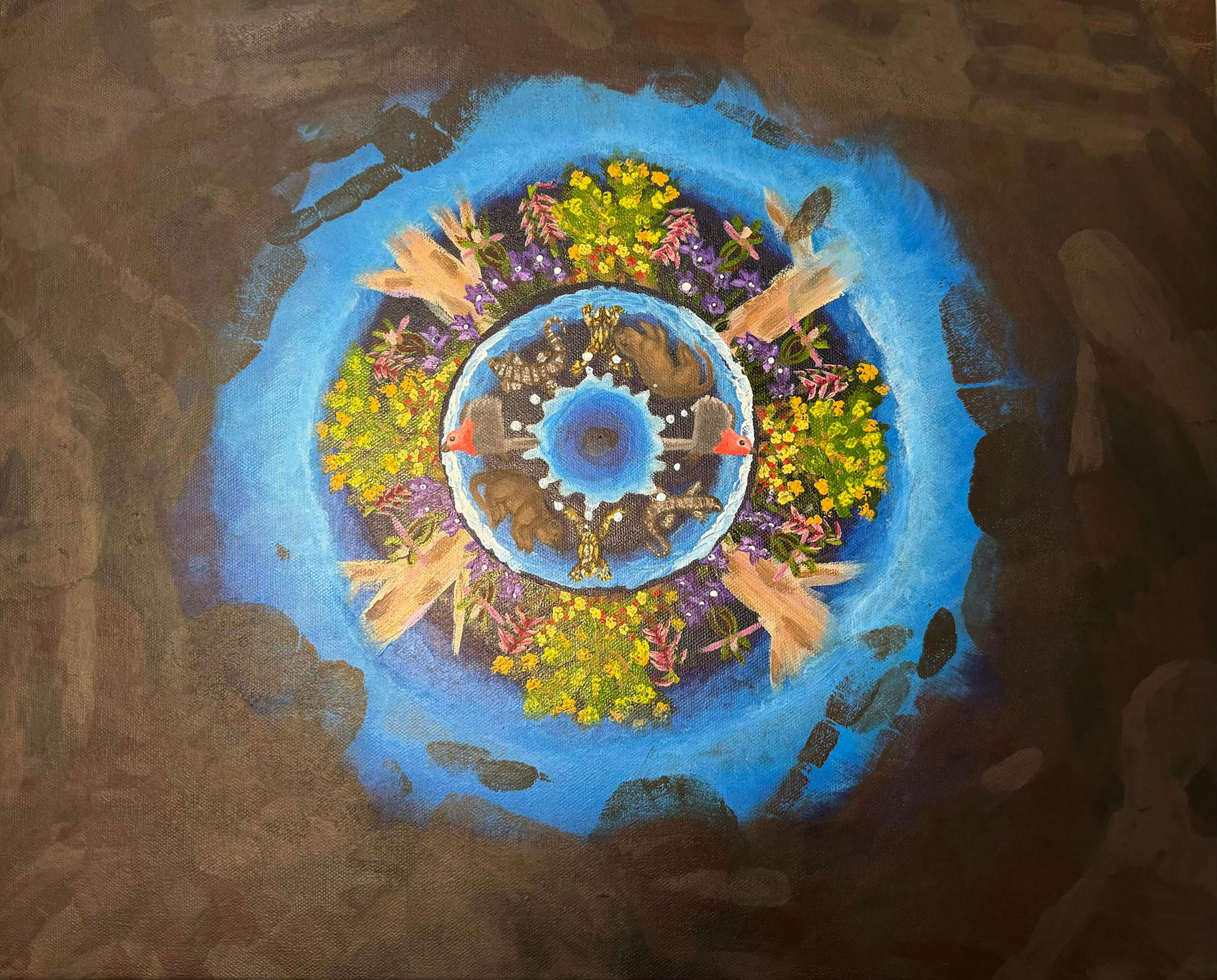
Ngunnawal Country, The Fenner Circle, and Brianna Gordon, “The Fenner Circle.” Acrylic paint on canvas. 9 October 2023. Original work by Brianna Gordon.
Our focus here is exploring changing relationships. Within the Circle, the critical discourse has shifted personal, interpersonal, professional and political orientations, decisions, and strengths toward decolonizing environmental disciplinary traditions, for Indigenous and non-Indigenous Circle members. Between the Circle and Fenner, we have seen interpenetrative spaces shape, open up, and close off Indigenous self-determination and decolonial research, teaching, and learning in environmental studies. Our context is the co-location of Indigenous and settler-colonial jurisdictions, as distinct to environmental schools located in European imperial centers. This context provides immediacy, leverage, and saliency to the work of the Circle. We offer it here as of potential value for environmental schools globally, and their networks of academics and professional societies.
The article is organized around three sections—the environmental school and the Circle; Circle actions; and achievements and outcomes. Our approach engages a Wiradjuri/wiradyuri intellectual tradition of metanarrative, determined by wiradyuri scholars who are lead co-authors. This facilitates additional learnings from Country, 5 including the importance of yindyamarra (defined as respect, be gentle, polite, honor, do slowly 6 ). The Circle has thrown a walang (rock/actions) into the bilabang (billabong or water hole) that is our environmental school. As the yulang (ripples/decolonial achievements and outcomes) extend outward, they support us in translating this work into new contexts and roles beyond Fenner. We have organized these yulang as: the creation of autonomous space for Indigenous experience; feelings of safety, discomfort and connection among peers; questioning and reinvigorating research and teaching practices; and building strategy, longevity, and solidarity practices. We share how the Circle has built our collective and individual authority as agents for decolonization by providing opportunities for open, honest, Indigenous-led dialogue.
THE BILABANG (WATER BODY/THE INSTITUTIONAL SPACE)
The Fenner School is our putative bilabang. The Circle was established here by two Indigenous and one non-Indigenous PhD scholars, and its membership is open to all Fenner postgraduate students and academics. Fenner describes itself as a “world-leading center for cross-disciplinary environmental and sustainability research, education and policy-relevant advice.” 7 Approximately 200 people contribute to research and teaching at Fenner, including permanent staff, research affiliates, and Higher Degree by Research (HDR) students. The physical sciences, including ecology, the water, forestry, soil and fire sciences, and geography are the dominant disciplinary expertise at Fenner. Social science and humanities expertise are also found at Fenner. The Circle gathers monthly to yarn about decolonial pedagogies and ontologies in academia and how to incorporate them in our research and teaching practices. The Circle’s history and activities are outlined in How to weave a Circle. Generally, between 8 and 15 individuals attending each yarn, almost all being postgraduates. The wider membership is kept informed through emails.
Like any waterhole, Fenner is a multifaceted place. Steeped in unceded Ngunawal Country, the buildings, most inhabitants and many of the underlying norms, reference the coupled authority of academia and the settler-state. In this instance, it is the publicly funded national university in the national capital of Canberra. The Circle references Country as place, purpose and meaning, and, from here, brings its work into relation with the settler-state institutions. This approach recognizes the ongoing presence of Indigenous sovereignty in Australia, the laws of the First Nations. It is what the Circle is prioritizing and negotiating at Fenner.
These are two very different positions taken by the school, and the Circle also presents a very different starting point for environmental studies. The affirmation of Indigenous sovereignty affirms the interwoven existence of Indigenous peoples and Country, known as relationality8,9 or relational accountability.8 As Indigenous people articulate globally, their law, knowledge, and culture arise from Country. 10 This is in stark contrast to the separation of the environment from society for its study and understanding that dominates environmental studies. Efforts to support ontological pluralism, and thus respect Indigenous authority, 11 are challenged by the pervasiveness of this separation thinking. This challenge is magnified by the colonial assertion of presumed universal ontological supremacy: that it is the environmental authority for this assumed separate environment. 12
WALANG WALANG (ROCKS/WHAT WE ARE DOING)
The Circle—a new research and learning institutional presence
The Circle was established as a place for Indigenous participants to be comfortable in some aspect of the physical and intellectual milieu of the academy. As it has gone on, the Circle has created opportunities for Indigenous participants to exercise their priorities and values as Indigenous people. For example, a custodian Circle has been established within the Circle, comprised of participants who identify as Indigenous, whether they are Indigenous to Australia or another continent. The custodian Circle ensures Circle outputs and activities reflect Indigenous ways. For example, reviewing and approving guidelines for acknowledging country, an Indigenous diplomatic practice, which is now a standard protocol for public events. Similarly, the Circle developed a working on Country protocol, which provides thorough practices for environmental research, and this was read and approved by the custodian Circle before circulation.
The Circle was also established to build non-Indigenous capacity. Before Circle participation, non-Indigenous scholars particularly had rarely considered how their work could benefit from taking Indigenous intellectual or research approaches seriously. Participating in the Circle has given researchers ideas and information to consider how they could decolonize their research and teaching practices in a nonjudgemental, approachable space. These ideas can be as simple as properly seeking permission from the relevant Indigenous people to conduct research, or extending to understanding more complex ideas such as Country, what it means to work on Country or how to work with Indigenous peoples and their knowledge systems.
Yarning as a method of attending to Indigenous experiences and each other
The monthly yarn is a periodic walang bringing us together. Yarns are predominately based around Indigenous-led research. A long established Indigenous pedagogy, yarning is a method of learning, sharing, decision-making, and conflict resolution.13,14 Although some aspects of yarning may appear similar to the settler-state academic traditions of lecturing, tutoring, laboratory work, or workshops, it is a pedological approach demanding an ethics of reciprocal care rarely found in academic settings. The profound difference between these two knowledge generation and sharing traditions is yarning requires that key Indigenous practice of attending to Country and kin. 15 In this context, attending means “to listen, to feel and to act, to understand oneself differently, to care, to respond” in alignment with Country.12 There are no expectations of academic excellence, or even direct contribution at the yarns. Indeed, simply attending to listening is encouraged and in keeping with Indigenous practice. 16
Through the yarns, Circle members have been supported to attend to Country. This practice means to keep refusing to slip into the assumption that our work is produced for a colonialist gaze and education. Through ethics of attending, we understand ourselves differently, while also supporting each other’s decolonization journey thoughtfully and with care. Circle members recognize such yarns, where the conversation is not for non-Indigenous peoples, need to be normal not novel, and seek to learn to listen deeply and respectfully so as to appropriately contribute. Indigenous and non-Indigenous members are learning together from their different positionality.
Changing together through deep reflexivity and positionality
The ability to effect change in Fenner, and ultimately the academy, individually and collectively, requires non-Indigenous researchers and educators to understand their positionality in an academia that has long systemically ignored Indigenous sovereignty. Being reflexive about research, teaching values, practice, and yourself, can prompt important changes in your academic choices and conduct. Professional and private lives are inseparable.17,18 Knowing your motivations, values, biases, and how they influence your research priorities and perspectives, frees you to conduct your work with integrity and clarity.
In environmental studies, it is long overdue to examine what it means to yindyamarra (honor and respect) Country and each other from our different standpoints. The tradition of suppressing subjectivity to study a separate environment has curtailed expertise in reflexivity and positionality in much of environmental studies. Academia disincentivizes the substantial commitment to learn anew by promising secure positions and power through entrenched specialization. 19 This work can be discomforting. It involves critically examining yourself and your research/teaching motives through ongoing self-reflexivity and learning. There can be fear of making mistakes, hesitancy about contributing to discrimination, and the backlash of “white fragility.” 20 This is why yarning is so important. We do not always get it right with each other, but we know that when we make a bung suggestion or get ahead of ourselves, we are led by the ethics of Indigenous authority.
Reflexivity and positionality work do not happen systemically in the school; however, with small but significant walang we can change our environmental school, as collectively we make Fenner. In this, we need to not just know ourselves but know our school. Generative learning from our immediate research and teaching context sustains the yarns, providing material for clarification and analysis. In turn, this supports action informed by this knowledge. Through the yarns, we grow our skills and comfort with centering Indigenous sovereignty in academia together. As a collective, we use our influence to establish different standards in environmental studies.
Shifting editing and publishing norms
Publications are a central and centralizing regulation of who is considered an “expert” and what “expertise” is appropriate in the academy, and, thus, are an important platform for maintaining the subjugation of Indigenous knowledge.21,22,23 For example, journal editorial standards for expert evidence creation are renown for jarring with Indigenous pedagogy, most notably the linear method-and-findings model of scientific and some social science ontology. The Circle too has its own regulatory standards. All Circle publications require a collective and collaborative writing process led by Indigenous authority and praxis—whether for a publication by one or more authors, or an edited collection.
We have created a publishing platform on our school website to share information about decolonizing environmental studies, while also modeling a non-traditional, Indigenous-led editorial process. The Circle publishes a monthly decoloyarns: short, public audience articles, crafted in a strongly collegiate and relational manner. Decoloyarns began as an Indigenous sovereign space in the Fenner School newsletter and website. Anyone in Fenner, and beyond to the larger Australian National University (ANU) bilabang, can propose a decoloyarn. Authors are taken through a deep-thinking process by the decoloyarns editorial circle to ensure they answer key criterion, including how their contribution reflects decolonial practices. The editorial circle crafts “top and tail” material that frames the contribution. The top generally highlights to readers the key theme of the contribution and links it with some relevant aspect of the colonial/decolonial experience. The tail usually offers the readers ways to follow up on the content, be it further reading or tangible actions. Every decoloyarn is at least either developed with Indigenous oversight or read over and approved by the appropriate Indigenous authority; bringing editors, authors, and decoloyarn participants into repetitively respectful relations in Indigenous sovereignty. This editorial process has only been possible through the trust and purpose we have developed through the yarning circles.
The Circle has also produced what is essentially a journal special edition, with contributions exploring what Circle participants have realized about their research through their involvement with the Circle. Authors were primarily non-Indigenous scholars articulating their “academic shortfalls” in relation to Country and Indigenous knowledge(s). To attend to this, all bar one of the peer reviewers were from the custodian Circle. Most contributions do not follow a traditional publication format for structural reasons that are logical to each specific piece and respecting Indigenous authority. Exemplifying this editorial approach was the decision that some contributions require publication with Indigenous peer-review comments and author responses in situ. We did not expect it would be easy to publish; neither did we expect it to be so difficult. We have been rejected by an Indigenous journal for having too many non-Indigenous voices, an environmental management journal on the basis they “recently” had an Indigenous issues themed publication, and by the ANU press for not fitting the standard format. These rejections have offered insights to understand the standardization imperative of publication platforms and their politics of positionality.
Observing, naming, and discussing the interpenetrative spaces between the Circle and the university is generative work for the Circle. It allows Indigenous and non-Indigenous members to form a positional analytic with which to speak about and strategize in relation to white settler-colonial discursive power, together. The Circle’s mixed publication experiences have similarly demonstrated to Circle members that decolonizing academic knowledge spaces is refractive, uneven, and often a matter of regrouping. For example, despite the striking popularity of decoloyarns evident in Fenner website traffic, a recent decoloyarn drafted to announce the release of the working on Country protocol remains unpublished, as the school wishes to negotiate provisions and caveats to the wording (pers. comm, 2023). This response does not recognize decoloyarns as a sovereign space, and instead positions the decoloyarns as subject to the school’s institutional authority. We are now developing—through a whole-Circle decision making process—an autonomous site to continue decoloyarning.
YULANG/RIPPLES (DECOLONIAL ADVANCEMENTS AND OUTCOMES)
Creating space
The Circle is unlike any other university group the authors have experienced. Neither a reading group, working group, nor a professional network but a place to engage intellectually and strategically with contemporary academia with the presence of Indigenous sovereignty. For us, the Circle is akin to a group of trusted critical friends. Every member brings unique valued contributions for rich discussions from different viewpoints. Yarns run the gamut, from engaging and funny to challenging and moving. This space is the first ripple in the Fenner bilabang.
For Indigenous scholars, the Circle provides a space where they can unapologetically privilege their research and teaching practices and priorities, within a system that rarely values or incorporates Indigenous ways of being, knowing, and doing. For postgraduates, their research is challenging enough without this discrimination. The Circle also can, and does, give Indigenous scholars a sense of community, again contributing to protection from the vicissitudes of the academy. This is especially important when living and researching away from Country, friends, and family. One of the Indigenous co-authors has experienced very difficult, culturally unsafe moments throughout their PhD, rooted in situations where their Indigenous ways and those of academia clash, yet not understood as such by others. Knowing that there is a group of Indigenous and non-Indigenous students alike who have their back is powerful. As this scholar has so eloquently said: when I stand alone I am weak, but by being part of a community, I carry the strength of all. It is important to note here that Indigenous scholars and students also benefit from decolonizing their mind; however, it is not appropriate to discuss further in this article.
For non-Indigenous scholars who started their decolonizing journey with the Circle, they have found their expectations about the potential power and value of decolonial research reinforced here. This contrasts with the academic silences fostered by the aforementioned ontological supremacy 24 . They have also experienced the academy positioning decolonial research as strange, possibly illegitimate—another reinforcement of the arguments made in the decolonial scholarship. One of the non-Indigenous co-authors shared that “Much of what I have learnt about whiteness, settler-colonialism, and working for Country, has been guided by Indigenous scholarship and supported by mob who stood by me outside the academy. The Circle made my learnings feel real and welcome in an otherwise alienating university experience.” “Mob” is a multifaceted Aboriginal English word describing a group of Indigenous people.
The Circle’s approach to combine Indigenous leadership with Indigenous practices and with all participants welcome has been the bedrock to carving a culturally safe place for Indigenous people to engage with non-Indigenous people about respectful research and learning practices. When someone joins the Circle, it signals their willingness to listen to Indigenous people and work to decolonize the academy. Given that non-Indigenous participants come with sincere intentions and cultural humility, they are less afraid to ask questions, “silly” or otherwise, and the Indigenous participants do not have to fear that the questions and comments are coming from a place of malice or neglect. This means the Circle is a culturally safe place for both Indigenous and non-Indigenous people to explore the decolonizing space together.
Safety and discomfort
Simply, the Circle is a place in the academy where Indigenous peoples are free to be their full selves, with the non-Indigenous participants and others outside the Circle discomforted and, indeed, encouraged to embrace discomfort. When interrogating research and learning approaches, the Circle neither excuses nor minimizes the discomfort caused to non-Indigenous researchers who have participated, willingly or not, in exploitative and unethical research practices. Over the years, we have seen how this discomfort is often a decisive moment for individuals—to embrace decolonizing their mind and journey or to see an insurmountable obstacle that encourages the researcher to not engage further.
As a general practice, it is critical that those guiding non-Indigenous researchers through discomfort, including correcting mistakes, are Indigenous, and, further, do so voluntarily. Indigenous members can engage as little or as much as they want and have full autonomy over when, where, and how they engage. The Circle is not an exploitative space for White researchers to demand Indigenous peoples show them how they are wrong and give fully formed solutions/corrections, as often expected in academic spaces. This approach fosters our growth, confidence, and understanding for all without exploiting Indigenous peoples in the process.
Research contextualized by the longevity of Indigenous peoples decolonial insistence means that non-Indigenous academics, specifically White settler-colonial scholars, understand that staying engaged after mistake-making is not charity work, nor is it service work or reparations. Staying is accessing the education that should be embedded in every university class. Staying engaged in the decolonial research agenda is to take seriously the fact that we all, as a collective of Aboriginal voices in the 1970’s asserted, have liberations tied up with each other. 25
Connection and collaboration across difference
Many Circle members expressly include Indigenous ontology and/or research methods in their environmental research and teaching. Several Fenner undergraduate courses now have a positionality component introduced by Circle members, sometimes as an assessment item, with student feedback reporting the value of this activity. Similarly, many Circle participants include Indigenous perspectives in their teaching material. For undergraduates who have been exposed only to material produced within the “western” environmental science paradigm, this material introduces a new intellectual world. Positionality is also something many Circle participants deliberately include in their research practice, including publications. For postgraduates, bringing these methodologies into their doctoral research means introducing supervisors to their value and consequence.
The Circle has offered non-Indigenous people the power of learning good colluder or conspirator behaviors. In turn, this can lead to research and teaching collaborations, other shared activities, and enduring relationships. The connections also offer avenues for non-Indigenous researchers to leverage their privilege guided by Indigenous leadership. Many non-Indigenous members are now capable, and willing, to do some of the educational work that non-Indigenous peoples (and other colonized minds) require before engaging with Indigenous peoples in research and other professional capacities. Circle co-founders, particularly the Indigenous co-founders, are confident and comfortable with our non-Indigenous colluders and conspirators doing this work.
Having a cohort of non-Indigenous colleagues who can challenge and educate others in the school was one of the outcomes the co-founders had hoped for when establishing the Circle. This effectively increases the cultural and intellectual safety for Indigenous peoples beyond that articulated in the walang walang section, by actively tackling the issue of invisible labor and minority tax that Indigenous researchers carry. This increased capacity of the non-Indigenous cohort represents yulang after yulang as they influence students and move to other institutions.
RETURNING TO THE BILABANG
Yarn by yarn and more, the Circle has supported non-Indigenous and Indigenous members to become educated about Indigenous ways of knowing, being, and doing and about the matrix of dominance that is colonialism 26 . The Circle has recognized the profound difference in Indigenous research and learning practices and priorities, from questions posed to answers presented, and how this meaningful difference keeps being disciplined by academia. This education has rippled into our academic studies and teaching practices, while recurring yarns ensure Circle members remain attentive to what matters. Many from the Circle now participate in, and beyond, academia with a strengthened standpoint, whether Indigenous or non-Indigenous. This education includes witnessing the shifting sands of who feels excited (mostly postgraduate students) and those discomforted by the Circle (mostly senior White academics). This is perhaps indicative of the creativity afforded by postgraduate study, intergenerational change, and/or the intractability of academic privilege.
Campuses may seem remote and distinct from more familiar sites of environmental rights contestations, such as rainforests, watersheds, and mines. However, we have been privy to how the academy repetitiously deploys colonial disciplinary traditions to normalize and neutralize the marginalization, exploitation, and extraction of Indigenous knowledges. The most recent iteration is to “defensibly” and “urgently” solve problems created by non-Indigenous knowledge systems and authorities27,28. In response, the Circle has kicked off vital camaraderie in decolonizing academic practice of scholars and pursing institutional change. Through describing our walang walang and yulang yulang, we have demonstrated that the revival and restoration of Indigenous knowledge practices does not require the approval or oversight of colonial power holders in order to gather interest, engagement, relationality, and material change in how research and inquiry are undertaken. The Circle continues to demonstrate it is possible to center Indigenous sovereignty, and decolonize environmental research and teaching here on Ngunawal Country.
Teaching and learning through and with Country has always been part of Indigenous cultural practice in this unceded place 29 . We have used the metanarrative of the bilabang to map the institution and its relationship with decolonizing through articulations of Indigenous resistance, but alongside we have shared that we seek to decolonize this bilabang, because this bilabang belongs with Country. So, despite push backs, we remain calmly buoyed by every instance of Indigenous staunchness and strategy for regaining territories and domains. Ultimately, through establishing and attending to a sovereign space, Indigenous and non-Indigenous participants have started to shape self-understandings, projects, and an academic future that we all believe in and are excited about.
Footnotes
ACKNOWLEDGEMENTS
The Fenner Circle is guided and held accountable by a group of multinational but all Indigenous custodians. We would like to acknowledge and thank the Custodian Circle for approval of this article and the opportunity for it to go through internal review as part of our process of relational accountability. We would like to thank them as they have made both this article and the Fenner Circle possible. We acknowledge the members of the Fenner Circle, far and wide, for their support and experience that makes up the Fenner Circle and contributes to our achievements/yulangs. Lastly, we would like to acknowledge Country for bringing us together, holding us accountable, and providing both physical and emotional space to gather, yarn, and collaborate as has been done here for time immemorable. Through the writing and workshopping of this article, the authors have been in sky, land, and water Country. We have presented this work on Noongar Country, while we have written and been situated on Ngunawal, Gadigal, Darug, Wiradyuri, and Wurundjeri Country among many others, which is perpetually both a privilege and a reminder that the work we do must be deeply relational and always for Country and for people.
AUTHORS’ CONTRIBUTIONS
Conceptualization: K.H., B.G., R.G., R.S., and J.W. Data Curation: NA. Formal Analysis: NA. Funding Acquisition: NA. Investigation: NA. Methodology: K.H., B.G., and R.S. Project Administration: K.H. and R.G. Resources: NA. Software: NA. Supervision: NA. Validation: NA. Visualization: K.H., B.G., R.G., R.S., and J.W. Writing—Original Draft: K.H., B.G., R.G., and R.S. Writing—Review and Editing: K.H., R.G., and J.W.
AUTHOR DISCLOSURE STATEMENT
No competing financial interests exist.
FUNDING INFORMATION
The authors did not receive any financial help or funding for writing this article.