




Abstract
This paper explores best practices for developing culturally responsive research by informing empirical and biomedical methods with traditional/Indigenous forms of knowledge (TK). Federally funded research in collaboration with Native American tribes faces a need to interface with cultural competency and tribal self-determination. These goals are often paired with a desire to integrate “Traditional Knowledge” and “Indigenous methods” in research. Such efforts serve as positive forces to promote Native American self-determination in health research if properly integrated with the scientific method. Thus, TK is an important starting point for defining the outcomes researchers seek to test empirically. A key hazard of translating TK to biomedical and empirical research is the conflation of postmodern philosophy and critical theoretical methodology with science (e.g., post-positivist methodologies and experimentation). While both subjectivist and objectivist methodologies are indispensable for addressing issues of environmental justice, these methodologies use different approaches to answer different questions and cannot be used interchangeably. We propose a methodological order of operations for multidisciplinary research in which TK informs hypothesis generation and testing, which in turn can influence policy decisions and advocacy. Establishing such an order of operations is essential to avoid cultural appropriation, reap the benefits of the empirical method, and ensure the integrity of Native American and academic partnerships. Accordingly, this process is not just a best practice recommendation for environmental justice. Rather we are describing a process which most appropriately promotes the goals of community science.
INTRODUCTION
This article presents perspectives from a collaborative team of medical scientists, social scientists, educators, and Native American community members. Of our six co-authors, two are enrolled tribal members, two have longstanding working relationships and a history of research with Indigenous populations, and two are established bioethicists. This article represents our effort to articulate an approach to ethical and productive, research with Native American tribes that we hope is translatable to other contexts.
Calls to action concerning NIH strategic goals have highlighted the importance of integrating Native American perspectives in scientific collaborations. 1 Specifically, the National Institute for Environmental Health Science (NIEHS) has embraced the concept of tribal (traditional) ecological knowledge (TEK) as valid information for health research. 2 Two follow-up articles to a 2015 NIEHS conference on TEK are salient to this topic. Finn et al. provide recommendations to “researchers and federal funders to ensure respect for the contributions of TEK to research and to ensure equity and self-determination for Tribal nations who participate in research.” 3 Our colleagues then expanded on how concepts of TEK can guide relevant health indicators. 4 These conversations reflect growing interest in empowering Indigenous communities towards more autonomy and control over biomedical research and education. Promoting self-determination in Indigenous communities, particularly in the domain of community science, requires an earnest look at how qualitative cultural data can best be integrated with established scientific practices without further reinforcing harmful dynamics.
We concur with our colleagues’ efforts to integrate Traditional Ecological Knowledge (TEK), as a specific subset of Traditional Knowledge (TK) with science. We also caution that some efforts to integrate diverse perspectives into contemporary scientific institutions have the potential to conflate knowledge-seeking efforts with advocacy. Specifically, we observe a persistent hazard that TK-driven research, and by extension scholarship, could be conflated with Critical Theory. 5 Specifically, as discussed below, Critical Theorists have suggested that TK and “Western” knowledge are two distinct entities and require different (i.e., “Indigenized”) methodologies. Our team has applied these terms as well, but we caution that careful definitions are necessary. A method for clear delineation of terms and methodologies will promote the success of TK integration with empirical research and thus, improve self-determination (i.e., research conducted by and for Indigenous communities). While both subjectivist and objectivist methodologies are indispensable for addressing issues of the human condition such as health disparities, these methodologies use different approaches to answer different questions and cannot be used interchangeably. For the purposes of this article, we contrast empirical research with Critical Theory, which pursues the philosophical goal of human emancipation from power structures. 6 This goal aligns with the ideals of Indigenous self-determination in research but not the process. Thus, we argue that TK, need not be interpreted solely through a critical or other subjective perspectives. Rather TK can be compatible with explicitly truth-seeking processes (i.e., empirical research).
In the context of environmental justice, a politically infused area of study, the above distinctions are of paramount importance. As we discuss below, there is strong precedent for such distinctions in environmental science. Environmental justice is necessarily an enterprise of both research and advocacy. The importance of each domain demands a deliberate distinction of methods, goals, and processes to ensure success. Only then can any sort of justice be achieved.
We propose as best practice for TK focused research that community-engaged, mixed method, and multidisciplinary research, common in the field of environmental justice, should maintain a methodological order of operations to avoid the above pitfalls. Within this framework, TK and qualitative research should serve as a starting point for scientific research: informing hypothesis generation and testing using the scientific method. Finally, the lessons of the empiricism can then be leveraged to influence policy decisions, advocacy, and further research. Establishing such an order of operations is essential to avoid cultural appropriation, reap the benefits of the empirical method, and ensure the integrity of Native American and academic partnerships.
A CALL TO ACTION FOR INCLUSION: INDIGENOUS THINKING IN RESEARCH
Academic institutions have had a historically fraught relationship with Native American (NA) communities. Historic and cultural trauma from dispossession coupled with relatively recent high-profile abuses of data ownership 7 have undermined the ability of researchers to establish productive partnerships with these populations. Academics and health researchers therefore operate under a trust deficit with tribal populations. Acknowledgment that this deficit is well-earned serves only as a preliminary step towards repairing these important partnerships.
Increasingly, NIH grant reviewers are encouraged to view integration of TEK/TK into community-engaged projects favorably. The favorable view of TEK stems from discussions at the 2015 TEK conference in Bethesda Maryland held by NIH grant reviewers, awardees, program officers, and NA representatives.8 In those discussions, deference to community priorities (as opposed to academic interests) was recognized as a strength in research partnerships with NA communities. Thus, Indigenous ways of knowing (TK) were correctly posited as an underappreciated phenomena in biomedical (scientific) research. Our colleagues at NIH are not the first government organization to realize this and seek integration with Indigenous ways of knowing. It has become a policy requirement in Canada that “traditional knowledge” (TK) or “traditional ecological knowledge” (TEK) be considered and incorporated into environmental assessment and resource management. 8 However, this requirement was apparently established with no formal or expert guidance on how to interpret or identify TK/TEK.
In response to the Canadian requirements, Usher provided a sufficiently parsimonious definition of TEK: “knowledge about the environment (but by extension any knowledge) derived from the experience and traditions of a particular group of people.” 9 This definition appropriately emphasizes the experiential aspect of knowledge acquisition, which would logically extend to multiple knowledge contexts. However, this definition falls short of establishing an operable or operationalizable framework for integrating TK with modern empiricism. Like Usher, Finn et al. offer a familiar and helpful definition of TEK: “a subset of Indigenous knowledge preserved through oral tradition and through cultural expressions such as arts, crafts, and ceremonies and the cultivation, collection, and preparation of traditional foods.” 10
Out of necessity, both Isaac et al. and Finn et al. refer to TEK in their NIEHS recommendations as a conceptual framework that describes cultural aspects of what is known while also referring to it as knowledge per se. Furthermore, these discussions often describe two knowledge systems via Critical theoretical arguments without necessarily acknowledging the postmodernist origins of these ideas. It is appropriate for our colleagues to raise these issues using critical examination. Here, we respond to their calls to further the discussion. We suggest the most salient aspect of TK in scientific research is stakeholder (in this case NA communities) worldviews, which is required to translate research findings into “real world” action (applied research).
INTEGRATION OF TK WITH SCIENCE: CLARIFYING THE GOALS
The ongoing push for expanding the scope of scientific investigation to include diverse perspectives is important and well-established.9 Nevertheless, the success of this goal will depend on clear definitions that are translatable across multiple disciplines such as science philosophy, anthropology, ethnobiology, bioethics, and intercultural communication. For example, some scholars have suggested that ethnobiology could serve as a multidisciplinary framework of partially overlapping epistemologies (i.e., including TK), but has not yet been successfully integrated with wider theoretical debates. 11 Part of the difficulty lies in a characterization as science as competing with TK. We note that Critical Theory as an extension of postmodern philosophy explicitly rejects objective observations, canonical descriptions, and universal narratives. 12 Since TK can be interpreted through a Critical and postmodern lens, there is potential to conflate advocacy with impartial scientific research. This mistake also has the potential effect of compromising the actual needs and goals of the community of interest, such as when Indigenous STEM programs are conflated with colonialism. 13
However, TK/science integration need not be superficial, nor do science and TK need to be in competition. Rather, TK can and must be positioned as a starting point in NA-academic partnerships. TK must likewise be interpreted as crucial guidance to define culturally contextualized research outcomes. For example, one may test a hypothesis on the outcome of “improved health” or “water quality” via impartial empirical observations, field sampling, and data analysis. However, the meaning of these outcomes must be informed with and back-translated into the community context. This is an essential step both for guiding action and achievable goal setting. Specifically, stakeholders who profit from a polluting industry may define “water quality” by a different standard than a community living downstream who, in part, derive their identity, health, and wellness from fishing activities. Therefore, community-engaged research, which is conducted in partnership with non-academic community collaborators, 14 rightfully requires integration of multiple stakeholder perspectives, including culturally appropriate contextualization.
The implications for environmental justice should be self-evident: justice is defined subjectively. Therefore, the harmed community should have some say in how justice might be achieved, hence the need for community engagement and consultation. This is the goal and an important first step. We worry, however, that some TK-related scholarship may inadvertently argue against the inclusive research practices that would fulfil the goals of environmental justice. This worry arises from an intimate understanding of the ontological differences between the inclusive efforts of advocacy and the innately discriminate and dispassionate process of hypothesis testing. An appropriate process for integrating community concerns must be established or the integrity of community science will collapse under the weight of its own goals.
Is inclusive research compatible with an exclusionary thesis?
Usher’s definition of TK seems to align with the Finn et al. recommendations to NIEHS, suggesting potential compatibility of differing cultural perspectives. However, other uses of these terms imply more significant differences, especially given Critical Theory’s patronage of TK. When translated across disciplines, the uniqueness of TK/TEK is sometimes used to imply deeper ideological difference, perhaps as a well-intentioned effort to add weight to the considerations of marginalized groups. Scholarship of TEK and TK often invoke, or even rely upon, unverifiable assumptions made in non-biomedical scholarship that generally refer to “Indigenous ways of knowing” or “Indigenous epistemology.” 15 Often, these examples of sociological and pedagogical scholarship assert a plurality of knowledge systems that are potentially incompatible. 16 This perspective extends from Critical Theory, which seeks to prevent harm from hegemonic power structures. The unintended consequence of this perspective might be to conflate empowerment for colonizing efforts. Specifically, if “western methods” are incompatible with TK, then improving biomedical research capacity at Tribal-run institutions could be interpreted as “colonizing.”
Broadly, claims of differing epistemology appear as a form of postmodern scholarship that argues that science supplants Indigenous beliefs. Some posit the claim that “Western” (i.e., nonindigenous) scholarship robs Indigenous peoples of the necessary agency to learn and understand science. Some theorists have asserted that to hold “Western” beliefs and methods as valid science marginalizes “Indigenous” methods. 17 For example, Bang and Marin argue that “settled expectations of nature-culture relations are rooted in historically structured racial hierarchies in which the privileges of whiteness are recursively mobilized.” 18 This vision of TK, by virtue of its intent to dismantle perceived normative power structures is designed to deconstruct science as practiced by most researchers. Such zero-sum assertions may seem empowering, but they also imply that the methods deemed acceptable at NIH and elsewhere inherently compete with Indigenous worldviews. This claim is dependent on an assumption that Indigenous worldviews and cultures have no interest in the scientific method or objective measurement.
Ultimately, the Critical Theory perspective is deconstructive, seeking to break down hegemonic (perceived as oppressive) institutions and practices. Perhaps this is a worthy goal, but it seems doubtful our colleagues at NIH or their Canadian counterparts seek to support work that dismantles the power structures that supply their funding. While this might be philosophically defensible in postmodernist terms, it would be a self-defeating enterprise by any other measure.
Additionally, the framing of Indigenous vs. western is intrinsically vague and possibly paradoxical, depending on the context. As many have pointed out, the definition of TK depends on who describes it, and the definitions may even compete with one another.16,17,19 These concepts are likely employed in various ways by scholars or storytellers to pursue different priorities. Hence, the call to action that researchers consider and/or integrate various incarnations of TK with their work places a great philosophical and rhetorical burden on those who may not be prepared to tackle the issue.
We caution against a characterization of western epistemology as normative assumptions owing to the dominance of western European cultural groups. This view of history ignores cultural and ideological diversity within the category deemed “Western,” and it perpetuates the marginalization of other cultural groups. In TK scholarship (and colloquially), western knowledge appears to reference anything ranging from Greek and classical philosophy to renaissance European culture to any thinking associated with the United States. The claim that these normative (western) assumptions are instruments of marginalization implies another false assumption: that all members of the “Western” tradition follow the same normative beliefs. For example, philosophies such as logical positivism, post-positivism, postmodernism, and deconstructionism all originated from European culture while having vastly different, even contradictory positions regarding knowledge and truth.19 Perhaps this seems like an obvious distinction, but we believe it is essential to extend these epistemological considerations to their logical conclusions to determine how they are and are not compatible.
Establishing an order of operations for TK to interface with scientific research
To accomplish the goal of more inclusive NA-academic research, we must align our methods and measurements with the historical, cultural, and real-world perspectives of NA populations and knowledge keepers. We suggest the process of knowledge generation (in this case, integrating TK into research efforts) is analogous to a mathematical expression. The order in which operations (addition, subtraction, multiplication) are performed and/or combined influence the outcome, independent of any intrinsic worth or worthiness of the functions involved. Performing any given operation does not devalue the other operation(s) in the sequence but treating the operations as interchangeable will lead to inconsistent results. In the case of health research, such results would be difficult to interpret or apply across disciplines (or cultural contexts, for that matter). Addition is no less important than multiplication in an algebraic expression, but addition also cannot replace multiplication. Similarly, Critical scholarship and advocacy are essential for challenging harmful systems, but they can’t take the place of scientific inquiry when confirming relationships between variables. If we extend this to TK, Indigenous perspectives are essential for framing hypothesis testing by defining the parameters to test. TK can also interface with interpretive scholarship and informing policy decisions by characterizing the lived experience of a given population.
A SEPARATION OF POWERS AND AN ORDER OF OPERATIONS
The heuristic in Figure 1 describes a process that comports with established best practices in Human Health Risk Assessment. 20 A key feature of the formalized risk assessment processes is the separation of policy (and by extension politics) from empirical, evidence-gathering procedures. The risk assessment process iteratively informs both scientific and policy domains. However, policy considerations are explicitly excluded from the hypothesis testing phase in research. For example, most federally funded researchers are prohibited from using grant money for lobbying efforts. When establishing the process of risk assessment pursuant to federal regulations on environmental health, The National Research Council (NRC), took great care to insist that policy considerations take place independently via stakeholder engagement and deliberation. 21 This deliberation would consider the scientific evidence but was kept separate to not bias the scientific findings due to factors such as: finances, conflicts of interest, and religious beliefs. We argue that this longstanding model adequately accommodates the need to integrate TK with scientific research.
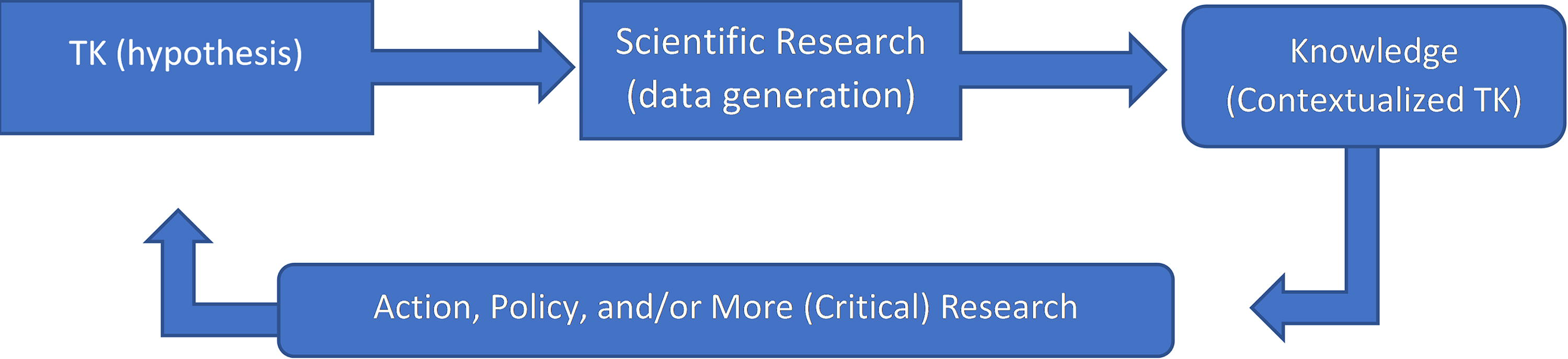
Order of operations model for community engaged research that incorporates TK/TEK in a fashion that complements other values and goals such as those set forth in NIH strategic plans.
The scientists who originally drafted the NRC recommendations on Human Health Risk Assessment (HHRA) were rightly concerned that conflicts of interests from industry and politics would impede the honest reporting of environmental research. This is because environmental research, especially when conducted to pursue legislative goals, is the study of externalities to the commons from human activities. Therefore, the NRC’s original recommendations were meant to safeguard environmental science from the influences of biased powers. This separation of powers represented great societal progress.
Figure 1 was further informed by 14 years of NIH funded work and collaboration with Great Lakes Native American tribes and consortia. The most salient example, a recent NIEHS R01, included tribal scientists who evaluated knowledge, self-efficacy, and behavior changes in response to using mobile software that provides personalized fish consumption advice. 22 As communicated by elders and stakeholders, in past focus groups and communications, living well is connected to treaty-affirmed hunting, gathering, and ceremonial rights. This understanding led the team to develop and test the impact of an interactive software-driven fish consumption advisory on, pre- and post-intervention ratios of estimated omega-3 fatty acids and mercury/PCB intakes. While well-received, the intervention did not appear to significantly alter fish consumption. The results of this randomized controlled study were somewhat unexpected; however, meaningful information was gained due to the deference to TK during the planning phase of the grant proposal. During the randomized trial, the survey also included an assessment of Great Lakes Native American cultural affinity (minobimaadiziiwin) at one-month pre- and one-month post-viewing of the software intervention.
As reported in Dellinger et al (2022), the team calculated the correlation of this score of minobimaadiziiwin affinity with behaviors relating to fish consumption. 23 The strength of relationships between minobimaadiziiwin affinity and health literacy outcomes of interest were estimated via Kendall’s tau-b correlation. At both time points, in which nearly all participants adhered to advisory guidelines on contaminants, higher affinity for minobimaadiziiwin was significantly and positively correlated with intake of omega-3 polyunsaturated fatty acids, greater amount of fish consumption (grams/month), confidence in selecting fish to eat, as well as to feed one’s family, and the knowledge that many fish are safe to eat depending on how much is eaten. The positive behaviors and confidence also increased across timepoints. These associations, and their high internal consistency, suggest that a powerful health and wellness phenomenon is influencing knowledge and behaviors related to treaty protected activities (Great Lakes fish harvest, nutritional intake, and consumption). These published data demonstrate the importance, and feasibility, of aligning study design and quantitative assessment with the guidance of TK holders, in this case minobimaadiziiwin. 24
In summary, the conflation of interests leaves researchers vulnerable to the same pitfalls that initiated the current trust, and by extension, justice deficit between the academy and community. Specifically, researchers who are not mindful of the concepts illustrated in Figure 1, may be tempted to engage in “post-hoc” community engagement. In which they procure funding with a predefined scope of work before seeking input from the TK holders. It is common for research teams to approach our tribal partners with available funding to pursue a project not initiated by the prospective collaborators. Offering funds first and collaboration second can appear coercive. Keeping an order of operations in mind can ameliorate this temptation. Furthermore, formalizing this phenomenon, in a similar fashion to HHRA, provides a framework to support community engagement scholars at their own institutions.
CONCLUSION: De(FUSING) COLONIZATION
For the purposes of this paper, we assume unbiased scientific research is the pursuit of approximate truth, whereas a Critical theoretical interpretation of TK seems to imply an inherent incompatibility with empirical research due to the Postmodern assertion that truth cannot be learned, discovered, or experienced. We also assume the knowledge generated by science benefits society when coupled with sound ethics. Although science and ethics operate independently, they do not entail contradictory world views. Ethically speaking, NA tribes should benefit from publicly funded research as much as possible. To that end, scientific research must be culturally tailored to specific contexts to adequately translate findings for these communities.
We aim to benefit NA tribes while not throwing the proverbial baby (the scientific method and evidence-based approaches to improving conditions for NA tribes) out with the proverbial bathwater (the historic trauma and abuses of data ownership). Therefore, to address abuses of the past, both distant and recent, and begin to repair the deserved trust breach, we ought not assume inherent cultural incompatibility in scientific understanding. In fact, failure to see the distinction between unethical behavior and scientific methods could contribute to further harm from oppressive systems. Thus, vigilance is required when realigning research priorities to better serve our stakeholders. Responsible integration of TK and scientific research requires careful cross-examination of philosophical assumptions and biases. We propose that traditional knowledge should set the standards and goals for research by defining outcome variables in hypotheses generation and testing.
Footnotes
ACKNOWLEDGMENTS
The authors would like to thank the Great Lakes Inter-Tribal Council and the Great Lakes Native American Research Center for Health. Insights from this article are primarily drawn from interactions with the GLNARCH. The collaborating authors also thank their home institution: The Institute for Health and Equity for fostering intellectual discourse and solutions based public health inquiry.
AUTHOR’S CONTRIBUTIONS
Conceptualization: J.D., M.D., R.S., F.J.; Writing—original draft: All authors; Writing—review and editing: All authors. All authors approved the final version of the article.
AUTHOR DISCLOSURE STATEMENT
The authors declare they have nothing to disclose.
FUNDING INFORMATION
This work was partially funded by the Advancing a Healthier Wisconsin Endowment.