




Abstract
Community-based participatory research provides communities with an avenue to actively collaborate with environmental researchers. The research aims to gain insight into critical problems of concern to community members while maintaining community autonomy over the research and its outcomes. This article describes the development and implementation of an environmental health communication tool designed to meet the needs of residents of Colfax, Louisiana, a rural community with limited technological access, which is engaging in advocacy with federal and state regulatory agencies to prohibit open burning and open detonation of military and Superfund wastes at a nearby thermal treatment site. We discuss how environmental scientists: (a) designed a community reporting tool specific to community goals and needs, (b) incorporated science and health communication practices, and (c) paired the tool with community outreach activities to support community-based environmental justice efforts. The reporting tool was evaluated with regard to Universal Design for Learning criteria. The tool was found to include key principles, including multiple means of representation, multiple means of action and expression, and multiple means of engagement. Consistent with these principles, several community members expressed that the booklets provided a concise and understandable summary of the data for use in their advocacy.
INTRODUCTION
Communities with pollution sources often have few resources to safeguard community health and advocate for change among state regulators. 1 Rural communities face special challenges due to a lack of monitoring infrastructure to track pollution, depopulation, underrepresentation, and fewer educational and job opportunities. 2 Some communities seeking information about pollution exposures have turned to community-based participatory research (CBPR), 3 in which community members have meaningful opportunities to participate in every stage of the research process, from the conceptualization of research aims to communicating findings. 4 In developing community reporting tools, scientists must share their findings with communities in accessible ways that not only further understanding of the collected data but also support community advocacy efforts toward federal and state regulators to enact positive environmental changes and improved health outcomes. 5
Through CBPR, scientists strive to co-create research findings with community partners in meaningful and relevant ways, such as public policy development. 6 Although the public may not be formally trained in scientific terminology and methodologies, communities bring local expertise to collaborative research partnerships regarding local daily life and generational knowledge within particular geographical, ecological, and/or cultural contexts. 7 Such expertise plays an important role guiding not only the employment of research tools used to quantify community observations and experiential knowledge but also how findings are communicated to the community and broader public.
A major challenge of developing a community empowerment tool within a CBPR context is the clarity (or lack thereof) with which scientists communicate information and key findings to community partners. 8 This article explores how environmental scientists developed an environmental health communication reporting tool in conjunction with a CBPR study of ambient air pollution. We conclude by reviewing the tool’s utility in supporting community engagement with federal and state environmental regulators.
The most successful community-oriented science communication tools are those driven by the community 9 , which sets the direction of research and may participate in development of methods. With no prescriptive methodology for dissemination of environmental health information to community partners, the community’s priorities, needs, and experiences are critical in guiding the development of such reporting tools. As such, the booklet is intended to be both an environmental health reporting tool and a communications tool.
METHODS
Project site
The community of Colfax, Louisiana (population 1,632, 66% of residents identifying as Black or African American, 10 86% of residents without a college degree, median annual income of $19,156, 39% of residents living below the poverty line 11 ), includes a historically Black enclave known as “The Rock” living in close proximity to a commercial open-burn/open-detonation (OBOD) hazardous waste thermal treatment facility. In 2014, community members began to experience disturbances from explosion noise, property damage, and health effects, leading them to form the Central Louisiana Coalition for a Clean and Healthy Environment (CLCCHE). The CLCCHE reached out to the Louisiana State University Superfund Research Program (LSUSRP) in 2018 to initiate a CBPR collaboration with the goal of documenting community exposures and the impact of living near the CBPR. The research team and CLCCHE began to hold frequent meetings, and the LSUSRP sought and received funding to conduct an air pollution study in Colfax.
Opening in the early 1980s, the OBOD facility disposes of hazardous waste from Superfund sites, military ordinances, explosives, propellants, fireworks, and ammonium perchlorate (275,177 pounds of net explosives and 784,598 pounds of other material in 2020). 12 Operations increased drastically in 2014, when the facility began accepting large quantities of expired military ordnances from Camp Minden, LA (following the accidental detonation of approximately 170,000 pounds of explosive waste from that site in 2012). 13 Colfax residents reported enduring loud bombing noises, smoke, and symptoms of thyroid, skin, and respiratory disease. 14
Research study summary
In June 2020, the LSUSRP partnered with the CLCCHE to begin an oral history study that ascertained the impacts of the facility’s operations on the community. 15 The long-form interviews were open-ended, allowing residents to freely share their stories. The interview transcripts were coded to identify testimony about specific diseases or other impacts potentially attributable to the OBOD operation. Public comments from a permit hearing were also coded, and responses were mapped for different health effects and observations (e.g., seeing smoke, property damage). Insights gained from those interviews informed the LSUSRP proposal to the community for an air pollution sampling study design. Specifically, testimony about the locations of symptoms informed the LSUSRP research team’s proposal about where to put the samplers, and narratives about types of health effects informed the research team’s proposal about the types of chemicals for which to analyze the samples. The LSUSRP research team met with community members at a meeting organized by CLCCHE in August, 2021. During this meeting, residents participated in a mapping exercise in which they viewed a poster of the draft sampler map and made corrections on the map. Residents also provided verbal feedback about the types of material to sample for. Changes recommended by the community members were noted and incorporated into the plan, and then the research team worked with the CLCCHE to identify homes near the sampling locations identified during the August meeting.
Following community participation in the design of the sampling plan, air pollution measurements using two high volume samplers for particulate matter having a 50% cut-point of 2.5 µm (PM2.5), ten PurpleAir low-cost sensors for detecting continuous PM2.5 concentrations, and passive samples for collecting fine (36 deployed at 10 sites with triplicate samplers at 1 site) and total PM (21 deployed at 10 sites with triplicate samplers at 1 site), were conducted between March 2022 and March 2023. It was imperative for the LSUSRP to communicate aggregated insights from the community interviews and air pollution sampling campaign with the community in a timely manner to allow the community to utilize the data.
Development of the community-informed reporting tool
The Colfax community is older than the U.S. population (i.e., 25% age 60 or older), 16 and internet access is not consistently available across the community. To fulfill the reporting responsibilities of the CBPR partnership, environmental scientists from the LSUSRP developed a series of “Report to the Community” booklets (Supplementary Data S1) that provided Colfax residents with transparency of the research process as it unfolded, resulting in timely access to findings. The printed or electronic booklets presented community partners with concise information summarizing data. Specifically, the booklets shared ongoing and completed data (oral history findings, computer models of pollutant dispersion, air pollution monitoring plans, and monitoring results to-date). Periodic reporting kept the community informed about the scientists’ progress and offered opportunities for residents to ask questions and provide feedback. Furthermore, the timely distribution of study findings maximized community autonomy, giving residents greater power to make informed decisions and take responsive action at the individual and community levels.
The booklets were designed based on the goals and needs articulated by the CLCCHE to provide access to data that underscore their lived experiences with pollution from the OBOD facility and to offer clear descriptions of the findings, which could be used to meet the community’s advocacy goals. The booklets were thus designed to communicate complex and integrated scientific data in a manner accessible to Colfax residents while still honoring the expertise they brought to our partnership. Booklets were offered only in English, because only 1.2% of Colfax households speak limited English. 17
We share an example booklet in the Supplementary Data S1 (Supplementary Fig. S1). Contents vary in each issue but generally include:
study timeline with overall progress markers; summary and mapping of community members’ aggregated self-reported health outcomes; cross-walk table associating chemicals listed in the thermal treatment facility’s reporting and their health effects; maps illustrating computer simulations dispersion of pollutants emitted by the facility, with lists of waste processed for the days presented; sample collection plans; and air pollutant sampling results to date (particulate matter concentration and composition) across the sampling locations.
The booklet incorporates and builds upon the findings from a study investigating air pollution exposure impacts within the Colfax community. 18 Within this document, we integrated qualitative and quantitative evidence with the potential to influence public policy. 19 Our Community Advisory Board encouraged us to use names for the booklets going to communities because they felt that neighbors would have an easier frame of reference if they were thinking of a specific neighbor’s home. The use of names corresponding to outdoor samples was not considered a privacy concern after consultation with the Institutional Review Board.
Seven meetings were conducted over the period August 2021–August 2023 (August 2021, March 2022, June 2022, September 2022, December 2022, March 2023, August 2023). Booklets were developed specifically for the community for six of those meetings. The booklets contain data spanning the beginning of the study to the last date collected, which is typically 2–3 months prior to the booklet dissemination. Members of the Community Engagement Core Advisory Committee were consulted to receive feedback on the booklet design before disseminating. A booklet developed for the Louisiana Department of Environmental Quality (LDEQ) was shared during the December 2022 meeting to present preliminary findings to date for consideration during a hearing about the facility’s permit status and terms of operation. Booklets were distributed at community meetings, during visits to residents’ homes for sampler maintenance, and during door-to-door booklet dissemination. Extra booklets were also typically left with the CLCCHE for distribution to others who ask for them. Approximately 200–300 booklets have been disseminated to residents to date. Contents have been discussed between members of the research team and the community during public meetings and visits to individual homes. Listening attentively to residents’ personal narratives, taking time for each conversation so that residents do not feel rushed, and working diligently in hot, humid weather all helped to earn the trust of community members, based on feedback from the Community Engagement Core Advisory Board. Open sharing of the LSUSRP research team’s plans and findings helped to further build that trust.
A communication expert (W. Sauermilch) was enlisted after the booklets were created and disseminated over multiple occasions to assess the conformity of the booklets to the Principles of Universal Design for Learning (UDL) and evaluate their efficacy of the booklets as a reporting tool.
20
UDL is applied here as an analytical framework to ensure that the material can be understood by community members with various learning styles. The principles of UDL include:
21
As the community is small and rural, attempts to enroll study participants in a survey about the delivery of information did not produce a sufficient number of responses. Informal conversations during community meetings provided qualitative indications that community members understood and utilized the booklets. However, this information is not sufficient for a rigorous study of the booklets’ efficacy. For these reasons, we primarily present in this paper an evaluation of the booklets based on the three UDL criteria rather than an assessment of what the community members learned.
RESULTS
Multiple means of representation
Transparent content with clear and accessible language
When reporting scientific information, transparency is critical in building community trust in the scientific process and results. 22 Within the booklet, the study’s timeline is central to the organization and presentation of scientific information. The timeline is the first page readers see and serves as a table of contents, visually communicating the study’s five major stages via a color-coded flowchart (e.g., purple stages have been completed, yellow stages are in progress or have not begun; Fig. 1). To the right of each step on the flowchart, bullets update readers on each major stage.

This figure shows an excerpt from our report. This figure illustrates a study timeline shown on a page of one of the booklets. The timeline shown here illustrates that three steps (interviews and community input, computer models, and sampler set-up) have been completed, while two steps (sample collection and data analysis) were not yet complete at the time this booklet was written.
We are transparent about the study’s preliminary findings by integrating scientific information with easy-to-understand explanations. Although we may not have been ready to draw conclusions about preliminary data, we shared gathered information, what data might indicate (e.g., “samples contain a reactive type of particle called an EPFR that may damage the heart and breathing”), and possible explanations (e.g., “there may be other sources of pollution affecting the concentration at [redacted name of a community member]”). By employing transparency, we help ensure that residents have the information to make timely health and safety-related decisions. 23
Researchers are often accustomed to explaining scientific findings to academic audiences rather than community audiences. Thus, when communicating with the public—either when collecting data or distributing findings—it is imperative that researchers avoid the use of scientific jargon as much as possible. 24 In developing the booklets, we conveyed findings using straightforward phrases and sentences (e.g., “electronic samplers: measures particles small enough to get deep into the lungs”) while avoiding scientific terminology and complex explanations (e.g., “particle concentrations are high enough to be hazardous over time at both ‘high volume’ locations”). Names of chemical compounds (e.g., PM2.5, ammonium perchlorate, barium, chromium, environmentally persistent free radicals) were included for accuracy, but otherwise, the guide was written at a seventh-grade reading level (based on the Flesch Reading Ease scale 25 ) to ensure that information was accessible to the majority of community members who may not have been exposed to scientific technology concepts accessible through post-secondary education. This follows recommendations from the Agency for Toxic Substances and Disease Registry and the Centers for Disease Control and Prevention, which recommend that health information be written at an eighth-grade reading level or lower. 26
Visual communication tools
Visuals offer scientists an effective tool to convey complex information in clear and accessible ways. 27 In creating the booklets, every piece of information contained within the guide was presented using a visual representation along with descriptive text. A variety of visual formats, including but not limited to maps to illustrate pollutant plumes (Fig. 2), matrices to link measured compounds with symptom categories (Fig. 3a), heat maps of residents’ symptoms 28 (Fig. 3b), and color-coded graphs to summarize concentrations (Fig. 4), were used to communicate complex data.
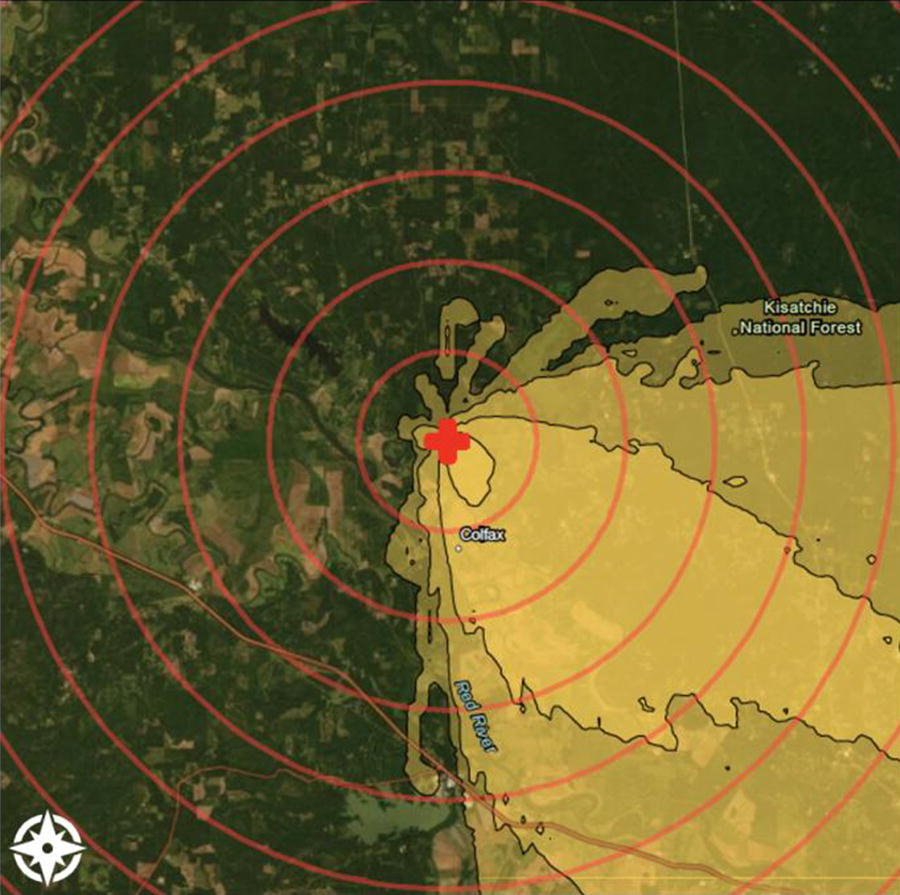
This figure shows an excerpt from our report. This figure shows map of the Colfax area with a superimposed plume of pollution released from the open burn-open detonation thermal treatment facility.

This figure shows an excerpt from our report. Image A on the left shows a table. The row headers contain names of chemicals, and the column headers contain types of health effects. Within the table, X's illustrate if a listed chemical corresponds to a health effect. Image B on the right shows a map with a superimposed heat map. The heat map shows where residents have stated to experience respiratory problems. Most of the cases are clustered within The Rock community in Colfax.

This figure shows an excerpt from our report. Image A on the left shows boxplots of P M2.5 concentration data from PurpleAir samplers. The figure illustrates some concentrations reaching between 55 and 500 micrograms per cubic meter (noted by red), levels hazardous for extended exposures. Background colors of green, yellow, orange, and red illustrate P M2.5 levels corresponding to “safe”, “hazardous over time”, “hazardous now for people with health problems, young children, and older adults”, and “hazardous now for everyone”, respectively. Image B in the bottom right shows weekly average concentration data at two sampling sites superimposed over the color codes. Image C in the top right contains a data explaining the color codes, along with the number of P M2.5 readings at each level.
To help residents better understand how we collected different types of air pollutants for analysis, we included photographs of the samplers placed throughout their community with corresponding explanatory text (Fig. 5). Subsequent pages within the guide presented data. For electronic sampler results, we used a box plot showing not only the concentration of air pollutants collected at 10 community locations, but also the hazard level associated with exposure (on average and outliers) over time using a color-coded key (Fig. 4). We capitalized on readers’ understanding of previously presented graphics by incorporating the same color-coded hazard level scheme in subsequent visuals. By doing so, we provided data to support longstanding community concerns about the possible connection between pollution associated with the thermal treatment of hazardous wastes by the facility and health symptoms—a need often overlooked when communicating environmental health information to communities. 29

This figure shows an excerpt from our report. On the left is an image of a field technician servicing a piece of equipment as a resident looks on. On the right shows bullet points with information about the sampler set-up.
Contextual markers
Throughout the guide, we incorporated contextual markers to help the community members draw connections between their lived experiences and the scientific data. Within visuals and texts, scientists included referent points on maps (e.g., Red River, Kisatchie National Forest; Figs. 2 and 3); sampler photographs from community locations (Fig. 5); and the names of community locations and residents hosting high volume samplers on their property (e.g., the home of a community leader, redacted from the Fig.; Fig. 4 30 ).
Presentation and discussion as dissemination tools
In Colfax, LSUSRP researchers were invited by CLCCHE to make community-wide presentations and followed up with door-to-door residential outreach during each of the seven visits between August, 2021 and August, 2023, providing opportunities for residents to discuss findings in ways specific to their individual needs, interests, questions, and concerns.
Meeting attendance varied between 20 and 50 residents per meeting, and booklets were distributed to approximately 40–50 households along with one-on-one discussions about the content of the reports. The goal of these endeavors was to build trust, increase scientific transparency and learning, strengthen collaborative partnerships, and deepen community respect (e.g., culture, needs, time, local expertise, degree of community activism). 31 During the meetings, the LSUSRP research team would present a slideshow about the research. Both the formal presentations and the one-on-one discussions were typically followed by an interactive discussion, as described under “Multiple Means of Engagement” below.
Dissemination via multiple channels
We utilized a variety of dissemination channels to ensure that community residents had the opportunity to access and review the guide. Creating a digital version of the guide afforded us the flexibility to share information electronically. However, relying solely upon digital dissemination may limit information reach due to demographic factors associated with reduced digital access of health information, including education, income, 32 age, 33 race/ethnicity, 34 and living in rural areas. 35 The use of multiple dispersion channels helps scientists maximize information reach within communities.
Multiple means of engagement
A growing concern within the literature is the accessibility of environmental health information to vulnerable and hard-to-reach populations. 36 The booklets need to convey information to residents in ways that foster individual understanding and support community participation in environmental decision-making activities. 37
Presentations and in-home discussions would typically be followed by a vigorous question and answer period. During most meetings, residents would ask pointed questions about the data, including how we connect OBOD events to our data and the effects of meteorology and background air pollution on pollution in Colfax. During most in-home conversations and community meetings, residents would often offer testimony about their own experiences observing pollution and experiencing health effects during or just after OBOD operation. Especially during in-home discussions, many residents shared their personal stories about having to move further from the facility, specific experiences with their health, concerns for their extended family members, and stories about neighbors’ experiences. Hence, presentations and discussions were bidirectional, reflecting a high level of understanding, learning, and engagement.
Multiple means of action and expression
Utilization or application of the booklets by community members for different purposes reflects learning, therefore constituting an expression of learning, although we did not explicitly test learning from either formative or summative perspectives in a manner similar to a classroom discussion of material. 38 Community members utilized the booklets for several purposes. First, community members have told the research team during conversations following CLCCHE meetings and during in-home visits that they used the booklets to learn about the specific chemical exposures that present potential health risks. Aggregation of the health effect data was stated by individual community members to provide visual evidence that they were not alone in experiencing specific symptoms or diagnoses. Community members also told us that the research team members’ presentations of results during CLCCHE meetings and in-home descriptions of our findings help them to understand the data and how it fit in with their personal experiences. Active questioning of the research team by community members during CLCCHE meetings indicated that community members were processing the information. Second, the CLCCHE members have shared the booklets with regulators, including the U.S. Environmental Protection Agency Region 6 and Headquarters and submitted them to the LDEQ along with public comments about proposed changes to the facility’s permit. The booklets were cited when discussing the LDEQ decision to restrict OBOD in the facility’s permit. 39 Third, some community members have stated that they shared the booklets with their lawyers to support their claims in a lawsuit against the facility. Fourth, some community members have stated that they shared the booklets with their physicians.
DISCUSSION
Limitations of the community reporting tool are primarily due to interindividual differences. In designing and disseminating a community reporting tool, it is critical to remember that communities are heterogeneous and a tool developed to meet the goals and preferences of one community may not be effective for other communities. 40 Discussion of technical findings is challenging with oversimplified language because accuracy and completeness are also important to science writing, and community partners may be more driven by contexts that are relevant to their lives. Local context may not be apparent to all readers, because a seventh-grade Flesch Reading Ease score may undermine relatability for some readers who either did not complete high school or, for a smaller portion of the local population, completed some graduate school. Attention to UDL principles is intended to overcome this issue by using clear graphics to present the data for a range of audiences. Finally, the door-to-door outreach is time-consuming and is difficult to accomplish on tight travel budgets and timelines. We were able to accomplish this because Colfax is a small community, and it was feasible to identify which households were or were not represented at the CLCCHE meetings. However, we recognize that the same approach might not be feasible in a more urbanized area.
Several community members expressed verbally that they were glad to finally have data in hand. Many stated that the data contained in the booklets illustrated what they have experienced for years, offering a sense of validation. The booklets also provided a concise and understandable data summary that community members could use for their own advocacy in public comments about the permits. One resident submitted a booklet as part of their public comments. The utility of the booklets shared in this article is especially notable given the shift within environmental health literacy efforts, which recommend moving away from improving individual-level educational processes towards one focusing on public health in which individuals have greater empowerment. 41 An individual’s lack of autonomy in making health-related decisions is a broad and often overlooked risk factor associated with poor health outcomes, but empowerment is an important promoter of personal health and well-being. 42 Community reporting tools for environmental health information can promote community empowerment for residents to make informed and timely decisions about risk assessment, personal health, and the use of preventative measures.
Footnotes
ACKNOWLEDGMENTS
The authors thank the residents of Colfax for their efforts.
AUTHORS’ CONTRIBUTIONS
W.S.: conceptualization, methodology, validation, writing—original draft, writing—review and editing article, visualization, project administration; J.I.: conceptualization, writing—review and editing of community outreach documents, funding acquisition; M.R.: conceptualization, writing—review and editing of community outreach documents, funding acquisition; C.G.: writing—developing data and figures, review, and editing of community outreach documents; S.C.: conceptualization, funding acquisition; J.R.-B.: conceptualization, methodology, validation, resources, data curation, writing—writing, review, and editing of article and community outreach documents, supervision, project administration, funding acquisition.
AUTHOR DISCLOSURE STATEMENT
No potential conflict of interest was reported by the author(s).
FUNDING INFORMATION
This work was supported by the National Institute of Environmental Health Sciences Superfund Research Program [P42 ES013648]. J.R.-B. was supported in part by the National Institute of Environmental Health Sciences Center for Human Health and the Environment [P30 ES025128] and by a National Institute of Environmental Health Sciences Time-Sensitive Research Grant [R21 ES036500].

Supplementary Material
Please find the following supplemental material available below.
For Open Access articles published under a Creative Commons License, all supplemental material carries the same license as the article it is associated with.
For non-Open Access articles published, all supplemental material carries a non-exclusive license, and permission requests for re-use of supplemental material or any part of supplemental material shall be sent directly to the copyright owner as specified in the copyright notice associated with the article.
