




Abstract
Every day, humans interact with the environment, and people can become more stressed and depressed due to the prevailing lifestyle in recent decades. Ultimately, part of the psychological pressure on the user comes from the environment and is known as “perceived oppressiveness.” However, the design of the environment can be such that it causes mental recovery and restoration from stress and continuous mental concentration. Based on this, the present article uses the content analysis method and investigates the dimensions of perceived oppressiveness in the built environment. The research results explain the different dimensions of perceived oppressiveness in users’ mental health. The dimensions of perceived oppressiveness in the built environment can be classified into three main categories: environmental, human, and human–environment interactions. To create cities that minimize mental strain, urban designers and planners must strategically intervene in four key areas: structural and design elements, functional zoning, environmental pollution, and security and safety. These interventions can be effectively implemented by meticulously considering the details of built elements, landscape approaches, land use allocation, and environmental pollution mitigation strategies. Additionally, incorporating user preferences, environmental quality perception, and opportunities for social interaction into urban design can further reduce the perceived oppressiveness of urban environments. Moreover, this research contributes to the discussion of environmental justice in urban design by highlighting the potential for uneven distribution of environmental liabilities.
INTRODUCTION
Urbanization has led to increasing mental health problems among residents. 1 Although mental illnesses are related to several factors and effective clinical preventions are available, mental health can also be obtained through the surrounding environment. 2 In addition to the environment’s physical form, the environment is also defined based on its psychological impact. 3 Humans are exposed to mental stress and fatigue every day. Part of this problem has been related to the dominant lifestyle and busyness of people in recent decades. Based on this, the necessity of mental restoration and freedom from mental fatigue and preoccupation is apparent. Restoration is defined as the recovery of diminished daily functions and capabilities. 4 The two main theories of restoration include the theory of attention recovery (ART) 5 and stress recovery (SRT) 6 and are based on the effect of the environment on the user. These two theories emphasize the natural environment, and they believe that exposure to the natural environment can lead to mental health restoration. Additionally, many studies have demonstrated that natural environments are more restorative than built environments, 7 and even short visits to forest environments can have positive psychological effects on human moods and have more significant impacts on subjective restoration and vitality than does a downtown urban environment. 8 Moreover, researchers have shown that green environments can reduce the incidence of human stress-related mental disorders and therefore enhance mental health 9 ; even exposure to virtual natural surroundings can reduce arousal and stress. 10 However, in reality, people spend most of their time in built environments. Despite the ever-increasing expansion of urbanization and increasing density, the level of green spaces in cities is decreasing, and due to social, economic, and cultural reasons, daily access to natural spaces outside cities is also unavailable. In fact, living in crowded city areas means exposure to stimuli, which can cause mental fatigue. 11 For this reason, the need to create urban restorative environments (restorative built environments) becomes more necessary. This, in turn, determines the necessity of restorative environments that allow the human brain to recover. 12 Therefore, in recent years, researchers have focused on the impact of the urban environment on human mental health and have investigated the effective dimensions and factors involved. Recent studies have further demonstrated that urban nature has the potential to provide an inexpensive intervention for improving human health issues. 13 Even small public urban green spaces have a positive influence on mental health. 14 However, all natural environments are not equally restorative. 15 In built environments, there is a type of negative psychological pressure known as perceived oppressiveness. In fact, the term “perceived oppressiveness” refers to people’s feelings of psychological pressure in high-density urban environments. 16 To attain effective dimensions of mental restoration in the built environment, it is necessary to examine the different aspects of this factor.
Therefore, the present study presents a review of the current literature using the methods of content analysis and theoretical literature analysis and aims to answer the following question: “What are the components of the restorative streetscape based on perceived oppressiveness?” In the first stage of the article, keywords and different dimensions are explained. In the second stage, a conceptual model is presented to answer the research question and determine the role of different dimensions of perceived oppressiveness on the restoration qualities of the built environment.
MATERIALS AND METHODS
The present article was written by reviewing the literature and analyzing it using the content analysis method. Based on Kerlinger’s definition, content analysis can be used for analyzing communications in an objective, systematic, and quantitative manner to measure effective variables. 17 Additionally, Holsti (1968) emphasizes that inference can be performed through objective and systematic identification of specific characteristics of messages. 18 Content analysis seeks to extract and analyze the content from within a message. Therefore, by using four databases, namely, Google Scholar, Scopus, Science Direct, and SAGE, and applying filters such as, English language articles that include social and environmental science, and art and humanities concerns, data were extracted and analyzed. The research literature review contained two main categories, namely, perceived oppressiveness in streetscapes and mental restoration and theories.
Perceived oppressiveness in the streetscape
The environment has desirable and undesirable effects on the user. Streetscapes, as the most common public spaces, have a significant impact on mental health. 19 Streetscapes are defined as the design and visual quality of a street, encompassing both natural and built elements, such as buildings, street surfaces, urban furnishings, and landscaping. 20 Depression has a psychological effect on dwellers. 21 One of the perceptual aspects and negative effects on the psyche of users is oppression. One of the main features of high-density cities is streetscapes, which are the dominant cause of people’s perceived oppressiveness. 22 In the streetscape, several factors affect the perception of oppressiveness. Most of the studies conducted in this field are related to dense environments, especially in the vicinity of tall buildings, and their negative psychological effects on users. In this context, the term oppression has the definition of mental pressure or distress and not the connotation of unjust treatment or control of one group of people over another. For instance, the impact of building characteristics, including height, width, configuration, and angle, was assessed, and the results demonstrated that these characteristics had a significant impact on perceived oppressiveness. 23 The presence of urban oppression affects the psyche of users and the environment in a wide range of ways. Oppression is an obstacle to sustainable urban development. 24
Mental restoration and theories
In the twenty-first century, the world has significant global health challenges, 25 and factors such as rapid urbanization, population growth, and climate change have prompted repeated requests for rethinking approaches to prevention. 26 Based on these findings, extensive studies have been conducted in this area. As shown in Table 1, researchers have investigated various aspects of the effects of different environments on mental health.
Summary of Research on the Influence of Different Environments on Aspects of Human Mental Health
Abigail R Kimbell, Andrea Schuhmann, and Hutch Brown,” More Kids in the Woods: Reconnecting Americans with Nature”, 2009.
Stephen Kaplan,” The Restorative Benefits of Nature: Toward an Integrative Framework”, Journal of Environmental Psychology 15, no. 3 (1995): 169–82.
M He and H Pang,” A Review of Soundscape Research History and Progress”, Landsc. Archit 5 (2016): 88–97.
Kimbell, Schuhmann, and Brown, “More Kids in the Woods: Reconnecting Americans with Nature.”
Zhao, Xu, and Ye, “Effects of Auditory-Visual Combinations on Perceived Restorative Potential of Urban Green Space.”
Wang, Zhao, and Xing, “Perceived Restorativeness of Landscape Characteristics and Window Views on University Campuses.”
Bum-Jin Park et al.,” Relationship between Psychological Responses and Physical Environments in Forest Settings”, Landscape and Urban Planning 102, no. 1 (2011): 24-32.
Matilda Van den Bosch and Å Ode Sang,” Urban Natural Environments as Nature-Based Solutions for Improved Public Health–A Systematic Review of Reviews”, Environmental Research 158 (2017): 373–384.
Jing Xie et al.,” A Preferred Road to Mental Restoration in the Chinese Classical Garden”, Sustainability 14, no. 8 (2022): 4422.
Ali Jahani, Saba Kalantary, and Asal Alitavoli,” An Application of Artificial Intelligence Techniques in Prediction of Birds Soundscape Impact on Tourists’ Mental Restoration in Natural Urban Areas”, Urban Forestry & Urban Greening 61 (2021): 127088.
Wood et al., “Public Green Spaces and Positive Mental Health–investigating the Relationship between Access, Quantity and Types of Parks and Mental Wellbeing.”
Helena Nordh et al.,” Components of Small Urban Parks That Predict the Possibility for Restoration”, Urban Forestry & Urban Greening 8, no. 4 (2009): 225–235.
Takayama et al., “Emotional, Restorative and Vitalizing Effects of Forest and Urban Environments at Four Sites in Japan.”
Zhu et al., “Does the Presence of Birdsongs Improve Perceived Levels of Mental Restoration from Park Use? Experiments on Parkways of Harbin Sun Island in China.”
Y Zhang,” Research on Soundscape Restorative Benefits of Urban Open Space and Promotion Strategy of the Acoustic Environment Quality”, New Archit 165 (2014): 18-22.
Eleanor Ratcliffe, Birgitta Gatersleben, and Paul T Sowden,” Bird Sounds and Their Contributions to Perceived Attention Restoration and Stress Recovery”, Journal of Environmental Psychology 36 (2013): 221–228.
Eleanor Ratcliffe, Birgitta Gatersleben, and Paul T Sowden,” Associations with Bird Sounds: How Do They Relate to Perceived Restorative Potential?”, Journal of Environmental Psychology 47 (2016): 136–144.
Oleg Medvedev, Daniel Shepherd, and Michael J Hautus,” The Restorative Potential of Soundscapes: A Physiological Investigation”, Applied Acoustics 96 (2015): 20-26.
Zhao, Xu, and Ye, “Effects of Auditory-Visual Combinations on Perceived Restorative Potential of Urban Green Space.”
Jahani, Kalantary, and Alitavoli, “An Application of Artificial Intelligence Techniques in Prediction of Birds Soundscape Impact on Tourists’ Mental Restoration in Natural Urban Areas.”
Jaeyoung Ha and Hyung Jin Kim,” The Restorative Effects of Campus Landscape Biodiversity: Assessing Visual and Auditory Perceptions among University Students”, Urban Forestry & Urban Greening 64 (September 01, 2021): 127259, https://doi.org/10.1016/j.ufug.2021.127259.
Hui Ma and Shan Shu,” An Experimental Study: The Restorative Effect of Soundscape Elements in a Simulated Open-Plan Office”, Acta Acustica United with Acustica 104, no. 1 (2018): 106–115.
Xuan Guo et al.,” Audio-Visual Interaction and Visitor Characteristics Affect Perceived Soundscape Restorativeness: Case Study in Five Parks in China”, Urban Forestry & Urban Greening 77 (2022): 127738.
Nathalie Michels et al.,” Indoor Nature Integration for Stress Recovery and Healthy Eating: A Picture Experiment with Plants versus Green Color”, Environmental Research 212 (September 01, 2022): 113643, https://doi.org/10.1016/j.envres.2022.113643.
LAJ Elzinga,” The Green Office: The Influence of Plants at the Office, Effectuating a More Natural Environment, on Restoration from Mental Fatigue and Stress as Mediated by Restorative Characteristics among Office Employees.”, 2020.
Jee Heon Rhee et al.,” Effects of Nature on Restorative and Cognitive Benefits in Indoor Environment”, Scientific Reports 13, no. 1 (2023): 13199.
Xin Han et al.,” Restorative Perception of Urban Streets: Interpretation Using Deep Learning and MGWR Models”, Frontiers in Public Health 11 (2023): 1141630.
Pall J Lindal and Terry Hartig,” Effects of Urban Street Vegetation on Judgments of Restoration Likelihood”, Urban Forestry & Urban Greening 14, no. 2 (2015): 200-209.
Zijiao Zhang et al.,” Emotional Responses to the Visual Patterns of Urban Streets: Evidence from Physiological and Subjective Indicators”, International Journal of Environmental Research and Public Health 18, no. 18 (2021): 9677.
Takayama et al., “Emotional, Restorative and Vitalizing Effects of Forest and Urban Environments at Four Sites in Japan.”
Mathew White et al.,” Blue Space: The Importance of Water for Preference, Affect, and Restorativeness Ratings of Natural and Built Scenes”, Journal of Environmental Psychology 30, no. 4 (2010): 482–493.
Helena Nordh, Chaham Alalouch, and Terry Hartig,” Assessing Restorative Components of Small Urban Parks Using Conjoint Methodology”, Urban Forestry & Urban Greening 10, no. 2 (January 01, 2011): 95-103, https://doi.org/10.1016/j.ufug.2010.12.003.
Ronghua Wang et al.,” Characteristics of Urban Green Spaces in Relation to Aesthetic Preference and Stress Recovery”, Urban Forestry & Urban Greening 41 (May 01, 2019): 6-13, https://doi.org/10.1016/j.ufug.2019.03.005.
Ulrika K. Stigsdotter et al.,” It Is Not All Bad for the Grey City – A Crossover Study on Physiological and Psychological Restoration in a Forest and an Urban Environment”, Health & Place 46 (July 01, 2017): 145–154, https://doi.org/10.1016/j.healthplace.2017.05.007.
Li Deng et al.,” Empirical Study of Landscape Types, Landscape Elements and Landscape Components of the Urban Park Promoting Physiological and Psychological Restoration”, Urban Forestry & Urban Greening 48 (2020): 126488.
Jingwei Zhao and Master Wang Xinxin,” Effects of Landscape Types and Complexity Along Path on Mental Restoration”, HERD: Health Environments Research & Design Journal, 2022, 19375867221104252.
Bin Jiang, Chun-Yen Chang, and William C Sullivan,” A Dose of Nature: Tree Cover, Stress Reduction, and Gender Differences”, Landscape and Urban Planning 132 (2014): 26-36.
Agnes E Van den Berg, Sander L Koole, and Nickie Y van der Wulp,” Environmental Preference and Restoration:(How) Are They Related?”, Journal of Environmental Psychology 23, no. 2 (2003): 135–146.
Kathleen L Bagot, Felicity Catherine Louise Allen, and Samia Toukhsati,” Perceived Restorativeness of Children’s School Playground Environments: Nature, Playground Features and Play Period Experiences”, Journal of Environmental Psychology 41 (2015): 1-9.
Zhao, Xu, and Ye, “Effects of Auditory-Visual Combinations on Perceived Restorative Potential of Urban Green Space.”
Shixian Luo et al.,” Sit down and Rest: Use of Virtual Reality to Evaluate Preferences and Mental Restoration in Urban Park Pavilions”, Landscape and Urban Planning 220 (2022): 104336.
Ha and Kim, “The Restorative Effects of Campus Landscape Biodiversity: Assessing Visual and Auditory Perceptions among University Students.”
Linghan Liu et al.,” Restorative Benefits of Urban Green Space: Physiological, Psychological Restoration and Eye Movement Analysis”, Journal of Environmental Management 301 (January 01, 2022): 113930, https://doi.org/10.1016/j.jenvman.2021.113930.
Qiaohui Liu et al.,” The Relationship between the Restorative Perception of the Environment and the Physiological and Psychological Effects of Different Types of Forests on University Students”, International Journal of Environmental Research and Public Health 18, no. 22 (2021): 12224.
Wood et al., “Public Green Spaces and Positive Mental Health–investigating the Relationship between Access, Quantity and Types of Parks and Mental Wellbeing.”
William C Sullivan and Chun-Yen Chang,” Mental Health and the Built Environment”, Making Healthy Places: Designing and Building for Health, Well-Being, and Sustainability, 2011, 106–116.
Roger S Ulrich et al.,” A Review of the Research Literature on Evidence-Based Healthcare Design”, HERD: Health Environments Research & Design Journal 1, no. 3 (2008): 61-125.
Velarde, Fry, and Tveit, “Health Effects of Viewing Landscapes–Landscape Types in Environmental Psychology.”
Kaplan, “The Restorative Benefits of Nature: Toward an Integrative Framework.”
Ana Karinna Hidalgo,” Mental Health in Winter Cities: The Effect of Vegetation on Streets”, Urban Forestry & Urban Greening 63 (August 01, 2021): 127226, https://doi.org/10.1016/j.ufug.2021.127226.
Peschardt and Stigsdotter, “Associations between Park Characteristics and Perceived Restorativeness of Small Public Urban Green Spaces.”
Liu et al., “Restorative Benefits of Urban Green Space: Physiological, Psychological Restoration and Eye Movement Analysis.”
Tianyao Zhang, Jiahui Liu, and Hongyang Li,” Restorative Effects of Multi-Sensory Perception in Urban Green Space: A Case Study of Urban Park in Guangzhou, China”, International Journal of Environmental Research and Public Health 16, no. 24 (2019): 4943.
Andrea Faber Taylor and Frances E Kuo,” Children with Attention Deficits Concentrate Better after Walk in the Park”, Journal of Attention Disorders 12, no. 5 (2009): 402–409.
Nicole van den Bogerd et al.,” Greening the Classroom: Three Field Experiments on the Effects of Indoor Nature on Students’ Attention, Well-Being, and Perceived Environmental Quality”, Building and Environment 171 (2020): 106675.
Ruth K Raanaas et al.,” Benefits of Indoor Plants on Attention Capacity in an Office Setting”, Journal of Environmental Psychology 31, no. 1 (2011): 99-105.
Ulrika Karlsson Stigsdotter et al.,” Forest Design for Mental Health Promotion—Using Perceived Sensory Dimensions to Elicit Restorative Responses”, Landscape and Urban Planning 160 (April 01, 2017): 1-15, https://doi.org/10.1016/j.landurbplan.2016.11.012.
Kaplan, “The Restorative Benefits of Nature: Toward an Integrative Framework.”
Chie Imamura et al.,” Effect of Indoor Forest Bathing on Reducing Feelings of Fatigue Using Cerebral Activity as an Indicator”, International Journal of Environmental Research and Public Health 19, no. 11 (2022): 6672.
Elzinga, “The Green Office: The Influence of Plants at the Office, Effectuating a More Natural Environment, on Restoration from Mental Fatigue and Stress as Mediated by Restorative Characteristics among Office Employees.”
Frances E Kuo and William C Sullivan,” Aggression and Violence in the Inner City: Effects of Environment via Mental Fatigue”, Environment and Behavior 33, no. 4 (2001): 543–571.
Stigsdotter et al., “Forest Design for Mental Health Promotion—Using Perceived Sensory Dimensions to Elicit Restorative Responses.”
Wang, Zhao, and Xing, “Perceived Restorativeness of Landscape Characteristics and Window Views on University Campuses.”
Park et al., “Relationship between Psychological Responses and Physical Environments in Forest Settings.”
Van den Bosch and Sang, “Urban Natural Environments as Nature-Based Solutions for Improved Public Health–A Systematic Review of Reviews.”
Zhao, Xu, and Ye, “Effects of Auditory-Visual Combinations on Perceived Restorative Potential of Urban Green Space.”
Mercede Erfanian et al.,” Psychological Well-Being and Demographic Factors Can Mediate Soundscape Pleasantness and Eventfulness: A Large Sample Study”, Journal of Environmental Psychology 77 (2021): 101660.
Agnieszka Jaszczak et al.,” Redefinition of Park Design Criteria as a Result of Analysis of Well-Being and Soundscape: The Case Study of the Kortowo Park (Poland)”, International Journal of Environmental Research and Public Health 18, no. 6 (2021): 2972.
Francesco Aletta et al.,” Exploring Associations between Soundscape Assessment, Perceived Safety and Well-Being: A Pilot Field Study in Granary Square, London” (Proceedings of the International Congress on Acoustics, International Congress on Acoustics, 2019), 7946–7953.
van den Bogerd et al., “Greening the Classroom: Three Field Experiments on the Effects of Indoor Nature on Students’ Attention, Well-Being, and Perceived Environmental Quality.”
Charlotte Gunn, Maria Vahdati, and Mehdi Shahrestani,” Green Walls in Schools-The Potential Well-Being Benefits”, Building and Environment 224 (2022): 109560.
Nathan Sciulli, David Goullet, and Tristan Snell,” Working from Home with a View of Nature (and Sunlight) Benefits People’s Well-Being”, Ecopsychology 15, no. 1 (2023): 69–80.
Sarena Sabine,” Personally Relevant Indoor Nature Imagery’s Impact on Students’ Well-Being, Connection to Nature, and Eco-Conscious Behaviors”, 2019.
Sergio Altomonte et al.,” Ten Questions Concerning Well-Being in the Built Environment”, Building and Environment 180 (2020): 106949.
Charles Spence,” Using Ambient Scent to Enhance Well-Being in the Multisensory Built Environment”, Frontiers in Psychology 11 (2020): 598859.
Danya Kim and Jangik Jin,” Does Happiness Data Say Urban Parks Are Worth It?”, Landscape and Urban Planning 178 (2018): 1–11.
Wood et al., “Public Green Spaces and Positive Mental Health–investigating the Relationship between Access, Quantity and Types of Parks and Mental Wellbeing.”
Birch, Rishbeth, and Payne, “Nature Doesn’t Judge You–how Urban Nature Supports Young People’s Mental Health and Wellbeing in a Diverse UK City.”
Christine Bertram and Katrin Rehdanz,” The Role of Urban Green Space for Human Well-Being”, Ecological Economics 120 (2015): 139–152.
Fahimeh Malekinezhad et al.,” Investigating the Mental Health Impacts of University Campus Green Space through Perceived Sensory Dimensions and the Mediation Effects of Perceived Restorativeness on Restoration Experience”, Frontiers in Public Health 8 (2020): 578241.
Pearson and Craig, “The Great Outdoors? Exploring the Mental Health Benefits of Natural Environments.”
Gary W Evans,” The Built Environment and Mental Health”, Journal of Urban Health 80 (2003): 536–555.
Andrew J Hoisington et al.,” Ten Questions Concerning the Built Environment and Mental Health”, Building and Environment 155 (2019): 58–69.
Giulia Melis et al.,” The Effects of the Urban Built Environment on Mental Health: A Cohort Study in a Large Northern Italian City”, International Journal of Environmental Research and Public Health 12, no. 11 (2015): 14898-915.
Jie Xiao et al.,” The Impact of Built Environment on Mental Health: A COVID-19 Lockdown Perspective”, Health & Place 77 (2022): 102889.
Kim and Jin, “Does Happiness Data Say Urban Parks Are Worth It?”
Wood et al., “Public Green Spaces and Positive Mental Health–investigating the Relationship between Access, Quantity and Types of Parks and Mental Wellbeing.”
Le E Saw, Felix KS Lim, and Luis R Carrasco,” The Relationship between Natural Park Usage and Happiness Does Not Hold in a Tropical City-State”, PloS One 10, no. 7 (2015): e0133781.
Kim and Jin, “Does Happiness Data Say Urban Parks Are Worth It?”
Jiang, Chang, and Sullivan, “A Dose of Nature: Tree Cover, Stress Reduction, and Gender Differences.”
Anna A Adevi and Fredrika Mårtensson,” Stress Rehabilitation through Garden Therapy: The Garden as a Place in the Recovery from Stress”, Urban Forestry & Urban Greening 12, no. 2 (2013): 230–237.
Ratcliffe, Gatersleben, and Sowden, “Bird Sounds and Their Contributions to Perceived Attention Restoration and Stress Recovery.”
Elzinga, “The Green Office: The Influence of Plants at the Office, Effectuating a More Natural Environment, on Restoration from Mental Fatigue and Stress as Mediated by Restorative Characteristics among Office Employees.”
Jill McSweeney et al.,” Indoor Nature Exposure and Influence on Physiological Stress Markers”, International Journal of Environmental Health Research 31, no. 6 (2021): 636–650.
Catharine Ward Thompson et al.,” Mitigating Stress and Supporting Health in Deprived Urban Communities: The Importance of Green Space and the Social Environment”, International Journal of Environmental Research and Public Health 13, no. 4 (2016): 440.
Mohamed Elsadek et al.,” The Influence of Urban Roadside Trees and Their Physical Environment on Stress Relief Measures: A Field Experiment in Shanghai”, Urban Forestry & Urban Greening 42 (2019): 51-60.
Matthew HEM Browning, Kangjae Lee, and Kathleen L Wolf,” Tree Cover Shows an Inverse Relationship with Depressive Symptoms in Elderly Residents Living in US Nursing Homes”, Urban Forestry & Urban Greening 41 (2019): 23–32.
Danielle F Shanahan et al.,” Health Benefits from Nature Experiences Depend on Dose”, Scientific Reports 6, no. 1 (2016): 28551.
Ruth McCaffrey, Claire Hanson, and William McCaffrey,” Garden Walking for Depression: A Research Report”, Holistic Nursing Practice 24, no. 5 (2010): 252–259.
Erja Rappe and Sirkka-Liisa Kivelä,” Effects of Garden Visits on Long-Term Care Residents as Related to Depression”, HortTechnology 15, no. 2 (2005): 298–303.
Debarati Mukherjee et al.,” Park Availability and Major Depression in Individuals with Chronic Conditions: Is There an Association in Urban India?”, Health & Place 47 (2017): 54–62.
Mathew P White et al.,” Would You Be Happier Living in a Greener Urban Area? A Fixed-Effects Analysis of Panel Data”, Psychological Science 24, no. 6 (2013): 920–928.
Adevi and Mårtensson, “Stress Rehabilitation through Garden Therapy: The Garden as a Place in the Recovery from Stress.”
Kirsten MM Beyer et al.,” Exposure to Neighborhood Green Space and Mental Health: Evidence from the Survey of the Health of Wisconsin”, International Journal of Environmental Research and Public Health 11, no. 3 (2014): 3453–3472.
There are two main theories in the field of restorative environments. First, ART 27 was proposed and described by Kaplan and Kaplan. There are two types of attention: voluntary and involuntary attention. When a person makes a voluntary effort to maintain concentration, they experience mental fatigue after a while. Kaplans rely on nature for attention-related fatigue restoration. Being away, extension, fascination, and compatibility lead to mental restoration and enhanced mental capacity. 28 Although the four mentioned features are related to the natural environment and can be found in the built environment, the probability of their simultaneous presence in the natural environment is greater. The second method is SRT, 29 which was proposed by Ulrich (1983). This theory states that natural environments can reverse stress, and urban environments hinder this process. 30 In the years when these two theories were explained, the percentage of nature in cities was greater, and the access of users to the natural environments in the suburbs was easier. However, given the current conditions, low share of natural spaces, and difficult access to natural environments, these two theories need to be re-examined and applied to modern urban environments, especially in dense environments with a high level of perceived oppressiveness.
DISCUSSION
A coherent classification of the factors that affect perceived oppressiveness in the streetscape has not yet been presented. In the first stage, this article classified the effective factors into three main categories: environmental factors, human–environment interactions, and human factors. The second stage explains each of these main categories and their subcategories. Table 2 presents the indicators affecting perceived oppressiveness in the streetscape. Notably, quantitatively, more environmental components than human–environment interactions and human factors have been studied.
Indicators Affecting Perceived Oppressiveness in the Streetscape
Environmental factors
The environmental factors affecting perceived oppressiveness in streetscapes can be classified into three categories: structure and details, functions, and pollutions. The first category includes the structure and details. The physical shape of buildings is an effective factor for oppression. 31 For example, increasing the solid angle of a building causes an increase in perceived oppressiveness. 32 Another influential factor is configuration. In other words, the maximum allowable psychological stress imposed on occupants is 8% of the configuration factor of the buildings. 33 Another influential factor is the number of buildings next to each other. In other words, residents with a higher density of cityscape perceive a greater percentage of oppression than residents with a low density of cityscape. 34 According to the mentioned cases, even under the same conditions, residents of cities, especially dense areas, likely perceive more oppression than residents of rural areas. This is likely due to the high density of buildings, the presence of high-rises, and the overall built environment surrounding them. Even the arrangement of adjacent buildings and the distances between them can affect the perceived oppressiveness of the user. Based on this, it is expected that the creation of distances between buildings, which may be due to the increase in the share of the sky, will reduce perceived oppressiveness. However, since contextual and individual factors influence user perception, it is necessary to examine each factor in different contexts. In summary, physical factors, including the solid angle, 35 visible area of the building, distance from the building, 36 configuration factor, 37 color of the wall, 38 and texture and angles of view, 39 were assessed. Previous studies by Takei (1981) demonstrated that the most effective index for evaluating oppressiveness is the configuration factor. 40
The second category includes four subcategories: greenscape, bluescape, soundscape, and uses and activities. Research has demonstrated that natural environments can reduce stress in a wide range of environments, from passive viewing to forest bathing. 41 The impact of the presence of greenery on perceived oppressiveness 42 has been investigated in different studies. Planting trees in front of tall buildings functions as a partial screening tool for building walls and as a visual buffer can decrease perceived oppressiveness, 43 even with respect to configuration factors. 44 Moreover, a higher eye-level tree canopy density has a greater effect on reducing mental stress. 45 Both the quality and the quantity of streetscape greenery are related to mental stress. 46 Planting design in streetscapes is an important issue. 47 In fact, the location of trees is a more effective factor than their number; in other words, the closer the trees are to a person, the more effective they are at reducing perceived oppressiveness. 48 Another subcategory is bluescape. Increasing the share of the sky causes a decrease in perceived oppressiveness. 49 Additionally, the sky has a greater effect than trees on reducing perceived oppressiveness. 50 The contribution of the sky itself should be considered an effective factor in reducing perceived oppressiveness. Both the widening of streets and the low height of buildings in streetscapes, which consequently increase the share of the sky, are effective factors in reducing perceived oppressiveness. In the field of streetscape soundscape, noises, and sound disturbances caused by factors such as car traffic can increase the user’s perception of perceived oppressiveness. Moreover, annoyance caused by road traffic noise causes concurrent stress to urban inhabitants, 51 indirectly affecting neighborhood satisfaction. 52 Long-term exposure to high levels of road traffic noise can lead to symptoms such as tiredness, depression, stomach upset, and irritation. 53 The perceived oppressiveness caused by acoustic noise is related to visual perception. In fact, visual characteristics and the quality of the environment that users perceive can have a modifying effect on noise-induce annoyance. 54 For instance, a green view can moderate noise annoyance in an urban residential setting, 55 and a view of housing blocks can increase noise annoyance. 56 Therefore, it is expected that being placed in a streetscape full of noise pollution with tall and dense buildings will cause a stronger perception of oppression than being in streets without visual pollution.
The third category includes environmental pollution (water pollution, soil pollution, plastic pollution, radioactive contamination, air pollution, noise pollution, light pollution, thermal pollution, and visual pollution), traffic and crowding. Pollution can affect different aspects of human health. However, studies related to the types of pollution and their impact on users’ perceptions and behaviors are rare. For instance, there are a moderate number of survey studies related to the assessment of user attitudes toward air pollution. 57 The results indicate that people are annoyed by air pollution. 58 Moreover, noise pollution, crowdedness, and vehicle traffic have the most essential effects on users’ stress. 59 It seems that crowding due to violating users’ privacy and creating a psychological burden can cause perceived oppressiveness. Vehicular traffic can also increase users’ perception of oppression by increasing the volume of noise pollution. There is more potential for mental restoration with higher levels of greenery, clearer traffic signs, and fewer nonmotor vehicles. 60
Human–environment interactions
The classification of distance and angles and the security and safety that result from the interaction of humans and the environment are among the factors that influence the way of perception and perceived oppressiveness. Concerning the distances, there is an inverse relationship between the distance of the building and perceived oppressiveness. 61 The concept of perceived oppressiveness is intertwined with concepts such as security and safety. Naturally, when a user in an environment feels that his or her privacy, security, and safety are threatened, his or her perceived oppression increases unconsciously. Based on this, there is an inverse relationship between the concepts of security and safety and between the concepts of perceived oppressiveness and the environment. Perceived oppressiveness causes a feeling of unsafety, and ultimately, the user may experience psychological stress. 62 Moreover, since a crowded environment reduces people’s sense of self-control, it can cause psychological stress for the user. 63 The relationships that shape the interaction between the user and the environment still have research potential. In any context, the amount of perceived oppressiveness from the environment can differ from a quantitative perspective. Therefore, there is a need for future studies to analyze these dimensions.
Human factors
The human factors include four categories: preferences, perceptions, social aspects, and acquired characteristics. The user’s perception of environmental quality can be one of the influencing factors on perceived oppressiveness. In fact, the perception of environmental quality is an essential factor for predicting mental stress, 64 mental health, 65 and mental distress. 66 For instance, there is an inverse relationship between perceived environmental quality and stress. 67 Also, there is a direct relation between perceived environmental quality and satisfaction with a place. 68 The user’s evaluation of environmental quality is shaped by both objective and subjective dimensions. Objective dimensions are influenced by the physical characteristics of the environment, interacting with the individual’s own characteristics and expectations. Subjective dimensions, on the other hand, stem from intangible aspects of the environment, such as the perception of environmental justice. The right to the city and environmental justice itself can significantly influence a user’s perception of oppression. Environmental justice is a theoretical lens, and a social movement focusing on justice in the distribution of environmental burdens and benefits and the processes that determine this distribution. 69 In fact, environmental justice ensures fair treatment and meaningful participation for all people, regardless of background. 70 However, it’s important to note that environmental justice has different interpretations and affects between societies and groups. For instance, youth experiencing homelessness face a heightened risk of health problems and long-term negative consequences due to a pervasive lack of access to environmental justice like clean air, water, food, and adequate sanitation facilities. 71 Future research should focus on how different aspects of environmental justice influence perceived oppression. Another factor that affects perceived oppressiveness is users’ private space. The loss of private space causes stress and manifests as claustrophobia, the fear of suffocation, or oppressiveness 72 ; therefore, there is a relationship between perceived oppressiveness and the notion of privacy. 73 On the contrary, social interactions affect users’ perception of environmental quality and their perception of how much they want to stay in an environment. To the best of our knowledge, the relationship between social interactions among users and their impact on perceived oppressiveness has not been investigated. However, it seems that social interactions are perceived as a moderating factor of perceived oppressiveness. It also seems that the acquired characteristics of the user include factors such as age and gender, as they affect the perceptual dimensions of the environment and affect perceived oppression from the environment. However, proving or rejecting this hypothesis requires additional studies. In sum, the current knowledge about the human dimensions and their influence on the perceived oppressiveness of the user is limited. Therefore, future studies must investigate the impact of human categories on perceived oppressiveness.
Statistical analysis
To review the research literature in the field of “perceived oppressiveness” in databases such as Scopus, ScienceDirect, and Google Scholar, the following terms were searched: “perceived oppressiveness,” OR “oppressiveness,” OR “oppression”. These studies, along with their quantitative analysis, are included in Figure 1. This analysis indicates that, first, most of the studies have evaluated the impact of perceived oppressiveness when the user interacts with tall buildings. However, streetscapes that lack tall buildings can still cause negative psychological pressure on users. In other words, perceived oppressiveness is not only due to the presence of tall buildings and other environmental characteristics that can aggravate or moderate it. Second, the majority of these studies have investigated the effect of green spaces on perceived oppressiveness. Several studies have investigated the effect of green space in the horizontal or vertical dimension on the facades of buildings; generally, their ability to reduce perceived oppressiveness is less pronounced in the vertical mode. Regarding green spaces, studies have concluded that planting design is also an effective factor for reducing perceived oppressiveness. After the impact of green space, the largest share of studies (related to spaces and natural elements) is dedicated to the sky. In general, studies have concluded that seeing the sky can moderate perceived oppressiveness. Therefore, when researchers propose that the distance between buildings reduces perceived oppressiveness, this hypothesis proposes that the reason is the view of the sky. In fact, the contribution of the sky view between the gaps of buildings is effective in reducing perceived oppressiveness. 74 Another growing problem are the effects of noise annoyance and sound pressure levels, which can cause oppression. However, this topic has not been widely studied. For example, determining the effects of each type of natural sound and determining the most effective solutions for reducing perceived oppressiveness are problematic. The angles and distances created by the interaction between humans and the environment have been investigated in some related research. Most of the contributions of these studies are related to environmental characteristics and human–environment interactions. However, there is a lack of attention given to the indicators and dimensions related to humans, which need to be investigated in future studies.
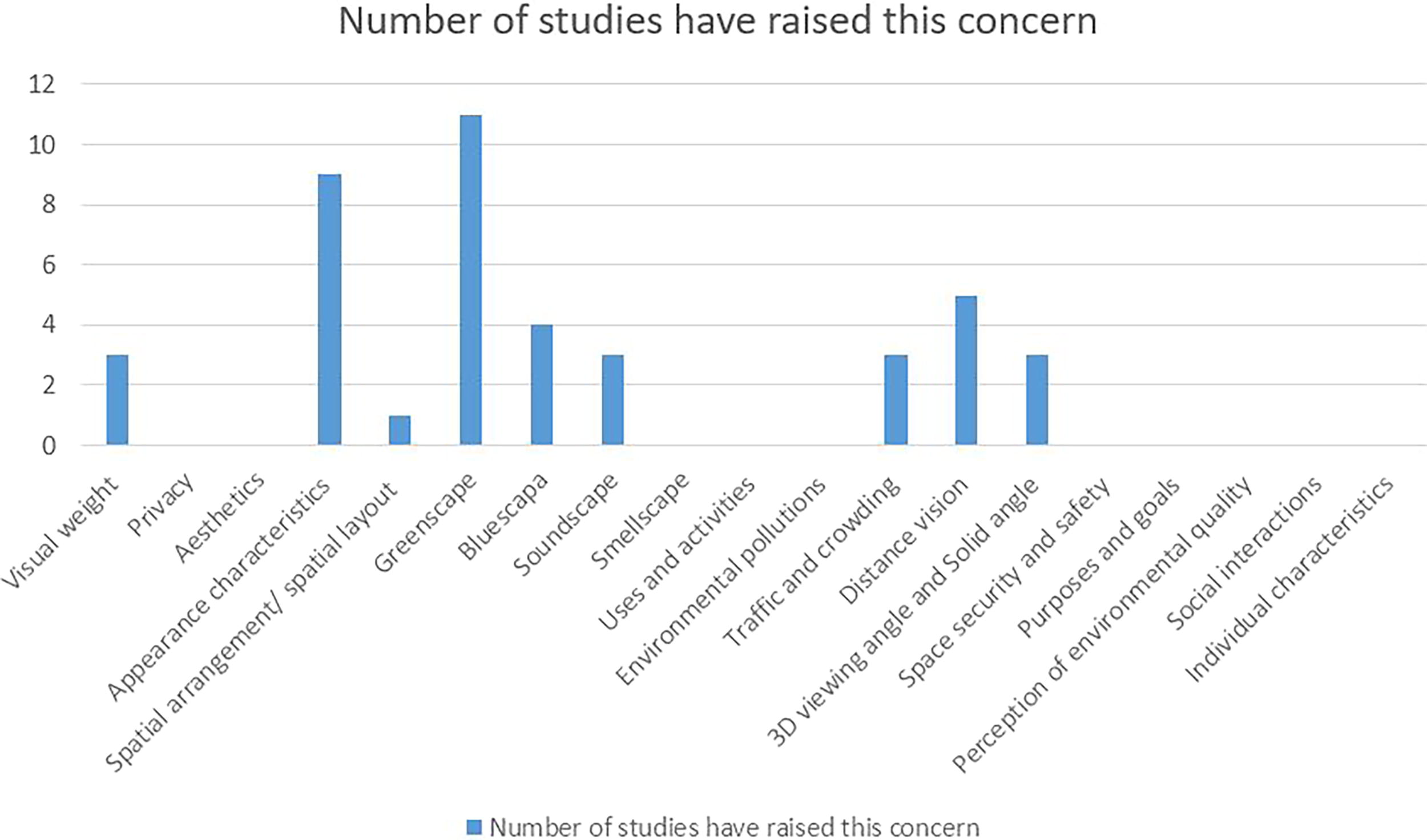
Number of studies that refer to each subcategory that affects perceived oppressiveness.
Limitations and future studies
As understanding of which types of natural environments promote human mental health is still limited, 75 there is much potential for future studies. Notably, the need for restorative environments in high-density urban spaces is more important than the need for restorative environments in natural environments in suburbs, 76 and most of the time, people interact with built environment spaces; therefore, this topic should be considered in future research. On the contrary, although early studies focused on urban environments dominated by natural elements or natural environments 77 and some research has investigated the restorative effect of built environments, there is potential for assessing the effects of different aspects of built environments on human mental and physical restoration. Another promising research in this context is comparing user perceptions of oppression in urban and rural environments. Given the distinct nature of these settings, it is likely that users perceive oppression differently. This comparison could provide valuable insights for developing restorative urban design approaches and targeted interventions. Additionally, because people in urban societies spend most of their time in indoor spaces, 78 one of the most significant issues that should be investigated in future studies is mental recovery in indoor spaces. Most of those previous studies focused on the effects of green spaces on human health; moreover, there is no evidence of an association between outdoor blue spaces and human health, 79 and further research is needed on the relationship between urban blue spaces and health. 80 On the contrary, although visual perception is not the only way to affect the psychological response in urban green spaces 81 and visual senses can offer a more authentic experience, 82 most related studies tend to focus solely on the aspect of human visual perception. In other words, few studies have been conducted to demonstrate the effects of auditory-visual combinations on restorative potential. 83
CONCLUSION
Preoccupations and mental pressures inflicted on humans, especially the residents of urban environments, in recent decades have not been hidden from anyone and are tangible. Some of these pressures are imposed on the human psyche by the environment. The hidden stress that the user perceives in the urban environment is known as perceived oppressiveness. This type of perception exists in urban environments and reaches its peak in dense environments, especially in the vicinity of tall buildings. Perceived oppressiveness can aggravate mental fatigue. On the contrary, due to these issues, mental health protection is necessary because of mental pressure, fatigue, and stress. If mental restoration does not occur, the user becomes distressed and shows symptoms such as an inability to concentrate and perform tasks. An environment based on perceptual capability has the potential to cause cognitive restoration. Environment-based mental restoration is explained by two basic theories, Kaplan’s attention restoration theory and Ulrich’s stress restoration theory, emphasizing the restorative potential of the natural environment. Currently, users spend most of their time in urban environments, and in this environment, the share of green spaces is decreasing due to the expansion of urbanization; the environment also imposes mental pressure and hidden stress on the user, so it is necessary to review the dimensions that are effective in mental restoration, with emphasis on the principles of perceived oppressiveness in streetscapes. This article was written with the method of content analysis and included the concern and necessity of answering the question “What are the components of the restorative streetscape based on perceived oppressiveness?” In response to the research question, the main factors affecting perceived oppressiveness in streetscapes were classified into three main categories: environmental factors, human–environment interactions, and human factors. Importantly, the tolerance threshold of users for each of the proposed components differs based on the context and the factors affecting it. Therefore, measuring and explaining the tolerable threshold in each field is necessary. Paying attention to this amount for each factor in the design of the streetscape will make it possible to bear less mental pressure and give the user space to remain in the environment. In this way, and in the presence of restorative environment components, users’ mental health can be restored. Considering the mere presence of factors in the restorative environment without considering tolerable thresholds for perceived oppressiveness can make it extremely challenging to characterize the potential for cognitive restoration of the user.
This study has created a new way to answer one of the challenges of creating restorative environments in the streetscape. Urban designers can effectively reduce perceived oppression through well-designed interventions in four categories: structures and details, functions, pollution, and security and safety. Prioritizing user preferences, fostering a positive perception of environmental quality, and creating opportunities for social interaction are crucial factors in improving mental health by reducing perceived oppressiveness. Future research should investigate the tolerable level of perceived oppressiveness for users in different contexts. This study identified several factors that can help reduce perceived oppression, such as focusing on landscape approach, minimizing environmental pollution, and increasing access to green and blue spaces. Dense urban areas with tall buildings can exacerbate perceived oppression. In such settings, solutions such as creating space between buildings, incorporating pocket parks with green spaces, and maximizing sky visibility offer potential for mitigation. However, further research across a wider range of settings is necessary to fully understand and address the complexities of perceived oppression in urban environments. Additionally, many questions remain unanswered in the field of restoration and perceived oppressiveness, which indicates the necessity of future studies. It is also necessary to examine the tolerable threshold for users in any field in future research. By considering the tolerable thresholds of restorative factors for a user, streetscapes can become restorative environments with which users interact every day, and steps can be taken to reduce the negative psychological pressure on the user’s psyche, which, in turn, will improve their mental health.
Footnotes
ACKNOWLEDGMENT
The authors would like to thank the editorial office of the Environmental Justice journal for facilitating the review and publication process.
AUTHORS’ CONTRIBUTIONS
All four authors participated in all sections, and based on the greater share of participation in each section, it can be stated as follows: The article’s main idea was presented by M.F. The original text was written by H.J.K. M.K. did the initial collection and analysis. Checking the correctness of the collected information, analyzing and re-categorizing, and re-reading the text were done by M.G. M.K., M.F., and M.G. approved the final version of the article.
AUTHOR DISCLOSURE STATEMENT
The authors declare that they have no competing interests.
FUNDING INFORMATION
No funding was received for this article.