




Abstract
Introduction:
Public–private partnerships (PPPs) can play a critical role in advancing our understanding of environmental exposures by maximizing cross-disciplinary expertise and resource-sharing among government, community, and industry researchers. However, experiences with PPPs associated with community environmental monitoring involving industry partners have not been well-documented.
Goal:
To build on existing literature combined with the expertise of practitioners from various sectors to identify overarching elements and specific principles necessary for creating and sustaining successful PPPs for community environmental monitoring.
Methods:
A scoping literature review and 24 semistructured interviews with diverse PPP stakeholders were conducted. Excerpts from the review were coded to successful/barrier elements. Interview transcripts were analyzed using content analysis.
Results:
Trust emerged as a foundational principle both in the literature review and in interviews. After trust is developed, three critical principles for successful PPPs are: a sound organizational structure with sufficient resources to maintain the PPP, clear and inclusive approaches to communication, and developing scientifically robust data as the basis for decision-making.
Conclusions:
Community interviewees realized the value of PPPs but engaged in them cautiously given power imbalances and prior negative experiences. Our analyses confirm that historic events and power imbalances affect trust and participation of community partners, and that trust-building is a continuous process requiring honesty, bidirectional communication, sustained presence, and acknowledgment of prior activities adversely impacting the environment. A centralized repository or a professional community society would facilitate the sharing of lessons learned. PPPs may benefit by including trained facilitators for equitable and participatory processes.
INTRODUCTION
There is a rich literature on public–private partnerships (PPPs) regarding issues such as infrastructure and education.1,2,3,4,5 However, little has been published on PPPs related to environmental monitoring, specifically on PPPs that include both a community and an industrial partner.6,7,8 Yet by combining the expertise and resources of public and private sectors, the PPP approach has the potential to be a valuable tool for public health protection. It is therefore important to understand the elements that can promote successful PPPs as well as those that can be barriers. 9
There are many definitions of PPPs 10 as well as what constitutes “private” versus “public” entities. Even the concept of a partnership lacks a cohesive definition. We posit a general definition of a PPP based on concepts from Lewis (2001) 11 and Kernaghan (1993). 12
A relationship that consists of shared and/or compatible objectives, power, work, support, and/or information and an acknowledged distribution of specific roles and responsibilities among the partners. The PPP is a cooperative investment of resources and results in joint goals, risk-taking, sharing of authority, and mutual benefits for all partners.
In this research, we focus on PPPs where there may be a history of mistrust and one partner is/was the source of the environmental issue. These types of PPPs present unique challenges and opportunities. Because of the potential advantages of PPPs for environmental problems and improving public health and environmental justice outcomes, we explored lessons learned using two approaches:
A scoping review of the existing peer-reviewed literature on environmental PPPs. Interviews to understand the experiences of stakeholders, especially those that are not reflected in the published literature.
Our objective is to develop a comprehensive and generalizable set of principles and elements that can be used as the basis for creating and sustaining successful environmental PPPs. The ultimate goal is to create opportunities to improve public health.
We also think it useful to ask: Why is the concept of a successful PPP so important? A successful partnership empowers local communities by ensuring that project goals promote community objectives and values and enable transparency and engagement.13,14,15,16 Participants also feel empowered to express their ideas to people of authority by having scientific data to support their policy requests.16,17,18 Projects conducted as part of a successful partnership are the ones that can lead to the most rapid impacts on policy.17,18 Furthermore, leveraging science and local knowledge enables all stakeholders to learn from one another, recognizing that local knowledge can complement and help refine the scientific method. This process can also make results more credible and more widely available for both scientists and lay audiences.15,16 Community outcomes of a successful partnership can include building infrastructure and leadership, improving social capital, increasing trust among stakeholders, job creation, and improving environmental management.13,16,17 For individuals, outcomes include knowledge gain, scientific literacy, stewardship actions, a sense of ownership, and broadened networks. By involving community members in co-management, individuals gain increased knowledge of and control over their issues.13,15,16,17,19
METHODS
The research included a scoping literature search and a series of stakeholder interviews. The research was informed by an Advisory Committee comprised of members with diverse backgrounds, who advised on the list of search terms, helped pilot the interview instrument, and assisted in identifying potential interviewees.
Literature search and review
Our scoping review followed the JBI Manual for Evidence Synthesis. 20 An informationist developed and conducted the literature searches with team input. We searched Medline (Ovid), Embase.com, PubMed (non-Medline records), and Web of Science to identify studies published from database inception to March 20, 2023.
Search terms were developed using a combination of controlled vocabulary and keywords to define the concepts of PPPs and environmental monitoring. Each reviewer (A.R. and J.S.L.) reviewed the search results, blinded to the other’s decision. Conflicts were resolved by discussion between the reviewers. Inclusion criteria were: studies on environmental monitoring, studies on PPPs, and studies in English or Spanish.
The language that describes PPPs is highly variable and evolving. Therefore, we began with identifying relevant publications using a wide search (Supplementary Data S1). We then screened out publications that did not include both public and private entities or lacked an environmental focus. We were particularly interested in identifying research on PPPs with community and industry partners.
Publications related to activities other than monitoring, but which had an environmental purpose and included lessons learned, were retained. In addition, certain community-based participatory research (CBPR) publications that included lessons learned regarding stakeholder collaboration were retained.
In a scoping review, reviewers balance “feasibility with breadth and comprehensiveness of the scoping process.” 21 This led to the identification of additional exclusion criteria (e.g., citizen science studies without a partnership, monitoring of pathogens and illnesses, research on monitoring tools, PPPs conducted outside North America).
Next, the full text of each relevant publication was considered to develop a final group of articles for inclusion, and reference lists were examined to identify relevant articles not captured during the initial literature searches.
The included articles were uploaded into Dedoose. 22 Each was reviewed by one researcher, and relevant information was extracted in the form of excerpts. Each excerpt was assigned a code corresponding to success or barrier elements.
Stakeholder interviews
We included individuals from industry, government, community groups/non-governmental organizations (NGOs), and academia. Potential interviewees were identified via recommendations from individuals who have participated in PPP activities, publication authors, and interviewees themselves. Inclusion criteria were: interviewees were currently or previously engaged in PPP activities; speaking English or Spanish. To the extent possible, we included interviewees who had participated in a PPP that included an industry partner. Interviewees were offered a $40 gift card. Institutional IRB (Institutional Review Board) approval was obtained. Participants’ identities and affiliations are kept confidential.
We developed a semistructured interview guide (Supplementary Data S2).23,24 Each interview lasted about 60 minutes and was conducted by two coauthors (F.W. and J.S.L.) via Zoom with private links.
The interview transcripts were analyzed separately and independently by three researchers (F.W., N.N., C.J.) using content analysis. A coding matrix (available on request) with all categories of overarching themes was developed, and codes were added or removed based on the agreement among the investigators. After coding, the emerging themes were organized according to the objectives of the study. All recommendations regarding elements considered key to successful PPPs as well as barriers to successful PPPs were collated.
RESULTS
Description of data
Literature searches yielded 15,342 records. After full-text screening and bibliography review, we included 110 records (see PRISMA [Preferred Reporting Items for Systematic Reviews and Meta-Analyses] diagram and list of included publications in Supplementary Data S3). Of these, special attention was paid to 10 which described environmental PPPs between an industry partner and community organizations.25,26,27,28,29,30,31,32,33,34
The remaining 100 publications described a wide variety of partnerships. Many described partnerships between academic or governmental institutions and community groups, often describing CBPR.35,36,37 Another common theme was PPPs between governments and industry/polluting partners that sought to limit or remediate pollution.38,39 Other types of PPPs included philanthropic collaborative research by nonpolluting private partners40,41 and governmental coordination of product development by private partners.42,43 Additionally, the search yielded 22 publications that provided general commentary or review rather than focusing on a specific PPP.44,45,46,47,48,49,50,51,52,53,54,55,56,57,58,59,60,61,62,63,64,65
Twenty-four interviews were completed with 9 women and 15 men: 8 from NGOs, 6 from academia, 4 from community organizations, 3 from industry, and 3 from governmental organizations. Twenty-seven codes were used to retrieve 1,786 transcript selections.
Recurring themes regarding successful PPPs
An overall theme that appeared in the interviews and literature was that of relationship-building. Information from the scoping review and interviews confirmed the importance of having committed stakeholders working together to achieve a common goal, despite potentially having different and sometimes conflicting aims. One NGO interviewee described PPPs as follows: “It’s really a collaboration of people that have the same problem…And they either want to work together because the problem is complex and they need more brain power, or they don’t have enough resources to do it by themselves.”
Or, as one community stakeholder explained, “if you are being sincere with them—talk about ‘We’ and not talk about ‘I’ or ‘they.’ If you keep saying ‘We’, this is a partnership.” Another participant, an NGO stakeholder, highlighted that a shared commitment must prevail for a PPP to be successful: “I would say, [it] is that shared commitment that made the [PPP] successful… I mean, everything else you can kind of work through. But if you don’t have that shared commitment for what you’re trying to achieve, the other pieces are just almost irrelevant.”
The interviewees noted the importance of building relationships early on. This allows stakeholders to understand each other, align goals, build trust, co-create solutions, and navigate challenges effectively. As these relationships mature over time, they form the backbone of resilient and impactful collaborations between the public and private sectors. As one stakeholder mentioned during an interview: “…I have to say you’re 50/50 if you don’t have the relationship upfront at best. You’re likely to fail if you don’t have the relationship before you get started.”
In the following section, we discuss lessons learned from the literature and interviews that can help future PPPs build successful relationships.
Principles and elements associated with successful PPPs
Regarding developing and sustaining a successful PPP, the foundational principle that appeared consistently is trust. It is only after trust is developed that the next two principles become possible: the development of a sound organizational structure with sufficient resources to maintain the PPP; and clear and inclusive approaches to communication. With these principles in place, then the fourth—developing scientifically robust data as the basis for decision-making—should follow more naturally (Fig. 1).
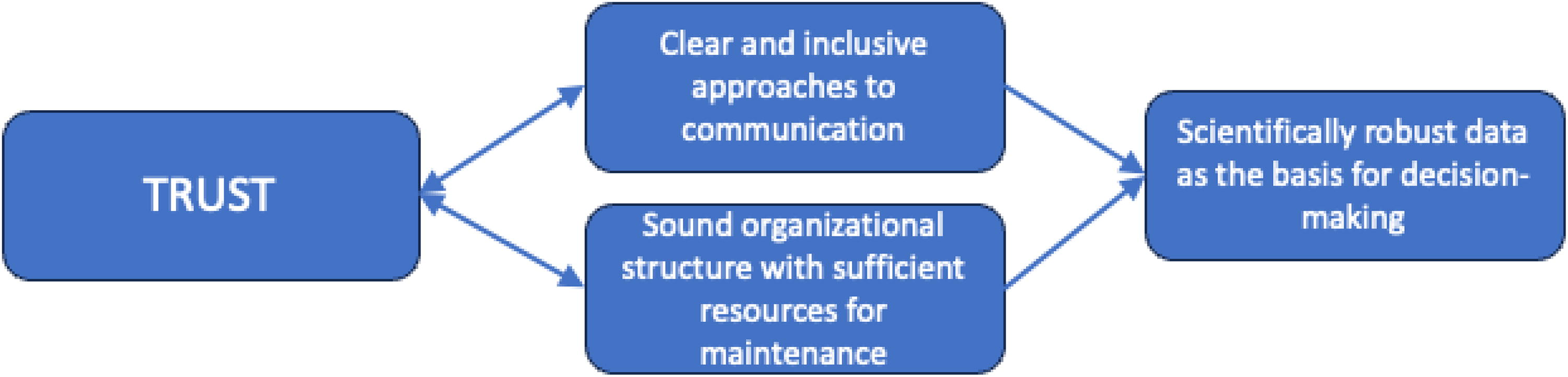
Principles for developing and sustaining a successful PPP.
Trust
A trusting relationship can be summarized as a willingness to take risks on the behavior of others based on the belief that those involved will “do what is right.”66,67,68 Trust is not automatic and must be earned through the investment of time and commitment and participation in the day-to-day social life of the communities.69,70,71,72,73,74 Furthermore, trust follows when there is a clear benefit to all parties.75,76 Trust is required “to hold the group together during difficult periods of consensus development.” 77 Pursuing a shared goal and learning together are activities that build trust and help build capacity and engagement with the community. 78
Our in-depth interviews also showed trust-building to be an essential process, requiring thoughtful action from non-community partners, as illustrated in quotes from community stakeholders: “How you can develop trust is by training… a training program for them [industry and academic partners] to understand diversity, understand the African American community, understand their inherent biases or subconscious bias. They haven’t. So the lack of trust is still there.” Another community stakeholder asserted: “The people that started the mistrust need to develop a process to show that they can be trusted and putting money into it, putting people power into it, putting man hours into implementing different kinds of programs.” A sampling of other trust-related interviewee quotes is given in Table 1.
Stakeholders’ Selected Quotes on PPPs and Aspects of Trust
Sound organizational structure with sufficient resources for maintenance
Skilled leadership: Sound organization structure requires skilled leadership (with shared decision making and accountability), which is crucial to the success of PPPs.79,80,81,82,83,84,85,86 Aspects of skilled leadership include establishing conflict resolution processes,87,88,89 a good relationship among partners,90,91,92,93,94 clearly defined roles, 95,96,97,98 written agreements, 99,100,101,102,103 fairness, 104 treating community as equal partners,105,106,107,108,109,110,111,112,113,114 and valuing each collaborator’s time and expertise.115,116,117,118,119,120,121
Successful partnerships negotiate risks, costs, and benefits in advance and set up ground rules that describe stakeholder roles, duties, and responsibilities with what one industry stakeholder termed “constructive spirit of engagement.” The interviews revealed the importance of having the right people at the table (stakeholder representation, technical knowledge and soft skills, trustworthiness): “…if you’re in a situation where you have multiple partnerships, you really work to respect all partners and keep them as on equal footing as you can…” The inclusion of trained facilitators and/or conflict resolution mediators was mentioned as a valuable resource to build trust, address power imbalances (Table 2), and sustain equitable processes. Despite the importance of having a process for conflict resolution, minimal published information on how to accomplish this (either from the interviewees or in the literature) has been proffered.
Stakeholders’ Selected Quotes on PPPs and Power Imbalance
Availability of resources for sustaining PPPs: Successful PPPs have the needed and appropriate assets (e.g., staff, finance, legal, and scientific expertise),122,123,124,125,126,127,128,129,130 technical capabilities (e.g., IT, metadata skills, scientific knowledge, and expertise),131,132,133,134 organizational capabilities (e.g., data sharing and knowledge transfer skills, networking)135,136,137 and adequate recognition of and compensation for community partner contributions.138,139,140,141,142,143,144,145,146,147 A community stakeholder indicated: “It’s essential that the community members have ways to be reimbursed for their time.” One community stakeholder commented on some of the barriers to success in PPPs in the following terms: “But we are also not quite as fiscally stable as I’d like us to be. Our resources are really severely limited; and I know that the kind of work that we could do is just so far beyond any resources that we really have access to.”
Consistent and suitable funding is key for gathering sufficient quality data.148,149,150,151,152,153,154 Funding is necessary for sampling materials and transport, and compensating community members for their time and expertise,155,156,157,158 which is particularly important in remote areas where people may not be able to afford the costs of collecting and sending data. 159 Sufficient time and resources should be provided to the partners in order to get to know each other.160,161
Sustainable structures and processes: Stakeholder interviewees recognized that organizations’ buy-in in the PPPs is necessary. The performance of the partners is deeply impacted by their own organizational dynamics. Sustainable structures and processes also include having well-organized meetings established by the partners 162 that encourage discussion and debate. 163 Frequent meetings enhance mutual understanding about different organizational cultures, enhance community empowerment, and improve the likelihood of success of initial and long-term goals.164,165,166
Active participation with consistent community presence: This is important not only at the start of the PPP but throughout its existence.167,168,169,170,171,172,173,174,175 Key groups need to be included even if past relationships have been adversarial.176,177,178,179 Community members and local industry can bring expertise regarding the strengths of the community and community outreach as well as the operations of the industry; governmental partners can offer resources and monitoring expertise. 180 True inclusion means community involvement at all stages of research,181,182,183 including research design and execution 184 and community-member mentoring. 185 Providing multiple avenues for collaboration can improve sustained engagement. 186 Examples include hands-on projects187,188 and the use of multiple methods for monitoring, including approaches with meaning to local communities. 189 Celebrating and advertising the PPP’s successes can both incentivize participation and maintain good collaborations. 190 In addition, community training should be an integral part of the collaboration191,192,193 and community members should—to the extent possible—be hired as staff, coordinators, and trainers.194,195,196,197,198 Table 3 includes selected quotes from community stakeholders on elements that create or sustain active participation.
Selected Quotes from Community Stakeholders on Elements That Create or Sustain Active Participation
Clear and inclusive approaches to communication
Communication refers to processes for information-sharing among the members of the PPP and between the PPP and stakeholders outside of the PPP. From the community stakeholders’ viewpoint, clear and inclusive communications require addressing issues of trust and equity, as illustrated in Table 4.
Community Stakeholder Quotes on How to Create Conditions for Clear and Inclusive Communications
Community first: Community partners and the overall community are empowered by being the first to receive results.199,200,201 According to Parlee et al. (2021) 202 , monitoring results and experiences belong to the communities and Indigenous organizations, and they should decide how to share them and, where possible, take the lead in doing so. If communication with the general public is inadequate or their interests are ignored, strong public opposition can result in the relocation, suspension, or even termination of PPP projects. 203
Dialogue and knowledge-sharing: Early and frequent communication among partners and with the community is essential.204,205,206,207 Communication can take the form of regular newsletters, website updates, blog posts and webinars, community gatherings, frequent sharing of data, door-to-door outreach, regular face-to-face meetings, and focus groups208,209 and should occur over the entire duration of the process. 210 A true dialogue will include frank discussions about problems and challenges.211,212 There should be safe spaces and opportunities for both public and private dialogue. 213 Finally, there should be recognition that all parties bring something to the dialogue and an appreciation for each party’s contribution (e.g., specialized expertise in environmental science, deep familiarity with the community and the local area).214,215
Shared and clear goals: It is essential that at the beginning of the process, the parties entering into a PPP are clear regarding the effort’s goals, and that the parties share in these goals.216,217,218 “Put your egos and institutional agendas aside,” said an interviewee. Likewise, strategies to obtain these goals should be clarified early on. 219 For PPPs created for the purpose of environmental monitoring, the reasons underlying the need for the monitoring and how the collected data will inform action (“Why are we doing this? What do we expect to happen as a result of this data collection, interpretation, and communication?” 220 should be discussed and agreed upon). 221
Willingness to challenge each partner’s own conventions: There needs to be recognition of each partner’s belief systems and conventions and an environment that fosters challenges to those beliefs and conventions.222,223
Local language communication: While obvious, we note that information about—and results from—PPP activities need to include all languages used in the community. 224 Information should be “tailored to the cultural and socioeconomic attributes of the community in question.” 225 An interviewee said: “If there are language barriers… you [should] have effective people to translate and work on that.”
Obtaining scientifically sound data as the basis for decision-making
One goal of an environmental monitoring PPP is to use the data derived from the PPP’s activities to effect some change, for example, to take action to reduce exposures, if needed. Data obtained to provide the foundation for action must be scientifically credible and based on methods and protocols that withstand scientific scrutiny. The basic aspects of obtaining scientifically credible data have been described extensively elsewhere. Here we focus on three elements that can provide additional insights.
Data confidentiality: Privacy issues may prevent people from participating in PPP monitoring efforts. 226 Data derived from humans (e.g., blood, urine) are extremely sensitive and privacy is paramount. Environmental sampling results can also produce adverse impacts on a community (e.g., impacts on property values). A successful PPP will be clear about how data confidentiality will be addressed and will communicate the process for maintaining confidentiality.227,228
Training: PPP partners will often require training, not only on the science, technical criteria (e.g., wireless connectivity), sampling and analysis, and data management,229,230,231 but also on awareness and knowledge of environmental issues.232,233,234 Perez-Belmont et al. (2019) 235 recommended that training should be “dynamic, inclusive, and attractive.” In addition, training on mediation and conflict resolution could be helpful; as one academic stakeholder commented: “Those types of negotiation trainings might be really value added for health risk scientists.” A member of the Advisory Board noted the need for realistic expectations on training capacity. At the project’s end, people will still only be experts in their own domain but should have some understanding of what other partners do/bring to the table.
Evaluation: To assess a PPP’s success, evaluation metrics are needed. Our interviews revealed that many PPP participants have either not included evaluations or were just beginning to plan for them. Although infrequently used by the interviewees in the research, academic and community stakeholders highlighted the usefulness of evaluation systems that inquire about both processes and outcomes to help improve current and future PPPs. However, they also warn that considerable time and resources are needed for effective evaluation. Aspects of evaluations that the reader may wish to consider are found in Supplementary Data S4.
DISCUSSION
In this research, our focus was on lessons learned from PPPs that include a community group and a private entity considered to be associated with and/or responsible for environmental concerns in the community. The concept of partnerships between public and private entities to address an environmental issue is not a new one, yet this specific type of partnership is relatively unexplored in the literature. However, we know from our professional experiences and from the interviewees that these kinds of activities are occurring. We used a scoping review of the literature in combination with interviews of PPP participants to develop a comprehensive list of key principles (Fig. 1) and elements for developing and sustaining successful PPPs.
Various views regarding the characteristics of the different PPP partners emerged during the interviews. Industry stakeholders displayed confidence that they possess the most advanced scientific knowledge, resources, innovative creativity, and profit management ability. Government stakeholders saw themselves as fair regulators capable of harmonizing risks and benefits for the common well-being despite time-consuming review processes, as well as private and community stakeholder pressure. Academic partners were well-versed in their methodological tools and research capabilities but were sometimes seen as uncommitted and extractive to the communities they studied. Community stakeholders realized the value of PPPs but engaged in them cautiously given power imbalances and past negative experiences. Prior research has shown that historic events and power imbalances clearly affect the trust and participation of community partners.236,237 Trust-building is a continuous process that requires honesty, bidirectional listening and communication, sustained presence, and acknowledgment of previous activities adversely impacting the environment by some industry agents, universities, and governments. 238 As our research suggests, one cannot have clear inclusive communication with a power imbalance.
Moreover, an extensive body of research on university–community partnerships documents the need to address power imbalances.239,240,241 In the present study, which focuses on PPPs that involve an industry partner, both the literature and the stakeholder interviews also revealed power imbalance to be an important barrier that needs to be consciously and systematically addressed in order to have a successful PPP. We further found that it is not the only or the main barrier. The factor that appeared to be key to successful community–industry PPP success was trust, which is the product of an intentional process that is time-consuming, and requires absolute transparency and commitment, as clearly expressed in the quotes included in this article. Addressing power differentials is necessary to build and sustain trust, and building equitable, nonextractive PPPs requires intentional efforts and resources to deal with power differentials. Further research is needed to better understand whether “power differentials” should be, as proposed in the present study, included in the Trust principle or should be considered a principle on their own.
Study limitations
Based on our findings from the literature search and lessons learned from the interviews, we believe that our findings represent the current state of knowledge on this subject. However, we note here certain limitations to our research.
Scoping literature review: While we cast a wide net using a large number of search terms, because of inconsistent and evolving PPP-related nomenclature, there may be additional publications not captured by our searches. It is also likely that there are ongoing PPPs not described in the literature, as there is minimal impetus for community members and industry representatives to publish findings. Finally, while we opted to include studies from North America to improve the likelihood of generalizability of principles and elements, it will be worth examining the literature from outside North America in future research.
Interviews: The sample may not adequately represent each of the groups (e.g., gender, sector). Only the audio part of the interviews was recorded to protect the identity of the participants, which may have limited our ability to accurately code the materials.
Recommendations for future research
We offer the following recommendations for future research:
Without a public searchable record or repository of the type of PPP explored here (industry and communities partnering to address local environmental problems), it is difficult to identify individuals who can share their stories. A centralized repository or possibly a professional community society is needed to facilitate the sharing of lessons learned.
The language around PPPs is at present inconsistent, making searches for information difficult. A common terminology needs to be developed to enhance future research on this subject.
The development of a transparent approach to the evaluation of PPPs would be of value to existing and future PPPs. An evaluative process would include success metrics that cover PPP processes, communication, trust, and outcome.
Different instruments that help gauge community engagement have been developed but did not appear in our literature search, such as the “Spectrum of Community Engagement to Ownership” 242 and more recently a model discussed in a National Academy of Medicine publication 243 ; these instruments can provide a critical framework for the description of power data and discussion of power in future research.
CONCLUSIONS
This research focused on understanding what aspects of community–industry relationships could lead to successful PPPs and the barriers that prevent this from occurring. From both the literature and the in-depth qualitative interviews, we found that the four guiding principles for successful PPPs are trust, a sound organizational structure with sufficient resources to maintain the PPP, clear and inclusive approaches to communication, and developing scientifically robust data as the basis for decision-making. PPPs may also benefit by including trained facilitators to support the creation of equitable and participatory processes. We recognize the extensive literature describing citizen science-based and CBPR-based partnerships with academia and government. However, given the potential importance of community–industry collaborations for assessing, examining, and addressing local environmental problems, the dearth of information on this topic is concerning. To our knowledge, this research presents the first examination of community–industry partnerships in North America. We hope our results are useful for future PPPs and for addressing critical research gaps.
Footnotes
ACKNOWLEDGMENTS
The authors thank the interviewees and the Advisory Committee (Donna Vorhees, ScD, Sabine Lange, PhD, Michael Thompson, Brian Jones, Laundette Jones, PhD, Jane Clougherty, ScD) for their time and input.
AUTHORS’ CONTRIBUTIONS
A.M.R.: Conceptualization (support), methodology (equal), formal analysis (equal), writing original draft (equal), reviewing and editing (equal), and visualization (equal). F.W.: Conceptualization (support), methodology (equal), writing—original draft (equal), formal analysis (lead), and writing—reviewing and editing (equal). N.N.: Methodology (supporting) and analysis (supporting). C.J.: Methodology (supporting) and analysis (supporting). L.R.: Methodology (supporting) and formal analysis (supporting). J.N.: Analysis (supporting) and writing—original draft (supporting). S.S.L.: Writing—reviewing and editing (supporting). J.E.C.: Writing—reviewing and editing (supporting). D.V.: Writing—reviewing and editing (supporting). J.S.L.: Funding acquisition (lead), project administration, conceptualization (lead), formal analysis (equal), writing—original draft (equal), writing—reviewing and editing (equal), and visualization (equal).
AUTHOR DISCLOSURE STATEMENT
L.R. and S.S.L. received no compensation. D.V. received no compensation, and the views expressed in the article are her own and not those of her employer, the Health Effects Institute. The authors have no interests, funding, or employment that may inappropriately influence or affect the integrity of the submission. J.S.L. consults with governmental and private sectors; she has no competing interests to declare.
FUNDING INFORMATION
Research support was provided by a grant from the Foundation for Chemistry Research & Initiatives (FCRI) (a 501(c)(3) tax-exempt organization established by the American Chemistry Council) in coordination with the American Chemistry Council’ s Long-Range Research Initiative (ACC-LRI). FCRI/ACC-LRI had no role in the design of the study, nor in the collection, analyses, or interpretation of data; nor in the writing of the article; or in the decision to publish the results.

Supplementary Material
Please find the following supplemental material available below.
For Open Access articles published under a Creative Commons License, all supplemental material carries the same license as the article it is associated with.
For non-Open Access articles published, all supplemental material carries a non-exclusive license, and permission requests for re-use of supplemental material or any part of supplemental material shall be sent directly to the copyright owner as specified in the copyright notice associated with the article.
