




Abstract
This commentary explores the role of participatory research in improving climate literacy among Indigenous peoples and local communities (IPLCs) in Southeast Asia. IPLCs, deeply interconnected with their natural environments, face disproportionate vulnerabilities to climate change due to limited access to information and socioeconomic disparities. We conceptualize IPLC-relevant climate literacy, encompassing understanding climate change science and nature-based carbon sinks, being aware of adaptation options, and understanding how carbon markets work and the associated risks. We draw on our participatory research experience in the Philippines and Laos, motivated by the importance of integrating local knowledge with scientific knowledge. Our participatory research projects engaged IPLCs in various stages, enabling shared decision making and knowledge exchange. In the Philippines, functional participatory research saw IPLCs understanding and advocating for mangrove and seagrass ecosystems’ role in climate change adaptation. In Laos, empowerment-focused participatory action research explored soil management practices’ impacts on soil moisture, promoting community-led adaptation strategies. However, limitations include the challenges to achieving extensive community outreach and time and cost constraints in fieldwork. Although participatory research offers a valuable platform, there should be a more active and broader program for improving IPLCs’ climate literacy to enhance climate resilience.
INTRODUCTION
Climate change poses unprecedented challenges to humanity, 1 demanding urgent action to mitigate its impacts and build resilience.2,3 It differentially impacts communities, not only due to highly localized effects but also by specific pathways mediated by local economic systems and culture. 4 These nuanced impacts threaten the livelihoods and well-being of Indigenous people and local communities (IPLCs) who face multifaceted challenges stemming from environmental degradation, resource exploitation, and shifting climatic patterns. 5 The urgency of addressing these challenges is underscored by the intersection of place-specific vulnerabilities and intricate sociocultural and economic dynamics shaping IPLCs’ experiences in the face of environmental change.
In Southeast Asia, IPLCs whose livelihoods are intertwined with forest resources tend to be poor, live in remote areas, have limited levels of formal education, 6 and have limited recognition of their cultural rights. 7 Despite their intimate knowledge of local environments, IPLCs often lack access to comprehensive information about climate change dynamics and mitigation and adaptation options, leading to reactive rather than proactive response activities.8,9,10 This disparity undermines their resilience and perpetuates socioeconomic inequalities, exacerbating their vulnerabilities within the broader climate change context. 11 Therefore, it is essential to bridge the informational gap among IPLCs by increasing their climate literacy.
In this article, we aim to contribute to the broader discussion on how climate literacy can be increased among IPLCs. When we recognize that the interactions in field research produce coupled action-reactions between the researcher and the researched, 12 this opens the possibility of researcher-researched relations being more than a unidirectional extraction of knowledge. Given the researchers’ immersion in the field site, engagement and collaboration with IPLC research participants provide spaces for fostering climate literacy, which is important given IPLCs’ exacerbated climate-related vulnerabilities.
We posit that participatory research is a useful platform for explaining the concepts of climate change, carbon, and its commodification to IPLCs; however, this remains a co-benefit and needs to be supplemented by a broader program of climate literacy outreach to IPLCs. We structure our article by first providing a background and conceptual framework (Section 2) about IPLCs in Southeast Asia, the kind of climate literacy relevant to IPLCs, and participatory research approaches. We then explore the prospects of using participatory research to increase climate literacy among IPLCs, reflecting on our own projects in the Philippines (Section 3) and the Lao PDR (Section 4). In Section 5, we discuss why, despite these prospects, increasing climate literacy remains a co-benefit in participatory research.
BACKGROUND AND CONCEPTUAL FRAMEWORK
Indigenous peoples and local communities in Southeast Asia
Southeast Asia is a politically and ethnoculturally diverse region. Politically, its governments range from the more authoritarian postsocialist regimes (e.g., Vietnam, Laos) to the more decentralized democracies (e.g., Indonesia, Philippines). In the Philippines, ∼17 million (Indigenous people) IPs belonging to 110 ethnolinguistic groups are closely linked with their traditional territorial claims. 13 In Laos, the government does not promote the concept of indigeneity but emphasizes equality among its 49 ethnic groups.14,15 Against this backdrop, we find using the term “Indigenous peoples and local communities” (IPLCs) more productive to refer to rural people (e.g., farmers, fishermen, healers) whose livelihoods, cultures, identities, health, and spiritual well-being are intricately linked to the natural environment on which they live.16,17
In relation to climate change, we are concerned about IPLCs for a few reasons. First, their voices matter in addressing climate change. It is important to understand their needs and challenges so that they can be appropriately empowered to protect a fifth of the world’s forest carbon stocks. 18 Although not all indigenous or local knowledge may be environmentally beneficial, its inclusion into environmental management19,20,21 empowers them to drive conservation, allows for projects to be cost-effective, locally-innovative and fair22,23 and better informs decision making on the local environment.24,25,26,27 Second, IPLCs are victims of climate injustice. Although their contribution to climate change is small,28,29 their place-specific exposure and lower socioeconomic status makes them more vulnerable to its impacts30,31 such as more intense and frequent typhoons, floods, and droughts.32,33 This is compounded upon pre-existing injustices, for example, of being removed from their ancestral lands and traditional customs due to processes of modern state-making.34,35,36 The global interest in nature-based carbon credits also makes them susceptible to second-order climate injustices, that is, social injustices such as land dispossession and inequitable distribution of carbon revenues that arise from efforts to mitigate climate change. 37
An IPLC-relevant climate literacy
Climate literacy refers to the understanding that the climate and earth systems shape life, the ability to communicate about climate change, and the capacity to make informed decisions to address the impacts of climate change.38,39 For IPLCs, this understanding is crucial for interpreting observations of changing and extreme weather and for identifying adaptation options. Having “factual knowledge about the environment and environmental changes” 40 (e.g., knowledge system on cyclone prediction, and responses of certain plants to temperature changes) prepares IPLCs to identify suitable and effective adaptation strategies, (e.g., using local plants for flood protection). 41
In the current era of green neoliberalism, where the trading of nature-based carbon credits is viewed as a strategy to mitigate climate change,42,43 an IPLC-relevant conceptualization of climate literacy should incorporate additional dimensions. Nature-based carbon credits, typically purchased by net carbon emitters, are generated through project interventions at forest sites. Despite their pivotal role in forest conservation and carbon sequestration, IPLCs often find themselves excluded from decision-making processes,44,45 perpetuating historical and ongoing climate injustices and hindering the realization of sustainable development goals.46,47 Although the trading of nature-based carbon credits offers the potential to reward IPLCs for protecting ecosystems, it also presents the risks of dispossession in insecure tenure contexts48,49 and of receiving less-than-deserved benefits from carbon revenues.50,51,52 Knowledge about these risks is essential for them to safeguard their own rights.
Against this backdrop, our conceptualization of an IPLC-relevant climate literacy encompasses three key components (Fig. 1): (i) an understanding of the basic science of climate change and nature-based carbon sinks (NCS, i.e., natural or modified ecosystems that capture or store more carbon than they release, such as terrestrial and mangrove forests, peatlands, agricultural soils, and seagrass meadows 53 ); (ii) awareness about climate change adaptation options; as well as (iii) understanding how carbon markets work, the associated risks, and carbon rights (the right to benefit from payments associated with reducing forest-based greenhouse gas emissions 54 ). In parallel to financial literacy, the third component can also be understood as carbon (credit) literacy: whereas money is the currency in financial literacy, carbon credits are the currency in carbon literacy. This differs from another use of the term “carbon literacy,” which refers to understanding one’s carbon footprint, 55 and which we feel is less important for IPLCs, whose carbon emissions are minimal 56 but who experience distributional and second-order climate injustices. 57
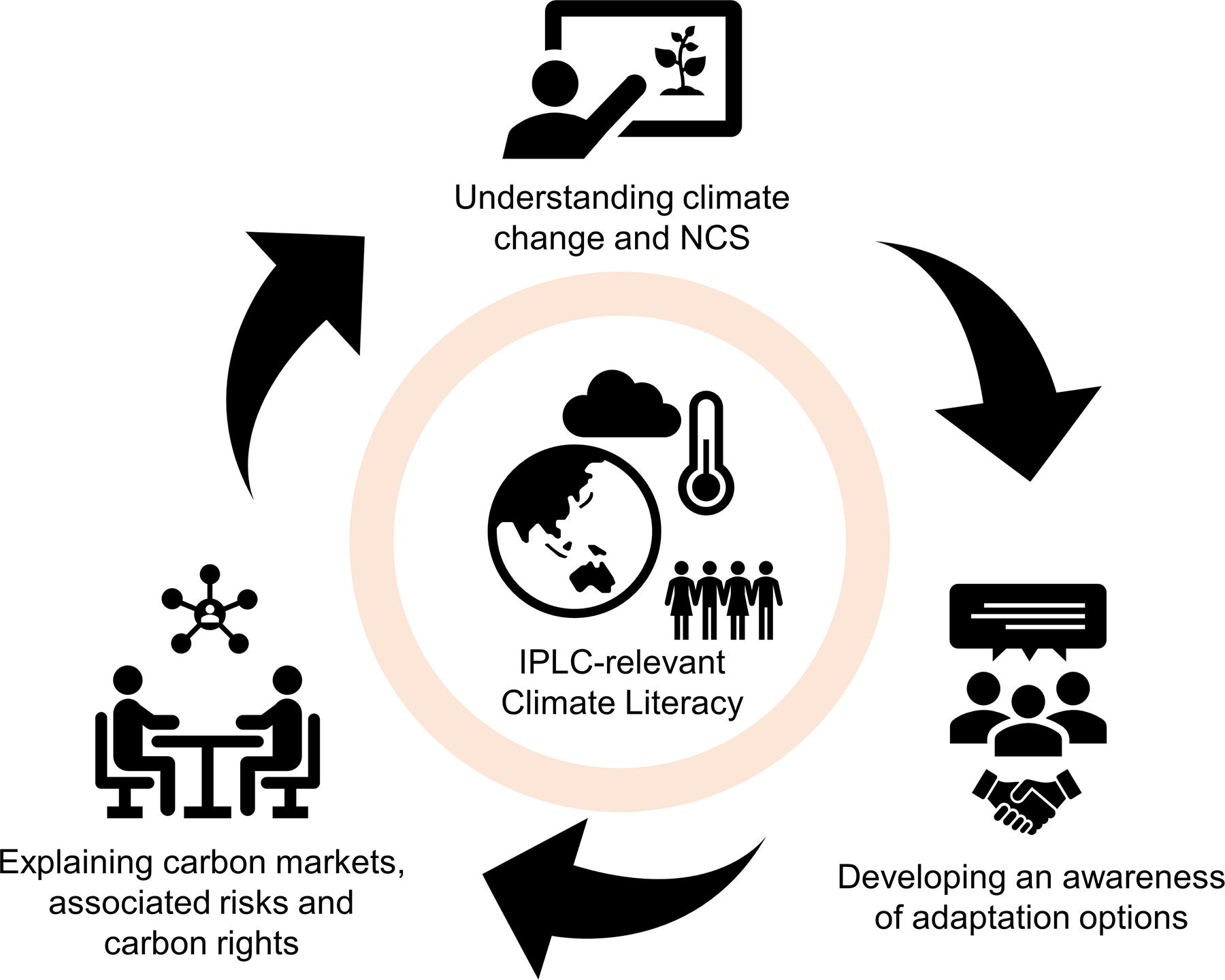
An IPLC-relevant climate literacy. IPLC, Indigenous peoples and local communities.
Participatory research
Participatory research involves the active engagement of scientists with stakeholders or informants, leading to iterative changes in the research design or output. 58 The underlying intent of inviting participation in research can be distilled into two non-mutually exclusive purposes: functional and empowerment. 59 Functional participation aims to glean insights into the preferences of potential end-users to enhance the relevance and appropriateness of the research products. For example, in a crowdsourced approach for hydrological monitoring, citizen science supplemented water monitoring data in a remote Kenyan river basin. 60 Empowerment participation is grounded in postcolonial, postpositivist, or feminist perspectives of knowledge production, advocating for individuals’ constructive self-determination. 61 An example is participatory action research (PAR), where researchers and participants are partners in identifying and examining a local issue of concern to change it for the better.62,63 Although a critique of functional participatory research is that it can be extractive and utilitarian, empowerment participatory research such as PAR is often difficult because it deviates from academic research norms (e.g., of having a predetermined research question), necessitates adaptability and requires significant time for trust-building64,65,66 Such critiques—one questioning the ideology of participation and the other its pragmatism—can be discouraging to the participatory researcher.
We offer a different view that, regardless of the type of participation, there exist researcher-researched interactions that are more than a unidirectional transfer of knowledge. For instance, the “i2S Stakeholder Engagement Options Framework,” 67 shows that stakeholder involvement can take place to various degrees across different stages of the research process. In the “inform” level of participation, researchers provide the necessary information to the community, while in the “support” level, researchers provide input as requested to the community-led research.67,68 This means that there is a spectrum of options for shared decision-making between the researcher and the participants, 69 ranging from consulting participants, partnering with them, to allowing them to lead. 70 Figure 2 illustrates the level of stakeholder influence in the participatory research that we each conducted in the Philippines and Laos, which respectively entailed functional and empowerment participation. In the next sections, we discuss these two projects to show how they provided opportunities for the researcher to improve the participants’ climate literacy.
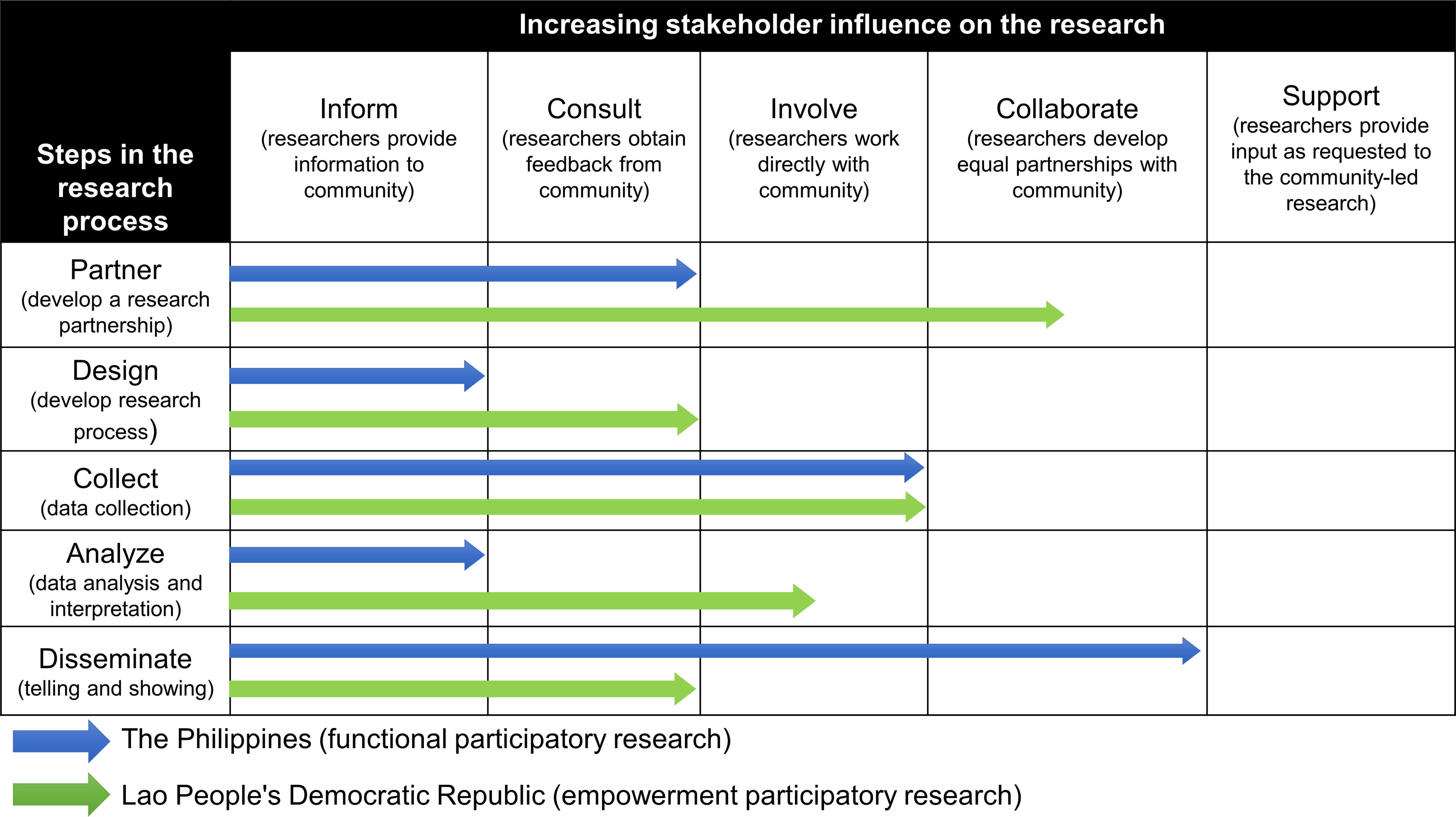
The level of stakeholder influence on each research stage in the Philippines and Laos participatory research projects. Modified from Vaughn and Jacqueza and Bammer.baVaughn, Participatory research methods.bBammer, Stakeholder engagement.
IMPROVING CLIMATE LITERACY: FUNCTIONAL PARTICIPATORY RESEARCH IN THE PHILIPPINES
The functional participatory research of Q., the second author, involved focus group discussions and key informant interviews with the IPLCs (households, coastal residents, or members of local community-based organizations) of the municipalities of Lawaan, Balangiga, and Balangkayan in the Eastern Samar province of the Philippines. These municipalities have been severely affected by devastating typhoons, notably in 1984 (Typhoon Agnes) and 2013 (Typhoon Haiyan), resulting in internal migration, the loss of fishing livelihoods, and the destruction of properties. 71 They are thus prioritized in the country’s existing efforts to develop and implement disaster risk reduction and management (DRRM) and climate change adaptation (CCA) strategies 72 involving the restoration, conservation, and sustainable management of coastal ecosystems. 73
The main objective of this research was to understand and capture local communities’ multiple perceptions of the role of mangroves and seagrasses in climate change mitigation and adaptation. 74 These diverse perceptions are critical insights for developing and implementing a localized CCA (e.g., blue carbon-focused) strategy. 75 As local communities rely on mangroves and seagrasses for food, livelihoods, and recreation,76,77 involving them ensures that their local knowledge and practices will be incorporated into the strategy development. Additionally, policymakers can anticipate how they, as end-users of these habitats, would respond to new DRRM and CCA programs, enabling more effective and inclusive decision-making processes 78 Throughout the steps in the research process, the local communities were informed about the project details and analyses to be conducted. They were more involved during the data collection and dissemination phases of the research project, providing feedback to researchers and assisting in sharing the results and outputs of the project (see Fig. 2).
Q. explained to the local communities both the concept of climate change and the significance of NCS, specifically mangrove and seagrass meadows. He explained the concept of climate change by referencing the more frequent occurrences of intense typhoons in recent years, which the local coastal communities could readily relate to. This discussion established the context of the research and took place during a focus group session during the data collection phase. Explaining the importance of NCS occurred during one-on-one interviews with local community members on their perceived values. For instance, Q. explained that mangroves and seagrasses offered various ecosystem services, from tangible benefits such as serving as a food source and providing coastal protection to intangible benefits such as carbon sequestration. Drawing from local communities’ own experiences allowed them to better comprehend the knowledge and relate to the interview questions. This approach of utilizing people’s own experiences to make intangible carbon visible 79 has proven effective when communicating carbon concepts to project communities.
This participatory research project also provided a platform for the research participants to discuss climate adaptation options. Significantly, in all focus group discussions, the participants shared that they had realized the importance of mangroves after the most catastrophic typhoon, Typhoon Haiyan, in 2013. The mangroves had provided the benefit of sheltering properties from extensive destruction. This had shifted local communities’ perception on the importance of mangrove conservation and protection, and each village had since initiated at least five community-led mangrove planting activities to restore degraded coastal areas. The focus group discussions added a unique value by bringing together villagers and officials to discuss the ecosystem services of mangroves, thereby elevating the importance of mangroves from a belief at a personal level (held by the respective stakeholders) to a shared, unanimous viewpoint.
However, Q. reflected that it was tricky to discuss financial and political topics in depth with the participants throughout the research activities. How carbon markets work, the associated risks, and the concept of carbon rights were neither within his research scope nor within his direct sphere of influence. These were also intimate and delicate topics—intimate because they may affect the local communities’ land use decisions, and delicate because how carbon payments are distributed can be subjective and contextual. 80 If building this component of climate literacy was to be formally carried out through a participatory researcher’s field interactions, it would be helpful to have a curated set of information relevant to the political-legislative context (e.g., implications on land tenure, carbon rights).
IMPROVING CLIMATE LITERACY: EMPOWERMENT PARTICIPATORY RESEARCH IN LAOS
L., the first author, conducted PAR-style research in an upland village of ∼800 m AMSL in Xieng Nguen district, Luangprabang province, Laos. The village, the lowest level of administration in Laos, spans about 2310 hectares and comprised 53 households and a population of 391 people, mainly from the Khmu and Hmong ethnic minority groups. 81 It had been established in the 1980s after the Second Indochina War, with nine Khmu and Hmong families from another district assigned by the authorities to be the first settlers as part of a strategy to displace the remaining rebels. Around 2010, the village saw another wave of migration, likely because of the government’s village consolidation policy elsewhere. Given this history of migration, the villagers are not considered indigenous; however, in part due to their rurality, they are socioeconomically marginalized compared to urban dwellers and the Lao ethnic majority. At the time of fieldwork in 2019–2020, the villagers (henceforth referred to as IPLCs) mainly relied on semi-subsistence agriculture for their livelihoods (e.g., swidden cultivation, permanent paddy rice farming, vegetable gardening, cash cropping of coffee, tomatoes and chilies, and cattle-raising).
The PAR approach was chosen because of its promise of relevance, its emancipatory potential and its potential for producing immediately useful outcomes for the research participants. Fieldwork was conducted over many visits of 3–4 days each, over almost 1 year, with the help of interpreters. The research objective, to understand the relationship between soil management practices and soil moisture, was identified only after an initial period of participant-observation to understand issues of concern to the IPLCs that also fit within the broader research theme of watershed management. Despite L.’s aspiration to involve the IPLCs as much as possible, the extent of participation varied between research stages (Fig. 2). After coming to an agreement with the village leaders on the research objective, a core group of four IPLC participants were involved to various degrees throughout the research process. For example, in the project design stage, the participants provided feedback on L.’s project proposal. In the data collection stage, the participants were involved in collecting soil samples and testing soil texture but were not involved in the laboratory analyses of soil moisture. Data analysis and interpretation were conducted mainly by L. with feedback from the participants. The results and recommendations were shared with the village leaders, but a village-wide engagement was hindered by the constraints imposed by the COVID-19 pandemic.
In terms of improving climate literacy, the research was the most effective in developing an awareness of adaptation options. When L. presented the soil moisture study analysis back to the IPLC participants and village leaders, she emphasized taking care of the soil to adapt to the increasingly variable weather conditions, particularly the drier conditions in 2019. The PAR experience seemed to have left a lasting impression: 1.5 years after its completion, one participant shared, “I recommended to [other villagers]…: if we didn’t conserve the soil, the soil will not be re-fertile and can’t grow vegetables again… If clearing the forest for pasture, should leave the big trees so they will [retain] the soil… For vegetable cultivation if weeding should leave the weeds in the soil so they fertilize the soil, if take away will not feed the soil.”
However, there were a few missed opportunities for improving climate literacy. First, the fieldwork did not explicitly elucidate the basic science of climate change and the importance of NCS to the IPLC participants, as this knowledge was not foundational to take part in the research. Nonetheless, in hindsight, broader contextual factors should oblige a researcher, often viewed by rural IPLCs as a subject–matter expert, 82 to share with the villagers. As part of the ongoing government policy to stabilize shifting cultivation, upland swidden farmers in Laos are being controversially blamed for causing deforestation and climate change. 83 Furthermore, the IPLCs were experiencing more variable weather patterns that affected their livelihoods. Against this backdrop, L. could have incorporated a sharing on the causes of climate change as an additional component to the fieldwork.
Second, the topic of carbon markets and their attendant risks were not discussed, as this was not necessary for the research objective. Nonetheless, discussing this topic entails dealing with inherent uncertainties (e.g., depending on the progress of global and national carbon trading frameworks) and sensitivities (e.g., risk of land-grabbing and inequitable benefit–sharing mechanisms), requiring the researcher to shed his/her expert ego and the participants to feel comfortable in sharing their vulnerabilities. During L.’s fieldwork, the field interactions provided opportunities for the researcher to converse not as an expert, but as an equal, with the IPLC participants. For example, conversations ranged from views about marriage and ethnicity to comparing the cost of utilities in Laos and Singapore. This was possible because of the frequent and close engagement with the participants over several months. We thus feel that the trust-building process emphasized in PAR 84 allows the creation of conversational safe spaces for discussing more sensitive but important topics, including carbon markets work and the attendant risks.
A CALL FOR A BROADER AND MORE ACTIVE PROGRAM OF IPLC CLIMATE LITERACY OUTREACH
Our projects in the Philippines and Laos differed in their participatory approach, but in their own ways they both offered valuable spaces for improving climate literacy, especially among remote IPLC communities. Although these spaces should be leveraged on by the researcher concerned about climate justice, improving climate literacy is challenged by the inherent nature of research.
First, climate literacy initiatives should aim to reach as many members of the IPLC community as possible to mitigate intracommunity knowledge inequalities, especially given the direct impact of climate change on their livelihoods and the serious risks associated with carbon projects. However, certain participatory research approaches may not facilitate extensive outreach. The PAR approach in Laos fostered frequent interactions and building trust with a core group of IPLC project participants, but opportunities to engage the wider village population were limited. Similarly, while the Philippines project comprised interviews and focus group discussions, the latter proved more effective in reaching out to more people. Notably, focus group discussions attended by government representatives signaled to the IPLCs the importance of the events and helped ensure a higher turnout. Although this dynamic may be perceived as potentially silencing participant voices, it can be managed by involving government representatives only at the start of the event.
Second, any research project will have its cost and time constraints. For example, L. had to initiate and delimit the research after several weeks of scoping, because an endless amount of time would otherwise be spent talking with participants who themselves are unfamiliar with the research process. 85 These constraints also require that the level of participation, and hence the number of researcher-researched interactions, be adjusted in different stages of the research process. For example, in the Laos project, it would also have been ideal to involve the IPLC participants in the soil laboratory analysis, but this was constrained by practical considerations, such as whether this would entail having to pay for their lodging, take time away from their daily livelihoods, or necessitate training them in complex laboratory methods to ensure data accuracy. 86 A similar scenario was observed in soil carbon research projects in the Philippines, where soil samples were analyzed in the laboratory without participant involvement in the interest of obtaining data in the most cost-efficient way.
Recognizing these limitations, improving carbon literacy through participatory research should realistically be viewed as a co-benefit rather than the main agenda of research. We thus recommend that governments and civil society should have a dedicated program of climate literacy outreach, which also curates IPLC-relevant information on the potential risks and benefits of carbon credit projects. Currently, examples in Southeast Asia remain scant: in Laos some agricultural extension programs emphasize climate-resilient farming techniques, 87 and in Indonesia a social media app enables users to learn about their rights in a forest carbon program. 88 Participatory researchers, in maximizing their interactions in the field, may help to conduct climate literacy outreach, but a broader and more active approach is needed if the intention is to outreach to as many IPLCs as possible.
Finally, it is important to acknowledge that the empowerment of IPLCs in the face of climate change requires more than just improving climate literacy. 89 For example, the implementation of CCA strategies for Filipino coastal communities requires significant financial and resource support. Other systemic and structural barriers that also need to be overcome90,91 include strengthening the political capacities of local institutions and officially recognizing customary land and resource tenure. Participatory researchers should continue to bring their insights from the field to engage decision-makers on these underlying issues. 92
CONCLUSION
Participatory research provides opportunities to enhance IPLCs’ awareness about climate change and associated risks in the face of ongoing climate injustices. Through our discussion of the Philippines and Laos projects, we considered how both functional and empowerment participatory research approaches provided spaces for sharing about climate science and the importance of NCS, climate adaptation options, and carbon markets, its associated risks and carbon rights. Some of these opportunities empowered IPLC participants to make informed decisions and foster a deeper connection to their environment and its conservation. Improving climate literacy is not merely a matter of knowledge dissemination but should be a communicative strategy that should embrace IPLCs’ own perspectives and be contextually sensitive.
However, participatory research is limited in its outreach, and time and cost constraints mean that improving climate literacy remains an optional cobenefit rather than a fieldwork priority. A dedicated program of IPLC-relevant climate literacy outreach, supported by a curated set of information on carbon markets and its attendant risks, should be considered by governments and civil society. Broader-scale systemic and structural barriers also need to be overcome for fully empowering IPLCs in the face of climate change.
Footnotes
ACKNOWLEDGMENTS
This article benefited from the financial support provided by the Ministry of Education, Singapore, under its Social Science Research Council (SSRC) grant “Climate Governance of Nature-based Carbon Sinks in Southeast Asia” (MOE2021-SSRTG-021). Any opinions, findings, and conclusions or recommendations expressed in this material are those of the authors and do not reflect the views of the funding body. The authors are also grateful to all the IPLC participants and their communities in our research projects in the Philippines and Laos.
AUTHORS’ CONTRIBUTIONS
Y.L.: Conceptualization, writing—original draft, and writing—review and editing. J.M.D.Q.: Writing—original draft, writing—review and editing, and visualization.
AUTHOR DISCLOSURE STATEMENT
The authors declare that they have no known competing financial interests or personal relationships that could have appeared to influence the work reported in this article.
FUNDING INFORMATION
This article received financial support from the Ministry of Education, Singapore, under its Social Science Research Council (SSRC) grant “Climate Governance of Nature-based Carbon Sinks in Southeast Asia” (MOE2021-SSRTG-021).