




Abstract
Community-engaged research, often produced by community–academic partnerships, is a critical tool used by environmental justice communities to achieve policy action. The Communiversity Model, developed by Dr. Beverly Wright, is a theoretical framework and intervention strategy that collects data and fosters progress toward environmental justice simultaneously and has been in use in Gulf Coast communities since the 1990s. This research draws on a retrospective evaluation of a recent application of the Communiversity Model, the Historically Black Colleges and Universities—Community-Based Organizations Gulf Coast Equity Consortium (HBCU-CBO GCEC, or simply GCEC). Through a comparative case study analysis, we explore the mechanisms by which the Communiversity Model builds community-based organizations’ (CBOs) capacities to conduct research and policy action. Results indicate that the Communiversity Model is an effective tool for building community capacity to conduct research and policy action. Resource sharing, association with partners, and equitable valuation of contributions were partners’ most valued model elements. The education and training, community engagement, and research support provided increased CBOs’ capacities to achieve prioritized goals. The production of community-generated data was most useful in achieving policy change when communities were able to cultivate political allies, but entrenched political opposition slowed policy action. Flexibility and long-term commitment are necessary elements of a successful partnership under the model. The Communiversity Model was described by partners as more effective than other community–academic partnerships and was characterized by accountability and trust. While the Communiversity Model is not appropriate for implementation in all contexts, these case studies provide valuable insights for those considering its adoption.
INTRODUCTION
Environmental injustice exacerbates health inequities, and these impacts are concentrated in Black communities and other communities of color due to systemic racism and injustice.1,2,3,4,5 This is compounded by climate change and is expected to worsen, as more frequent and severe natural disasters will further impact these communities.6,7,8,9
While these threats to human health are dire, grassroots organizations have long worked incrementally toward environmental and policy change.10,11,12 Communities have the power to influence policy that can create positive impacts as coalitions work toward policy change at the federal level.13,14 Each community is unique, but there are intervention models that can be a roadmap for environmental justice organizations to maximize their impact.
Several reviews have assessed community-engaged research partnerships, proposing methods for evaluation that encompass partner relationships, resources, and community capacity.15,16 A 2019 review of long-term partnerships found that some combination of partnership resources, trusting relationships, flexibility, and accountability mechanisms led to teams of partners who were equipped to reach their goals. 17 However, fewer studies establish links between partnership best practices and structural changes. In one study reviewing almost 300 cases, authors identified project elements associated with structural change, including duration greater than 4 years, hiring paid community members, and shared identity between community members and researchers. 18 Formal leadership by community members, proactive inclusion of policy goals in the project design phase, and diversity of funding streams to ensure sustainability were critical factors in structural change outcomes. 19
Since the implementation of the Justice40 Initiative, the Bipartisan Infrastructure Law, and the Inflation Reduction Act, billions of dollars have become available to fund environmental justice initiatives.20,21 These investments are intended to benefit environmental justice communities and should build on their knowledge. In that context, this is a critical time to evaluate evidence-based models for community-driven policy action. One such approach is Dr. Beverly Wright’s Communiversity Model, which has been implemented in Gulf Coast communities since the 1990s, producing policy change and enhanced community capacity to advocate and conduct environmental justice research. 22 The model includes elements of community-based participatory research, citizen science, and other community-driven research models, aligning with the principles of environmental justice adopted at the First National People of Color Environmental Leadership Summit in 1991.23,24,25
The Communiversity Model (see Fig. 1) offers an approach for assessing community concerns, emphasizing solutions to inequities in communities made vulnerable to environmental degradation. Rooted in addressing tensions between communities of color and researchers, the model promotes racial equity and integrates community life experiences with theoretical knowledge to create effective research and policy. 26
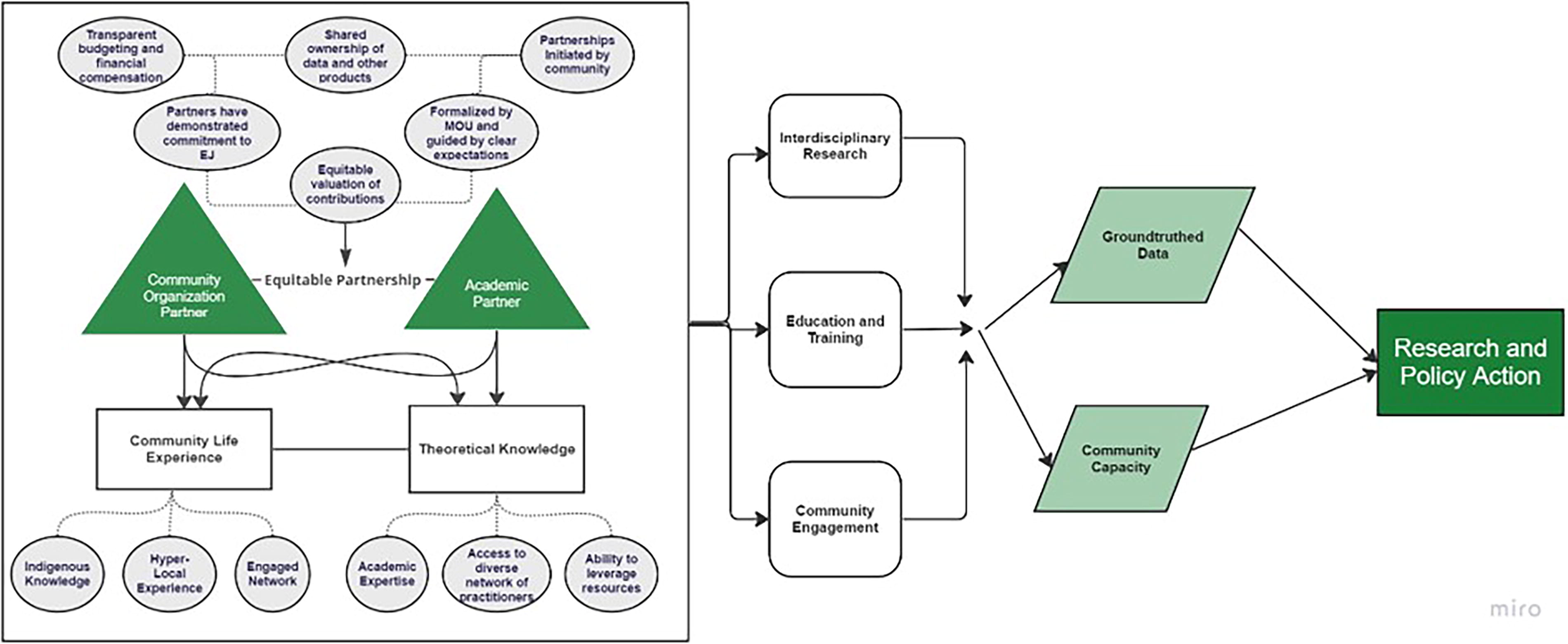
The Communiversity Model, developed by Dr. Beverly Wright.
We present a comparative case study analysis examining how the Communiversity Model builds community-based organizations’(CBOs) abilities to conduct research and policy action. The guiding research questions are:
How did each core element of the Communiversity Model contribute to research and policy action produced by each case/community? What implementation and contextual factors influenced the successes and challenges of the project in each case/community? What lessons were learned in each case/community that provide guidance for future applications of the Communiversity Model?
Findings could be used to identify elements contributing to research and policy change, to refine the existing framework, and to provide guidance for communities to replicate the model.
METHODS
The aim of this research is to conduct a comparative case study analysis to explore how the Communiversity Model builds CBOs’ capacities to conduct research and policy action, the model’s functionality, and how each of its elements influences outcomes. This research examines activities from 2017 to 2022. This study is mixed methods, applying a concurrent embedded approach in which primary methods were qualitative with some quantitative data integrated to inform interpretation. 27
Project overview
This research evaluates a recent application of the Communiversity Model, the Historically Black Colleges and Universities—Community-Based Organizations Gulf Coast Equity Consortium (GCEC or the Consortium). Founded by convening partners and pioneers of the environmental justice movement, Dr. Beverly Wright and Dr. Robert Bullard, the GCEC is a network of partnerships in five cities (Houston, TX; New Orleans, LA; Mobile, AL; Gulfport, MS; and Pensacola, FL). Researchers from HBCUs joined CBOs to address environmental justice issues in communities subject to industrial pollution and vulnerable to climate change. Convening partners provided funding for the Consortium and were also members alongside faculty and CBOs.
Study population
The study examines three cases, each representing a CBO member of the GCEC. These cases were purposively selected from five available CBO Consortium members from 2017 to 2022 (duration of the GCEC), chosen with a “most similar” approach as each joined the Consortium at the same time and remained an active member. 28 All cases have similar community profiles (Table 1) and were provided equal funding and equivalent support, including project management resources, environmental education, and technical/research training.
Case Profiles—HBCU-CBO GCEC Member Organizations
ACTS, achieving community tasks successfully; CHESS, clean, healthy, educated, safe and sustainable; HBCU-CBO GCEC, Historically Black Colleges and Universities—Community-Based Organizations Gulf Coast Equity Consortium; UFM, unity in the family ministries.
Data sources
Sources included stakeholder interviews and programmatic documents (Table 2). These data sources provided information about implementation and contextual factors and Consortium member perspectives on the project and its outcomes. All data were collected from 2017 to 2022 by GCEC staff. Interviews (12) were recorded and transcribed and narrative reports, and workplans were submitted by partners according to templates. Training surveys were collected by staff using paper forms. The primary author was involved in the design, collection, and analysis of all data sources.
Data Sources
Analytic approach
Thematic analysis was used to analyze interview transcripts and programmatic documents, chosen for its iterative approach to identifying themes and data relationships. 29 Nvivo v. 12 was used to facilitate data management. Open coding was conducted by two co-authors (D.W. and K.B.). D.W. was involved with data collection, while K.B. had cursory project knowledge. Including an unaffiliated researcher enabled a more inductive approach, where preexisting concepts of the model would not dominate the initial coding stage. During this stage, we created memos to track thoughts about definitions and boundaries of codes while frequently comparing notes and memos.
Following the initial stage, constructs from the Communiversity Model framework (depicted in Fig. 1) were added as new codes, while others were combined or collapsed. After aligning our memos and code lists, each code was assigned a definition. We then re-coded the data using the unified codebook and a more deductive approach (Fig. 2).
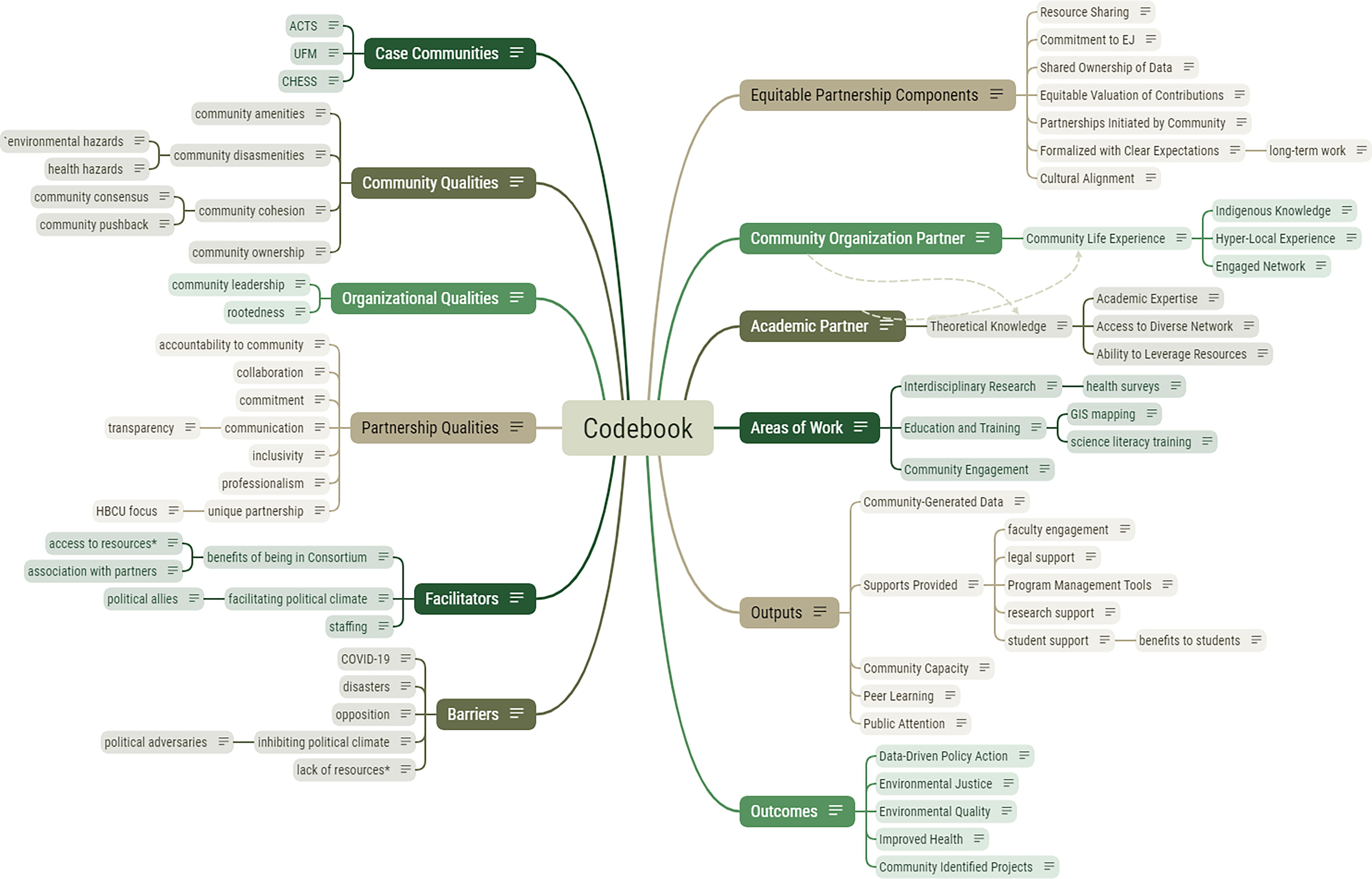
Codebook.
During and after the second stage, we mapped emergent themes, related codes, quotations, and notes and memos into a matrix. To develop each theme, we reviewed code reports and comparisons across cases and added case-specific data and relevant excerpts to the matrix to build evidence and identify commonalities and differences. For example, in exploring how the model’s areas of work were associated with domains of community capacity, we reviewed coding relationships across cases to track associations. Accepted themes were collapsed and adjusted, and themes without compelling evidence were rejected. The matrix was sorted and mapped to research questions to ensure that adequate data were present for each. Seven themes, 10 subthemes, supporting quotes, and associated research questions are depicted in Table 3.
Map of Thematic Analysis Results
RESULTS
The Communiversity Model was understood as critical to community success
Across cases, the model was considered a driver of CBOs’ success. During an interview, a clean, healthy, educated, safe, and sustainable (CHESS) leader called the model “one of the best things we could have ever gotten, because it gave us direction…that created community leadership.”
Key partnership qualities
Transparent budgeting/financial compensation, equitable valuation of contributions, and commitment to environmental justice were partnership components (see Fig. 1) mentioned most across data sources. In addition, partners mentioned community accountability, professionalism, and equity as critical components, reflecting existing components of the model’s conditions for equitable partnerships. In CBO project reports, leaders describe the willingness of Consortium partners to be physically present at meetings and events, even when it is difficult, in order to be accountable to the communities they serve. In an interview, an achieving community tasks successfully (ACTS) leader described their experience as a Consortium partner: “The level of respect and dignity is so unlike other organizations who want to come in and tell you how you ought to be running your organization rather than…recognizing the fact that we know something about our community.” Across cases, financial compensation came up in every interview and over three-fourth of project reports CHESS’s leader shared “the respect that brings to the organization itself…having the finances to do the work and remain viable…people start to listen.”
Key CBO qualities
CBOs with engaged networks were described as deeply rooted and led by continuously verified community priorities. Each case had network challenges, but reliance on community-defined priorities was effective in building trust. Unity in the family ministries (UFM) leaders described their community as “at odds with each other…really bumping heads because of what had gone on in the past with them,” referring to disagreements about remediation vs. relocation and lawsuit participation. Despite that, “they saw that somebody was actually doing some work for them” and their network of members tripled following a community forum. Survey data were not collected at UFM’s forum due to space limitations, but data were collected at ACTS’ and CHESS’ forums, with 93% and 96% (respectively, n = 49 and n = 56) of respondents reporting satisfaction with the process for choosing priorities for their research-to-action plan. An ACTS leader shared during an interview that “everyone agrees on the issues…people feel committed to those because they chose them.”
Key academic partners
Valued academic partners were accessible, collaborative, and willing to leverage their networks and resources. CBOs were asked to describe faculty support they received in progress reports and shared examples ranging from professors facilitating funding relationships to providing testimony in court hearings. The only difference across cases occurred when the faculty partner was located further from the CBO, making engagement difficult.
Cultural alignment between CBOs and faculty emerged as another component of partnership success. An annual report from 2019 stated that partners “consistently emphasized the value of HBCU partnerships…CBOs describe inherent trust and interest in working with this group.” CBO partners partially attributed the collaboration’s success to faculty who share their cultural backgrounds. It evoked pride to learn alongside Black doctors from their own communities or those facing similar issues (described by faculty and CBOs alike as “people who look like us”). During an interview, a UFM leader shared that “the HBCUs…that’s what drove [members] to really start participating.”
The model’s three main areas of work (education and training, community engagement, and interdisciplinary research) increased community capacity
In the Communiversity Model framework (Fig. 1), three areas of work are linked to community capacity. To explore those linkages, the codebook included Goodman et al.’s domains of community capacity—citizen participation, community power, community values, critical reflection, resources, sense of community, skills, leadership, understanding community history, and social/organizational networks. 35 Coding relationships between areas of work and domains illustrated these associations.
Education and training built skills and citizen participation
Across cases, education and training were linked to skills and citizen participation. Most trainings were common across cases, while some customized training was also implemented. In 2018, CBOs and their members participated in asset mapping training, resulting in 77% (n = 102) of respondents improving their asset mapping skills, and 72% of respondents improving their understanding of Geographic Information Systems (GIS). Reflecting on that training in an interview, UFM’s leader shared that “the people in our community got to a point where they could stand up and start talking…they felt comfortable and knowledgeable to talk about what was going on in the community.”
Community engagement built social/organizational networks, community power, citizen participation, and leadership
Community engagement activities included holding community meetings, developing networks, and hosting events. CHESS’ leader reported that consistent engagement produced a robust network—“one of the key things that was missing was togetherness amongst the community…because CHESS was able to…start regular community meetings…it created a lot of interest.”
A UFM leader shared that “we were having problems with getting enough people to come out to our initial meetings…but because we were able to start giving them…the research that we had, our numbers started increasing…from three or four people to 20, 25 people.” He described community power and leadership, sharing that engagement resulted in “[their ability] to do exactly what the project was set out to do, to let them speak for themselves…from all of that, we were able to convince our county commission.”
Interdisciplinary research built community power, resources, leadership, and skills
Each CBO participated in common research activities, including developing asset maps and collecting health surveys. Each case also conducted individual projects. UFM produced a flood risk map, ACTS created an air monitoring system, and CHESS created an inventory of local toxic sites.
These projects built research skills. According to a 2019 year-end report, each CBO’s “research clusters” participated in survey development and research ethics trainings, and co-created a health survey protocol that generated cross-community data. A UFM leader described community power built by their research: “We can show them where all those landfills are located and the cancer risk and respiratory risk…we were able to take those maps…and make [decision-makers] start looking at this thing differently.” ACTS leaders shared in their progress reports that they secured funding for their air monitoring project, and stated that they are “the first community in the state of Texas to have their own air monitoring system where…[they] own all of the data and [they’re] doing it [themselves].
Partnership support facilitated the achievement of goals
Consortium support was equivalent in each community. Project reports from 2017 to 2022 show equal financial/technical assistance provided.
Access to resources allowed organizations to sustain long-term work
Consortium support, including financial resources, created project sustainability. In 2017, CBOs completed community profiles indicating capacity gaps. All shared a need for staffing. By 2018, they reported that all had hired staff using Consortium resources. CHESS was able to formalize its organization. During an interview, their leader shared that the financial resources provided “makes us independent…[most] neighborhood organizations…are dependent on nickels and dimes from politicians and that makes them subservient to them whether they want to be or not.”
Association with faculty partners allowed CBOs to leverage their resources
Across cases, CBOs received resources and public attention through partners who amplified their work and lent their expertise. Progress reports share examples of faculty partners attending community events, providing testimony, and inviting CBOs to conferences.
The power of this network was routinely invoked by partners, who described the “attitude shift” they witnessed in decision makers who became aware of the scope of Consortium partners. During a 2018 interview with an ACTS leader, she stated that “the relationship with this coalition has helped us…with expertise that is recognized locally and nationally.” This was echoed in a 2020 interview with a UFM leader, “you’ve got somebody behind you who has some clout…you know, when we were little nobodies trying to get something done, when the [partners] stepped in…they looked at us in a whole different vein.”
Policy action was achieved through the cultivation of political allies
Each case operates within a conservative political climate that is averse to their policy agendas. When asked about barriers to policy change during an interview, one faculty member stated: “we’re in Texas and Louisiana, Mississippi, Florida…fighting against some of the people that are just trying to smash us like bugs.” The political climate and ability to cultivate allies emerged as an influential factor in achieving policy action.
Community-generated data provides an important bargaining tool
Some communities have been successful in cultivating allies using data. UFM worked with faculty to produce maps showing how landfill flooding pollutes local waterways as well as those in nearby affluent communities. This led to the creation of an EJ Ad Hoc Committee for their county commissioner, an environmental impact study, the halting of a road project, and the reallocation of 11 million dollars to remediation of local pollution. When a UFM leader was asked about this progress, he attributed it to the validation of community concerns with scientific proof, “with this data, we’ve given [our county commissioner] a big stick to fight with… it’s not like we’re sitting and crying about…people are dying and people are sick…we need to have something to show them why and how.”
Community-generated data are entry points for more powerful community engagement
Community-generated data were instrumental in building engagement. In all cases, community members conducted multiple research projects. CBOs saw networks grow in number, confidence, and commitment. UFM leaders attributed this to participation in data-gathering, “they brought us all of their pictures of all the flooding in the yards…it was an easy task because they felt that they were part of what we were doing.” Progress reports between 2018 and 2022 also reported consistency from research clusters as respondents shared that participation in data-gathering stoked engagement.
Entrenched political opposition slows policy action
Political opposition makes policy change difficult—political actors may not be moved by data. In that case, network building and public attention become intermediate goals. Political opposition was referenced across data sources but was most concentrated for CHESS. When asked about barriers to policy change, a CHESS leader shared that “we have not been able to…get the politicians on our side the way that we like.” He lamented their inability to make political inroads—“not having the politicians on our side is difficult…it’s hard for them to go back to the people who they shook hands with and say no.”
In this case, the network of community opposition has grown stronger with political immobility-CHESS has cultivated a staunch network of supporters, reporting consistent growth in engagement at events opposing threats of industrial encroachment (in progress reports from 2018 to 2022). Describing their political capital during an interview, a CHESS CBO leader says, “Politicians may not know or care [about Africatown]. It’s a small community in the thick of things. We never really had a politician from here. But we’re gonna make them hear us.”
Disasters shift community priorities
Findings indicated that disasters shifted priorities for communities and individuals. From 2017 to 2022, every GCEC community experienced a natural disaster, most notably Hurricane Harvey. ACTS’ priorities shifted to recovery, as shared in progress reports from 2017 and 2018. Staff had their own homes to care for, and Consortium activities took lower priority. ACTS described this shift as a threat and an opportunity:
Threat—Some residents are very concerned with repairs and adjustments that they must make in their lives… Opportunity—Residents have an increased awareness of their environment…this is an opportunity to…educate utilizing citizen science tools.
This was mirrored for all cases during COVID-19, which forced partners to shift strategies and priority issues. This was challenging for CBOs with elderly members and limited technological access. In 2020 and 2021, progress reports included questions about strategic changes made because of the pandemic. CHESS’ leader shared that because “we have a lot of elderly in the community, it’s been tough to have regular meetings even by Zoom, because not a lot of people have the ability to do so.”
Long-term (3–5 years+) commitment to partnership is critical to success
According to annual reports, the Consortium initially committed to supporting partners for 3 years (extended each time funding was received). Guaranteed continuity allowed for priorities to fluctuate in response to changing needs. In progress reports and interviews, CBOs reported feeling supported in following their members’ directions, even if they differed from original intentions.
According to convening notes, this commitment was discussed in relation to hiring staff, as CBOs required assurance of sustainable jobs. Referring to this commitment, a CHESS leader stated that “we have enough that allows us to be upfront, open and honest with what we’re doing…we can’t feel threatened by anyone who’s gonna cut off our funds.”
All partners acknowledged that their priority issues are unlikely to be addressed in the short term. During a convening, an ACTS representative summarized the conversation by saying “we all understand that what we’re dealing with is of a long-term nature, there’s not gonna be any quick fixes.” During an interview, the same representative stated that “what makes us successful is…it takes us time to get to the end. This work in the community, some of the issues have been discussed for so long, it doesn’t take too much to figure it out. But you still need to have those conversations, and not go making assumptions.”
DISCUSSION
Partners reported significant accomplishments, including policy changes, remediation, and pollution prevention. The Communiversity Model was valued by partners who partially attributed their achievements to its structure and support. These findings support the value of the model’s partnership components and offer details about how community capacity is built and contributes to research and policy action outcomes.
Essential model qualities included financial compensation, equitable valuation of contributions, and commitment to environmental justice. Key characteristics of CBO partners included deep local roots and leadership based on community priorities. Key characteristics of academic partners included accessibility and willingness to leverage networks and resources. These findings have implications for the implementation of the Communiversity Model. In this project, all academic partners were HBCUs. That has often been the case in previous model applications. While not a prerequisite for implementation, findings indicated that cultural alignment between CBOs and academic partners was a valued partnership component. That alignment extends beyond the racial background of professors to the culture of institutions.
Education and training, community engagement, and interdisciplinary research were associated with the development of community capacity in several domains, including skills, citizen participation, social/organizational networks, community power, resources, and leadership. Community-engaged research was found to be a driver of policy action. In facilitating political climates, community-generated data was a tool for advocacy. In inhibiting climates, community-generated data rallied networks and fed power.
Findings also indicate that long-term commitment and financial resources were key to partnership trust. Unexpected barriers such as disasters illustrate how long-term partnership commitment contributes to the model’s success. With the guarantee of continuity, partners can respond to changing needs in their communities without concern for an overarching agenda. Policy change and other long-term impacts take time. Sustained commitment allows partners to trust that support will be there if years of incremental change are needed to reach goals. For that reason, institutions with resources contingent on a specific project or agenda may be less suited to the Communiversity Model.
Limitations
This research draws upon decades of implementation of the Communiversity Model but examines one project. All cases are located in predominantly Black communities on the Gulf Coast. Findings should be considered in this context and adapted to communities considering implementation. These results support one approach to community-engaged environmental justice work and do not include a comparison with other models.
Data collection included the time of the COVID-19 pandemic, which caused project adjustments. The decision to include data collected pre- and mid-pandemic is intentional and based on the model’s historical applications in complex environments. Environmental justice communities often face changing landscapes, and frameworks such as this should be adaptive to that reality.
Two of the authors (D.W. and B.W.) have been involved with this project since its inception. While this is typical of community-engaged research projects and facilitates a deep understanding of the data, we included strategies to enhance our research’s rigor, including reliance on verbatim transcripts and engagement of an external researcher (K.B.). While Consortium partners were not directly involved in this paper, they contributed to the evaluation design that produced the data and have reviewed and agreed upon evaluation results over the 5-year project duration.
CONCLUSION
Community–academic partnerships and community-engaged research are long-used tools in environmental justice communities. Previous studies indicate best practices for partnerships, but more research is needed to support specific models and draw connections between model elements and outcomes that include systemic change.
This research describes the Communiversity Model’s key partnership qualities and how it cultivates community capacity. Results indicate that policy action outcomes are susceptible to factors including political landscapes and disasters. Future research priorities include examining Communiversity Model in other contexts and exploring the long-term outcomes and sustained policy changes among additional cases where the model has been implemented.
Results indicate that the Communiversity Model is an effective tool for building community capacity to conduct research and policy action and provide evidence to support recommendations for future implementation.
Footnotes
ACKNOWLEDGMENTS
This article is an outcome of the HBCU-CBO GCEC project, and the authors are grateful to the project team, including Monique Harden, Mary Williams, Dr. Denae King, and Dr. Robert Bullard, as well as all Consortium members for their guidance, leadership, and participation.
AUTHORS’ CONTRIBUTIONS
All authors contributed to the completion of this article. D.W. contributed to conceptualization, investigation, data curation, formal analysis, methodology, visualization, and writing. B.W. contributed to conceptualization, methodology, supervision, project administration, and review and editing. K.B. contributed to formal analysis, visualization, and review and editing. J.L.G. and G.S. contributed to conceptualization, supervision, and review and editing.
ETHICS EXEMPTION STATEMENT
This work concerns programmatic research as opposed to human subjects research, and as such is exempted from institutional review. The data were collected as a part of a program evaluation and does not contain personal or sensitive information. Documents were submitted to the Deep South Center for Environmental Justice in order to fulfill programmatic reporting requirements, and the information submitted is not confidential.
AUTHOR DISCLOSURE STATEMENT
No competing financial interests exist.
FUNDING INFORMATION
No funding was received for this article.