




Abstract
This practice brief presents lessons learned through the Water Equity Science Shop (WESS), a community-academic-government partnership seeking to address drinking water challenges in California through community-engaged research and knowledge dissemination. Formed in 2017, WESS is comprised of Community Water Center, a community-based organization (CBO) working towards realizing California’s Human Right to Water; researchers at the University of California (Berkeley and Los Angeles); and scientists at the California Environmental Protection Agency’s Office of Environmental Health Hazard Assessment. We describe the development of an online “Drinking Water Tool,” which presents data and maps on drinking water access, threats, and local decision-making processes. We discuss how features of the WESS collaboration have extended the “4 Rs”—the rigor, relevance, reach, and reflexivity—of our science and resulted in new approaches for assessing drinking water (in)justice that have both influenced and been influenced by complementary efforts by state agencies. Through our reflections, we elucidate how collaborations between communities, CBOs, academic institutions, and state agencies can generate actionable evidence and accessible data to support the incorporation of environmental justice goals into drinking water supply and management.
BACKGROUND
Community-academic partnerships have undertaken research on environmental health and justice that centers communities’ priorities 1 and strengthens science. 2 Our research collaborative, the Water Equity Science Shop (WESS; Fig. 1), integrates the European Science Shop model 3 and principles of community-engaged research practices to address drinking water challenges in California. WESS is led by the Community Water Center (CWC), a community-based water justice organization, along with researchers at the University of California, Berkeley and Los Angeles, and regulatory scientists from Cal-EPA’s Office of Environmental Health Hazard Assessment (OEHHA). 4 One fruit of this collaboration is the Drinking Water Tool (DWT), a free online mapping platform owned and managed by CWC. 5 CWC’s vision is safe, clean, and affordable drinking water for all, through movement-building for community-driven water solutions. CWC convenes the AGUA Coalition (la Asociación de Gente Unida por el Agua, or the Association of People United for Water), a grassroots coalition of 53 residents representing 34 impacted communities and 11 CBOs dedicated to securing safe, clean, and affordable drinking water. When describing community members in WESS’s work, we are referring to residents who have established relationships with AGUA and/or CWC, many of whom live in low-income communities and/or communities of color struggling with drinking water challenges in California’s Central Valley and Central Coast regions. The impetus for WESS to develop the DWT emerged from CWC’s annual Needs Assessment, which collects input from community members on organizing, advocacy, and research priorities. Many AGUA members had advocated for a comprehensive and accessible statewide tool with information on water quality concerns, drought impacts, and local groundwater agencies.
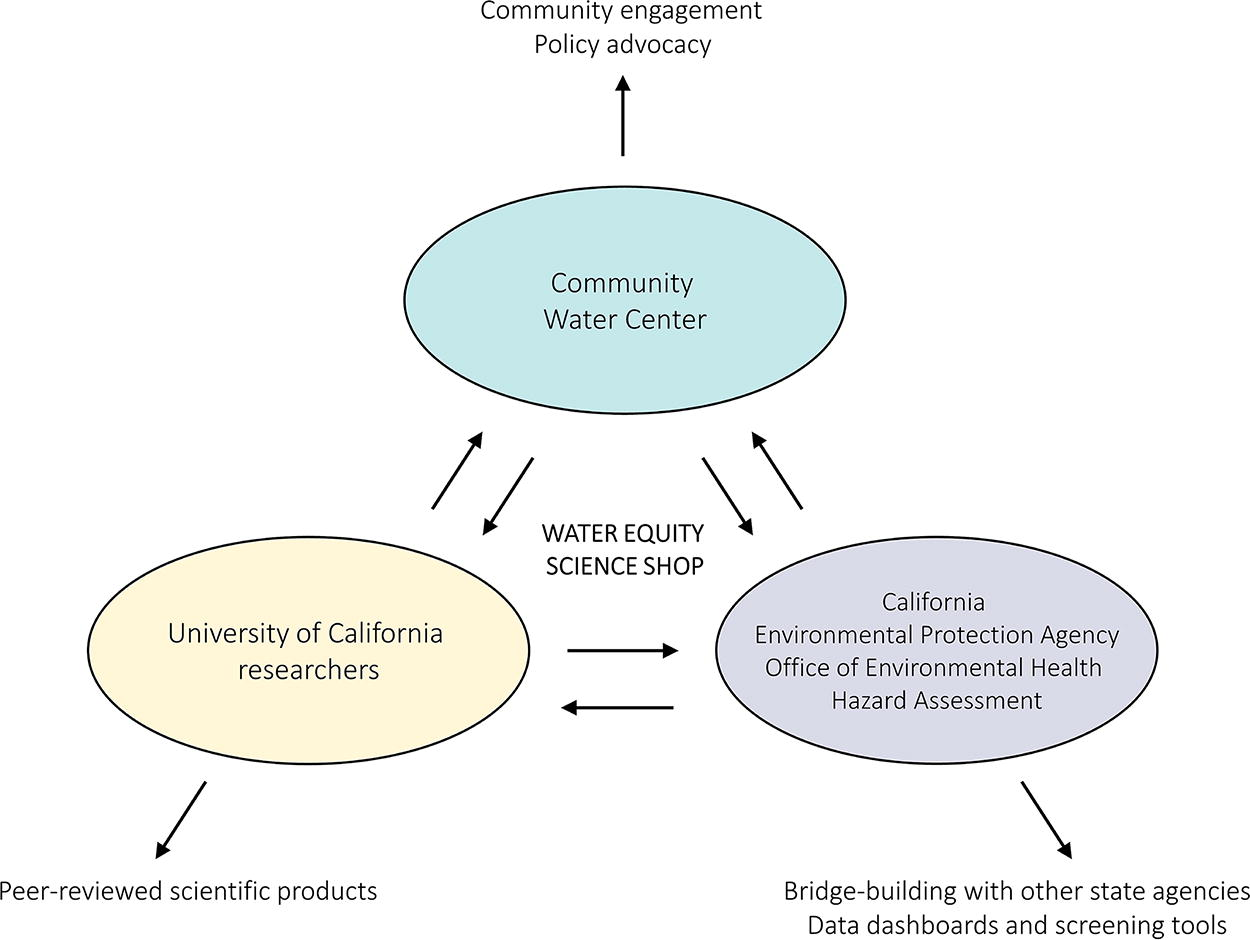
Water Equity Science Shop. Collaboration outputs are listed next to their primary agents.
Launched in 2020, the DWT centralizes information on (i) water quality data and possible contamination sources; (ii) predicted impacts on domestic wells under California’s Sustainable Groundwater Management Act 6 -based groundwater levels; and (iii) decision-makers, key agencies, and opportunities to get involved in water governance. The bilingual English/Spanish DWT is designed for various end-users, including impacted residents, CBOs, government agencies, academic researchers, and the public. The DWT addressed the need for more accessible data on drinking water, which at the time was not easily available nor interpretable. California’s State Water Resources Control Board has since developed online platforms such as the SAFER Dashboard7,8 to improve drinking water data accessibility, with a specific focus on human right to water metrics. WESS updated the DWT in 2023 after several rounds of community-engaged feedback (Fig. 2), adding refined data on domestic well areas and contaminant sources alongside improvements in mapping water quality, identifying monitoring gaps, and communicating potential water quality threats. In this practice brief, we present lessons learned in community engagement, environmental justice (EJ) research, and knowledge-sharing through WESS and the DWT.
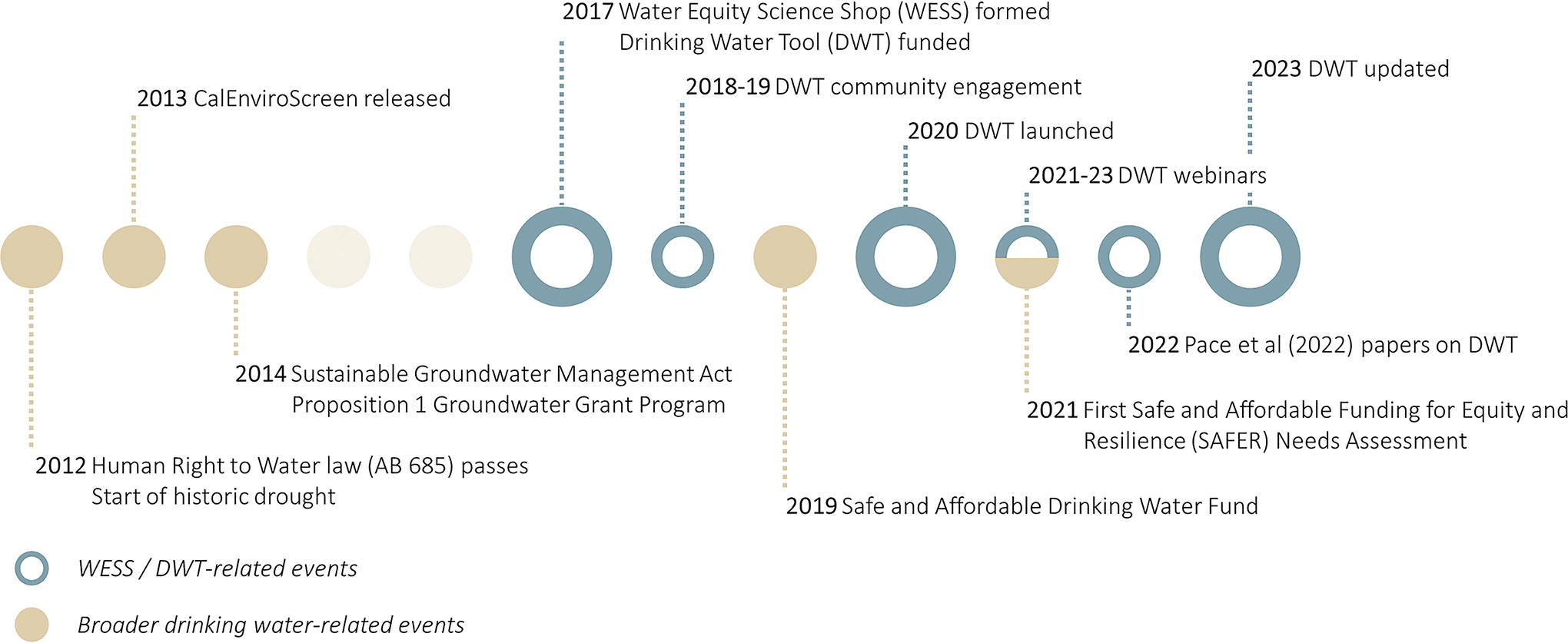
Timeline of the Water Equity Science Shop’s (WESS) development, the evolution of its Drinking Water Tool (DWT), and the broader landscape of California drinking water policy.
FINDINGS
We apply a “4 Rs” framework to assess WESS’s outputs. Balazs and Morello-Frosch introduced the “3 Rs” framework to show how community-engaged research can strengthen the rigor, relevance, and reach of science. 9 They define relevance as “whether science is asking the right questions”; rigor as the “practice and promotion of good science”; and reach as “[how] knowledge is disseminated to diverse audiences and translated into useful tools.” Recent scholarship has suggested reflexivity—self-examination of positionality, intention, and other aspects of research—as a fourth “R.”10,11,12
Relevance through responsiveness
In 2013, OEHHA launched CalEnviroScreen, the first state-managed tool for mapping cumulative health impacts related to environmental and social stressors.13,14 Similar tools have since been developed in other states15,16 and at the federal level. 17 The first iteration of the DWT incorporated data from CalEnviroScreen’s drinking water quality indicator. 18 Strengths of such government tools include their rigor, accessibility, and legitimacy in the eyes of policymakers. However, state agencies must navigate layers of bureaucracy for such tools to be approved and updated. In contrast, responding quickly to community needs and changing conditions are high priorities for WESS and, in particular, CWC. Climate change and EJ concerns have brought the importance of such responsiveness into sharp relief in California, as communities recover from thousands of domestic wells running dry during the recent record-breaking drought 19 and as the science on the health threats posed by drinking water contaminants such as per- and polyfluoroalkyl substances (PFAS) rapidly advances. 20
Tools managed by nongovernment actors also function as proof-of-concept prior to state adoption. While planning the latest DWT update, CWC raised the addition of PFAS data as a high priority, compelled by emerging research on human exposures through drinking water and its potential health effects. 21 At this point, the Water Board had made its PFAS sampling data available through GeoTracker, an environmental regulatory database. 22 Though a powerful resource as-is, the GeoTracker platform did not include EJ concerns as an analytical lens. To address this gap, we integrated the Water Board’s data into the DWT to overlay PFAS data with demographic characteristics and domestic well area boundaries, and tailored visualizations based on new regulatory standards. 23 WESS is using these spatial layers to identify partner communities for a drinking water sampling project to test for PFAS in unregulated domestic well areas. This EJ and health-motivated approach to mapping PFAS data is now being considered for the next CalEnviroScreen update.
Despite the success of the DWT, there remain barriers to entry to its use; for example, some communities may lack access to computers, the internet, or computer literacy. To this end, CWC’s public training workshops have proven invaluable, but going forward, WESS will need to consider and develop lower-tech alternatives to the DWT, as well as translate it into more languages. It is also likely that the needs and priorities we elevate through the DWT may not completely align or resonate with other EJ communities in California. To build trust in and legitimacy of the DWT, WESS must continually create room for conversations about water justice and broaden opportunities for communities’ feedback on the tool. Our view of building legitimacy with EJ communities is less a static benchmark and more an ongoing process, requiring consistent communication to strengthen existing relationships as well as constant outreach to establish new connections.
Rigor through collaborative methods development
Our facilitation of diverse partnerships and conversations about drinking water justice represents our effort to practice and promote “good science” with the objective of equitably improving health outcomes and protecting drinking water sources. The strength of our science is in our community-centered approach, which allows for rigorous study designs grounded in local needs and experiences. It is the input and direction from CBOs and community members—from defining the research question to recruiting participants and collecting data—that lays the foundation for WESS’s rigorous science. This would not be possible without the relationship of trust, built upon years of collaboration, between CWC and its community members, OEHHA, and the research team. Since 2018, we have organized meetings to bring together DWT user groups to provide opportunities for dialogue. The goal is to establish an iterative process of collectively identifying data gaps and brainstorming ways to leverage existing resources to address drinking water threats, such as providing interim water access to domestic well users.
One challenge (and solution) that came up from these conversations was how to handle uneven data coverage. Given California’s incomplete domestic well drilling records, state and local agencies were struggling with how to include domestic well communities in their sustainable groundwater planning decisions—or whether to do so at all. WESS recognized that including domestic well communities in planning decisions by estimating domestic well reliance using incomplete data was preferable to excluding domestic well communities from planning altogether. To enhance the accuracy of our domestic well use estimates, we integrated residential parcel data with water systems’ service area boundaries to better define the spatial extent of domestic well communities. 24 This enabled WESS to estimate domestic well populations across multiple spatial scales and to develop the first statewide estimates of populations reliant on domestic wells versus community water systems. WESS is using these data refinements to strategize outreach to communities at risk of elevated contaminant exposure and cumulative health effects.
Reach through community and interagency knowledge-sharing
Knowledge-sharing is frequent and multidirectional with community partners, CBOs, and state agencies. This feedback process helps drive WESS’s research and tool development. For example, during an advisory meeting in 2022, community partners proposed adding drinking water threats as a standalone data layer. How-to workshops—e.g., step-by-step walkthroughs on the DWT, attended by interested user groups ranging from community members to state agency employees—have been particularly effective for presenting our updates and work while providing feedback opportunities on the tool’s design and functionality. To maximize the accessibility and reach of our work, WESS has also engaged in other nonacademic forms of knowledge dissemination including op-eds, 25 podcast episodes, 26 and blog posts. 27
OEHHA’s participation in WESS has been key to legitimizing our projects within the regulatory space and bridging relationships with other agencies striving to improve the accessibility and interpretability of their drinking water data. A key component of our reach has been to create opportunities for research groups and agencies facing similar challenges, such as how to overlay water sampling data with demographic data, to compare methods and results. Under OEHHA’s lead, WESS hosted a meeting with Water Board researchers in 2023 to share geographic information system (GIS) best practices for designing state-owned drinking water tools with a variety of end-users. Together, we evaluated the implications of common analytical choices, such as areal versus population weighting for estimating median household income within water system boundaries. It became clear the two methods could produce different income estimates, with implications for which communities might be prioritized for state funding and resources. Although it will take time for these conversations to translate into action, this meeting underscored the importance of interagency data sharing and research transparency.
Reflexivity through multidirectional learning
WESS has encouraged multidirectional learning between CWC and its community partners, OEHHA, and university researchers. In addition, over years of collaboration, many WESS collaborators have worn different “hats” of advocacy, academia, and government, resulting in overlapping experiences, shared understandings, and trust. While this has strengthened WESS’s capacity to undertake community-driven research that informs policy and regulatory change, it is important to acknowledge and address asymmetries in power and privilege among researchers, regulatory scientists, and community partners. Given the diverse lived experiences among WESS members, our collaborative works to address these power dynamics by centering the needs expressed by AGUA and community members as communicated through CWC in how we prioritize our research and policy translation activities. This work also requires extensively forecasting the benefits of projects (e.g., informing advocacy and organizing priorities related to policy initiatives) as well as their potential for unintended harm (e.g., community stigma related to drinking water sampling campaigns), while maximizing community empowerment and movement-building. Clear and transparent consultation is required to solicit community feedback and approval, provide equitable compensation for participants, and ensure benefits for all partners; 28 it is also necessary for establishing a culture of accountability and reciprocity. 29 Table 1 summarizes our reflections on structural asymmetries in power and positionality in community-engaged EJ research along with implications for WESS.
Structural Asymmetries in Power and Positionality in Community-Engaged Environmental Justice Research, and Its Implications for WESS
Some EJ scholars have understandably challenged the EJ movement’s reliance on the state for solutions or reparations,30,31 while others have characterized this critique as an over-simplification of the complex relationships between EJ movements and government actors.32,33,34 It is true that “the state”—here construed as governmental institutions—has historically played an outsized role in the marginalization and disenfranchisement of low-income communities and/or communities of color, environmentally and otherwise; 35 the environmental racism embedded in the policy decisions that resulted in the lead crisis in Flint, Michigan’s drinking water is one of many examples. 36 Similarly, in California, there are state documents rationalizing disinvestment in rural, low-income, communities of color along with testimonies by residents who had their concerns about drinking water quality and access continually dismissed by regional water board administrators due to their Spanish-speaking accents. 37 To advance EJ through policy-making, communities, often in collaboration with academic researchers and regulatory scientists, typically have to actively engage the state in order to dismantle these racist legacies in environmental decision-making. Our experience suggests that while often challenging, such state engagement can enable EJ communities to effectively (re)shape environmental decision-making as well as the science that informs it.
PRACTICE RECOMMENDATIONS
We conclude with three community-engaged research practice recommendations that have guided our work.
Recommendation 1: leverage nongovernmental tools to respond to evolving crises
One of the primary strengths of the DWT is the nimbleness with which it can respond to evolving EJ priorities and emerging research. This responsiveness was made possible through CWC’s frequent and bidirectional community outreach (e.g., through their Annual Needs Assessments and public-facing workshops) as well as the research team and OEHHA’s efforts to stay abreast of breaking research and new data. We recommend development and deployment of nongovernmental tools to collect, synthesize, and visualize environmental justice-relevant data for their responsiveness, in ways that support their future integration into state-managed regulatory instruments.
Recommendation 2: work with state agencies to enhance the reach and sustainability of advocacy and research
Ensuring the reach and sustainability of tools like the DWT outside of state contexts is challenging. While WESS has enjoyed success applying for various funding sources that encourage such initiatives, collaborating directly with state agencies facilitated translation of WESS’s research and CWC’s advocacy into policy decisions concerning drinking water access and resource distribution to impacted communities. It is important to acknowledge; however, that state agencies have played (and continue to play) a direct role in enabling environmental injustices. Thus, it is critical to forecast the potential benefits and pitfalls of working with state agencies and ensure that these collaborations be steered by the needs, priorities, and well-being of community partners.
Recommendation 3: invest in sustainable relationships that enable collaboratives to weather ebbs and flows in funding
WESS partners codeveloped federal, state, and foundation funding proposals to support community-and data-driven research that advances water justice goals in policymaking. Common ethical challenges of community-based participatory research often involve differences in power, perspectives, priorities, and resources between researchers, CBOs, and government agencies.38,39 Our core strength stems from our history of successful and iterative work together that has sustained our collaborative over the long-term, both when funding has been abundant and when it has temporarily run dry. As a collaborative, we have taken particular care to anticipate ebbs and flows in funding to minimize the burden placed on CWC or their constituents. We have found that “braiding” funding streams40,41—for example, by pulling from multiple sources, or by CWC taking on the role of primary fiscal grantee—has supported a flexible research agenda and a more equitable balance of power related to setting research and policy advocacy priorities. Together, WESS partners have ensured a nimbleness in research aims and approaches, which integrate primary and secondary data analysis to enable the collaborative to keep policy relevant work active, even during temporary shortfalls in funding.
Footnotes
ACKNOWLEDGMENTS
The authors are grateful to everyone who participated in our advisory committee webinars and contributed to this tool. They especially want to thank the AGUA Coalition (la Asociación de Gente Unida por el Agua, or the Association of People United for Water) a regional, grassroots coalition of impacted community residents and allied nonprofit organizations dedicated to securing safe, clean, and affordable drinking water for San Joaquin Valley and Central Coast communities.
AUTHORS’ CONTRIBUTIONS
S.K.: Conceptualization, methodology, writing—original draft, writing—review and editing. A.L.: Conceptualization, writing—original draft, writing—review and editing. T.T.: Conceptualization, funding acquisition, writing—review and editing. K.B.: Writing—review and editing. L.J.C: Funding acquisition, supervision, writing—review and editing. J.L.R.: Conceptualization, writing—review and editing. L.A.: Writing—review and editing. L.B.: Writing—review and editing. R.M.F: Funding acquisition, supervision, writing—review and editing. CP: Conceptualization, supervision, writing—original draft, writing—review and editing, funding acquisition.
AUTHOR DISCLOSURE STATEMENT
The authors have no conflicts of interest to report.
FUNDING INFORMATION
This project was supported by the National Institute of Environmental Health Sciences (award #P42ES004705) and the Water Quality, Supply, and Infrastructure Improvement Act of 2014 through an agreement with the State Department of Water Resources (award #4600012684).