




Abstract
The Problem:
Southeast Dearborn, Michigan, is home to a predominantly Arab American community facing environmental health inequities due to multiple pollution sources and discriminatory zoning decisions—environmental injustices that have also impacted nearby communities in Metro Detroit for decades. More work is needed to integrate science and advocacy efforts to address these longstanding environmental injustices, and we see opportunities to do this with youth.
Key Points:
Developed in 2018, the Environmental Health Research-to-Action (EHRA) academy was designed by a team of community and academic partners in Dearborn to engage high school youth in high-impact active learning opportunities with a variety of experts involved in community science, academic research, community organizing, regulation, policymaking, and law. The academy consists of 8–10 sessions during summer that include practice conducting air and water monitoring, use of existing data and mapping tools, storytelling, and power mapping for policy advocacy. In this practice brief, we introduce design, implementation, evaluation, and impacts of the EHRA academy. We report on pre- and post-academy surveys for five cohorts, as well as follow-up surveys with a subset of alumni. We offer highlights from EHRA as a working model that is building capacity to effectively address environmental injustice.
Conclusions:
Although EHRA remains deeply rooted in Dearborn, in support of a predominately Middle Eastern and North African community experiencing environmental injustice, it has become an intergenerational, multiracial, and cross-cultural network with a shared goal of environmental justice throughout Metro Detroit. EHRA-like programs can provide opportunities often not offered in K-12 curriculum to practice community science and advocacy in an integrated way. To inform policy solutions, we can support youth in using existing data, collecting their own data, and sharing their experiences living fenceline to cumulative exposures.
THE PROBLEM
The city of Dearborn, Michigan, particularly the south side of Dearborn (often referred to by residents as the “Southend”), continues to experience brutal environmental health conditions because of industrialization, disinvestment, and a history of environmental racism. 1 In the Southend, industrial air pollutants affect a community largely made up of families who have immigrated to the United States from Middle Eastern and North African (MENA) nations, particularly Yemen. 2 Negative health outcomes associated with pollution affect Southend Dearborn residents at rates higher than their counterparts in the city and United States, with estimated self-reported crude prevalence rates of adult asthma (15.5%), chronic obstructive pulmonary disease (16.1%), “not good” physical health (20.7%), and “not good” mental health (28.9%) notably higher than the rest of the city (12.3%, 9.6%, 13.7%, and 19.4%) and age-adjusted rates for the United States (9.7%, 5.7%, 10.3%, and 15.2%), respectively. 3 Rate of smoking (40.6%) and lack of health insurance (20.1%) are relatively high as well.
In the United States, MENA communities experience health disparities that are understudied and underreported. 4 This is partially because many epidemiological studies, not unlike the U.S. Census, have not collected racial or ethnic data in ways that distinguish Arab Americans from White Americans. This is starting to change, however, as federal agencies now have until March 2029 to include a new MENA category when collecting racial and ethnic data. Environmental stressors can also exacerbate health problems stemming from anti-Arab discrimination. 5 Research consistently demonstrates the detrimental physical and mental health impacts of both interpersonal and institutional discrimination. 6 Arab Americans face heightened discrimination, particularly post-9/11 and related to the Trump administration’s discriminatory policies like travel bans. 7 Also, many from Arab nations identify as Muslim and practice Islam, and studies show that Islamophobia correlates with negative mental health outcomes, unhealthy behaviors, and reluctance to seek health care, thus perpetuating health disparities. 8 Dearborn’s large MENA community has been an integral part of Metro Detroit for generations and, particularly in the Southend, has been disproportionately harmed by the region’s many environmental pollution sources, alongside other communities of color.
As a whole, the region is classified as a nonattainment area for sulfur dioxide (SO2) emissions. 9 This means the air quality does not meet national Clean Air Act standards for SO2, which is associated with lung disease, irritation of the nose and throat, aggravation of existing heart disease, decreased fertility, premature death, loss of smell, headaches, nausea, vomiting, and inhibition of thyroid function. 10 In 2023, residents also lived with a higher rate of particulate matter (PM) 2.5 pollution than 95% of the state. 11 Dearborn is merely one of several cities in Metro Detroit experiencing cumulative environmental exposures. Other neighboring cities, such as Hamtramck, Melvindale, Detroit, and River Rouge, are also surrounded by major polluting industries and harmed by similar environmental injustices. 12 Adjacent to Dearborn, Southwest Detroit has levels of air pollution that rank “among the top five percent in the country,” as industries such as Marathon Petroleum and Cleveland Cliffs (formerly AK Steel) continue to emit large amounts of pollutants that disperse across the region. 13 Further, even with an abundance of air emission sources, there exists an insufficient number of regulatory air monitors in place to detect and report on the status of these air pollutants, as depicted in Figure 1. 14
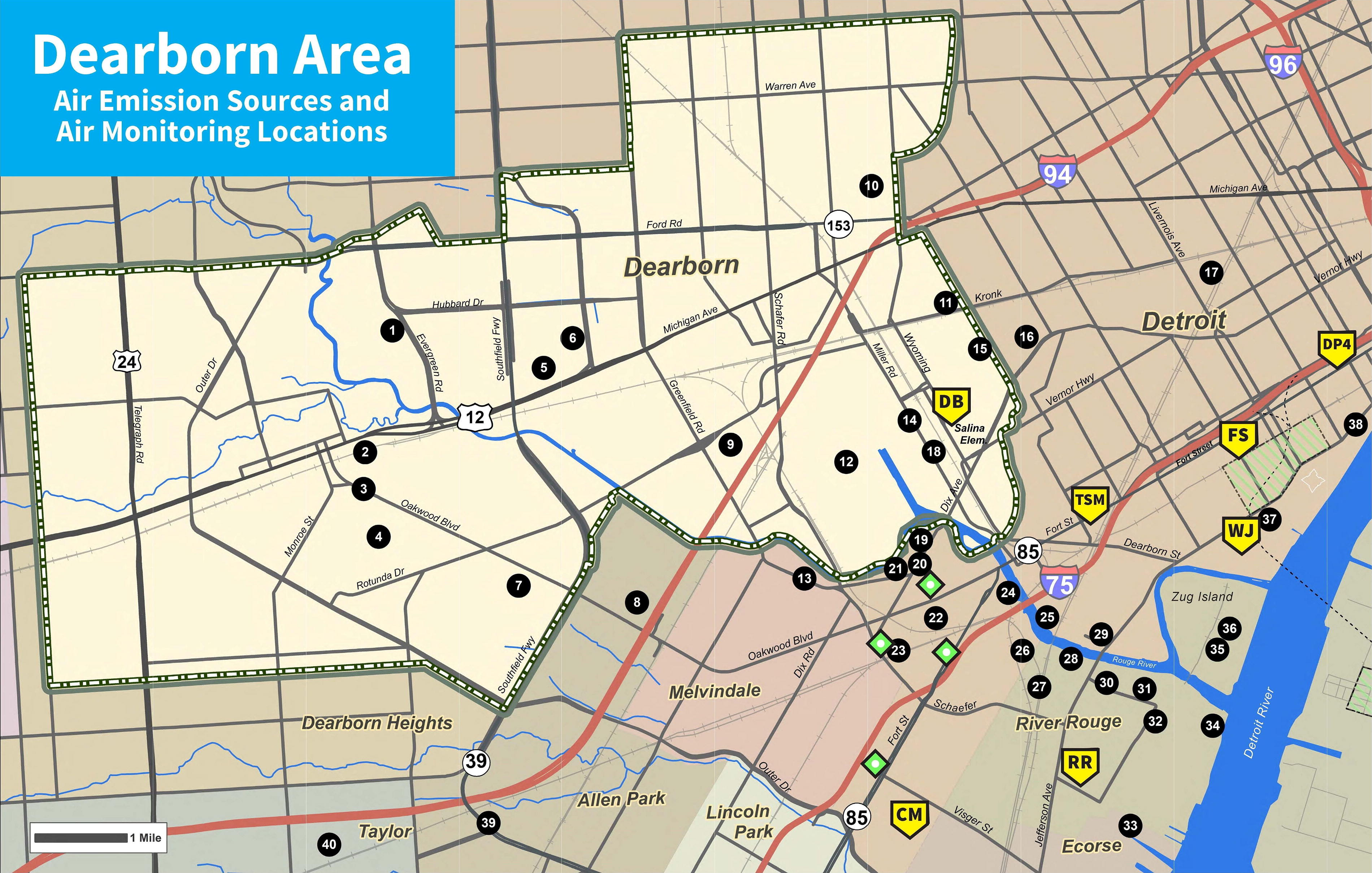
Map of cumulative pollution sources in Dearborn, MI, and surrounding communities.
Policy advocacy is essential to achieve the systematic change necessary to eliminate the inequities facing the Dearborn community, as well as the many areas in Metro Detroit threatened by environmental injustice. For decades, Dearborn residents have organized and mobilized within their community to advocate for policy and regulatory reform that combats environmental racism and health injustice.7 One major achievement in the Dearborn struggle for environmental health and justice took place in 2022, when longtime environmental advocate, Abdullah Hammoud, became the seventh mayor and the first Arab American mayor for the city of Dearborn. Under his administration, the city established its first ever Department of Public Health and has prioritized improving air quality and resource accessibility across the area. Of course, much more work is needed at the city, state, and federal level to protect the environmental health of marginalized communities.
Further, in the United States, issues such as environmental health, climate change, and environmental justice are not regularly taught in schools,15,16 and there is a general lack of environmental health literacy across ages. 17 Few states are required to teach about climate change at all. Students may learn the basics of climate science but not always about the ways this relates to their family or communities, or how policies shape these issues. Further, communities facing environmental injustice are often the same communities with less access to educational resources and barriers to political processes as compared with more affluent communities that have cleaner air and water and more amenities such as greenspace. 18 For instance, in Dearborn’s Southend, many families come from immigrant backgrounds and may be faced with language and educational barriers. To achieve environmental justice, all people—especially those experiencing cumulative impacts—must have access to actionable information to reduce their own exposures when possible and to enable opportunities to meaningfully engage in environmental decision-making.
In this practice brief, we describe the Environmental Health Research-to-Action (EHRA) youth academy that has been underway for 5 years to respond to local environmental injustices. Started in Dearborn’s Southend, EHRA maintains these roots but has expanded to include youth from various communities in Metro Detroit living frontline to cumulative environmental exposures. Our authorship team includes two of EHRA’s academic co-founders and three EHRA alumni, who range from college graduate to high school junior and hail from three EHRA academy years: 2018, 2022, and 2023. Together, we share and reflect on several findings from our annual pre- and post-surveys and a recent alumni survey with a subset of alumni. In doing so, we aim to further explore the extent to which the EHRA academy has impacted its participating youth and how, if at all, that has translated into demonstrable change within their families, communities, and beyond.
THE EHRA ACADEMY
Designed in 2018, the EHRA academy was created as an opportunity for youth ages 16–18 years old completing their 10th, 11th, or 12th grade year to participate in a variety of high-impact active learning opportunities. In particular, EHRA is dedicated to supporting marginalized youth who live fenceline to cumulative exposures to gain skills, knowledge, and an intergenerational network to support them in working toward environmental justice. EHRA was developed by a team of leaders from academic, healthcare, community, government, legal, and faith-based organizations. Over 5 years of programming, 101 youth have completed the academy, and nearly a quarter have had a relative participate (e.g., sibling, cousin). This includes high school students from Dearborn, Detroit, Melvindale, Hamtramck, and River Rouge. Of these participants, 56% identify as MENA, 36% as Black or African American, 11% as Asian, 5% as White, and 10% as Hispanic or Latinx, and 22% were born outside the United States. More about the participants is shared in Table 1, with some missing data as we continue to refine program evaluation each year.
Overview of EHRA Participants
*This information was collected before the academy. We received a 100% response rate for gender. Other gender categories are offered to select nonbinary, for instance. For race, participants could check all categories that applied, and we received a 95% and 91% response rate in 2022 and 2023, respectively.
EHRA, the Environmental Health Research-to-Action.
EHRA has a large network of supporters in community, agency, K-12, and academic settings who share the application each May, and alumni share it with their alma mater, peers, and younger family members. Students apply to the academy using a simple Google form with the following prompts: (1) In 250 words or less, why are you interested in learning more about environmental justice issues related to air, water, and energy? (2) In 250 words or less, how are you, your family, or your community affected by environmental issues? (3) In 250 words or less, explain what you would hope to gain from participating in this fellowship? (4) Please briefly list any other volunteer, sports, service, or leadership activities you are involved with in your community, and (5) Is there anything else the EHRA planning team should know? For example, are there any barriers to your participation that we may be able to assist with [e.g., transportation, computer, physical, or learning (dis)abilities]? Please also use this space for questions. We prioritize those from frontline communities experiencing environmental injustice. We do not require other materials such as information about grades (i.e., GPA) or transcripts, as we are not necessarily seeking those students with the best grades but those most committed to understanding and addressing environmental public health issues. A team of community and academic reviewers work to ensure diversity across many identities by neighborhood, race/ethnicity, (dis)ability, and gender. Across the 5 years of programming, the acceptance rate for the academy is 25%, on average, with between 24 and 200 applicants and 20 participants selected each year, on average.
The program seeks not only to fill the gaps in K-12 education but also to focus on the integration of different disciplines, such as STEM, policy education, and communications. EHRA began as a fully in-person academy for summer 2018 and 2019, shifting fully online for the summer 2021 academy to prevent disease transmission early in the COVID-19 pandemic. (The 2020 summer academy was canceled due to COVID-19.) Being online enabled us to include applicants from a wider geographic range in Metro Detroit since there was no transportation required. Today, the EHRA academy is hybrid and consists of 8–10 sessions with approximately 45 hours of programming facilitated over the course of 2–3 weeks in July. In-person sessions include a welcoming keynote and icebreakers, environmental tour of environmental issues and solutions, air and water monitoring 101, policy advocacy, storytelling, and a final event with youth presentations, closing remarks, and a celebration with food. The hybrid approach reduces transportation burdens and allows for wider participation across the region while also facilitating deeper and more meaningful relationships among participants in each cohort. Figure 2 shows the curriculum from the most recent EHRA academy in summer 2023, and Figure 3 shows images from various years.
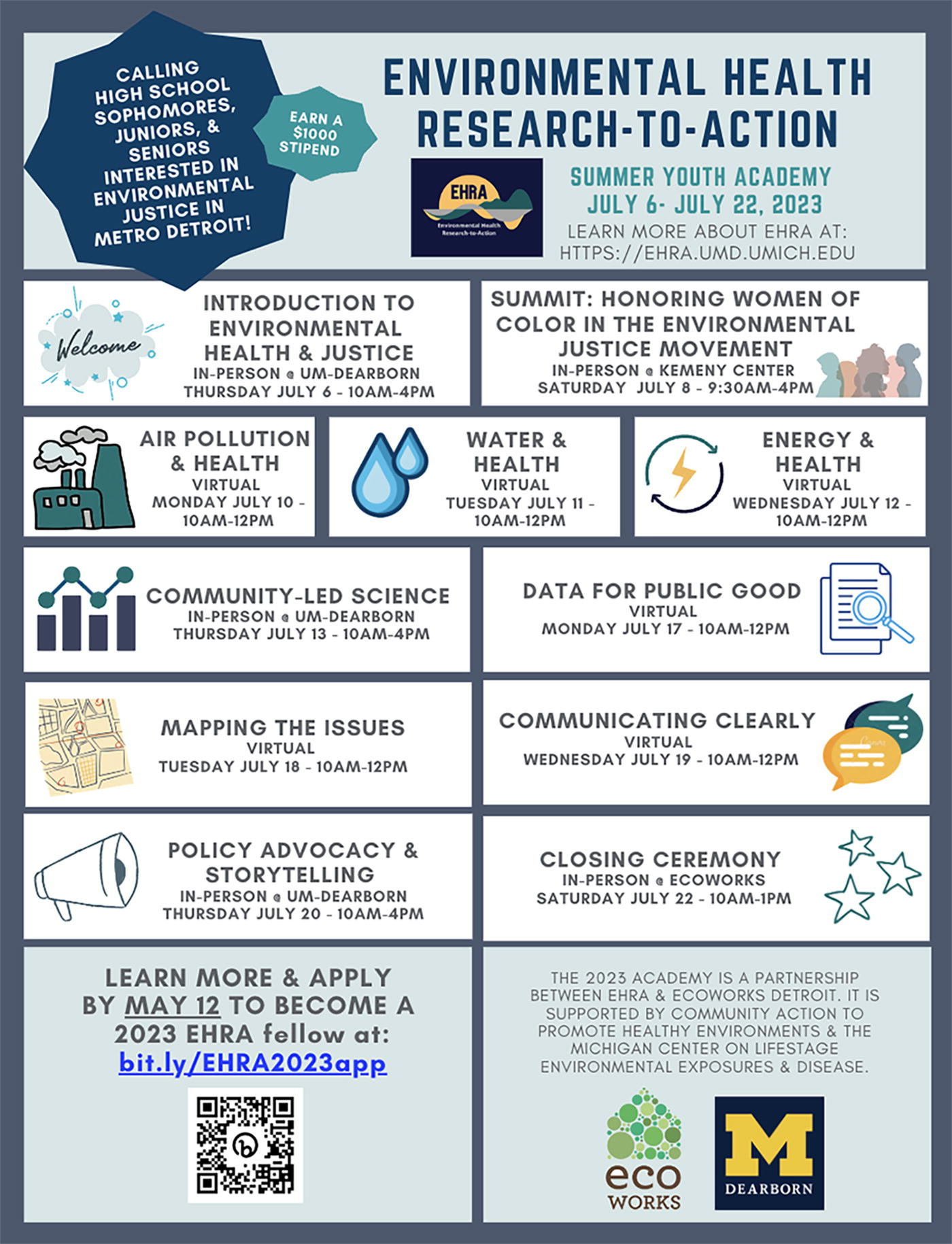
EHRA Academy 2023 summer flyer. EHRA, the Environmental Health Research-to-Action.
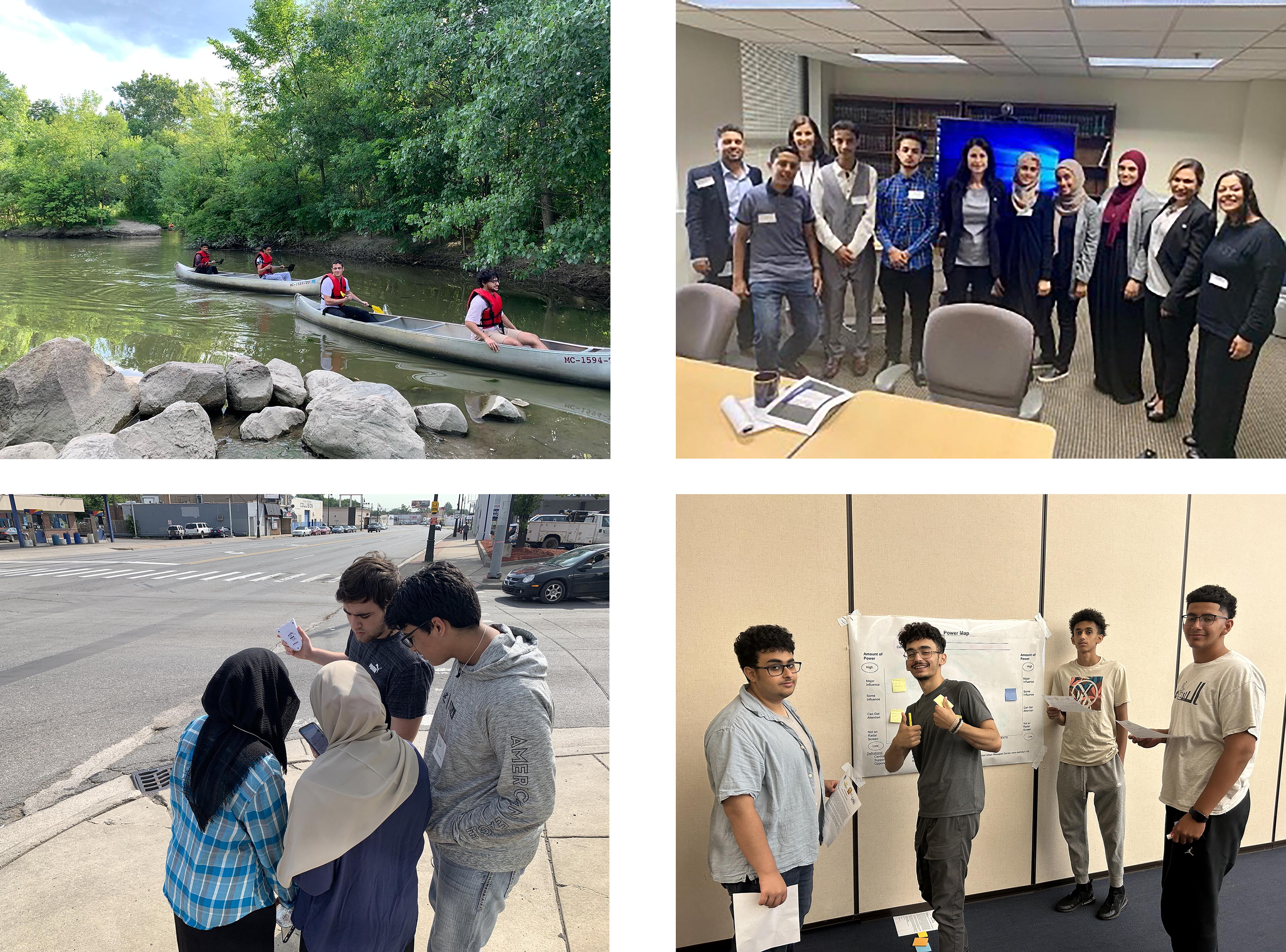
Images from the EHRA Academy. Top left: EHRA participants kayak the Rouge River, and they will later test its water quality. Top right: EHRA participants meet with State Attorney General Dana Nessel and Solicitor General Fadwa Hammoud with EHRA co-founder Samra'a Luqman. Bottom left: EHRA participants test air quality on a heavily trafficked road. Bottom right: EHRA participants discuss who has power to address specific local environmental justice issues, such as fugitive dust, vegetative buffers, or flooding mitigation.
Rooted in values of community-based participatory research, EHRA centers community at the core of education, youth at the forefront of advocacy, and partnerships as requisites to environmental justice. 19 EHRA stands on the shoulders of grassroots activists and their decades of organizing to deliver achievements such as these. It is also made possible by collaborations with academic, community, and agency organizations that dedicate their resources and expertise to programming and outreach efforts. We have had generous partners extend their community spaces for us to carry out our in-person lessons, fund $1000 stipends for participating youth, and offer to lead educational lessons and activities throughout the program. EHRA has also been successful at piloting and co-organizing several youth-led and youth-centered initiatives in addition to the annual summer academies, including a virtual EHRA Talks online series, a Legendary Women of Environmental Justice conference, and a 6th–8th grade curriculum, EHRA Foundations.
KEY POINTS
As suggested by our ongoing assessment, EHRA and programs like it have the potential to impact youth participants, their families and communities, and policymaking in ways that advance environmental health and justice. Having completed five summer academies, we can now begin noting impacts.
Later we describe the impacts reported by youth in pre- and post-academy and alumni surveys, but first we describe ways that youth have engaged with wider audiences using science to explain environmental health and justice issues and inform their proposed policy solutions. In their projects and presentations, they share data from federal datasets and mapping tools (e.g., EJScreen), data they collect (e.g., surveys, using air sensors, and water testing), and their own data by way of sharing their experiences living fenceline to cumulative exposures. For instance, participants have presented environmental concerns, data, stories, and policy recommendations to:
Michigan’s State Attorney General Dana Nessel and Solicitor General Fadwa Hammoud, Congresswoman Debbie Dingell, Michigan’s Environmental Justice Advocate, Regina Strong, Members of the American Moslem Society, the oldest mosque in the state of Michigan, Dearborn Mayor and City Council, High school students across Metro Detroit, Their families, and Various community and agency leaders.
Participant teams have completed 20 final capstone projects with presentations at a closing ceremony of the academy each year covering the following topics, among others:
Infrastructure and Its Effects on Tap Water
Air Quality and Health: A Comparison between South Dearborn and Southwest Detroit
Air Quality in Wayne County
The Devil We Know: PFAS
PM2.5 on Dearborn’s Main Roads
Over the past five cohorts, pre- and post-EHRA academy surveys were conducted, assessing a variety of topics including knowledge on EHRA topics, environmental advocacy activities, and pedagogical design of the academy. These were administered 2 weeks prior as part of pre-academy paperwork (pre) and on the last day of the academy (post). In winter 2024, we also conducted a brief alumni survey, which 26 (26%) alumni completed. These surveys were deemed exempt by the University of Michigan Institutional Review Board. Using Microsoft Excel, pre- and post-academy survey questions common to all 5 years were statistically analyzed to determine trends or themes. Depending on the question, the mean, median, max, and standard deviation were calculated.
To assess changes in knowledge, we used the EHRA pre- and post-academy surveys to gauge how well students believed they could explain or teach key EHRA topics to someone who has very little knowledge of that topic (Table 2). Responses could range from 1 (“not at all”) to 5 (“extremely well”).
Change in Knowledge about Environmental Health and Justice Topics Presented in EHRA (2018–2023)
*The curriculum was primarily focused on air pollution. Water affordability and quality were added to the curriculum in 2022 in response to concerns about local flooding and water shutoffs by EHRA participants and community leaders. Energy and health were added in 2023 in response to concerns about utility shutoffs and power outages. Due to the slight curricular changes and refinement of the assessment tools, some questions were not asked all 5 years and were added more recently, which explains the lower “n.”’
EHRA, the Environmental Health Research-to-Action.
As shown in Table 3, to assess EHRA’s impact on youth advocacy related to environmental issues, students were asked (after their acceptance into EHRA) to indicate which environmental advocacy activities they were involved in before the academy. Immediately after the academy in the post-academy survey for 2021, 2022, and 2023, participants were asked about their likelihood of participating in those same activities in the next 5 years. (We expect many were energized when completing their post-academy survey and may have been overly ambitious, stating they would engage in many more activities than may be feasible.)
Pre–Post Academy Advocacy Activities (2021–2023)
The 2024 alumni survey gave us additional insights on how alumni thought about their experience a year or more later, as well as how they had applied their lessons from EHRA. Figure 4 is a word cloud reflecting responses (larger words or phrases were reported more frequently) when asked: “If you could use one or two words to describe the impact the EHRA academy has had on you thus far, what word(s) would you use?” Table 4 provides the percentage of alumni (n = 26) who pursued which advocacy activities. Most students said that they spoke about environmental issues to their families and friends. Students also used social media to promote policy advocacy, education, and awareness.
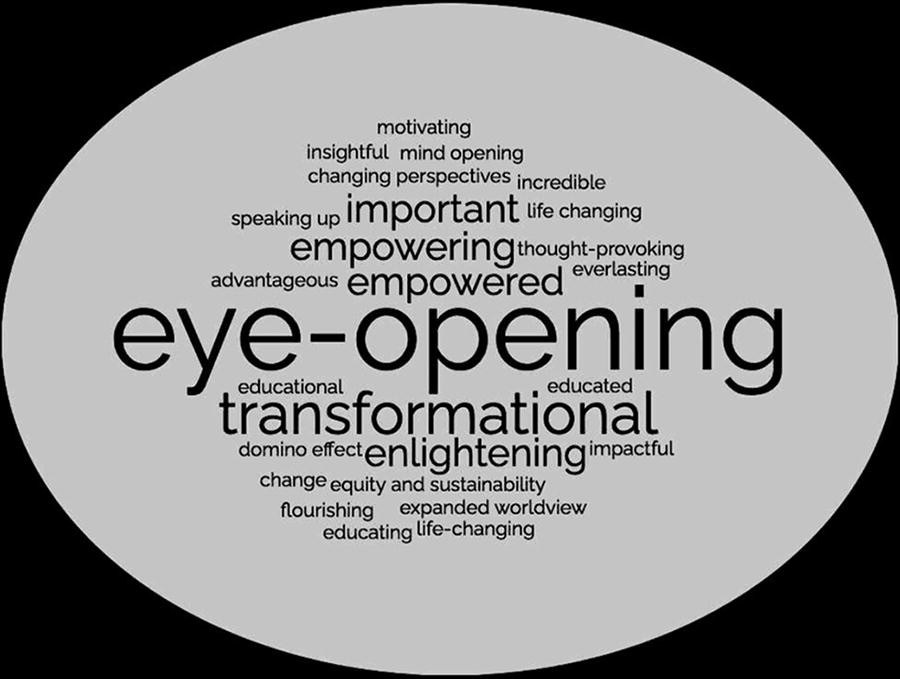
Word cloud: one or two words describing EHRA’s impact on you (n = 26). EHRA, the Environmental Health Research-to-Action.
Advocacy Activities Completed by 2018–2023 EHRA Alumni (n = 26)
EHRA, the Environmental Health Research-to-Action.
When prompted, “Please discuss how you have applied EHRA academy teachings to your life or career,” alumni discussed ways they had engaged in research, outreach, and advocacy since EHRA, as well as some mentioning their choice of career path or college major in public health or health care. Seven students described going on to participate in related research, and nearly all mentioned some form of outreach or advocacy. Sample responses include:
Since EHRA, I have begun to implement environmental justice conversations in school and in social conversations. I have also gone on to do environmental research in college to study the concept further.—2018 participant
Being in the EHRA academy taught me to be more vocal about public health. I come from a heavily polluted area, and I always thought there was nothing I could do about it. From EHRA I learned that our voice matters. Something like joining a community meeting does a lot. I’m always informed now and well educated.—2019 participant
After being in EHRA it motivated me to major in public health and ensure that when I become a PA I will advocate for well-rounded care that includes environmental injustice my community faces which affects their health. I’m doing so, I hope to partner with organizations aimed at fighting environmental injustice to provide resources for awareness to non-English-speaking communities. In applying for my PA program, I include the impact that EHRA had on me and brought to me so much awareness. In doing so, I have always educated my family members which led them to take action by voting and creating and signing petitions related to environmental injustice.—2019 participant
I’ve written two papers in school using EHRA [air monitoring] flow data I personally collected, anecdotal stories shared through the program, along with statistics proving the need for change to the air quality of metro Detroit. I have presented these findings also and advocated for specific changes on social media.—2022 participant
Another 2018 participant explained, “I can with confidence say that I made the struggles of the Southend and environmental advocacy a personality trait.” They went on to describe public meetings and webinars they have attended, ways that have focused class assignments on environmental health and justice issues, participation in a state lobby day, participation in research at the University of Michigan’s School of Public Health, and served on a board related to local food systems. They also referenced several of the EHRA guests and speakers with whom they stayed connected. Overall, these open-ended responses offered powerful examples of the types of opportunities alumni have pursued in their own words beyond what can be captured in closed-ended questions.
Alumni continue to think critically about the issues their communities face. When asked, “In your opinion, what are the largest barriers to environmental justice, education, and/or awareness facing your community?,” alumni reported on many environmental justice issues as well as many structural and social determinants of health. Regarding the process of research-to-action in their community, one 2023 alumni reported:
“The largest barriers are negligence and the inability to voice our the issues. I have realized how a lot can change if the community policy makers actually consider the locals and research done by them. What happens very often is a person may do research of the environment in the community for a purpose— like a school project or genuine concern—but they don’t go ahead publish it or make it aware to the public or the policy makers. And many times if these concerns are in fact brought to light, it gets neglected because of costs, “lack of urgency”, etc. But we don’t realize how our environment is degrading right in front of us, at the moment.”
Several (12) commented on the “lack of knowledge to know how serious the matter really is” or made similar statements, including a reference to misinformation. Several (7) discussed language or cultural barriers to navigating environmental decision-making in their community. Several (6) also mentioned the challenges of addressing environmental justice in the face of corporate lobbyists and funding.
Over the last 5 years, we have also stayed connected to alumni in various ways. We maintain an alumni listserv and WhatsApp group where alumni, community partners, and EHRA team members share a variety of advocacy, research, career, internship, and volunteer opportunities, as well as environmental news. Some alumni have stayed in touch and sent updates. Others have stayed involved more formally, serving as a paid youth coordinator, as participants on funded follow-up projects, or working with EHRA faculty who advise their undergraduate research opportunities, for instance.
Finally, we note that EHRA is a space where we work intentionally to recognize, support, and celebrate the diversity of youth frontline to cumulative environmental exposures in Metro Detroit, including MENA youth. Examining environmental health within and across the region requires an intersectional approach that honors intersecting racial/ethnic identities, abilities, genders, cultures, and religions. We work to ensure that during the academy participants engage with community, academic, and agency leaders who reflect this same diversity and are compensated for their contributions. Each year, speakers and facilitators entail 25–30 people, including over two-thirds identifying as women and over half as BIPOC. As such, participants often see and learn about the challenges and opportunities of cross-cultural and multiracial organizing efforts related to environmental health and justice. During EHRA, youth work in diverse teams for their culminating projects, often noting similarities and differences about the environmental threats they face in their separate but nearby communities. EHRA also honors and celebrates this diversity by supporting local food vendors to ensure culturally appropriate food options (e.g., halal) and scheduling around prayer and days of worship for Muslim participants, for instance. We know there are likely many other ways we can promote an inclusive, anti-racist program, and we continue to learn and work toward this goal.
CONCLUSION
By reviewing and reflecting on various outputs and survey responses, we can learn the ways that participants found EHRA as “eye-opening” and “transformational.” EHRA increases youth knowledge, and it is likely to inform and motivate youth advocacy activities. For some, they have reported applying or building on EHRA lessons in a variety of ways. By equipping youth with the tools, resources, and a network of longtime leaders, EHRA is designed to support the next generation of youth in their efforts to seek justice and accountability, promote education, and spread awareness whether personally or on their professional path. It is also an opportunity for older generations of researchers, agency staff, and organizers to learn from them in these interactions. Although EHRA remains deeply rooted in Dearborn’s Southend, in support of a predominately MENA community experiencing environmental injustice, it has become an intergenerational, multiracial, and cross-cultural network with a shared goal of environmental justice throughout Metro Detroit.
We do not propose EHRA as a prescriptive model, and we recognize there are locally relevant needs and assets that may drive similar programs. We believe EHRA’s impact rests partially on the ability of our community to collectively build knowledge. This entails the sharing of existing data, community-collected data, and stories as data in accessible ways that bring everyone along together and inform community-identified solutions that are communicated to many different relevant audiences, including family, community, and decision-makers. This brief introduction to EHRA and survey analyses do not allow for a nuanced description of how and why participants and alumni move down their respective paths into science and/or advocacy, which types of science or advocacy they pursue, and the long-term impacts of their efforts. It does give us a glimpse of what might be working as the program aims to impact individual participants and their communities, as well as build capacity to address environmental injustice through integration of science and policy in locally relevant and meaningful ways.
Footnotes
ACKNOWLEDGMENT
The authors wish to thank the many people who have participated in and contributed to EHRA since its inception.
AUTHOR DISCLOSURE STATEMENT
The authors have no conflicts of interest to declare.
FUNDING INFORMATION
The financial support has been provided by grant